The best kettlebell leg exercises are the ones that strengthen your quads, glutes, hamstrings, and calves while improving balance, power, and functional movement.
Kettlebells make leg training simple, efficient, and joint-friendly—perfect for home workouts or gym sessions without machines.
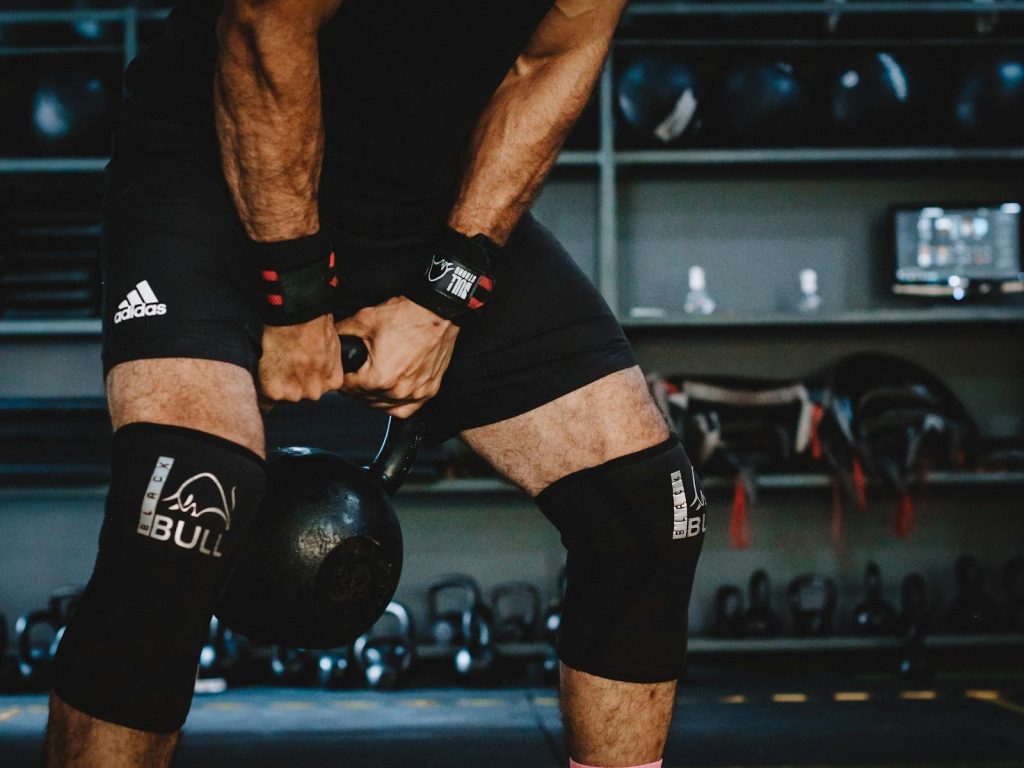
Understanding how kettlebell movements strengthen the lower body helps you build safe, effective routines supported by resistance-training research. Following proper form, progression, and strength guidelines is crucial because kettlebell exercises load multiple joints at once. Most people can begin with lighter weights, then gradually increase load and complexity according to established exercise-science standards.
This complete guide walks you through 22 of the best kettlebell leg exercises, programming tips, safety guidelines, sets/reps, and FAQs.
Why Kettlebell Leg Exercises Matter
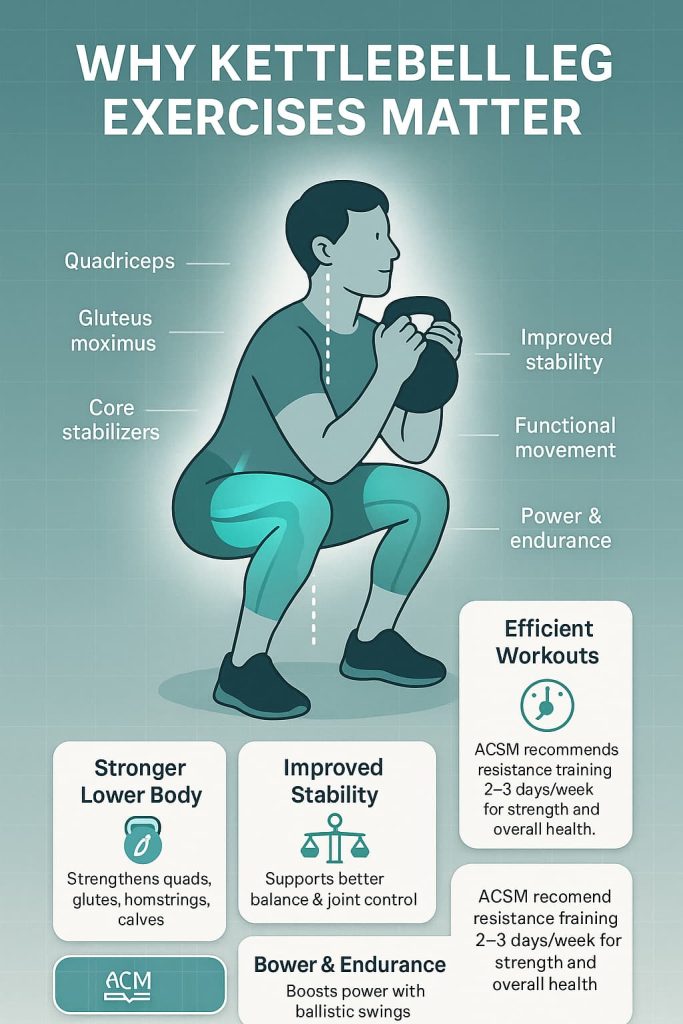
Kettlebell lower-body training supports:
- Stronger quads, glutes, hamstrings, and calves
- Better balance and stability
- Improved daily function (lifting, bending, squatting)
- Increased power and endurance through ballistic kettlebell movements
- Time-efficient workouts without machines
Resistance training 2–3 days per week is recommended for general health and strength development, according to the American College of Sports Medicine (ACSM).
How to Warm Up Before Kettlebell Leg Exercises
A 2–3 minute warm-up improves circulation, joint mobility, and movement control.
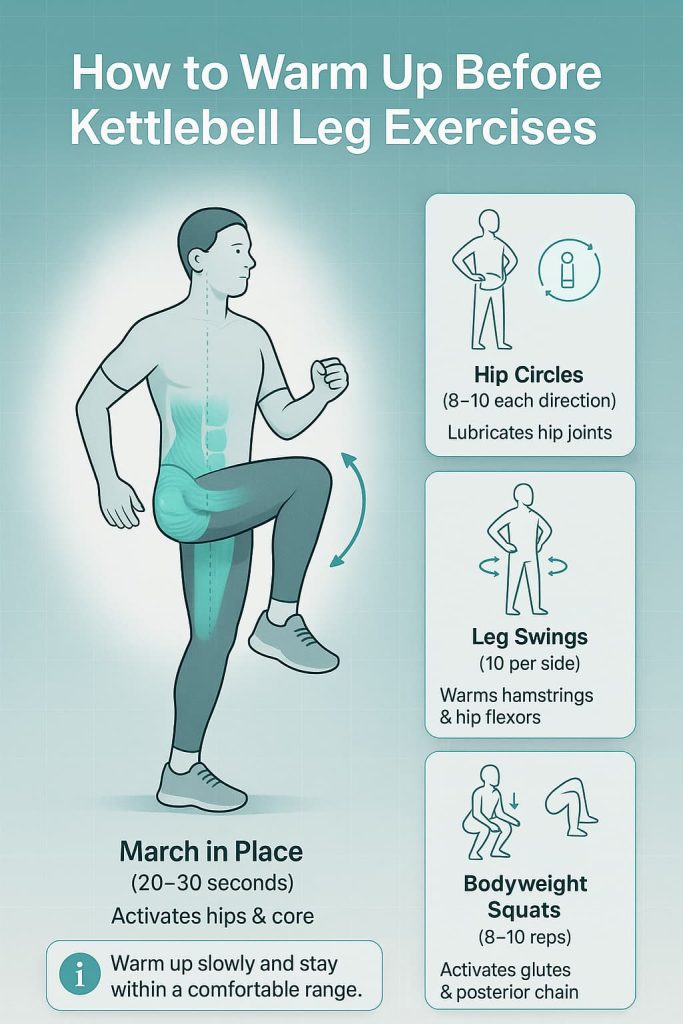
Try this routine:
- March in place — 20–30 seconds
- Hip circles — 8–10 each direction
- Leg swings — 10 per side
- Bodyweight squats — 8–10 reps
- Glute bridges — 8–10 reps
Warm up slowly and stay within a comfortable range.
22 Best Kettlebell Leg Exercises (Beginner to Advanced)
These 22 kettlebell leg exercises strengthen your quads, glutes, hamstrings, and stabilizers through beginner, intermediate, and advanced progressions. Each movement supports better balance, mobility, and lower-body power using simple, effective kettlebell patterns.
Beginner Kettlebell Leg Exercises (Level 1)
1. Kettlebell Deadlift
Why it works:
Builds foundational hip-hinge mechanics, which are essential for all kettlebell and barbell lifts. It strengthens the entire posterior chain without overloading the lower back.
Muscles worked:
Glutes, hamstrings, erector spinae, core stabilizers.
How to do it:
- Stand with feet hip-width apart and the kettlebell between your feet.
- Push your hips back, keeping your spine neutral.
- Grip the kettlebell firmly with both hands.
- Drive through your heels to stand tall.
- Lower with control and repeat.
Trainer Tip:
Think “hips back first” rather than bending at the waist to protect your lower back.
2. Kettlebell Goblet Squat
Why it works:
The front-loaded position encourages an upright torso, allowing deeper, safer squats while improving quad and core activation.
Muscles worked:
Quads, glutes, core, upper-back stabilizers.
How to do it:
- Hold the kettlebell at chest height, elbows tucked.
- Stand with feet shoulder-width apart.
- Sit your hips down and back into a squat.
- Keep your chest lifted and knees tracking forward.
- Drive through your heels to stand.
Trainer Tip:
Use your elbows to gently push your knees outward at the bottom for better depth and alignment.
3. Kettlebell Sumo Deadlift
Why it works:
The wide stance reduces lower-back strain and targets the inner thighs while still strengthening the posterior chain.
Muscles worked:
Inner thighs (adductors), glutes, hamstrings, core.
How to do it:
- Stand wider than shoulder width with toes slightly turned out.
- Place the kettlebell on the floor directly between your feet.
- Hinge your hips back and grip the handle with both hands.
- Drive through your heels to stand tall.
- Lower with control.
Trainer Tip:
Push your knees out as you lift to keep your hips engaged and avoid internal collapse.
4. Kettlebell Split Squat
Why it works:
Improves single-leg strength, hip stability, and balance—ideal for correcting muscle imbalances.
Muscles worked:
Quads, glutes, hip stabilizers.
How to do it:
- Step one foot back into a split stance.
- Hold the kettlebell at your chest (goblet position).
- Lower straight down into a lunge.
- Press through the front heel to return to the top.
- Switch legs.
Trainer Tip:
Keep 80% of your weight on the front leg for maximal strength benefits.
5. Kettlebell Reverse Lunge
Why it works:
Reverse lunges reduce forward knee stress and allow controlled loading of the glutes and quads.
Muscles worked:
Glutes, quads, hamstrings, core.
How to do it:
- Hold the kettlebell at your chest or beside your leg.
- Step one leg back into a lunge.
- Keep your front knee stacked over your ankle.
- Push through the front heel to return to standing.
- Alternate legs.
Trainer Tip:
Keep your torso upright for better glute activation and balance.
6. Kettlebell Step-Up
Why it works:
Mimics stair climbing and improves functional lower-body power and coordination.
Muscles worked:
Quads, glutes, calves, stabilizers.
How to do it:
- Stand in front of a sturdy bench or step.
- Hold a kettlebell at your side or in goblet position.
- Step onto the platform with one foot.
- Drive through your heel to stand tall.
- Lower with control and repeat.
Trainer Tip:
Choose a step height where your knee stays below hip level to avoid strain.
7. Kettlebell Glute Bridge
Why it works:
Isolates the glutes without loading the spine, making it ideal for beginners or those with back sensitivity.
Muscles worked:
Glutes, hamstrings, lower-back stabilizers.
How to do it:
- Lie on your back with knees bent and feet flat.
- Place the kettlebell on your hips, holding it securely.
- Drive through your heels to lift your hips.
- Squeeze your glutes at the top.
- Lower slowly.
Trainer Tip:
Keep your ribs down to prevent over-arching your lower back during the lift.
Intermediate Kettlebell Leg Exercises (Level 2)
8. Single-Leg Kettlebell Deadlift
Why it works:
Improves balance, hip stability, and unilateral posterior-chain strength—key for athletic performance.
Muscles worked:
Hamstrings, glutes, calves, core stabilizers.
How to do it:
- Hold the kettlebell in the hand opposite your working leg.
- Hinge forward while lifting the back leg straight behind you.
- Keep your hips squared.
- Stand tall and repeat.
Trainer Tip:
Slightly bend your standing knee to maintain balance and protect the joint.
9. Kettlebell Front Rack Squat
Why it works:
Front-rack loading forces the core to stabilize your torso, allowing deeper, more controlled squats.
Muscles worked:
Quads, glutes, core, upper back.
How to do it:
- Hold the kettlebell in the front rack position.
- Squat down with an upright torso.
- Drive through your heels to stand.
- Switch sides or use two kettlebells for added difficulty.
Trainer Tip:
Keep your elbows pointing slightly forward to stabilize the kettlebell.
10. Kettlebell Suitcase Deadlift
Why it works:
Challenges anti-lateral flexion (side-bending), improving functional core stability while strengthening the legs.
Muscles worked:
Glutes, hamstrings, obliques, erector spinae.
How to do it:
- Place the kettlebell at your side.
- Hinge your hips back and grip the handle.
- Stand tall without leaning toward the weight.
- Lower with control.
Trainer Tip:
Keep your torso completely square—no tilting toward the kettlebell.
11. Kettlebell Lateral Lunge
Why it works:
Builds hip strength and mobility while challenging side-to-side athletic movement.
Muscles worked:
Inner thighs, glutes, quads.
How to do it:
- Hold the kettlebell at your chest.
- Step out to the side and bend one knee.
- Keep the other leg straight.
- Push back to center.
Trainer Tip:
Sit your hips back during the side step to avoid knee strain.
12. Kettlebell Curtsy Lunge
Why it works:
Targets the outer glutes and hip stabilizers—muscles crucial for knee alignment and balance.
Muscles worked:
Gluteus medius, gluteus minimus, quads.
How to do it:
- Hold the kettlebell at chest height.
- Step one leg diagonally behind the other.
- Lower into a lunge.
- Return to standing and alternate.
Trainer Tip:
Keep your pelvis facing forward; avoid twisting your torso.
13. Kettlebell Romanian Deadlift (RDL)
Why it works:
Strengthens the hamstrings and glutes through controlled, deep hip hinging.
Muscles worked:
Hamstrings, glutes, lower-back stabilizers.
How to do it:
- Hold the kettlebell with both hands.
- Hinge back with a slight knee bend.
- Lower the kettlebell to mid-shin.
- Stand tall and squeeze your glutes.
Trainer Tip:
Keep the kettlebell close to your body—“drag it down your legs.”
14. Kettlebell Clean to Squat
Why it works:
Combines explosive pulling strength with lower-body squatting strength, improving power production.
Muscles worked:
Glutes, quads, hamstrings, calves, core, shoulders.
How to do it:
- Swing the kettlebell into the front rack (clean).
- Drop immediately into a squat.
- Stand tall, reset, and repeat.
Trainer Tip:
Keep your wrist neutral during the clean to prevent bruising your forearm.
Advanced Kettlebell Leg Exercises (Level 3)
15. Kettlebell Swing (Two-Hand)
Why it works:
A ballistic hip-power exercise that builds strength, explosiveness, and conditioning.
Muscles worked:
Hamstrings, glutes, lower back, core.
How to do it:
- Hinge at the hips and hike the kettlebell back.
- Drive through your hips to swing it chest-height.
- Guide it back into the hinge.
- Repeat with a rhythmic motion.
Trainer Tip:
The swing is a hinge, not a squat—keep knees soft and hips dominant.
16. Single-Arm Kettlebell Swing
Why it works:
Adds anti-rotation core work and increases unilateral hip-power development.
Muscles worked:
Posterior chain, core, forearms.
How to do it:
- Hinge and swing the kettlebell with one arm.
- Keep shoulders square to the front.
- Switch arms every 5–10 reps.
Trainer Tip:
Avoid twisting—imagine two headlights on your hips pointing straight ahead.
17. Kettlebell Snatch to Overhead Lunge
Why it works:
Combines explosive pulling, overhead stability, and single-leg control—an advanced total-body challenge.
Muscles worked:
Glutes, quads, hamstrings, shoulders, core.
How to do it:
- Perform a kettlebell snatch overhead.
- Step back into a lunge with the kettlebell overhead.
- Return to standing and switch sides.
Trainer Tip:
Stabilize your shoulder before descending into the lunge.
18. Kettlebell Pistol Squat (Supported or Loaded)
Why it works:
Develops extreme unilateral strength, mobility, and balance.
Muscles worked:
Quads, glutes, calves, hip stabilizers.
How to do it:
- Hold a light kettlebell for counterbalance.
- Extend one leg forward.
- Lower into a single-leg squat.
- Stand up using control.
Trainer Tip:
Practice supported pistol squats first using a box or TRX handle.
19. Kettlebell Thruster (Squat + Press)
Why it works:
A full-body power movement that enhances leg strength and conditioning.
Muscles worked:
Quads, glutes, shoulders, core.
How to do it:
- Hold kettlebell(s) in the front rack.
- Squat down.
- Drive up explosively and press overhead.
- Lower and repeat.
Trainer Tip:
Use your legs—not your shoulders—to initiate the press.
20. Kettlebell Swing to Goblet Squat
Why it works:
Combines explosive hip drive with controlled squatting, challenging power and strength together.
Muscles worked:
Quads, glutes, hamstrings, core.
How to do it:
- Perform one kettlebell swing.
- Catch the kettlebell in goblet position.
- Drop immediately into a squat.
- Stand tall and repeat.
Trainer Tip:
Use fluid transitions—don’t pause unnecessarily between movements.
21. Double-Kettlebell Front Rack Squat
Why it works:
Increases load dramatically, improving total lower-body strength and bracing capacity.
Muscles worked:
Quads, glutes, core, upper back.
How to do it:
- Rack two kettlebells at shoulder height.
- Squat deeply while keeping your torso upright.
- Drive through your heels to stand.
Trainer Tip:
Brace your core before every rep—double kettlebells demand stability.
22. Double-Kettlebell Deadlift
Why it works:
Replicates barbell deadlifting with greater accessibility and smoother movement patterns.
Muscles worked:
Glutes, hamstrings, lower-back stabilizers, grip.
How to do it:
- Place two kettlebells outside your feet.
- Hinge at the hips and grip both handles.
- Stand tall by driving hips forward.
- Lower with control.
Trainer Tip:
Drive through your heels and keep both kettlebells tight to your body for optimal form.
Sample 20-Minute Kettlebell Leg Workout
Repeat 3–4 rounds:
- Goblet Squat — 12 reps
- Kettlebell Deadlift — 10 reps
- Reverse Lunge — 8 per leg
- Kettlebell RDL — 12 reps
- Kettlebell Swing — 15–20 reps
Rest 60–90 seconds between rounds.
Common Mistakes to Avoid
- Squatting instead of hinging during deadlifts and swings
- Rounding the back during hinge movements
- Choosing kettlebells that are too heavy too soon
- Letting knees collapse inward during squats and lunges
- Swinging with the arms instead of driving with the hips
- Not resting enough between sessions
Safety Guidelines for Kettlebell Leg Training
- Start with a manageable weight you can control safely.
- Maintain a neutral spine during squats, deadlifts, and swings.
- Keep kettlebell close to your body during hinge movements.
- Avoid ballistic swings until you master the hinge pattern.
- Stop immediately if you feel sharp pain or loss of control.
- Progress gradually—small increases in load follow evidence-based guidelines (2–10% increments when ready).
Who Should Avoid Certain Kettlebell Leg Exercises?
- Beginners should avoid advanced swings, snatches, and pistols until they master foundational movements.
- Individuals with unmanaged back pain should avoid swings or heavy hinges until evaluated by a professional.
- Those with balance limitations should skip single-leg exercises or do supported versions.
- Anyone recovering from injury should progress gradually and follow clinician guidance.
Frequently Asked Questions (FAQ)
1. What weight kettlebell should beginners use?
Many beginners start with 8–12 kg (18–26 lb) for lower-body exercises. Adjust based on comfort and control.
2. Are kettlebell swings good for leg strength?
Yes—swings primarily target the glutes and hamstrings and help build power.
3. Can I build muscle with kettlebell leg exercises?
Yes. Using progressive overload (heavier weight, higher volume, or harder variations) helps develop muscle.
4. How often should I train kettlebell legs?
Most people benefit from 2–3 sessions per week, allowing rest days in between.
5. Are kettlebell leg exercises safe for beginners?
Yes—start with foundational movements like goblet squats and deadlifts, and progress gradually.
6. Can kettlebells replace barbell leg training?
For many people, yes. Kettlebells offer strength, mobility, and power without needing large equipment.
7. Are kettlebell swings bad for the lower back?
No—when performed with proper hip hinging, swings help strengthen the posterior chain.
Conclusion
Kettlebell leg exercises offer a powerful, efficient way to build strength, stability, and lower-body definition using minimal equipment. Whether you’re a beginner or advanced lifter, these 22 exercises help you strengthen your quads, glutes, hamstrings, and overall athletic performance.
Start with movements that match your skill level, follow safe progression, and stay consistent.
Your strongest legs can be built with just one kettlebell.
References
- Comprehensive Review on Kettlebell Training (Strength, Power, Conditioning, Performance)
Jaiswal PR et al. Enhancing Athletic Performance: A Comprehensive Review on Kettlebell Training. Cureus. 2024.
https://www.cureus.com/articles/206113-enhancing-athletic-performance-a-comprehensive-review-on-kettlebell-training.pdf - Kettlebell Swing Training Improves Strength & Power
Lake JP, Lauder MA. Kettlebell swing training improves maximal and explosive strength. J Strength Cond Res. 2012;26(8):2228–2233.
https://pubmed.ncbi.nlm.nih.gov/22580981/ - Kettlebell Swing vs Explosive Deadlift Training
Maulit MR et al. Effects of Kettlebell Swing vs. Explosive Deadlift Training on Strength and Power.
https://www.researchgate.net/publication/312611001_Effects_of_Kettlebell_Swing_vs_Explosive_Deadlift_Training_on_Strength_and_Power - EMG & Kinematics of the Two-Hand Kettlebell Swing (Posterior Chain Focus)
Van Gelder LH, Bartz SD. EMG Analysis and Sagittal Plane Kinematics of the Two-Hand Kettlebell Swing. Int J Sports Phys Ther. 2015.
https://pmc.ncbi.nlm.nih.gov/articles/PMC4637916/