The snatch exercise is a full-body power lift that moves a weight from below the body to overhead in one fast, controlled motion. It is best known as an Olympic weightlifting movement, but you can also train snatch variations with a barbell, dumbbell, kettlebell, PVC pipe, or light technique bar.
The snatch exercise can help build explosive hip drive, leg power, shoulder stability, core control, coordination, and total-body strength. It is also a technical lift, so the goal is not to rush into heavy weight. The goal is to learn the positions, move well, and progress safely.
In this guide, you will learn what the snatch exercise is, which muscles it works, how to perform it, common mistakes to avoid, the best variations, and how to use it in a workout.
What Is the Snatch Exercise?
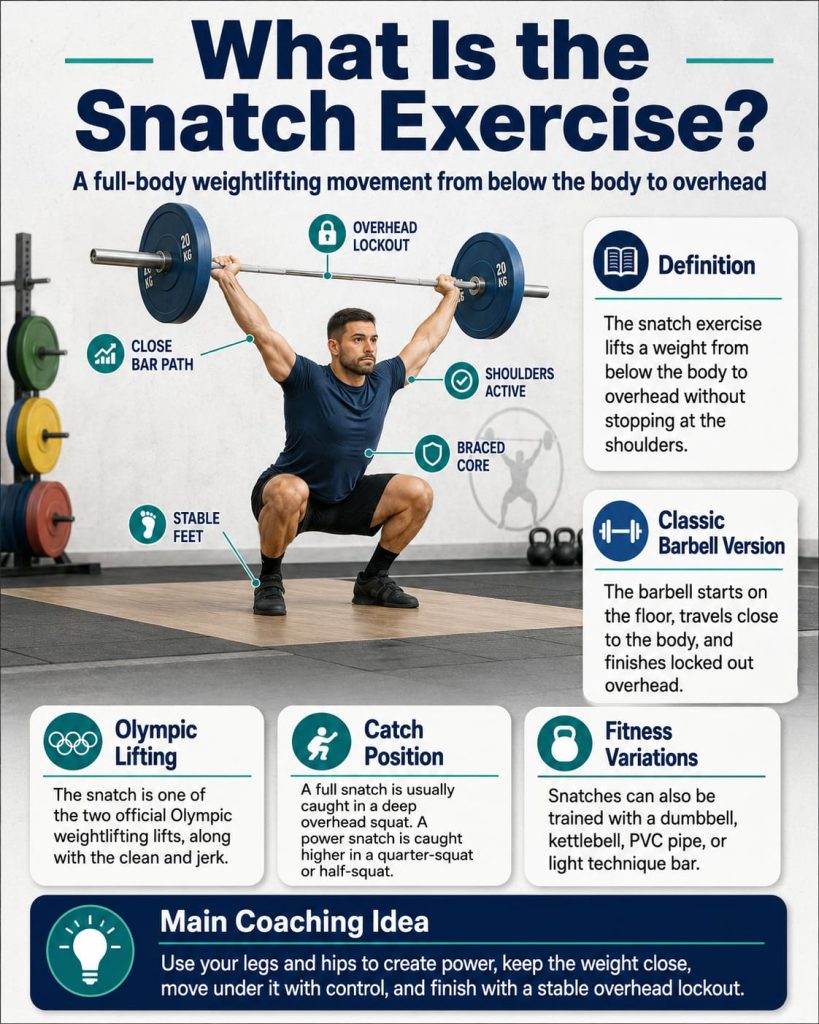
The snatch exercise is a weightlifting movement where you lift a weight from below the body to overhead without stopping at the shoulders. In the classic barbell snatch, the bar starts on the floor, travels close to the body, and finishes locked out overhead.
In Olympic weightlifting, the snatch is one of the two official lifts, along with the clean and jerk. The full barbell snatch is usually caught in a deep overhead squat. A power snatch is caught higher, usually in a quarter-squat or half-squat position.
For general fitness, the snatch can also mean a dumbbell snatch or kettlebell snatch. These versions are still explosive overhead movements, but they are usually easier to learn than the full Olympic barbell snatch.
The main idea is simple: use your legs and hips to create power, keep the weight close, move under it with control, and finish with a stable overhead lockout.
Muscles Worked by the Snatch Exercise
The snatch exercise trains the body as one connected system. It is not just a shoulder exercise or a leg exercise.
The glutes help create powerful hip extension. The hamstrings support the hinge and help control the pull. The quadriceps help push through the floor and stand up from the catch. The calves assist with explosive extension.
The traps, lats, shoulders, triceps, and upper back help guide and stabilize the weight overhead. The core braces the trunk so force can transfer from the lower body into the weight. The spinal erectors help maintain a strong back position during the pull.
Benefits of the Snatch Exercise
The snatch exercise is useful because it trains power, speed, coordination, and strength together.
It can help improve explosive hip extension, which is important for many athletic movements. It also builds overhead stability because the final position requires strong shoulders, upper-back control, and a braced core.
The snatch also improves timing and body awareness. You need to control your feet, hips, torso, arms, and overhead position in one smooth movement. This makes the exercise challenging, but also valuable when performed correctly.
For beginners, the best benefit often comes from simpler variations first. Power snatches, hang power snatches, snatch pulls, dumbbell snatches, and kettlebell snatches can train power without requiring the full deep overhead squat catch.
How to Do the Snatch Exercise With Proper Form
The barbell snatch has five main parts: setup, first pull, second pull, pull under, and catch.
Start with the bar over your midfoot and use a wide snatch grip. Keep your arms straight, chest lifted, back flat, core braced, and shoulders slightly over the bar.
During the first pull, push through the floor and guide the bar from the ground to the knees. Keep the bar close and do not yank it off the floor.
During the second pull, extend your hips, knees, and ankles powerfully as the bar reaches the upper thigh or hip area. This is where most of the power is created.
After full extension, pull yourself under the bar and punch it overhead. Catch with locked arms, active shoulders, and a stable torso. In a full snatch, you catch in an overhead squat. In a power snatch, you catch higher.
Once the weight is stable overhead, stand tall and finish with control.
Common Snatch Exercise Mistakes
The most common mistake is pulling with the arms too early. The legs and hips should create the power first. Your arms guide the weight after extension.
Another mistake is letting the bar drift away from the body. A forward bar path makes the catch harder and can pull you off balance. Keep the lats active and guide the weight close.
Many lifters also rush the first pull. If the hips shoot up too fast, the back position breaks down. Start controlled, then accelerate after the bar passes the knees.
Other common mistakes include cutting hip extension short, catching with soft elbows, landing too wide, losing the chest in the catch, and using heavy weight before technique is consistent.
Best Snatch Exercise Variations
Barbell Snatch
Best for: The barbell snatch is best for Olympic lifting skill, full-body power, explosive strength, and advanced coordination.
Muscles worked: The barbell snatch trains the glutes, hamstrings, quadriceps, calves, traps, lats, shoulders, triceps, upper back, spinal erectors, and core.
Equipment needed: Barbell, bumper plates, collars, and a safe lifting platform.
Why it stands out: The barbell snatch combines a strong pull, explosive hip extension, fast movement under the bar, overhead stability, and squat strength in one lift. It is one of the most complete power exercises, but it also requires the most technique.
Suggested sets and reps: Use 4 to 6 sets of 1 to 2 reps for skill work or 3 to 5 sets of 1 to 3 reps for power. Keep most sets around RPE 6 to 8.
Beginners: Start with a PVC pipe, overhead squat practice, muscle snatches, and hang power snatches before loaded full snatches.
Intermediate: Use light-to-moderate full snatches, power snatches, and hang snatches while focusing on clean bar path and stable catches.
Advanced: Use heavier singles, doubles, block snatches, pause snatches, and planned intensity work when technique is consistent.
Rest: Rest 2 to 4 minutes between working sets.
How to do it:
- Stand with the bar over your midfoot.
- Grip the bar wide with straight arms.
- Set your chest up, back flat, and core braced.
- Push through the floor and keep the bar close.
- Extend your hips, knees, and ankles powerfully.
- Pull yourself under the bar.
- Punch the bar overhead and catch in an overhead squat.
- Stand tall once the bar is stable.
Common mistakes: Pulling early with the arms, swinging the bar forward, catching with bent elbows, losing the chest in the catch, and adding weight too soon.
Expert tip: Think “push, extend, punch.” Push through the floor, extend hard through the hips, then punch under the bar.
Exercise variations: Power snatch, hang snatch, pause snatch, block snatch, and no-foot snatch.
Easier variation: Hang power snatch.
Harder variation: Full snatch from the floor with a deep overhead squat.
Power Snatch
Best for: The power snatch is best for building explosive strength without catching the bar in a deep squat.
Muscles worked: The power snatch trains the glutes, hamstrings, quadriceps, calves, traps, shoulders, triceps, upper back, lats, and core.
Equipment needed: Barbell, bumper plates, and a safe lifting area.
Why it stands out: The power snatch is easier to learn than the full snatch because the catch is higher. It still trains speed, hip extension, bar path, and overhead stability.
Suggested sets and reps: Use 3 to 5 sets of 2 to 3 reps for technique or 4 to 6 sets of 1 to 2 reps for power.
Beginners: Start from the hang position with a PVC pipe, empty bar, or light technique bar.
Intermediate: Train power snatches from the floor or hang position with moderate loads.
Advanced: Use block power snatches, heavy singles, or power snatch plus overhead squat complexes.
Rest: Rest 2 to 3 minutes between sets.
How to do it:
- Set up with a wide snatch grip.
- Keep your back flat, chest up, and arms straight.
- Pull the bar smoothly from the floor.
- Explode through your hips as the bar reaches the upper thigh.
- Pull under slightly and punch the bar overhead.
- Catch the bar in a quarter-squat or half-squat.
- Stand tall with the bar stable overhead.
Common mistakes: Catching with soft elbows, landing too wide, pressing the bar out, and swinging the bar forward.
Expert tip: Catch high, but stay balanced. Do not jump your feet wider than you can control.
Exercise variations: Hang power snatch, block power snatch, no-foot power snatch, and power snatch from blocks.
Easier variation: High-hang power snatch.
Harder variation: Power snatch from the floor.
Hang Power Snatch
Best for: The hang power snatch is best for learning hip drive, bar speed, and overhead catch mechanics.
Muscles worked: The hang power snatch trains the glutes, hamstrings, quadriceps, traps, shoulders, triceps, lats, upper back, and core.
Equipment needed: Barbell, PVC pipe, technique bar, dumbbell, or kettlebell.
Why it stands out: The hang power snatch removes the floor pull and lets you focus on the explosive part of the lift. It is one of the best beginner-friendly snatch variations.
Suggested sets and reps: Use 3 to 5 sets of 2 to 4 reps with light-to-moderate load.
Beginners: Start from the high hang with a PVC pipe or empty bar.
Intermediate: Use hang power snatches from above the knee or below the knee.
Advanced: Use hang power snatches in complexes, speed work, or technical warm-ups.
Rest: Rest 90 seconds to 3 minutes depending on load.
How to do it:
- Stand tall with a wide snatch grip.
- Hinge at the hips and lower the bar to the hang position.
- Keep your chest over the bar and your arms straight.
- Drive through the floor and extend your hips hard.
- Keep the bar close as it rises.
- Pull under slightly and punch overhead.
- Catch the bar above parallel.
- Stand tall and reset.
Common mistakes: Swinging the bar away, bending the arms early, using a stiff-legged hinge, and catching off balance.
Expert tip: Load the hips first, then explode. Do not rush from the hang position.
Exercise variations: High-hang power snatch, hang power snatch above the knee, hang power snatch below the knee, and pause hang power snatch.
Easier variation: High-hang muscle snatch.
Harder variation: Low-hang power snatch.
Snatch Pull
Best for: The snatch pull is best for building pulling power and explosive hip extension without catching the weight overhead.
Muscles worked: The snatch pull trains the glutes, hamstrings, quadriceps, calves, traps, lats, spinal erectors, upper back, grip, and core.
Equipment needed: Barbell and plates.
Why it stands out: The snatch pull trains the powerful pulling portion of the snatch while removing the overhead catch. It is useful when you want power work without the same mobility demand as a full snatch.
Suggested sets and reps: Use 3 to 5 sets of 2 to 4 reps. Keep the movement explosive and controlled.
Beginners: Start with snatch-grip deadlifts before adding the explosive finish.
Intermediate: Use snatch pulls after snatch practice or on a separate power day.
Advanced: Use heavier snatch pulls, pause pulls, block pulls, and deficit pulls based on your weak points.
Rest: Rest 2 to 3 minutes between sets.
How to do it:
- Set up like a snatch with a wide grip.
- Keep your arms straight and your back tight.
- Push through the floor to move the bar past the knees.
- Keep the bar close to your body.
- Extend your hips, knees, and ankles powerfully.
- Shrug upward after full extension.
- Let the elbows rise high and outside.
- Lower the bar under control.
Common mistakes: Bending the arms too soon, pulling with the lower back, letting the bar drift forward, and turning the movement into an upright row.
Expert tip: The snatch pull should look like the start of a real snatch. Keep the same balance and bar path.
Exercise variations: Snatch-grip deadlift, snatch high pull, pause snatch pull, block snatch pull, and deficit snatch pull.
Easier variation: Snatch-grip deadlift.
Harder variation: Deficit snatch pull.
Dumbbell Snatch
Best for: The dumbbell snatch is best for single-arm power, conditioning, home workouts, and beginners who want a simpler snatch variation.
Muscles worked: The dumbbell snatch trains the glutes, hamstrings, quadriceps, traps, shoulders, triceps, core, upper back, grip, and forearms.
Equipment needed: One dumbbell.
Why it stands out: The dumbbell snatch is easier to set up than a barbell snatch and does not require a wide grip or deep overhead squat. It is practical for general fitness and conditioning.
Suggested sets and reps: Use 3 to 5 sets of 3 to 5 reps per side for power or 3 to 4 sets of 6 to 10 reps per side for conditioning.
Beginners: Start from the hang position with a light dumbbell.
Intermediate: Pull from the floor and alternate sides with moderate load.
Advanced: Use heavier dumbbell snatches, intervals, or dumbbell snatch complexes.
Rest: Rest 60 to 120 seconds between sets.
How to do it:
- Place a dumbbell between your feet.
- Hinge and squat slightly to grip it with one hand.
- Keep your chest up, back flat, and arm straight.
- Drive through the floor and extend your hips.
- Pull the dumbbell close to your body.
- Punch overhead as the dumbbell reaches shoulder height.
- Catch with your arm locked and knees slightly bent.
- Stand tall and lower the dumbbell with control.
Common mistakes: Rounding the back, pulling too early with the arm, swinging the dumbbell forward, twisting the torso, and catching with a soft elbow.
Expert tip: Your legs launch the dumbbell. Your arm guides it.
Exercise variations: Hang dumbbell snatch, alternating dumbbell snatch, dumbbell power snatch, and dumbbell split snatch.
Easier variation: Hang dumbbell snatch.
Harder variation: Alternating dumbbell snatch from the floor.
Kettlebell Snatch
Best for: The kettlebell snatch is best for hip power, grip endurance, shoulder stability, and conditioning.
Muscles worked: The kettlebell snatch trains the glutes, hamstrings, quadriceps, traps, shoulders, triceps, lats, upper back, forearms, grip, and core.
Equipment needed: One kettlebell.
Why it stands out: The kettlebell snatch uses a hip hinge and a smooth overhead punch. It requires good timing because the bell rotates around the hand.
Suggested sets and reps: Use 3 to 4 sets of 3 to 5 reps per side for technique or 4 to 6 sets of 5 to 8 reps per side for conditioning.
Beginners: Learn the kettlebell deadlift, swing, clean, and high pull before trying kettlebell snatches.
Intermediate: Use light-to-moderate kettlebell snatches for crisp sets.
Advanced: Use heavier kettlebell snatches, longer intervals, or alternating reps.
Rest: Rest 60 to 120 seconds between sets.
How to do it:
- Place the kettlebell slightly in front of your feet.
- Hinge at the hips and hike the bell back between your legs.
- Drive your hips forward to launch the bell upward.
- Keep the bell close instead of letting it swing far away.
- Guide the elbow upward as the bell rises.
- Punch your hand up through the handle.
- Lock out overhead with your wrist straight and shoulder stable.
- Let the bell descend smoothly into the next backswing.
Common mistakes: Pulling with the arm, letting the bell crash onto the forearm, swinging too far away, losing the hinge, and catching with a bent elbow.
Expert tip: Think “zipper path.” Keep the kettlebell close before punching through to lockout.
Exercise variations: One-arm kettlebell swing, kettlebell high pull, dead-stop kettlebell snatch, alternating kettlebell snatch, and kettlebell half-snatch.
Easier variation: Kettlebell high pull.
Harder variation: Kettlebell snatch intervals.
How to Warm Up for the Snatch Exercise
A good snatch warm-up should prepare your ankles, hips, upper back, shoulders, wrists, and core. Start with 5 to 8 minutes of easy movement such as rowing, cycling, brisk walking, or light jogging.
Then use simple mobility and position drills. PVC pass-throughs help prepare the shoulders. Overhead squats help test the catch position. Hip hinges help prepare the pull. Light muscle snatches and high pulls help connect the warm-up to the actual lift.
Before working sets, build up gradually. Use a PVC pipe, empty bar, or light dumbbell first. Add weight only when the bar path feels close, the catch feels stable, and your body feels ready to move fast.
Sample Snatch Exercise Workout
Beginner Snatch Skill Workout
Use this workout 1 to 2 times per week. Keep the effort around RPE 5 to 7.
| Exercise | Sets | Reps | Rest |
|---|---|---|---|
| PVC pass-through | 2 | 10 | 30 seconds |
| PVC overhead squat | 3 | 5 | 60 seconds |
| Muscle snatch | 3 | 5 | 60 seconds |
| Hang power snatch | 4 | 3 | 90 seconds |
| Snatch-grip Romanian deadlift | 3 | 8 | 90 seconds |
| Front plank | 3 | 20 to 40 seconds | 60 seconds |
Progress by improving control first. Add small amounts of weight only when your reps stay smooth and stable.
Intermediate Power Snatch Workout
Use this workout 1 to 2 times per week. Keep the effort around RPE 6 to 8.
| Exercise | Sets | Reps | Rest |
|---|---|---|---|
| Overhead squat | 3 | 5 | 90 seconds |
| Hang power snatch | 4 | 2 | 2 minutes |
| Power snatch from floor | 5 | 2 | 2 to 3 minutes |
| Snatch pull | 4 | 3 | 2 minutes |
| Dumbbell snatch | 3 | 6 per side | 90 seconds |
Add weight only when the bar path, catch, and overhead position stay consistent.
Snatch Exercise Safety Tips
The snatch is a powerful exercise, but it is also highly technical. Treat it as a skill before treating it as a heavy lift.
Start with light loads and simple variations. Use a PVC pipe, empty bar, dumbbell, or kettlebell before attempting heavy barbell snatches. If you cannot overhead squat comfortably, spend more time on mobility, stability, and power snatch variations before catching full snatches.
Train in a clear space, especially when using a barbell and bumper plates. Avoid lifting heavy when tired, distracted, or rushed.
Stop the exercise and seek professional help if you feel sharp pain, numbness, dizziness, chest pain, or unusual symptoms. If you have a history of shoulder, back, hip, knee, wrist, or elbow problems, get guidance from a qualified coach or healthcare professional before using heavy snatch variations.
FAQs About the Snatch Exercise
Is the snatch exercise good for beginners?
The full barbell snatch is usually too advanced for most beginners, but beginner-friendly variations can be useful. Start with PVC drills, overhead squats, muscle snatches, hang power snatches, dumbbell snatches, and light technique work.
What is the difference between a snatch and a clean?
In the snatch, the weight moves from the floor to overhead in one continuous motion. In the clean, the weight moves from the floor to the shoulders first. The clean and jerk then adds a second movement from the shoulders to overhead.
Is the snatch exercise for strength or cardio?
It depends on how you use it. Heavy low-rep barbell snatches train power and strength. Light dumbbell or kettlebell snatches for moderate reps can be used for conditioning.
How many reps should I do for snatches?
For barbell snatches, use low reps, usually 1 to 3 reps per set. For dumbbell or kettlebell snatches, 5 to 10 reps per side can work well if your form stays controlled.
Should I do snatches before or after squats?
Do snatches before heavy squats in most workouts. Snatches require speed, timing, and coordination, so they are best performed while you are fresh.
Conclusion
The snatch exercise is a powerful full-body movement for building explosive strength, coordination, overhead stability, and athletic control. It can be trained with a barbell, dumbbell, kettlebell, PVC pipe, or technique bar depending on your experience level.
Start with simple progressions, keep the weight light enough to control, and build from overhead squats, muscle snatches, hang power snatches, and snatch pulls before attempting heavy full snatches. Choose the snatch variation that matches your level, practice with clean reps, and progress only when your form stays sharp.
This content is for informational purposes only and is not a substitute for professional medical advice.
References
International Weightlifting Federation: The Two Lifts
International Weightlifting Federation: What Are the 2 Olympic Lifts?
ACE Fitness Exercise Library: Snatch
NASM: Olympic Weightlifting to Enhance Sports Performance
BMJ Open Sport and Exercise Medicine: Injuries in Weightlifting and Powerlifting