Dumbbell squats are a lower-body strength exercise performed by holding dumbbells while bending the hips, knees, and ankles to lower into a squat. They primarily train the quadriceps, glutes, and adductors while also challenging the core, upper back, and grip.
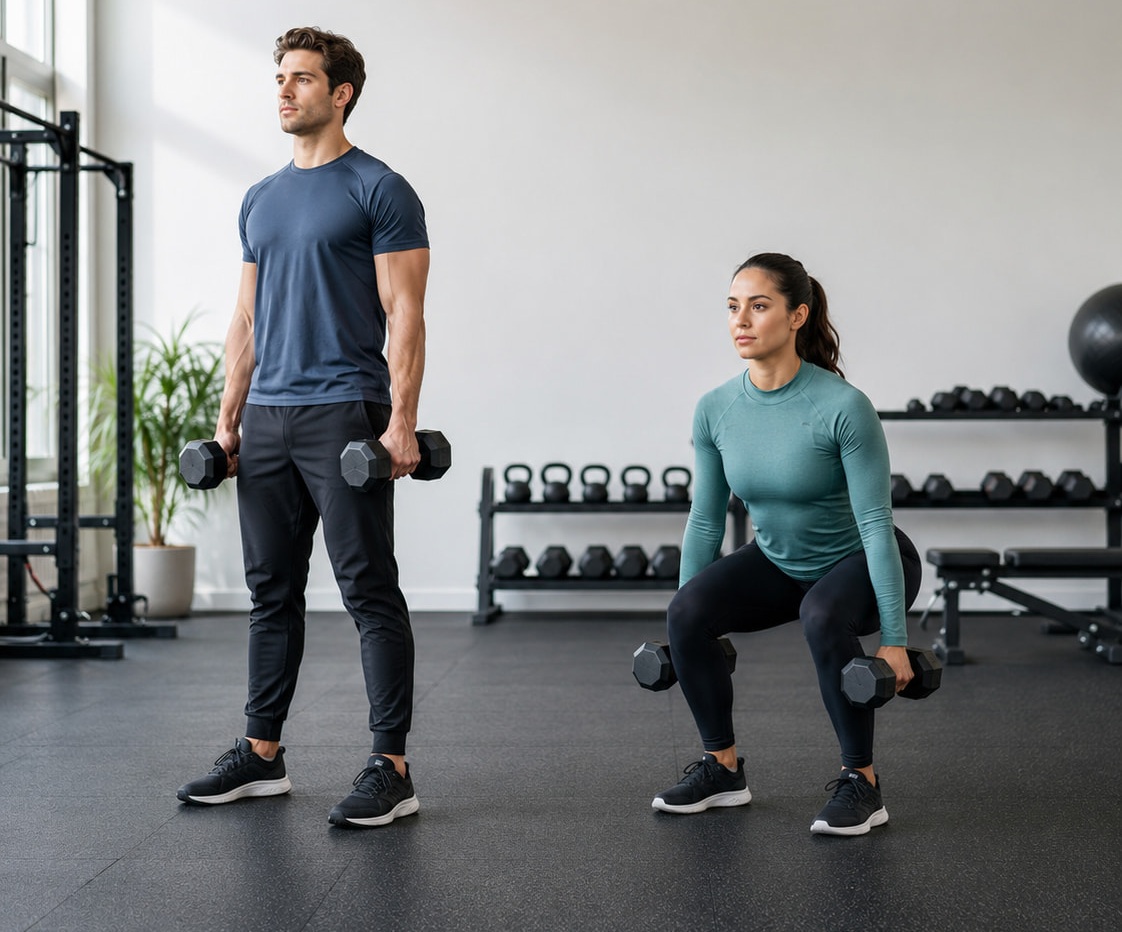
This guide focuses on the standard two-dumbbell squat, with one dumbbell hanging beside each thigh. You will learn how to set up the exercise, choose an appropriate depth and weight, avoid common mistakes, progress safely, and include dumbbell squats in a workout.
Dumbbell Squats at a Glance
| Training detail | Recommendation |
|---|---|
| Best for | Lower-body strength, muscle development, and home or gym workouts |
| Primary muscles | Quadriceps, gluteus maximus, and adductor magnus |
| Assisting muscles | Hamstrings, gluteus medius and minimus, calves, and core |
| Additional demands | Grip, upper-back, and trunk stability |
| Equipment needed | Two matched dumbbells |
| Experience level | Beginner to intermediate |
| Beginner starting range | 2–3 sets of 8–12 repetitions |
| Rest | 90–120 seconds between sets |
| Key cue | Keep the whole foot planted as you sit down between your legs |
What Are Dumbbell Squats?
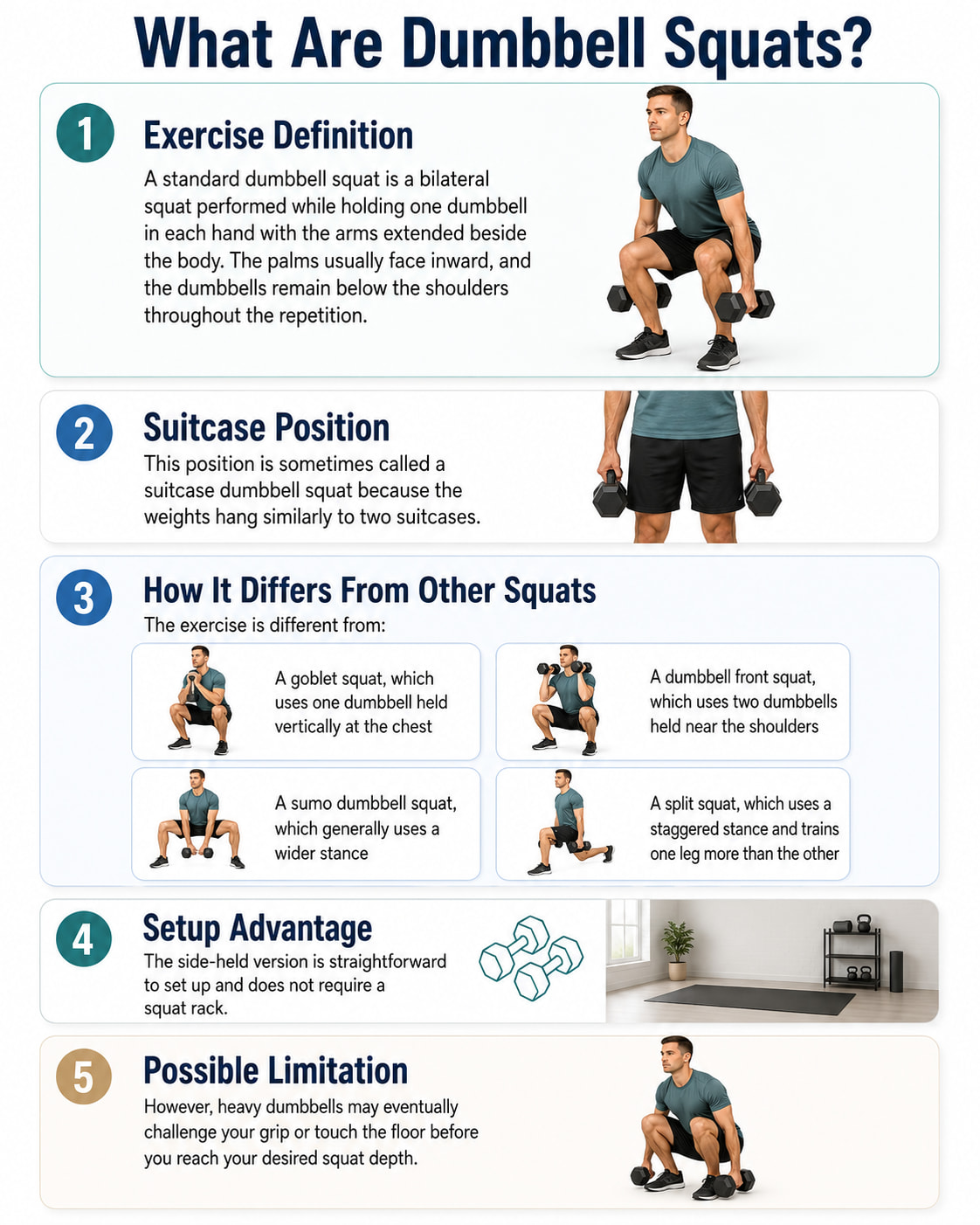
A standard dumbbell squat is a bilateral squat performed while holding one dumbbell in each hand with the arms extended beside the body. The palms usually face inward, and the dumbbells remain below the shoulders throughout the repetition.
This position is sometimes called a suitcase dumbbell squat because the weights hang similarly to two suitcases.
The exercise is different from:
- A goblet squat, which uses one dumbbell held vertically at the chest
- A dumbbell front squat, which uses two dumbbells held near the shoulders
- A sumo dumbbell squat, which generally uses a wider stance
- A split squat, which uses a staggered stance and trains one leg more than the other
The side-held version is straightforward to set up and does not require a squat rack. However, heavy dumbbells may eventually challenge your grip or touch the floor before you reach your desired squat depth.
Dumbbell Squat Muscles Worked
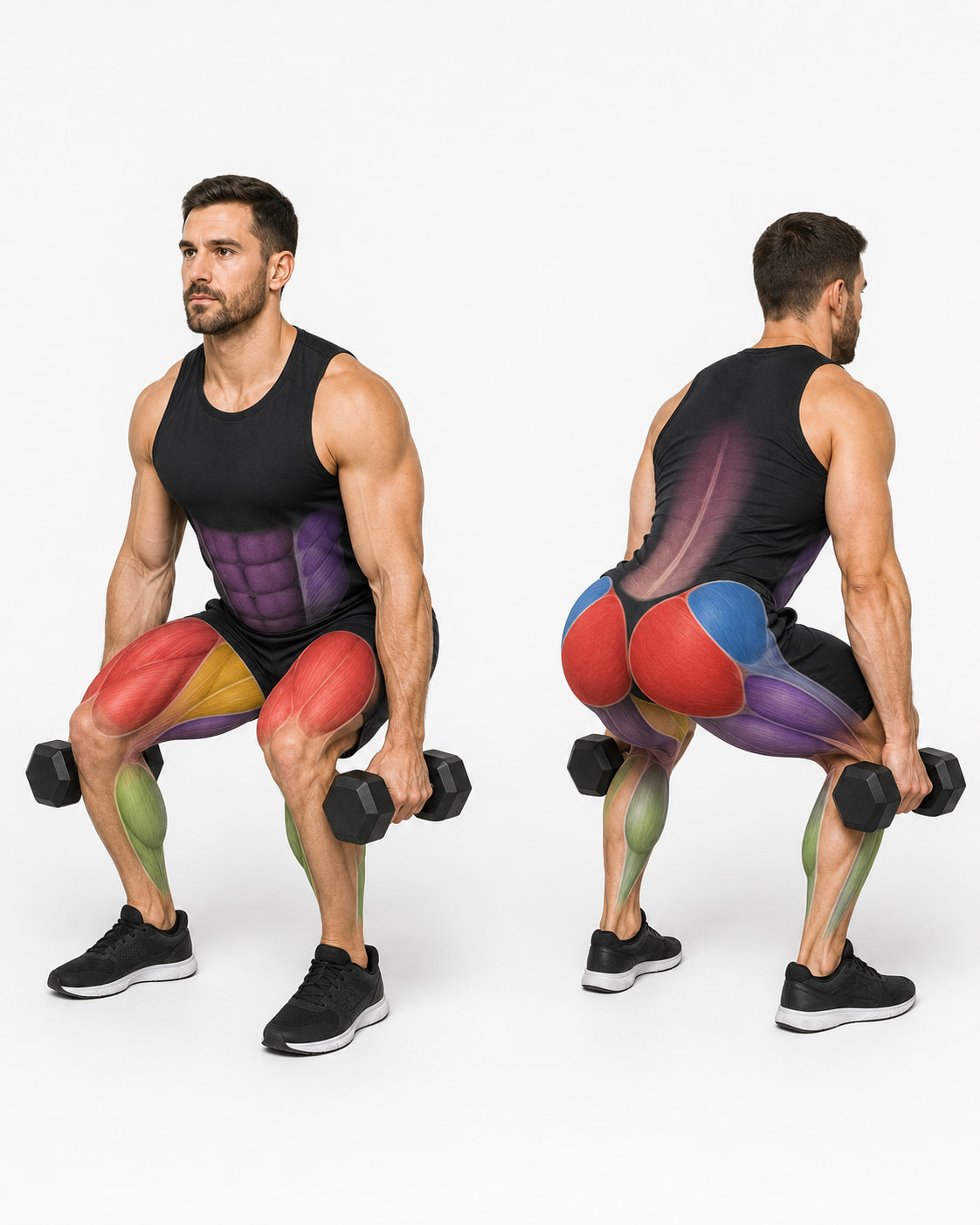
Dumbbell squats train several lower-body and stabilizing muscles at the same time.
- Quadriceps: Straighten the knees as you stand.
- Gluteus maximus: Extends the hips as you rise from the squat.
- Adductor magnus: Assists hip extension and helps control the thighs.
- Hamstrings: Support hip control and help stabilize the knees.
- Core and spinal stabilizers: Keep the trunk braced and controlled.
- Gluteus medius and minimus: Help stabilize the hips and knees.
- Calves: Assist ankle stability and control.
- Upper trapezius: Helps support the dumbbells and shoulder position.
- Forearms and hands: Maintain grip on the dumbbells.
A 2024 biomechanical review from the International Journal of Sports Physical Therapy explains that stance, foot angle, torso position, knee movement, and depth can change the muscular demands of a squat.
How to Do Dumbbell Squats
Best for: Building general lower-body strength and progressing beyond bodyweight squats.
Muscles worked: Quadriceps, gluteus maximus, adductor magnus, hamstrings, calves, core, upper back, and forearms.
Equipment needed: Two matched dumbbells and a clear, stable training surface.
Sets, reps, and rest: Begin with 2–3 sets of 8–12 repetitions. Rest for 90–120 seconds between sets and finish with approximately 2–3 controlled repetitions left in reserve.
Step-by-Step Instructions
- Stand upright with one dumbbell in each hand.
- Allow your arms to hang beside your body with your palms facing inward.
- Position your feet approximately hip- to shoulder-width apart.
- Turn your toes slightly outward if that feels more comfortable for your hips and knees.
- Keep your head in line with your spine and look forward or slightly downward.
- Inhale, gently brace your abdomen, and maintain pressure through the heel, base of the big toe, and base of the little toe.
- Bend your hips, knees, and ankles together to lower your body.
- Allow your knees to move in the same general direction as your toes.
- Keep the dumbbells controlled below your shoulders without swinging them.
- Descend as far as you can while keeping your feet planted, knees controlled, and trunk stable.
- Push the floor away and extend your knees and hips to stand.
- Finish tall with your ribs stacked over your pelvis. Do not lean backward or forcefully push your hips forward.
Exhale as you move through the hardest part of the upward phase. Reset your balance and brace before beginning the next repetition.
The American Council on Exercise similarly describes holding the weights beside the body, bending the hips and knees, maintaining stable foot pressure, and using a controllable range.
Coaching Cue
Sit down between your legs, then push the floor away.
This cue encourages both hip and knee movement without turning the squat into either an exaggerated sit-back or a knees-only movement.
Finding the Right Squat Stance
There is no single stance width or toe angle that works perfectly for everyone.
Start with your feet somewhere between hip- and shoulder-width apart. Use a small amount of toe turnout, then adjust until you can squat while:
- Keeping the whole foot planted
- Moving the knees in line with the feet
- Fitting the hips comfortably between the legs
- Maintaining control of the trunk
- Reaching a useful depth without discomfort
People with different hip structures, limb lengths, and ankle mobility may use slightly different stances. A stable and repeatable position is more important than copying another person’s exact foot placement.
Avoid an excessively wide stance if it prevents your knees from tracking with your feet. A stance that is too narrow may cause the dumbbells to hit your legs or make it harder to reach a comfortable depth.
How Deep Should You Squat?
Lower yourself to the deepest position you can control without:
- Lifting your heels
- Rolling onto the inside or outside edges of your feet
- Allowing your knees to collapse inward
- Rounding or suddenly relaxing your trunk
- Losing your balance
- Forcing the dumbbells into the floor
- Experiencing pain
Thighs approximately parallel to the floor can be a useful reference, but it is not a mandatory stopping point. Some people can squat comfortably below parallel, while others need to begin with a higher position.
A small 10-week barbell squat study available through the National Library of Medicine found that full squats produced greater increases in glute and adductor muscle volume than half squats, although both depths increased quadriceps size. The study involved only 17 men and used barbell squats, so it does not mean every person must use maximum depth during dumbbell squats.
Use a bench or box as a depth target when you are learning the movement. Gradually lower the target only when you can maintain the same level of control.
Can Your Knees Move Past Your Toes?
Your knees may move past your toes during a well-controlled squat. The amount of forward movement depends on your body proportions, ankle mobility, stance, depth, and the way the weight is held.
Trying to keep the shins completely vertical can force some people to push their hips too far backward and incline the torso excessively.
A 2023 review indexed by the National Library of Medicine concluded that blanket restrictions on forward knee movement are generally not an effective strategy for healthy trained individuals. Deliberately restricting the knees can shift considerably more demand toward the hips and lower back.
Instead of focusing on whether the knees cross an imaginary vertical line from the toes, concentrate on these points:
- Keep the whole foot planted.
- Let the knees follow the direction of the toes.
- Use a depth you can control.
- Avoid sudden inward knee collapse.
- Keep the hips and torso rising together.
People following a rehabilitation plan should use the movement limits provided by their qualified healthcare professional.
How to Choose the Right Dumbbell Weight
Choose a load that makes the final few repetitions challenging without changing your technique.
A practical starting test is:
- Learn the movement with bodyweight.
- Select a light matching pair of dumbbells.
- Perform 8–10 controlled repetitions.
- Stop and estimate how many more good repetitions you could have completed.
The weight is probably appropriate when you could complete approximately two or three additional repetitions with the same form.
The weight may be too heavy when:
- You cannot complete at least eight controlled repetitions.
- Your heels lift.
- Your knees repeatedly collapse inward.
- Your torso folds forward.
- The dumbbells swing.
- You shorten the range substantially.
- You need to bounce out of the bottom.
The weight may be too light when you can easily complete more than 15 repetitions and your training goal is strength or muscle development.
Once you reach the top of your target repetition range for every set with good form, increase to the next available dumbbell pair. A small increase of approximately 2.5–5 pounds, or 1–2 kilograms, per dumbbell is often enough.
When heavier weights are unavailable, increase difficulty by adding a few repetitions, using a brief pause, slowing the lowering phase, or adding one set. Change one variable at a time.
Benefits of Dumbbell Squats
1. Builds Lower-Body Strength
Dumbbell squats strengthen the muscles responsible for extending the knees and hips. They can be used as a main lower-body exercise by beginners or as an accessory exercise by experienced lifters.
2. Provides a Simple Progression From Bodyweight Squats
Adding a light dumbbell to each hand increases resistance without requiring the setup or technique of a barbell squat.
Beginners can first learn a comfortable bodyweight squat and then add dumbbells once they can control the movement.
3. Trains Several Muscles Efficiently
One exercise trains the quadriceps, glutes, adductors, calves, and trunk stabilizers. This makes dumbbell squats useful when workout time or equipment is limited.
4. Works Well in Home Workouts
You need only two dumbbells and enough clear floor space to squat. Adjustable dumbbells can make progression easier when space is limited.
The 2026 resistance-training guidance from the American College of Sports Medicine emphasizes that consistent resistance training matters more for most adults than using complicated programs or one specific type of equipment.
5. Challenges Grip and Trunk Stability
Holding the dumbbells beside the body requires the forearms, upper back, and trunk to maintain the weights in a stable position.
This can be useful, but it can also become a limitation. When your grip fails before your legs are sufficiently challenged, another squat variation may be more appropriate.
Common Dumbbell Squat Mistakes
1. Using Too Much Weight
Heavy dumbbells may cause you to rush, shorten the range, or lose trunk position.
Correction: Reduce the weight and complete every repetition at a consistent speed and depth.
2. Allowing the Knees to Collapse Inward
A small amount of natural knee movement may occur, but an obvious uncontrolled collapse usually reduces stability.
Correction: Keep pressure through the whole foot and guide each knee in the same general direction as the toes.
3. Lifting the Heels
Raised heels often indicate lost balance, an unsuitable stance, limited ankle movement, or an attempt to squat deeper than you can control.
Correction: Reduce the depth and experiment with a slightly different stance width or toe angle.
4. Driving Only Through the Heels
The cue “drive through your heels” can cause some people to lift their toes and shift too far backward.
Correction: Maintain a tripod foot with pressure through the heel, base of the big toe, and base of the little toe.
5. Turning the Squat Into a Deadlift
Pushing the hips far backward while barely bending the knees creates more of a hip-hinge movement.
Correction: Allow the hips, knees, and ankles to bend together.
6. Forcing a Perfectly Upright Torso
Some forward torso inclination is normal. Trying to remain completely vertical may feel unnatural or cause balance problems.
Correction: Keep the trunk braced while allowing a controlled amount of forward inclination.
7. Letting the Hips Rise Before the Chest
When the hips shoot upward first, the repetition often turns into a good morning.
Correction: Use a lighter weight and think about pushing the floor away so the hips and torso rise together.
8. Swinging the Dumbbells
Momentum makes the weights less stable and may pull the shoulders or trunk out of position.
Correction: Keep the arms long and the dumbbells directly below the shoulders throughout the repetition.
9. Forcing Extra Depth
Reaching lower is not useful when it requires the heels to lift, the trunk to collapse, or the dumbbells to hit the floor.
Correction: Stop at your deepest controlled position or use a different load placement.
10. Leaning Back at the Top
Forcefully pushing the hips forward and arching the lower back does not increase glute training.
Correction: Finish standing tall with the ribs and pelvis comfortably stacked.
Dumbbell Squat Sets, Reps, and Rest
The appropriate training range depends on your experience, goals, available weights, and the other exercises in your program.
| Goal | Sets and reps | Rest | Effort |
|---|---|---|---|
| Learning the exercise | 2 sets of 8–10 | 90–120 seconds | 3–4 reps in reserve |
| General strength | 3–4 sets of 6–10 | 2–3 minutes | 1–3 reps in reserve |
| Muscle development | 3–4 sets of 8–15 | 90–150 seconds | 1–3 reps in reserve |
| Muscular endurance | 2–3 sets of 12–20 | 60–90 seconds | 2–3 reps in reserve |
Reps in reserve means the number of additional good repetitions you estimate you could have completed before your technique or strength failed.
Complete failure is not necessary for most sets. Stop when your next repetition would probably require swinging, bouncing, collapsing, or substantially shortening the range.
How Often Should You Do Dumbbell Squats?
One or two dumbbell squat sessions per week is enough for many beginners.
The American College of Sports Medicine’s current guidance emphasizes training the major muscle groups at least twice weekly as part of a complete resistance-training program. This does not mean you must perform dumbbell squats in every session. Other exercises such as lunges, split squats, step-ups, and deadlift variations also contribute to lower-body training.
Place dumbbell squats early in your workout, after warming up, when you can concentrate on form and produce consistent repetitions.
Dumbbell Squat Regressions
Bodyweight Box Squat
Squat toward a stable bench or box without holding weights. Use a height that allows you to control the entire repetition.
This is useful for learning balance, depth, and coordinated hip and knee movement.
Supported Squat
Hold a sturdy railing or other stable support while squatting.
Use only enough assistance to maintain balance. Avoid pulling yourself up mainly with the arms.
Reduced-Range Dumbbell Squat
Hold light dumbbells but descend only to a comfortable depth.
Gradually increase the range as your strength and control improve.
Light Goblet Squat
Hold one light dumbbell close to the chest. The front-loaded position acts as a counterbalance and may help some beginners maintain a more comfortable torso position.
Dumbbell Squat Progressions
Increase the Dumbbell Weight
Add weight only after completing every planned set and repetition with stable technique.
Paused Dumbbell Squat
Pause for one or two seconds at the bottom without relaxing your brace or shifting onto your toes.
This removes some momentum and makes a light weight more challenging.
Tempo Dumbbell Squat
Lower for approximately three seconds, pause briefly, and stand at a normal controlled speed.
Do not move slowly simply for the sake of making the set painful. Use the tempo to improve control.
Dumbbell Front Squat
Hold the dumbbells near the shoulders rather than beside the thighs.
This removes some of the grip limitation but requires more upper-back, shoulder, and trunk control. The National Academy of Sports Medicine describes keeping the weights stable at shoulder height while bracing through the squat.
One-and-a-Half-Rep Dumbbell Squat
Lower into the squat, rise halfway, descend again, and then stand fully. That sequence counts as one repetition.
Use light weights because the extended time under tension becomes challenging quickly.
Split Squat or Rear-Foot-Elevated Split Squat
These unilateral variations place more demand on each leg without requiring extremely heavy dumbbells.
They also require more balance and should be introduced only after you can control a standard dumbbell squat.
Dumbbell Squat vs. Goblet Squat vs. Front Squat
| Variation | Weight position | Main advantage | Common limitation |
|---|---|---|---|
| Standard dumbbell squat | One dumbbell beside each thigh | Simple setup with low shoulder demand | Grip or dumbbell size may limit loading |
| Goblet squat | One dumbbell held at the chest | Useful counterbalance for learning squat form | Holding a heavy dumbbell at the chest becomes difficult |
| Dumbbell front squat | Two dumbbells held near the shoulders | Can challenge the legs without weights hanging near the floor | Requires more shoulder, upper-back, and rack-position control |
The American Council on Exercise goblet squat guide and the National Academy of Sports Medicine exercise library describe the goblet and two-dumbbell front-rack positions as separate variations.
None is universally better. Choose the version that lets you use a useful range, maintain control, and progressively challenge the target muscles.
Beginner Dumbbell Leg Workout
Perform this routine once or twice per week. Leave at least one day between sessions when you are new to resistance training.
Warm-Up
Spend approximately five minutes preparing for the workout:
- Two or three minutes of easy walking or cycling
- 8 controlled bodyweight squats
- 6 reverse lunges per side
- 8 ankle rocks per side
- One light warm-up set of dumbbell squats
Workout
| Exercise | Sets and reps | Rest |
|---|---|---|
| Dumbbell squat | 3 sets of 8–12 | 90–120 seconds |
| Dumbbell Romanian deadlift | 3 sets of 8–12 | 90–120 seconds |
| Supported reverse lunge | 2 sets of 8 per side | 60–90 seconds |
| Standing calf raise | 2 sets of 12–15 | 45–60 seconds |
Finish most sets with two or three repetitions in reserve.
When you complete 12 dumbbell squats in all three sets with consistent form, increase the weights by the smallest available amount. Return to eight or nine repetitions and gradually build back toward 12.
If heavier dumbbells are unavailable, add a one-second pause at the bottom before adding more sets.
Dumbbell Squat Safety Tips
- Use two dumbbells of the same weight.
- Clear enough floor space for the weights and your feet.
- Wear stable athletic shoes or train barefoot only on a safe, nonslip surface when appropriate.
- Keep your fingers and dumbbells clear of your feet.
- Do not drop the weights beside your ankles.
- Pick up and put down the dumbbells with a controlled squat or hip hinge.
- Avoid maximum-effort attempts when you are still learning the exercise.
- Use a box, support, or lighter load when balance is uncertain.
- Stop the set when you cannot maintain control of the weights or your body position.
Stop exercising and seek appropriate professional help if the movement causes sharp pain, numbness, dizziness, chest pain, or other unusual symptoms. People with an existing injury, recent surgery, significant balance limitation, or a health condition that affects exercise should ask a qualified healthcare professional how the movement should be modified.
Frequently Asked Questions
Are Dumbbell Squats Good for Beginners?
Yes. Beginners can first learn the movement with bodyweight, a stable box, or a light goblet squat. Add two dumbbells only when you can keep your feet planted, control your knees, and maintain a comfortable trunk position.
Where Should You Hold the Dumbbells?
For the standard dumbbell squat, hold one dumbbell beside each thigh with your palms facing inward and arms extended.
Holding one dumbbell at the chest creates a goblet squat. Holding two dumbbells near the shoulders creates a dumbbell front squat.
How Heavy Should Dumbbells Be for Squats?
Use a weight that allows you to complete the planned repetitions while keeping approximately two or three good repetitions in reserve. The correct weight depends on your current strength rather than your age, body size, or what another person uses.
How Low Should You Go?
Squat as low as you can while keeping your whole foot planted, knees controlled, trunk braced, and dumbbells stable. Parallel is a useful reference but not a requirement.
Is It Bad if Your Knees Pass Your Toes?
Not automatically. Some forward knee movement is normal and may be necessary depending on your proportions and squat depth. Focus on stable feet, controlled knee tracking, and a comfortable range rather than forcing the knees to remain behind the toes.
Can Dumbbell Squats Build Muscle?
They can help build the quadriceps, glutes, and adductors when the exercise is performed through a useful range with enough resistance and progressively increased over time.
Muscle development also depends on the total training program, consistency, recovery, and adequate nutrition. Your sets should become challenging, but you do not need to reach complete failure every time.
Conclusion
Dumbbell squats are a practical way to train the quadriceps, glutes, adductors, and trunk without a barbell or squat rack. Begin with a comfortable stance, keep the whole foot planted, allow the hips and knees to bend together, and use only as much depth and weight as you can control.
Build repetitions before adding weight. When the side-held position becomes limited by your grip or dumbbell size, progress to a front-rack squat, unilateral exercise, or another suitable loaded squat variation.
This content is for informational and educational purposes only and is not intended as a substitute for professional medical advice, diagnosis, or treatment.
References
- Currier BS, et al.
Read the ACSM position stand - Straub RK, Powers CM.
Read the full biomechanical review - Illmeier G, Rechberger JS.
Read the full review - Kubo K, et al.
Useful for discussing squat depth and the development of the quadriceps, glutes, and adductors.
Read the study - Bryanton MA, et al.
Read the study - Escamilla RF.
Read the review - Grgic J, et al.
Read the systematic review
5 thoughts on “Dumbbell Squats: Proper Form, Muscles Worked, and Tips”