Stretching exercises for women should target the whole body: neck, shoulders, chest, back, hips, glutes, hamstrings, quads, calves, and spine. A good routine does not need to be complicated. It should help you move through a comfortable range of motion, reduce feelings of tightness, and support better workout recovery.
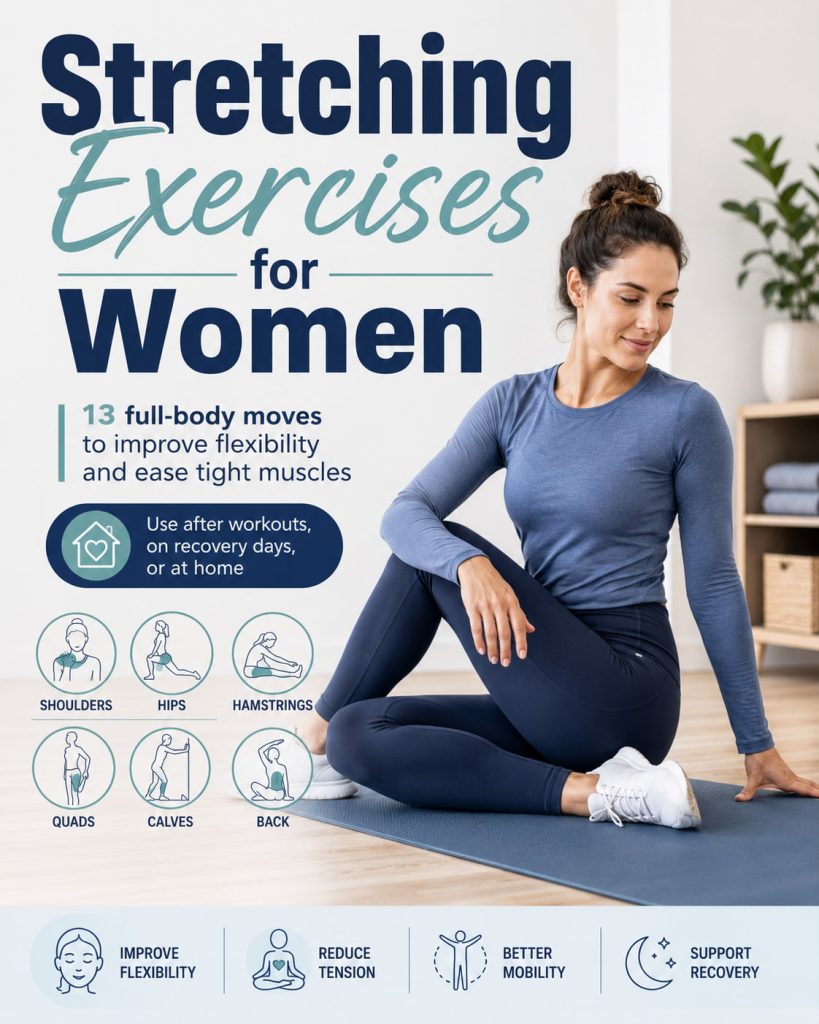
This guide covers 13 practical stretching exercises for women, including muscles worked, form tips, common mistakes, beginner modifications, and a simple full-body routine you can use at home or after training.
Stretching Exercises for Women: Quick Routine Overview
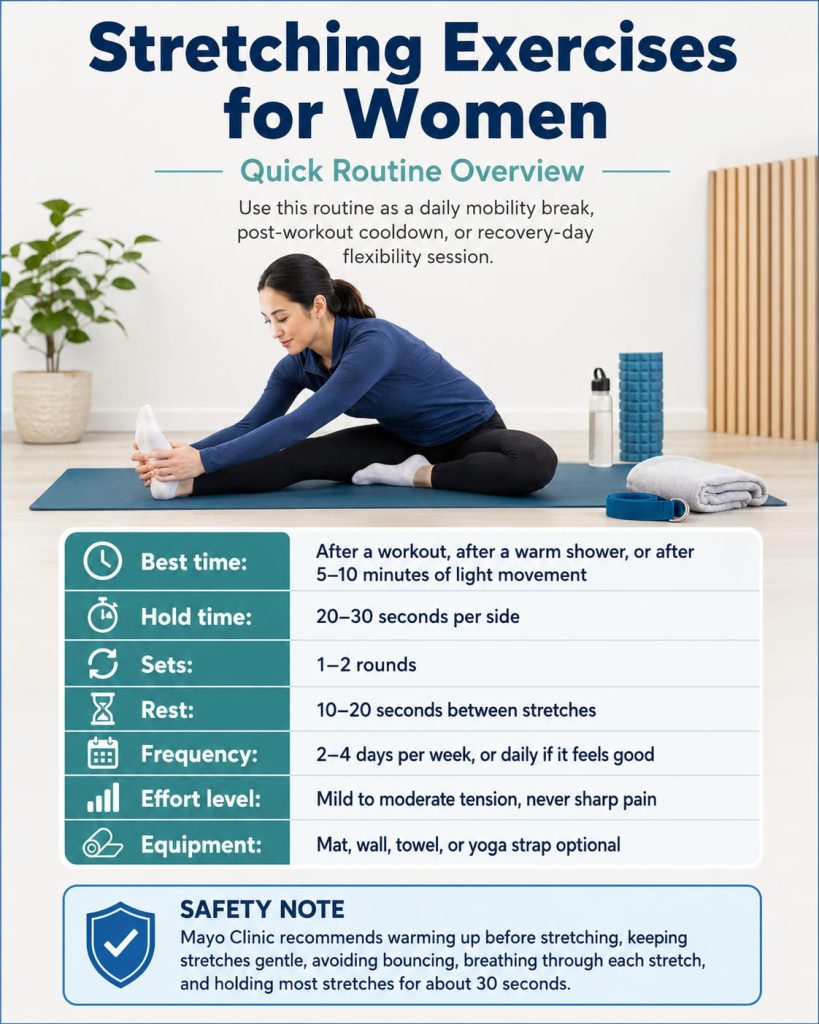
Use this routine as a daily mobility break, a post-workout cooldown, or a recovery-day flexibility session.
| Goal | Recommendation |
|---|---|
| Best time | After a workout, after a warm shower, or after 5–10 minutes of light movement |
| Hold time | 20–30 seconds per side |
| Sets | 1–2 rounds |
| Rest | 10–20 seconds between stretches |
| Frequency | 2–4 days per week, or daily if it feels good |
| Effort level | Mild to moderate tension, never sharp pain |
| Equipment | Exercise mat, wall, towel or yoga strap optional |
The Mayo Clinic recommends warming up before stretching, keeping stretches gentle, avoiding bouncing, breathing through each stretch, and holding most stretches for about 30 seconds.
Benefits of Stretching for Women
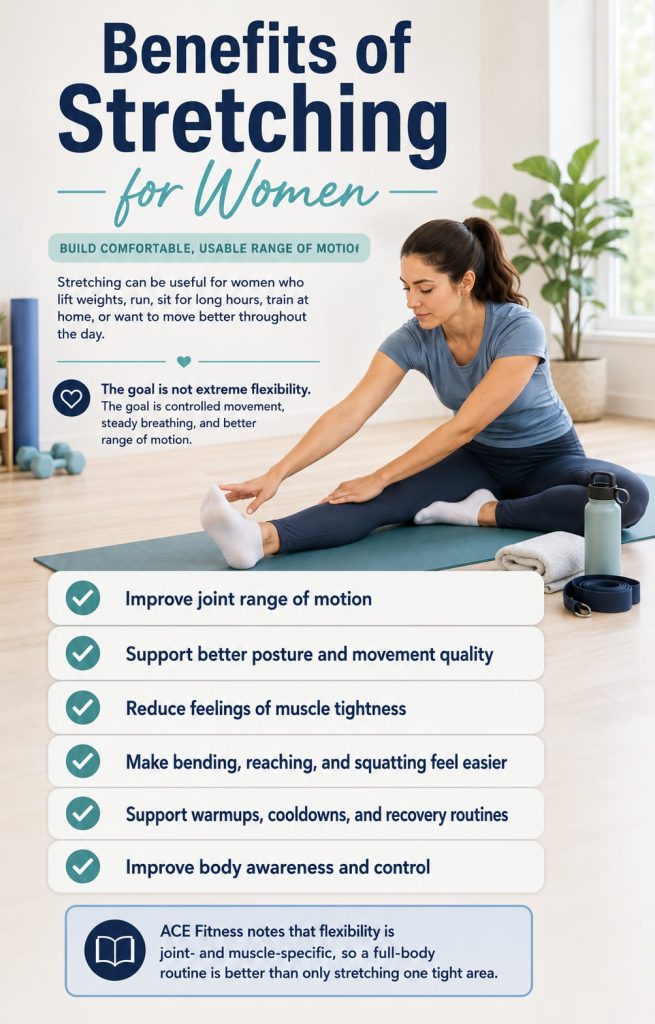
Stretching can be useful for women who lift weights, run, sit for long hours, train at home, or simply want to move better throughout the day. It is not about forcing extreme flexibility. The goal is to build comfortable, usable range of motion.
Regular flexibility work may help:
- Improve joint range of motion
- Support better posture and movement quality
- Reduce feelings of muscle tightness
- Make daily movements like bending, reaching, and squatting feel easier
- Support warmups, cooldowns, and recovery routines
- Improve body awareness and control
ACE Fitness notes that flexibility is joint- and muscle-specific, meaning someone may have flexible hamstrings but tight shoulders, hips, or calves. That is why a full-body routine works better than only stretching one “tight” area.
Static vs. Dynamic Stretching: When Should You Stretch?
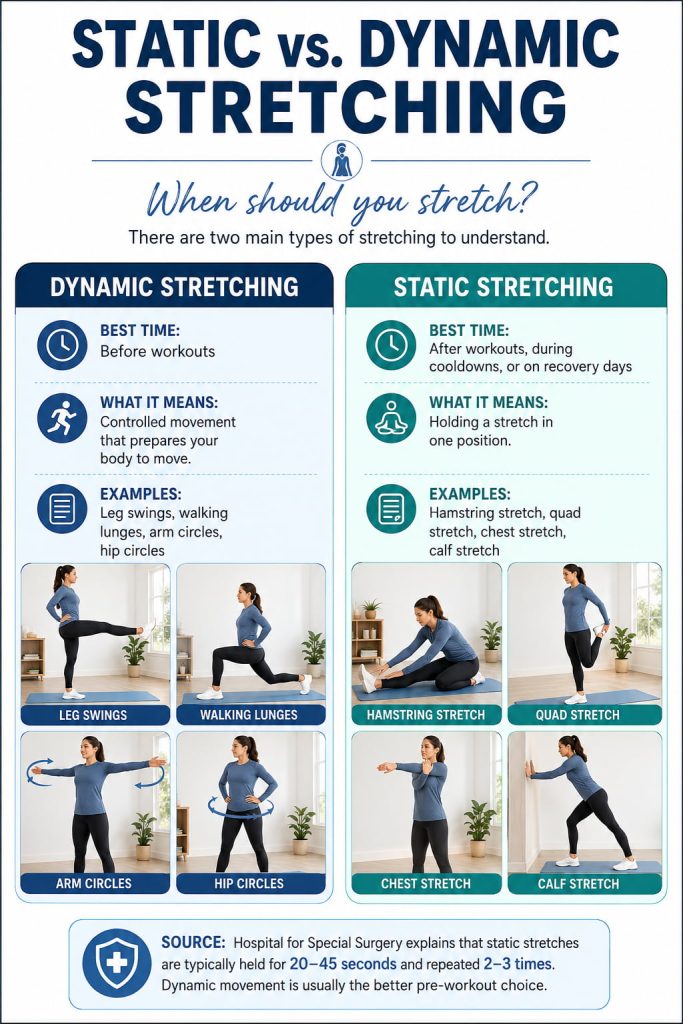
There are two main types of stretching to understand.
Dynamic stretching uses controlled movement. Examples include leg swings, walking lunges, arm circles, and hip circles. This is usually better before workouts because it helps prepare your body to move.
Static stretching means holding a stretch in one position. Examples include hamstring stretches, quad stretches, chest stretches, and calf stretches. Static stretches are usually best after workouts, during cooldowns, or on recovery days.
Hospital for Special Surgery explains that static stretches are typically held for 20–45 seconds and repeated 2–3 times. It also notes that static stretching right before explosive athletic performance may reduce quickness or power for some activities, so dynamic movement is usually the better pre-workout choice.
Before You Start: Safety and Form Rules
Stretching should feel controlled, not forced. Use these rules for every exercise in this guide:
- Warm up first with light walking, cycling, marching in place, or an easy workout.
- Stretch to mild or moderate tension, not pain.
- Breathe slowly and avoid holding your breath.
- Do not bounce or jerk into position.
- Keep your joints aligned and your body supported.
- Stop if you feel sharp pain, numbness, dizziness, chest pain, or unusual symptoms.
If you have an injury, medical condition, or have been inactive and want to begin a more vigorous routine, check with a qualified health professional. The American Heart Association gives similar guidance for people with medical concerns or long periods of inactivity.
13 Best Stretching Exercises for Women
The following stretching exercises for women target the neck, shoulders, chest, back, hips, glutes, hamstrings, quads, and calves.
Use them after workouts, on recovery days, or anytime you want a simple full-body flexibility routine.
1. Neck Side Stretch
Best for: Neck tightness, desk posture, upper-body cooldowns
Muscles worked: Upper trapezius, levator scapulae, side neck muscles
Equipment needed: None
Why it stands out
This is a simple stretch for women who spend time looking down at a phone, studying, working at a desk, driving, or carrying tension in the neck and shoulders.
Suggested sets, reps, and rest
Hold for 20–30 seconds per side. Repeat 1–2 times.
How to do it
- Sit or stand tall with your shoulders relaxed.
- Keep your chest lifted and your chin slightly tucked.
- Tilt your right ear toward your right shoulder.
- Keep your left shoulder down.
- Hold gently, then switch sides.
Common mistakes
- Pulling hard on the head
- Rounding the upper back
- Lifting the opposite shoulder
- Stretching into sharp pain
Coaching cue
“Lengthen your neck before you tilt.”
Variations, progressions, or regressions
For a gentler version, keep both hands relaxed at your sides. For a slightly deeper stretch, place the opposite hand behind your back, but do not yank on your head.
How to use it in a workout
Use it at the beginning of a recovery routine or at the end of an upper-body workout.
2. Cross-Body Shoulder Stretch
Best for: Shoulders, upper back, post-push workout cooldowns
Muscles worked: Rear deltoid, posterior shoulder, upper back muscles
Equipment needed: None
Why it stands out
This stretch targets the back of the shoulder, which can feel tight after push-ups, bench presses, overhead presses, rowing, or long periods at a desk.
Suggested sets, reps, and rest
Hold for 20–30 seconds per side. Repeat 1–2 times.
How to do it
- Stand tall or sit upright.
- Bring your right arm across your chest.
- Use your left arm to gently hold the right arm above or below the elbow.
- Keep both shoulders down.
- Hold, then switch sides.
Mayo Clinic includes a similar shoulder stretch in its basic stretching guide and recommends holding for about 30 seconds per side.
Common mistakes
- Shrugging the shoulders
- Pulling directly on the elbow joint
- Twisting the torso
- Holding your breath
Coaching cue
“Pull the arm across, but keep the shoulder away from your ear.”
Variations, progressions, or regressions
For a gentler option, hold closer to the wrist. For a deeper stretch, keep the arm straighter and gently draw it farther across your chest.
How to use it in a workout
Use after upper-body strength training, Pilates, swimming, or a long day of computer work.
3. Doorway Chest Stretch
Best for: Chest opening, posture support, push-day cooldowns
Muscles worked: Pectoralis major, pectoralis minor, front shoulders
Equipment needed: Doorway or wall corner
Why it stands out
The doorway chest stretch is one of the best stretching exercises for women who feel tight through the chest and front shoulders. It pairs well with workouts that include push-ups, planks, dumbbell presses, or long sitting periods.
Suggested sets, reps, and rest
Hold for 20–30 seconds. Repeat 1–2 times.
How to do it
- Stand in a doorway.
- Place your forearms on each side of the door frame.
- Keep your elbows around shoulder height or slightly below.
- Step one foot forward.
- Gently shift your chest through the doorway until you feel a stretch across the chest.
- Keep your ribs down and breathe.
Common mistakes
- Arching the lower back
- Flaring the ribs
- Pushing into shoulder pain
- Placing the elbows too high
Coaching cue
“Open through the chest, not the lower back.”
Variations, progressions, or regressions
For a gentler version, stretch one arm at a time against a wall. To adjust the target, move your arm slightly lower or higher until the stretch feels comfortable.
How to use it in a workout
Use after chest, shoulder, or arm workouts. It also works well during a midday posture reset.
4. Cat-Cow Stretch
Best for: Spine mobility, warmups, gentle recovery
Muscles worked: Spinal erectors, abdominals, upper back, neck stabilizers
Equipment needed: Exercise mat optional
Why it stands out
Cat-cow is a gentle movement-based stretch that helps you move the spine through flexion and extension. It is especially useful before lower-body workouts, yoga, Pilates, or full-body mobility sessions.
Suggested sets, reps, and rest
Do 6–10 slow reps. Rest as needed.
How to do it
- Start on your hands and knees.
- Place your hands under your shoulders and knees under your hips.
- Inhale and gently lift your chest and tailbone.
- Exhale and round your upper back toward the ceiling.
- Move slowly between both positions.
Common mistakes
- Moving too fast
- Locking the elbows
- Dropping into the lower back
- Forcing the neck upward
Coaching cue
“Move one part of your spine at a time.”
Variations, progressions, or regressions
For sensitive wrists, place your forearms on a bench or elevated surface. For a more controlled version, keep the movement smaller and focus on breathing.
How to use it in a workout
Use cat-cow early in your routine before static stretches or strength training.
5. Child’s Pose With Side Reach
Best for: Back, lats, shoulders, breathing reset
Muscles worked: Latissimus dorsi, spinal erectors, shoulders, hips
Equipment needed: Exercise mat optional
Why it stands out
This stretch targets the sides of the back and shoulders while giving the hips and spine a gentle break. It is useful after rows, pull-downs, deadlifts, squats, or core work.
Suggested sets, reps, and rest
Hold for 20–30 seconds per side. Repeat 1–2 times.
How to do it
- Start on your hands and knees.
- Sit your hips back toward your heels.
- Reach both arms forward.
- Walk your hands slightly to the right.
- Breathe into the left side of your ribs.
- Return to center, then switch sides.
Common mistakes
- Forcing the hips to the heels
- Holding tension in the neck
- Letting the elbows collapse
- Turning the stretch into a painful shoulder position
Coaching cue
“Reach long through your fingertips while your hips stay heavy.”
Variations, progressions, or regressions
Place a pillow or folded towel between your hips and heels if the position feels too intense. If kneeling is uncomfortable, try a standing lat stretch with your hands on a bench or countertop.
How to use it in a workout
Use it after back training, lower-body lifting, or as part of a relaxing evening stretch routine.
6. Kneeling Hip Flexor Stretch
Best for: Tight hips, running, squats, lunges, desk posture
Muscles worked: Iliopsoas, rectus femoris, hip flexors, front thigh
Equipment needed: Mat or folded towel for the back knee
Why it stands out
The kneeling hip flexor stretch is a key lower-body stretch because the hip flexors can feel tight after long sitting, running, cycling, or lower-body workouts. ACE Fitness notes that the standing hip flexor stretch targets the psoas, which may become tight from extended sitting and repeated aerobic activity.
Suggested sets, reps, and rest
Hold for 20–30 seconds per side. Repeat 1–2 times.
How to do it
- Kneel with your right knee on a mat and your left foot forward.
- Stack your left knee over your left ankle.
- Gently tuck your pelvis under, as if bringing your belt buckle toward your ribs.
- Squeeze your right glute lightly.
- Shift forward a few inches until you feel a stretch in the front of the right hip.
- Hold, then switch sides.
Common mistakes
- Arching the lower back
- Letting the front knee collapse inward
- Lunging too far forward
- Forgetting to engage the glute on the back-leg side
Coaching cue
“Tuck first, then shift forward.”
Variations, progressions, or regressions
For a regression, do the stretch standing in a split stance with the back heel lifted. For a progression, reach the arm on the kneeling side overhead and slightly across your body.
How to use it in a workout
Use after squats, lunges, running, cycling, or any workout where your hips feel tight.
7. Figure-4 Glute Stretch
Best for: Glutes, outer hips, lower-body cooldowns
Muscles worked: Gluteus maximus, gluteus medius, piriformis, deep hip rotators
Equipment needed: Mat optional
Why it stands out
The figure-4 stretch is one of the most useful stretching exercises for women who feel tight in the glutes or outer hips after lower-body training. It can be done on the floor, on a bench, or seated in a chair.
Suggested sets, reps, and rest
Hold for 20–30 seconds per side. Repeat 1–2 times.
How to do it
- Lie on your back with both knees bent.
- Cross your right ankle over your left thigh.
- Keep your right foot flexed.
- Hold behind your left thigh.
- Gently draw your legs toward your torso.
- Hold, then switch sides.
ACE Fitness recommends avoiding strain during the reclining figure-4 stretch and allowing gravity to help bring the legs closer instead of forcing the position.
Common mistakes
- Pulling too aggressively
- Letting the crossed foot go limp
- Lifting the head and neck
- Forcing the knee outward
Coaching cue
“Relax your upper body and let the hip open gradually.”
Variations, progressions, or regressions
For a beginner-friendly option, do the stretch seated in a chair. For a deeper version, move the supporting leg closer to your chest while keeping your breathing steady.
How to use it in a workout
Use after glute bridges, hip thrusts, deadlifts, squats, step-ups, or running.
8. 90/90 Hip Stretch
Best for: Hip mobility, glutes, internal and external hip rotation
Muscles worked: Glutes, deep hip rotators, adductors, hip capsule area
Equipment needed: Mat optional
Why it stands out
The 90/90 stretch trains both sides of the hips: one hip externally rotates while the other internally rotates. This makes it a strong choice for women who want better hip control for squats, lunges, yoga, dance, running, or general mobility.
Suggested sets, reps, and rest
Hold for 20–30 seconds per side. Repeat 1–2 times.
How to do it
- Sit on the floor.
- Bend your front leg at about 90 degrees.
- Bend your back leg at about 90 degrees.
- Sit tall with both hips heavy.
- Lean slightly forward over the front thigh until you feel a stretch.
- Hold, then switch sides.
Common mistakes
- Collapsing through the spine
- Forcing both knees flat
- Leaning away from the tight side
- Holding the breath
Coaching cue
“Sit tall first, then fold.”
Variations, progressions, or regressions
Sit on a yoga block, pillow, or folded towel if your hips feel restricted. For a progression, move slowly from one 90/90 side to the other without using your hands.
How to use it in a workout
Use before lower-body training as a controlled mobility drill or after training as a static stretch.
9. Seated Hamstring Stretch
Best for: Hamstrings, posterior chain, post-leg workout cooldowns
Muscles worked: Hamstrings, calves, lower back area
Equipment needed: Mat optional; towel or strap optional
Why it stands out
The seated hamstring stretch is simple, adjustable, and effective for targeting the back of the thigh. It is useful after running, walking, deadlifts, squats, or long sitting periods.
Suggested sets, reps, and rest
Hold for 20–30 seconds per side. Repeat 1–2 times.
How to do it
- Sit with your right leg extended.
- Bend your left knee and let it rest comfortably out to the side.
- Sit tall and lengthen your spine.
- Hinge forward from your hips toward the extended leg.
- Stop when you feel a stretch in the back of the thigh.
- Hold, then switch sides.
ACE Fitness cues the seated head-toward-knee stretch by first lengthening the spine, then gently folding forward.
Common mistakes
- Rounding the lower back aggressively
- Reaching for the toes at all costs
- Locking the knee hard
- Bouncing into the stretch
Coaching cue
“Lead with your chest, not your chin.”
Variations, progressions, or regressions
For tight hamstrings, slightly bend the extended knee or loop a towel around your foot. For a progression, flex the foot gently and hinge a little farther while keeping the back long.
How to use it in a workout
Use after lower-body strength training, running, cycling, hiking, or dance workouts.
10. Standing Quadriceps Stretch
Best for: Front thighs, hip flexors, lower-body cooldowns
Muscles worked: Quadriceps, rectus femoris, hip flexors
Equipment needed: Wall or chair for balance optional
Why it stands out
This stretch targets the front of the thigh and can help balance routines that include squats, lunges, step-ups, cycling, or running.
Suggested sets, reps, and rest
Hold for 20–30 seconds per side. Repeat 1–2 times.
How to do it
- Stand tall near a wall or chair.
- Shift weight into your left foot.
- Bend your right knee and bring your heel toward your glutes.
- Hold your ankle, sock, or pant leg.
- Keep both knees close together.
- Lightly brace your abs and avoid arching your back.
- Hold, then switch sides.
Mayo Clinic and Hospital for Special Surgery both emphasize keeping the abdominal muscles engaged during quad stretches to avoid excessive back arching.
Common mistakes
- Pulling the knee far behind the body
- Arching the lower back
- Letting the knee flare out
- Losing balance and twisting
Coaching cue
“Knees together, ribs down.”
Variations, progressions, or regressions
Use a wall for balance. If grabbing your foot is difficult, loop a towel or yoga strap around the ankle. If kneeling is more comfortable, try a side-lying quad stretch instead.
How to use it in a workout
Use after leg day, cycling, running, stair climbing, or any workout that heavily uses the quads.
11. Butterfly Stretch
Best for: Inner thighs, hips, groin mobility
Muscles worked: Adductors, gracilis, inner thighs, hip rotators
Equipment needed: Mat optional
Why it stands out
The butterfly stretch is a beginner-friendly way to stretch the inner thighs and hips. It is useful for lower-body workouts, yoga, dance, and general hip mobility.
Suggested sets, reps, and rest
Hold for 20–30 seconds. Repeat 1–2 times.
How to do it
- Sit tall on the floor.
- Bring the soles of your feet together.
- Let your knees open out to the sides.
- Hold your feet or ankles.
- Lengthen your spine.
- Stay upright or gently hinge forward.
Common mistakes
- Pressing the knees down forcefully
- Rounding the back
- Bouncing the legs
- Pulling the feet too close before your hips are ready
Coaching cue
“Let the knees get heavy; do not shove them down.”
Variations, progressions, or regressions
Sit on a folded towel if your lower back rounds. Move your feet farther away from your body to make the stretch easier. To progress, hinge forward slightly while keeping the spine long.
How to use it in a workout
Use after squats, lunges, lateral lunges, sumo deadlifts, skating movements, or dance-based workouts.
12. Wall Calf Stretch
Best for: Calves, ankles, walking, running, lower-body workouts
Muscles worked: Gastrocnemius, soleus, Achilles tendon area
Equipment needed: Wall
Why it stands out
The calves affect ankle movement, squatting depth, walking mechanics, running stride, and many lower-body exercises. This stretch is easy to scale and does not require floor work.
Suggested sets, reps, and rest
Hold for 20–30 seconds per side. Repeat 1–2 times.
How to do it
- Stand facing a wall.
- Place both hands on the wall.
- Step your right foot back.
- Keep your right heel on the floor.
- Keep the back leg mostly straight.
- Bend the front knee until you feel a stretch in the back calf.
- Hold, then switch sides.
Mayo Clinic’s calf stretch uses a similar setup and cues keeping the back heel down, the back straight, and the hips facing forward.
Common mistakes
- Turning the back foot outward
- Letting the heel lift
- Collapsing through the arch
- Leaning the hips sideways
Coaching cue
“Back heel heavy, toes straight ahead.”
Variations, progressions, or regressions
To target the deeper soleus muscle, slightly bend the back knee while keeping the heel down. For a gentler version, shorten your stance.
How to use it in a workout
Use after walking, running, jump rope, calf raises, hiking, or lower-body lifting.
13. Supine Spinal Twist
Best for: Spine rotation, glutes, lower-back relaxation
Muscles worked: Obliques, spinal rotators, glutes, lower back area
Equipment needed: Mat optional
Why it stands out
This floor stretch is a calm way to finish a routine. It adds gentle rotation after you have stretched the hips, hamstrings, quads, and calves.
Suggested sets, reps, and rest
Hold for 20–30 seconds per side. Repeat 1–2 times.
How to do it
- Lie on your back with both knees bent.
- Extend your arms out to the sides.
- Drop both knees slowly to the right.
- Keep both shoulders relaxed toward the floor.
- Breathe slowly.
- Return to center, then switch sides.
Common mistakes
- Forcing the knees to the floor
- Lifting both shoulders high
- Twisting too aggressively
- Holding the breath
Coaching cue
“Let the ribs soften as you exhale.”
Variations, progressions, or regressions
Place a pillow under your knees if the floor feels too far away. For a deeper version, cross one leg over the other before rotating, but keep the stretch comfortable.
How to use it in a workout
Use as the final stretch in a full-body cooldown or evening mobility routine.
Beginner Full-Body Stretching Routine for Women
This routine uses the best beginner-friendly moves from the list above. It should take about 10–15 minutes.
Routine
- Neck Side Stretch — 20 seconds per side
- Cross-Body Shoulder Stretch — 20 seconds per side
- Doorway Chest Stretch — 30 seconds
- Cat-Cow Stretch — 8 slow reps
- Child’s Pose With Side Reach — 20 seconds per side
- Kneeling Hip Flexor Stretch — 30 seconds per side
- Figure-4 Glute Stretch — 30 seconds per side
- Seated Hamstring Stretch — 30 seconds per side
- Standing Quadriceps Stretch — 30 seconds per side
- Wall Calf Stretch — 30 seconds per side
- Supine Spinal Twist — 30 seconds per side
Programming Notes
- Frequency: 2–4 days per week
- Rounds: Start with 1 round; build to 2 rounds if needed
- Effort: 4–6 out of 10 stretch intensity
- Progression: Add time slowly before adding intensity
- Best use: After workouts, on recovery days, or after light movement
The NHS recommends gentle flexibility work at home, building up slowly, wearing comfortable clothing, keeping water nearby, and aiming for at least twice weekly practice.
Post-Workout Stretching Routine
Use this after strength training, running, cycling, Pilates, or a full-body gym session.
Lower-Body Post-Workout Cooldown
- Kneeling Hip Flexor Stretch — 30 seconds per side
- Figure-4 Glute Stretch — 30 seconds per side
- Seated Hamstring Stretch — 30 seconds per side
- Standing Quadriceps Stretch — 30 seconds per side
- Wall Calf Stretch — 30 seconds per side
- Supine Spinal Twist — 30 seconds per side
Upper-Body Post-Workout Cooldown
- Neck Side Stretch — 20 seconds per side
- Cross-Body Shoulder Stretch — 30 seconds per side
- Doorway Chest Stretch — 30 seconds
- Child’s Pose With Side Reach — 30 seconds per side
- Cat-Cow Stretch — 6 slow reps
UC Davis Health notes that flexibility takes time and consistency, and that a stretching routine should cover major muscle groups while using steady breathing and avoiding bouncing.
How to Progress Your Flexibility Safely
Progression does not mean forcing deeper stretches. It means improving control, consistency, and comfort over time.
Use these simple progression steps:
- Start with shorter holds. Begin with 15–20 seconds if 30 seconds feels too intense.
- Add time slowly. Build toward 30–45 seconds per stretch.
- Add a second round. Once one round feels easy, repeat the routine.
- Improve position quality. Keep the spine long, shoulders relaxed, and joints aligned.
- Use props. A towel, yoga strap, wall, pillow, or block can make stretches more effective and comfortable.
- Stay consistent. A moderate routine done regularly works better than one aggressive session every few weeks.
Common Stretching Mistakes to Avoid
Stretching Cold Muscles Too Aggressively
Stretching is usually safer and more comfortable after light movement. Walk, bike, march in place, or do dynamic mobility first.
Bouncing
Bouncing can make a stretch harder to control. Move slowly into position and hold steady.
Chasing Pain
A stretch should feel like gentle to moderate tension. Pain is a sign to back off.
Holding Your Breath
Breathing helps you relax into the position. Use slow exhales instead of bracing hard.
Copying Someone Else’s Range of Motion
Flexibility varies by joint, muscle, training history, anatomy, and daily activity. Your stretch does not need to look like anyone else’s to be effective.
Only Stretching One Area
If your hips feel tight, your calves, hamstrings, glutes, back, or ankles may also need attention. A full-body approach is usually more useful.
Special Considerations for Pregnancy and Postpartum
Pregnant and postpartum readers should keep stretching gentle and individualized. Avoid pushing into end ranges, breath-holding, overheating, or positions that feel uncomfortable.
NHS pregnancy guidance advises pregnant exercisers to warm up and cool down, avoid exhaustion, drink plenty of water, and avoid lying flat on the back for long periods after 16 weeks.
If you are pregnant, postpartum, recovering from birth, or managing pelvic pain, abdominal separation, dizziness, bleeding, or unusual symptoms, speak with a qualified healthcare professional before using a new routine.
FAQ: Stretching Exercises for Women
What stretching exercises should women do daily?
A simple daily routine can include neck side stretches, cross-body shoulder stretches, doorway chest stretches, cat-cow, kneeling hip flexor stretches, figure-4 glute stretches, hamstring stretches, calf stretches, and a gentle spinal twist. You do not need to do every stretch every day. Choose the areas that feel most useful and keep the effort comfortable.
Is it better to stretch before or after a workout?
Dynamic stretching is usually better before workouts because it uses controlled movement to prepare your body. Static stretching is usually better after workouts or on recovery days because you hold each position for a set time.
How long should women hold each stretch?
Most people can start with 20–30 seconds per stretch. If you are new to stretching, start shorter and build gradually. Many expert sources recommend gentle static holds around 20–45 seconds, depending on the stretch and your comfort level.
Can stretching help tight hips and hamstrings?
Stretching may help reduce feelings of tightness and improve range of motion when done consistently. For hips, use kneeling hip flexor stretches, figure-4 stretches, 90/90 hip stretches, and butterfly stretches. For hamstrings, use seated hamstring stretches or a wall-supported hamstring stretch.
Is it okay to stretch every day?
Yes, gentle stretching can be done daily if it feels good and does not cause pain. Keep the intensity moderate and vary the routine based on what your body needs. Beginners can start with 2–4 days per week and increase gradually.
Should stretching hurt to work?
No. Stretching should not hurt. You should feel mild to moderate tension, not sharp pain, tingling, numbness, or joint discomfort. If a stretch hurts, reduce the range, use a prop, or choose a different variation.
What is the best beginner stretching routine for women?
The best beginner routine is full-body, simple, and repeatable. Start with neck, shoulder, chest, spine, hip, glute, hamstring, quad, calf, and gentle twisting stretches. Hold each stretch for about 20–30 seconds and complete one round 2–4 times per week.
Conclusion
The best stretching exercises for women are simple, full-body, and easy to repeat. Focus on controlled positions, steady breathing, and mild to moderate tension. Start with the beginner routine, stay consistent for a few weeks, and progress by adding time or a second round instead of forcing deeper stretches.
Use these stretches after workouts, on recovery days, or anytime your body needs a calm mobility reset.
This content is for informational purposes only and is not a substitute for professional medical advice.