Barbell core exercises help you train your abs, obliques, and deep trunk muscles with progressive load, better bracing, and full-body control. Instead of only doing floor-based ab work, you can use a barbell to challenge your core through rollouts, landmine movements, carries, holds, and front-loaded positions.
In this guide, you’ll learn the best barbell core exercises, how to do them correctly, which muscles they target, common mistakes to avoid, and how to build them into a real workout.
What Are Barbell Core Exercises?
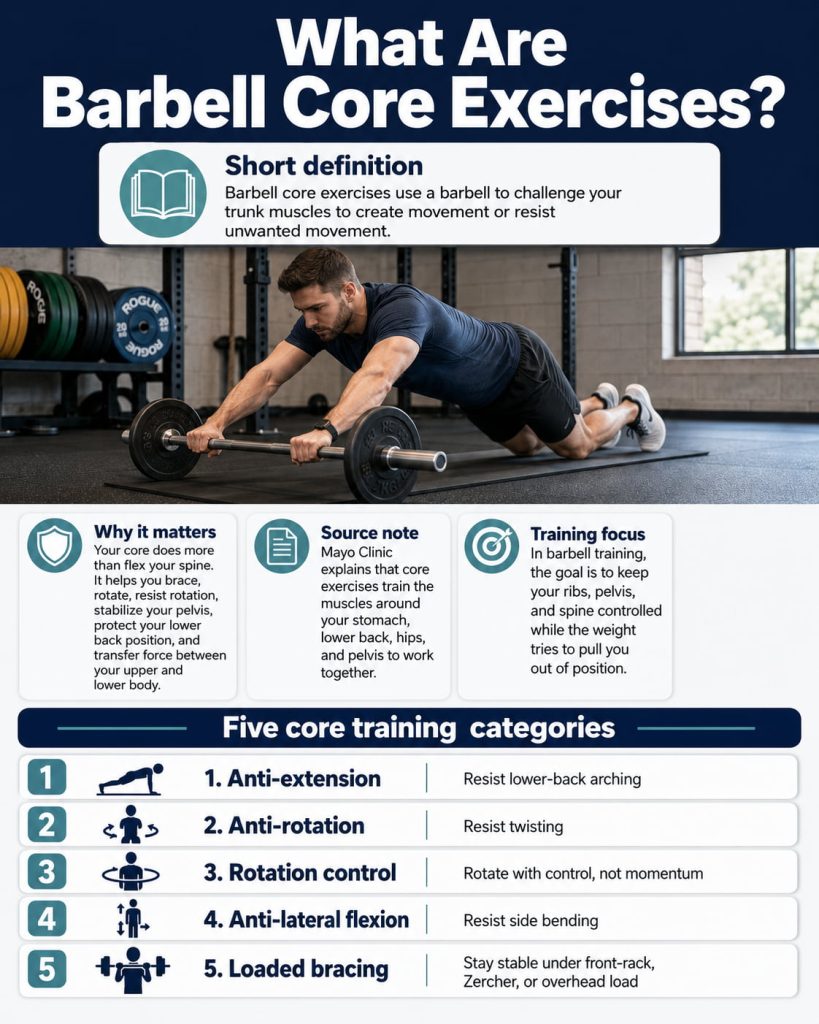
Barbell core exercises are movements that use a barbell to challenge your trunk muscles to either create movement or resist unwanted movement.
That matters because your core does more than flex your spine. It helps you brace, rotate, resist rotation, stabilize your pelvis, protect your lower back position, and transfer force between your upper and lower body.
The Mayo Clinic explains that core exercises train the muscles around your stomach, lower back, hips, and pelvis to work together. In barbell training, that usually means learning to keep your ribs, pelvis, and spine controlled while the weight tries to pull you out of position.
Good barbell core training usually fits into five categories:
- Anti-extension: resisting your lower back from arching
- Anti-rotation: resisting twisting
- Rotation control: rotating with control instead of momentum
- Anti-lateral flexion: resisting side bending
- Loaded bracing: staying stable under front-rack, Zercher, or overhead load
Muscles Worked by Barbell Core Exercises
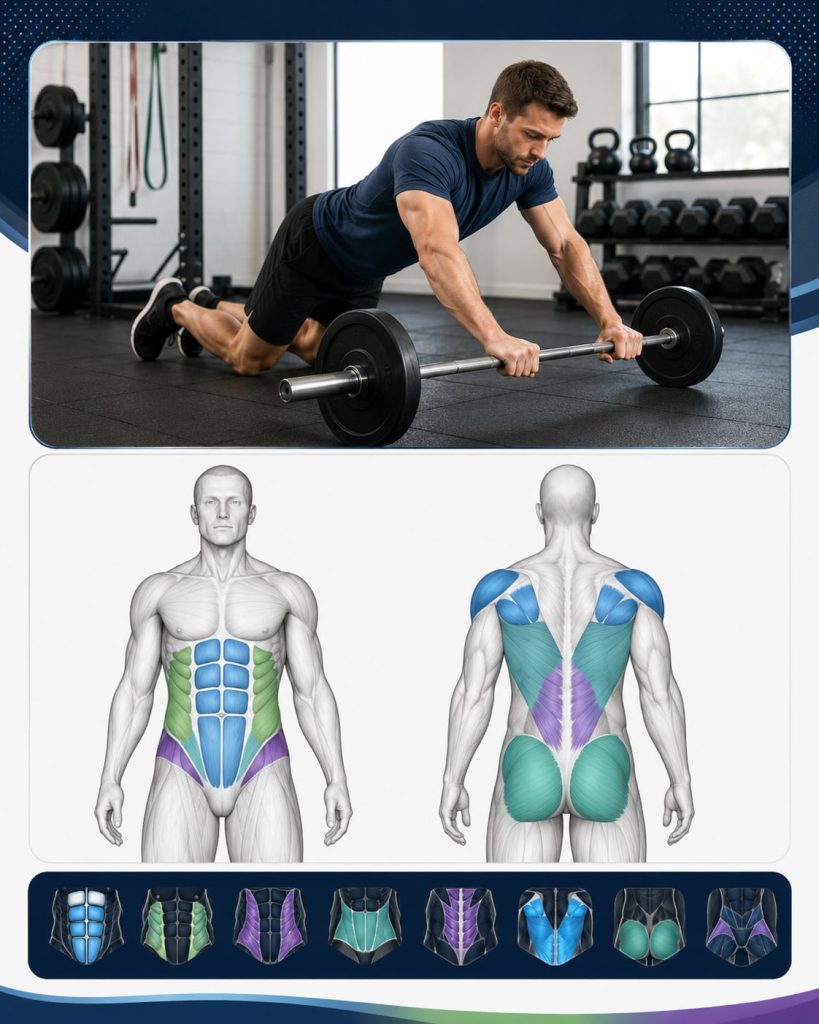
Barbell core exercises train more than just the visible “six-pack” muscle.
The main muscles involved include:
- Rectus abdominis: the front abdominal muscle that helps flex the trunk and resist extension
- External obliques: side abdominal muscles that help rotate and resist rotation
- Internal obliques: deeper side abdominal muscles that help with rotation, bracing, and trunk control
- Transverse abdominis: a deep abdominal muscle that helps create trunk stiffness
- Erector spinae: back muscles that help maintain spinal position
- Lats, shoulders, glutes, and hips: support many barbell core exercises, especially rollouts, landmine drills, and carries
The Cleveland Clinic identifies the rectus abdominis, internal obliques, external obliques, and transverse abdominis as key abdominal muscles that work with the back muscles to help keep the body stable and balanced.
Benefits of Barbell Core Exercises
Barbell core exercises are useful because they are easy to load, simple to progress, and carry over well to strength training.
1. They Build Stronger Bracing
Squats, deadlifts, presses, rows, and carries all require a strong brace. Barbell core exercises teach your trunk to stay stable while your arms, shoulders, hips, or legs move.
2. They Train the Core in Multiple Directions
Good core training is not just crunching forward. Barbell rollouts, landmine presses, Zercher carries, and overhead holds train your core to resist extension, rotation, and side bending.
3. They Are Easy to Progress
A barbell lets you progress with more range of motion, slower tempo, longer holds, or small weight increases. Control should come first, and load should come last.
4. They Carry Over to Bigger Lifts
A stronger, more controlled trunk may help you keep better positions during squats, deadlifts, overhead presses, cleans, and rows.
How to Choose the Right Barbell Core Exercise
Choose the exercise based on what you need most.
If you are a beginner, start with landmine anchored dead bugs, front-rack holds, or short-range rollouts. If you are intermediate, use landmine anti-rotation presses, Zercher holds, and controlled rollouts. If you are advanced, add longer rollouts, landmine rainbows, loaded carries, and overhead holds.
Use this simple guide:
| Goal | Best Barbell Core Exercise |
|---|---|
| Build anti-extension strength | Barbell rollout |
| Train obliques without twisting fast | Landmine anti-rotation press |
| Improve controlled rotation | Landmine rainbow |
| Start beginner-friendly core work | Landmine anchored dead bug |
| Improve bracing for squats | Barbell front rack march |
| Build loaded trunk strength | Zercher carry or hold |
| Improve overhead stability | Barbell overhead hold or carry |
7 Best Barbell Core Exercises for Abs, Obliques, and Control
The best barbell core exercises challenge your trunk without forcing sloppy movement. Start light, move slowly, and treat every rep like skill practice.
1. Barbell Rollout
Best for: Anti-extension strength, deep core control, and advanced ab training
Muscles worked: Rectus abdominis, transverse abdominis, obliques, lats, shoulders, glutes
Equipment needed: Barbell and round plates
Why It Stands Out
The barbell rollout is one of the most direct barbell core exercises for training anti-extension. As the bar rolls forward, your abs must work hard to stop your lower back from sagging.
The ACE Fitness exercise library lists the rollout as an advanced abdominal exercise, which is a good reminder that this move should be earned gradually.
Suggested Sets, Reps, and Rest
- Beginner: 2–3 sets of 5–8 short-range reps
- Intermediate: 3 sets of 8–10 reps
- Advanced: 3–4 sets of 8–12 controlled reps
- Rest: 60–90 seconds
Use a slow tempo. A good starting point is 2–3 seconds rolling out, a brief pause, then a controlled return.
How to Do It
- Load a barbell with round plates that roll smoothly.
- Kneel on a mat with the bar in front of you.
- Grip the bar slightly wider than shoulder width.
- Brace your abs like you are about to take a light punch.
- Squeeze your glutes and keep your ribs pulled down.
- Roll the bar forward slowly.
- Go only as far as you can without your lower back dropping.
- Pull the bar back by driving your arms down and bringing your ribs and pelvis together.
- Reset before the next rep.
Common Mistakes
- Letting the lower back sag
- Rolling too far before you have control
- Bending the hips instead of keeping the trunk braced
- Rushing the return
- Holding your breath for too long
Coaching Cue
“Move long without letting your ribs flare.”
Variations, Progressions, and Regressions
Regression: Do a short-range rollout from your knees. Stop when you feel your lower back starting to arch.
Progression: Increase range of motion before adding weight. Then add a pause at the longest position.
Advanced progression: Use a slower eccentric or perform rollouts from a slightly farther kneeling setup.
How to Use It in a Workout
Place barbell rollouts near the end of a strength workout or after your main lifts. Avoid doing them before heavy squats or deadlifts if they fatigue your trunk too much.
2. Landmine Anti-Rotation Press
Best for: Obliques, anti-rotation, trunk stiffness, and shoulder-friendly pressing
Muscles worked: Obliques, transverse abdominis, rectus abdominis, shoulders, chest, glutes
Equipment needed: Barbell and landmine attachment or secure corner setup
Why It Stands Out
The landmine anti-rotation press trains your core to resist twisting while your arms press the bar away from your body. This is useful because many sports and lifts require the trunk to stay stable while force moves through the arms and hips.
A NASM core training guide explains that anti-rotation work and loaded carries can train the core to stay strong and stable, which fits the goal of this exercise.
Suggested Sets, Reps, and Rest
- Beginner: 2 sets of 8 reps per side
- Intermediate: 3 sets of 8–12 reps per side
- Advanced: 3–4 sets of 10–12 reps per side
- Rest: 45–75 seconds
Use a light load at first. The goal is control, not max weight.
How to Do It
- Set one end of the barbell in a landmine attachment.
- Stand perpendicular to the bar with your feet about shoulder width.
- Hold the sleeve end of the bar with both hands near your chest.
- Brace your abs and squeeze your glutes lightly.
- Press the bar forward and slightly upward.
- Keep your hips and ribs square.
- Pause when your arms are extended.
- Pull the bar back to your chest under control.
- Complete all reps, then switch sides.
Common Mistakes
- Letting the torso rotate with the bar
- Shifting weight from side to side
- Arching the lower back
- Pressing too fast
- Loading the bar too heavily
Coaching Cue
“Press the bar away, but keep your belt buckle and chest facing forward.”
Variations, Progressions, and Regressions
Regression: Use an empty bar and a shorter press range.
Progression: Move your feet closer together to make balance harder.
Advanced progression: Perform the movement from a half-kneeling position to reduce lower-body compensation.
How to Use It in a Workout
Use this as a core accessory after upper-body or lower-body strength work. It pairs well with squats, presses, rows, and carries.
3. Landmine Rainbow
Best for: Controlled rotation, obliques, athletic core training, and trunk coordination
Muscles worked: Obliques, rectus abdominis, transverse abdominis, shoulders, lats, hips
Equipment needed: Barbell and landmine attachment
Why It Stands Out
The landmine rainbow trains your core through a controlled side-to-side arc. Unlike fast twisting drills, this exercise teaches you to rotate and resist rotation with tension.
The ACE Fitness landmine training guide explains that landmine training uses a barbell anchored at one end and can support rotational strength and anti-rotational stability when performed with good technique.
Suggested Sets, Reps, and Rest
- Beginner: 2 sets of 6 reps per side with an empty bar
- Intermediate: 3 sets of 8 reps per side
- Advanced: 3–4 sets of 8–10 reps per side
- Rest: 60–90 seconds
Keep the reps smooth. Do not turn this into a speed exercise.
How to Do It
- Set one end of the barbell in a landmine attachment.
- Stand facing the bar with your feet shoulder width apart.
- Hold the end of the bar with both hands at chest or face height.
- Brace your core and keep your knees slightly bent.
- Move the bar in an arc toward one hip.
- Control the bottom position without collapsing your posture.
- Bring the bar up and over to the opposite side.
- Let your hips rotate slightly if needed, but keep the movement controlled.
- Continue side to side for the target reps.
Common Mistakes
- Swinging the bar with momentum
- Letting the lower back overextend
- Dropping the bar too low
- Using too much weight
- Twisting from the spine without hip control
Coaching Cue
“Draw a smooth rainbow, not a fast chop.”
Variations, Progressions, and Regressions
Regression: Use a smaller arc and keep the bar higher.
Progression: Increase the arc only when you can control both sides evenly.
Advanced progression: Add a light plate and slow the lowering phase.
How to Use It in a Workout
Use landmine rainbows after your main lift or during an accessory circuit. They work well on full-body, upper-body, or athletic conditioning days.
4. Landmine Anchored Dead Bug
Best for: Beginner-friendly anti-extension training and lower-back position control
Muscles worked: Transverse abdominis, rectus abdominis, obliques, hip flexors, lats
Equipment needed: Barbell and landmine attachment
Why It Stands Out
The landmine anchored dead bug gives beginners a better way to feel core tension. Holding the bar helps anchor your upper body while your legs move. That makes it easier to focus on keeping your ribs down and your pelvis controlled.
This is a smart starting point before harder moves like rollouts.
Suggested Sets, Reps, and Rest
- Beginner: 2–3 sets of 6–8 reps per side
- Intermediate: 3 sets of 8–10 reps per side
- Advanced: 3 sets of 10–12 slow reps per side
- Rest: 45–75 seconds
Use slow reps and full exhales.
How to Do It
- Set a barbell in a landmine attachment.
- Lie on your back with your head near the sleeve end of the bar.
- Hold the bar with both hands above your chest.
- Bring your knees over your hips.
- Brace your abs and gently press your lower back toward the floor.
- Extend one leg slowly toward the floor.
- Stop before your back arches.
- Bring the leg back to the starting position.
- Repeat on the other side.
Common Mistakes
- Letting the lower back lift off the floor
- Moving the leg too fast
- Reaching too far before you have control
- Shrugging the shoulders
- Forgetting to breathe
Coaching Cue
“Exhale, lock the ribs down, then move the leg.”
Variations, Progressions, and Regressions
Regression: Do a bodyweight dead bug without the bar.
Progression: Extend the leg lower and farther away.
Advanced progression: Add a longer pause with the leg extended.
How to Use It in a Workout
Use this in your warm-up before squats, deadlifts, or overhead presses. It is also useful on recovery or technique-focused training days.
5. Barbell Front Rack March
Best for: Bracing, posture, anti-extension, and squat carryover
Muscles worked: Rectus abdominis, obliques, transverse abdominis, upper back, quads, glutes
Equipment needed: Barbell and rack
Why It Stands Out
The barbell front rack march trains your core to stay tall under a front-loaded barbell. The weight sits in front of your body, so your abs and upper back have to work together to prevent you from leaning backward or folding forward.
This makes it useful for front squats, cleans, lunges, and general bracing practice.
Suggested Sets, Reps, and Rest
- Beginner: 2 sets of 15–20 seconds
- Intermediate: 3 sets of 20–30 seconds
- Advanced: 3–4 sets of 30–45 seconds
- Rest: 60–90 seconds
Start with an empty bar or a very light load.
How to Do It
- Set a barbell in a rack at shoulder height.
- Step under the bar and place it in a front rack position.
- Keep your elbows high enough to support the bar.
- Unrack the bar and take one or two steps back.
- Brace your abs and stand tall.
- Slowly lift one knee without leaning back.
- Place the foot down softly.
- March with the opposite leg.
- Continue for time while keeping your ribs stacked over your pelvis.
Common Mistakes
- Leaning backward as the knee lifts
- Letting the elbows drop
- Holding the bar with the hands instead of supporting it on the shoulders
- Marching too fast
- Using a load that changes posture
Coaching Cue
“Stay tall like you are holding a front squat at the top.”
Variations, Progressions, and Regressions
Regression: Do a front rack hold without marching.
Progression: Add time before adding weight.
Advanced progression: Use a slow march with a 1–2 second pause at the top of each knee lift.
How to Use It in a Workout
Use front rack marches after squats or as part of a core finisher. They are also useful as a warm-up drill for lifters practicing front rack position.
6. Zercher Carry or Zercher Hold
Best for: Loaded bracing, full-trunk strength, and anti-flexion control
Muscles worked: Abs, obliques, upper back, biceps, forearms, glutes, quads
Equipment needed: Barbell, rack, and optional bar pad or towel
Why It Stands Out
The Zercher position places the bar in the crooks of your elbows. Because the weight sits in front of your torso, your core has to work hard to keep you from rounding forward or losing posture.
This is one of the most practical barbell core exercises for building strong bracing under load.
Suggested Sets, Reps, and Rest
For holds:
- Beginner: 2–3 sets of 15–20 seconds
- Intermediate: 3 sets of 20–30 seconds
- Advanced: 3–4 sets of 30–45 seconds
For carries:
- Beginner: 2–3 sets of 20–30 feet
- Intermediate: 3 sets of 30–50 feet
- Advanced: 3–4 sets of 50–80 feet
Rest: 60–120 seconds
How to Do It
- Set a barbell in a rack around lower-chest or upper-ab height.
- Place the bar in the crooks of your elbows.
- Clasp your hands together or keep your forearms angled upward.
- Brace your abs before lifting the bar.
- Stand tall and step back from the rack.
- For a hold, stay still and breathe behind the brace.
- For a carry, walk slowly with short, controlled steps.
- Keep your ribs down and your upper back active.
- Re-rack the bar carefully.
Common Mistakes
- Rounding the upper back too much
- Letting the bar pull the torso forward
- Taking rushed, uneven steps
- Starting too heavy
- Holding your breath for the entire set
Coaching Cue
“Brace first, then move.”
Variations, Progressions, and Regressions
Regression: Zercher hold from the rack.
Progression: Zercher carry for distance.
Advanced progression: Add a pause every few steps while keeping your posture unchanged.
How to Use It in a Workout
Use Zercher carries near the end of a lower-body or full-body workout. They are demanding, so avoid placing them before heavy technical lifts.
7. Barbell Overhead Hold or Carry
Best for: Anti-extension, overhead stability, shoulder control, and full-body tension
Muscles worked: Rectus abdominis, obliques, transverse abdominis, shoulders, traps, upper back, glutes
Equipment needed: Barbell, rack, and open space if carrying
Why It Stands Out
The barbell overhead hold trains your core to keep your ribs down while the bar is stacked overhead. If your abs and glutes relax, your lower back may arch and your rib cage may flare.
This exercise is useful for overhead pressing, Olympic lifting variations, and general trunk control.
Suggested Sets, Reps, and Rest
For holds:
- Beginner: 2 sets of 10–20 seconds with an empty bar
- Intermediate: 3 sets of 20–30 seconds
- Advanced: 3–4 sets of 30–45 seconds
For carries:
- Intermediate: 3 sets of 20–40 feet
- Advanced: 3–4 sets of 40–80 feet
Rest: 60–120 seconds
How to Do It
- Set a barbell in a rack around shoulder height.
- Grip the bar slightly wider than shoulder width.
- Press or jerk the bar overhead safely.
- Lock your elbows and stack the bar over your midfoot.
- Brace your abs and squeeze your glutes.
- Keep your ribs down without slouching.
- Hold for time or walk slowly with controlled steps.
- Lower or re-rack the bar with control.
Common Mistakes
- Arching the lower back
- Letting the bar drift forward
- Flaring the ribs
- Using too much weight
- Walking too fast during carries
Coaching Cue
“Stack the bar, ribs, pelvis, and feet.”
Variations, Progressions, and Regressions
Regression: Empty bar overhead hold.
Progression: Longer holds before adding weight.
Advanced progression: Overhead carry with slow steps and steady breathing.
How to Use It in a Workout
Use overhead holds after pressing work or on full-body training days. Avoid them if your shoulders are too fatigued to keep the bar stacked safely.
Sample Barbell Core Workout
You do not need to do all seven exercises in one session. Pick 2–4 movements that train different core functions.
Beginner Barbell Core Workout
Use this 2 times per week after your main strength work.
| Exercise | Sets | Reps or Time | Rest |
|---|---|---|---|
| Landmine Anchored Dead Bug | 2–3 | 6–8 reps per side | 45–60 sec |
| Landmine Anti-Rotation Press | 2–3 | 8 reps per side | 45–60 sec |
| Front Rack Hold | 2 | 15–25 sec | 60 sec |
Effort level: Keep 2–4 reps in reserve. Stop each set before your position breaks.
Progression: Add reps first, then time, then light load.
Intermediate Barbell Core Workout
Use this 2–3 times per week.
| Exercise | Sets | Reps or Time | Rest |
|---|---|---|---|
| Barbell Rollout | 3 | 6–10 reps | 60–90 sec |
| Landmine Rainbow | 3 | 6–8 reps per side | 60–90 sec |
| Zercher Carry | 3 | 30–50 feet | 90 sec |
Effort level: Keep 1–3 reps in reserve. Every rep should look controlled.
Progression: Increase range of motion or control before adding load.
Advanced Barbell Core Finisher
Use this once or twice per week after your main lifts.
| Exercise | Sets | Reps or Time | Rest |
|---|---|---|---|
| Barbell Rollout with Pause | 3–4 | 8–12 reps | 75–90 sec |
| Half-Kneeling Landmine Anti-Rotation Press | 3 | 8–10 reps per side | 60–75 sec |
| Barbell Overhead Carry | 3 | 40–80 feet | 90–120 sec |
Effort level: Hard but clean. Do not grind through sloppy reps.
Progression: Add small weight jumps only when you can keep the same posture, tempo, and range.
How Often Should You Do Barbell Core Exercises?
Most lifters can train barbell core exercises 2–3 times per week.
You can add them after your main workout or use them as part of a short accessory circuit. Since many barbell core exercises also challenge your shoulders, grip, hips, and back, treat them like real strength work instead of random ab finishers.
A simple weekly setup could look like this:
- Day 1: Anti-extension focus, such as rollouts
- Day 2: Anti-rotation focus, such as landmine presses
- Day 3: Loaded bracing focus, such as Zercher carries or front rack marches
You do not need maximum effort core work every day. Quality matters more than volume.
The ACSM emphasizes consistency, individualization, and appropriate loading in resistance training, which supports using flexible programming instead of forcing one rigid core routine for everyone.
Common Mistakes With Barbell Core Training
Going Too Heavy Too Soon
Barbell core exercises can be loaded, but that does not mean they should be heavy right away.
Start with an empty bar, short range of motion, or lighter landmine setup. Add difficulty only when your trunk position stays solid.
Treating Every Core Exercise Like an Ab Burnout
Feeling your abs work is fine, but the goal is not just fatigue. The goal is control.
Your reps should teach you to brace, breathe, and maintain position.
Letting the Lower Back Take Over
If your lower back is doing most of the work during rollouts, overhead holds, or landmine drills, reduce the range or load.
Good core work should feel challenging through the abs and obliques without sharp pain or uncontrolled spinal movement.
Moving Too Fast
Fast reps hide weak positions.
Slow down. Pause. Own the hardest part of the exercise.
Ignoring Breathing
You need to brace, but you also need to breathe. For longer holds and carries, use small controlled breaths while keeping your trunk tight.
Safety Tips for Barbell Core Exercises
Barbell core exercises are effective, but they require control.
Follow these guidelines:
- Start with an empty bar or light load.
- Learn the movement before adding plates.
- Keep your spine controlled instead of forcing range.
- Stop the set when your form breaks.
- Avoid heavy loaded twisting if you cannot control the bar path.
- Do not push through sharp pain, numbness, dizziness, chest pain, or unusual symptoms.
- Get professional guidance if you have a current back, shoulder, hip, abdominal, or pelvic injury.
Core training should challenge your muscles, not force your joints into painful positions.
FAQ
Are barbell core exercises good for abs?
Yes. Barbell core exercises can train the abs effectively, especially when the exercise challenges your trunk to resist extension, rotation, or side bending. Rollouts, landmine presses, and front-loaded carries are strong examples.
What is the best barbell core exercise?
The barbell rollout is one of the best direct barbell core exercises for anti-extension strength. However, the best exercise depends on your goal. For obliques, landmine anti-rotation presses and landmine rainbows are excellent. For bracing, Zercher carries and front rack marches are better choices.
Can beginners do barbell core exercises?
Yes, but beginners should choose controlled options first. Landmine anchored dead bugs, front rack holds, short-range rollouts, and light landmine anti-rotation presses are better starting points than heavy rollouts or loaded rotational drills.
Do squats and deadlifts train your core enough?
Squats and deadlifts train the core because your trunk must brace under load. However, direct barbell core exercises can still be useful because they target specific functions such as anti-rotation, anti-extension, and loaded carries.
How many barbell core exercises should I do per workout?
Most people only need 2–4 core exercises per session. A good workout might include one anti-extension exercise, one anti-rotation exercise, and one loaded carry or hold.
Should I do barbell core exercises before or after lifting?
Do them after your main lifts in most cases. Hard core work before heavy squats, deadlifts, or overhead presses may fatigue your trunk and reduce lifting quality. Light activation drills, such as dead bugs, can be used during warm-ups.
Are barbell rollouts bad for your lower back?
Barbell rollouts are not automatically bad, but they are advanced. They can irritate your lower back if you roll too far, lose your brace, or let your hips and ribs drop out of position. Start with short-range kneeling rollouts and progress slowly.
Conclusion
Barbell core exercises are best used to train control, not just fatigue. Rollouts build anti-extension strength, landmine drills train the obliques, and carries or holds teach full-body bracing under load.
Start with the variation you can control, use clean reps, and progress gradually. A strong core is built by owning positions before chasing heavier weight.
This content is for informational purposes only and is not a substitute for professional medical advice.