The landmine row is a barbell rowing exercise that builds the lats, upper back, rear delts, arms, grip, and core stability using a fixed angled bar path. It is a strong choice for lifters who want a back exercise that can be loaded heavily while still feeling more guided than a traditional bent-over barbell row.
In this guide, you will learn how to do the landmine row with proper form, which muscles it works, the main benefits, common mistakes, useful variations, and how to add it to a back or pull workout.
What Is the Landmine Row?
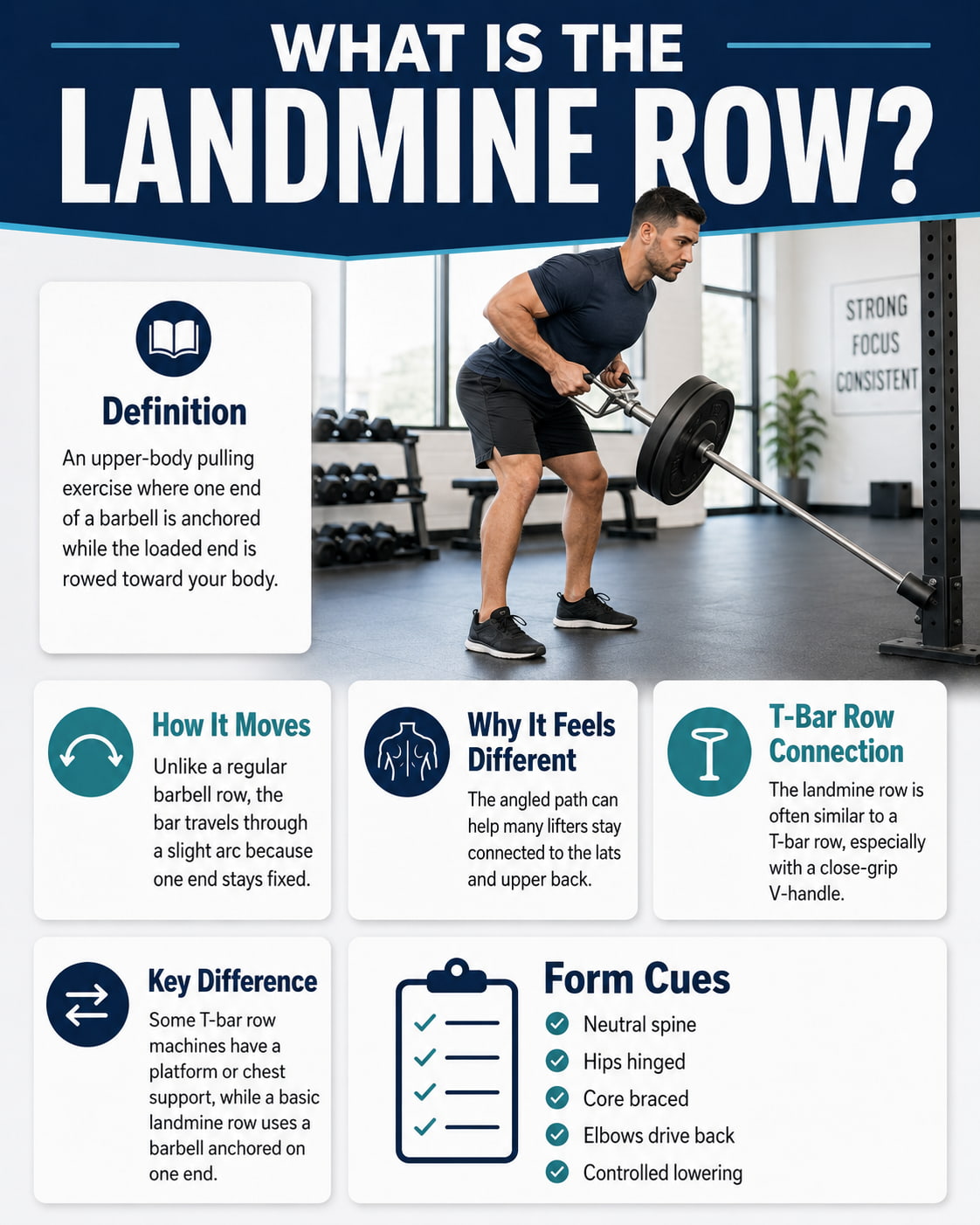
The landmine row is an upper-body pulling exercise where one end of a barbell is anchored in a landmine attachment or secure corner while the loaded end is rowed toward your body.
Unlike a regular barbell row, the bar does not travel straight up and down. It moves through a slight arc because one end of the bar stays fixed. This angled path gives the movement a different feel and can make it easier for many lifters to stay connected to their lats and upper back.
The landmine row is often grouped with the T-bar row. They are very similar, especially when you use a close-grip V-handle under the bar sleeve. The main difference is that some T-bar row machines have a built-in platform or chest support, while a basic landmine row uses a barbell anchored on one end.
Landmine Row Exercise Overview
Best for: The landmine row is best for building back strength, training the lats and upper back, improving pulling mechanics, and adding a heavy row variation to a pull day or upper-body workout.
Muscles worked: The main muscles worked are the latissimus dorsi, rhomboids, middle and lower traps, rear delts, teres major, biceps, brachialis, brachioradialis, forearms, spinal erectors, obliques, glutes, and hamstrings.
Equipment needed: You need a barbell, weight plates, and a landmine attachment. A close-grip V-handle is optional but very useful. If you do not have a landmine attachment, use a secure corner setup only if the bar is stable and the surface will not be damaged.
Why it stands out: The landmine row lets you train a strong rowing pattern with a fixed angled path. It can be easier to control than a free barbell row, and it gives you multiple grip options for changing the focus between the lats, upper back, and rear delts.
Suggested sets and reps: Use 3 to 4 sets of 8 to 12 reps for muscle growth. Use 3 to 5 sets of 4 to 8 reps for strength. Use 2 to 3 sets of 12 to 15 reps when learning the movement or using it as an accessory exercise.
Beginners: Start with 2 to 3 sets of 8 to 12 reps using a light load. Focus on keeping your torso still, spine neutral, and reps controlled. Stop the set before your lower back or arms take over.
Intermediate: Use 3 to 4 sets of 8 to 12 reps with 1 to 3 reps in reserve. Add load only when you can keep the same torso angle and pull with your back instead of jerking the bar.
Advanced: Use heavier sets of 4 to 8 reps, single-arm variations, Meadows rows, tempo reps, or pauses at the top. Keep the movement strict enough that the target muscles still do the work.
Rest: Rest 60 to 90 seconds for moderate hypertrophy sets, 90 to 120 seconds for heavier sets, and up to 3 minutes when using low reps with heavier loading.
How to do it:
- Anchor one end of a barbell in a landmine attachment or secure corner.
- Load the free end of the barbell with a manageable weight.
- Stand over the bar with the loaded end in front of you.
- Place a close-grip handle under the bar sleeve or grip the bar directly, depending on your variation.
- Hinge at your hips, bend your knees slightly, and keep your spine neutral.
- Brace your core and let your arms reach down toward the bar.
- Pull the handle toward your lower chest, upper stomach, or belly button.
- Drive your elbows back instead of curling the weight with your hands.
- Squeeze your upper back at the top without shrugging your shoulders.
- Lower the bar slowly until your arms are straight again.
- Repeat while keeping your torso angle stable.
Common mistakes: The most common mistakes are rounding the lower back, standing too upright, using momentum, shrugging the shoulders, pulling with the arms only, loading the bar too heavily, and letting the plates hit the floor before the back reaches a full stretch.
Expert tip: Think “elbows toward hips” if you want more lat focus. Think “elbows out and shoulder blades back” if you want more upper-back and rear-delt focus.
Exercise variations: Useful variations include the close-grip landmine row, landmine T-bar row, single-arm landmine row, Meadows row, wide-grip landmine row, and band-resisted landmine row.
Easier variation: A chest-supported row, seated cable row, or one-arm dumbbell row can be easier if holding the hip-hinge position is the limiting factor.
Harder variation: A Meadows row, pause landmine row, slow-eccentric landmine row, or heavy low-rep landmine row can make the exercise more challenging.
Landmine Row Muscles Worked
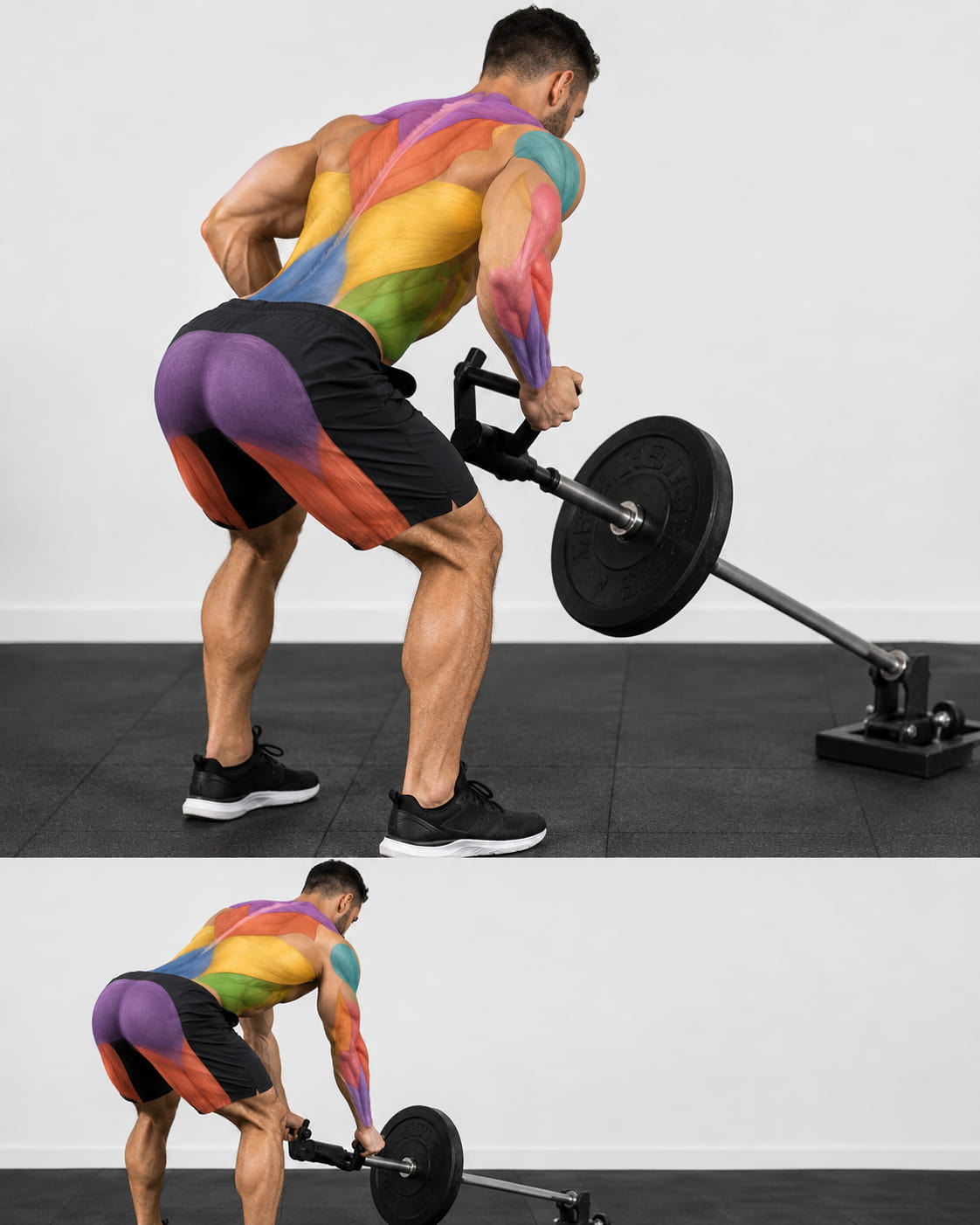
The landmine row is a compound pulling exercise. It trains the muscles that pull the upper arm back, retract the shoulder blades, bend the elbows, grip the handle, and stabilize the trunk.
Latissimus Dorsi
The lats are large back muscles that help pull your upper arms down and back. A close neutral grip with your elbows tucked closer to your sides usually places more emphasis on the lats.
To feel the lats more, pull the handle toward your lower ribs or upper stomach and keep your elbows from flaring too wide.
Rhomboids and Trapezius
The rhomboids and traps help pull your shoulder blades back and control the top of the row. These muscles are especially active when you squeeze your shoulder blades together without over-shrugging.
A wider grip or elbow-out row usually shifts more attention toward the mid-back, upper back, and rear delts.
Rear Delts and Teres Major
The rear delts help move the arms behind the body, while the teres major assists the lats during shoulder extension. These muscles are important for a strong, balanced pulling pattern.
If you want more rear-delt emphasis, use a wider grip and pull slightly higher while keeping the movement controlled.
Biceps, Brachialis, and Forearms
Your biceps and other elbow flexors help bend the elbows during the row. Your forearms and grip muscles work hard to hold the handle or bar.
Your arms assist the movement, but they should not dominate it. If your biceps fatigue before your back, reduce the weight and focus on driving through your elbows.
Core, Spinal Erectors, Glutes, and Hamstrings
The landmine row also trains the body position needed to hold a strong hip hinge. Your spinal erectors, obliques, glutes, and hamstrings help keep your torso stable while your upper body rows the weight.
These muscles are stabilizers, not the main target. If your lower back feels like it is doing most of the work, the load may be too heavy or your hinge position may need practice.
Benefits of the Landmine Row
Builds a Stronger Back
The landmine row trains the lats, traps, rhomboids, rear delts, and arms in one movement. This makes it useful for back-focused training, pull days, upper-body workouts, and general strength programs.
It is especially helpful when you want a row that can be loaded heavier than many dumbbell variations while still allowing a controlled pulling path.
Offers a More Guided Rowing Path
Because one end of the barbell stays fixed, the landmine row follows a natural angled path. This does not make the exercise automatic or risk-free, but it can help some lifters control the movement better than a traditional bent-over barbell row.
The guided path also makes it easier to repeat the same groove from rep to rep.
Works Well for Different Goals
The landmine row can be trained for strength, muscle growth, or higher-rep back volume.
For strength, use heavier sets of 4 to 8 reps. For muscle growth, use moderate sets of 8 to 15 reps. For back volume or a finisher, use lighter sets of 12 to 20 reps with strict form.
Easy to Modify With Grip Changes
Grip choice changes the feel of the exercise. A close neutral grip usually feels more lat-focused. A wide grip or T-bar handle often shifts more work toward the upper back, traps, rhomboids, and rear delts.
This makes the landmine row useful for different training needs without changing the entire exercise.
Useful for Pulling Balance
Many lifters do plenty of pressing but not enough rowing. Adding landmine rows can help build stronger pulling muscles around the upper back and shoulders.
That does not mean the exercise fixes posture or treats shoulder problems. It simply gives you a strong way to train the muscles that support pulling, scapular control, and upper-body strength.
How to Set Up the Landmine Row Safely
A landmine attachment is the best setup because it keeps the barbell anchored and allows it to move smoothly. Many gyms have landmine attachments connected to racks, platforms, or freestanding bases.
If you use a corner setup, make sure the bar is secure and the surface is stable. Do not wedge the bar into weak drywall, fragile flooring, or any setup where the bar can slip.
Use smaller plates when possible. Large plates can reduce your range of motion because they hit your body or the floor sooner. Smaller plates let you pull through a cleaner path and often make the exercise feel better.
A close-grip V-handle is the most common handle option. Place it under the bar sleeve, close to the loaded plates, then grip both handles evenly.
Common Landmine Row Mistakes
| Mistake | Why It Matters | How to Fix It |
|---|---|---|
| Rounding the lower back | It shifts stress away from the target muscles and makes the hinge harder to control. | Hinge from the hips, brace your abs, and keep your ribs and pelvis controlled. |
| Using too much momentum | It turns the row into a body swing instead of a back exercise. | Pause briefly at the bottom and pull each rep with control. |
| Shrugging at the top | It can make the upper traps dominate the movement. | Keep your neck long and pull your elbows back without lifting your shoulders toward your ears. |
| Pulling with the arms only | It reduces lat and upper-back involvement. | Think about driving your elbows back and moving the shoulder blades. |
| Standing too upright | It shortens the range of motion and changes the exercise into a partial high pull. | Hinge until your torso is angled forward and your arms can reach the bar naturally. |
| Going too heavy too soon | Heavy loading can break down your hinge and make reps sloppy. | Build from clean sets of 8 to 12 before adding more weight. |
| Twisting during single-arm rows | Rotation can reduce control and shift the target away from the back. | Brace your core and keep your chest and hips square. |
Landmine Row Variations and Progressions
Close-Grip Landmine Row
The close-grip landmine row is the most common version. You use a V-handle and pull with both hands. This variation is beginner-friendly, stable, and effective for training the lats and mid-back.
Use this version first if you are new to landmine rows.
Landmine T-Bar Row
The landmine T-bar row is similar to the close-grip version but may use a wider T-bar handle. A wider grip places more emphasis on the rhomboids, traps, rear delts, and upper back.
This is a good option when your goal is upper-back thickness and stronger shoulder-blade retraction.
Single-Arm Landmine Row
The single-arm landmine row lets you train one side at a time. It can increase range of motion and help you notice side-to-side strength differences.
You can perform it with your free hand braced on your thigh, a bench, or your hip. Keep your torso from rotating as you row.
Meadows Row
The Meadows row is a single-arm landmine row variation where you stand beside the bar and grip the thick end of the sleeve. It usually hits the upper back, rear delts, and lats hard because of the angled pull.
Start light. The thick grip and longer lever can make this variation more challenging than it looks.
Wide-Grip Landmine Row
The wide-grip version shifts the exercise toward the upper back and rear delts. It is useful if close-grip rows feel too lat-dominant or if you want more mid-back work.
Keep the elbows controlled and avoid turning the movement into a shrug.
Tempo Landmine Row
A tempo landmine row uses a slower lowering phase, such as 2 to 4 seconds down. This increases control and helps you keep tension on the target muscles.
This is a smart progression before adding heavier weight.
Landmine Row Regressions and Alternatives
If the landmine row feels awkward or your lower back fatigues before your back, choose a variation that gives more support.
A chest-supported row is a strong alternative because the bench supports your torso. This can help you focus on pulling without holding a hip hinge.
A seated cable row is another good option because it provides steady cable tension and a more upright position. It is useful for beginners who are still learning how to control the shoulder blades.
A one-arm dumbbell row works well when you want a simple unilateral row with the free hand and knee supported on a bench.
A machine row can also be useful when you want a stable setup, easier loading changes, and less demand on the lower back.
How to Program the Landmine Row
The landmine row fits best as a main row or secondary back exercise. Place it after your main pull-up, pulldown, deadlift, or heavy compound lift, depending on the goal of the workout.
| Goal | Sets and Reps | Rest | Effort |
|---|---|---|---|
| Beginner technique | 2 to 3 sets of 8 to 12 reps | 90 seconds | Stop with 2 to 4 reps in reserve |
| Muscle growth | 3 to 4 sets of 8 to 15 reps | 60 to 120 seconds | Stop with 1 to 3 reps in reserve |
| Strength | 3 to 5 sets of 4 to 8 reps | 2 to 3 minutes | Use heavy but clean reps |
| Back finisher | 2 to 3 sets of 12 to 20 reps | 45 to 75 seconds | Use lighter controlled reps |
Train the landmine row 1 to 2 times per week. If you train back twice per week, use one heavier landmine row day and one lighter or higher-rep row variation day.
Progress by adding reps first. For example, use the same weight until you can complete all sets at the top of your rep range with clean form. Then add a small amount of weight and repeat the process.
Sample Landmine Row Workout
Beginner Back Workout
| Exercise | Sets | Reps | Rest |
|---|---|---|---|
| Lat pulldown | 3 | 8 to 12 | 90 seconds |
| Landmine row | 3 | 8 to 12 | 90 seconds |
| Chest-supported dumbbell row | 2 | 10 to 12 | 75 seconds |
| Face pull | 2 | 12 to 15 | 60 seconds |
Use this workout once per week at first. Keep the landmine row smooth and stop each set before form breaks down.
Intermediate Pull Workout
| Exercise | Sets | Reps | Rest |
|---|---|---|---|
| Pull-up or assisted pull-up | 3 | 6 to 10 | 2 minutes |
| Landmine row | 4 | 8 to 12 | 90 to 120 seconds |
| Single-arm cable row | 3 | 10 to 12 each side | 75 seconds |
| Rear-delt fly | 3 | 12 to 15 | 60 seconds |
| Dumbbell curl | 2 to 3 | 10 to 12 | 60 seconds |
Use 1 to 3 reps in reserve on most sets. Add load only when the landmine row stays controlled from the first rep to the last rep.
Advanced Back Strength Option
| Exercise | Sets | Reps | Rest |
|---|---|---|---|
| Heavy landmine row | 5 | 4 to 6 | 2 to 3 minutes |
| Meadows row | 3 | 8 to 10 each side | 90 seconds |
| Chest-supported row | 3 | 8 to 12 | 90 seconds |
| Cable pullover | 2 to 3 | 12 to 15 | 60 seconds |
Use this only if your hinge, brace, and rowing form are already strong. Heavy sets should still look clean, not rushed.
Landmine Row vs Barbell Row vs Cable Row
| Exercise | Best For | Main Difference |
|---|---|---|
| Landmine row | Heavy back training with a guided angled path | One end of the bar stays fixed, creating a natural arc. |
| Barbell row | Free-weight strength and full-body tension | Requires more control because the bar is not anchored. |
| Cable row | Consistent cable tension and easier setup | Usually allows a more upright torso and smoother resistance. |
| Chest-supported row | Back training with less hip-hinge demand | The bench supports the torso so the lower back works less. |
The landmine row is not automatically better than every other row. It is simply a useful option when you want a strong barbell-based pull with more guidance than a free barbell row.
Safety Tips for the Landmine Row
Start lighter than you think you need. The landmine row can be loaded heavily, but the goal is not just to move plates. The goal is to row with your back while holding a stable hinge.
Keep your spine neutral, brace your core, and avoid twisting or jerking the weight. If your torso keeps rising during each rep, the load is probably too heavy.
Warm up with lighter sets before your working sets. A few controlled sets can help you find the right hinge angle, grip position, and bar path.
Stop the exercise and seek professional help if you feel sharp pain, numbness, dizziness, chest pain, or unusual symptoms.
FAQs About the Landmine Row
Is the landmine row the same as a T-bar row?
They are closely related. A landmine row often becomes a T-bar row when you use a close-grip or T-bar handle under the bar sleeve. Some T-bar row machines have chest support or a fixed platform, while a basic landmine row uses a barbell anchored at one end.
Is the landmine row good for lats?
Yes. The landmine row can train the lats well, especially when you use a close neutral grip and pull your elbows back toward your hips. A wider grip usually shifts more emphasis to the upper back and rear delts.
Should I use a close grip or wide grip?
Use a close grip if you want more lat focus and a stronger tucked-elbow row. Use a wider grip if you want more upper-back, rhomboid, trap, and rear-delt emphasis.
Can beginners do landmine rows?
Yes, beginners can do landmine rows if they start light and learn the hip hinge first. If the hinge position is difficult, a chest-supported row or seated cable row may be a better starting point.
How heavy should landmine rows be?
Use a weight that lets you complete all reps without rounding your back, shrugging, swinging, or losing your torso position. For most lifters, a good working set ends with 1 to 3 clean reps still available.
How often should I do landmine rows?
Most lifters can use landmine rows 1 to 2 times per week. If you already do several other rows, pulldowns, or pull-ups, keep the volume moderate and focus on quality reps.
Do landmine rows work the lower back?
The lower back helps stabilize your torso, but it should not be the main muscle you feel. If your lower back is doing most of the work, reduce the load, improve your hinge, or choose a chest-supported row.
Conclusion
The landmine row is a practical back exercise for building the lats, upper back, rear delts, arms, grip, and trunk stability. It works best when you set up the bar securely, hinge with control, pull through your elbows, and choose the grip that matches your goal.
Start with clean moderate reps, progress slowly, and use variations like the single-arm landmine row or Meadows row when you are ready for a harder challenge.
This content is for informational purposes only and is not a substitute for professional medical advice.