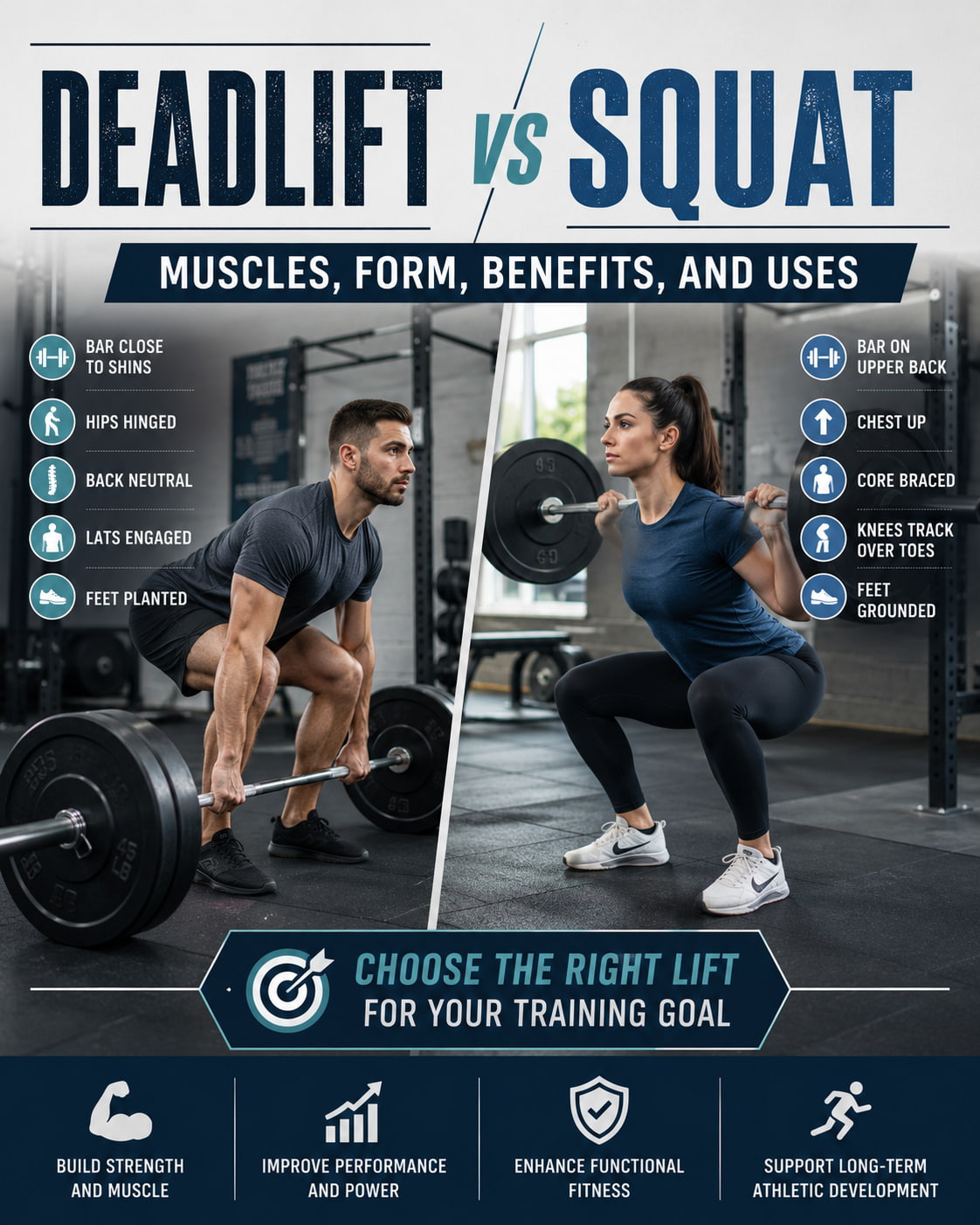
The main difference between the deadlift and squat is that the squat is usually more knee-dominant and quad-focused, while the deadlift is usually more hip-dominant and posterior-chain focused. Both are powerful compound lifts, but they train your lower body in different ways.
The squat teaches you to bend deeply through the hips, knees, and ankles while keeping your torso braced. The deadlift teaches you to hinge at the hips, keep the weight close, and lift from the floor with strong glutes, hamstrings, back, grip, and core control.
This guide breaks down Deadlift vs Squat for muscles worked, form, benefits, mistakes, variations, and how to use both lifts in a real workout routine.
Deadlift vs Squat Quick Comparison
| Category | Squat | Deadlift |
|---|---|---|
| Main movement pattern | Squat pattern | Hip hinge pattern |
| Primary emphasis | Quads, glutes, adductors | Glutes, hamstrings, back, grip |
| Starting position | Usually starts from standing | Usually starts from the floor |
| Bar position | On back, front rack, goblet, or hands | In hands, usually below hips |
| Main joint action | More knee bend | More hip hinge |
| Best for | Leg strength, quads, squat depth, lower-body muscle | Posterior chain, pulling strength, hip hinge, total-body strength |
| Beginner-friendly version | Bodyweight squat or goblet squat | Kettlebell deadlift or trap bar deadlift |
| Common mistake | Knees collapse, heels lift, torso loses position | Bar drifts away, back rounds, hips shoot up |
Deadlift vs Squat: Which One Is Better?
Neither lift is automatically better. The better choice depends on your goal.
Choose the squat if you want to build stronger quads, improve lower-body control, practice deep knee flexion, or train a more upright leg-dominant movement. Choose the deadlift if you want to build hip-hinge strength, stronger glutes and hamstrings, better pulling power, grip strength, and total-body tension.
For most lifters, the best answer is to train both. A well-built program can use squats for knee-dominant leg strength and deadlifts for hip-dominant posterior-chain strength. They complement each other when volume, load, and recovery are managed well.
What Is a Squat?
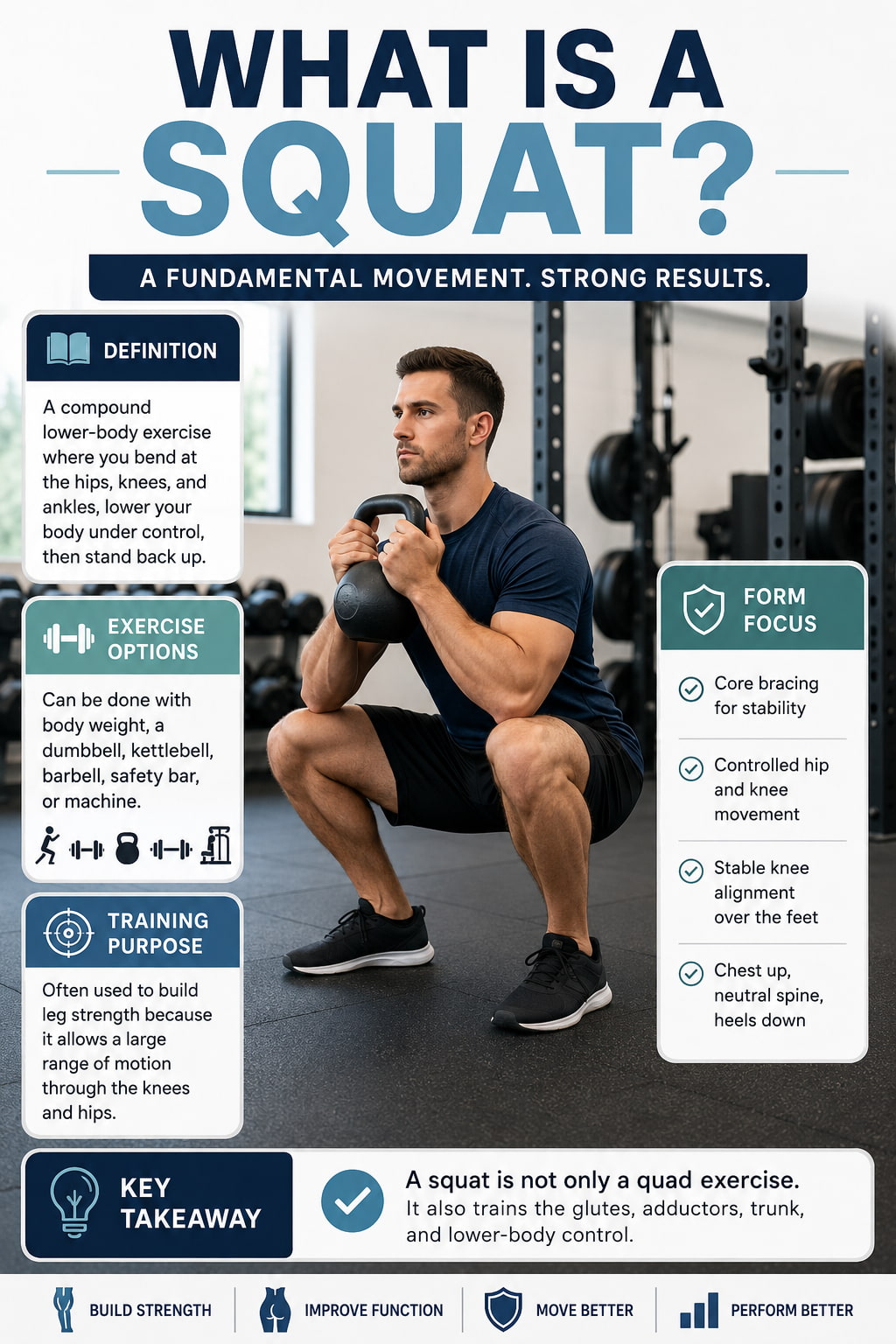
A squat is a compound lower-body exercise where you bend at the hips, knees, and ankles, lower your body under control, then stand back up. The movement can be done with body weight, a dumbbell, kettlebell, barbell, safety bar, or machine.
The squat is often used to build leg strength because it allows a large range of motion through the knees and hips. According to the ACE bodyweight squat guide, a good squat uses core bracing, controlled hip and knee movement, and stable knee alignment over the feet.
The squat is not only a “quad exercise,” but it often places more direct demand on the quadriceps than a standard deadlift because the knees bend more and the body moves through a deeper squat pattern.
What Is a Deadlift?
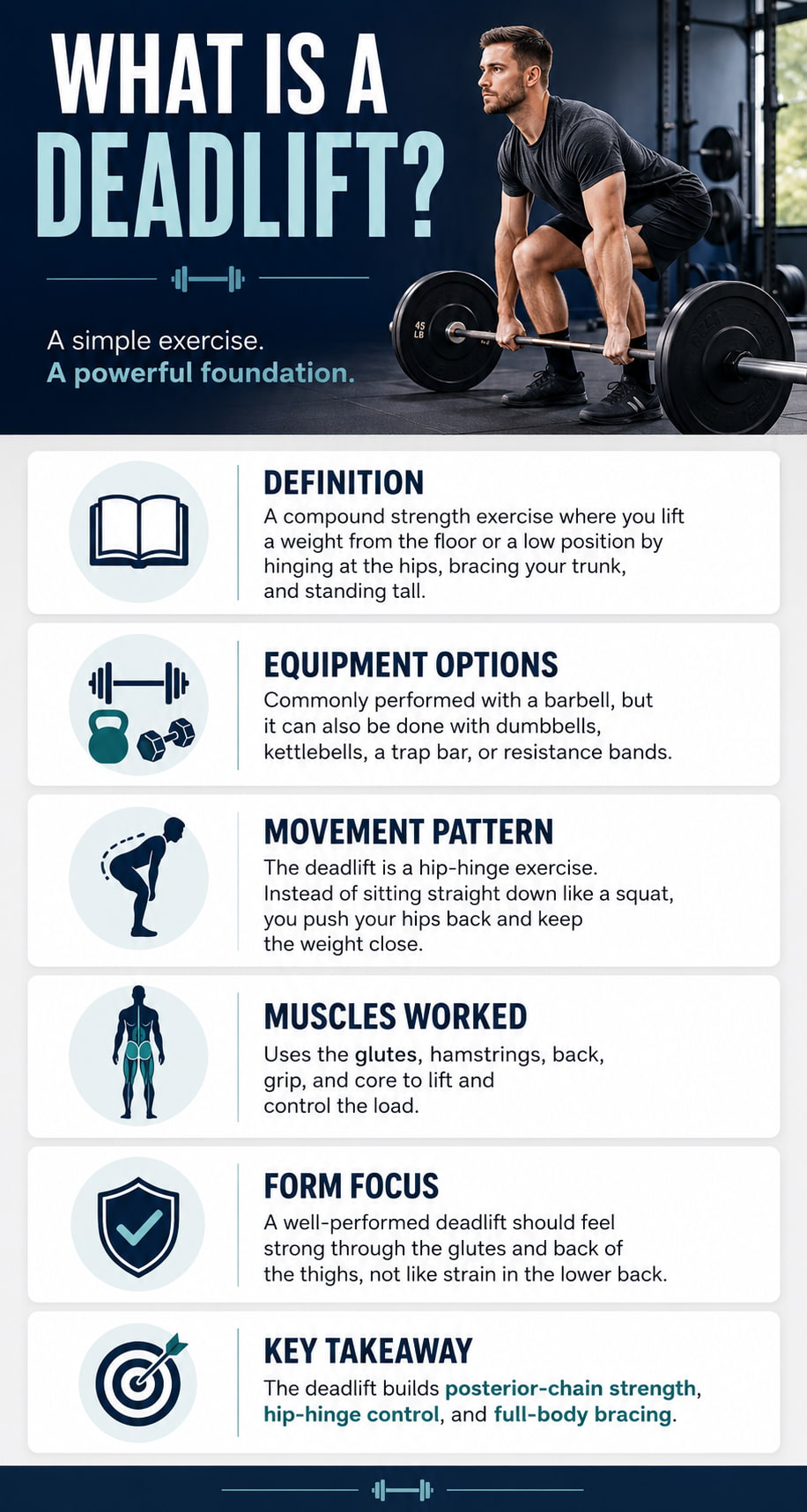
A deadlift is a compound strength exercise where you lift a weight from the floor or a low position by hinging at the hips, bracing your trunk, and standing tall. The most common version is the barbell deadlift, but you can also use dumbbells, kettlebells, a trap bar, or resistance bands.
The deadlift is a hip-hinge exercise. Instead of sitting straight down like a squat, you push your hips back, keep the weight close, and use the glutes, hamstrings, back, and core to lift the load.
The ACE deadlift guide notes that the movement should be felt mainly through the glutes and back of the thighs when performed well, not as strain in the lower back.
Muscles Worked in the Squat
The squat trains several lower-body and trunk muscles at once.
Quadriceps: The quads straighten the knees as you stand up. They work especially hard during deeper squat positions and more upright squat variations.
Glutes: The gluteus maximus helps extend the hips as you rise from the bottom. The glutes are strongly involved, especially when the squat is deep and controlled.
Adductors: The inner-thigh muscles help extend and stabilize the hips, especially during heavy squats and wider stances.
Hamstrings: The hamstrings assist with hip control, though they are usually not trained as directly as they are in hinge-based deadlift variations.
Calves: The calves help stabilize the ankle and support balance through the movement.
Core and spinal stabilizers: The abs, obliques, and spinal erectors help keep the torso stable under load.
NASM’s squat biomechanics article explains that the squat involves hip flexion, knee flexion, and ankle dorsiflexion on the way down, then hip extension, knee extension, and ankle plantarflexion on the way up. You can read more from NASM’s squat biomechanics guide.
Muscles Worked in the Deadlift
The deadlift is often called a full-body lift because many muscles work together to move and stabilize the load.
Glutes: The glutes extend the hips and help finish the lift strong.
Hamstrings: The hamstrings help control the hip hinge and support hip extension as you stand.
Spinal erectors: These muscles help maintain a strong torso position and resist unwanted rounding.
Lats and upper back: The lats help keep the bar close to the body. The traps and upper back help support posture and tension.
Quadriceps: The quads help push the floor away at the start, especially in trap bar deadlifts and sumo deadlifts.
Forearms and grip: The hands and forearms work hard to hold the weight.
Core: The trunk muscles brace to keep the spine stable during the pull.
The NASM barbell deadlift guide emphasizes a midfoot setup, bracing, shoulder position, and pulling tension into the bar before the lift begins.
Key Form Differences Between Squats and Deadlifts
The squat and deadlift may both train the lower body, but they are not the same movement.
In a squat, the hips travel down and back while the knees bend more. The torso usually stays more upright, especially in front squats, goblet squats, and high-bar squats.
In a deadlift, the hips travel back more than down. The torso leans forward more because the movement is built around a hip hinge. The goal is not to squat the bar up. The goal is to push through the floor, keep the bar close, and extend the hips.
A simple way to think about it:
The squat asks, “Can you lower and stand with control?”
The deadlift asks, “Can you hinge, brace, and lift from the floor?”
How to Do a Squat With Proper Form
Start with a bodyweight squat or goblet squat before progressing to heavy barbell squats.
- Stand with your feet about shoulder-width apart.
- Turn your toes slightly out if that feels natural for your hips.
- Brace your core and keep your chest lifted.
- Bend your knees and hips together.
- Lower under control while keeping your feet flat.
- Let your knees track in the same direction as your toes.
- Descend as low as you can while keeping control and a stable torso.
- Push through the full foot to stand tall.
- Finish with your hips and knees extended, without leaning back.
A good squat should feel strong through the thighs, glutes, and trunk. Your heels should stay down, your knees should not collapse inward, and your lower back should not round at the bottom.
How to Do a Deadlift With Proper Form
Start with a kettlebell deadlift, trap bar deadlift, or light barbell deadlift if you are still learning the hinge pattern.
- Stand with your feet about hip-width to shoulder-width apart.
- Position the weight close to your body.
- Hinge your hips back while keeping a slight bend in your knees.
- Grip the bar, dumbbells, kettlebell, or trap bar handles.
- Brace your core like you are preparing to absorb pressure.
- Keep your back neutral and your chest proud.
- Pull the slack out of the bar before lifting.
- Push the floor away and stand up with control.
- Keep the weight close to your legs.
- Finish tall by squeezing your glutes, not by leaning backward.
- Lower the weight by pushing your hips back and controlling the descent.
A good deadlift should feel powerful through the glutes, hamstrings, legs, back, grip, and core. It should not feel like you are yanking the weight with your lower back.
Benefits of Squats
Builds Stronger Quads
Squats are one of the best compound exercises for training the quadriceps because they involve controlled knee flexion and extension. If your goal is bigger, stronger thighs, squat variations deserve a major place in your program.
Strengthens the Glutes
The glutes work hard during squats, especially when you use a controlled depth and drive the hips back under the body as you stand.
Improves Lower-Body Control
A good squat teaches balance, bracing, foot pressure, knee tracking, and hip control. These skills carry over to lunges, step-ups, jumps, and many athletic movements.
Offers Many Beginner Options
Bodyweight squats, box squats, goblet squats, and assisted squats make the movement easier to learn before adding heavy barbell loading.
Works Well for Muscle-Building Programs
Squats can be trained with moderate reps, controlled tempo, and progressive overload. They fit well into leg days, full-body workouts, and strength-focused routines.
Benefits of Deadlifts
Builds Posterior-Chain Strength
Deadlifts strongly train the glutes, hamstrings, spinal erectors, lats, traps, and grip. This makes them useful for developing the back side of the body.
Teaches a Strong Hip Hinge
Many lifters struggle to hinge correctly. The deadlift teaches you to push your hips back, keep the torso braced, and lift without turning every lower-body movement into a squat.
Builds Total-Body Tension
A heavy deadlift requires the legs, hips, trunk, back, grip, and upper body to work as one system. This makes it valuable for general strength.
Trains Practical Lifting Strength
Deadlifts build the basic skill of lifting an object from the floor with control. That does not mean every rep should be maximal, but it does make the pattern useful for strength training.
Has Several Joint-Friendly Variations
Trap bar deadlifts, block pulls, rack pulls, kettlebell deadlifts, and Romanian deadlifts can be adjusted for different bodies, goals, and experience levels.
Deadlift vs Squat for Different Training Goals
For Quad Growth
Choose squats first.
Back squats, front squats, goblet squats, heel-elevated squats, and hack squats usually train the quads more directly than conventional deadlifts. Use a comfortable range of motion, keep the knees tracking well, and avoid cutting every rep short.
For Glute Training
Use both, but choose based on the type of glute stimulus you want.
Squats train the glutes through deep hip flexion and hip extension. Deadlifts train the glutes through hip-hinge strength and lockout power. For complete glute development, many lifters use a squat pattern, a hinge pattern, and a hip thrust or bridge pattern.
For Hamstrings
Choose deadlifts first.
Romanian deadlifts, conventional deadlifts, stiff-leg deadlifts, and single-leg Romanian deadlifts usually train the hamstrings more directly than squats. Squats involve the hamstrings, but they are usually not the main target.
For Back Strength
Choose deadlifts first.
Deadlifts challenge the spinal erectors, lats, traps, and upper-back stabilizers more directly than most squat variations. That said, heavy squats also require strong back bracing.
For Beginners
Start with the movement you can perform with better control.
Many beginners learn bodyweight squats and goblet squats first because they are simple and require less setup. Others may find a trap bar deadlift or kettlebell deadlift easier because the movement does not require deep squat mobility.
The best beginner choice is the one you can perform with stable feet, controlled range of motion, and no sharp pain.
For Strength
Train both if possible.
Squats are excellent for lower-body pushing strength. Deadlifts are excellent for pulling strength and posterior-chain development. A balanced strength program usually includes both patterns, even if one lift gets more priority.
For Athletic Power
Both can be useful.
A study published in the Journal of Strength and Conditioning Research reported that squat and deadlift training can both improve lower-body maximal strength and jump performance. The better choice depends on the athlete, sport, training history, and program design.
For Home Workouts
Squats are usually easier to train at home because bodyweight, dumbbell, and goblet squat options are simple to set up.
Deadlifts can still work at home with dumbbells, kettlebells, resistance bands, or a trap bar if you have space and equipment.
Common Squat Mistakes
Letting the Knees Collapse Inward
The knees should generally track in the same direction as the toes. If they cave inward, reduce the load and focus on control.
Lifting the Heels
Your feet should stay grounded. If your heels rise, you may be going too deep for your current mobility, shifting too far forward, or using a stance that does not fit your body.
Rounding the Lower Back
Do not chase depth if your pelvis tucks hard and your lower back loses position. Use a depth you can control.
Going Too Heavy Too Soon
A heavy squat with poor control does not build better legs. Start with a weight that lets you hit clean reps.
Turning the Squat Into a Good Morning
If your hips shoot up and your chest drops, the movement becomes more of a hinge. Strengthen your brace, reduce the load, and practice staying more upright.
Common Deadlift Mistakes
Letting the Bar Drift Away
The farther the bar moves from your body, the harder the lift becomes to control. Keep the bar close to your shins and thighs.
Rounding the Back
A neutral, braced spine is important. If you cannot hold your position, lower the weight or raise the starting height.
Pulling With the Arms
Your arms should act like straps. Do not bend your elbows or try to curl the weight.
Hips Shooting Up Too Early
If your hips rise before the bar moves, your setup is not strong enough. Brace, pull slack out of the bar, and push the floor away.
Leaning Back at Lockout
Finish tall with your glutes. Do not overextend your lower back at the top.
Squat Progressions and Regressions
Easier Squat Variations
Use these if you are new, rebuilding control, or working around mobility limits:
- Assisted squat
- Box squat
- Bodyweight squat
- Goblet squat
- Heel-elevated goblet squat
- Split squat
Harder Squat Variations
Use these when you can squat with consistent control:
- Barbell back squat
- Front squat
- Pause squat
- Tempo squat
- Bulgarian split squat
- Safety bar squat
- Zercher squat
Best Squat Progression Path
Start with bodyweight squats, move to goblet squats, then progress to barbell or machine variations based on your goal. Add load only when depth, knee tracking, bracing, and balance stay consistent.
Deadlift Progressions and Regressions
Easier Deadlift Variations
Use these to learn the hinge and build confidence:
- Hip hinge drill
- Kettlebell deadlift
- Dumbbell deadlift
- Trap bar deadlift
- Block pull
- Rack pull
Harder Deadlift Variations
Use these after you have strong hinge mechanics:
- Barbell conventional deadlift
- Sumo deadlift
- Romanian deadlift
- Deficit deadlift
- Pause deadlift
- Snatch grip deadlift
- Single-leg Romanian deadlift
Best Deadlift Progression Path
Start by learning the hip hinge. Then use a kettlebell, dumbbells, or trap bar. Move to barbell deadlifts once you can keep the weight close, brace well, and lift without rounding or jerking the bar off the floor.
Can You Squat and Deadlift on the Same Day?
Yes, you can squat and deadlift in the same workout, but the structure matters.
If both lifts are heavy, fatigue can build quickly. Most lifters should make one lift the main focus and train the other with lighter volume or a variation.
For example:
- Heavy squat plus Romanian deadlift accessory work
- Heavy deadlift plus lighter front squat or goblet squat
- Moderate squat plus moderate trap bar deadlift
- Squat strength work plus light hinge technique work
Avoid maxing both lifts in the same session unless you are an experienced lifter following a specific plan.
How to Program Squats and Deadlifts
The ACSM resistance training update notes that resistance training variables should match the goal. Heavier loads are commonly used for strength, higher weekly volume supports muscle growth, and moderate loads moved with speed can support power.
For general training, use this simple approach:
For strength: Use 3–5 sets of 3–6 reps with longer rest periods. Keep 1–3 reps in reserve on most sets.
For muscle growth: Use 3–4 sets of 6–12 reps with controlled tempo. Keep 1–3 reps in reserve.
For technique: Use 2–4 sets of 5–8 reps with light to moderate load and perfect control.
For power: Use lighter to moderate loads and move with speed, but only after technique is solid.
Most recreational lifters do well training squat and hinge patterns 1–2 times per week each. That does not mean heavy squats and heavy deadlifts every session. You can rotate main lifts, variations, and accessory exercises.
Sample Deadlift vs Squat Workout Routine
Beginner Full-Body Routine
Use this routine 2 times per week with at least one rest day between sessions.
Goblet squat: 3 sets of 8–10 reps
Kettlebell deadlift: 3 sets of 8–10 reps
Dumbbell row: 3 sets of 10 reps per side
Push-up or incline push-up: 3 sets of 8–12 reps
Plank: 3 sets of 20–40 seconds
Rest 60–90 seconds between sets. Use a weight that feels controlled. Stop each set with 2–3 good reps left in reserve.
Intermediate Lower-Body Routine
Use this once per week as a lower-body strength session.
Back squat: 4 sets of 4–6 reps
Romanian deadlift: 3 sets of 6–10 reps
Walking lunge: 3 sets of 8–10 reps per leg
Leg curl: 2–3 sets of 10–15 reps
Standing calf raise: 3 sets of 10–15 reps
Side plank: 2–3 sets of 20–40 seconds per side
Rest 2–3 minutes after squats and 90–120 seconds after accessory lifts.
Intermediate Deadlift-Focused Routine
Use this on a separate day from heavy squats.
Deadlift: 4 sets of 3–5 reps
Front squat: 3 sets of 6–8 reps
Hip thrust: 3 sets of 8–12 reps
Lat pulldown or pull-up: 3 sets of 8–12 reps
Farmer carry: 3 carries of 30–45 seconds
Rest 2–4 minutes after deadlifts and 60–120 seconds after accessory work.
Advanced Weekly Structure
Advanced lifters can separate heavy squat and heavy deadlift days.
Day 1: Squat focus
Back squat, pause squat, split squat, hamstring accessory, core work.
Day 2: Deadlift focus
Deadlift, Romanian deadlift, front squat or leg press, upper-back work, loaded carry.
Day 3: Volume or technique lower body
Tempo squat, hip hinge variation, single-leg work, trunk stability.
Keep hard sets manageable. If your deadlift performance drops, your back feels overly fatigued, or your squat technique breaks down, reduce volume before adding more weight.
Safety Tips for Squats and Deadlifts
Warm up before lifting. The Mayo Clinic weight training guide recommends warming up before weight training and moving weights in a controlled way.
Use a load you can control. Heavy training is useful, but only if your technique stays stable.
Do not chase depth or range of motion you cannot control. Your squat depth and deadlift start position should match your current mobility, strength, and equipment setup.
Breathe and brace. Do not relax your trunk under load.
Stop if you feel sharp pain, numbness, dizziness, chest pain, or unusual symptoms. Get help from a qualified professional if pain continues or if you are unsure whether an exercise is appropriate for you.
Deadlift vs Squat FAQ
Are deadlifts harder than squats?
Deadlifts may feel harder because they start from the floor and often use heavier loads. Squats may feel harder for lifters who struggle with ankle mobility, hip depth, or keeping the torso stable. The harder lift depends on your body, technique, and training history.
Can deadlifts replace squats?
Deadlifts can replace squats in some programs if squatting is not appropriate or available, but they do not train the body in the same way. Deadlifts are more hinge-focused, while squats are more knee-dominant. For balanced lower-body training, it is useful to include both a squat pattern and a hinge pattern.
Can squats replace deadlifts?
Squats can build strong legs and glutes, but they do not fully replace the hip-hinge, grip, and posterior-chain demands of deadlifts. If you do not deadlift, consider adding Romanian deadlifts, hip thrusts, back extensions, or kettlebell deadlifts.
Which is better for glutes, squats or deadlifts?
Both can train the glutes well. Squats challenge the glutes through deep hip and knee flexion. Deadlifts challenge the glutes through hip extension and hinge strength. Many lifters get the best results by using both.
Which is better for beginners?
The best beginner lift is the one you can perform with better form. Many beginners start with bodyweight squats and goblet squats, while others learn the hinge with kettlebell deadlifts or trap bar deadlifts.
Should I squat or deadlift first?
Do the lift that matters most for your goal first. If your main goal is squat strength or quad training, squat first. If your main goal is deadlift strength or posterior-chain training, deadlift first.
How often should I squat and deadlift?
Most lifters can train squat and hinge patterns 1–2 times per week each. Heavy squat and heavy deadlift sessions should usually be separated or balanced with lighter variations so recovery does not become a problem.
Conclusion
Deadlift vs Squat is not about finding one perfect lift. The squat is usually better for quad-focused leg strength, deep knee flexion, and lower-body control. The deadlift is usually better for hip-hinge strength, posterior-chain development, grip, and full-body pulling power.
For most lifters, the smartest plan is to learn both, use good form, progress gradually, and choose variations that match your body and goals. Start with clean technique, build strength over time, and let your training goal decide which lift gets priority.
This content is for informational purposes only and is not a substitute for professional medical advice.