The smith machine deadlift is a guided deadlift variation that uses the fixed bar path of a Smith machine to train your glutes, hamstrings, back, and grip with more built-in stability than a free-weight barbell deadlift.
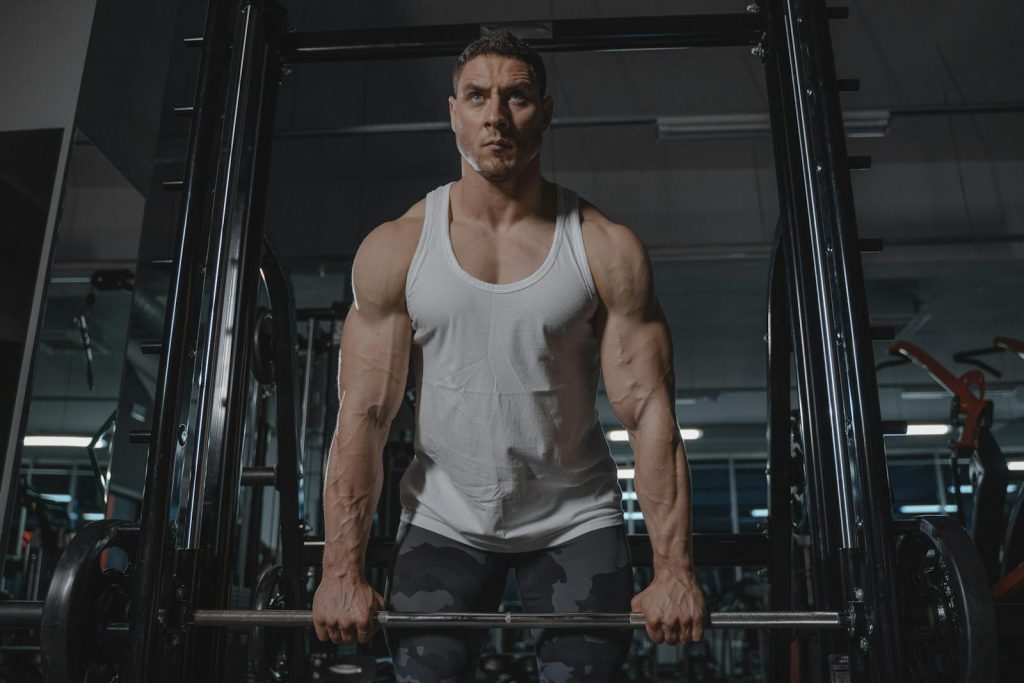
It is not the same as a traditional deadlift from the floor, but it can still be useful when you set up correctly, use a strong hip hinge, and match the variation to your goal. In this guide, you will learn how to do the smith machine deadlift, which muscles it works, its benefits, common mistakes, best variations, and how to add it to your workout.
What Is the Smith Machine Deadlift?
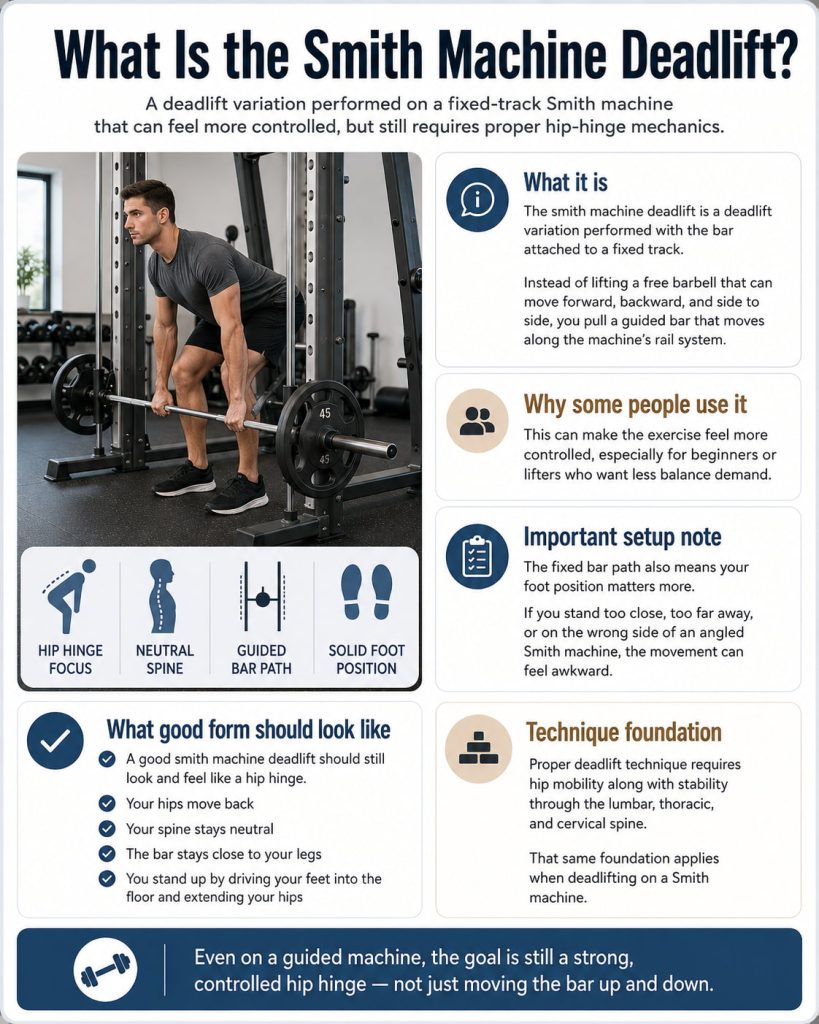
The smith machine deadlift is a deadlift variation performed with the bar attached to a fixed track. Instead of lifting a free barbell that can move forward, backward, and side to side, you pull a guided bar that moves along the machine’s rail system.
This can make the exercise feel more controlled, especially for beginners or lifters who want less balance demand. However, the fixed bar path also means your foot position matters more. If you stand too close, too far away, or on the wrong side of an angled Smith machine, the movement can feel awkward.
A good smith machine deadlift should still look and feel like a hip hinge. Your hips move back, your spine stays neutral, the bar stays close to your legs, and you stand up by driving your feet into the floor and extending your hips.
The American Council on Exercise explains that proper deadlift technique requires hip mobility along with stability through the lumbar, thoracic, and cervical spine. That same foundation applies when deadlifting on a Smith machine.
Smith Machine Deadlift Muscles Worked
The smith machine deadlift mainly trains the posterior chain, but it also uses several muscles from your lower body, trunk, upper back, and grip.
Primary muscles worked
Glutes: The gluteus maximus helps extend your hips as you stand tall. You should feel strong glute involvement near the top of each rep.
Hamstrings: The hamstrings help control the lowering phase and assist with hip extension. They are especially active in Romanian deadlift and stiff-leg variations.
Spinal erectors: These muscles help keep your torso position stable while you hinge and stand.
Quadriceps: The quads assist with knee extension, especially when you use more knee bend in a standard deadlift setup.
Secondary muscles worked
Upper back and traps: These muscles help keep the bar close and support your posture.
Lats: The lats help keep the bar pulled toward your body instead of letting it drift away.
Core muscles: Your abs, obliques, and deep trunk stabilizers help maintain a braced, neutral spine.
Forearms and grip: Your grip has to hold the bar through each rep, especially as the weight gets heavier.
ACE identifies the glutes and quads as key prime movers in the deadlift, with the hamstrings, adductors, core, lats, and forearms also contributing to the movement.
Smith Machine Deadlift Benefits
It can help beginners learn the hip hinge
The fixed bar path can make the smith machine deadlift feel more predictable than a free barbell. This may help beginners focus on bracing, hip movement, and controlled reps before moving to more demanding free-weight pulls.
That does not mean the Smith machine automatically teaches perfect form. You still need to set your feet correctly, keep your spine neutral, and avoid turning the movement into a squat.
It reduces balance demands
Because the bar is guided, you do not have to control the bar in every direction. This can be useful when your goal is to focus more on the target muscles and less on bar path control.
This is one reason the smith machine deadlift can work well for hypertrophy-focused training, especially Romanian deadlifts and rack pulls.
It keeps tension consistent
The Smith machine can make it easier to use slow eccentrics, pauses, and controlled tempo work. That can be helpful when training your glutes and hamstrings because you can focus on muscle tension instead of rushing through the lift.
It can be useful when free barbells are unavailable
In a crowded gym, the Smith machine may be open when barbells, platforms, or squat racks are taken. It gives you another way to train a deadlift pattern without skipping posterior-chain work.
It may feel more approachable for some lifters
Some people find a free-weight deadlift intimidating at first. The Smith machine can feel more controlled because the bar is already supported by the machine and can be locked into place.
Still, you should start light and build gradually. The Smith machine does not remove the need for good technique.
How to Do the Smith Machine Deadlift With Proper Form
Best for: The standard smith machine deadlift is best for lifters who want a guided deadlift variation that trains the glutes, hamstrings, back, quads, and grip. It can be useful for beginners learning the movement pattern or intermediate lifters who want a stable deadlift accessory.
How to do it:
- Set the Smith machine bar to the lowest safe height.
- Stand with your feet about hip-width apart.
- Position the bar close to your midfoot or just in front of your shins.
- If the Smith machine has an angled track, test your position with an empty bar first so the bar stays close to your body as you stand.
- Grip the bar slightly outside your legs.
- Brace your core and pull your shoulders down and back.
- Push your hips back and bend your knees enough to reach the bar.
- Keep your chest proud, ribs controlled, and spine neutral.
- Drive your feet into the floor and stand tall by extending your hips and knees.
- Lower the bar with control by hinging your hips back again.
- Reset your brace before each rep.
Suggested sets and reps: Start with 2–3 sets of 8–10 reps using a light to moderate load. For muscle growth, use 3–4 sets of 8–12 reps. For strength-focused accessory work, use 3–5 sets of 4–6 reps with clean form and longer rest.
Coaching cue: Think, “Push the floor away, keep the bar close, and finish tall with your glutes.”
Common Smith Machine Deadlift Mistakes
Standing in the wrong place
Your stance must match the machine’s bar path. Some Smith machines move straight up and down, while others move at a slight angle. If the machine is angled, one side may feel more natural than the other.
Before adding weight, perform several reps with the empty bar. The bar should stay close to your body without pulling you forward or forcing you backward.
Rounding your lower back
A rounded lower back usually means you are losing tension, reaching too low, or using more weight than you can control. Keep your spine neutral and brace before each rep.
If you cannot reach the bar without rounding, raise the starting height slightly or switch to a rack pull variation.
Letting the bar drift away
Even though the Smith machine controls the bar path, you still want the bar close to your legs. A bar that is too far away increases the demand on your lower back and makes the lift feel less efficient.
Squatting instead of hinging
A deadlift is not just a squat with the bar in your hands. Your hips should move back, your torso should lean forward slightly, and your hamstrings should feel loaded.
Some knee bend is normal, but too much knee bend shifts the movement away from a hinge pattern.
Using too much weight too soon
The Smith machine can make heavy loads feel more controlled, but that does not mean your tissues are ready for them. Increase weight gradually and keep every rep smooth.
The American College of Sports Medicine emphasizes that resistance training variables such as load and volume should match the goal and the lifter’s ability level.
Rushing the lowering phase
Dropping the bar quickly reduces control and can make your setup worse on the next rep. Lower the bar slowly enough to keep tension in your glutes, hamstrings, and trunk.
Smith Machine Deadlift vs Barbell Deadlift
The smith machine deadlift and barbell deadlift train similar muscle groups, but they are not identical.
| Feature | Smith Machine Deadlift | Barbell Deadlift |
|---|---|---|
| Bar path | Fixed track | Free bar path |
| Stability demand | Lower | Higher |
| Setup flexibility | Limited by machine path | More natural bar movement |
| Beginner friendliness | Can feel more controlled | Requires more bar control |
| Carryover to traditional deadlift | Helpful but not exact | Direct |
| Best use | Hypertrophy, practice, accessory work | Strength, power, full deadlift skill |
The barbell deadlift is usually better if your main goal is to build free-weight deadlift strength. The smith machine deadlift can still be useful if your goal is muscle growth, controlled posterior-chain training, or a guided hinge variation.
A simple way to choose: use the barbell deadlift when you want to train the full free-weight pulling skill. Use the smith machine deadlift when you want a controlled hinge variation that fits your body and your gym setup.
Best Smith Machine Deadlift Variations
1. Smith Machine Romanian Deadlift
Best for: The smith machine Romanian deadlift is best for targeting the hamstrings and glutes with a controlled hip hinge. It is a strong choice for hypertrophy-focused lower-body training.
Muscles worked: This variation mainly works the hamstrings, glutes, spinal erectors, adductors, upper back, lats, core, and forearms.
Equipment needed: You need a Smith machine and weight plates.
Why it stands out: The Romanian deadlift starts from the top instead of the floor. This helps you focus on pushing the hips back, feeling the hamstrings lengthen, and controlling the eccentric phase.
The National Academy of Sports Medicine describes the Romanian deadlift as a posterior-chain exercise that uses a controlled hip hinge, slight knee bend, neutral spine, and hamstring stretch.
Suggested sets and reps: Use 3–4 sets of 8–12 reps for muscle growth. Use a slower lowering phase of 2–4 seconds if you want more control and tension.
How to do it:
- Set the Smith machine bar around upper-thigh height.
- Stand with your feet hip-width apart.
- Hold the bar with an overhand grip just outside your thighs.
- Brace your core and keep your shoulders pulled down.
- Slightly bend your knees and keep that knee angle mostly fixed.
- Push your hips back as the bar lowers along your thighs.
- Stop when you feel a strong hamstring stretch without rounding your back.
- Drive your hips forward and stand tall.
- Squeeze your glutes at the top without leaning backward.
Common mistakes: Avoid bending the knees too much, rounding the back, lowering past your mobility, letting the bar pull you forward, and using momentum instead of control.
Coaching cue: Think, “Hips back, ribs down, hamstrings loaded.”
Exercise variations: Try a slow-eccentric Smith machine Romanian deadlift, paused Romanian deadlift, or B-stance Romanian deadlift.
How to use in a workout: Place it after your main squat, leg press, or deadlift variation. It also works well as the main hamstring movement on a lower-body hypertrophy day.
2. Smith Machine Rack Pull
Best for: The smith machine rack pull is best for lifters who want to train the top half of the deadlift, reduce range of motion, or work around limited mobility.
Muscles worked: This variation works the glutes, spinal erectors, hamstrings, traps, lats, upper back, core, and grip.
Equipment needed: You need a Smith machine and weight plates.
Why it stands out: The shorter range of motion can make the lift easier to control. It can also let you use heavier loads than a full-range deadlift, but only if your posture stays strong.
Suggested sets and reps: Use 3–5 sets of 4–8 reps for strength-focused accessory work, or 2–4 sets of 8–10 reps for muscle-building work.
How to do it:
- Set the Smith machine bar around knee height or slightly below the knees.
- Stand with the bar close to your thighs.
- Grip the bar just outside your legs.
- Brace your core and tighten your upper back.
- Push your hips back slightly and keep your spine neutral.
- Drive through your feet and stand tall.
- Lower the bar back to the starting height with control.
- Reset your brace before the next rep.
Common mistakes: Avoid leaning back at the top, shrugging every rep, rounding your back, and loading the bar heavier than you can control.
Coaching cue: Think, “Brace, stand tall, and lock in the upper back.”
Exercise variations: Try below-knee rack pulls, above-knee rack pulls, or paused rack pulls.
How to use in a workout: Use it after your main deadlift or as a heavier posterior-chain accessory when full-range deadlifts are not the best fit.
3. Smith Machine Sumo Deadlift
Best for: The smith machine sumo deadlift is best for lifters who prefer a wider stance and want more involvement from the glutes, inner thighs, and quads.
Muscles worked: This variation trains the glutes, hamstrings, adductors, quadriceps, spinal erectors, upper back, core, and grip.
Equipment needed: You need a Smith machine and weight plates.
Why it stands out: The wider stance changes the setup and may feel more comfortable for lifters with longer legs or limited hip hinge range. It can also reduce the amount of forward torso lean for some people.
Suggested sets and reps: Use 3–4 sets of 6–10 reps with moderate weight and clean technique.
How to do it:
- Set the Smith machine bar to the lowest safe height.
- Take a wide stance with your toes turned slightly out.
- Place the bar close to your body.
- Grip the bar with your hands inside your legs.
- Brace your core and push your knees in line with your toes.
- Keep your chest tall and spine neutral.
- Drive your feet into the floor and stand up.
- Finish with your hips under your ribs.
- Lower the bar with control and repeat.
Common mistakes: Avoid letting the knees collapse inward, standing too wide for your hip mobility, leaning back at lockout, and losing tension at the bottom.
Coaching cue: Think, “Spread the floor and drive straight up.”
Exercise variations: Try a paused sumo deadlift, tempo sumo deadlift, or higher-start sumo rack pull.
How to use in a workout: Use it as a main deadlift variation or as a lower-body accessory after squats or leg presses.
4. Smith Machine Single-Leg Romanian Deadlift
Best for: The smith machine single-leg Romanian deadlift is best for training one side at a time while using the machine for added guidance. It can help improve side-to-side control and glute-hamstring coordination.
Muscles worked: This variation works the hamstrings, glutes, spinal erectors, core, and hip stabilizers.
Equipment needed: You need a Smith machine and weight plates. Start with the empty bar until your balance and hinge pattern are consistent.
Why it stands out: The fixed bar gives you more stability than a dumbbell single-leg Romanian deadlift, but the single-leg position still challenges control.
Suggested sets and reps: Use 2–3 sets of 8–12 reps per side with light to moderate weight.
How to do it:
- Set the bar around upper-thigh height.
- Stand on one leg with a soft knee bend.
- Hold the bar with both hands.
- Brace your core and keep your hips square.
- Push your hips back as your free leg moves behind you.
- Lower until you feel tension in the working hamstring.
- Drive through the standing foot and return to the start.
- Complete all reps on one side before switching.
Common mistakes: Avoid twisting the hips, rounding the back, rushing the movement, and lowering farther than your control allows.
Coaching cue: Think, “Reach the back leg long and keep your hips square.”
Exercise variations: Try a kickstand Romanian deadlift, B-stance Romanian deadlift, or assisted single-leg Romanian deadlift.
How to use in a workout: Use it as an accessory movement after your main lower-body lifts or as part of a glute and hamstring finisher.
How to Program Smith Machine Deadlifts Into Your Workout
The best way to program smith machine deadlifts depends on your goal.
For beginners
Start with light weight and focus on learning the hinge pattern.
Beginner option:
- Smith machine deadlift: 2–3 sets of 8–10 reps
- Rest: 90–120 seconds
- Load: Light to moderate
- Goal: Clean form and control
Use this once or twice per week as part of a full-body or lower-body workout.
For muscle growth
Use moderate loads, controlled lowering, and enough weekly volume.
Hypertrophy option:
- Smith machine Romanian deadlift: 3–4 sets of 8–12 reps
- Smith machine rack pull: 2–3 sets of 8–10 reps
- Rest: 90–150 seconds
- Tempo: Lower for 2–4 seconds
This works well on a leg day focused on glutes, hamstrings, and posterior-chain development.
For strength accessory work
Use heavier loads, fewer reps, and longer rest. Keep the reps clean and avoid grinding with poor form.
Strength accessory option:
- Smith machine rack pull: 4–5 sets of 4–6 reps
- Rest: 2–3 minutes
- Load: Heavy but controlled
This can be placed after barbell deadlifts or on a separate lower-body strength day.
For a glute and hamstring finisher
Use lighter weight and controlled reps near the end of your workout.
Accessory finisher option:
- Smith machine Romanian deadlift: 2 sets of 12–15 reps
- Smith machine single-leg Romanian deadlift: 2 sets of 10 reps per side
- Rest: 60–90 seconds
Keep the weight manageable and focus on tension, not speed.
Sample Smith Machine Deadlift Workout
Beginner Lower-Body Workout
- Leg press: 3 sets of 10 reps
- Smith machine deadlift: 3 sets of 8 reps
- Seated leg curl: 2 sets of 12 reps
- Bodyweight reverse lunge: 2 sets of 10 reps per side
- Plank: 2 sets of 30–45 seconds
Intermediate Glute and Hamstring Workout
- Smith machine Romanian deadlift: 4 sets of 8–10 reps
- Hip thrust: 3 sets of 8–12 reps
- Seated or lying leg curl: 3 sets of 10–12 reps
- Walking lunge: 2 sets of 12 steps per side
- Back extension: 2 sets of 12–15 reps
Advanced Posterior-Chain Accessory Workout
- Barbell deadlift or trap bar deadlift: 3 sets of 3–5 reps
- Smith machine rack pull: 3 sets of 5–6 reps
- Smith machine Romanian deadlift: 3 sets of 8 reps
- Hamstring curl: 3 sets of 10–15 reps
- Farmer’s carry: 3 rounds
Who Should Do the Smith Machine Deadlift?
The smith machine deadlift can be useful for:
- Beginners learning a guided hinge pattern
- Lifters training in a crowded gym
- People who want a controlled posterior-chain accessory
- Bodybuilding-style workouts
- Hamstring and glute hypertrophy training
- Lifters who feel more confident with a guided bar path
It may not be the best choice for:
- Powerlifters who need direct barbell deadlift practice
- Lifters whose Smith machine path feels unnatural
- People who cannot hinge without rounding their back
- Anyone who feels sharp pain, numbness, dizziness, or unusual symptoms during the exercise
If the movement causes pain or symptoms that do not feel like normal muscle effort, stop the exercise and speak with a qualified professional.
Smith Machine Deadlift Safety Tips
Start with the empty bar and test the bar path before adding weight. This is especially important if the Smith machine track is angled.
Use a range of motion you can control. You do not have to force the bar to the lowest setting if your back rounds or your hips cannot stay in a good position.
Keep your feet planted. Do not let your heels lift or your weight shift excessively onto your toes.
Brace before every rep. Think of creating pressure around your midsection before you pull.
Control the lowering phase. A slow, steady descent helps you keep your position and reduces the chance of bouncing into the next rep.
Progress gradually. Add weight only when your form stays consistent from the first rep to the last.
Smith Machine Deadlift FAQ
Is the smith machine deadlift effective?
Yes, the smith machine deadlift can be effective for training the glutes, hamstrings, back, and grip. It is especially useful as a controlled accessory lift or hypertrophy exercise. However, it does not perfectly replace the free-weight barbell deadlift because the bar path is fixed.
Is the smith machine deadlift good for beginners?
It can be good for beginners if the machine setup feels natural and the lifter learns proper hip hinge mechanics. Beginners should start light, practice with the empty bar, and avoid chasing heavy weight too soon.
Is the smith machine deadlift bad for your back?
It is not automatically bad for your back. Problems are more likely when you round your spine, use too much weight, stand in the wrong position, or force a range of motion you cannot control. Keep the bar close, brace your core, and use a neutral spine.
Should I do smith machine deadlifts or barbell deadlifts?
Choose barbell deadlifts if your goal is to improve free-weight deadlift strength. Choose smith machine deadlifts if you want a guided hinge variation, more stability, or a controlled accessory exercise for glutes and hamstrings.
Can you do Romanian deadlifts on a Smith machine?
Yes. The Smith machine Romanian deadlift is one of the best Smith machine deadlift variations for targeting the hamstrings and glutes. Keep a slight knee bend, push your hips back, and lower only until you feel a controlled hamstring stretch.
How low should you go on a smith machine deadlift?
Go as low as you can while keeping a neutral spine, controlled hips, and the bar close to your body. Some lifters may pull from the lowest setting, while others may need to start from a slightly raised position.
How many sets and reps should I do?
For beginners, 2–3 sets of 8–10 reps works well. For muscle growth, use 3–4 sets of 8–12 reps. For strength-focused accessory work, use 3–5 sets of 4–6 reps with longer rest and strict form.
Conclusion
The smith machine deadlift can be a useful lower-body and posterior-chain exercise when you treat it like a real hinge, not just a guided pull. Set your feet carefully, keep the bar close, brace your core, and use a range of motion you can control.
For most lifters, the best starting point is the standard smith machine deadlift or smith machine Romanian deadlift. Choose one variation, practice it with clean form, and add it to your leg day or full-body workout 1–2 times per week.
References
- American Council on Exercise — Technique Series: How to Deadlift
- American Council on Exercise — The ACE Do It Better Series: The Deadlift
- National Academy of Sports Medicine — Romanian Deadlift Barbell
- National Academy of Sports Medicine — Dumbbell Romanian Deadlift
- National Strength and Conditioning Association — Exercise Technique: Deadlift
- National Strength and Conditioning Association — Romanian Deadlift