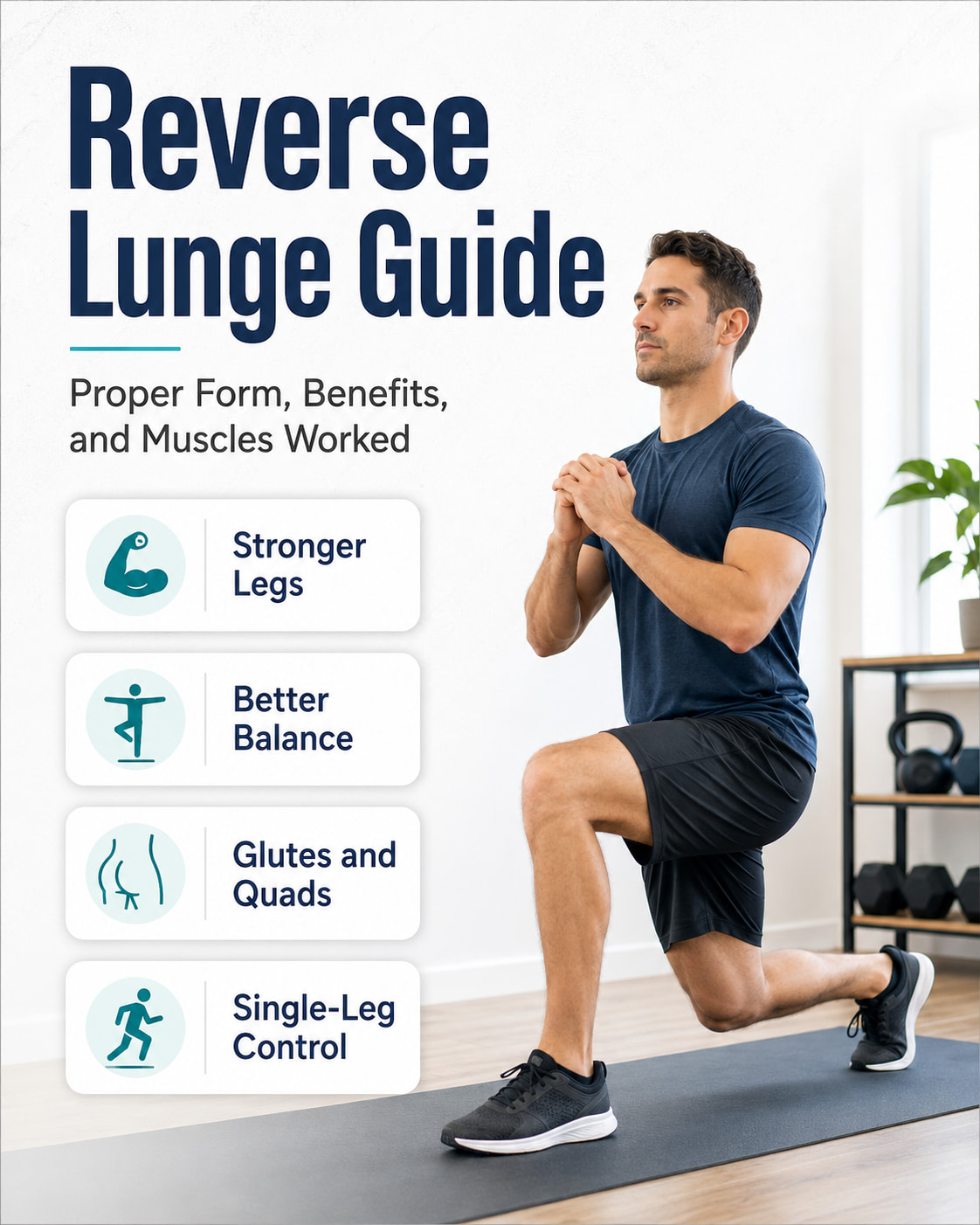
The reverse lunge is a single-leg lower-body exercise where you step one foot backward, lower into a lunge, and drive through the front foot to return to standing. It is useful for building stronger legs, improving balance, training the glutes and quads, and developing better control from side to side.
Unlike a forward lunge, the reverse lunge keeps the working foot planted, which can make the movement easier to control for many beginners. In this guide, you will learn proper reverse lunge form, muscles worked, benefits, common mistakes, variations, and how to use reverse lunges in a workout.
What Is a Reverse Lunge?
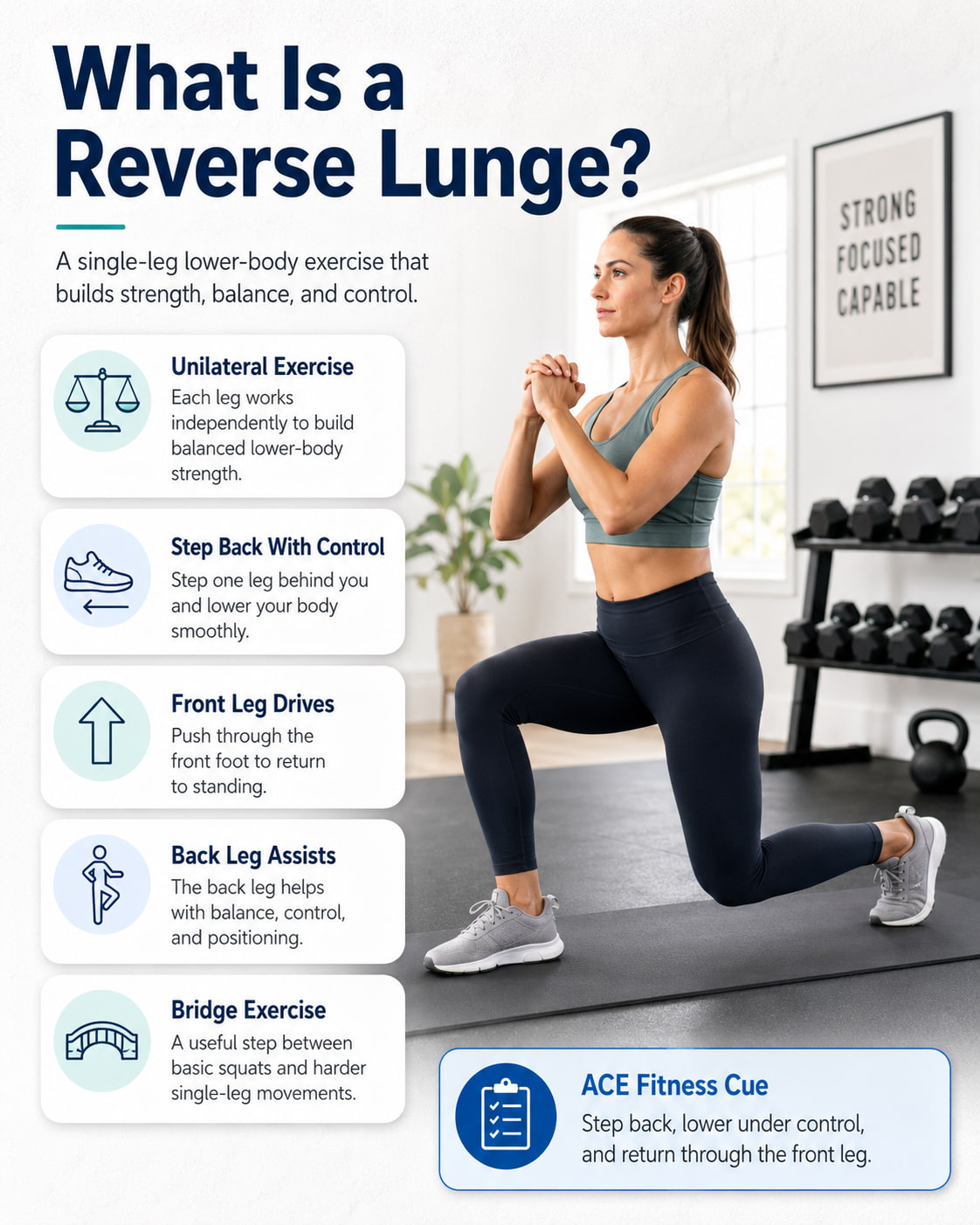
A reverse lunge is a unilateral lower-body exercise, meaning each leg works independently. You start standing tall, step one leg behind you, lower your body under control, then push through the front foot to stand back up.
The front leg usually does most of the strength work. The back leg helps you balance, control the step, and return to the starting position. This makes the reverse lunge a useful bridge between basic squats and more demanding single-leg exercises.
The ACE Fitness reverse lunge guide describes the movement as stepping backward from a hip-width stance, lowering under control, and returning to standing through the front leg.
How to Do a Reverse Lunge With Proper Form
Best for: Building single-leg strength, improving balance, training the quads and glutes, and learning controlled lower-body movement.
Muscles worked: Quadriceps, gluteus maximus, gluteus medius, hamstrings, adductors, calves, core, and spinal stabilizers.
Equipment needed: Bodyweight only. You can add dumbbells, kettlebells, a barbell, or a resistance band once your form is consistent.
Why it stands out: The reverse lunge is easier to control than many forward-moving lunge variations because the front foot stays planted. It also trains each leg separately, which can help you notice and improve strength or balance differences between sides.
Suggested sets and reps: Start with 2 to 3 sets of 6 to 10 reps per leg. For general strength and muscle building, use 3 to 4 sets of 8 to 12 reps per leg. For heavier accessory work, use 3 to 5 sets of 5 to 8 reps per leg.
Beginners: Use bodyweight only and hold a wall, rack, countertop, or chair for light support if balance is difficult. Keep the range of motion small at first.
Intermediate: Add dumbbells at your sides or hold one dumbbell in a goblet position. Use a controlled tempo and keep the front foot planted.
Advanced: Try deficit reverse lunges, barbell reverse lunges, front-rack kettlebell reverse lunges, or slow tempo reps with a pause near the bottom.
Rest: Rest 60 to 90 seconds between moderate sets. Rest 90 to 150 seconds if you are using heavier loads or training close to failure.
How to do it:
- Stand tall with your feet about hip-width apart and your arms at your sides or hands on your hips.
- Brace your core and keep your chest lifted without flaring your ribs.
- Step one foot backward and land softly on the ball of the back foot.
- Lower your back knee toward the floor while keeping the front foot flat.
- Keep the front knee tracking in the same direction as your toes.
- Stop at a depth you can control without your front heel lifting or your lower back rounding.
- Push through the midfoot and heel of the front foot to stand tall.
- Bring the back foot forward to return to the starting position.
- Repeat on the same side or alternate legs.
Common mistakes: Avoid stepping too narrow, rushing the descent, letting the front knee cave inward, lifting the front heel, pushing mostly from the back foot, leaning too far forward, or adding weight before you can control the bodyweight version.
Expert tip: Think “front foot owns the rep.” The back foot helps with balance, but the front leg should control the lowering phase and drive you back to standing.
Exercise variations: Bodyweight reverse lunge, dumbbell reverse lunge, goblet reverse lunge, kettlebell front-rack reverse lunge, barbell reverse lunge, deficit reverse lunge, tempo reverse lunge, and alternating reverse lunge.
Easier variation: Supported reverse lunge or split squat. A split squat removes the step-back portion, so you can practice the lunge position with more control.
Harder variation: Deficit reverse lunge. Standing on a low step increases range of motion and requires more strength, balance, and hip control.
Reverse Lunge Muscles Worked
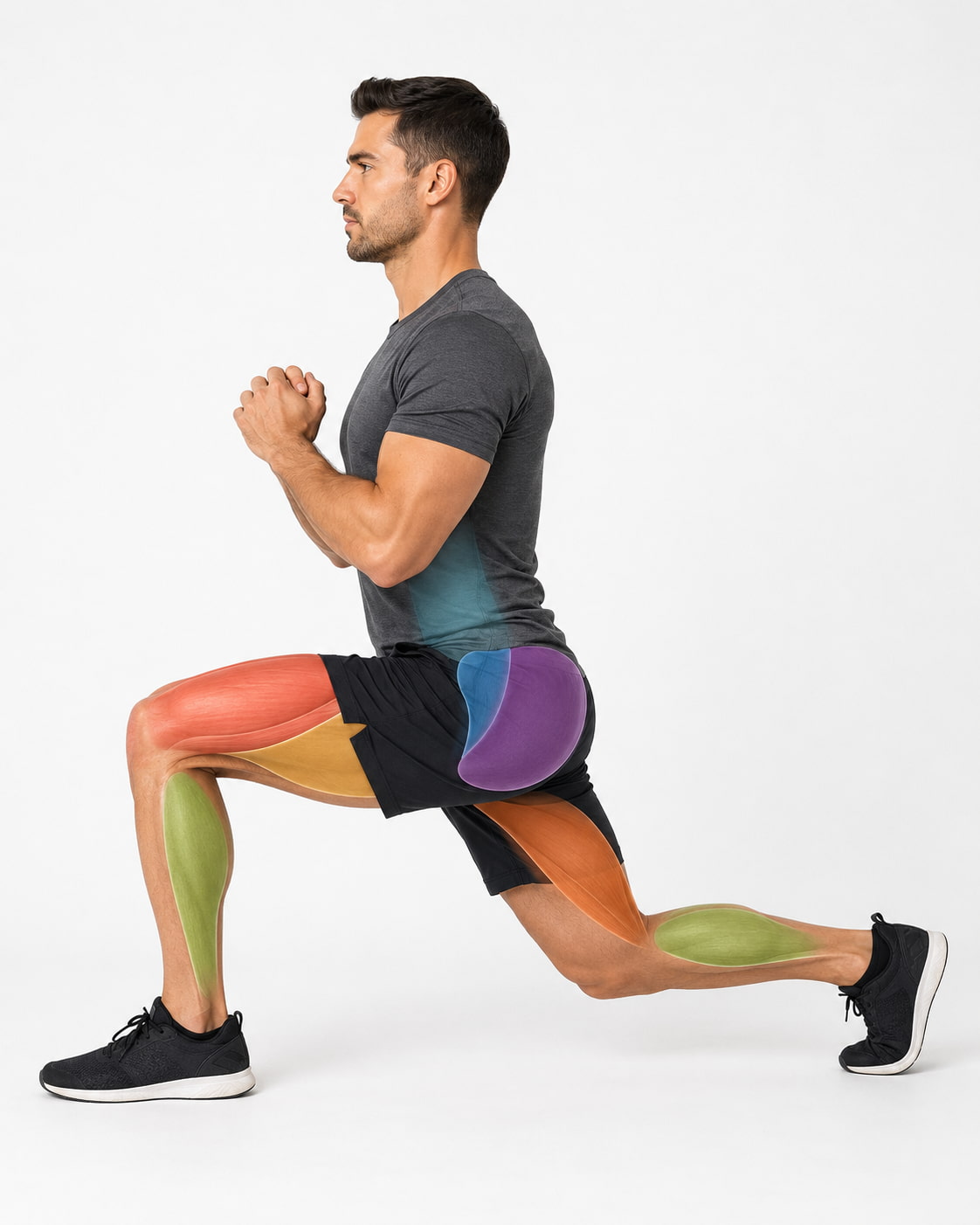
Reverse lunges train several lower-body muscles at the same time. Cleveland Clinic lists lunges as working the quadriceps, hamstrings, gluteal muscles, erector spinae, and adductors, while also helping with balance and stability.
Quadriceps
The quadriceps are the large muscles on the front of your thighs. They help straighten the front knee as you push yourself back to standing.
You will usually feel more quad demand when you keep a more upright torso, use a shorter-to-moderate step, and allow the front knee to bend with control.
Glutes
The gluteus maximus helps extend the hip as you rise from the bottom position. The gluteus medius helps stabilize the pelvis and control side-to-side movement.
A 2024 EMG study on the reverse lunge found that gluteus medius and gluteus maximus activation were greater in the stationary limb, while rectus femoris and biceps femoris activity were greater in the lead limb. This supports the idea that both legs work, but they do not do the exact same job.
Hamstrings
The hamstrings assist with hip extension and help stabilize the knee and hip during the movement. They are involved in reverse lunges, but they are usually not loaded as directly as they are in Romanian deadlifts, leg curls, or hip-hinge exercises.
Adductors
The adductors are the inner-thigh muscles. They help stabilize the pelvis and guide the leg as you lower and stand. If your knees drift inward or your stance feels unstable, your adductors and hip stabilizers may need better control.
Calves and Feet
The calves help stabilize the ankle and foot, especially on the front leg. Keeping the front foot flat helps you maintain balance and push through the floor more effectively.
Core and Spinal Stabilizers
Your core helps keep your ribs, pelvis, and spine controlled. The reverse lunge is not a direct ab exercise, but your trunk has to stay stable while your legs move.
Benefits of Reverse Lunges
Builds Single-Leg Strength
Reverse lunges train one leg at a time. This is useful because many daily and athletic movements happen on one leg or with one leg doing more work than the other.
Walking, climbing stairs, stepping backward, changing direction, and getting up from low positions all require lower-body control. Cleveland Clinic notes that lunges can support independent leg strengthening and carry over to daily movements like stairs and picking things up from the floor.
Trains the Glutes and Quads Together
The reverse lunge is effective because it combines knee extension and hip extension. Your quads help straighten the knee, while your glutes help drive the hips forward as you stand.
This makes the movement useful for lower-body strength, muscle building, and accessory work after squats or deadlifts.
Improves Balance and Coordination
Because one leg steps backward while the other leg stays planted, the reverse lunge challenges coordination and balance. Harvard Health notes that reverse lunges can help develop hip muscles for stability and teach control of backward movement and coordination.
Easier to Control Than Some Lunge Variations
Many people find reverse lunges easier to control than forward lunges because the front foot stays fixed. You do not have to catch your body weight moving forward with each rep.
That does not mean reverse lunges are always better. It simply means they can be a smart option when you want a controlled lunge variation.
Works With Minimal Equipment
You can do reverse lunges with bodyweight, dumbbells, kettlebells, a barbell, a Smith machine, or a resistance band. That makes them useful for home workouts, gym programs, travel training, and lower-body accessory work.
Reverse Lunge vs Forward Lunge
The main difference is direction. In a forward lunge, you step forward and absorb force as the front foot lands. In a reverse lunge, you step backward while the front foot stays planted.
A 2021 biomechanics study comparing forward and backward lunges found greater patellofemoral joint loading variables during forward lunges than backward lunges in the tested group. The study involved 20 asymptomatic females, so it should not be used to claim that reverse lunges treat knee pain, but it does help explain why backward lunges may feel more manageable for some people.
Reverse lunges are often a better starting point if you struggle with forward-lunge balance, foot placement, or knee control. Forward lunges can still be useful, especially for athletes who need deceleration and forward movement control.
Common Reverse Lunge Mistakes
Stepping Too Narrow
If your feet land on one straight line, balance becomes much harder. Step back as if your feet are on train tracks, not a tightrope.
Taking Too Short a Step
A very short step can crowd the front knee and make the movement feel unstable. Step back far enough that you can lower with control while keeping the front foot flat.
Taking Too Long a Step
A step that is too long can make it hard to use the front leg and may turn the movement into an awkward stretch. Use a step length that lets both knees bend naturally.
Letting the Front Knee Cave Inward
Your front knee should track in the same general direction as your toes. Cleveland Clinic lists knee cave, too much forward torso bend, and unnecessary heavy loading as common lunge mistakes.
Lifting the Front Heel
If your front heel comes off the floor, you may be stepping too short, shifting too far forward, or losing ankle control. Keep pressure through the midfoot and heel.
Dropping Into the Bottom Position
Do not fall into the rep. Lower slowly enough that you could stop at any point. Mayo Clinic’s weight-training guidance recommends controlled movement, warming up before lifting, and not ignoring pain.
Loading Too Soon
Add resistance only when your bodyweight reps are smooth, balanced, and repeatable. If you cannot control your knee, foot, and torso without weight, extra load will usually make the problem worse.
Beginner Modifications and Regressions
If reverse lunges feel awkward, start with a simpler version. A supported reverse lunge lets you hold a wall, rack, chair, or countertop for balance while you learn the pattern.
A split squat is another good regression. Set your feet in a staggered stance and lower straight down without stepping back each rep. This removes the coordination demand and helps you build strength in the lunge position.
You can also shorten the range of motion. Lower halfway, pause, and stand tall. Increase depth only when you can keep your front foot flat, front knee controlled, and torso stable.
Reverse Lunge Progressions and Variations
Bodyweight Reverse Lunge
This is the best starting point. Use it to learn balance, foot pressure, knee tracking, and controlled depth before adding resistance.
Dumbbell Reverse Lunge
Hold a dumbbell in each hand at your sides. This is one of the easiest ways to load the movement because the weight stays close to your center of mass.
Goblet Reverse Lunge
Hold one dumbbell or kettlebell at chest height. This variation encourages a tall torso and can be easier to learn than a barbell version.
Barbell Reverse Lunge
Place a barbell on your upper back and perform the same reverse-lunge pattern. This allows heavier loading but requires stronger balance, bracing, and setup.
Deficit Reverse Lunge
Stand on a low step or plate and step backward to the floor. The deficit increases range of motion and makes the front leg work harder. Start with a small elevation.
Tempo Reverse Lunge
Use a slow lowering phase, such as three seconds down, a short pause, and a controlled drive up. This improves control and makes lighter loads feel more challenging.
Alternating Reverse Lunge
Alternate legs each rep. This can work well for conditioning or general lower-body training, but same-side reps are usually easier when learning form.
How Many Reverse Lunges Should You Do?
For beginners, start with 2 to 3 sets of 6 to 10 reps per leg. Keep 2 to 3 reps in reserve, meaning you should finish each set feeling like you could still do a few clean reps.
For muscle and general strength, use 3 to 4 sets of 8 to 12 reps per leg. Rest 60 to 90 seconds between sets.
For heavier strength accessory work, use 3 to 5 sets of 5 to 8 reps per leg. Rest 90 to 150 seconds and use a load you can control without losing balance.
The CDC recommends adults perform muscle-strengthening activities at least two days per week for all major muscle groups, and ACSM’s 2026 resistance-training update emphasizes consistency, goal-based programming, and using tools such as bodyweight, bands, and free weights effectively.
Sample Reverse Lunge Workouts
Beginner Lower-Body Workout
| Exercise | Sets | Reps | Rest |
|---|---|---|---|
| Bodyweight squat | 2 | 10 to 12 | 60 seconds |
| Supported reverse lunge | 2 to 3 | 6 to 8 per leg | 60 seconds |
| Glute bridge | 2 to 3 | 10 to 15 | 60 seconds |
| Standing calf raise | 2 | 12 to 15 | 45 seconds |
Use this workout 1 to 2 times per week. When reverse lunges feel stable, remove the support or add a light dumbbell.
Intermediate Leg Workout
| Exercise | Sets | Reps | Rest |
|---|---|---|---|
| Goblet squat | 3 | 8 to 12 | 90 seconds |
| Dumbbell reverse lunge | 3 | 8 to 10 per leg | 90 seconds |
| Romanian deadlift | 3 | 8 to 12 | 90 seconds |
| Side plank | 2 | 20 to 40 seconds per side | 45 seconds |
Use a load that feels challenging but controlled. Stop the set when balance, knee tracking, or posture breaks down.
Advanced Lower-Body Accessory Workout
| Exercise | Sets | Reps | Rest |
|---|---|---|---|
| Barbell squat or deadlift | 3 to 5 | 3 to 6 | 2 to 3 minutes |
| Barbell reverse lunge | 3 to 4 | 6 to 8 per leg | 90 to 150 seconds |
| Deficit reverse lunge | 2 to 3 | 8 to 10 per leg | 90 seconds |
| Hamstring curl or hip hinge | 3 | 10 to 12 | 60 to 90 seconds |
Use this as an accessory day after your main strength lift. Keep the reverse lunge strict instead of chasing maximum weight.
Safety Tips for Reverse Lunges
Warm up before loaded reverse lunges. Five to 10 minutes of light cardio, bodyweight squats, hip mobility, and easy lunges can help prepare your muscles and joints. Mayo Clinic recommends warming up before weight training and moving weights in a controlled way instead of rushing.
Use a stable surface and supportive shoes. Avoid slippery floors, unstable pads, or heavy weights that force you to twist or stumble.
Do not force depth. A controlled half-range reverse lunge is better than a deep lunge with knee cave, heel lift, or poor balance.
Stop and seek professional help if reverse lunges cause sharp pain, numbness, dizziness, chest pain, severe shortness of breath, joint pain that continues, or unusual symptoms.
Frequently Asked Questions
What muscles do reverse lunges work?
Reverse lunges work the quadriceps, glutes, hamstrings, adductors, calves, core, and spinal stabilizers. The front leg usually handles most of the strength demand, while the back leg helps with balance and movement control.
Are reverse lunges good for beginners?
Yes, reverse lunges can be beginner-friendly when done with bodyweight, a short range of motion, and support if needed. If stepping backward feels too difficult, start with split squats or supported reverse lunges.
Which leg should I feel during a reverse lunge?
You should feel the front leg working the most, especially the quad and glute. The back leg should help you balance, but it should not be doing most of the pushing.
Are reverse lunges better than forward lunges?
Reverse lunges are not automatically better, but they are often easier to control. They may also feel more comfortable for some people because the front foot stays planted and the body does not have to catch as much forward momentum.
Should I do reverse lunges with dumbbells?
Use dumbbells once your bodyweight form is stable. Start light, hold the dumbbells at your sides, and keep each rep smooth. If the weight changes your knee tracking or balance, reduce the load.
Why do my knees hurt during reverse lunges?
Knee discomfort may happen if you step too short, let the knee cave inward, lift the front heel, use too much weight, or force too much depth. Reduce the range of motion, slow down, and check your alignment. If pain continues, stop and get professional guidance.
How often should I do reverse lunges?
Most people can train reverse lunges 1 to 3 times per week, depending on their program and recovery. Start with one or two weekly sessions and increase gradually if your form stays strong and your legs recover well.
Conclusion
The reverse lunge is a practical lower-body exercise for building stronger legs, improving balance, and training better single-leg control. Start with bodyweight reps, keep the front foot planted, lower with control, and progress only when your form stays clean.
Use reverse lunges as a main single-leg exercise, an accessory after squats or deadlifts, or a bodyweight movement in home workouts. The best version is the one you can perform with steady balance, good knee tracking, and consistent control.
References
- ACE Fitness: Reverse Lunge
- Cleveland Clinic: How To Do Lunges, Form, Variations and Muscles Worked
- Harvard Health: Try This, Take a Step Back
- The Reverse Lunge: A Descriptive Electromyographic Study
- PubMed: Patellofemoral Joint Loading During the Forward and Backward Lunge
- Mayo Clinic: Weight Training, Do’s and Don’ts of Proper Technique
4 thoughts on “Reverse Lunge Guide: Form, Muscles Worked, and Benefits”