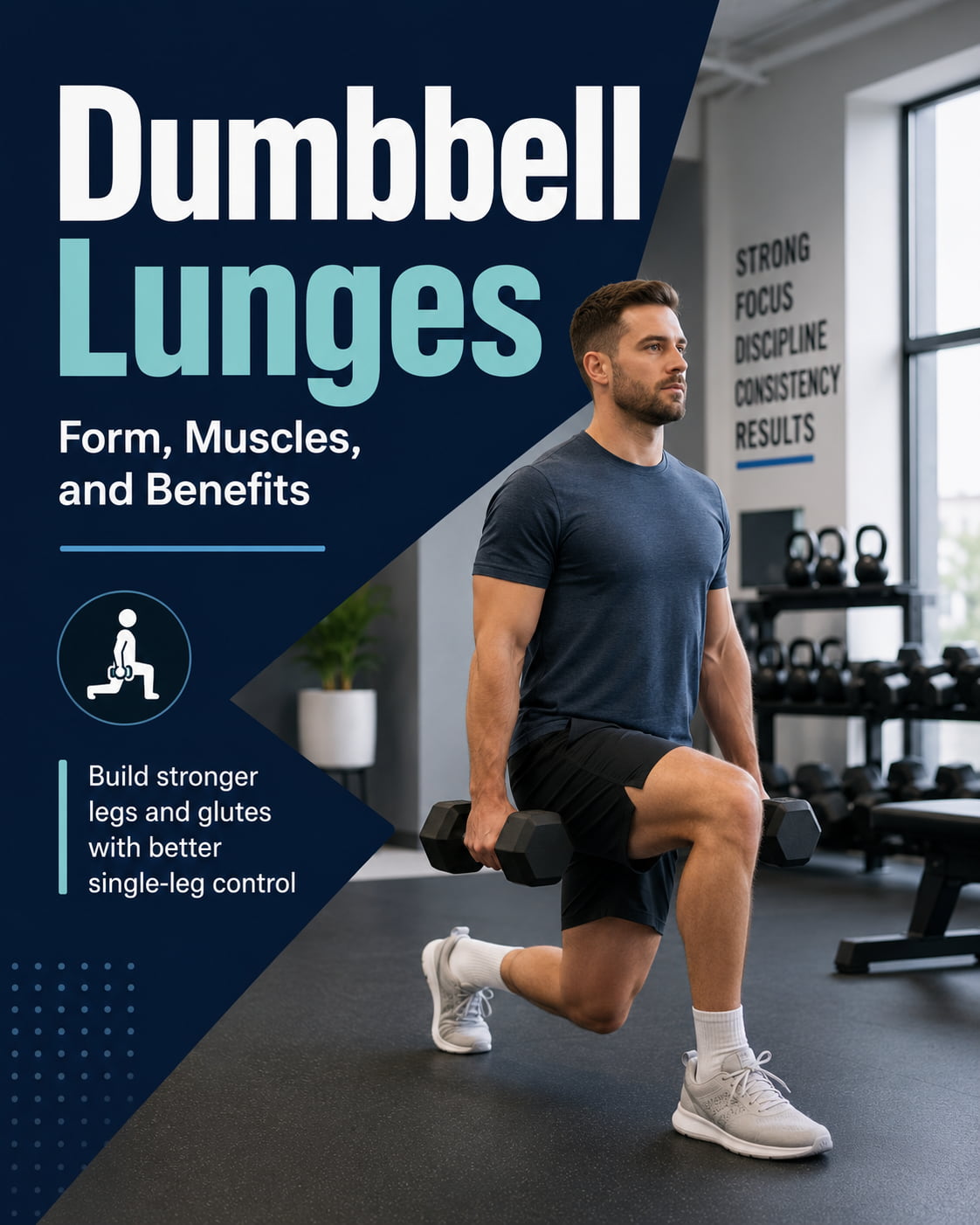
Dumbbell lunges are one of the most practical lower-body exercises for building stronger legs, glutes, balance, and single-leg control. They work by loading one leg at a time while your hips, knees, ankles, and core stabilize your body through a controlled stepping pattern.
The dumbbell lunge is simple in theory, but it rewards good technique. Done well, it can strengthen your quads, glutes, hamstrings, adductors, calves, and trunk stabilizers with only a pair of dumbbells. In this guide, you will learn proper form, muscles worked, benefits, common mistakes, useful variations, and how to add dumbbell lunges to a real workout.
What Are Dumbbell Lunges?
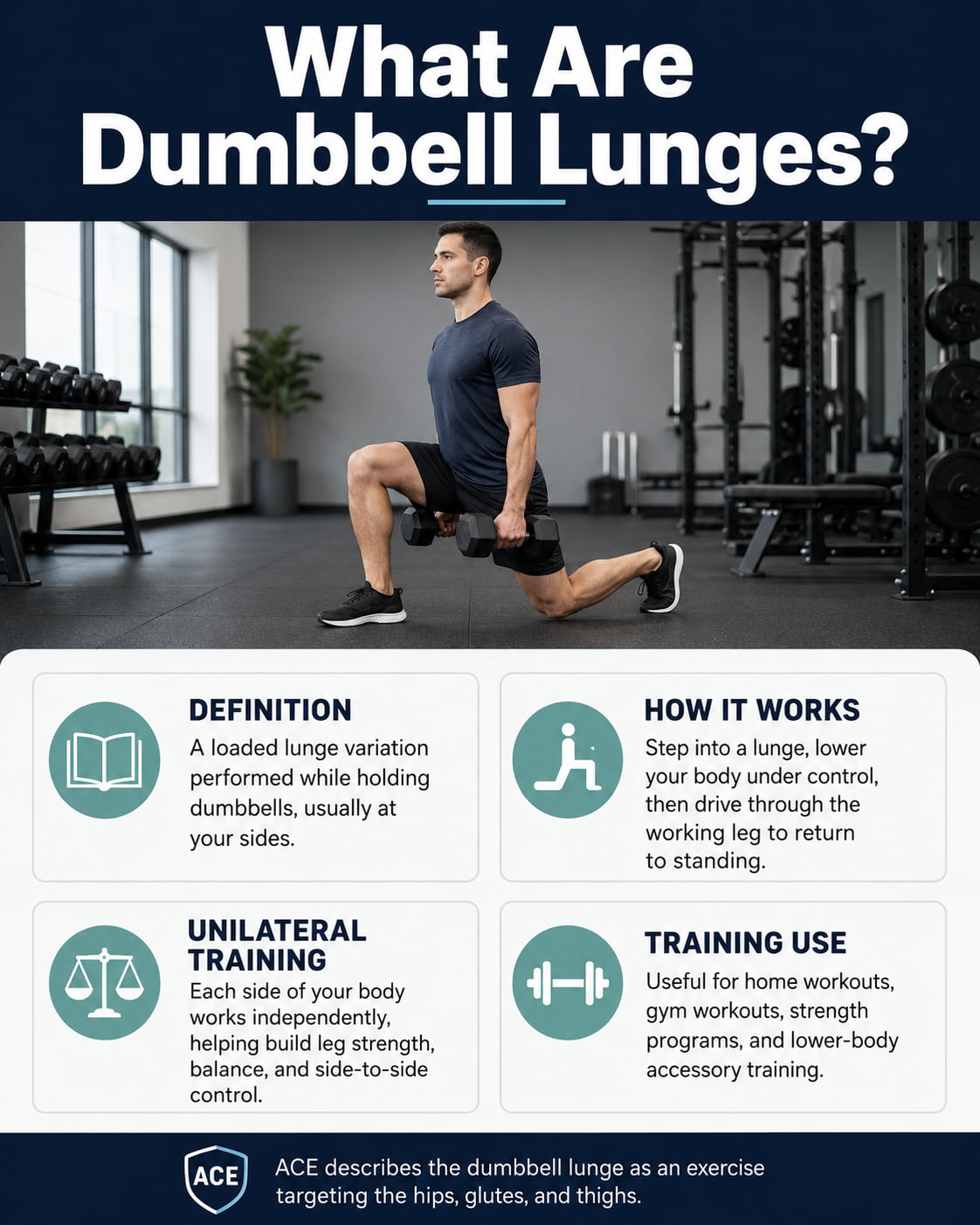
Dumbbell lunges are a loaded lunge variation performed while holding dumbbells, usually at your sides. You step into a lunge, lower your body under control, then drive through the working leg to return to standing.
The movement is a unilateral exercise, which means each side of your body works independently. That makes it useful for building leg strength, improving balance, and noticing strength differences between sides.
The American Council on Exercise dumbbell lunge guide describes the lunge as a dumbbell exercise that targets the hips, glutes, and thighs. That simple setup makes it useful in home workouts, gym workouts, strength programs, and lower-body accessory training.
Dumbbell Lunges Exercise Guide
Best for: Building lower-body strength, improving single-leg control, training balance, and strengthening the legs and glutes with minimal equipment.
Equipment needed: A pair of dumbbells and enough space to step safely.
Suggested sets and reps: Use 2 to 4 sets of 8 to 12 reps per leg for general strength and muscle. For heavier strength work, use 3 to 5 sets of 5 to 8 reps per leg. For a lighter finisher, use 2 to 3 sets of 12 to 15 reps per leg.
Beginners: Start with bodyweight lunges or light dumbbells. Use a shorter range of motion, move slowly, and practice balance before adding more load.
Intermediate: Use moderate dumbbells, controlled depth, and 8 to 12 reps per leg. Leave about 1 to 3 good reps in reserve so your form stays clean.
Advanced: Use heavier dumbbells, slower eccentrics, walking lunges, deficit lunges, or Bulgarian split squats. Progress only when you can control the knee, hip, foot, and torso through every rep.
Rest: Rest 60 to 90 seconds between moderate sets. Rest 2 to 3 minutes when using heavier dumbbells or lower-rep strength work.
How to do it:
- Stand tall with your feet about hip-width apart and hold one dumbbell in each hand.
- Brace your core, keep your chest lifted, and let your arms hang naturally at your sides.
- Step forward with one foot and plant the whole foot firmly on the floor.
- Lower your body under control until both knees bend comfortably.
- Keep your front knee tracking in the same direction as your toes.
- Keep your front heel down and avoid pushing your weight only into the toes.
- Drive through the front foot to stand back up.
- Return to the starting position and repeat on the same side or alternate legs.
Common mistakes: The most common mistakes are stepping too far, dropping too fast, letting the front knee cave inward, pushing mostly off the back foot, rounding the back, and using dumbbells that are too heavy. The goal is not just to get down and up. The goal is to control the whole rep.
Expert tip: Think “step, lower, drive” instead of “fall and push.” A good dumbbell lunge should look smooth, stable, and intentional from the first rep to the last.
Exercise variations: Useful variations include dumbbell reverse lunges, dumbbell walking lunges, dumbbell split squats, dumbbell lateral lunges, and Bulgarian split squats.
Easier variation: Use a bodyweight split squat or hold a wall, rack, or sturdy support for balance. You can also reduce the range of motion until your control improves.
Harder variation: Use heavier dumbbells, slow the lowering phase to 3 seconds, add a deficit, or progress to dumbbell walking lunges or Bulgarian split squats.
Dumbbell Lunges Muscles Worked
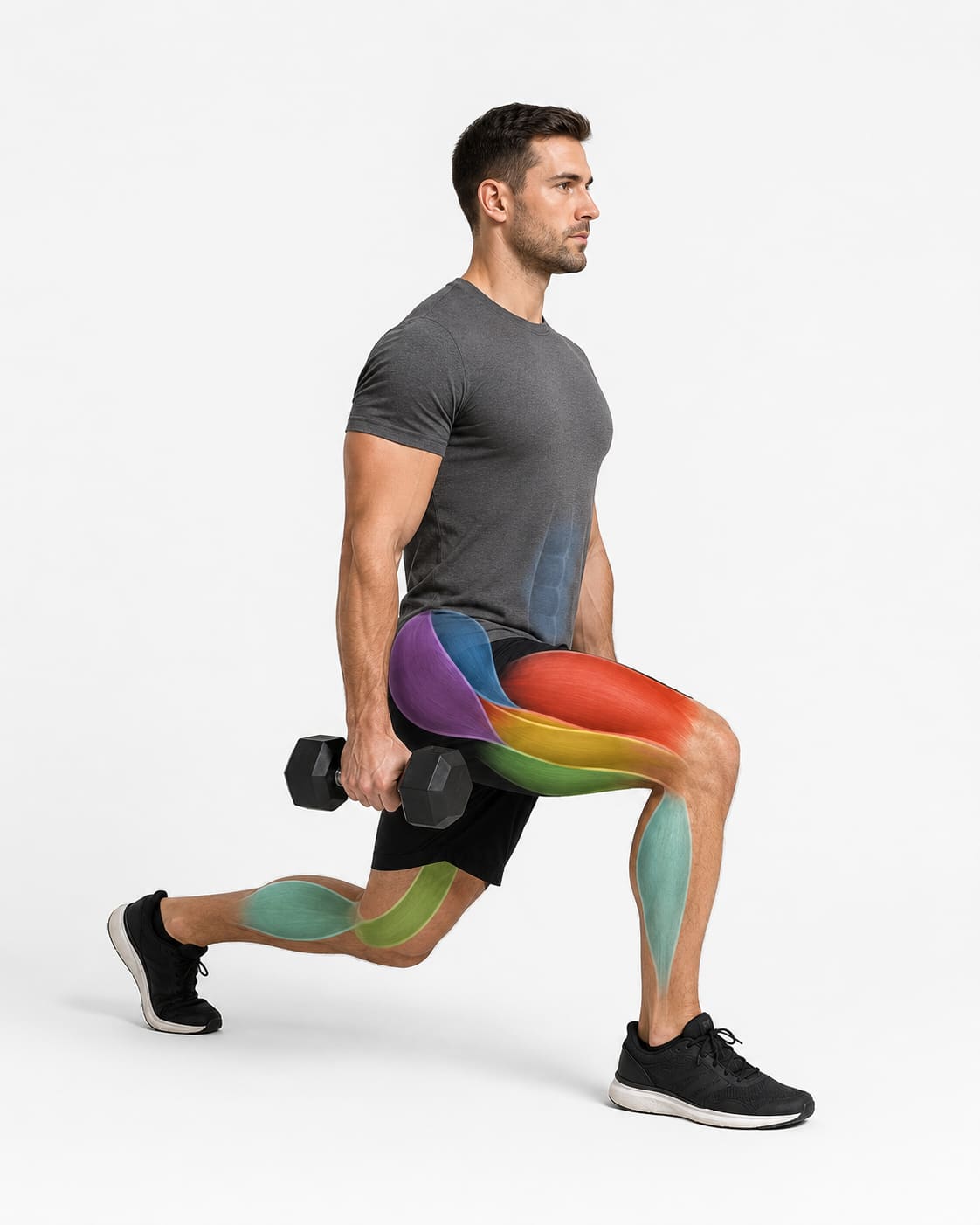
Dumbbell lunges are a compound lower-body exercise. Your front leg usually does most of the work, while the back leg helps with balance and support.
Quadriceps
The quadriceps are the muscles on the front of your thighs. They help straighten the knee as you push up from the bottom of the lunge. You will usually feel more quad involvement when your torso stays fairly upright and your front knee bends under control.
Glutes
The gluteus maximus helps extend the hip as you stand back up. The gluteus medius and smaller hip stabilizers help keep your pelvis steady and stop your knee from drifting inward. If you want more glute emphasis, use a controlled step, keep the front foot flat, and push through the whole foot instead of bouncing off the back leg.
Hamstrings
The hamstrings assist with hip control and help stabilize the knee during the lowering and lifting phases. They may not feel as dominant as the quads or glutes, but they still support the movement.
Adductors
The adductors are the inner-thigh muscles. They help stabilize the hip and control the leg as you lower and stand. This is one reason lunges can feel more demanding than machine-based leg exercises.
Calves and lower legs
Your calves help stabilize the ankle and foot. They work especially hard when you perform walking lunges, longer sets, or slower tempo reps.
Core and spinal stabilizers
Your abs, obliques, and spinal stabilizers help keep your torso steady. The dumbbells add load, so your trunk has to resist leaning, twisting, or collapsing as you move.
Dumbbell Lunges Benefits
1. They build stronger legs and glutes
Dumbbell lunges load the major muscles of the lower body through a deep, controlled movement pattern. Your quads work hard to extend the knee, while your glutes help drive the hip forward as you stand.
2. They train one leg at a time
Many lower-body exercises allow your stronger side to hide weakness on the other side. Dumbbell lunges make each leg do its own work. This can be useful for building more balanced strength and better lower-body control.
3. They improve balance and stability
Because you step into a split stance, your body has to stabilize from the foot up. Your hips, core, and lower legs all help you stay balanced. The Cleveland Clinic lunge guide explains that lunges can support balance and stability while training each leg independently.
4. They are easy to load and progress
You do not need a squat rack or machines to make dumbbell lunges challenging. You can increase the dumbbell weight, add reps, slow the tempo, use walking lunges, or move into harder variations over time.
5. They carry over to everyday movement
Lunges train stepping, lowering, standing, and stabilizing. Those patterns show up in sports, stairs, hiking, yard work, and daily movement. The Mayo Clinic lunge guide also notes that lunges can be useful for conditioning in sports that involve lunging actions.
How to Make Dumbbell Lunges More Quad or Glute Focused
Small changes in setup can change how the exercise feels.
For more quad emphasis, keep your torso more upright, use a moderate step length, and let the front knee bend under control while your heel stays down. This usually makes the front thigh work harder.
For more glute emphasis, use a slightly longer step and allow a small forward torso lean while keeping your spine neutral. Push through the front foot and focus on extending the hip as you stand. The NASM lunge training guide explains that a more upright lunge tends to be more quad-dominant, while a slight forward lean can increase glute contribution.
Do not exaggerate either position. A good lunge should still feel balanced, controlled, and repeatable.
Common Dumbbell Lunge Mistakes
Using too much weight too soon
Heavy dumbbells can make lunges unstable fast. If your step changes, your knee collapses inward, or your torso starts twisting, the weight is too heavy for clean training.
Taking a stride that is too long
A very long stride can make it harder to drive up smoothly. It may also cause you to lose control at the bottom. Choose a step length that lets the front foot stay flat and the front knee track comfortably.
Rushing the lowering phase
Dropping quickly into the bottom of the lunge reduces control. Lower with purpose, pause briefly if needed, then stand strong.
Letting the knee cave inward
The front knee should generally track in the same direction as the toes. If the knee dives inward, reduce the load, slow down, and focus on foot pressure and hip control.
Pushing mostly off the back foot
The back leg helps with balance, but the front leg should do most of the work. Think about pushing the floor away with the front foot.
Losing trunk position
Avoid leaning side to side, rounding the back, or twisting with the dumbbells. Keep the ribs stacked over the pelvis and the core braced.
Dumbbell Lunge Variations and When to Use Them
Dumbbell Reverse Lunge
The reverse lunge is often easier to control than a forward lunge because you step backward instead of forward. It can be a good option for beginners or lifters who want a smoother, more stable lunge pattern.
Dumbbell Walking Lunge
The walking lunge is more dynamic. It works well for muscle-building, athletic conditioning, and longer lower-body sets. Use it when you have enough space and can maintain clean form from rep to rep.
Dumbbell Split Squat
The split squat keeps your feet in place. This removes the stepping portion and lets you focus on strength, depth, and control. It is one of the best regressions for learning lunges.
Dumbbell Lateral Lunge
The lateral lunge trains side-to-side movement and places more demand on the adductors and hip stabilizers. It is useful, but it usually requires more mobility and control than a basic forward or reverse lunge.
Dumbbell Bulgarian Split Squat
The Bulgarian split squat is a harder single-leg variation with the rear foot elevated. It can build serious leg and glute strength, but it should come after you can control regular split squats and lunges.
Dumbbell Lunges Sets, Reps, and Programming
For general strength and muscle, use dumbbell lunges 1 to 2 times per week as part of a lower-body or full-body workout. If your total training volume is moderate and recovery is good, some lifters can use a lunge variation up to 3 times per week.
For beginners, 2 to 3 sets of 8 to 10 reps per leg is enough. Use bodyweight or light dumbbells and focus on clean balance.
For intermediate lifters, 3 to 4 sets of 8 to 12 reps per leg works well. Use a weight that feels challenging but still lets you finish with stable form.
For strength, use 3 to 5 sets of 5 to 8 reps per leg with heavier dumbbells and longer rest. For muscle-building, use 2 to 4 sets of 8 to 15 reps per leg with controlled tempo.
The ACSM resistance training guidance supports training major muscle groups consistently and adjusting load, volume, and frequency based on the goal. For dumbbell lunges, that means you should progress gradually instead of making every set heavy.
A simple progression rule is to increase reps first. When you can complete all sets on both legs with good balance, full control, and 1 to 2 reps in reserve, increase the dumbbell weight slightly.
Sample Dumbbell Lunge Workout for Legs and Glutes
Use this workout once per week as a lower-body accessory session or after your main squat, deadlift, or leg press work.
| Exercise | Sets | Reps | Rest | Effort |
|---|---|---|---|---|
| Goblet squat | 3 | 8 to 10 | 90 sec | 2 reps in reserve |
| Dumbbell lunges | 3 | 8 to 12 per leg | 90 sec | 1 to 3 reps in reserve |
| Romanian deadlift | 3 | 8 to 10 | 90 sec | Controlled |
| Dumbbell reverse lunge | 2 | 10 per leg | 60 sec | Moderate |
| Standing calf raise | 2 | 12 to 15 | 45 to 60 sec | Smooth reps |
Start with lighter dumbbells than you think you need. Lunges create a lot of total work because every rep is done per leg. Add load only when both sides stay stable.
Safety Tips for Dumbbell Lunges
Warm up before lunges with light lower-body movement, easy bodyweight squats, hip hinges, and bodyweight split squats. Your first loaded set should feel like practice, not a max effort.
Use a clear training area with enough room to step safely. Keep the dumbbells close to your sides and avoid swinging them.
Stop the exercise and seek professional help if you feel sharp pain, numbness, dizziness, chest pain, or unusual symptoms. Mild muscle effort is normal. Sharp or unusual pain is not something to push through.
Dumbbell Lunges FAQs
Are dumbbell lunges good for glutes?
Yes, dumbbell lunges can be useful for strengthening the glutes, especially when you control the lowering phase, keep the front foot grounded, and drive through the front leg. A slightly longer step and small forward torso lean can increase glute emphasis, as long as your spine stays neutral.
Are dumbbell lunges better than squats?
They are not better or worse. They train the lower body differently. Squats are usually better for loading both legs heavily at the same time. Dumbbell lunges are better for single-leg control, balance, and training each side more independently.
Should my knee go past my toes during dumbbell lunges?
It can happen naturally for some people depending on limb length, ankle mobility, and lunge style. The more important points are that your front heel stays down, your knee tracks with your toes, and the movement feels controlled without sharp pain.
How heavy should dumbbells be for lunges?
Choose dumbbells that allow clean reps. Beginners may start with bodyweight or very light dumbbells. Intermediate lifters can use a moderate load for 8 to 12 reps per leg. The right weight should challenge your legs without making you lose balance or rush the rep.
Are reverse lunges easier than forward lunges?
For many people, yes. Reverse lunges often feel easier to control because stepping backward can reduce the forward momentum of the movement. They are a good option if forward lunges feel unstable.
Can I do dumbbell lunges every day?
Most people do not need daily dumbbell lunges. The muscles and joints need time to recover, especially when you use challenging loads. One to three times per week is usually more practical, depending on your workout plan and recovery.
Conclusion
Dumbbell lunges are a simple but powerful exercise for building stronger legs, glutes, balance, and single-leg control. Start with clean form, choose a load you can control, and progress slowly through better reps, more range, heavier dumbbells, or harder variations.
Use dumbbell lunges as part of a balanced lower-body program, not as a random finisher. When each rep is stable and intentional, this exercise can become one of the most useful movements in your leg training.
1 thought on “Dumbbell Lunges Guide: Proper Form, Muscles Worked, Benefits, and Tips”