Stronglifts 5×5 is a simple barbell strength program built around five main lifts: squat, bench press, barbell row, overhead press, and deadlift. You train three days per week, alternate two full-body workouts, and add weight gradually when you complete your target reps.
The goal is not to chase random exercises. The goal is to practice the big lifts often, build strength with progressive overload, and keep the plan simple enough to follow consistently. In this guide, you will learn how the Stronglifts 5×5 workout plan works, which muscles it trains, how to progress, and how to avoid common beginner mistakes.
What Is Stronglifts 5×5?
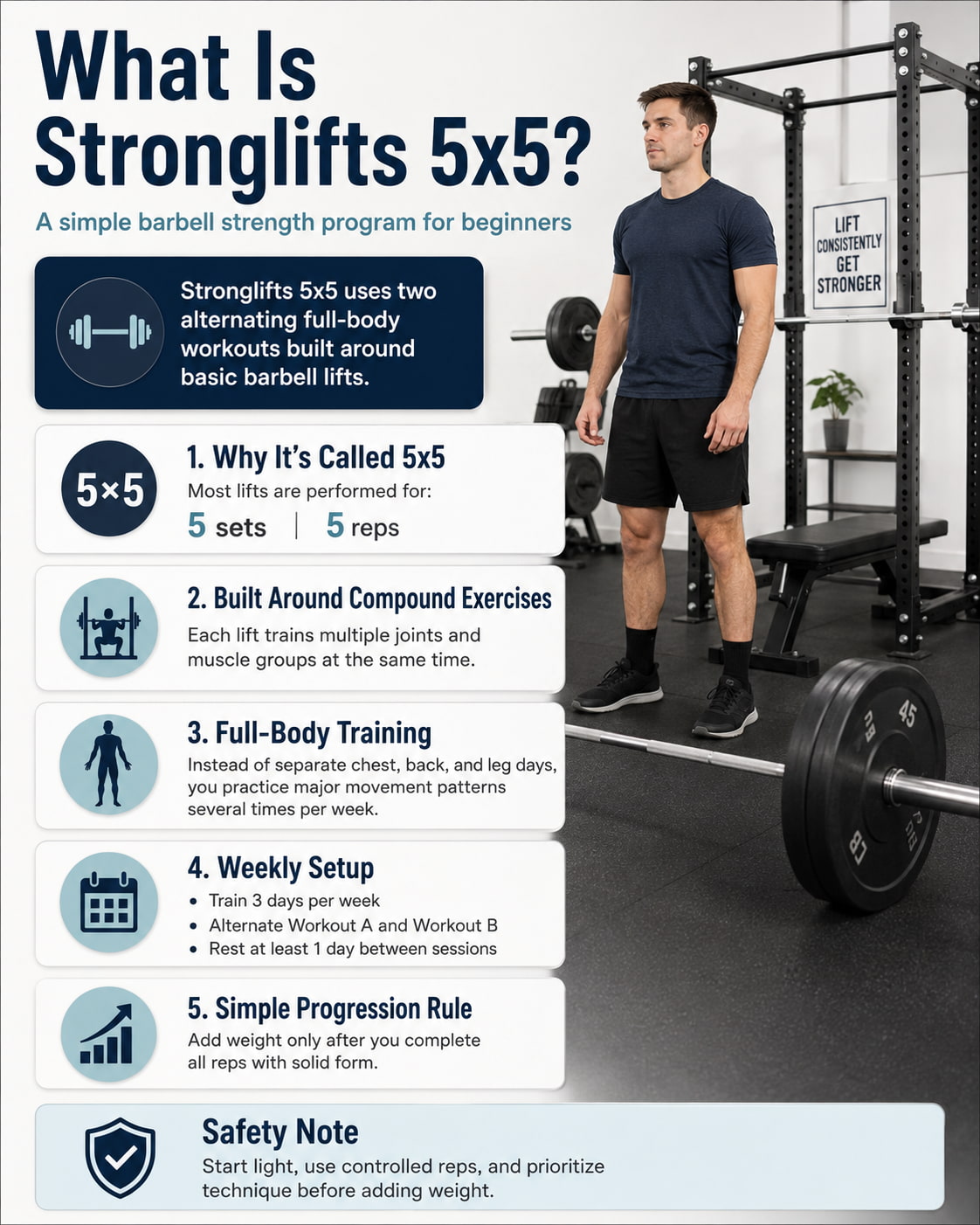
Stronglifts 5×5 is a beginner-friendly barbell program that uses two alternating workouts. Most lifts are performed for five sets of five reps, which is why the program is called 5×5.
The routine is built around compound exercises. That means each lift trains multiple joints and muscle groups at the same time. Instead of splitting the body into chest day, back day, and leg day, Stronglifts uses full-body training so you practice major movement patterns several times per week.
The official Stronglifts 5×5 workout program uses three weekly workouts, at least one rest day between sessions, and a simple rule: add weight only after you complete the required reps with solid form.
Stronglifts 5×5 Workout Plan
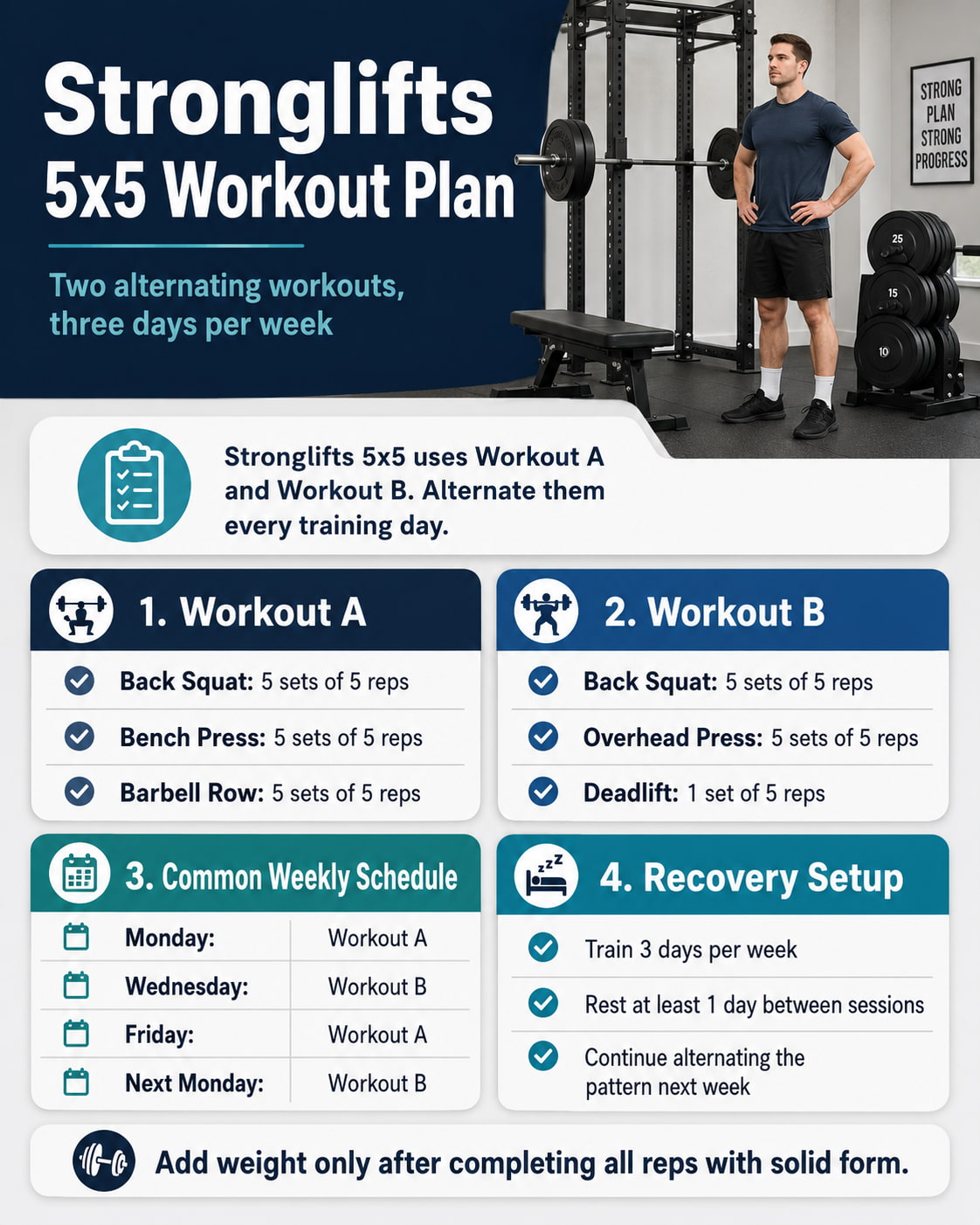
Stronglifts 5×5 uses Workout A and Workout B. You alternate them every training day.
| Workout A | Sets and reps |
|---|---|
| Back Squat | 5 sets of 5 reps |
| Bench Press | 5 sets of 5 reps |
| Barbell Row | 5 sets of 5 reps |
| Workout B | Sets and reps |
|---|---|
| Back Squat | 5 sets of 5 reps |
| Overhead Press | 5 sets of 5 reps |
| Deadlift | 1 set of 5 reps |
A common weekly schedule looks like this:
| Day | Workout |
|---|---|
| Monday | Workout A |
| Wednesday | Workout B |
| Friday | Workout A |
| Next Monday | Workout B |
This setup gives you three strength sessions per week with recovery days between workouts. The following week continues the alternating pattern.
Why Deadlift Is 1×5 Instead of 5×5
Deadlifts are different because they are usually performed after squats and overhead presses in Workout B. By that point, your legs, hips, back, grip, and core have already done a lot of work.
One heavy set of five reps is enough for most beginners because deadlifts are demanding and use a lot of muscle mass. You still warm up with lighter deadlift sets before your top set, but the main work set is 1×5.
Stronglifts 5×5 Exercises and Muscles Worked
1. Back Squat
Best for: Building lower-body strength, practicing full-body bracing, and training a repeatable squat pattern.
Muscles worked: The squat mainly trains the quadriceps, glutes, adductors, hamstrings, calves, spinal erectors, core, and upper back.
Equipment needed: Barbell, weight plates, squat rack, and safety pins or safety arms.
Why it stands out: The squat is the anchor lift in Stronglifts 5×5 because it appears in every workout. It trains the legs hard while also teaching posture, breathing, bracing, balance, and bar control.
Suggested sets and reps: Use 5 sets of 5 reps in both Workout A and Workout B.
Beginners: Start light enough that every rep looks controlled. Many new lifters begin with the empty bar, but a goblet squat or bodyweight box squat can be useful if the barbell is too heavy or form is not ready.
Intermediate: Use smaller weight jumps when the lift becomes challenging. Focus on repeatable depth, stable knees, and strong bracing before adding more load.
Advanced: Stronglifts 5×5 is usually too basic as a long-term advanced plan. Advanced lifters may need more variation, planned volume changes, and specific intensity work.
Rest: Rest about 2 to 5 minutes between work sets depending on difficulty. Easy sets need less rest, while heavy sets need more.
How to do it:
- Set the bar in a rack around upper-chest height.
- Step under the bar and place it firmly across your upper back, not on your neck.
- Grip the bar, brace your upper back, and stand tall to unrack it.
- Step back carefully and set your feet about shoulder-width apart.
- Brace your core, bend your knees and hips, and squat down under control.
- Keep your heels grounded and knees tracking in line with your toes.
- Drive through your feet to stand back up with control.
Common mistakes: Starting too heavy, cutting depth short, letting the knees collapse inward, relaxing the upper back, bouncing out of the bottom, and turning the squat into a good morning.
Expert tip: Treat every warm-up set like practice. If your empty-bar reps look sloppy, heavier work sets will usually make the problem worse.
Exercise variations: High-bar squat, low-bar squat, front squat, pause squat, box squat, and goblet squat.
Easier variation: Goblet squat or box squat.
Harder variation: Pause squat or front squat.
2. Bench Press
Best for: Building upper-body pressing strength and training the chest, shoulders, and triceps.
Muscles worked: The bench press mainly trains the pectorals, anterior deltoids, triceps, upper back stabilizers, forearms, and core.
Equipment needed: Barbell, flat bench, rack, weight plates, and a spotter or safety setup when possible.
Why it stands out: Bench press gives Stronglifts 5×5 a heavy horizontal pushing movement. It balances the barbell row in Workout A and helps build pressing strength with a simple progression.
Suggested sets and reps: Use 5 sets of 5 reps in Workout A.
Beginners: Start with a weight you can control from the rack to the chest and back up without twisting, bouncing, or losing shoulder position.
Intermediate: Use microloading when 5 lb jumps become too large. Bench press often stalls sooner than squats because smaller muscles are involved.
Advanced: Advanced lifters usually need more bench frequency, paused work, close-grip work, or volume variation than basic 5×5 provides.
Rest: Rest 2 to 5 minutes between work sets. Use longer rest when bar speed slows or the last reps are difficult.
How to do it:
- Lie on the bench with your eyes under the bar.
- Set your feet firmly on the floor.
- Grip the bar slightly wider than shoulder-width.
- Pull your shoulder blades back and keep your upper back tight.
- Unrack the bar and hold it over your chest with straight arms.
- Lower the bar under control toward your lower chest or sternum area.
- Press the bar back up while keeping your feet planted and shoulders stable.
Common mistakes: Bouncing the bar off the chest, flaring the elbows too aggressively, lifting the hips off the bench, relaxing the upper back, and using a grip that feels unstable.
Expert tip: Think “push yourself into the bench” instead of only pushing the bar up. A stable upper back makes the press stronger and safer.
Exercise variations: Pause bench press, close-grip bench press, incline bench press, dumbbell bench press, and push-up.
Easier variation: Push-up from an incline or dumbbell bench press with light weights.
Harder variation: Paused bench press or close-grip bench press.
3. Barbell Row
Best for: Building upper-back strength and balancing the pressing work in the program.
Muscles worked: The barbell row trains the lats, middle traps, rhomboids, rear delts, biceps, forearms, spinal erectors, hamstrings, glutes, and core.
Equipment needed: Barbell and weight plates.
Why it stands out: Strong rows help support better pulling strength, upper-back control, and shoulder balance. In Stronglifts 5×5, rows are the main horizontal pulling exercise.
Suggested sets and reps: Use 5 sets of 5 reps in Workout A.
Beginners: Start light enough to keep your back flat and torso position consistent. Do not turn each rep into a lower-back swing.
Intermediate: Use controlled reps and smaller weight jumps when your torso starts rising too much. The goal is a strong row, not a sloppy hip drive.
Advanced: More advanced lifters may rotate row variations or add chest-supported rows to build the back without extra lower-back fatigue.
Rest: Rest 2 to 4 minutes between work sets.
How to do it:
- Stand with your feet around hip-width to shoulder-width apart.
- Hinge at your hips and let the bar hang below your shoulders.
- Keep your back flat, chest slightly up, and core braced.
- Pull the bar toward your lower ribs or upper stomach.
- Squeeze your shoulder blades back without shrugging hard.
- Lower the bar under control to the starting position.
Common mistakes: Rounding the lower back, jerking the weight, standing too upright, pulling with only the arms, and letting the bar drift away from the body.
Expert tip: Set your hinge before every set. If you cannot hold the position, reduce the load or use a chest-supported row temporarily.
Exercise variations: Pendlay row, bent-over row, chest-supported row, one-arm dumbbell row, and cable row.
Easier variation: Chest-supported dumbbell row.
Harder variation: Strict Pendlay row from the floor.
4. Overhead Press
Best for: Building shoulder strength, triceps strength, core stiffness, and standing pressing control.
Muscles worked: The overhead press trains the shoulders, triceps, upper chest, traps, serratus anterior, upper back, forearms, glutes, and core.
Equipment needed: Barbell, weight plates, and rack.
Why it stands out: Overhead press is one of the hardest lifts to progress because it uses smaller muscle groups than the squat or deadlift. It teaches full-body tension while pressing weight overhead.
Suggested sets and reps: Use 5 sets of 5 reps in Workout B.
Beginners: Start very light. The empty bar may be too heavy for some lifters, so a lighter bar or dumbbells can help build the pattern first.
Intermediate: Use microplates when progress slows. Smaller jumps are especially helpful for overhead press because 5 lb can feel like a large increase.
Advanced: Advanced lifters may need more pressing volume, push press variations, paused reps, or accessory work for triceps and upper back.
Rest: Rest 2 to 5 minutes between work sets.
How to do it:
- Set the bar at upper-chest height in a rack.
- Grip the bar just outside shoulder-width.
- Unrack the bar and hold it at the front of your shoulders.
- Brace your abs and squeeze your glutes.
- Press the bar upward in a straight path.
- Move your head slightly back as the bar passes your face.
- Finish with the bar overhead, arms locked out, and ribs down.
- Lower the bar under control to your shoulders.
Common mistakes: Leaning back too much, turning the lift into a standing incline press, flaring the ribs, pressing around the face instead of moving the head, and using weight that is too heavy.
Expert tip: Before each rep, squeeze your glutes and brace your abs. A stronger trunk gives your shoulders a better platform to press from.
Exercise variations: Seated overhead press, dumbbell shoulder press, push press, landmine press, and Z press.
Easier variation: Dumbbell shoulder press or landmine press.
Harder variation: Pause overhead press or strict press with slower tempo.
5. Deadlift
Best for: Building posterior-chain strength, grip strength, hip extension, and full-body pulling power.
Muscles worked: The deadlift trains the glutes, hamstrings, spinal erectors, lats, traps, quads, adductors, forearms, and core.
Equipment needed: Barbell and weight plates.
Why it stands out: Deadlift is the heaviest pulling movement in Stronglifts 5×5. It strengthens the hips and back side of the body while teaching you to brace and lift from the floor.
Suggested sets and reps: Use 1 set of 5 reps in Workout B after warm-up sets.
Beginners: Start with a weight that allows the bar to begin at a proper height. If standard plates are unavailable, use blocks or a rack pull height that lets you maintain a flat back.
Intermediate: Keep the bar close, control your setup, and avoid turning the lift into a rushed pull. If grip limits you before your legs and hips do, use chalk if your gym allows it.
Advanced: Advanced lifters usually need more planned deadlift volume and intensity management than one basic top set each week.
Rest: Rest about 3 to 5 minutes before your heavy set. Warm-up sets usually need shorter rests.
How to do it:
- Stand with the bar over the middle of your feet.
- Set your feet about hip-width apart.
- Hinge down and grip the bar just outside your legs.
- Bring your shins close to the bar and brace your core.
- Keep your back flat and chest proud without overextending.
- Push the floor away and stand tall with the bar close to your body.
- Lock out by extending your hips, not by leaning backward.
- Lower the bar under control while keeping it close.
Common mistakes: Starting with the bar too far forward, rounding the back, yanking the bar off the floor, leaning back at lockout, bending the elbows, and doing too many heavy sets too soon.
Expert tip: The deadlift starts before the bar moves. Build tension, brace hard, and make the first inch smooth.
Exercise variations: Romanian deadlift, trap-bar deadlift, rack pull, pause deadlift, and sumo deadlift.
Easier variation: Trap-bar deadlift or block pull.
Harder variation: Pause deadlift or deficit deadlift.
How to Start Stronglifts 5×5
Start lighter than your ego wants. The first few weeks should feel like skill practice, not max testing. This gives you time to learn the lifts, improve your setup, and build momentum before the weights become challenging.
For many beginners, the empty Olympic bar is enough for squat, bench press, and overhead press. Rows and deadlifts may need slightly more weight so the bar starts at a useful height from the floor. If the barbell is too heavy, use dumbbells, a lighter training bar, or a simpler variation until your form is ready.
Use an effort level around RPE 6 to 7 during the first week. That means the sets should feel controlled, with several reps left in reserve. Stronglifts gets heavier quickly, so there is no need to force hard reps on day one.
How Stronglifts 5×5 Progression Works
The basic progression rule is simple: when you complete all your prescribed reps with good form, add weight next time you perform that lift.
Most lifters use small jumps, such as 5 lb total on the bar. Smaller jumps can work better for bench press, overhead press, and barbell row because those lifts usually progress more slowly than the squat and deadlift.
| Result | What to do next |
|---|---|
| You complete every rep with good form | Add a small amount of weight next time |
| You miss one or more reps | Repeat the same weight next time |
| You repeat the weight and improve reps | Stay patient and keep working |
| You miss the same lift repeatedly | Check form, rest, sleep, food, and weight jumps |
| You are stuck for weeks despite good recovery | Consider smaller jumps, deloading, or moving to a more flexible plan |
A missed rep is not a disaster. It is feedback. It may mean the weight is heavy enough now, your rest periods are too short, your technique needs work, or your recovery is not keeping up.
Warm-Up for Stronglifts 5×5
Do not walk into the gym and immediately load your work weight. Warm-up sets prepare your joints, muscles, breathing, and technique.
A simple warm-up can include 5 minutes of easy cardio, light mobility for the hips and shoulders, and several lighter sets of the first lift. For example, if your squat work weight is 135 lb, you might do the empty bar first, then a few gradual warm-up sets before starting 5×5.
Warm-up sets should not exhaust you. They should make your work sets feel smoother.
Common Stronglifts 5×5 Mistakes
Starting Too Heavy
This is the biggest mistake. If the first week feels like a test, the program will become difficult too soon. Start light, build clean reps, and let progression do its job.
Adding Weight After Bad Reps
Do not add weight just because you technically survived the set. If your depth disappeared, your back rounded, or your spotter had to help, repeat the weight.
Resting Too Little
Stronglifts is not circuit training. Heavy sets of five need enough rest for strength performance. If you rush every set, your form and reps will drop.
Ignoring Technique
The program is simple, but the lifts are not automatically easy. Squat, bench press, row, overhead press, and deadlift all require practice. Record your sets when possible or ask a qualified coach to check your form.
Adding Too Many Extra Exercises
A few accessories can be useful later, but beginners often add too much too soon. Extra curls, dips, lunges, ab circuits, and conditioning can interfere with recovery if the main lifts are already hard.
Beginner Modifications and Progressions
Stronglifts 5×5 works best when the lifter can perform the main barbell lifts safely. If you are not ready for a lift, use a simpler variation first.
| Main lift | Beginner option | Progression target |
|---|---|---|
| Back Squat | Goblet squat or box squat | Barbell back squat |
| Bench Press | Push-up or dumbbell bench press | Barbell bench press |
| Barbell Row | Chest-supported row | Barbell row |
| Overhead Press | Dumbbell press or landmine press | Barbell overhead press |
| Deadlift | Trap-bar deadlift or block pull | Barbell deadlift from the floor |
Progress when you can control the movement, keep the target muscles working, and finish your sets without sharp pain or major form breakdown.
Sample Stronglifts 5×5 Weekly Routine
| Day | Exercise | Sets and reps | Rest | Effort |
|---|---|---|---|---|
| Monday | Squat, Bench Press, Barbell Row | 5×5 each | 2–5 min | RPE 6–8 |
| Wednesday | Squat, Overhead Press, Deadlift | Squat 5×5, Press 5×5, Deadlift 1×5 | 2–5 min | RPE 6–8 |
| Friday | Squat, Bench Press, Barbell Row | 5×5 each | 2–5 min | RPE 6–8 |
Train three times per week on non-consecutive days. Add weight only when all target reps are completed with solid form. If a lift feels too heavy or form breaks down, repeat the same weight next time instead of forcing a jump.
Who Should Use Stronglifts 5×5?
Stronglifts 5×5 is a strong fit for beginners, returning lifters, and people who want a clear barbell plan without complicated exercise selection.
It may not be the best fit if you cannot recover from squatting three times per week, do not have access to a rack and barbell setup, need sport-specific programming, or have pain that changes how you need to train.
The CDC recommends that adults perform muscle-strengthening activity on two or more days per week, and the American College of Sports Medicine has emphasized that resistance-training variables should match the goal. Stronglifts is one structured way to train strength, but it is not the only effective option.
Safety Tips for Stronglifts 5×5
Use safety pins for squats when possible. Use a spotter or safe bench setup for heavier bench press sets. Keep the training area clear, secure the plates when needed, and do not sacrifice form to add weight faster.
Stop the exercise and seek professional help if you feel sharp pain, numbness, dizziness, chest pain, or unusual symptoms. Muscle effort is normal during strength training. Sharp or unusual symptoms are not something to push through.
FAQs About Stronglifts 5×5
Is Stronglifts 5×5 good for beginners?
Yes, Stronglifts 5×5 can be useful for beginners because it uses a simple schedule, repeatable lifts, and clear progression. Beginners still need to start light, learn proper form, and use safe equipment.
Can Stronglifts 5×5 build muscle?
Yes, Stronglifts 5×5 can help build muscle, especially for new lifters. It uses compound lifts, repeated weekly practice, and progressive overload. Lifters focused mainly on bodybuilding may eventually need more exercise variety and weekly volume.
How long should I do Stronglifts 5×5?
Use it as long as you are progressing with good form and recovering well. When you can no longer add weight despite good sleep, nutrition, technique, and effort, it may be time to reduce jumps, adjust volume, or move to an intermediate plan.
What weight should I start with?
Start with a weight that feels easy and controlled. Many beginners start with the empty bar for squat, bench press, and overhead press. If that is too heavy, use a lighter bar, dumbbells, or a simpler variation.
What should I do if I fail a set?
Repeat the same weight next time. Do not add weight after missed reps. Also check your rest time, sleep, food intake, technique, and whether your weight jumps are too large.
Can I do cardio with Stronglifts 5×5?
Yes, but keep it controlled at first. Easy walking, cycling, or light conditioning on rest days is usually easier to recover from than hard intervals or long exhausting sessions.
Is Stronglifts 5×5 enough for arms and abs?
The main lifts train the arms and core indirectly, but they do not isolate them much. Beginners should prioritize the main lifts first. Later, small amounts of direct arm or core work can be added if recovery stays good.
Conclusion
Stronglifts 5×5 works because it keeps training simple: practice the big barbell lifts, train three days per week, and add weight gradually when your reps are strong. Start light, use clean form, rest enough between sets, and treat missed reps as feedback instead of failure.
If you want a simple strength plan, Stronglifts 5×5 is a practical place to start. Run it patiently, track every workout, and progress only as fast as your technique allows.
This content is for informational purposes only and is not a substitute for professional medical advice.