Barbell exercises for shoulders can help you build stronger delts, improve overhead strength, and add structure to your upper-body training when you use the right movements with good form. The best barbell shoulder exercises are not just heavy presses. A complete shoulder plan should train the front delts, side delts, rear delts, upper traps, triceps, and the stabilizing muscles that help control the shoulder blades.
In this guide, you will learn the best barbell shoulder exercises, how to do each one, which muscles they target, common mistakes to avoid, and how to build a practical workout for strength and size.
What Muscles Do Barbell Shoulder Exercises Work?
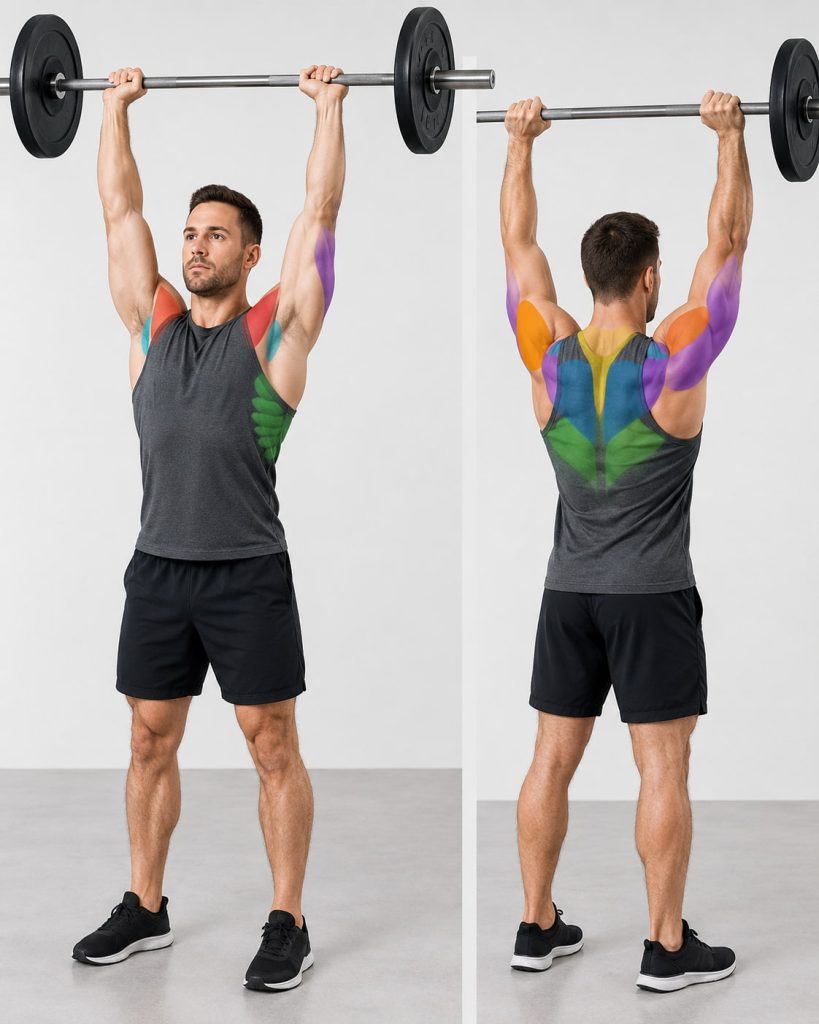
Barbell shoulder training mainly targets the deltoids, which are the rounded muscles covering the shoulder joint. The deltoids have three main sections.
The anterior deltoid is the front part of the shoulder. It works hard during overhead presses, push presses, front raises, and most pressing exercises.
The lateral deltoid is the middle part of the shoulder. It helps raise the arm out to the side and contributes to wider-looking shoulders. Barbell exercises do not isolate the side delts as cleanly as dumbbell or cable lateral raises, but wide-grip upright rows, high pulls, and some landmine movements can still challenge this area.
The posterior deltoid is the rear part of the shoulder. It helps pull the upper arm backward and supports shoulder balance. Rear-delt rows and incline rows are important because many barbell shoulder routines become too front-delt dominant.
The triceps assist during pressing. The upper traps help elevate and stabilize the shoulder girdle. The rotator cuff, serratus anterior, rhomboids, and lower traps help control the shoulder blades during pressing and rowing. ACE’s deltoid training research supports using more than one exercise because no single shoulder movement trains all three deltoid heads equally well. ACE Fitness also notes the value of including rear-delt-focused work instead of relying only on presses.
12 Best Barbell Exercises for Shoulders
Barbell shoulder exercises are best used to build pressing strength, stronger delts, and better upper-body control. The exercises below include heavy presses, landmine variations, rear-delt rows, and controlled accessories to train the shoulders more completely.
1. Standing Barbell Overhead Press
Best for: Building strict shoulder strength, front-delt size, triceps strength, and full-body bracing.
Muscles worked: Anterior deltoids, lateral deltoids, triceps, upper traps, upper chest, serratus anterior, rotator cuff, spinal erectors, and core.
Equipment needed: Barbell, weight plates, collars, and a squat rack or power rack.
Why it stands out: The standing barbell overhead press is one of the best foundational shoulder exercises because it trains the delts while forcing the core, glutes, and upper back to stabilize the body. It is a pure strength movement when performed without leg drive.
Suggested sets and reps: Use 3 to 5 sets of 3 to 8 reps for strength or 3 to 4 sets of 6 to 10 reps for muscle growth.
Beginners: Start with an empty bar, training bar, or lighter fixed barbell. Practice a smooth bar path before adding weight.
Intermediate: Use controlled working sets with 1 to 3 reps in reserve. Add small weight jumps only when every rep stays clean.
Advanced: Use heavier top sets, pause reps, or tempo eccentrics, but avoid excessive back arching.
Rest: Rest 2 to 3 minutes for heavy sets and 90 to 120 seconds for moderate-rep sets.
How to do it:
- Set the bar in a rack around upper-chest height.
- Grip the bar slightly wider than shoulder-width.
- Unrack the bar and hold it at the upper chest with wrists stacked over elbows.
- Brace your core, squeeze your glutes, and keep your ribs down.
- Press the bar upward while moving your head slightly back.
- Drive the bar overhead until your arms are straight and the bar is stacked over your midfoot.
- Lower the bar under control back to the upper chest.
Common mistakes: The biggest mistakes are leaning back too far, pressing the bar forward, flaring the elbows too wide, letting the wrists bend backward, and turning the movement into a standing incline press.
Expert tip: Think “press up and slightly back.” The bar should finish over your shoulders, hips, and midfoot, not out in front of your face.
Exercise variations: Try pause overhead presses, tempo overhead presses, pin presses, or strict presses from a seated position.
Easier variation: Use a seated barbell press, landmine press, or dumbbell shoulder press.
Harder variation: Use a paused standing press, Z press, or heavy push press after strict pressing work.
2. Seated Barbell Shoulder Press
Best for: Training the shoulders with more torso support and less lower-body involvement.
Muscles worked: Anterior deltoids, lateral deltoids, triceps, upper traps, upper chest, rotator cuff, and upper back.
Equipment needed: Barbell, bench with back support, rack, plates, and collars.
Why it stands out: The seated barbell shoulder press reduces the amount of leg and hip movement you can use. This makes it easier to focus on pressing strength through the shoulders and triceps.
Suggested sets and reps: Use 3 to 4 sets of 6 to 10 reps for strength and hypertrophy.
Beginners: Use a light load and stop the bar around chin or upper-chest level if your shoulders do not tolerate a deeper range.
Intermediate: Lower the bar with control and keep your back against the bench without turning the exercise into a high-incline bench press.
Advanced: Add a slow lowering phase or paused reps near the bottom position.
Rest: Rest 90 to 180 seconds between sets.
How to do it:
- Set a bench inside a rack with the bar around upper-chest height.
- Sit tall with your feet flat on the floor.
- Grip the bar slightly wider than shoulder-width.
- Unrack the bar and hold it near the upper chest or collarbone.
- Brace your core and press the bar overhead.
- Finish with your arms straight and the bar stacked above your shoulders.
- Lower the bar slowly to the starting position.
Common mistakes: Common errors include using too much weight, bouncing the bar off the chest, over-arching the lower back, and letting the elbows drift too far behind the bar.
Expert tip: Keep your elbows slightly forward of the bar at the bottom. This usually creates a stronger and more comfortable pressing position.
Exercise variations: Use a military-style seated press, high-incline barbell press, Smith machine shoulder press, or seated pin press.
Easier variation: Use a landmine press or machine shoulder press.
Harder variation: Use a seated press without back support or a Z press.
3. Barbell Push Press
Best for: Building shoulder power, heavier overhead strength, and athletic coordination.
Muscles worked: Deltoids, triceps, upper traps, quadriceps, glutes, calves, spinal erectors, and core.
Equipment needed: Barbell, plates, collars, and a rack.
Why it stands out: The push press lets you use your legs to help drive the bar overhead. This allows heavier loading than a strict press and helps train force transfer from the lower body into the upper body. CrossFit describes the push press as a shoulder-to-overhead movement that begins with a shallow dip, followed by rapid hip and knee extension before the arms finish the press. CrossFit highlights its value for upper-body pressing strength, power, and coordination.
Suggested sets and reps: Use 3 to 5 sets of 3 to 6 reps for power or 3 to 4 sets of 5 to 8 reps for strength.
Beginners: Learn the strict press first. Then practice the dip and drive with an empty bar.
Intermediate: Use the push press as your first main lift after warming up.
Advanced: Use heavy triples, cluster sets, or speed-focused sets, but keep the dip controlled and vertical.
Rest: Rest 2 to 3 minutes between heavy sets.
How to do it:
- Hold the bar at your shoulders with your feet about hip- to shoulder-width apart.
- Brace your core and keep your torso upright.
- Dip straight down by bending your knees slightly.
- Drive hard through your legs and hips.
- Use the upward momentum to press the bar overhead.
- Lock the bar out overhead with control.
- Lower the bar back to your shoulders before starting the next rep.
Common mistakes: Many lifters dip too deep, lean forward, let the knees cave inward, press too early, or catch the bar poorly on the way down.
Expert tip: Keep the dip short and vertical. Think “dip, drive, press” instead of turning it into a squat.
Exercise variations: Try push press from the rack, push press from blocks, behind-the-neck push press for advanced weightlifters, or single-arm landmine push press.
Easier variation: Use a light landmine push press.
Harder variation: Use a push jerk or heavy barbell push press after building strong strict-press mechanics.
4. Barbell Z Press
Best for: Strict shoulder strength, core control, posture, and reducing leg drive.
Muscles worked: Anterior deltoids, lateral deltoids, triceps, upper traps, upper back, deep core, hip flexors, and spinal erectors.
Equipment needed: Barbell, plates, collars, and a rack or blocks.
Why it stands out: The Z press is performed seated on the floor with your legs straight. Because you cannot use leg drive or much lower-back extension, it exposes weak bracing, poor overhead mobility, and unstable pressing mechanics quickly.
Suggested sets and reps: Use 3 to 4 sets of 4 to 8 reps.
Beginners: This is not the best first shoulder press. Start with seated barbell presses or landmine presses.
Intermediate: Use light to moderate loading and focus on staying tall through the torso.
Advanced: Use paused reps or slow eccentrics, but avoid leaning backward to finish reps.
Rest: Rest 2 to 3 minutes between sets.
How to do it:
- Sit on the floor with your legs straight and spread slightly apart.
- Set the bar at shoulder height in a rack or on blocks.
- Grip the bar slightly wider than shoulder-width.
- Brace your core and sit tall.
- Press the bar overhead without leaning back.
- Lock out with the bar over your shoulders.
- Lower the bar under control to the starting position.
Common mistakes: Common mistakes include slouching, leaning back, bending the knees excessively, losing core tension, and using a load that is too heavy for strict control.
Expert tip: If you cannot sit tall with your legs straight, elevate your hips slightly on a plate or choose a seated shoulder press instead.
Exercise variations: Try kettlebell Z presses, dumbbell Z presses, or single-arm landmine Z presses.
Easier variation: Use a seated barbell shoulder press with back support.
Harder variation: Use a paused Z press or strict Z press from pins.
5. Two-Hand Landmine Press
Best for: Shoulder-friendly pressing, beginners, lifters with limited overhead mobility, and front-delt training.
Muscles worked: Anterior deltoids, upper chest, triceps, serratus anterior, core, and upper traps.
Equipment needed: Barbell, landmine attachment or secure corner setup, plates, and collars.
Why it stands out: The landmine press moves on an angled path instead of a fully vertical path. This can make it easier to control for lifters who struggle with overhead pressing. ACE describes landmine training as using a fixed barbell end while the free end moves through an arc, creating a blend of vertical and horizontal force. ACE Fitness includes landmine pressing as a useful training option because the fixed bar creates a more guided movement path.
Suggested sets and reps: Use 3 to 4 sets of 8 to 12 reps.
Beginners: Start with the empty barbell or a very light plate. Focus on control rather than load.
Intermediate: Use it after your main press or as your main shoulder press if vertical pressing feels uncomfortable.
Advanced: Use heavier sets, pauses, or a slight athletic stance for stronger drive.
Rest: Rest 60 to 120 seconds between sets.
How to do it:
- Secure one end of the barbell in a landmine attachment or stable corner.
- Hold the free end of the bar with both hands at upper-chest height.
- Stand with your feet about shoulder-width apart.
- Brace your core and keep your ribs down.
- Press the bar upward and forward along its natural arc.
- Finish with your arms extended without shrugging aggressively.
- Lower the bar slowly back to your chest.
Common mistakes: Avoid leaning too far into the bar, letting the lower back arch, flaring the elbows, and pressing so high that you lose control of your ribs.
Expert tip: Let the shoulder blade move naturally as you press. Do not pin your shoulders down so hard that the movement feels stiff.
Exercise variations: Try tall-kneeling landmine press, half-kneeling landmine press, split-stance landmine press, or single-arm landmine press.
Easier variation: Use a shorter range of motion or lighter load.
Harder variation: Use a single-arm landmine press or landmine push press.
6. Half-Kneeling Single-Arm Landmine Press
Best for: Single-arm shoulder strength, core stability, anti-rotation control, and shoulder-friendly pressing.
Muscles worked: Anterior deltoids, lateral deltoids, triceps, serratus anterior, obliques, glutes, and upper back.
Equipment needed: Barbell, landmine attachment or secure corner setup, plates, and collars.
Why it stands out: The half-kneeling position helps reduce lower-back compensation and forces the core and hips to stabilize. It also lets each shoulder work independently, which can help reveal side-to-side strength differences.
Suggested sets and reps: Use 3 to 4 sets of 8 to 12 reps per side.
Beginners: Start with the empty bar and press slowly. Keep the front foot flat and the back knee cushioned.
Intermediate: Use this as a secondary shoulder press after your main barbell press.
Advanced: Add pauses at the top or bottom, or use heavier loads while keeping the torso still.
Rest: Rest 60 to 90 seconds between sides or 90 to 120 seconds between full rounds.
How to do it:
- Set up a barbell in a landmine attachment.
- Kneel with the leg opposite the pressing arm forward.
- Hold the end of the bar at shoulder height with one hand.
- Brace your core and squeeze the glute of the kneeling-side leg.
- Press the bar upward and forward.
- Keep your torso from rotating as you press.
- Lower the bar with control to shoulder height.
Common mistakes: Common mistakes include rotating the torso, arching the lower back, letting the front knee cave inward, and turning the press into a chest-dominant movement.
Expert tip: Imagine your ribs and pelvis are stacked. Press with your shoulder without letting your body twist.
Exercise variations: Try tall-kneeling landmine press, standing single-arm landmine press, split-stance landmine press, or landmine push press.
Easier variation: Use a two-hand landmine press.
Harder variation: Use a standing single-arm landmine press with a heavier load.
7. Barbell Front Raise
Best for: Front-delt isolation and light shoulder accessory work.
Muscles worked: Anterior deltoids, upper chest, serratus anterior, traps, and core.
Equipment needed: Light barbell, fixed barbell, or unloaded training bar.
Why it stands out: The barbell front raise directly targets the front delts. It can be useful as an accessory, but most lifters already get plenty of front-delt work from presses, bench presses, push-ups, and incline presses.
Suggested sets and reps: Use 2 to 3 sets of 10 to 15 reps with light to moderate weight.
Beginners: Use a very light fixed barbell or skip this exercise if pressing already gives your shoulders enough work.
Intermediate: Add it near the end of the workout after heavier pressing.
Advanced: Use slow tempo reps, but do not chase heavy weight on this movement.
Rest: Rest 45 to 75 seconds between sets.
How to do it:
- Stand tall and hold a light barbell in front of your thighs.
- Use an overhand grip around shoulder-width apart.
- Brace your core and keep your elbows slightly bent.
- Raise the bar forward to about shoulder height.
- Pause briefly without shrugging hard.
- Lower the bar slowly back to your thighs.
Common mistakes: Avoid swinging the bar, leaning backward, raising the bar too high, using a heavy load, or turning the movement into a lower-back exercise.
Expert tip: If your front delts are already tired from pressing, do not force this exercise. Side-delt and rear-delt work may be more useful.
Exercise variations: Try plate front raises, dumbbell front raises, cable front raises, or landmine front raises.
Easier variation: Use a lighter fixed barbell or a single weight plate.
Harder variation: Use a slow 3-second lowering phase.
8. Wide-Grip Barbell Upright Row
Best for: Side delts, upper traps, and controlled shoulder accessory work when tolerated well.
Muscles worked: Lateral deltoids, anterior deltoids, upper traps, biceps, forearms, and upper back.
Equipment needed: Barbell or EZ-bar.
Why it stands out: The upright row can train the side delts and traps, but it must be programmed carefully. ACE has warned that traditional barbell upright rows may bother some shoulders because of the arm position used during the movement. ACE Fitness recommends reconsidering movements that create unnecessary shoulder stress for certain lifters.
Suggested sets and reps: Use 2 to 3 sets of 10 to 15 reps with light to moderate weight.
Beginners: Skip this exercise if it causes pinching or discomfort. Use lateral raises, landmine presses, or rear-delt rows instead.
Intermediate: Use a wider grip and stop around lower-chest height instead of pulling the bar high toward the chin.
Advanced: Use controlled tempo reps and moderate loading. Do not force range of motion.
Rest: Rest 60 to 90 seconds between sets.
How to do it:
- Stand tall and hold the barbell with a grip wider than shoulder-width.
- Let the bar rest in front of your thighs.
- Brace your core and keep your chest tall.
- Pull the bar upward by leading with your elbows.
- Stop around lower-chest height or before discomfort appears.
- Lower the bar slowly back to the starting position.
Common mistakes: The main mistakes are using a narrow grip, pulling too high, shrugging aggressively, swinging the body, and ignoring shoulder pinching.
Expert tip: This exercise should feel like side delts and traps working, not a sharp pinch in the front or top of the shoulder.
Exercise variations: Try EZ-bar upright rows, cable upright rows, dumbbell upright rows, or high pulls.
Easier variation: Use a cable lateral raise, dumbbell lateral raise, or landmine lateral-style raise.
Harder variation: Use a barbell high pull only if you already have good pulling mechanics and shoulder tolerance.
9. Barbell High Pull
Best for: Shoulder power, upper traps, athletic pulling, and advanced shoulder-girdle training.
Muscles worked: Lateral deltoids, posterior deltoids, upper traps, biceps, forearms, glutes, hamstrings, quads, spinal erectors, and core.
Equipment needed: Barbell, plates, and collars.
Why it stands out: The high pull trains explosive hip drive and upper-body pulling together. It can build powerful shoulders and traps, but it is more technical than a standard shoulder exercise.
Suggested sets and reps: Use 3 to 5 sets of 3 to 6 reps with crisp speed.
Beginners: Avoid this exercise until you can hinge, deadlift, and row with good control.
Intermediate: Start from the hang position with light weight and focus on timing.
Advanced: Use hang high pulls or clean-grip high pulls for power development.
Rest: Rest 2 to 3 minutes between sets.
How to do it:
- Stand with the bar in front of your thighs using a clean-width grip.
- Hinge slightly at the hips while keeping your back neutral.
- Drive through your legs and extend your hips powerfully.
- Pull the bar upward close to your body.
- Let your elbows rise high and outside without forcing a painful position.
- Lower the bar under control and reset before the next rep.
Common mistakes: Common errors include pulling mostly with the arms, letting the bar drift forward, using too much weight, catching the shoulders in a painful position, and turning the movement into a sloppy upright row.
Expert tip: The power should come from the legs and hips first. The arms guide the bar after the lower body creates momentum.
Exercise variations: Try hang high pulls, clean pulls, snatch-grip high pulls, or landmine high pulls.
Easier variation: Use a barbell upright row with a controlled range or a chest-supported rear-delt row.
Harder variation: Use clean high pulls from blocks or hang positions.
10. Barbell Rear-Delt Row
Best for: Rear delts, upper-back thickness, shoulder balance, and posture support.
Muscles worked: Posterior deltoids, rhomboids, middle traps, lower traps, lats, biceps, forearms, and spinal erectors.
Equipment needed: Barbell, plates, and collars.
Why it stands out: Rear-delt rows help balance all the pressing in most shoulder programs. Instead of only building the front of the shoulder, this movement strengthens the back side of the delts and upper back.
Suggested sets and reps: Use 3 to 4 sets of 8 to 15 reps.
Beginners: Start light and learn to hinge with a neutral spine before loading the bar.
Intermediate: Use this after presses or on a pull day to add rear-delt volume.
Advanced: Use pauses near the top or slow eccentrics to reduce momentum.
Rest: Rest 60 to 120 seconds between sets.
How to do it:
- Hold a barbell with a wider-than-shoulder-width grip.
- Hinge at your hips until your torso is angled forward.
- Keep your back neutral and core braced.
- Pull the bar toward your upper chest or lower sternum.
- Keep your elbows out wider than a standard row.
- Squeeze your rear delts and upper back at the top.
- Lower the bar slowly without rounding your back.
Common mistakes: Avoid standing too upright, using too much body swing, pulling to the stomach like a lat row, shrugging excessively, and losing your hinge position.
Expert tip: Think about pulling your elbows out and back, not just pulling the bar with your hands.
Exercise variations: Try chest-supported rear-delt rows, seal rows, wide-grip bent-over rows, or incline bench rows.
Easier variation: Use a chest-supported dumbbell rear-delt row.
Harder variation: Use a paused barbell rear-delt row or a stricter torso angle.
11. 45-Degree Incline Barbell Row to Upper Chest
Best for: Rear delts, upper back, shoulder balance, and reducing lower-back fatigue during rows.
Muscles worked: Posterior deltoids, lateral deltoids, rhomboids, middle traps, lower traps, lats, biceps, and forearms.
Equipment needed: Barbell, incline bench, plates, and collars.
Why it stands out: This row supports your chest on an incline bench, which reduces the need to hold a bent-over position. ACE’s deltoid research found that the 45-degree incline row performed well for shoulder muscle activity, especially when rear-delt and upper-back training are needed. ACE Fitness supports using rows as part of a complete delt plan rather than relying only on pressing.
Suggested sets and reps: Use 3 to 4 sets of 8 to 12 reps.
Beginners: Use light weight and focus on pulling to the upper chest with control.
Intermediate: Use it as your main rear-delt and upper-back exercise in a shoulder workout.
Advanced: Add a 1-second pause at the top of each rep.
Rest: Rest 60 to 120 seconds between sets.
How to do it:
- Set an incline bench around 30 to 45 degrees.
- Lie chest-down on the bench with your feet stable.
- Hold the barbell with a wider-than-shoulder-width grip.
- Let your arms hang toward the floor.
- Pull the bar toward your upper chest.
- Keep your elbows angled out from your body.
- Lower the bar slowly until your arms are extended.
Common mistakes: Common mistakes include pulling too low toward the stomach, lifting the chest off the bench, jerking the bar, and turning the exercise into a lat-focused row.
Expert tip: Pull toward the upper chest and think about moving your upper arms, not just your hands.
Exercise variations: Try dumbbell incline rows, seal rows, chest-supported T-bar rows, or wide-grip machine rows.
Easier variation: Use dumbbells or a lighter fixed barbell.
Harder variation: Use a pause at the top or a slower 3-second lowering phase.
12. Light Barbell Cuban Press
Best for: Shoulder control, light accessory work, external-rotation strength, and warm-up practice for advanced lifters.
Muscles worked: Rear delts, rotator cuff, lateral delts, upper traps, lower traps, and triceps.
Equipment needed: Very light barbell, training bar, or fixed barbell.
Why it stands out: The Cuban press combines a high pull, external rotation, and overhead press pattern. It is not a heavy strength exercise. It works best as a light control drill or accessory for lifters who can move through the range comfortably.
Suggested sets and reps: Use 2 to 3 sets of 8 to 12 reps with very light weight.
Beginners: Most beginners should skip this exercise and use band external rotations, face pulls, or light rear-delt work first.
Intermediate: Use a very light bar and move slowly.
Advanced: Use it as a warm-up or accessory, not as a max-effort lift.
Rest: Rest 45 to 75 seconds between sets.
How to do it:
- Stand tall and hold a very light barbell in front of your thighs.
- Pull the bar upward like a wide-grip upright row.
- Stop when your elbows are around shoulder height.
- Rotate your forearms upward until the bar is near forehead level.
- Press the bar overhead with control.
- Reverse the movement slowly back to the starting position.
Common mistakes: Avoid using heavy weight, forcing the rotation, rushing the movement, arching the lower back, and continuing if the shoulder feels pinched.
Expert tip: Treat this as a skill and control drill. If you need momentum, the load is too heavy.
Exercise variations: Try dumbbell Cuban presses, band external rotations, cable external rotations, or face pulls.
Easier variation: Use band external rotations or a light dumbbell Cuban rotation without the press.
Harder variation: Use slower tempo reps, but keep the load light.
How to Choose the Best Barbell Exercises for Shoulders
Choose barbell shoulder exercises based on your goal, skill level, mobility, and comfort.
- For strength, start with standing overhead presses, seated presses, or push presses.
- For muscle growth, combine a heavy press with moderate-rep landmine presses, rows, and lighter accessories.
- For shoulder-friendly training, landmine presses are often easier to control than fully vertical overhead presses because the bar moves on an angled path.
- For beginners, use an empty bar, training bar, light fixed barbell, or landmine setup before adding heavy weight.
- For advanced lifters, barbell push presses, high pulls, and Z presses can add variety, but only when strict pressing mechanics are already solid.
Stop the set if you feel sharp pain, numbness, tingling, dizziness, chest pain, or unusual symptoms. Mayo Clinic advises urgent medical help when shoulder pain appears with symptoms such as breathing difficulty, chest tightness, or sweating. Mayo Clinic also recommends medical attention for intense shoulder pain, sudden swelling, or inability to use the arm.
Benefits of Barbell Exercises for Shoulders
They Build Overhead Pressing Strength
The barbell lets you train strict overhead strength with progressive overload. Because both hands hold one bar, you can often use more total load than you would with single-arm tools. This makes barbell presses useful for building stronger front delts, triceps, upper chest, upper back, and core stability.
They Are Easy to Progress
Barbell exercises are simple to track. You can add small amounts of weight, improve reps, increase sets, slow the tempo, or improve your range of motion over time. That makes them useful for both strength and muscle-building goals.
They Train the Upper Body as a System
A good barbell shoulder workout is not only about the delts. Presses, landmine movements, high pulls, and rows also train the upper back, traps, arms, trunk, and posture muscles. This helps the shoulders work with the rest of the body instead of becoming an isolated weak point.
They Support Balanced Shoulder Development
A complete routine should include pressing and pulling. Heavy presses are excellent for strength, but too much pressing without rear-delt and upper-back work can leave the shoulders feeling unbalanced. Include rear-delt rows, incline rows, and controlled accessory work to build a more complete shoulder program.
Sample Barbell Shoulder Workout
This routine is best for beginner to intermediate lifters who want stronger, more muscular shoulders with balanced delt development.
| Exercise | Sets | Reps | Rest | Effort |
|---|---|---|---|---|
| Standing Barbell Overhead Press | 4 | 5 to 8 | 2 to 3 minutes | 1 to 3 reps in reserve |
| 45-Degree Incline Barbell Row to Upper Chest | 3 | 8 to 12 | 90 seconds | 1 to 3 reps in reserve |
| Half-Kneeling Single-Arm Landmine Press | 3 | 8 to 10 per side | 60 to 90 seconds | Controlled |
| Wide-Grip Barbell Upright Row or Barbell Rear-Delt Row | 2 to 3 | 10 to 15 | 60 to 90 seconds | No shoulder pinching |
| Light Barbell Cuban Press | 2 | 10 to 12 | 45 to 75 seconds | Very light and smooth |
Train this workout 1 to 2 times per week. If you already do a lot of bench pressing, incline pressing, or push-ups, you may need less front-delt work and more rear-delt or upper-back work.
For muscle growth, ACSM’s updated resistance training guidance notes that higher weekly volume can support hypertrophy and gives roughly 10 weekly sets per muscle group as a useful target. ACSM also emphasizes training major muscle groups at least twice weekly as part of a complete resistance training plan.
Common Mistakes to Avoid
Pressing With Too Much Lower-Back Arch
A small natural arch is normal, but excessive leaning turns the overhead press into a standing incline press. Brace your core, squeeze your glutes, and keep your ribs stacked over your pelvis.
Training Only the Front Delts
Presses are valuable, but they heavily involve the front delts. To build balanced shoulders, include rear-delt rows, incline rows, landmine presses, and upper-back work.
Pulling Upright Rows Too High
A high upright row can bother some shoulders. Use a wider grip, moderate weight, and a range of motion that feels smooth. Stop if you feel pinching.
Using Momentum on Accessory Exercises
Front raises, Cuban presses, and rear-delt rows should not be ego lifts. Use controlled reps and lighter weight so the target muscles do the work.
Ignoring Pain Signals
Muscle fatigue is normal. Sharp pain, numbness, tingling, dizziness, chest pain, or unusual symptoms are not normal training signals. Stop the exercise and seek professional help if these occur.
How to Progress Barbell Shoulder Training
Start by improving form before adding load. Once your reps look consistent, use small jumps in weight. For upper-body barbell work, even 2.5 to 5 pounds can be enough progress.
- For strength, add weight when you can complete all sets at the top of your rep range with clean form.
- For example, if your plan is 4 sets of 5 to 8 reps and you can complete 8 reps on every set, add a small amount of weight next time.
- For muscle growth, progress by adding reps first, then load. You can also add one extra set to a key exercise if recovery is good. Keep most sets 1 to 3 reps away from failure. Shoulder exercises often break down quickly when every set is pushed too hard.
- For better shoulder balance, track your pulling and rear-delt work. A simple rule is to include at least one rear-delt or upper-back movement for every heavy pressing movement in your shoulder routine.
Beginner, Intermediate, and Advanced Use
Beginner
Beginners should focus on the standing overhead press, seated barbell press, two-hand landmine press, and light rear-delt rows. Use an empty bar or light fixed barbell. Keep reps smooth and stop before form breaks down.
Intermediate
Intermediate lifters can combine a heavy press with landmine pressing and rear-delt work. A strong setup would include one main press, one landmine press, one row to the upper chest, and one light accessory.
Advanced
Advanced lifters can use push presses, high pulls, Z presses, and paused pressing variations. These exercises require better bracing, shoulder control, and load management. Advanced training should still include rear-delt and upper-back work to balance heavy pressing.
FAQs About Barbell Exercises for Shoulders
What is the best barbell exercise for shoulders?
The standing barbell overhead press is the best overall barbell shoulder exercise for strict strength. It trains the delts, triceps, upper back, and core together. However, it should not be your only shoulder exercise because it mostly emphasizes the front delts.
Can you build shoulders with only a barbell?
Yes, you can build stronger shoulders with only a barbell, especially if you use presses, landmine presses, rear-delt rows, and incline rows. However, dumbbells, cables, and bands can be better for isolating the side delts and training certain shoulder angles.
Do barbell shoulder exercises work all three delt heads?
They can, but not equally. Presses mainly train the front delts. Upright-row and high-pull patterns can involve the side delts. Rear-delt rows and incline rows are better for the posterior delts. A complete routine should include more than one movement pattern.
Are barbell upright rows bad for shoulders?
They are not automatically bad for everyone, but they can bother some lifters. A wider grip, lighter load, and lower pulling height may make them more comfortable. If upright rows cause pinching or pain, choose lateral raises, landmine presses, or rear-delt rows instead.
How often should I train shoulders with a barbell?
Most lifters can train shoulders directly 1 to 2 times per week. Your total shoulder workload also includes bench presses, incline presses, push-ups, rows, and pull-ups. If your shoulders feel constantly sore or cranky, reduce pressing volume and add more recovery.
What should I do if overhead pressing hurts my shoulders?
Stop pressing through pain. Try a lighter load, shorter range of motion, landmine press, or neutral-grip dumbbell press. If pain is sharp, persistent, or comes with numbness, weakness, chest pain, dizziness, or unusual symptoms, seek professional medical guidance.
Conclusion
Barbell exercises for shoulders are most effective when you use them with balance. Heavy overhead presses build strength, landmine presses offer a controlled angled path, and rear-delt rows help keep your shoulders from becoming too front-dominant.
Start with exercises you can control, use a full but comfortable range of motion, and progress gradually. Strong delts are built with smart pressing, consistent pulling, clean technique, and enough recovery.
This content is for informational purposes only and is not a substitute for professional medical advice.
References
- ACSM: Resistance Training Guidelines Update
- ACE Fitness: Smart Shoulder Solutions for Training the Deltoids
- ACE Fitness: A Pro’s Guide to Muscle Mechanics: The Shoulders
- ACE Fitness: The ACE Workout Builder for Landmine Training
- ACE Fitness: Is Your Exercise Selection Helping or Hurting Your Clients?
- CSCCa: Barbell Overhead Press
- Mayo Clinic: Shoulder Pain, When to See a Doctor