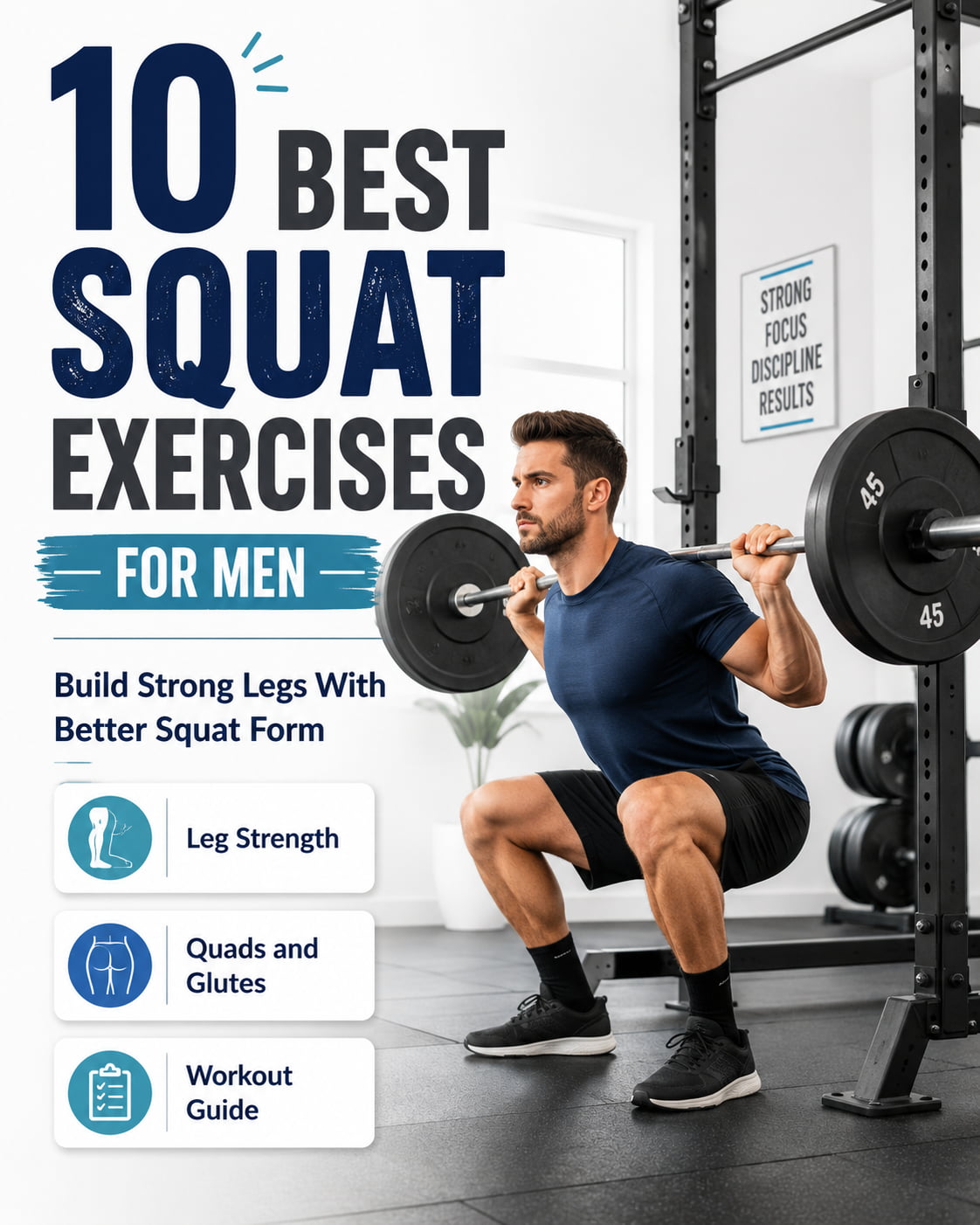
Squat exercises for men are some of the most effective lower-body movements for building stronger legs, improving athletic power, and developing better full-body control. The best squat variation depends on your goal, equipment, mobility, and training experience.
A good squat workout should train more than just the quads. It should also challenge the glutes, hamstrings, adductors, calves, core, and upper back while teaching you how to move with control.
This guide covers the best squat exercises for men, how to do each one correctly, common mistakes to avoid, and how to use them in a real leg workout.
Squat Exercises for Men: What Makes a Squat Worth Doing?
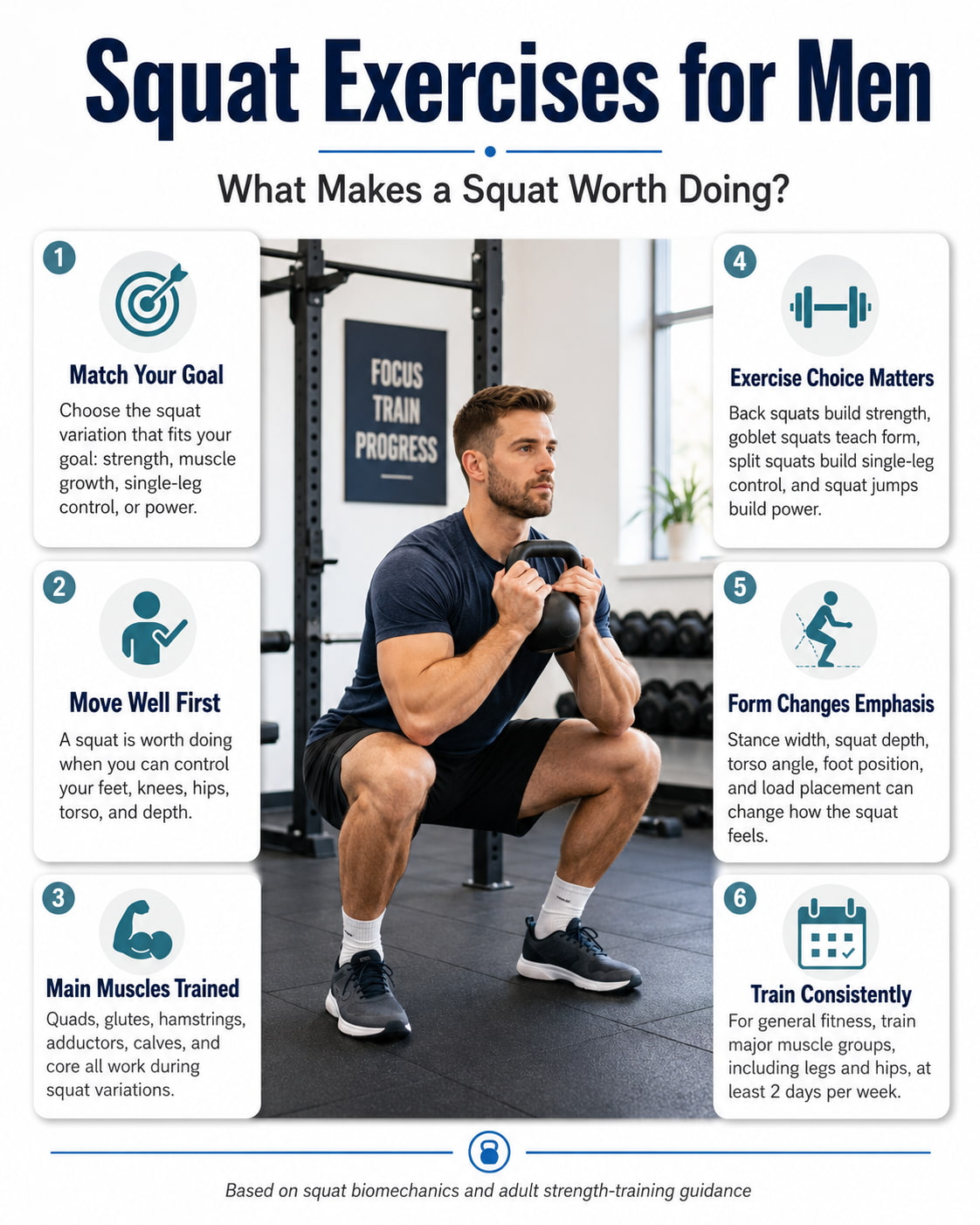
A squat is worth doing when it matches your training goal and allows you to move well. A heavy barbell back squat can be great for strength, but it is not always the best starting point. A goblet squat may be better for learning form. A Bulgarian split squat may be better for single-leg strength. A squat jump may be better for power.
Most squat variations train the quadriceps, glutes, hamstrings, adductors, calves, and core to some degree. The exact emphasis changes based on stance width, squat depth, torso angle, load position, and equipment. A biomechanical review published in the International Journal of Sports Physical Therapy notes that squat demands can change when you adjust stance width, foot rotation, trunk position, tibia position, and depth.
For general fitness, the CDC recommends muscle-strengthening activities at least 2 days per week that work all major muscle groups, including the legs and hips. That does not mean every workout needs to be heavy. It means your training should be consistent, progressive, and balanced.
Quick Form Checklist Before You Load Any Squat
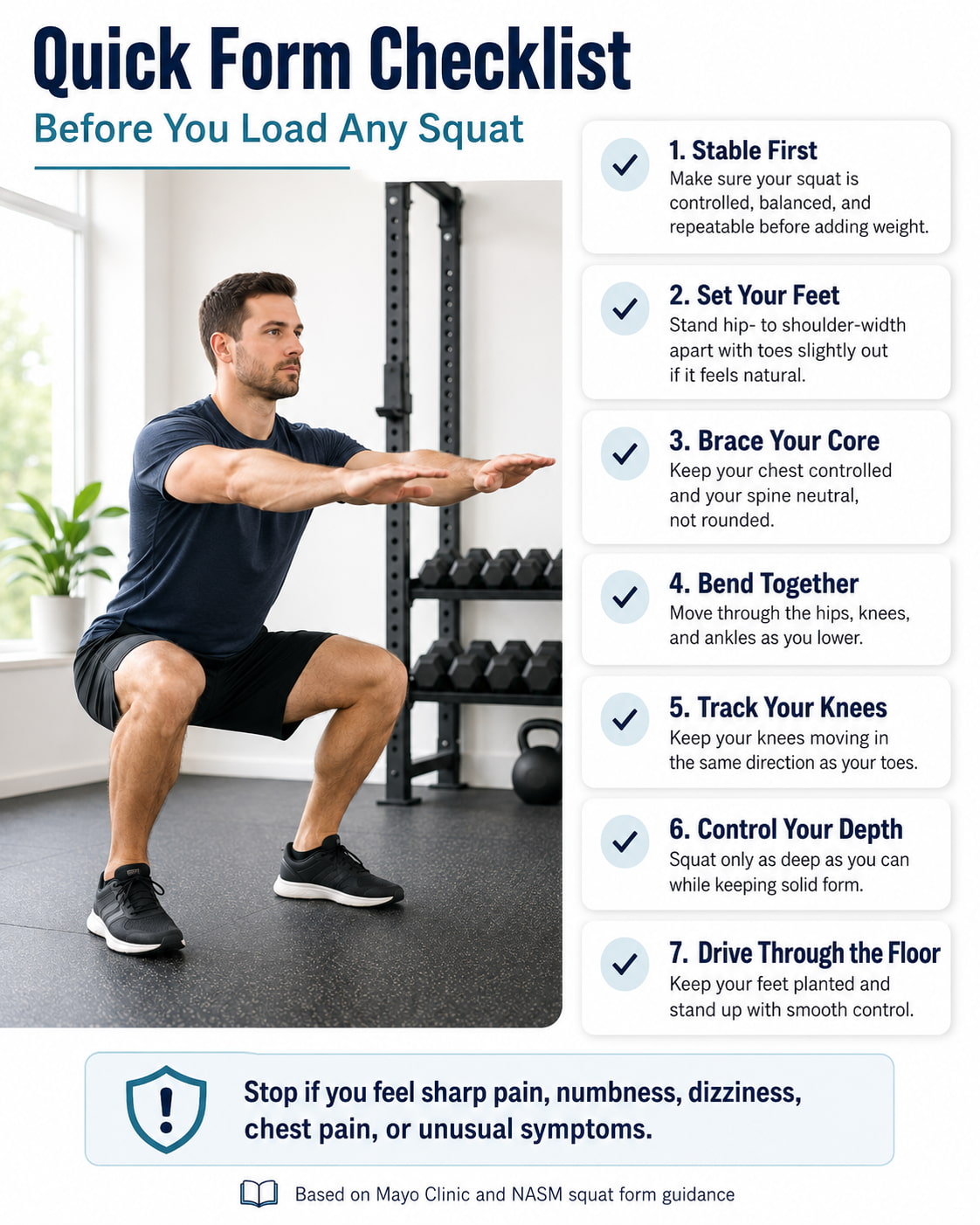
Before adding weight, make sure your squat is stable and repeatable.
Start with your feet around hip-width to shoulder-width apart. Point your toes slightly out if that feels natural for your hips. Keep your chest tall, brace your core, and keep your spine controlled rather than rounded.
As you descend, bend through the hips, knees, and ankles together. Keep your feet planted. Let your knees track in the same direction as your toes. Lower only as far as you can while keeping control, then drive through the floor to stand.
Mayo Clinic’s squat guidance emphasizes smooth control, stable posture, and keeping the knees centered over the feet during dumbbell squats. NASM also highlights common squat compensations such as knee valgus, foot collapse, heels lifting, and excessive forward lean.
Stop and seek professional help if squats cause sharp pain, numbness, dizziness, chest pain, severe shortness of breath, or unusual symptoms.
10 Best Squat Exercises for Men
The best squat exercises for men help build stronger quads, glutes, hamstrings, and core strength while improving lower-body power and control.
Below are 10 effective squat variations you can use for strength, muscle growth, athletic performance, or beginner-friendly leg training.
1. Bodyweight Squat
Best for: Learning squat form, warming up, beginner leg training, conditioning, and high-rep control.
Muscles worked: Quadriceps, glutes, hamstrings, adductors, calves, core, and spinal stabilizers.
Why it stands out: The bodyweight squat is the base pattern for almost every loaded squat. It teaches depth, balance, knee tracking, and torso control without adding external weight.
Suggested sets and reps: Use 2–4 sets of 10–20 reps. For warm-ups, use 1–2 easy sets of 8–12 reps.
Beginners: Use a chair or box behind you. Sit back lightly, stand tall, and focus on smooth reps.
Intermediate: Use a slower tempo, such as 3 seconds down and 1 second up, to make the movement more challenging.
Advanced: Use pause squats, high-rep sets, or bodyweight squat finishers after heavier leg work.
Rest: Rest 30–90 seconds depending on whether you use it as a warm-up, skill drill, or conditioning movement.
How to do it:
- Stand with your feet about hip-width to shoulder-width apart.
- Brace your core and keep your chest lifted.
- Bend your hips and knees together as you lower.
- Keep your feet flat and knees tracking over your toes.
- Lower to a depth you can control.
- Push through your feet and stand tall.
Common mistakes: Rushing the reps, letting the knees cave inward, lifting the heels, rounding the back, or dropping into a depth you cannot control.
Expert tip: Think “sit between your heels,” not just “push your hips back.” This helps you keep the squat balanced.
Exercise variations: Prisoner squat, pause squat, tempo squat, chair squat, and narrow-stance squat.
Easier variation: Chair squat.
Harder variation: Pause bodyweight squat or jump squat.
2. Goblet Squat
Best for: Beginners, home workouts, learning upright squat mechanics, and building quads and glutes with simple equipment.
Muscles worked: Quadriceps, glutes, hamstrings, adductors, calves, core, upper back, and forearms.
Equipment needed: Dumbbell or kettlebell.
Why it stands out: The goblet squat is one of the best loaded squat exercises for men because the front-held weight encourages a more upright torso and makes it easier to feel balance. ACE describes the goblet squat as a dumbbell exercise for the butt, hips, and thighs.
Suggested sets and reps: Use 3–4 sets of 8–12 reps for muscle growth or 2–3 sets of 10–15 reps for general fitness.
Beginners: Start with a light dumbbell and focus on reaching the same depth on every rep.
Intermediate: Use a heavier weight and pause for 1 second at the bottom.
Advanced: Use slow eccentrics, 1.5 reps, or heels-elevated goblet squats for more quad emphasis.
Rest: Rest 60–120 seconds between sets.
How to do it:
- Hold a dumbbell vertically at chest height.
- Keep your elbows close to your ribs.
- Stand with your feet about shoulder-width apart.
- Brace your core and lower into a squat.
- Keep your chest tall and knees tracking with your toes.
- Push the floor away and return to standing.
Common mistakes: Letting the weight drift away from the chest, rounding the upper back, rising onto the toes, or turning the movement into a shallow knee bend.
Expert tip: Keep the dumbbell close to your sternum. If the weight pulls you forward, it is probably too heavy for clean reps.
Exercise variations: Kettlebell goblet squat, heels-elevated goblet squat, pause goblet squat, and goblet box squat.
Easier variation: Bodyweight squat or goblet squat to a box.
Harder variation: Double kettlebell front squat.
3. Barbell Back Squat
Best for: Building lower-body strength, training heavy loads, improving full-body bracing, and developing strong quads and glutes.
Muscles worked: Quadriceps, glutes, adductors, hamstrings, calves, spinal erectors, core, and upper back.
Equipment needed: Barbell, weight plates, squat rack, and safety pins or spotter arms.
Why it stands out: The barbell back squat lets you use heavier loads than most squat variations. It is a strong choice for men who want to build leg strength, improve lifting performance, or make the squat a main lower-body strength movement.
Suggested sets and reps: Use 3–5 sets of 3–6 reps for strength or 3–4 sets of 6–10 reps for muscle growth.
Beginners: Learn with bodyweight squats and goblet squats first. Use an empty bar only when your form is consistent.
Intermediate: Train with moderate loads and leave 1–3 reps in reserve on most sets.
Advanced: Use heavy sets, pause squats, tempo squats, or periodized strength blocks.
Rest: Rest 2–4 minutes for heavy sets and 90–150 seconds for moderate hypertrophy sets.
How to do it:
- Set the bar on a rack around upper-chest height.
- Position the bar across your upper back.
- Grip the bar evenly and brace your core.
- Step back and set your feet about shoulder-width apart.
- Lower under control while keeping your feet planted.
- Drive up through the floor and stand tall.
Common mistakes: Going too heavy too soon, losing core tension, letting the knees cave inward, bouncing out of the bottom, or cutting depth short without a reason.
Expert tip: Treat every rep like a full-body lift. Tight upper back, tight core, stable feet, and controlled breathing matter as much as leg strength.
Exercise variations: High-bar back squat, low-bar back squat, pause back squat, tempo back squat, and pin squat.
Easier variation: Goblet squat or box squat.
Harder variation: Pause back squat or heavy low-bar back squat.
4. Front Squat
Best for: Quad strength, upright posture, core control, and lifters who want a front-loaded barbell squat.
Muscles worked: Quadriceps, glutes, adductors, hamstrings, calves, core, upper back, and spinal stabilizers.
Equipment needed: Barbell, squat rack, and weight plates.
Why it stands out: The front squat places the load in front of your body, which usually forces a more upright torso than a back squat. This can make it a strong option for quad-focused training and full-body bracing.
Suggested sets and reps: Use 3–5 sets of 3–6 reps for strength or 3–4 sets of 6–10 reps for muscle growth.
Beginners: Start with a goblet squat or dumbbell front squat before using a barbell.
Intermediate: Use clean, controlled reps and practice keeping the elbows high throughout the set.
Advanced: Use pause front squats, tempo front squats, or heavy triples with excellent bracing.
Rest: Rest 2–3 minutes for strength work and 90–150 seconds for moderate sets.
How to do it:
- Set the bar across the front of your shoulders.
- Keep your elbows high and upper arms close to parallel with the floor.
- Brace your core and stand tall.
- Squat down while keeping your torso upright.
- Keep your knees tracking over your toes.
- Drive through your feet and return to standing.
Common mistakes: Dropping the elbows, letting the bar roll forward, collapsing through the upper back, or using a grip that strains the wrists.
Expert tip: Drive your elbows up as you come out of the bottom. This keeps the bar secure and helps prevent your torso from folding forward.
Exercise variations: Clean-grip front squat, cross-arm front squat, strap-assisted front squat, pause front squat, and tempo front squat.
Easier variation: Goblet squat or dumbbell front squat.
Harder variation: Pause front squat.
5. Dumbbell Front Squat
Best for: Home workouts, dumbbell-only leg training, quad-focused squats, and lifters without a barbell.
Muscles worked: Quadriceps, glutes, hamstrings, adductors, calves, core, shoulders, and upper back.
Equipment needed: Pair of dumbbells.
Why it stands out: The dumbbell front squat is easier to set up than a barbell front squat but still trains upright squat mechanics. NASM describes it as a lower-body compound exercise that places the load in front of the body, emphasizes the quadriceps, and challenges core stability.
Suggested sets and reps: Use 3–4 sets of 8–12 reps or 2–3 sets of 12–15 reps for lighter dumbbell training.
Beginners: Use one dumbbell in a goblet position first.
Intermediate: Hold two dumbbells at shoulder height and use a controlled tempo.
Advanced: Use heavy dumbbells, slow eccentrics, or heels-elevated dumbbell front squats.
Rest: Rest 60–120 seconds between sets.
How to do it:
- Hold two dumbbells at shoulder height.
- Keep your elbows slightly forward and core braced.
- Stand with your feet about shoulder-width apart.
- Lower into a squat with control.
- Keep your torso tall and feet flat.
- Push through your feet and stand up smoothly.
Common mistakes: Letting the dumbbells pull the torso forward, dropping the elbows, rounding the upper back, or turning the reps into shallow squats.
Expert tip: Keep your ribs down and abs tight. The front-loaded position works best when your trunk stays strong.
Exercise variations: Single-dumbbell front squat, double dumbbell front squat, heels-elevated dumbbell front squat, and dumbbell box squat.
Easier variation: Goblet squat.
Harder variation: Double dumbbell front squat with a pause.
6. Box Squat
Best for: Learning depth control, building confidence, improving squat consistency, and reducing guesswork at the bottom.
Muscles worked: Quadriceps, glutes, hamstrings, adductors, calves, core, and spinal stabilizers.
Equipment needed: Box, bench, or sturdy platform. A barbell or dumbbell can be added when appropriate.
Why it stands out: The box squat gives you a clear target. It can help beginners learn where to stop and help experienced lifters build strength from a consistent depth.
Suggested sets and reps: Use 3–4 sets of 5–8 reps for strength practice or 2–4 sets of 8–12 reps for general leg training.
Beginners: Use a higher box and bodyweight only. Lower the box height over time as mobility and control improve.
Intermediate: Use a goblet or barbell box squat with controlled contact on the box.
Advanced: Use pause box squats, speed box squats, or heavier barbell box squats.
Rest: Rest 90–180 seconds depending on load.
How to do it:
- Stand in front of a box with your feet about shoulder-width apart.
- Brace your core and begin the squat.
- Sit back and down until your hips lightly touch the box.
- Keep tension instead of relaxing on the box.
- Drive through your feet and stand tall.
- Repeat with the same depth each rep.
Common mistakes: Plopping onto the box, rocking backward, relaxing the core, using a box that is too low, or letting the knees cave in.
Expert tip: Touch the box like it is a depth marker, not a chair. Stay tight and control the transition.
Exercise variations: Bodyweight box squat, goblet box squat, barbell box squat, pause box squat, and speed box squat.
Easier variation: Higher box squat.
Harder variation: Barbell pause box squat.
7. Sumo Squat
Best for: Wide-stance leg training, glute and adductor emphasis, inner-thigh strength, and lifters who feel better with a wider stance.
Muscles worked: Quadriceps, glutes, adductors, hamstrings, calves, core, and spinal stabilizers.
Equipment needed: Dumbbell, kettlebell, barbell, or no equipment.
Why it stands out: The sumo squat uses a wider stance and more hip external rotation than a standard squat. Research on back squat variations shows that stance width can influence joint demands and muscle emphasis, so the sumo squat can be useful when you want a wider-stance option.
Suggested sets and reps: Use 3–4 sets of 8–12 reps for strength and muscle growth or 2–3 sets of 12–15 reps for lighter training.
Beginners: Start with bodyweight and use a moderate stance rather than forcing an extreme width.
Intermediate: Hold a dumbbell or kettlebell in front of the body.
Advanced: Use a heavier dumbbell, kettlebell, or barbell variation while keeping the knees tracking with the toes.
Rest: Rest 60–120 seconds between sets.
How to do it:
- Stand wider than shoulder-width.
- Turn your toes slightly out.
- Brace your core and keep your chest tall.
- Lower by bending your hips and knees.
- Track your knees in the same direction as your toes.
- Push through your feet to stand.
Common mistakes: Going too wide, letting the arches collapse, forcing the knees inward, leaning too far forward, or losing control at the bottom.
Expert tip: Your stance should feel strong, not stretched. Widen only as much as you can control.
Exercise variations: Dumbbell sumo squat, kettlebell sumo squat, bodyweight sumo squat, and sumo box squat.
Easier variation: Bodyweight sumo squat.
Harder variation: Heavy dumbbell sumo squat or barbell sumo squat.
8. Bulgarian Split Squat
Best for: Single-leg strength, quad and glute growth, balance, athletic control, and fixing side-to-side strength gaps.
Muscles worked: Quadriceps, glutes, adductors, hamstrings, calves, core, and hip stabilizers.
Equipment needed: Bench or box. Dumbbells can be added.
Why it stands out: The Bulgarian split squat trains one leg at a time, which makes it one of the best squat exercises for men who want strong, balanced legs without always loading the spine heavily. ACE classifies the Bulgarian split squat as an advanced exercise using a bench and dumbbells.
Suggested sets and reps: Use 3–4 sets of 8–12 reps per leg.
Beginners: Start with a regular split squat with both feet on the floor.
Intermediate: Elevate the rear foot and use bodyweight or light dumbbells.
Advanced: Use heavier dumbbells, a slower tempo, or a 1-second pause near the bottom.
Rest: Rest 60–120 seconds between legs or sets.
How to do it:
- Stand a few feet in front of a bench.
- Place the top of one foot on the bench behind you.
- Keep your front foot flat and core braced.
- Lower your back knee toward the floor.
- Keep your front knee tracking over your toes.
- Drive through the front foot and return to standing.
Common mistakes: Standing too close to the bench, pushing mostly through the rear leg, letting the front knee collapse inward, or leaning forward without control.
Expert tip: Think of the back leg as a kickstand. The front leg should do most of the work.
Exercise variations: Bodyweight Bulgarian split squat, dumbbell Bulgarian split squat, front-foot elevated split squat, and pause Bulgarian split squat.
Easier variation: Regular split squat.
Harder variation: Dumbbell Bulgarian split squat with a slow lowering phase.
9. Hack Squat
Best for: Quad-focused gym training, stable machine squatting, higher-volume leg work, and reducing balance demands.
Muscles worked: Quadriceps, glutes, adductors, hamstrings, calves, and core.
Equipment needed: Hack squat machine or similar guided squat machine.
Why it stands out: The hack squat machine supports your body and guides the movement path. This makes it useful for training the legs hard without needing the same balance and bar control required by a free-weight squat.
Suggested sets and reps: Use 3–4 sets of 8–12 reps for muscle growth or 2–3 sets of 12–15 reps as an accessory movement.
Beginners: Use a light load and a comfortable range of motion. Learn the machine setup before adding weight.
Intermediate: Use controlled reps and stop 1–2 reps before form breaks.
Advanced: Use heavier sets, slow eccentrics, or high-rep finishers after free-weight squats.
Rest: Rest 90–150 seconds between sets.
How to do it:
- Set your shoulders and back against the machine pads.
- Place your feet firmly on the platform.
- Unlock the handles and brace your core.
- Lower under control to a safe depth.
- Keep your knees tracking over your toes.
- Push through your feet and extend your hips and knees.
Common mistakes: Placing the feet too low for your mobility, letting the heels lift, bouncing at the bottom, locking the knees aggressively, or loading the machine too heavily.
Expert tip: Control the bottom position. A machine gives support, but it does not replace good joint alignment.
Exercise variations: Narrow-stance hack squat, high-foot hack squat, pause hack squat, and machine squat.
Easier variation: Leg press or light machine squat.
Harder variation: Slow-tempo hack squat.
10. Squat Jump
Best for: Lower-body power, athletic explosiveness, conditioning, and teaching fast hip, knee, and ankle extension.
Muscles worked: Quadriceps, glutes, hamstrings, calves, core, and hip stabilizers.
Why it stands out: The squat jump turns the squat pattern into an explosive power exercise. ACE recommends learning how to squat and land properly before progressing to more advanced jumping drills.
Suggested sets and reps: Use 3–5 sets of 3–6 reps. Keep every rep fast and controlled.
Beginners: Start with fast bodyweight squats or small jump-and-stick landings.
Intermediate: Use regular squat jumps with full reset between reps.
Advanced: Use loaded jump squats only with proper coaching and light loads.
Rest: Rest 60–120 seconds between sets. Use longer rest when training for power.
How to do it:
- Stand with your feet about hip-width to shoulder-width apart.
- Brace your core and lower into a short squat.
- Drive through your feet and jump upward.
- Land softly with bent knees.
- Keep your knees tracking over your toes.
- Reset before the next rep.
Common mistakes: Doing too many reps, landing stiff-legged, letting the knees cave in, jumping while fatigued, or treating power work like cardio.
Expert tip: Stop the set when jump height or landing quality drops. Power training depends on quality, not exhaustion.
Exercise variations: Jump-and-stick landing, squat jump, box jump, and light loaded jump squat.
Easier variation: Fast bodyweight squat.
Harder variation: Box jump or light loaded squat jump.
How to Choose the Right Squat for Your Goal
For strength, choose the barbell back squat, front squat, or box squat. Use lower reps, heavier loads, longer rest, and clean technique.
For muscle growth, use goblet squats, dumbbell front squats, hack squats, Bulgarian split squats, and moderate-rep barbell squats. Use controlled reps and enough weekly volume.
For beginners, start with bodyweight squats, chair squats, goblet squats, and box squats. Build control first, then add load.
For athletic power, use squat jumps after a proper warm-up and before heavy fatigue. Keep the reps low and explosive.
For home workouts, use bodyweight squats, goblet squats, dumbbell front squats, sumo squats, and Bulgarian split squats.
ACSM’s updated resistance-training guidance emphasizes that load and volume should match the goal. Heavier loads are commonly used for strength, higher weekly volume supports hypertrophy, and moderate loads moved quickly are used for power.
Sample Squat Workout for Men
Beginner Squat Workout
| Exercise | Sets | Reps | Rest |
|---|---|---|---|
| Goblet Squat | 3 | 8–12 | 60–90 sec |
| Box Squat | 3 | 8–10 | 60–90 sec |
| Bodyweight Squat | 2 | 12–15 | 45–60 sec |
| Split Squat | 2 | 8–10 per leg | 60–90 sec |
Train this workout 1–2 times per week. Use an effort level around 6–7 out of 10. Add reps first, then add load when every set feels stable.
Intermediate Squat Workout
| Exercise | Sets | Reps | Rest |
|---|---|---|---|
| Barbell Back Squat | 4 | 5–8 | 2–3 min |
| Dumbbell Front Squat | 3 | 8–12 | 90 sec |
| Bulgarian Split Squat | 3 | 8–10 per leg | 90 sec |
| Squat Jump | 3 | 4–6 | 60–90 sec |
Train this workout 1–2 times per week. Do squat jumps early in the session, before heavy fatigue. Keep 1–3 reps in reserve on most strength sets.
Advanced Squat Workout
| Exercise | Sets | Reps | Rest |
|---|---|---|---|
| Front Squat or Back Squat | 5 | 3–6 | 2–4 min |
| Hack Squat | 4 | 8–12 | 90–150 sec |
| Bulgarian Split Squat | 3 | 8–10 per leg | 90 sec |
| Sumo Squat | 3 | 10–15 | 60–90 sec |
Use this as a focused lower-body session once per week, or rotate it with a second lower-body day that emphasizes hip hinges, hamstrings, calves, and glutes.
Common Squat Mistakes to Avoid
The biggest squat mistake is loading the movement before you own the pattern. If your knees collapse inward, heels lift, back rounds, or torso folds forward, lower the load and clean up the movement.
Do not force a depth you cannot control. Deep squats can be useful, but depth should match your mobility, strength, and goal. A controlled parallel squat is better than a deeper squat with poor posture.
Avoid rushing every rep. Slower lowering phases help you feel balance, control, and muscle tension. Explosive reps are useful for power work, but even then, landing and alignment matter.
Do not train every squat set to failure. Hard sets can build strength and muscle, but constant max-effort squatting can reduce technique quality and recovery. Most sets should stop with 1–3 good reps left in reserve.
How Often Should Men Do Squat Exercises?
Most men can train squat exercises 1–3 times per week depending on goal, volume, and recovery.
If you are a beginner, 1–2 squat sessions per week is usually enough. If you are intermediate, you may use one heavier squat day and one lighter or single-leg day. If you are advanced, you can rotate heavy, moderate, and accessory squat variations across the week.
You should not hammer the same muscles hard every day. Mayo Clinic advises resting trained muscles and avoiding training the same muscle groups hard on back-to-back days.
FAQs
What is the best squat exercise for men?
The best squat exercise for most men is the one they can perform consistently with good form. For beginners, the goblet squat is often the best starting point. For strength, the barbell back squat is a strong choice. For quad focus, front squats and hack squats work well.
Are squats enough to build strong legs?
Squats are excellent, but they are not the only movement you need. A complete leg program should also include hip hinges, lunges or split squats, calf work, and hamstring-focused exercises. Squats build a strong base, but balanced training gives better long-term results.
How many squat sets should I do per workout?
Most lifters do well with 3–6 hard squat sets per workout, plus accessory work if needed. Beginners may need less. Advanced lifters may need more total weekly volume, but only if recovery and technique stay strong.
Should beginners start with barbell squats?
Not always. Many beginners should start with bodyweight squats, chair squats, goblet squats, or box squats. These variations teach control before heavy loading.
Are front squats better than back squats?
Front squats are not automatically better. They usually encourage a more upright torso and can feel more quad-focused. Back squats usually allow heavier loads. The better choice depends on your goal, mobility, equipment, and comfort.
Can squats build glutes too?
Yes. Squats can train the glutes, especially when you use a controlled range of motion and drive the hips through the movement. Wider-stance squats, Bulgarian split squats, and deeper controlled squats may increase glute demand for many lifters.
Should I squat if my knees hurt?
Do not push through sharp pain. Reduce the load, shorten the range of motion, check your form, or choose a different variation. If knee pain continues or feels unusual, ask a qualified healthcare professional or physical therapist for guidance.
Conclusion
Squat exercises for men should be chosen with a purpose. Use bodyweight squats and goblet squats to build form, barbell squats and front squats for strength, Bulgarian split squats for single-leg control, hack squats for stable leg volume, and squat jumps for power.
Start with the variation you can perform well, progress gradually, and keep your reps controlled. Strong legs are built by consistent training, smart loading, and good technique.
This content is for informational purposes only and is not a substitute for professional medical advice.