Squat exercises for beginners are simple lower-body movements that help you build leg strength, improve balance, and learn how to sit down and stand up with better control. The best beginner squat variations teach proper form first, then gradually add range of motion, tempo, or light resistance.
This guide covers 11 beginner-friendly squat exercises, the muscles they work, how to do them correctly, common mistakes to avoid, and a simple workout routine you can use at home or in the gym.
What Makes Squat Exercises for Beginners Effective?
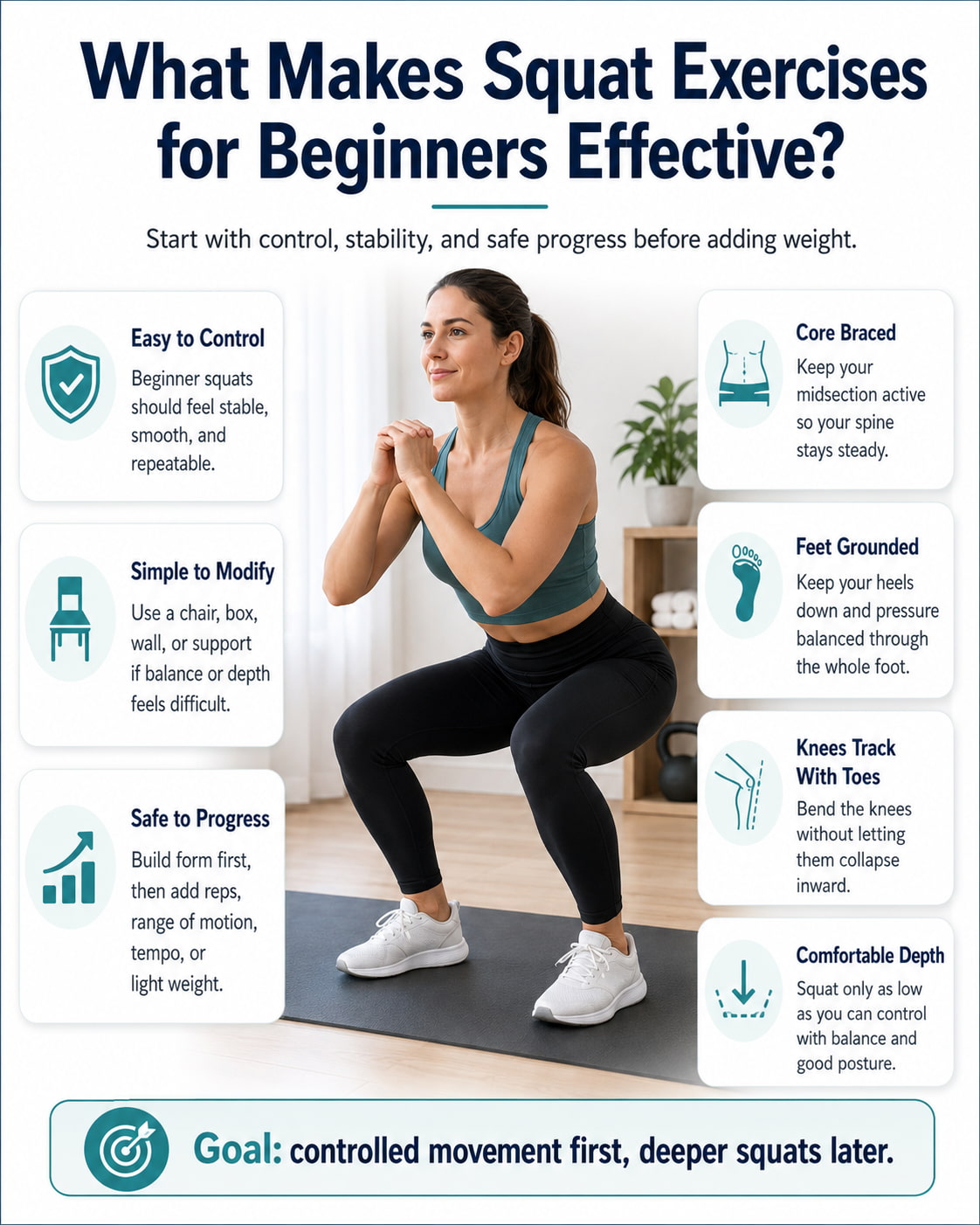
Good squat exercises for beginners should be easy to control, simple to modify, and safe to progress. A beginner does not need to start with a heavy barbell squat. Most people do better by first learning how to brace the core, keep the feet grounded, control knee tracking, and move through a comfortable range of motion.
A useful beginner squat should help you practice three things: sitting the hips down and back, bending the knees without letting them collapse inward, and standing tall without rounding the back. The ACE bodyweight squat guide recommends keeping the feet slightly wider than hip-width, bracing the core, maintaining a flat back, and keeping the knees aligned with the feet during the movement.
The goal is not to squat as low as possible on day one. The goal is to squat as low as you can with control, balance, and pain-free movement.
How to Do a Beginner Squat With Good Form
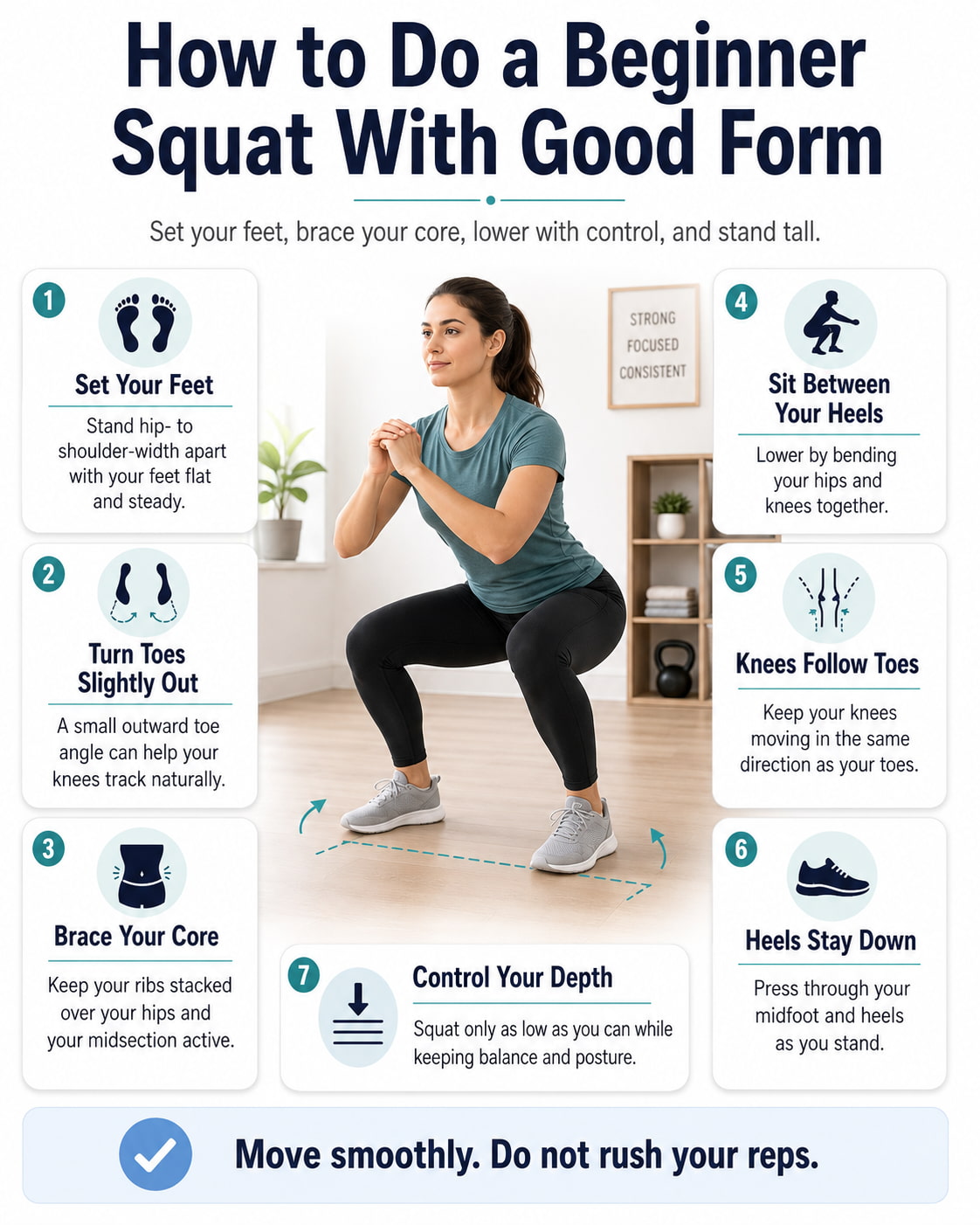
Start with your feet about hip-width to shoulder-width apart. Turn your toes slightly outward if that feels natural. Keep your chest lifted, ribs stacked over your hips, and core lightly braced.
As you lower, bend your hips and knees together. Think about sitting between your heels instead of folding forward at the waist. Your knees should track in the same direction as your toes, and your heels should stay on the floor.
Lower only as far as you can while keeping control. Then press through your midfoot and heels to stand tall. Do not rush the movement. Mayo Clinic’s strength-training guidance emphasizes smooth, controlled reps, proper technique, and using a resistance level you can manage with good form.
Muscles Worked by Beginner Squat Exercises
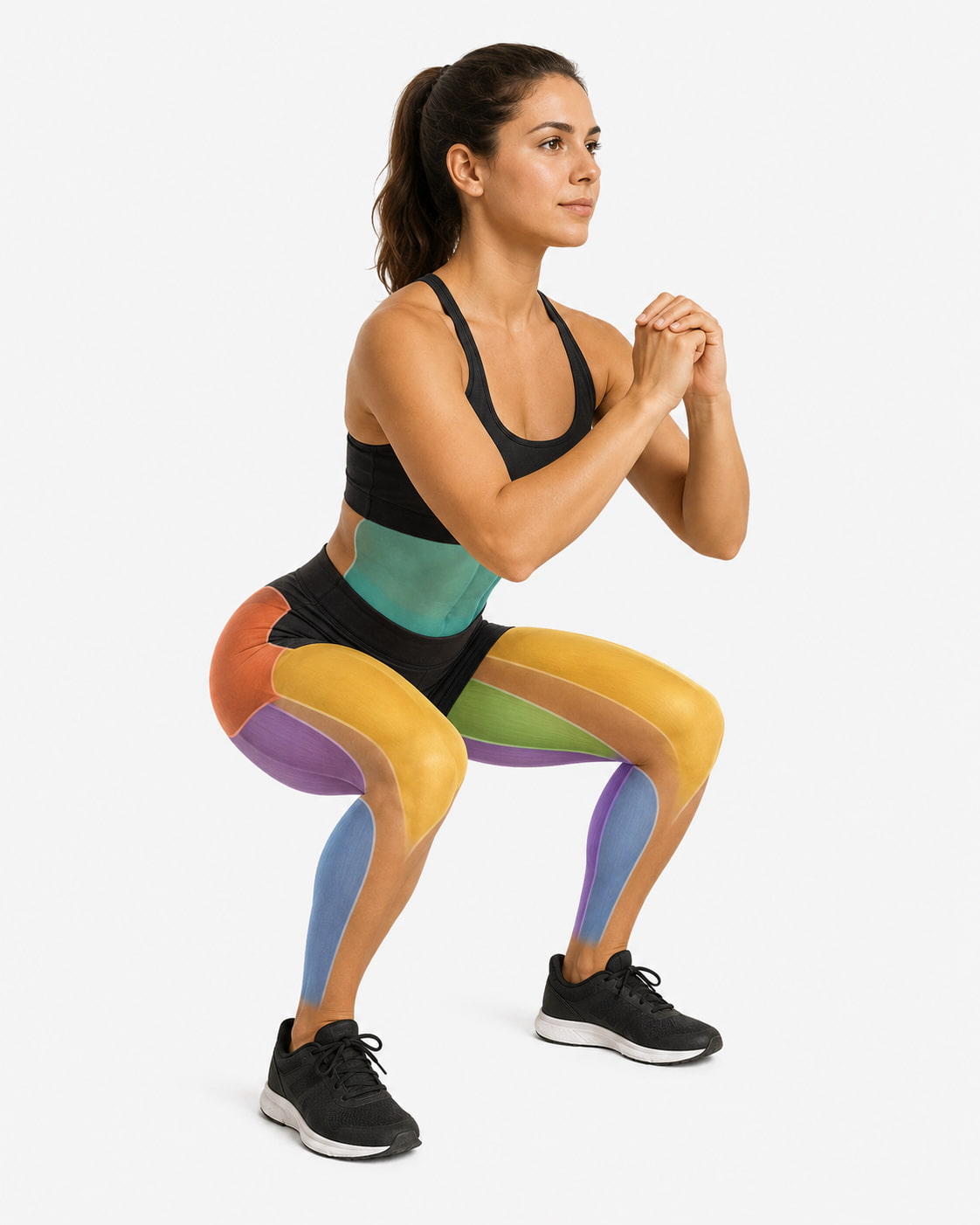
Beginner squat exercises mainly train the quadriceps, glutes, hamstrings, adductors, calves, and core. The quadriceps help straighten your knees as you stand. The glutes help extend your hips. The hamstrings and adductors assist with hip control, while the calves and foot muscles help you stay balanced.
Your core also works during squats. It helps stabilize your spine and pelvis so your legs can produce force safely. Cleveland Clinic describes squats as a foundational movement for strengthening the legs, glutes, quads, and core.
Benefits of Squat Exercises for Beginners
Squats are useful because they train a movement pattern you use every day. Sitting in a chair, standing up, picking something up from the floor, climbing stairs, and getting out of a car all require some version of a squat pattern.
Beginner squat exercises may help build lower-body strength, improve balance, support better movement control, and make daily activities feel easier. They are also flexible. You can do bodyweight squats at home, assisted squats near a chair, or light goblet squats in the gym.
Squats are also easy to progress. You can start with a chair sit-to-stand, then move to a bodyweight squat, then add a pause, tempo, or light dumbbell when your form is ready.
11 Best Squat Exercises for Beginners
The exercises below are arranged from easiest to more challenging. Start with the version that matches your current ability, not the one that looks hardest.
1. Chair Sit-to-Stand Squat
Best for: True beginners, older beginners, people learning the squat pattern, and anyone who needs a stable target for depth.
Muscles worked: Quadriceps, glutes, hamstrings, calves, adductors, and core.
Equipment needed: A sturdy chair or bench.
Why it stands out: The chair sit-to-stand is one of the best squat exercises for beginners because it teaches the basic movement in a familiar way. You learn how to shift your weight, control your knees, and stand up using your legs instead of momentum.
Suggested sets and reps: Start with 2–3 sets of 8–12 reps. Use it early in a beginner workout as your main squat pattern.
Beginners: Use a higher chair and keep your arms forward for balance. Sit down fully if needed, then stand up with control.
Intermediate: Lightly touch the chair instead of fully sitting. This builds more control and keeps tension in the legs.
Advanced: Hold a light dumbbell at your chest or slow the lowering phase to 3 seconds.
Rest: Rest 60–90 seconds between sets.
How to do it:
- Stand in front of a sturdy chair with your feet about shoulder-width apart.
- Reach your arms forward or keep your hands near your chest.
- Push your hips back and bend your knees.
- Sit down lightly on the chair without collapsing.
- Press through your feet and stand tall.
- Repeat with slow, controlled movement.
Common mistakes: Dropping onto the chair, pushing only through the toes, letting the knees cave inward, and rocking forward to stand.
Expert tip: Pretend the chair is a target, not a place to relax. Touch it softly and stand up with control.
Exercise variations: Use a higher chair, lower chair, bench, box, or light dumbbell depending on your ability.
Easier variation: Use your hands on the chair arms or a countertop for assistance.
Harder variation: Pause just above the chair for 1–2 seconds before standing.
2. Assisted Squat
Best for: Beginners who struggle with balance, depth, ankle mobility, or confidence during regular squats.
Muscles worked: Quadriceps, glutes, hamstrings, calves, adductors, upper back stabilizers, and core.
Equipment needed: A wall, countertop, rail, doorframe, or suspension trainer.
Why it stands out: Assisted squats let you practice deeper movement without feeling unstable. The support helps you stay upright and control your knees while your legs learn the pattern.
Suggested sets and reps: Do 2–3 sets of 8–15 reps. Use it as a warm-up, skill drill, or main squat if bodyweight squats still feel difficult.
Beginners: Hold a stable surface lightly and squat only as low as you can control.
Intermediate: Use less hand support and focus on keeping your weight evenly distributed through both feet.
Advanced: Use a slower tempo or pause at the bottom while keeping only fingertip assistance.
Rest: Rest 45–75 seconds between sets.
How to do it:
- Stand facing a sturdy support.
- Hold the support lightly with both hands.
- Set your feet about shoulder-width apart.
- Brace your core and lower into a squat.
- Keep your knees tracking with your toes.
- Press through your feet and stand tall.
Common mistakes: Pulling too hard with the arms, leaning backward, losing heel contact, and letting the support replace leg effort.
Expert tip: Use the support for balance, not for lifting your body. Your legs should still do most of the work.
Exercise variations: Try a wall-assisted squat, rail-assisted squat, suspension trainer squat, or countertop squat.
Easier variation: Reduce the depth and keep more pressure through your hands.
Harder variation: Move to a chair squat or bodyweight squat without support.
3. Wall Squat or Wall Sit
Best for: Beginners who need to build quad endurance, posture, and confidence at a controlled depth.
Muscles worked: Quadriceps, glutes, hamstrings, calves, and core.
Equipment needed: A wall.
Why it stands out: A wall squat teaches control without requiring much balance. A wall sit also builds strength endurance because your legs must hold a steady position.
Suggested sets and reps: For wall squats, do 2–3 sets of 8–12 reps. For wall sits, hold 15–30 seconds for 2–3 rounds.
Beginners: Keep the squat shallow and stay higher on the wall.
Intermediate: Lower until your thighs are closer to parallel while keeping your knees comfortable.
Advanced: Hold a light weight at your chest or extend the wall sit to 40–60 seconds.
Rest: Rest 60–90 seconds between rounds.
How to do it:
- Stand with your back against a wall.
- Step your feet forward slightly.
- Slide down the wall into a comfortable squat.
- Keep your knees aligned with your toes.
- Hold the position or slide back up.
- Keep your back and hips controlled against the wall.
Common mistakes: Sliding too low too soon, letting the knees cave inward, placing the feet too close to the wall, and holding your breath.
Expert tip: Keep your feet far enough forward that your knees do not feel jammed at the bottom.
Exercise variations: Use a wall squat for reps, a wall sit for time, or a small stability ball behind the back if available.
Easier variation: Stay higher on the wall and hold for a shorter time.
Harder variation: Add a longer hold or perform slow wall squat reps.
4. Box Squat
Best for: Beginners who need a clear depth target and want to learn how to sit the hips back.
Muscles worked: Quadriceps, glutes, hamstrings, adductors, calves, and core.
Equipment needed: A sturdy box, bench, or chair.
Why it stands out: The box squat gives you feedback. You know exactly how low to go, which makes it easier to build confidence and consistent form.
Suggested sets and reps: Perform 2–4 sets of 6–12 reps. Use it as your main squat exercise before progressing to full bodyweight squats.
Beginners: Choose a higher box and sit back slowly.
Intermediate: Use a lower box and lightly touch it without losing tension.
Advanced: Hold a dumbbell or kettlebell at chest height.
Rest: Rest 60–120 seconds between sets.
How to do it:
- Stand in front of a box with your feet about shoulder-width apart.
- Brace your core and keep your chest lifted.
- Push your hips back and bend your knees.
- Lower until your glutes lightly touch the box.
- Pause briefly without relaxing completely.
- Drive through your feet and stand tall.
Common mistakes: Sitting too far back, relaxing on the box, bouncing off the box, and letting the chest drop.
Expert tip: Touch the box quietly. A soft touch usually means you are controlling the movement well.
Exercise variations: Use a high box, low box, goblet box squat, or tempo box squat.
Easier variation: Use a higher box or chair.
Harder variation: Use a lower box or add a 2-second pause before standing.
5. Bodyweight Squat
Best for: Beginners who can squat without support and want to build the foundation for future loaded training.
Muscles worked: Quadriceps, glutes, hamstrings, calves, adductors, and core.
Why it stands out: The bodyweight squat is the basic squat pattern. Once you can perform it well, it becomes easier to progress to goblet squats, dumbbell squats, and other lower-body exercises.
Suggested sets and reps: Do 2–4 sets of 8–15 reps. Use it as a main beginner strength exercise or as part of a warm-up.
Beginners: Squat to a comfortable depth and use your arms forward for balance.
Intermediate: Increase the range of motion or slow the lowering phase.
Advanced: Add tempo, pauses, or a light load after your form is consistent.
Rest: Rest 45–90 seconds between sets.
How to do it:
- Stand with your feet hip-width to shoulder-width apart.
- Brace your core and keep your chest lifted.
- Bend your hips and knees together.
- Lower until you reach a comfortable depth.
- Keep your knees tracking over your toes.
- Press through your feet and stand tall.
Common mistakes: Rushing reps, lifting the heels, rounding the lower back, collapsing the knees inward, and forcing depth.
Expert tip: Think “knees follow toes.” This simple cue helps keep your lower body aligned.
Exercise variations: Try a narrow-stance squat, wide-stance squat, arms-forward squat, or heel-elevated squat.
Easier variation: Return to a chair squat or assisted squat.
Harder variation: Move to a tempo squat or goblet squat.
6. Counterbalance Squat
Best for: Beginners who tip forward, lose balance, or struggle to keep the torso upright.
Muscles worked: Quadriceps, glutes, hamstrings, calves, adductors, shoulders, and core.
Equipment needed: A light dumbbell, small weight plate, medicine ball, or no equipment with arms extended forward.
Why it stands out: Holding the arms or a light object in front of the body can help you balance. This makes it easier to sit lower without falling backward or rounding the back.
Suggested sets and reps: Perform 2–3 sets of 8–12 reps. Use it as a technique drill before regular bodyweight squats.
Beginners: Extend your arms forward without weight.
Intermediate: Hold a very light object in front of your chest.
Advanced: Pause at the bottom while keeping the arms steady.
Rest: Rest 45–90 seconds between sets.
How to do it:
- Stand with your feet about shoulder-width apart.
- Extend your arms forward or hold a light object in front of you.
- Brace your core and lower into a squat.
- Keep your heels down and chest controlled.
- Stand back up without swinging your arms.
- Reset your posture before the next rep.
Common mistakes: Holding the weight too heavy, reaching too far forward, losing core tension, and letting the knees collapse inward.
Expert tip: The counterbalance should help your posture, not turn the exercise into an arm raise.
Exercise variations: Use arms-forward squats, plate counterbalance squats, or medicine ball counterbalance squats.
Easier variation: Use no weight and reduce the squat depth.
Harder variation: Add a 3-second lowering phase or bottom pause.
7. Tempo Squat
Best for: Beginners who need better control, smoother reps, and stronger awareness of squat form.
Muscles worked: Quadriceps, glutes, hamstrings, calves, adductors, and core.
Why it stands out: Tempo squats slow the movement down. This helps beginners feel where their knees, hips, feet, and torso are during each part of the squat.
Suggested sets and reps: Do 2–3 sets of 6–10 reps using a 3-second lowering phase. Use it after you can perform regular bodyweight squats with good form.
Beginners: Use a slow lower and normal stand-up.
Intermediate: Add a 3-second lower and 1-second pause.
Advanced: Use a 4-second lower or hold a light goblet weight.
Rest: Rest 60–90 seconds between sets.
How to do it:
- Stand in your normal squat stance.
- Brace your core and begin lowering slowly.
- Take about 3 seconds to reach your bottom position.
- Keep your knees aligned with your toes.
- Press through your feet to stand up.
- Reset before the next rep.
Common mistakes: Counting too fast, relaxing at the bottom, leaning forward more as you lower, and losing heel contact.
Expert tip: Slow reps reveal form problems. If your knees or heels move around, shorten the range and rebuild control.
Exercise variations: Try a 3-second lower, 4-second lower, or tempo box squat.
Easier variation: Use a box or chair as a depth target.
Harder variation: Add a pause at the bottom or hold a light dumbbell.
8. Pause Squat
Best for: Beginners who want more strength and control at the bottom of the squat without adding heavy weight.
Muscles worked: Quadriceps, glutes, hamstrings, adductors, calves, and core.
Why it stands out: The pause removes momentum. You must stay tight, balanced, and controlled before standing up.
Suggested sets and reps: Do 2–3 sets of 6–10 reps with a 1–2 second pause. Use it after regular bodyweight squats feel stable.
Beginners: Pause at a higher squat depth instead of forcing a deep position.
Intermediate: Pause near your normal bottom position for 2 seconds.
Advanced: Combine a slow lower with a pause or hold a light goblet weight.
Rest: Rest 60–120 seconds between sets.
How to do it:
- Stand with your feet about shoulder-width apart.
- Lower into a controlled squat.
- Pause at your comfortable bottom position.
- Keep your core braced and feet grounded.
- Stand up smoothly without bouncing.
- Repeat with the same depth each rep.
Common mistakes: Relaxing during the pause, bouncing out of the bottom, holding the breath, and letting the knees drift inward.
Expert tip: The pause should feel active. Keep tension in your legs and core the whole time.
Exercise variations: Use a pause bodyweight squat, pause box squat, or pause goblet squat.
Easier variation: Pause higher or use a chair behind you.
Harder variation: Increase the pause to 3 seconds or add light resistance.
9. Prisoner Squat
Best for: Beginners who already have solid bodyweight squat form and want to improve posture and upper-back control.
Muscles worked: Quadriceps, glutes, hamstrings, calves, adductors, upper back, and core.
Why it stands out: Placing the hands behind the head removes the arm counterbalance. This makes your core and upper back work harder to keep the chest lifted.
Suggested sets and reps: Do 2–3 sets of 8–12 reps. Use it as a bodyweight progression after regular squats.
Beginners: Keep the elbows slightly forward and squat to a comfortable depth.
Intermediate: Keep the elbows wider while maintaining a tall chest.
Advanced: Add a slow tempo or pause at the bottom.
Rest: Rest 60–90 seconds between sets.
How to do it:
- Stand with your feet about shoulder-width apart.
- Place your hands lightly behind your head.
- Brace your core and keep your chest lifted.
- Lower into a squat with control.
- Keep your knees aligned with your toes.
- Stand tall without pulling on your neck.
Common mistakes: Pulling the head forward, flaring the ribs, arching the lower back, and dropping the chest.
Expert tip: Keep your hands light. They are there for position, not to pull your neck.
Exercise variations: Try a prisoner box squat, prisoner tempo squat, or prisoner pause squat.
Easier variation: Return your arms forward for balance.
Harder variation: Use a slower descent or longer pause.
10. Goblet Squat
Best for: Beginners ready to add light resistance while keeping the torso more upright.
Muscles worked: Quadriceps, glutes, hamstrings, adductors, calves, upper back, arms, and core.
Equipment needed: A dumbbell or kettlebell.
Why it stands out: The goblet squat is one of the best loaded squat exercises for beginners. Holding the weight in front of your chest can help you stay upright and feel more balanced. ACE’s goblet squat guide demonstrates the dumbbell held vertically in front of the chest with the elbows close.
Suggested sets and reps: Start with 2–3 sets of 8–10 reps. Use it after you can do bodyweight squats without pain or major form breakdown.
Beginners: Use a very light dumbbell and focus on form before load.
Intermediate: Increase to 3–4 sets or use a slightly heavier weight.
Advanced: Add a tempo, pause, or lower box target.
Rest: Rest 90–120 seconds between sets.
How to do it:
- Hold a dumbbell or kettlebell close to your chest.
- Stand with your feet about shoulder-width apart.
- Brace your core and keep your elbows close.
- Lower into a squat with control.
- Keep your chest lifted and knees tracking with your toes.
- Press through your feet to stand tall.
Common mistakes: Holding the weight too far away, rounding the back, choosing a weight that is too heavy, and letting the elbows pull the torso forward.
Expert tip: Keep the weight close to your body. The farther it drifts forward, the harder it is to control your posture.
Exercise variations: Use a dumbbell goblet squat, kettlebell goblet squat, goblet box squat, or goblet pause squat.
Easier variation: Use a lighter weight or return to a bodyweight squat.
Harder variation: Add load gradually or use a 3-second lowering phase.
11. Dumbbell Sumo Squat
Best for: Beginners who want a wider-stance squat that also trains the inner thighs.
Muscles worked: Quadriceps, glutes, adductors, hamstrings, calves, and core.
Equipment needed: One dumbbell or kettlebell.
Why it stands out: The dumbbell sumo squat uses a wider stance and slightly turned-out toes. This can feel more comfortable for some beginners and places more emphasis on the adductors while still training the quads and glutes.
Suggested sets and reps: Do 2–3 sets of 8–12 reps. Use it as a second squat variation after your main squat exercise.
Beginners: Start with bodyweight only or use a very light dumbbell.
Intermediate: Hold one dumbbell vertically with both hands.
Advanced: Increase load gradually or add a pause at the bottom.
Rest: Rest 60–120 seconds between sets.
How to do it:
- Stand with your feet wider than shoulder-width.
- Turn your toes slightly outward.
- Hold a dumbbell with both hands in front of your body.
- Brace your core and lower between your legs.
- Keep your knees tracking in the same direction as your toes.
- Press through your feet and stand tall.
Common mistakes: Taking the stance too wide, letting the knees collapse inward, rounding the back, and swinging the dumbbell.
Expert tip: Your knees should follow your toes. If your knees feel forced, narrow your stance slightly.
Exercise variations: Try a bodyweight sumo squat, dumbbell sumo squat, kettlebell sumo squat, or sumo box squat.
Easier variation: Use no weight and reduce your depth.
Harder variation: Hold a heavier dumbbell or add a 2-second pause at the bottom.
Beginner Squat Workout Routine
Use this routine 2–3 days per week on nonconsecutive days. Keep the effort around moderate. You should finish each set feeling like you could still do 2–3 more good reps.
| Exercise | Sets | Reps or Time | Rest |
|---|---|---|---|
| Chair Sit-to-Stand Squat | 2 | 8–12 reps | 60 seconds |
| Bodyweight Squat | 2 | 8–12 reps | 60–90 seconds |
| Wall Sit | 2 | 15–30 seconds | 60 seconds |
| Goblet Squat | 2 | 8–10 reps | 90 seconds |
If goblet squats are too challenging, replace them with assisted squats or box squats. If the workout feels too easy, add reps first. After that, add one extra set. Add weight only when your form stays consistent.
The CDC physical activity guidelines recommend muscle-strengthening activities on 2 or more days per week that work all major muscle groups. Squats can be part of that plan, but they should not be your only strength exercise. Add pushes, pulls, hip hinges, carries, and core exercises over time.
Common Squat Mistakes Beginners Should Avoid
Letting the Knees Cave Inward
Your knees should generally track in the same direction as your toes. If they collapse inward, reduce depth, slow down, and focus on pushing the floor apart gently with your feet.
Lifting the Heels
If your heels lift, you may be going too low, standing too narrow, or lacking ankle mobility. Use a chair squat or reduce depth until you can keep your feet grounded.
Rounding the Lower Back
A rounded back usually means you lost core tension or went deeper than you can control. Brace your core, keep your chest steady, and stop before your pelvis tucks under too much.
Using Too Much Weight Too Soon
Beginners often progress faster by improving form before adding load. Mayo Clinic’s weight training technique guide recommends starting with a weight you can lift comfortably for 12–15 repetitions and increasing slowly as your technique stays correct.
Rushing Every Rep
Fast reps can hide poor control. Slow down enough to feel your feet, knees, hips, and torso working together.
How to Progress Your Squats Safely
The best beginner progression is simple: improve control first, increase reps second, add load third.
Start with a squat variation you can perform for 8–12 clean reps. When you can complete all your sets with steady balance, good knee tracking, and no sharp pain, add 1–2 reps per set. Once you can perform about 12–15 reps with good form, add another set or move to a slightly harder variation.
A practical progression may look like this:
Chair sit-to-stand squat, then assisted squat, then box squat, then bodyweight squat, then tempo squat, then goblet squat.
You do not need to progress every workout. Stay with the same variation for a few weeks if it is still helping you improve. A 2024 biomechanical review in the International Journal of Sports Physical Therapy explains that squat demands can change based on stance width, foot rotation, trunk position, tibia position, and depth. That means small changes can make a squat easier, harder, or better suited to your body.
How Often Should Beginners Do Squats?
Most beginners can train squat exercises 2–3 times per week. Start with two sessions if you are new to exercise, sore often, or still learning form. Move to three sessions when recovery feels good and your technique is consistent.
Avoid doing hard squat workouts every day. Your muscles and joints need time to recover, especially when you add new exercises or resistance.
FAQ
What is the best squat exercise for complete beginners?
The chair sit-to-stand squat is usually the best first squat exercise for complete beginners. It teaches the movement with a clear target and gives you confidence before progressing to bodyweight squats.
How many squats should a beginner do?
A good starting point is 2–3 sets of 8–12 reps. If that feels too hard, start with 5–8 controlled reps. Quality matters more than the number.
Should beginners squat every day?
Most beginners do not need daily squats. Two to three sessions per week is enough for building strength while allowing recovery. Light practice can be fine, but hard squat workouts should have rest days between them.
How deep should a beginner squat?
Squat as low as you can while keeping your heels down, knees controlled, and back neutral. You do not need to force a deep squat. Range of motion can improve gradually.
Are squats bad for your knees?
Squats are not automatically bad for your knees. Poor form, too much load, too much volume, or forcing painful depth can cause problems. Choose a comfortable variation and stop if you feel sharp pain or unusual symptoms.
When should I add weight to squats?
Add weight when you can perform bodyweight squats with good control for multiple sets. Start with a light goblet squat before moving to heavier dumbbell or barbell variations.
Conclusion
Squat exercises for beginners should build skill before intensity. Start with supported or chair-based squats, practice smooth reps, keep your knees tracking with your toes, and progress only when your form is ready.
The best squat is not the hardest version. It is the one you can perform safely, consistently, and with enough control to build strength over time.
Stop and seek professional help if an exercise causes sharp pain, numbness, dizziness, chest pain, severe shortness of breath, or unusual symptoms.
This content is for informational purposes only and is not a substitute for professional medical advice.