Dumbbell quad exercises help you train the front of your thighs with squats, lunges, split squats, step-ups, and isometric holds using only dumbbells. They are useful for home workouts, gym leg days, and lifters who want stronger quads without needing a leg press, hack squat, or squat rack.
In this guide, you will learn the best dumbbell quad exercises, how to perform them with proper form, which muscles they work, common mistakes to avoid, and how to use them in a complete quad-focused workout.
What Are Dumbbell Quad Exercises
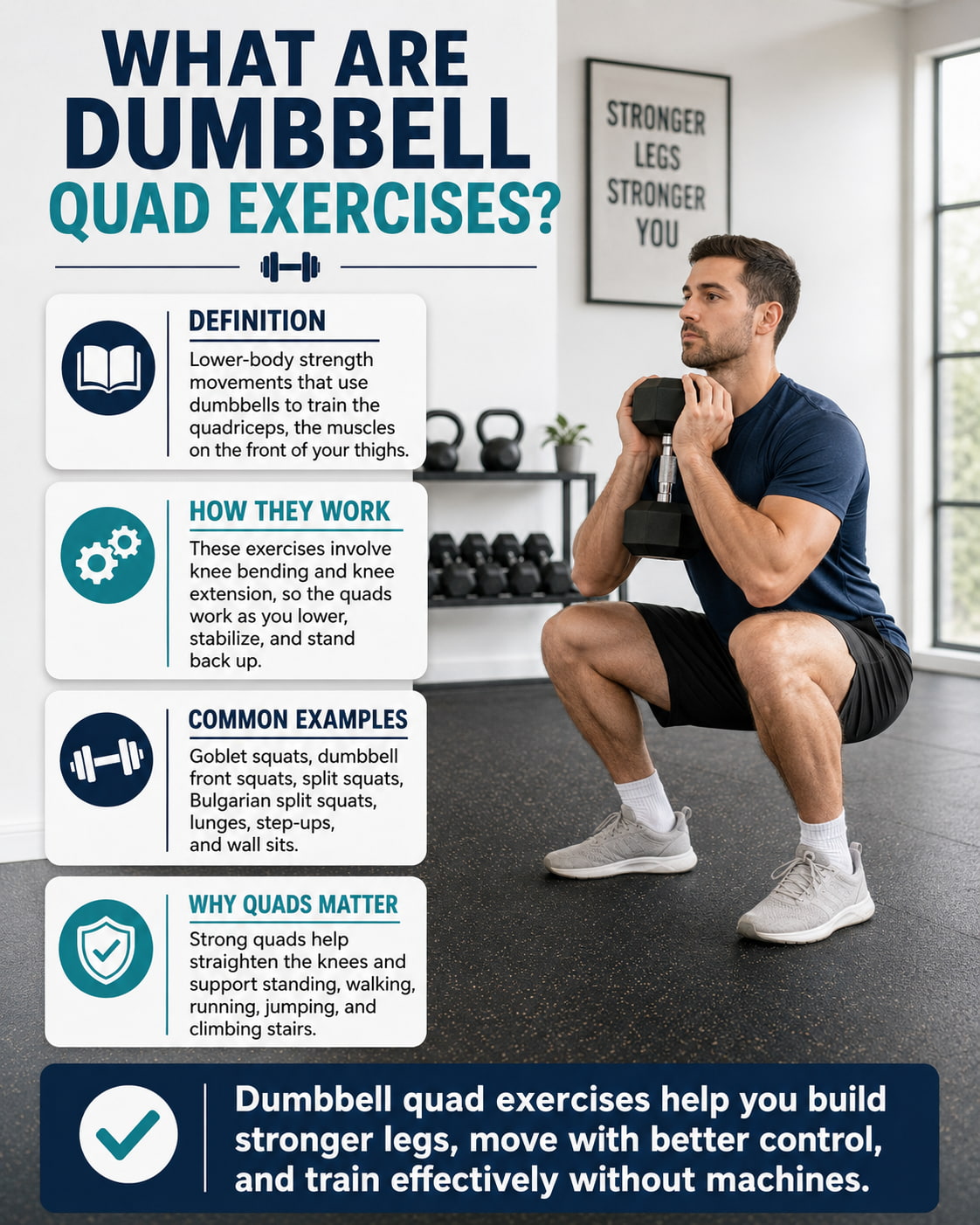
Dumbbell quad exercises are lower-body strength movements that use dumbbells to train the quadriceps, the muscles on the front of your thighs. These exercises usually involve knee bending and knee extension, which means the quads work hard as you lower, stabilize, and stand back up.
Common examples include goblet squats, dumbbell front squats, split squats, Bulgarian split squats, lunges, step-ups, and wall sits.
According to the Cleveland Clinic, the quadriceps help straighten the knee and support everyday movements such as standing, walking, running, jumping, and climbing stairs. That is why strong quads matter for more than just leg size. They help you move better, train harder, and handle lower-body exercises with more control.
Muscles Worked by Dumbbell Quad Exercises
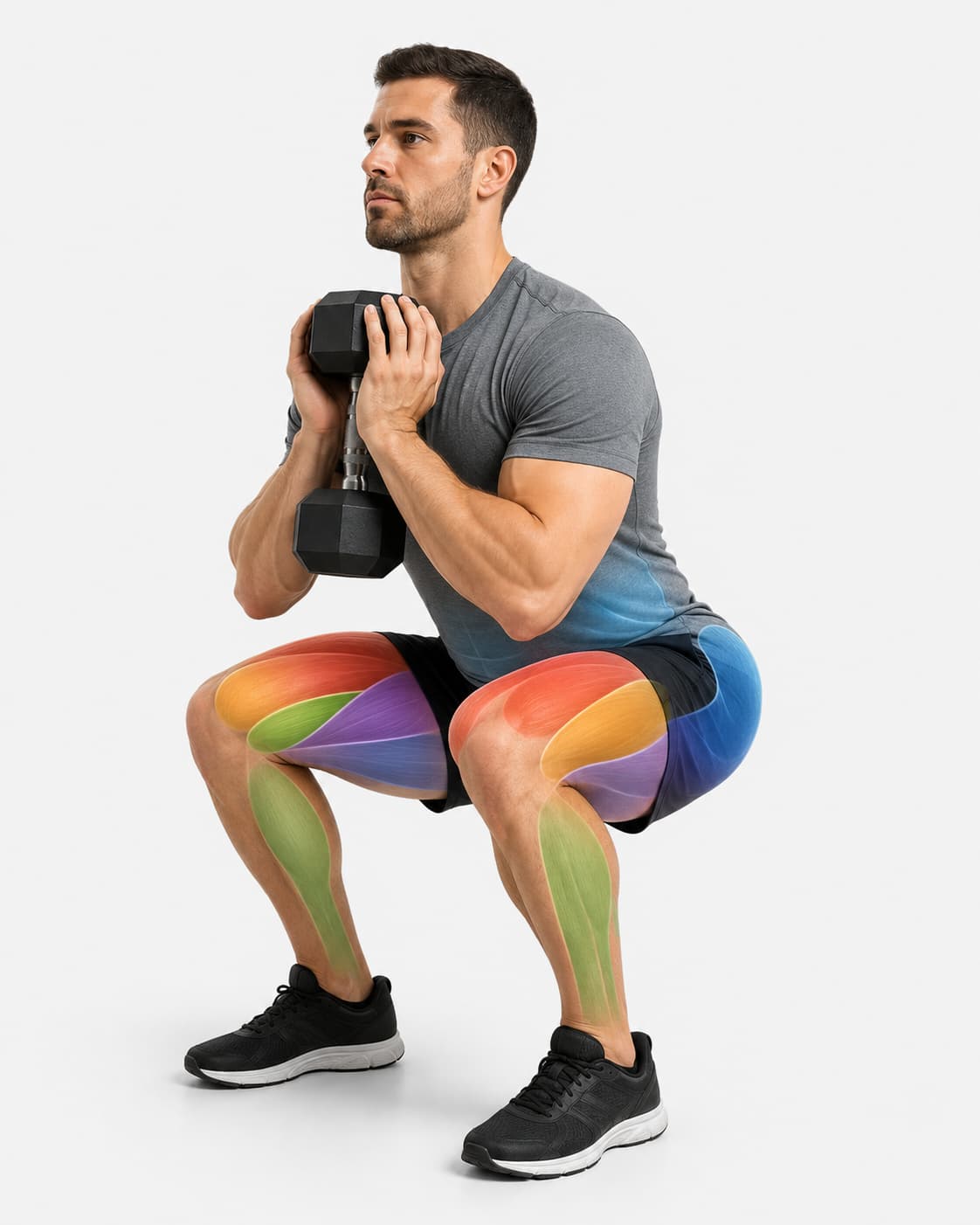
The main muscles worked are the quadriceps. This group includes the rectus femoris, vastus lateralis, vastus medialis, and vastus intermedius. The rectus femoris also crosses the hip, so it helps with hip flexion as well as knee extension.
Dumbbell quad exercises also train supporting muscles. The glutes help extend the hips, the hamstrings assist with lower-body control, the calves stabilize the ankles, and the core helps keep the torso braced. Single-leg exercises also challenge the hips, feet, and deep stabilizers because each leg has to control balance and alignment.
How to Make Dumbbell Exercises More Quad Focused
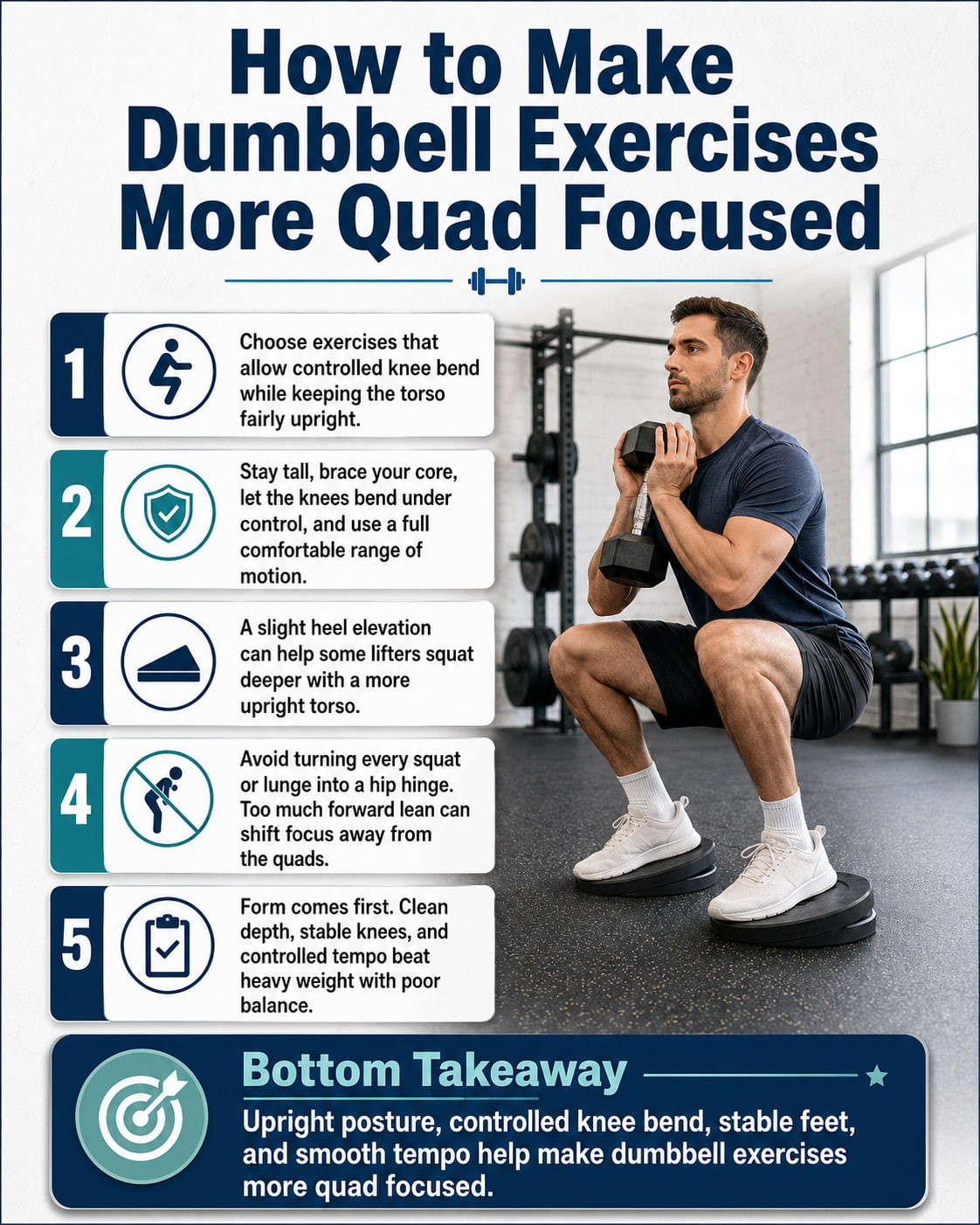
To bias the quads, choose exercises that allow more controlled knee bend while keeping the torso fairly upright. A biomechanical squat review published in the International Journal of Sports Physical Therapy reported that a more upright trunk position increases the knee flexion moment and decreases the hip flexion moment, which supports the idea that torso position can change how a squat feels.
In simple training terms, stay tall, let the knees bend under control, use a full comfortable range of motion, and avoid turning every squat or lunge into a hip hinge. A slight heel elevation can also help some lifters squat deeper with a more upright torso, especially if ankle mobility limits depth.
Load still matters, but form comes first. A lighter dumbbell with clean depth, stable knees, and controlled tempo will usually train the quads better than a heavier load with a shallow range of motion and poor balance.
11 Best Dumbbell Quad Exercises
Below are 11 dumbbell quad exercises that help build stronger thighs using squat, lunge, split squat, step-up, and isometric patterns.
Choose the exercises that match your level, focus on controlled form, and progress with more reps, weight, or range of motion over time.
1. Dumbbell Goblet Squat
Best for: Beginners, home workouts, squat practice, and building quad strength with a simple setup.
Muscles worked: Quadriceps, glutes, adductors, hamstrings, calves, and core.
Equipment needed: One dumbbell.
Why it stands out: The goblet squat is one of the easiest dumbbell quad exercises to learn because the weight sits in front of the chest. This front-loaded position often helps you stay more upright and control the bottom of the squat. The ACE Fitness goblet squat guide teaches a similar setup with the dumbbell held vertically in front of the chest and the elbows close to the body.
Suggested sets and reps: Do 3 to 4 sets of 8 to 15 reps.
Beginners: Start with body weight or a light dumbbell and stop at the deepest range you can control without your heels lifting.
Intermediate: Use a heavier dumbbell and slow the lowering phase to 2 or 3 seconds.
Advanced: Add a pause at the bottom or use 1.5 reps, lowering fully, coming halfway up, lowering again, then standing.
Rest: Rest 60 to 90 seconds between sets.
How to do it:
- Stand with your feet about shoulder-width apart and hold one dumbbell at chest height.
- Brace your core and keep your chest tall.
- Bend your knees and hips together as you lower into a squat.
- Keep your knees tracking in the same direction as your toes.
- Push through your whole foot to stand back up.
Common mistakes: The most common mistakes are rounding the back, letting the elbows drift too far forward, lifting the heels, collapsing the knees inward, and cutting the squat too shallow without a reason.
Expert tip: Think about sitting down between your heels, not folding over your thighs. This helps keep the squat more quad-focused.
Exercise variations: Use a pause goblet squat, tempo goblet squat, box goblet squat, or heels-elevated goblet squat.
Easier variation: Perform a bodyweight squat to a box before adding the dumbbell.
Harder variation: Use a heavier dumbbell, add a slow eccentric, or perform 1.5-rep goblet squats.
2. Dumbbell Front Squat
Best for: Lifters who want a stronger dumbbell squat pattern with more load than a single goblet squat allows.
Muscles worked: Quadriceps, glutes, adductors, upper back, calves, and core.
Equipment needed: Two dumbbells.
Why it stands out: The dumbbell front squat lets you hold a dumbbell in each hand at the shoulders. This increases loading potential while still encouraging a more upright torso. NASM describes the dumbbell front squat as a front-loaded squat that emphasizes the quadriceps while challenging core stability.
Suggested sets and reps: Do 3 to 5 sets of 6 to 12 reps.
Beginners: Use light dumbbells and practice holding them in a comfortable front-rack position.
Intermediate: Use moderate loads for sets of 8 to 10 reps with a controlled lowering phase.
Advanced: Use heavier dumbbells for 4 to 6 reps, or add a 2-second pause near the bottom.
Rest: Rest 90 to 150 seconds between sets.
How to do it:
- Hold two dumbbells at shoulder height with your elbows slightly forward.
- Stand with your feet about shoulder-width apart.
- Brace your core and keep your ribs down.
- Lower into a squat while keeping your torso tall.
- Drive through your feet and stand up without letting the dumbbells pull you forward.
Common mistakes: Avoid letting the dumbbells fall away from the shoulders, arching the lower back, tipping forward too much, and letting the knees cave inward.
Expert tip: Keep the dumbbells close to your body. The farther they drift forward, the harder it is to stay braced.
Exercise variations: Try a double-dumbbell front squat, offset front squat, tempo front squat, or front squat to a box.
Easier variation: Use one dumbbell in a goblet hold instead.
Harder variation: Use two heavy dumbbells and pause at the bottom of each rep.
3. Heels Elevated Goblet Squat
Best for: Increasing quad emphasis and helping lifters squat deeper when ankle mobility is limited.
Muscles worked: Quadriceps, glutes, adductors, calves, and core.
Equipment needed: One dumbbell and a small heel wedge, weight plates, or a stable slant board.
Why it stands out: Elevating the heels can make it easier to keep the torso upright and allow more forward knee travel. That usually makes the exercise feel more quad-dominant than a regular squat. It is especially useful when you want a strong quad stimulus with limited equipment.
Suggested sets and reps: Do 3 to 4 sets of 10 to 15 reps.
Beginners: Use a very small heel lift and a light dumbbell.
Intermediate: Use a moderate dumbbell and pause for 1 second at the bottom.
Advanced: Use a slow 3-second lowering phase or 1.5 reps.
Rest: Rest 60 to 90 seconds between sets.
How to do it:
- Place your heels on a stable wedge or small plates.
- Hold a dumbbell at chest height.
- Keep your torso tall and brace your core.
- Lower into a squat by bending your knees under control.
- Stand by pushing through your midfoot and heel.
Common mistakes: Do not use an unstable heel lift, bounce out of the bottom, force painful depth, or let your knees collapse inward.
Expert tip: Keep your heels supported and your feet fully stable. This is not a balance drill.
Exercise variations: Use a heels-elevated dumbbell front squat, pause squat, or close-stance heels-elevated squat.
Easier variation: Perform a regular goblet squat without heel elevation.
Harder variation: Add a longer pause at the bottom or use a heavier dumbbell.
4. Dumbbell Close Stance Squat
Best for: Quad-focused squatting in a small space.
Muscles worked: Quadriceps, glutes, adductors, calves, and core.
Equipment needed: One or two dumbbells.
Why it stands out: A closer stance can make the squat feel more knee-dominant for many lifters. It also works well when you have limited space and want a simple quad exercise that does not require a bench, box, or large walking area.
Suggested sets and reps: Do 3 to 4 sets of 8 to 15 reps.
Beginners: Start with one dumbbell in a goblet hold and use a comfortable stance.
Intermediate: Use two dumbbells held at your sides or in a front-rack position.
Advanced: Add heel elevation, tempo reps, or a bottom pause.
Rest: Rest 60 to 120 seconds between sets.
How to do it:
- Stand with your feet hip-width or slightly narrower.
- Hold one dumbbell at your chest or two dumbbells at your sides.
- Brace your core and keep your chest lifted.
- Squat down while keeping your knees tracking over your toes.
- Stand up smoothly without locking the knees aggressively.
Common mistakes: Avoid forcing the feet too close, rounding the back, shifting onto the toes, or using a range of motion your hips and ankles cannot control.
Expert tip: Close stance does not mean feet touching. Use the narrowest stance that still feels stable and smooth.
Exercise variations: Try a close-stance goblet squat, close-stance front squat, or heels-elevated close-stance squat.
Easier variation: Use a standard goblet squat with a wider stance.
Harder variation: Use two dumbbells in the front-rack position and lower for 3 seconds each rep.
5. Dumbbell Split Squat
Best for: Building single-leg quad strength without needing much balance or space.
Muscles worked: Quadriceps, glutes, adductors, hamstrings, calves, and core.
Equipment needed: One or two dumbbells.
Why it stands out: The split squat is one of the best dumbbell quad exercises for learning single-leg control. Because your feet stay planted, it is easier to control than a lunge. It also lets you focus on the front leg without stepping forward or backward every rep.
Suggested sets and reps: Do 2 to 4 sets of 8 to 12 reps per leg.
Beginners: Start with body weight and hold onto a support if needed.
Intermediate: Hold one dumbbell in the opposite hand of the front leg or two dumbbells at your sides.
Advanced: Use a front-foot elevation, slow tempo, or heavier dumbbells.
Rest: Rest 60 to 120 seconds between legs or sets.
How to do it:
- Stand in a staggered stance with one foot forward and one foot behind.
- Keep your front foot flat and your torso tall.
- Lower your back knee toward the floor.
- Let the front knee bend while staying aligned with the toes.
- Push through the front foot to stand back up.
Common mistakes: Avoid taking too short of a stance, pushing mostly off the back foot, leaning too far forward, or letting the front knee drift inward.
Expert tip: Think of the back leg as a kickstand. The front leg should do most of the work.
Exercise variations: Use a bodyweight split squat, dumbbell split squat, front-rack split squat, or front-foot elevated split squat.
Easier variation: Hold onto a rack, wall, or sturdy support for balance.
Harder variation: Elevate the front foot or add a 2-second pause at the bottom.
6. Dumbbell Bulgarian Split Squat
Best for: Advanced single-leg quad training and building strength with lighter dumbbells.
Muscles worked: Quadriceps, glutes, adductors, hamstrings, calves, and core.
Equipment needed: Two dumbbells and a bench or stable box.
Why it stands out: The Bulgarian split squat creates a large challenge for the front leg while also training balance and hip stability. ACE describes the Bulgarian split squat with the rear foot placed behind the body on a bench or box about knee height. This setup makes the front leg work hard through a deep single-leg pattern.
Suggested sets and reps: Do 3 to 4 sets of 6 to 12 reps per leg.
Beginners: Master regular split squats before elevating the rear foot.
Intermediate: Hold dumbbells at your sides and use a controlled range of motion.
Advanced: Add a slow eccentric, pause reps, or front-foot elevation.
Rest: Rest 90 to 150 seconds between sets.
How to do it:
- Stand a few feet in front of a bench with one foot behind you on the bench.
- Hold dumbbells at your sides.
- Keep your front foot flat and your torso controlled.
- Lower until your front knee is deeply bent and your back knee moves toward the floor.
- Drive through the front foot to return to the top.
Common mistakes: Avoid standing too close to the bench, bouncing the back knee, overusing the rear leg, or letting the front heel lift.
Expert tip: Adjust your front foot position before adding weight. A good setup should feel stable, not cramped.
Exercise variations: Try bodyweight Bulgarian split squats, dumbbell Bulgarian split squats, front-rack Bulgarian split squats, or pause reps.
Easier variation: Do a regular dumbbell split squat with both feet on the floor.
Harder variation: Use front-foot elevation or 1.5 reps.
7. Dumbbell Front Foot Elevated Split Squat
Best for: Increasing range of motion and loading the front quad through a deeper bend.
Muscles worked: Quadriceps, glutes, adductors, hamstrings, calves, and core.
Equipment needed: One or two dumbbells and a low step or weight plate.
Why it stands out: Elevating the front foot allows the front knee and hip to move through more range of motion. This can make the exercise very effective for quad training when performed with control. It also helps lifters work on single-leg strength without needing heavy weights.
Suggested sets and reps: Do 2 to 4 sets of 8 to 12 reps per leg.
Beginners: Start with a very low elevation and body weight.
Intermediate: Hold dumbbells at your sides and control the bottom position.
Advanced: Use a higher but stable elevation, slow tempo, or pause reps.
Rest: Rest 60 to 120 seconds between sets.
How to do it:
- Place your front foot on a low, stable platform.
- Step your back foot behind you into a split stance.
- Hold dumbbells at your sides.
- Lower your back knee toward the floor while keeping the front foot planted.
- Push through the front foot to stand back up.
Common mistakes: Do not use a platform that is too high, rush the bottom position, lose balance, or let the front heel lift.
Expert tip: Use elevation to increase control, not to chase extreme depth. The best range is the one you can own.
Exercise variations: Use a bodyweight version, one-dumbbell suitcase hold, two-dumbbell hold, or front-rack hold.
Easier variation: Perform a regular split squat on the floor.
Harder variation: Add a 3-second lowering phase and a 1-second pause at the bottom.
8. Dumbbell Forward Lunge
Best for: Dynamic quad loading, deceleration control, and athletic-style leg training.
Muscles worked: Quadriceps, glutes, adductors, hamstrings, calves, and core.
Equipment needed: Two dumbbells.
Why it stands out: The forward lunge makes the front leg absorb and control the step. This increases the demand on the quads, especially when you land softly and lower with control. The ACE dumbbell lunge guide describes stepping forward, lowering the back knee toward the floor, and pushing through the front foot to return.
Suggested sets and reps: Do 2 to 4 sets of 8 to 12 reps per leg.
Beginners: Start with body weight or use reverse lunges first.
Intermediate: Hold dumbbells at your sides and alternate legs.
Advanced: Use heavier dumbbells, walking lunges, or a controlled deficit lunge.
Rest: Rest 60 to 120 seconds between sets.
How to do it:
- Stand tall with a dumbbell in each hand.
- Step forward with one leg.
- Lower your back knee toward the floor under control.
- Keep the front knee aligned with the toes.
- Push through the front foot to return to standing.
Common mistakes: Avoid stepping too short, landing hard, pushing off the back leg too much, or letting the front knee collapse inward.
Expert tip: Land quietly. A soft, controlled step usually means better control and better quad loading.
Exercise variations: Use alternating forward lunges, walking lunges, deficit lunges, or front-rack lunges.
Easier variation: Use a reverse lunge or bodyweight forward lunge.
Harder variation: Use walking dumbbell lunges or slow eccentric forward lunges.
9. Dumbbell Reverse Lunge
Best for: Beginners, knee-friendly control, and single-leg quad training with less forward momentum.
Muscles worked: Quadriceps, glutes, hamstrings, adductors, calves, and core.
Equipment needed: One or two dumbbells.
Why it stands out: The reverse lunge is often easier to control than the forward lunge because you step backward instead of catching your body weight forward. It still trains the front-leg quad strongly when you keep the front foot planted and stand through the lead leg.
Suggested sets and reps: Do 2 to 4 sets of 8 to 12 reps per leg.
Beginners: Use body weight and practice stepping back softly.
Intermediate: Hold dumbbells at your sides and alternate legs.
Advanced: Use a front-rack hold, deficit setup, or heavier dumbbells.
Rest: Rest 60 to 120 seconds between sets.
How to do it:
- Stand tall with your feet hip-width apart.
- Hold dumbbells at your sides.
- Step one foot backward into a lunge.
- Lower the back knee toward the floor while the front foot stays planted.
- Push through the front foot to return to standing.
Common mistakes: Avoid pushing off the back foot too much, stepping too narrow, losing balance, or leaning forward excessively.
Expert tip: Keep your front foot heavy. The front leg should be the main working leg.
Exercise variations: Try alternating reverse lunges, static reverse lunges, deficit reverse lunges, or front-rack reverse lunges.
Easier variation: Hold onto a wall or rack and use body weight.
Harder variation: Stand on a low platform and step backward into a deficit reverse lunge.
10. Dumbbell Step Up
Best for: Functional quad strength, stair strength, balance, and unilateral leg training.
Muscles worked: Quadriceps, glutes, hamstrings, calves, adductors, and core.
Equipment needed: Two dumbbells and a stable box, bench, or step.
Why it stands out: Step-ups train the front leg through a pattern that carries over well to stairs and sport movement. They are also easy to adjust. A lower box is usually more beginner-friendly, while a higher box increases difficulty. ACE notes that step-up patterns challenge lower-body strength and dynamic stability, and dumbbells can be added to increase intensity.
Suggested sets and reps: Do 2 to 4 sets of 8 to 12 reps per leg.
Beginners: Use a low step and body weight before holding dumbbells.
Intermediate: Hold dumbbells at your sides and control the lowering phase.
Advanced: Use a higher step, heavier dumbbells, or slow negatives.
Rest: Rest 60 to 120 seconds between sets.
How to do it:
- Stand in front of a stable box or step with dumbbells at your sides.
- Place one foot fully on the step.
- Lean slightly forward while keeping your spine neutral.
- Drive through the working foot to stand on the step.
- Lower yourself back down slowly and repeat.
Common mistakes: Avoid pushing off the back leg, using a box that is too high, letting the knee cave inward, or dropping down quickly.
Expert tip: Make the top leg do the work. The bottom foot should assist as little as possible.
Exercise variations: Use low step-ups, high step-ups, lateral step-ups, or slow eccentric step-ups.
Easier variation: Use a lower step and no dumbbells.
Harder variation: Use heavier dumbbells or lower for 3 seconds on each rep.
11. Dumbbell Wall Sit
Best for: Quad endurance, low-skill finishers, and training when space is limited.
Muscles worked: Quadriceps, glutes, calves, and core.
Equipment needed: One dumbbell and a wall.
Why it stands out: The wall sit is an isometric quad exercise, meaning you hold tension without moving through reps. It is simple, easy to set up, and useful as a finisher after squats, lunges, or step-ups. It also lets you train the quads when you do not have room for dynamic exercises.
Suggested sets and reps: Do 2 to 4 holds of 20 to 60 seconds.
Beginners: Start with body weight and a higher hip position.
Intermediate: Hold one dumbbell at your chest.
Advanced: Hold a heavier dumbbell, lower closer to parallel, or extend the hold time.
Rest: Rest 45 to 90 seconds between holds.
How to do it:
- Stand with your back against a wall.
- Walk your feet forward and slide down into a squat position.
- Keep your knees aligned with your toes.
- Hold a dumbbell at your chest if you can maintain posture.
- Stay still and breathe until the set is complete.
Common mistakes: Avoid sliding too low if you cannot control the position, holding your breath, letting the knees collapse inward, or placing your feet too close to the wall.
Expert tip: Aim for steady tension. The goal is not to shake as hard as possible; it is to hold a strong position with control.
Exercise variations: Use a bodyweight wall sit, dumbbell wall sit, single-leg assisted wall sit, or wall sit with calf raise.
Easier variation: Hold a higher wall sit position without weight.
Harder variation: Hold a dumbbell at your chest or increase the hold time gradually.
Dumbbell Quad Workout
Use this routine 1 to 2 times per week depending on your total leg training, recovery, and experience level. If you already train legs hard with squats, deadlifts, or sports, start with the lower end of the volume.
| Level | Exercise | Sets and Reps | Rest |
|---|---|---|---|
| Beginner | Goblet Squat | 3 sets of 8 to 12 reps | 60 to 90 seconds |
| Beginner | Reverse Lunge | 2 sets of 8 to 10 reps per leg | 60 to 90 seconds |
| Beginner | Dumbbell Step Up | 2 sets of 8 reps per leg | 60 to 90 seconds |
| Beginner | Wall Sit | 2 holds of 20 to 40 seconds | 45 to 60 seconds |
| Intermediate | Dumbbell Front Squat | 4 sets of 6 to 10 reps | 90 to 150 seconds |
| Intermediate | Bulgarian Split Squat | 3 sets of 8 to 12 reps per leg | 90 to 120 seconds |
| Intermediate | Heels Elevated Goblet Squat | 3 sets of 10 to 15 reps | 60 to 90 seconds |
| Intermediate | Dumbbell Wall Sit | 2 holds of 30 to 60 seconds | 60 seconds |
Work at an effort level where you finish most sets with 1 to 3 reps in reserve. That means the set should feel challenging, but your form should not break down. The American College of Sports Medicine notes in its resistance training guidance that consistency is a key driver of results, so choose a plan you can repeat and progress instead of constantly changing exercises.
Programming Tips for Better Quad Training
Train your quads with enough volume to create a challenge, but not so much that your knees, hips, or lower back feel beat up every session. For most lifters, 6 to 12 hard quad-focused sets per week is a reasonable starting range. More advanced lifters may need more, but only if recovery, technique, and performance stay strong.
Use progressive overload. Add reps before adding weight. For example, if your goal is 8 to 12 reps, keep the same dumbbell until you can perform 12 clean reps on all sets. Then increase the weight slightly and build back up.
Use controlled tempo. Lowering for 2 to 3 seconds helps you own the movement and keeps tension on the quads. Do not drop into the bottom position or bounce out of it.
Use a full comfortable range of motion. Deeper knee bend can increase quad demand, but depth should be controlled and pain-free. Stop short of any range that causes sharp pain, numbness, dizziness, chest pain, or unusual symptoms.
Common Mistakes to Avoid
One major mistake is using dumbbells that are too heavy before the movement is stable. If your knees cave inward, heels lift, back rounds, or reps become rushed, the weight is too heavy or the variation is too advanced.
Another mistake is turning every quad exercise into a hip hinge. Some forward lean is normal, especially in lunges and step-ups, but excessive forward lean can shift the work away from the quads and into the hips and lower back. Stay tall enough to keep the front thigh doing the job.
A third mistake is ignoring single-leg work. Squats are useful, but split squats, lunges, and step-ups help train each leg individually. This can improve balance, coordination, and strength from side to side.
The final mistake is doing too many exercises without a plan. Pick 2 to 4 movements per workout, train them well, and progress them over time.
Frequently Asked Questions
Can you build quads with only dumbbells
Yes, you can build stronger quads with dumbbells if you train hard enough, use good technique, and progress over time. Dumbbells may not load as heavily as machines or barbells, but exercises like front squats, Bulgarian split squats, front-foot elevated split squats, step-ups, and wall sits can create a strong quad stimulus.
What dumbbell exercise works the quads the most
For many lifters, the best options are the heels-elevated goblet squat, dumbbell front squat, Bulgarian split squat, and front-foot elevated split squat. These exercises allow deep knee bend, an upright torso, and strong front-leg loading.
Are dumbbell squats enough for quads
Dumbbell squats can be enough for beginners and many intermediate lifters, especially when paired with lunges, split squats, and step-ups. If you are more advanced, you may eventually need heavier loading, slower tempo, higher volume, or machine and barbell options to keep progressing.
How often should I train quads with dumbbells
Most people can train dumbbell quad exercises 1 to 2 times per week. Beginners should start with one focused session and build gradually. Intermediate lifters can usually train quads twice per week if they manage soreness, sleep, and total leg volume.
Should my knees go over my toes during dumbbell quad exercises
Your knees can move forward during squats, lunges, and split squats as long as your heels stay down, your knees track with your toes, and the movement feels controlled. Do not force range of motion. Use the depth that lets you stay stable and pain-free.
What is the best dumbbell quad exercise for beginners
The goblet squat is usually the best starting point because it is simple, easy to load, and teaches a strong squat pattern. Reverse lunges and low step-ups are also good beginner-friendly options when performed with control.
Conclusion
Dumbbell quad exercises can build strong, athletic legs without machines or a squat rack. Start with goblet squats, front squats, split squats, lunges, step-ups, and wall sits. Focus on upright posture, controlled knee bend, stable foot pressure, and steady progression.
Choose a few exercises, train them consistently, and add reps or weight only when your form stays clean.
This content is for informational purposes only and is not a substitute for professional medical advice.