Sissy squat alternatives are quad-focused exercises that help you build stronger legs without needing to perform the traditional sissy squat. If the sissy squat feels too difficult, uncomfortable, unstable, or hard to load, you can still train your quads effectively with safer, more scalable movements.
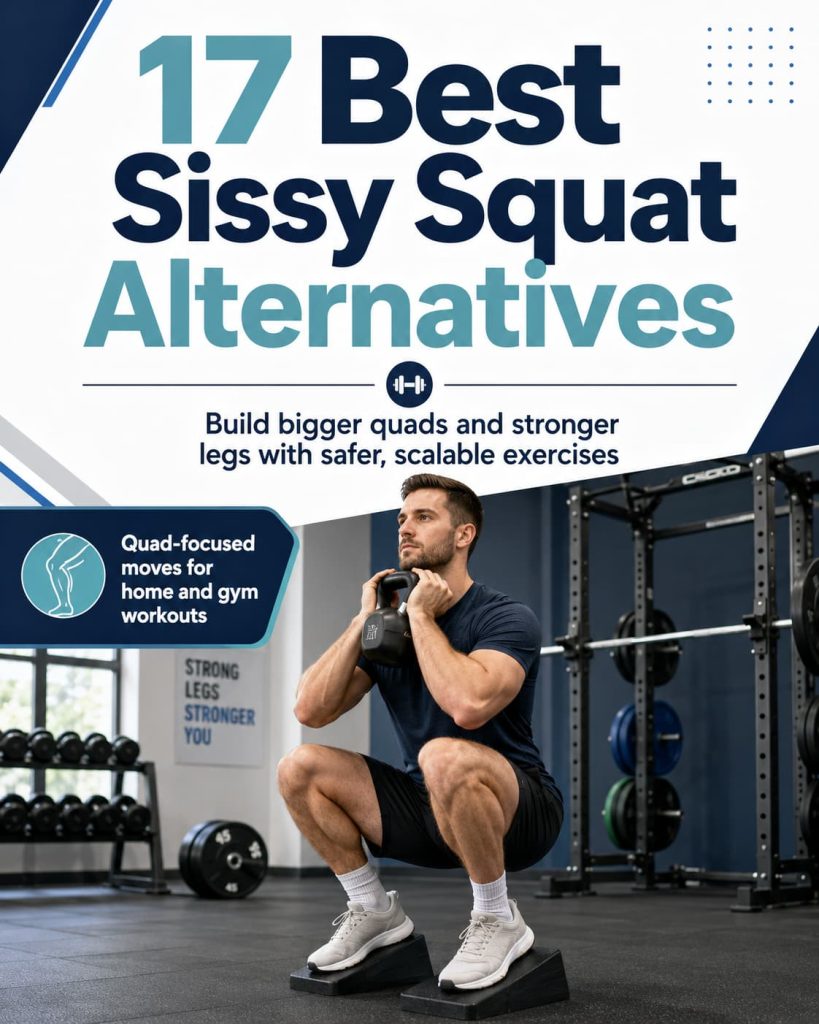
The best sissy squat alternatives include leg extensions, heel-elevated squats, cyclist squats, hack squats, leg presses, split squats, Spanish squats, wall sits, reverse Nordic curls, step-ups, and sled work. These exercises train the front of your thighs through knee bending, knee extension, controlled depth, and progressive overload.
In this guide, you will learn the best alternatives, how to perform each exercise, which muscles they target, common mistakes to avoid, and how to use them in a real quad-building workout.
What Makes a Good Sissy Squat Alternative?
A good sissy squat alternative should train the quadriceps hard while giving you more control over balance, range of motion, and load.
The sissy squat is a very knee-dominant movement. That means your knees bend deeply while your quads work hard to control the movement and extend the knees. A good replacement does not need to look exactly like a sissy squat, but it should still challenge the quads.
According to Cleveland Clinic’s quadriceps guide, the quadriceps are the muscles on the front of the thigh that help straighten the knee and support movements such as walking, running, jumping, and squatting.
A strong sissy squat alternative should help you do at least one of these things: train knee extension directly, load the quads through a deep squat pattern, improve single-leg control, build quad endurance, or add more lower-body volume without relying on the sissy squat.
Muscles Worked by Sissy Squat Alternatives
Most sissy squat alternatives mainly target the quadriceps, but many also train other lower-body muscles.
The quadriceps are the main target. They work to straighten the knees and control knee bending during squats, lunges, step-ups, leg presses, and leg extensions.
The glutes assist during squat and lunge patterns, especially when you drive up from the bottom position.
The adductors help stabilize the hips and support deeper squat positions.
The hamstrings assist with lower-body control, especially during lunges, split squats, leg presses, and step-ups.
The calves help stabilize the ankles during squats, sled drags, step-ups, and lunges.
The core helps keep your torso stable during loaded exercises such as front squats, goblet squats, landmine squats, and Bulgarian split squats.
Quick Guide to the Best Sissy Squat Alternatives
| Goal | Best Options |
|---|---|
| Best direct quad isolation | Leg extension |
| Best beginner option | Heel-elevated goblet squat |
| Best bodyweight option | Wall sit or reverse Nordic curl |
| Best machine option | Hack squat or leg press |
| Best dumbbell option | Bulgarian split squat or dumbbell split squat |
| Best barbell option | Front squat |
| Best knee-dominant squat | Cyclist squat |
| Best band-supported option | Spanish squat |
| Best conditioning option | Backward sled drag |
| Best single-leg control option | Forward step-down |
17 Best Sissy Squat Alternatives
These sissy squat alternatives help you target the quads with more control, better balance, and easier progression.
Choose the exercises that match your equipment, training level, and knee comfort to build stronger legs safely.
1. Leg Extension
Best for: Direct quad isolation and controlled knee extension.
Muscles worked: Quadriceps.
Equipment needed: Leg extension machine.
Why it stands out: The leg extension is one of the closest sissy squat alternatives for isolating the quads because it trains knee extension directly. It removes balance demands and allows you to focus on the front of the thighs. Mayo Clinic’s knee extension guide explains that this machine exercise targets the quadriceps.
Suggested sets and reps: Do 2 to 4 sets of 10 to 20 reps. Use a controlled tempo and avoid swinging the weight.
Beginners: Start with light weight and a comfortable range of motion. Focus on smooth reps before increasing the load.
Intermediate: Use moderate weight and pause briefly near the top of each rep to increase quad tension.
Advanced: Try single-leg reps, slow eccentrics, one-and-a-half reps, or higher-rep finishers.
Rest: Rest 60 to 90 seconds between sets.
How to do it:
- Sit on the leg extension machine with your back supported.
- Adjust the shin pad so it rests just above your ankles.
- Keep your knees lined up with the machine’s pivot point.
- Grip the handles lightly and brace your core.
- Extend your knees until your legs are almost straight.
- Pause briefly at the top.
- Lower the weight slowly back to the start.
Common mistakes: Avoid swinging the weight, lifting your hips off the seat, locking the knees aggressively, using too much weight, or letting the stack crash down.
Expert tip: Think about squeezing the front of your thighs instead of simply kicking the weight up.
Exercise variations: Single-leg leg extension, paused leg extension, slow eccentric leg extension, and one-and-a-half rep leg extension.
Easier variation: Use a lighter load and a shorter range of motion.
Harder variation: Use single-leg reps with a slow lowering phase.
2. Heel-Elevated Goblet Squat
Best for: Beginner-friendly quad-focused squatting.
Muscles worked: Quadriceps, glutes, adductors, calves, and core.
Equipment needed: Dumbbell or kettlebell, plus a slant board, wedge, or small weight plates.
Why it stands out: The heel-elevated goblet squat is one of the best sissy squat alternatives for lifters who want more quad focus without using a machine. Elevating the heels helps many people stay more upright and bend the knees deeper. ACE Fitness shows the goblet squat as a front-loaded squat variation in its goblet squat exercise guide.
Suggested sets and reps: Do 3 to 4 sets of 8 to 15 reps.
Beginners: Start with bodyweight or a light dumbbell. Use a small heel elevation and focus on balance.
Intermediate: Use a heavier dumbbell or kettlebell and squat through a deeper controlled range.
Advanced: Add a slow 3-second lowering phase, a pause at the bottom, or higher-rep sets.
Rest: Rest 60 to 120 seconds between sets.
How to do it:
- Place your heels on a slant board, wedge, or small plates.
- Hold a dumbbell or kettlebell close to your chest.
- Stand with your feet about hip-width to shoulder-width apart.
- Brace your core and keep your chest tall.
- Bend your knees and squat down under control.
- Keep your knees tracking in the same direction as your toes.
- Pause briefly at the bottom.
- Push through your feet to stand back up.
Common mistakes: Avoid letting the heels lift, rounding your upper back, dropping too fast, letting the knees collapse inward, or holding the weight too far from your body.
Expert tip: Keep your torso tall and let your knees travel forward with control.
Exercise variations: Bodyweight heel-elevated squat, kettlebell goblet squat, dumbbell goblet squat, and paused heel-elevated squat.
Easier variation: Perform a bodyweight heel-elevated squat while holding a stable support.
Harder variation: Use a heavier dumbbell and slow the lowering phase.
3. Cyclist Squat
Best for: Deep quad tension with minimal equipment.
Muscles worked: Quadriceps, glutes, calves, and core.
Equipment needed: Slant board, wedge, or weight plates.
Why it stands out: The cyclist squat uses a narrow stance and elevated heels to create a strong quad bias. It is a practical alternative to sissy squats because it keeps tension on the quads while still looking like a familiar squat pattern.
Suggested sets and reps: Do 2 to 4 sets of 10 to 20 reps.
Beginners: Start with bodyweight and reduce depth if needed. Use a stable heel elevation.
Intermediate: Hold a dumbbell in the goblet position and control the full range of motion.
Advanced: Use slow tempo reps, bottom pauses, or high-rep finisher sets.
Rest: Rest 60 to 90 seconds between sets.
How to do it:
- Stand with your heels elevated on a wedge or plates.
- Set your feet close together, around hip-width or slightly narrower.
- Keep your torso upright.
- Brace your core.
- Bend your knees forward in line with your toes.
- Squat down as far as you can control.
- Pause briefly at the bottom.
- Push through your feet to stand.
Common mistakes: Avoid bouncing at the bottom, letting the knees cave inward, using an unstable heel setup, turning it into a wide squat, or going deeper than you can control.
Expert tip: Think “knees forward, chest tall, quads loaded.”
Exercise variations: Bodyweight cyclist squat, goblet cyclist squat, Smith machine cyclist squat, and paused cyclist squat.
Easier variation: Use a higher box target and squat to a controlled depth.
Harder variation: Hold a dumbbell or use slow 3-second lowering reps.
4. Front Squat
Best for: Heavy quad-focused strength training.
Muscles worked: Quadriceps, glutes, adductors, upper back, and core.
Equipment needed: Barbell and squat rack.
Why it stands out: The front squat is a powerful sissy squat alternative because the barbell sits in front of your body, which encourages a more upright torso. This often places more demand on the quads than many hip-dominant squat variations.
Suggested sets and reps: Do 3 to 5 sets of 4 to 8 reps for strength or 3 to 4 sets of 6 to 10 reps for muscle growth.
Beginners: Learn goblet squats and double-dumbbell front squats before moving to the barbell.
Intermediate: Use moderate loads and focus on keeping the elbows high throughout the set.
Advanced: Use heavier loading, paused reps, tempo reps, or front squat clusters.
Rest: Rest 2 to 3 minutes between heavier sets.
How to do it:
- Set a barbell at upper-chest height in a rack.
- Rest the bar across the front of your shoulders.
- Use a clean grip, cross-arm grip, or strap-assisted grip.
- Lift your elbows high and brace your core.
- Step back and set your feet around shoulder-width apart.
- Squat down while keeping your torso upright.
- Keep your knees tracking with your toes.
- Drive through your midfoot to stand.
Common mistakes: Avoid letting the elbows drop, holding the bar only in your hands, rounding your upper back, losing core tension, or adding weight before your position is stable.
Expert tip: Drive your elbows forward and up as you come out of the bottom.
Exercise variations: Barbell front squat, dumbbell front squat, kettlebell front squat, paused front squat, and front squat to box.
Easier variation: Use a goblet squat or double-dumbbell front squat.
Harder variation: Add pauses at the bottom or use heavier sets in the 4 to 6 rep range.
5. Hack Squat
Best for: Stable machine-based quad growth.
Muscles worked: Quadriceps, glutes, adductors, and calves.
Equipment needed: Hack squat machine.
Why it stands out: The hack squat is a top gym alternative to sissy squats because the machine supports your torso and lets you focus on the legs. A controlled setup can make it easier to train the quads hard without worrying as much about balance.
Suggested sets and reps: Do 3 to 4 sets of 8 to 15 reps.
Beginners: Start with light weight and a comfortable depth. Learn how the machine moves before increasing load.
Intermediate: Use moderate weight and focus on consistent depth every rep.
Advanced: Use slow eccentrics, paused reps, rest-pause sets, or higher-volume quad blocks.
Rest: Rest 90 to 150 seconds between sets.
How to do it:
- Place your back and shoulders against the pads.
- Set your feet about hip-width to shoulder-width apart.
- Keep your heels flat on the platform.
- Unlock the machine safely.
- Lower under control.
- Stop at a depth you can control.
- Keep your knees tracking in line with your toes.
- Push the platform away to return to the top.
Common mistakes: Avoid placing the feet so low that your heels lift, bouncing at the bottom, locking out harshly, letting the knees cave inward, or using more depth than your hips and knees can control.
Expert tip: Lower smoothly and keep pressure through your whole foot.
Exercise variations: Close-stance hack squat, paused hack squat, slow eccentric hack squat, and high-rep hack squat.
Easier variation: Use a shorter range of motion and lighter load.
Harder variation: Add a 2-second pause at the bottom of each rep.
6. Leg Press
Best for: High-volume quad training with stable support.
Muscles worked: Quadriceps, glutes, hamstrings, adductors, and calves.
Equipment needed: Leg press machine.
Why it stands out: The leg press is one of the most useful sissy squat alternatives because it is stable, easy to load, and beginner-friendly. Mayo Clinic’s seated leg press guide recommends keeping the feet planted and stopping just short of full knee extension.
Suggested sets and reps: Do 3 to 5 sets of 8 to 15 reps. For a quad finisher, use 2 to 3 sets of 15 to 25 reps.
Beginners: Use light weight and learn how to control the bottom position without your hips rolling off the pad.
Intermediate: Use moderate weight and a consistent range of motion.
Advanced: Use heavier loading, high-rep sets, tempo reps, or single-leg leg press variations.
Rest: Rest 90 to 180 seconds between sets.
How to do it:
- Sit with your back and hips supported.
- Place your feet about shoulder-width apart on the platform.
- Brace your core and grip the handles.
- Unlock the machine.
- Lower the platform under control.
- Keep your knees tracking in line with your toes.
- Stop before your hips lift or tuck under.
- Push the platform away.
- Finish just short of locking your knees.
Common mistakes: Avoid rounding your lower back, locking your knees hard, letting your knees cave inward, using too much weight, or lowering deeper than you can control.
Expert tip: Keep your hips heavy against the pad and control the bottom position.
Exercise variations: Standard leg press, close-stance leg press, single-leg leg press, paused leg press, and high-rep leg press.
Easier variation: Use a lighter load and reduce the range of motion.
Harder variation: Use single-leg reps or slow 3-second eccentrics.
7. Smith Machine Squat
Best for: Guided quad-focused squatting.
Muscles worked: Quadriceps, glutes, adductors, calves, and core.
Equipment needed: Smith machine.
Why it stands out: The Smith machine squat gives you a fixed bar path, which can make it easier to focus on tempo, depth, and quad tension. It is especially useful for heel-elevated and close-stance squat variations.
Suggested sets and reps: Do 3 to 4 sets of 8 to 12 reps.
Beginners: Start with light weight and find a stance that feels natural.
Intermediate: Use moderate load and keep the same depth on every rep.
Advanced: Try heel-elevated Smith squats, paused reps, or high-rep quad-focused sets.
Rest: Rest 90 to 150 seconds between sets.
How to do it:
- Set the bar around upper-chest height.
- Position the bar across your upper back.
- Set your feet in a comfortable squat stance.
- Brace your core.
- Unlock the bar.
- Squat down under control.
- Keep your knees tracking over your toes.
- Drive through your feet to stand.
- Re-rack the bar safely.
Common mistakes: Avoid forcing an unnatural stance, standing too far forward, bouncing at the bottom, letting the knees cave inward, or relying on the machine instead of controlling the movement.
Expert tip: Use the machine for stability, not momentum.
Exercise variations: Standard Smith squat, heel-elevated Smith squat, close-stance Smith squat, and paused Smith squat.
Easier variation: Use a bodyweight squat or goblet squat first.
Harder variation: Use a heel-elevated setup with slower reps.
8. Landmine Squat
Best for: Controlled loaded squatting with a joint-friendly feel.
Muscles worked: Quadriceps, glutes, adductors, core, and upper back.
Equipment needed: Barbell and landmine attachment or secure corner setup.
Why it stands out: The landmine squat is easier to control than many barbell squat variations because the weight moves on an angled path. Holding the bar in front of the body also helps you keep a more upright torso.
Suggested sets and reps: Do 3 to 4 sets of 8 to 15 reps.
Beginners: Start with the empty bar or light weight. Focus on posture and smooth reps.
Intermediate: Add plates and use a full controlled range of motion.
Advanced: Use heel elevation, pauses, or heavier sets for more quad emphasis.
Rest: Rest 60 to 120 seconds between sets.
How to do it:
- Place one end of a barbell in a landmine attachment or secure corner.
- Hold the other end of the bar at chest height.
- Stand with your feet about shoulder-width apart.
- Brace your core.
- Squat down while keeping your chest tall.
- Keep your knees tracking with your toes.
- Pause briefly at the bottom.
- Push through your feet to stand.
Common mistakes: Avoid letting the bar drift away from your chest, leaning too far forward, shifting only onto your toes, cutting the range of motion too short, or loading too heavily too soon.
Expert tip: Keep the bar close to your body and squat between your feet.
Exercise variations: Standard landmine squat, heel-elevated landmine squat, landmine front squat, and paused landmine squat.
Easier variation: Use a goblet squat.
Harder variation: Add load and use a slow lowering phase.
9. Spanish Squat
Best for: Band-supported quad tension and controlled knee-dominant training.
Muscles worked: Quadriceps, glutes, and core.
Equipment needed: Heavy resistance band or strong strap.
Why it stands out: The Spanish squat uses a band or strap behind the knees, allowing you to sit back while keeping the torso upright. This makes it a useful alternative for lifters who want quad tension without the same balance demand as a sissy squat. A Spanish squat biomechanics paper from the International Society of Biomechanics in Sports archive discusses how the Spanish squat targets knee extensor muscles.
Suggested sets and reps: Do 2 to 4 sets of 10 to 20 reps, or hold for 20 to 45 seconds.
Beginners: Start with shallow reps or short holds. Make sure the anchor is secure.
Intermediate: Use deeper reps and longer holds while keeping the torso upright.
Advanced: Add a dumbbell, use longer isometric holds, or combine reps and holds in the same set.
Rest: Rest 60 to 90 seconds between sets.
How to do it:
- Anchor a heavy band or strap to a sturdy post at knee height.
- Step inside the band so it sits behind both knees.
- Walk back until the band has strong tension.
- Stand tall with your feet about shoulder-width apart.
- Sit back and down into a squat.
- Keep your torso upright.
- Pause at the bottom.
- Drive your feet into the floor to stand.
Common mistakes: Avoid using a weak anchor, letting the band slide too low, leaning too far forward, rushing the movement, or forcing depth.
Expert tip: Sit back into the band while keeping your chest tall.
Exercise variations: Spanish squat reps, Spanish squat hold, loaded Spanish squat, and Spanish squat pulse.
Easier variation: Use a shallower hold with less knee bend.
Harder variation: Hold a dumbbell at your chest while performing slow reps.
10. Wall Sit
Best for: No-equipment quad endurance and beginner-friendly isometric work.
Muscles worked: Quadriceps, glutes, hamstrings, and calves.
Equipment needed: Wall.
Why it stands out: The wall sit is simple, scalable, and easy to perform almost anywhere. It trains the quads with an isometric hold, which means your muscles work without visible movement. Cleveland Clinic’s wall sit guide explains that wall sits can challenge the quads, hamstrings, and glutes.
Suggested sets and reps: Do 2 to 4 sets of 20 to 60 seconds.
Beginners: Hold a higher wall sit angle and stop before your form breaks down.
Intermediate: Work toward longer holds with your knees around a comfortable squat angle.
Advanced: Add a weight plate, use longer holds, or try single-leg wall sit progressions after building strong control.
Rest: Rest 60 to 90 seconds between sets.
How to do it:
- Stand with your back against a wall.
- Walk your feet forward.
- Slide down until your knees are bent to a comfortable angle.
- Keep your back against the wall.
- Keep your knees tracking over your feet.
- Hold the position while breathing steadily.
- Push through your feet to stand back up.
Common mistakes: Avoid sliding too low too soon, holding your breath, placing your feet too close to the wall, letting the knees collapse inward, or staying in the hold after form breaks down.
Expert tip: Keep your feet heavy and breathe steadily through the hold.
Exercise variations: Standard wall sit, weighted wall sit, heel-elevated wall sit, and single-leg wall sit.
Easier variation: Use a higher position with less knee bend.
Harder variation: Hold a weight plate or extend the hold time.
11. Bulgarian Split Squat
Best for: Single-leg quad strength and muscle building.
Muscles worked: Quadriceps, glutes, adductors, hamstrings, calves, and core.
Equipment needed: Bench or box, with dumbbells optional.
Why it stands out: The Bulgarian split squat is one of the strongest single-leg sissy squat alternatives. Your front leg does most of the work, and a more upright torso can increase the quad focus. ACE Fitness describes the setup in its Bulgarian split squat exercise guide.
Suggested sets and reps: Do 2 to 4 sets of 8 to 12 reps per leg.
Beginners: Start with a regular split squat before elevating the rear foot.
Intermediate: Use bodyweight or light dumbbells and keep the front knee tracking well.
Advanced: Hold heavier dumbbells, elevate the front heel slightly, or use slow eccentrics.
Rest: Rest 90 to 150 seconds between sets.
How to do it:
- Stand a few feet in front of a bench.
- Place the top of your rear foot on the bench.
- Keep most of your weight on the front leg.
- Brace your core.
- Lower your back knee toward the floor.
- Keep your front knee tracking over your toes.
- Pause briefly at the bottom.
- Drive through the front foot to stand.
Common mistakes: Avoid placing the front foot too close, pushing too much through the back foot, dropping too fast, letting the front knee cave inward, or losing balance between reps.
Expert tip: Make the front leg do the work.
Exercise variations: Bodyweight Bulgarian split squat, dumbbell Bulgarian split squat, heel-elevated Bulgarian split squat, and paused Bulgarian split squat.
Easier variation: Use a regular split squat with both feet on the floor.
Harder variation: Hold dumbbells and use a slow 3-second lowering phase.
12. Dumbbell Split Squat
Best for: Easier single-leg quad training.
Muscles worked: Quadriceps, glutes, adductors, hamstrings, calves, and core.
Equipment needed: Dumbbells optional.
Why it stands out: The dumbbell split squat is easier to learn than the Bulgarian split squat because both feet stay on the floor. It still trains one leg at a time and can strongly target the quads when you keep your torso upright and allow the front knee to bend.
Suggested sets and reps: Do 2 to 4 sets of 8 to 15 reps per leg.
Beginners: Use bodyweight and hold a wall or rack for balance if needed.
Intermediate: Hold dumbbells at your sides and use a consistent range of motion.
Advanced: Elevate the front heel, add pauses, or use heavier dumbbells.
Rest: Rest 60 to 120 seconds between sets.
How to do it:
- Stand in a split stance with one foot forward and one foot back.
- Keep your torso upright.
- Brace your core.
- Lower your back knee toward the floor.
- Let your front knee bend and track over your toes.
- Pause briefly near the bottom.
- Push through the front foot to stand.
- Complete all reps, then switch sides.
Common mistakes: Avoid using too narrow of a stance, letting the front heel lift, pushing mainly through the back leg, letting the knee cave inward, or rushing the reps.
Expert tip: Drop straight down and drive through the front foot.
Exercise variations: Bodyweight split squat, dumbbell split squat, front-foot-elevated split squat, and heel-elevated split squat.
Easier variation: Hold onto a rack or wall for support.
Harder variation: Hold dumbbells and elevate the front heel slightly.
13. Reverse Lunge
Best for: Controlled single-leg training with less forward momentum.
Muscles worked: Quadriceps, glutes, hamstrings, adductors, calves, and core.
Equipment needed: Dumbbells optional.
Why it stands out: The reverse lunge is a practical alternative because it is usually easier to control than a forward lunge. Stepping backward can help many lifters keep better balance and knee tracking.
Suggested sets and reps: Do 2 to 4 sets of 8 to 12 reps per leg.
Beginners: Start with bodyweight reverse lunges and hold support if balance is difficult.
Intermediate: Hold dumbbells and use a smooth step-back rhythm.
Advanced: Use a front-rack position, deficit reverse lunge, or heavier dumbbells.
Rest: Rest 60 to 120 seconds between sets.
How to do it:
- Stand tall with your feet hip-width apart.
- Brace your core.
- Step one foot backward.
- Lower your back knee toward the floor.
- Keep your front knee tracking over your toes.
- Push through the front foot to return to standing.
- Repeat on the other side.
Common mistakes: Avoid stepping too short, pushing mainly off the back foot, leaning too far forward, letting the front knee collapse inward, or losing control between reps.
Expert tip: Step back softly and pull yourself up with the front leg.
Exercise variations: Bodyweight reverse lunge, dumbbell reverse lunge, deficit reverse lunge, and front-rack reverse lunge.
Easier variation: Use bodyweight and a shorter range of motion.
Harder variation: Hold dumbbells or perform deficit reverse lunges.
14. Step-Up
Best for: Functional quad strength and single-leg control.
Muscles worked: Quadriceps, glutes, hamstrings, calves, and core.
Equipment needed: Step, box, or bench.
Why it stands out: The step-up builds useful leg strength while training one leg at a time. It is easy to scale by changing the step height or adding dumbbells. Mayo Clinic’s step-up guide notes that the exercise works the quadriceps, hamstrings, and glutes.
Suggested sets and reps: Do 2 to 4 sets of 8 to 15 reps per leg.
Beginners: Use a low step and bodyweight only.
Intermediate: Add dumbbells and control the lowering phase.
Advanced: Use a higher step, heavier load, or slow eccentric step-down.
Rest: Rest 60 to 120 seconds between sets.
How to do it:
- Stand in front of a sturdy box or step.
- Place one foot fully on the surface.
- Brace your core.
- Push through the working foot to lift your body up.
- Stand tall at the top.
- Step down slowly with control.
- Complete all reps, then switch legs.
Common mistakes: Avoid pushing off too much with the bottom leg, using a step that is too high, letting the knee collapse inward, landing heavily, or rushing the lowering phase.
Expert tip: Make the top leg lift you instead of jumping off the floor leg.
Exercise variations: Bodyweight step-up, dumbbell step-up, high step-up, low step-up, and step-up with slow lower.
Easier variation: Use a lower step and hold support.
Harder variation: Hold dumbbells and use a slower descent.
15. Forward Step-Down
Best for: Eccentric quad control and knee tracking practice.
Muscles worked: Quadriceps, glutes, calves, and core.
Equipment needed: Low step or box.
Why it stands out: The forward step-down trains the quads as they control your body during the lowering phase. It is a strong choice for building control, improving balance, and exposing differences between legs.
Suggested sets and reps: Do 2 to 3 sets of 6 to 12 reps per leg.
Beginners: Start with a very low step and hold a wall or rack for balance.
Intermediate: Use a slow 2 to 4 second lowering phase.
Advanced: Increase the step height gradually or hold light dumbbells.
Rest: Rest 60 to 90 seconds between sets.
How to do it:
- Stand on a low step with one foot near the edge.
- Let the other foot hover in front of the step.
- Brace your core.
- Slowly bend the working knee.
- Lower the free heel toward the floor.
- Lightly tap the heel down if needed.
- Push through the working foot to return to the top.
- Complete all reps, then switch sides.
Common mistakes: Avoid using a step that is too high, dropping quickly, letting the knee cave inward, shifting the hip out to the side, or pushing off the floor with the free leg.
Expert tip: Lower like you are using a brake, not falling off the step.
Exercise variations: Forward step-down, lateral step-down, slow eccentric step-down, and weighted step-down.
Easier variation: Use a smaller step and hold support.
Harder variation: Use a higher step or hold dumbbells.
16. Reverse Nordic Curl
Best for: Advanced bodyweight quad strength.
Muscles worked: Quadriceps, hip flexors, and core.
Equipment needed: Mat or soft surface.
Why it stands out: The reverse Nordic curl is one of the closest bodyweight alternatives to a sissy squat because it loads the quads through a long-lever knee-extension pattern. It creates strong tension through the front of the thighs and requires excellent control.
Suggested sets and reps: Do 2 to 4 sets of 4 to 10 reps.
Beginners: This is not usually a beginner exercise. Start with partial range of motion and support if needed.
Intermediate: Use a small range of motion and focus on keeping your hips extended.
Advanced: Increase the range gradually, add pauses, or use a slower lowering phase.
Rest: Rest 90 to 150 seconds between sets.
How to do it:
- Kneel on a mat with your knees about hip-width apart.
- Keep your hips extended and your torso tall.
- Brace your abs and squeeze your glutes lightly.
- Lean backward from the knees.
- Keep a straight line from knees to shoulders.
- Go only as far as you can control.
- Use your quads to pull yourself back up.
Common mistakes: Avoid bending at the hips, arching the lower back, dropping too far too soon, moving too fast, or forcing the knees into discomfort.
Expert tip: Stay tall from knees to shoulders and move slowly.
Exercise variations: Partial reverse Nordic curl, band-assisted reverse Nordic curl, paused reverse Nordic curl, and slow eccentric reverse Nordic curl.
Easier variation: Use a resistance band for assistance or reduce the range of motion.
Harder variation: Increase the range slowly and pause at the hardest point.
17. Backward Sled Drag
Best for: Quad conditioning and scalable lower-body volume.
Muscles worked: Quadriceps, glutes, calves, hamstrings, and core.
Equipment needed: Sled, turf, and straps or handles.
Why it stands out: The backward sled drag is an excellent quad-focused conditioning exercise. Every step requires the quads to work as you drive through the feet and pull the sled backward. It is easy to scale by adjusting load, distance, and speed.
Suggested sets and reps: Do 4 to 10 rounds of 15 to 40 yards.
Beginners: Use a light sled and short distances. Focus on steady steps.
Intermediate: Use moderate load and repeat longer rounds with clean posture.
Advanced: Use heavier sled drags, longer distances, or combine backward drags with sled pushes.
Rest: Rest 45 to 120 seconds between rounds.
How to do it:
- Attach straps to the sled.
- Hold the straps and walk backward until they are tight.
- Keep your chest tall.
- Bend your knees slightly.
- Drive through your feet and pull the sled backward.
- Take short, controlled steps.
- Keep tension on the sled the whole time.
Common mistakes: Avoid taking steps that are too long, letting the sled jerk forward, rounding your back, using a load that ruins posture, or sprinting before you can control the movement.
Expert tip: Push the ground away with every step.
Exercise variations: Backward sled drag, forward sled push, heavy sled march, and alternating forward-backward sled work.
Easier variation: Use a lighter sled and shorter distance.
Harder variation: Add load, increase distance, or reduce rest.
How to Choose the Right Sissy Squat Alternative
The best sissy squat alternative depends on your training goal, equipment, experience level, and comfort.
If you want direct quad isolation, choose the leg extension. It is simple, controlled, and easy to progress.
If you train at home, choose heel-elevated goblet squats, cyclist squats, wall sits, dumbbell split squats, reverse lunges, step-ups, and reverse Nordic curls.
If you train in a gym, choose hack squats, leg presses, Smith machine squats, landmine squats, front squats, leg extensions, and sled drags.
If you are a beginner, start with wall sits, heel-elevated goblet squats, leg presses, leg extensions, step-ups, and dumbbell split squats.
If you are advanced, use front squats, hack squats, Bulgarian split squats, reverse Nordic curls, cyclist squats, forward step-downs, and heavy sled drags.
If an exercise causes sharp pain, numbness, dizziness, chest pain, or unusual symptoms, stop and seek help from a qualified professional.
Programming Tips for Bigger Quads
For stronger and bigger quads, train them at least twice per week if your recovery allows. The ACSM resistance training guideline update supports regular resistance training for major muscle groups and explains that higher training volume is often useful for muscle growth.
Most lifters can start with 8 to 12 hard quad-focused sets per week and build from there. More advanced lifters may use 12 to 20 weekly sets if recovery, sleep, nutrition, and technique are solid.
For heavy compound lifts such as front squats, hack squats, and leg presses, use 3 to 5 sets of 4 to 12 reps.
For muscle-building accessories such as split squats, step-ups, cyclist squats, and landmine squats, use 2 to 4 sets of 8 to 15 reps.
For isolation exercises such as leg extensions, use 2 to 4 sets of 10 to 20 reps.
For isometric exercises such as wall sits and Spanish squat holds, use 2 to 4 sets of 20 to 60 seconds.
For sled work, use 4 to 10 rounds of 15 to 40 yards.
A simple progression method is to add reps first. When you can complete the top of your rep range with good form, add a small amount of weight the next time.
Sample Quad Workout Without Sissy Squats
Beginner Quad Workout
This workout is best for beginners who want stronger quads without doing sissy squats. Perform it 1 to 2 times per week.
| Exercise | Sets | Reps | Rest |
|---|---|---|---|
| Heel-elevated goblet squat | 3 | 8 to 12 | 90 sec |
| Leg extension | 3 | 12 to 15 | 60 sec |
| Dumbbell split squat | 2 | 8 to 10 per leg | 90 sec |
| Wall sit | 2 | 20 to 40 sec | 60 sec |
Use a controlled tempo and stop each set with about 2 to 3 reps in reserve. Add reps before adding more weight.
Intermediate Gym Quad Workout
This workout is best for lifters who have access to machines and free weights. Perform it 1 to 2 times per week.
| Exercise | Sets | Reps | Rest |
|---|---|---|---|
| Front squat | 4 | 5 to 8 | 2 to 3 min |
| Hack squat or leg press | 3 | 8 to 12 | 2 min |
| Bulgarian split squat | 3 | 8 to 10 per leg | 90 sec |
| Leg extension | 3 | 12 to 20 | 60 to 90 sec |
| Backward sled drag | 4 | 20 yards | 60 to 90 sec |
Use loads that feel challenging but still allow clean technique. Most working sets should finish with 1 to 3 reps in reserve.
No-Machine Quad Workout
This option works well at home or in a simple gym setup.
| Exercise | Sets | Reps | Rest |
|---|---|---|---|
| Cyclist squat | 3 | 10 to 15 | 90 sec |
| Dumbbell split squat | 3 | 8 to 12 per leg | 90 sec |
| Step-up | 3 | 8 to 12 per leg | 60 to 90 sec |
| Reverse Nordic curl | 2 | 4 to 8 | 90 sec |
| Wall sit | 2 | 30 to 60 sec | 60 sec |
Keep the movements controlled. Do not rush the reps just to feel more burn.
Common Mistakes When Replacing Sissy Squats
Choosing Exercises That Are Not Quad-Focused Enough
Romanian deadlifts, hip thrusts, good mornings, and glute bridges are useful exercises, but they are not direct sissy squat replacements. They train more hip extension than knee extension. For a closer match, choose exercises that involve deep knee bending, direct knee extension, or strong quad tension.
Loading Too Heavy Too Soon
Quad-focused exercises can feel intense quickly. Start with a load you can control. Add weight only when your knees, hips, feet, and torso stay stable.
Cutting Every Rep Short
A shorter range of motion is useful when learning, but do not turn every exercise into a shallow partial rep. Use the deepest comfortable range you can control with good form.
Letting the Knees Cave Inward
During squats, leg presses, step-ups, lunges, and split squats, keep your knees tracking in the same direction as your toes. This improves control and helps you load the quads more effectively.
Ignoring Tempo
Fast reps reduce control. Lower slowly, pause when useful, and drive up with purpose. A controlled 2 to 3 second lowering phase works well for many quad-focused exercises.
Doing Too Many Alternatives in One Workout
You do not need all 17 exercises in one session. Most workouts need only 3 to 5 well-chosen movements. Choose one main lift, one single-leg exercise, one isolation exercise, and one optional finisher.
FAQ
What is the best alternative to sissy squats?
The leg extension is the best direct alternative for isolating the quads. For compound exercises, the heel-elevated goblet squat, hack squat, leg press, front squat, and cyclist squat are excellent choices.
Can I build big quads without sissy squats?
Yes. Sissy squats are useful, but they are not required. You can build bigger quads with progressive exercises such as leg presses, hack squats, front squats, split squats, step-ups, cyclist squats, and leg extensions.
What can I do instead of sissy squats at home?
Good home options include heel-elevated goblet squats, cyclist squats, wall sits, dumbbell split squats, reverse lunges, step-ups, forward step-downs, and reverse Nordic curls.
Are leg extensions a good sissy squat alternative?
Yes. Leg extensions are one of the best sissy squat alternatives for direct quad training because they isolate knee extension. They do not copy the full sissy squat movement, but they train the target muscle very effectively.
Are reverse Nordic curls the same as sissy squats?
No. Reverse Nordic curls and sissy squats both challenge the quads, but they use different body positions. Reverse Nordic curls are performed from a kneeling position, while sissy squats are usually performed standing.
What is the most knee-friendly sissy squat alternative?
There is no single best option for every person. Many lifters find wall sits, Spanish squats, leg presses, and controlled split squats easier to adjust because you can change depth, load, stance, and range of motion.
How many sissy squat alternatives should I do in one workout?
Most workouts only need 3 to 5 quad-focused exercises. A good structure is one squat or leg press pattern, one single-leg movement, one isolation exercise, and one finisher.
Conclusion
Sissy squats can be effective, but they are not the only way to build strong quads. The best sissy squat alternatives let you train the front of your thighs with more control, better loading options, and exercises that match your current strength level.
Start with a few reliable movements such as heel-elevated goblet squats, leg extensions, leg presses, split squats, and wall sits. As you get stronger, progress to hack squats, front squats, Bulgarian split squats, cyclist squats, reverse Nordic curls, and sled work.
Choose exercises you can perform with control, progress gradually, and build your quad workouts around quality reps instead of forcing painful positions.
This content is for informational purposes only and is not a substitute for professional medical advice.
References
- Cleveland Clinic — Quadriceps: Anatomy, Function, and Common Conditions
- Mayo Clinic — Squat Exercise
- Mayo Clinic — Knee Extension With Weight Machine
- ACE Fitness — Goblet Squat
- ACSM — Updated Resistance Training Guidelines
Discover 17 sissy squat alternatives to build bigger quads and stronger legs with clear form tips, workout ideas, and beginner-friendly options.