Landmine leg exercises use a barbell anchored at one end to train squats, lunges, hinges, single-leg strength, and explosive lower-body movements with a more guided bar path. They are especially useful if you want strong legs and glutes while also challenging balance, bracing, and full-body control.
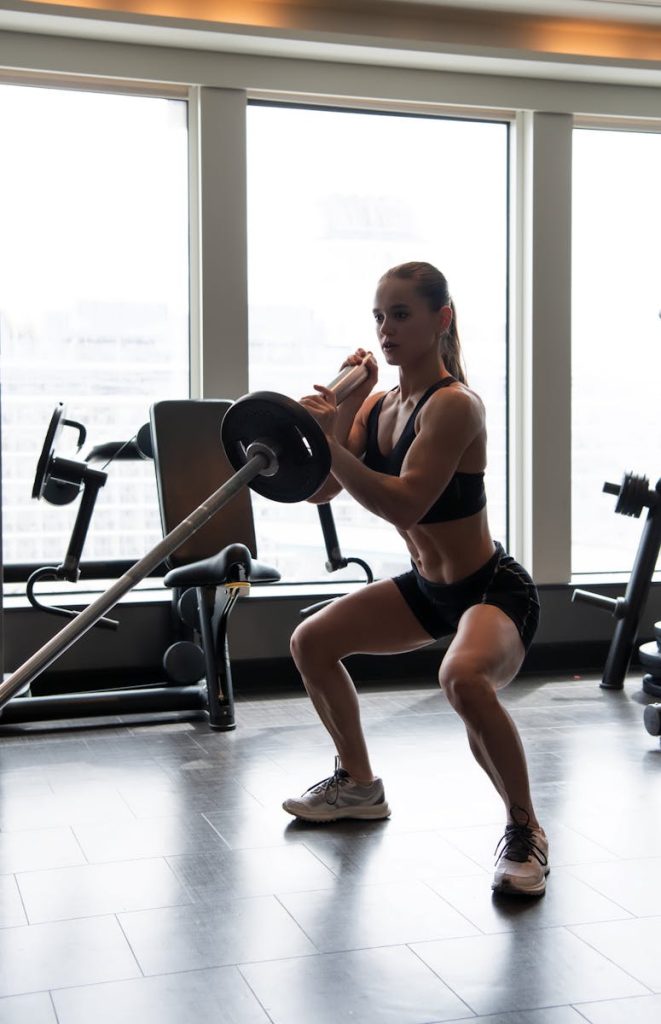
The landmine setup can feel more approachable than a straight barbell because the bar moves in an angled arc instead of straight up and down. That makes it a smart option for beginners, athletes, and experienced lifters who want joint-friendly variety in their lower-body training.
In this guide, you’ll learn the best landmine leg exercises, which muscles they target, how to perform each move, common mistakes to avoid, and how to build a practical landmine leg workout.
What Are Landmine Leg Exercises?
Landmine leg exercises are lower-body movements performed with one end of a barbell secured in a landmine attachment, corner, or stable anchor point. The other end of the barbell is lifted, held, or loaded to perform exercises like squats, lunges, deadlifts, and rotational power drills.
The American Council on Exercise includes landmine movements in resistance-training programming and lists landmine goblet squats as a beginner-friendly lower-body option.
Landmine training is useful because the anchored bar gives you a fixed pivot point. You still have to stabilize your body, but the bar path is often easier to control than a free barbell.
Muscles Worked by Landmine Leg Exercises
Landmine leg exercises can train almost every major lower-body muscle, depending on the movement.
The main muscles worked include:
- Quadriceps: front thigh muscles used in squats, split squats, lunges, and step patterns
- Glutes: hip extension, hip stability, and power production
- Hamstrings: hip hinge strength, deadlift patterns, and single-leg stability
- Adductors: inner thigh muscles used heavily in sumo deadlifts, lateral lunges, and Cossack squats
- Calves: ankle stability and support during standing landmine movements
- Core stabilizers: trunk control, anti-rotation, and bracing
- Hip stabilizers: balance and control during single-leg and lateral exercises
Core involvement matters because your core includes the abdominal muscles, back muscles, and muscles around the pelvis, according to Mayo Clinic.
Benefits of Landmine Leg Exercises
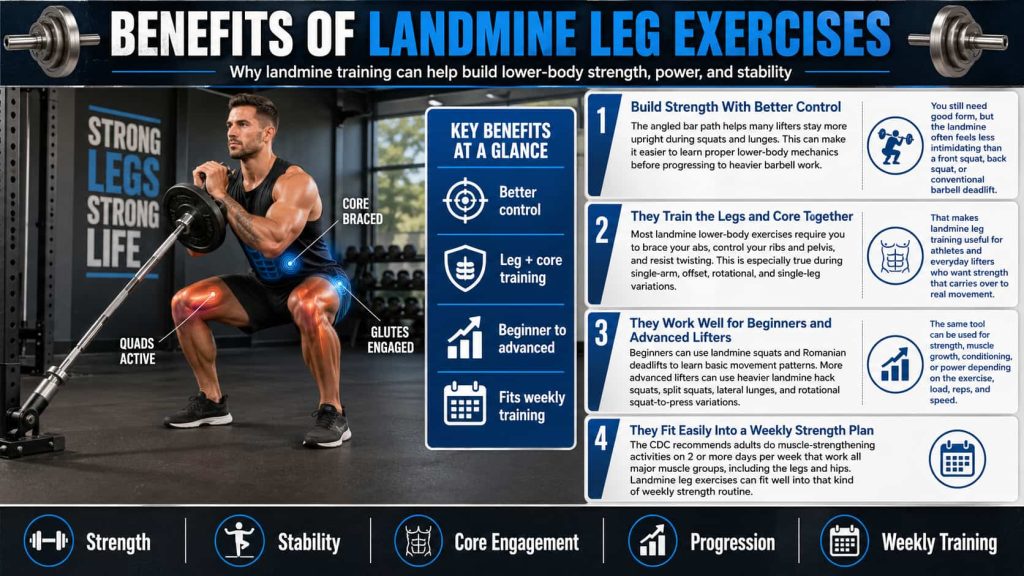
Landmine Leg Exercises Can Build Strength With Better Control
The angled bar path helps many lifters stay more upright during squats and lunges. This can make it easier to learn proper lower-body mechanics before progressing to heavier barbell work.
You still need good form, but the landmine often feels less intimidating than a front squat, back squat, or conventional barbell deadlift.
They Train the Legs and Core Together
Most landmine lower-body exercises require you to brace your abs, control your ribs and pelvis, and resist twisting. This is especially true during single-arm, offset, rotational, and single-leg variations.
That makes landmine leg training useful for athletes and everyday lifters who want strength that carries over to real movement.
They Work Well for Beginners and Advanced Lifters
Beginners can use landmine squats and Romanian deadlifts to learn basic movement patterns. More advanced lifters can use heavier landmine hack squats, split squats, lateral lunges, and rotational squat-to-press variations.
The same tool can be used for strength, muscle growth, conditioning, or power depending on the exercise, load, reps, and speed.
They Fit Easily Into a Weekly Strength Plan
The CDC recommends adults do muscle-strengthening activities on 2 or more days per week that work all major muscle groups, including the legs and hips. Landmine leg exercises can fit well into that kind of weekly strength routine.
12 Best Landmine Leg Exercises
Below are 12 landmine leg exercises that train your quads, glutes, hamstrings, inner thighs, core, and lower-body stability. Use them to build strength, power, balance, and muscle with a more controlled bar path than many traditional barbell lifts.
1. Landmine Squat
Best for: Beginners, squat pattern practice, quad and glute strength
Muscles worked: Quads, glutes, hamstrings, adductors, calves, core
Equipment needed: Barbell, landmine attachment or secure corner, weight plates
Why it stands out
The landmine squat is one of the best beginner-friendly landmine leg exercises because the bar acts like a counterbalance. Holding the bar in front of your chest can help you keep a more upright torso and sit into the squat with better control.
It is a great first landmine leg exercise before moving to harder variations like the landmine hack squat, split squat, or squat to press.
Suggested sets and reps
- For strength: 3–5 sets of 4–8 reps
- For muscle: 3–4 sets of 8–12 reps
- For beginners: 2–3 sets of 8–10 controlled reps
How to do it
- Place one end of the barbell in a landmine attachment or secure corner.
- Stand facing the free end of the bar.
- Hold the end of the bar with both hands at chest height.
- Set your feet about shoulder-width apart.
- Brace your core and keep your chest tall.
- Bend your knees and hips to lower into a squat.
- Keep your knees tracking in the same direction as your toes.
- Drive through your midfoot and heels to stand back up.
Common mistakes:
- Letting the knees collapse inward
- Rounding the upper back
- Rising onto the toes
- Cutting the depth too short without control
- Relaxing the core at the bottom
Coaching cue:
Keep the end of the bar close to your chest and think, “sit down between your heels.”
Exercise variations
- Easier: bodyweight box squat before adding the landmine
- Easier: landmine squat to a bench
- Harder: tempo landmine squat
- Harder: landmine squat with pause at the bottom
How to use in a workout:
Use the landmine squat as your main lower-body strength exercise near the start of the session.
2. Landmine Hack Squat
Best for: Quad strength, leg size, controlled squat depth
Muscles worked: Quads, glutes, hamstrings, calves, core
Equipment needed: Barbell, landmine attachment, weight plates
Why it stands out
The landmine hack squat lets you lean back slightly into the bar while keeping your feet forward. This shifts more demand to the quads while still training the glutes and trunk.
It is a strong option if you want a machine-like squat pattern without needing a hack squat machine.
Suggested sets and reps
- For strength: 3–4 sets of 5–8 reps
- For muscle: 3–4 sets of 8–15 reps
- For control: 2–3 sets of 10 slow reps
How to do it
- Stand with your back facing the landmine.
- Position the free end of the bar over one shoulder.
- Step your feet slightly forward.
- Brace your core and keep your torso firm.
- Bend your knees and lower into a squat.
- Keep your heels down and knees tracking over your toes.
- Drive through your feet to stand.
- Repeat all reps, then switch the bar to the opposite shoulder if needed.
Common mistakes:
- Standing too close to the anchor point
- Letting the heels lift
- Collapsing the knees inward
- Twisting because the bar is on one shoulder
- Going too heavy before learning the setup
Coaching cue:
Push your knees forward and out while keeping your whole foot connected to the floor.
Exercise variations
- Easier: light landmine hack squat with short range of motion
- Easier: landmine squat instead
- Harder: paused landmine hack squat
- Harder: 1.5-rep landmine hack squat
How to use in a workout:
Use this as a quad-focused main lift or as a second exercise after a heavier squat or deadlift pattern.
3. Landmine Front Squat
Best for: Upright squatting, core bracing, quads and glutes
Muscles worked: Quads, glutes, hamstrings, upper back, core
Equipment needed: Barbell, landmine attachment, weight plates
Why it stands out
The landmine front squat is similar to a goblet squat, but the barbell allows you to load it differently. Because the weight sits in front of your body, your core has to work hard to keep your torso stable.
This is a good choice for lifters who struggle with traditional front rack mobility.
Suggested sets and reps
- For strength: 3–5 sets of 5–8 reps
- For muscle: 3–4 sets of 8–12 reps
- For beginners: 2–3 sets of 8 reps
How to do it
- Stand facing the landmine.
- Hold the end of the barbell with both hands at upper-chest height.
- Set your feet slightly wider than hip-width.
- Brace your abs and keep your elbows close.
- Lower into a squat under control.
- Keep your chest tall and knees tracking over your toes.
- Pause briefly at the bottom.
- Stand by driving through your feet.
Common mistakes:
- Holding the bar too far away from the chest
- Letting the elbows flare too much
- Losing core tension
- Shifting weight onto the toes
- Bouncing out of the bottom position
Coaching cue:
Keep your ribs stacked over your hips and let the knees bend naturally.
Exercise variations
- Easier: landmine goblet squat to a box
- Harder: slow eccentric landmine front squat
- Harder: landmine front squat with bottom pause
How to use in a workout:
Use this as a squat variation on lower-body days or as a teaching tool before heavier front-loaded squats.
4. Landmine Reverse Lunge
Best for: Glutes, quads, single-leg strength, knee-friendly lunge practice
Muscles worked: Glutes, quads, hamstrings, calves, adductors, core
Equipment needed: Barbell, landmine attachment, weight plates
Why it stands out
The landmine reverse lunge is one of the most practical landmine leg exercises because it trains one leg at a time while giving you some support from the angled bar path.
Reverse lunges are often easier to control than forward lunges because you step backward instead of dropping your weight forward. A slight forward torso lean can also increase glute involvement during lunge patterns, according to NASM.
Suggested sets and reps
- For strength: 3–4 sets of 6–8 reps per leg
- For muscle: 3–4 sets of 8–12 reps per leg
- For beginners: 2–3 sets of 6–8 reps per leg
How to do it
- Stand facing the landmine and hold the bar at chest height.
- Brace your core.
- Step one foot backward into a reverse lunge.
- Lower until your front thigh is near parallel to the floor.
- Keep your front knee tracking over your toes.
- Push through the front foot to return to standing.
- Repeat on one side or alternate legs.
Common mistakes:
- Taking too short of a step
- Pushing off the back foot too much
- Letting the front knee cave inward
- Losing balance at the bottom
- Leaning back instead of staying controlled
Coaching cue:
Think, “front leg does the work; back leg gives balance.”
Exercise variations
- Easier: bodyweight reverse lunge
- Easier: supported reverse lunge with no added plates
- Harder: deficit landmine reverse lunge
- Harder: offset single-arm landmine reverse lunge
How to use in a workout:
Use this after your main squat or deadlift exercise to build single-leg strength.
5. Landmine Split Squat
Best for: Unilateral leg strength, glute control, quad development
Muscles worked: Quads, glutes, hamstrings, adductors, calves, core
Equipment needed: Barbell, landmine attachment, weight plates
Why it stands out
The landmine split squat keeps your feet planted, so it removes the stepping demand of lunges. That makes it easier to focus on strength, depth, and muscle tension.
It is excellent for building balanced leg strength because each side works independently.
Suggested sets and reps
- For strength: 3–4 sets of 6–8 reps per leg
- For muscle: 3–4 sets of 8–12 reps per leg
- For endurance: 2–3 sets of 12–15 reps per leg
How to do it
- Stand facing the landmine with the bar at chest height.
- Step one foot back into a split stance.
- Keep your front foot flat and your back heel lifted.
- Brace your core.
- Lower straight down until both knees bend.
- Keep the front knee aligned with the toes.
- Drive through the front foot to stand.
- Complete all reps, then switch sides.
Common mistakes:
- Setting the stance too narrow
- Turning the hips open
- Letting the front heel lift
- Dropping too quickly
- Using the back leg too much
Coaching cue:
Move like an elevator: straight down, straight up.
Exercise variations
- Easier: bodyweight split squat
- Easier: landmine split squat with partial range
- Harder: rear-foot-elevated landmine split squat
- Harder: slow tempo landmine split squat
How to use in a workout:
Use this as an accessory strength move after squats or as a main lift in a single-leg-focused workout.
6. Landmine Lateral Lunge
Best for: Inner thighs, glutes, side-to-side strength, athletic movement
Muscles worked: Glutes, quads, adductors, hamstrings, calves, core
Equipment needed: Barbell, landmine attachment, weight plates
Why it stands out
Most leg workouts are dominated by forward-and-backward movements. The landmine lateral lunge trains side-to-side strength, which is important for athletic movement, hip control, and balanced lower-body development.
It also places a strong demand on the adductors and glutes.
Suggested sets and reps
- For strength: 3–4 sets of 6–8 reps per side
- For muscle and control: 3 sets of 8–12 reps per side
- For mobility-focused training: 2–3 sets of 8 slow reps per side
How to do it
- Stand facing the landmine and hold the bar at chest height.
- Step one foot out to the side.
- Shift your hips back toward the stepping leg.
- Keep the opposite leg straighter.
- Keep your chest lifted and core braced.
- Push through the working foot to return to standing.
- Repeat on one side or alternate sides.
Common mistakes:
- Turning the lateral lunge into a forward lunge
- Letting the working knee cave inward
- Rounding the back
- Keeping the hips too high
- Pushing off the straight leg too much
Coaching cue:
Sit your hip back over the working heel.
Exercise variations
- Easier: bodyweight lateral lunge
- Easier: shorter step lateral lunge
- Harder: deeper landmine lateral lunge
- Harder: alternating landmine lateral lunge
How to use in a workout:
Use this after your main lift to train the hips, adductors, and side-to-side control.
7. Landmine Cossack Squat
Best for: Hip mobility, adductors, lateral strength, advanced control
Muscles worked: Adductors, glutes, quads, hamstrings, calves, core
Equipment needed: Barbell, landmine attachment, weight plates
Why it stands out
The landmine Cossack squat is a deeper side-to-side squat variation. It builds strength through a larger range of motion and challenges hip mobility more than a standard lateral lunge.
The landmine can act as a counterbalance, making the movement more controlled than a free-loaded Cossack squat.
Suggested sets and reps
- For mobility and control: 2–3 sets of 5–8 reps per side
- For strength: 3–4 sets of 6 reps per side
- For advanced training: 3 sets of 8–10 reps per side
How to do it
- Stand facing the landmine with a wide stance.
- Hold the bar at chest height.
- Shift your weight toward one leg.
- Bend that knee and sit your hips down and back.
- Keep the opposite leg long with the heel on the floor if possible.
- Keep your chest tall and core braced.
- Push through the working foot to return to center.
- Repeat on the other side.
Common mistakes:
- Forcing depth before mobility is ready
- Letting the working heel lift
- Rounding the lower back
- Collapsing the knee inward
- Moving too quickly
Coaching cue:
Go only as low as you can while keeping your foot, knee, hip, and spine controlled.
Exercise variations
- Easier: assisted bodyweight Cossack squat
- Easier: shallow landmine Cossack squat
- Harder: full-depth landmine Cossack squat
- Harder: slow eccentric Cossack squat
How to use in a workout:
Use this as a mobility-strength accessory, not as your heaviest lower-body lift.
8. Landmine Romanian Deadlift
Best for: Hamstrings, glutes, hip hinge strength
Muscles worked: Hamstrings, glutes, spinal stabilizers, adductors, core
Equipment needed: Barbell, landmine attachment, weight plates
Why it stands out
The landmine Romanian deadlift trains the hip hinge pattern. It is useful for building hamstring and glute strength while teaching you to move from the hips instead of rounding through the back.
The American Council on Exercise describes the Romanian deadlift as a movement where you keep a slight knee bend, maintain a straight back, push the hips back, and lower the weight until you feel tension along the back of the legs.
Suggested sets and reps
- For strength: 3–5 sets of 5–8 reps
- For muscle: 3–4 sets of 8–12 reps
- For form practice: 2–3 sets of 8 slow reps
How to do it
- Stand facing the landmine.
- Hold the end of the bar with both hands.
- Set your feet about hip-width apart.
- Keep a soft bend in your knees.
- Brace your core and keep your back neutral.
- Push your hips back as the bar lowers.
- Stop when you feel a hamstring stretch without rounding your back.
- Drive your hips forward to stand tall.
Common mistakes:
- Squatting instead of hinging
- Rounding the lower back
- Locking the knees too hard
- Letting the bar drift too far away
- Going lower than your mobility allows
Coaching cue:
Push your hips back like you are closing a car door behind you.
Exercise variations
- Easier: bodyweight hip hinge
- Easier: light landmine RDL
- Harder: slow eccentric landmine RDL
- Harder: landmine RDL with a pause below the knees
How to use in a workout:
Use this as your main hip-hinge exercise or pair it with a squat-focused movement.
9. Landmine Single-Leg Romanian Deadlift
Best for: Balance, hamstrings, glutes, hip stability
Muscles worked: Hamstrings, glutes, calves, hip stabilizers, core
Equipment needed: Barbell, landmine attachment, weight plates
Why it stands out
The landmine single-leg Romanian deadlift builds hamstring strength and balance at the same time. The anchored bar gives you a fixed path, which can make the exercise easier to control than a dumbbell or kettlebell single-leg RDL.
It is especially useful for athletes because it trains one leg to stabilize while the hips hinge.
Suggested sets and reps
- For balance and control: 2–3 sets of 6–8 reps per leg
- For strength: 3–4 sets of 6–8 reps per leg
- For muscle: 3 sets of 8–12 reps per leg
How to do it
- Stand facing the landmine.
- Hold the end of the bar with both hands or one hand.
- Shift your weight onto one leg.
- Keep a soft bend in the working knee.
- Hinge at the hips as the opposite leg moves behind you.
- Keep your hips square to the floor.
- Stop when you feel tension in the hamstring.
- Drive through the working foot to return to standing.
Common mistakes:
- Opening the hips to the side
- Reaching with the back leg instead of hinging
- Rounding the spine
- Bending the working knee too much
- Rushing the balance portion
Coaching cue:
Keep your back heel, hips, and shoulders moving as one long line.
Exercise variations
- Easier: kickstand landmine RDL
- Easier: bodyweight single-leg hinge with support
- Harder: single-arm landmine single-leg RDL
- Harder: paused landmine single-leg RDL
How to use in a workout:
Use this as a single-leg accessory after your main hinge or squat movement.
10. Landmine Sumo Deadlift
Best for: Glutes, adductors, deadlift strength, wider-stance pulling
Muscles worked: Glutes, quads, hamstrings, adductors, traps, core
Equipment needed: Barbell, landmine attachment, weight plates
Why it stands out
The landmine sumo deadlift uses a wider stance and more upright torso than many conventional hinge variations. This can help target the glutes, adductors, and quads while still training the posterior chain.
It is a strong option for lifters who want a lower-body pulling movement that feels more controlled than a straight bar deadlift.
Suggested sets and reps
- For strength: 3–5 sets of 4–8 reps
- For muscle: 3–4 sets of 8–12 reps
- For beginners: 2–3 sets of 6–10 reps
How to do it
- Stand over the free end of the landmine with a wide stance.
- Turn your toes slightly out.
- Hinge and squat down to grip the end of the bar.
- Brace your core and keep your chest proud.
- Push the floor away to stand up.
- Squeeze your glutes at the top without leaning back.
- Lower the bar with control.
- Reset your position before the next rep.
Common mistakes:
- Standing too narrow
- Letting the knees collapse inward
- Pulling with a rounded back
- Overextending at the top
- Jerking the bar off the floor
Coaching cue:
Push your knees out and drive the floor apart with your feet.
Exercise variations
- Easier: landmine deadlift from blocks
- Easier: lighter sumo landmine deadlift
- Harder: paused landmine sumo deadlift
- Harder: slow eccentric landmine sumo deadlift
How to use in a workout:
Use this as a main lower-body strength lift or as a glute/adductor-focused deadlift variation.
11. Landmine Squat to Press
Best for: Full-body strength, conditioning, leg drive, power practice
Muscles worked: Quads, glutes, shoulders, triceps, core, calves
Equipment needed: Barbell, landmine attachment, weight plates
Why it stands out
The landmine squat to press connects lower-body strength with upper-body pressing. Your legs start the movement, your core transfers force, and your upper body finishes the press.
This is a good option when you want a time-efficient exercise that trains the legs, shoulders, and trunk together.
Suggested sets and reps
- For power: 3–5 sets of 3–6 fast reps
- For conditioning: 3–4 sets of 8–12 reps
- For beginners: 2–3 sets of 6 controlled reps
How to do it
- Stand facing the landmine.
- Hold the end of the bar with both hands at chest height.
- Set your feet shoulder-width apart.
- Lower into a controlled squat.
- Drive through your legs to stand.
- As you rise, press the bar up and forward.
- Lower the bar back to your chest.
- Reset and repeat.
Common mistakes:
- Turning the press into a slow shoulder grind
- Squatting too shallow
- Losing core tension overhead
- Letting the elbows flare too wide
- Using too much weight
Coaching cue:
Legs drive first, arms finish second.
Exercise variations
- Easier: landmine squat only
- Easier: landmine press only
- Harder: single-arm landmine squat to press
- Harder: alternating landmine squat to press
How to use in a workout:
Use this near the beginning for power or near the end as a full-body conditioning move.
12. Landmine Rotational Squat to Press
Best for: Athletic power, rotation, legs and core, full-body coordination
Muscles worked: Glutes, quads, obliques, shoulders, calves, core stabilizers
Equipment needed: Barbell, landmine attachment, weight plates
Why it stands out
The landmine rotational squat to press trains the lower body, trunk, and upper body as one connected system. It teaches you to rotate through the hips and upper back while keeping your core controlled.
This is one of the best landmine leg exercises for athletes who need power in multiple directions.
Suggested sets and reps
- For power: 3–5 sets of 3–5 reps per side
- For athletic conditioning: 3 sets of 6–8 reps per side
- For technique: 2–3 sets of 5 slow reps per side
How to do it
- Stand facing the landmine with the bar held near one shoulder.
- Set your feet about shoulder-width apart.
- Lower into a small squat.
- Drive through your legs and rotate your hips.
- Press the bar diagonally across your body.
- Pivot your feet as you rotate.
- Control the bar back to the starting position.
- Repeat, then switch sides.
Common mistakes:
- Twisting through the lower back instead of rotating through the hips
- Keeping the feet glued to the floor
- Using too much weight
- Pressing without leg drive
- Losing control on the return
Coaching cue:
Turn your feet, hips, ribs, and hands together.
Exercise variations
- Easier: half-kneeling landmine press
- Easier: standing rotational press without squat
- Harder: faster rotational squat to press
- Harder: heavier landmine rotational press with strict control
How to use in a workout:
Use this early in a workout as a power drill before heavy strength work, or use it as an athletic finisher with light to moderate load.
How to Program Landmine Leg Exercises Into a Workout
Landmine leg exercises can be used for strength, muscle growth, power, or conditioning. The best approach depends on your goal.
For general strength and muscle, use controlled reps and progressive overload. For power, keep the load lighter and move with speed while maintaining clean technique. The American College of Sports Medicine notes that resistance-training load and volume should be tailored to the goal, with heavier loading often used for strength and higher weekly volume used for hypertrophy.
For Strength
Use heavier loads and lower reps.
Best options:
- Landmine squat
- Landmine hack squat
- Landmine sumo deadlift
- Landmine split squat
Recommended range:
3–5 sets of 4–8 reps
For Muscle Growth
Use moderate loads, controlled tempo, and enough weekly volume.
Best options:
- Landmine front squat
- Landmine hack squat
- Landmine Romanian deadlift
- Landmine reverse lunge
- Landmine split squat
Recommended range:
3–4 sets of 8–15 reps
For Power
Use lighter to moderate loads and move explosively without losing form.
Best options:
- Landmine squat to press
- Landmine rotational squat to press
- Lighter landmine reverse lunge to drive
Recommended range:
3–5 sets of 3–6 fast reps
For Balance and Stability
Use slower reps and single-leg variations.
Best options:
- Landmine single-leg Romanian deadlift
- Landmine split squat
- Landmine reverse lunge
- Landmine lateral lunge
Recommended range:
2–4 sets of 6–10 reps per side
Sample Landmine Leg Workout
Beginner Landmine Leg Workout
Use this workout if you are new to landmine training.
- Landmine squat — 3 sets of 8 reps
- Landmine Romanian deadlift — 3 sets of 8 reps
- Landmine reverse lunge — 2 sets of 8 reps per leg
- Landmine lateral lunge — 2 sets of 8 reps per side
Rest 60–90 seconds between sets.
Intermediate Landmine Leg Workout
Use this workout if you already have basic squat, lunge, and hinge experience.
- Landmine hack squat — 4 sets of 8 reps
- Landmine Romanian deadlift — 4 sets of 10 reps
- Landmine split squat — 3 sets of 8 reps per leg
- Landmine lateral lunge — 3 sets of 10 reps per side
- Landmine squat to press — 3 sets of 8 reps
Rest 60–120 seconds between sets.
Advanced Landmine Leg Workout
Use this workout for strength, power, and athletic control.
- Landmine rotational squat to press — 4 sets of 4 reps per side
- Landmine sumo deadlift — 4 sets of 6 reps
- Landmine hack squat — 4 sets of 8 reps
- Landmine single-leg Romanian deadlift — 3 sets of 8 reps per leg
- Landmine Cossack squat — 3 sets of 6 reps per side
Rest 90–150 seconds after heavy sets and 45–90 seconds after accessory exercises.
Common Landmine Leg Exercise Mistakes
Going Too Heavy Too Soon
The landmine may feel more stable than a free barbell, but it still requires control. Start lighter than you think you need, especially on lunges, single-leg RDLs, and rotational exercises.
Ignoring the Bar Path
The bar moves in an arc. Do not force it to move like a straight barbell. Position your feet so the bar path feels natural and does not pull you off balance.
Letting the Knees Collapse Inward
During squats, lunges, and lateral movements, keep your knees tracking in the same direction as your toes. Knee collapse usually means you need to slow down, reduce the load, or improve hip and foot control.
Rounding the Back During Hinges
On landmine Romanian deadlifts and sumo deadlifts, hinge from your hips and keep your spine neutral. If you feel your lower back taking over, reduce the range of motion and practice the hip hinge.
Turning Every Exercise Into a Core Twist
Some landmine moves are rotational, but many are not. During squats, split squats, lunges, and RDLs, keep your torso stable instead of twisting around the bar.
Moving Too Fast Without Control
Speed is useful for power drills, but only after you can control the movement. For most strength and muscle-building landmine leg exercises, use a steady tempo and own each rep.
How to Make Landmine Leg Exercises Easier or Harder
Make Them Easier
- Use less weight
- Shorten the range of motion
- Use two-leg variations before single-leg work
- Hold the bar with both hands
- Practice bodyweight versions first
- Use a bench or box for depth control
Make Them Harder
- Add weight gradually
- Slow down the lowering phase
- Add a pause at the hardest point
- Use single-leg variations
- Use offset or single-arm loading
- Add explosive intent for power drills
- Increase total weekly sets
FAQs About Landmine Leg Exercises
Are landmine leg exercises good for building muscle?
Yes. Landmine leg exercises can build muscle when you use enough resistance, train through a controlled range of motion, and progress over time. Squats, hack squats, split squats, Romanian deadlifts, and lunges are especially useful for leg and glute growth.
Are landmine leg exercises good for beginners?
Yes. Many landmine leg exercises are beginner-friendly because the anchored bar creates a more controlled path. The landmine squat, landmine front squat, and landmine Romanian deadlift are good starting points.
Can landmine exercises replace barbell squats?
They can replace barbell squats for some lifters, especially if the goal is general strength, muscle, or joint-friendly training variety. However, if your goal is powerlifting or maximizing back squat strength, landmine squats should support your program rather than fully replace barbell squats.
What is the best landmine leg exercise for glutes?
The landmine reverse lunge, landmine split squat, landmine Romanian deadlift, and landmine single-leg Romanian deadlift are some of the best glute-focused options. Use a slight forward torso lean during lunge patterns if you want more glute emphasis.
What is the best landmine leg exercise for quads?
The landmine hack squat is one of the best quad-focused landmine leg exercises. The landmine front squat and landmine squat are also strong choices for building the front of the thighs.
How often should I do landmine leg exercises?
Most people can train landmine leg exercises 1–3 times per week depending on recovery, training level, and total workout volume. A simple plan is to include landmine lower-body work on 2 weekly strength-training days.
Can landmine leg exercises help with athletic power?
Yes. Exercises like the landmine squat to press and landmine rotational squat to press can train leg drive, trunk rotation, and full-body power. Keep the load moderate and move with speed while maintaining clean technique.
Conclusion
Landmine leg exercises are a practical way to build lower-body strength, power, stability, and muscle with one simple setup. The best routine includes more than one movement pattern: squat, lunge, hinge, single-leg work, lateral training, and power-based exercises.
Start with 3–5 exercises that match your goal. Use controlled form, progress the load gradually, and choose variations that challenge your legs without sacrificing balance or technique.
Stop exercising and seek professional guidance if you feel sharp pain, numbness, dizziness, or unusual symptoms during training.
References
- American Council on Exercise — The ACE Workout Builder for Landmine Training
- American Council on Exercise — Romanian Deadlift Exercise Library
- American Council on Exercise — Single-Arm Single-Leg Romanian Deadlift
- Mayo Clinic — Exercises to Improve Your Core Strength
- NASM — The Lunge: An Effective Lower Body Training Exercise
- Physical Activity Guidelines for Americans — Peer-Reviewed Summary on PubMed Central