The seated military press is a strict overhead pressing exercise that builds shoulder strength by pressing a barbell, dumbbells, or machine handles from shoulder level to overhead while seated. It mainly targets the front and side delts, with strong help from the triceps and upper-back stabilizers.
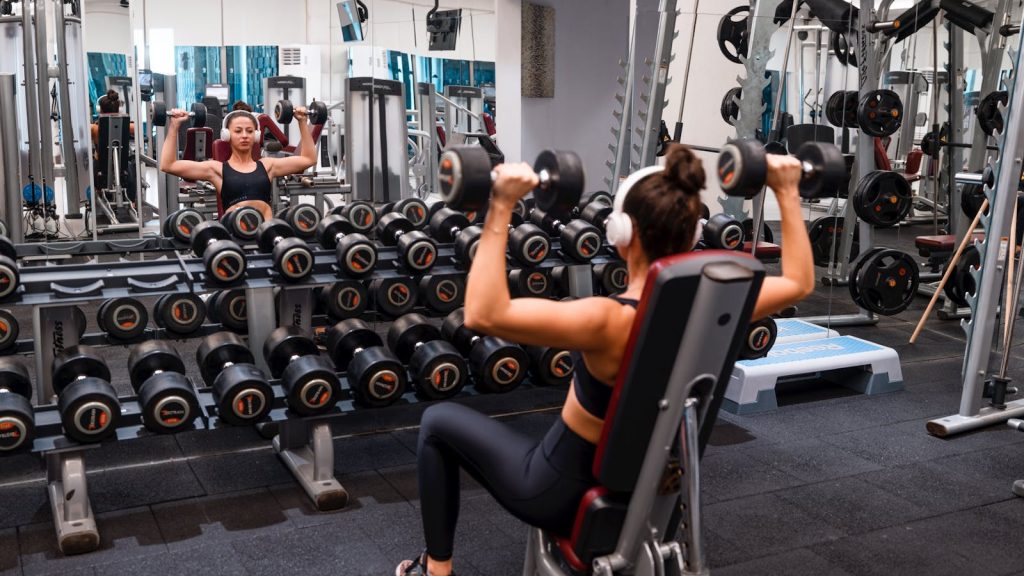
Because you are seated, the exercise reduces lower-body drive and makes it easier to focus on upper-body pressing mechanics. That makes it a useful shoulder-building movement for lifters who want more control than a standing press but still want a serious compound lift.
What Is the Seated Military Press?
The seated military press is a seated overhead press variation where you press weight vertically above your head without using your legs for momentum. Most lifters use the term to describe a seated barbell shoulder press, but the same movement pattern can also be trained with dumbbells, a Smith machine, or a shoulder press machine.
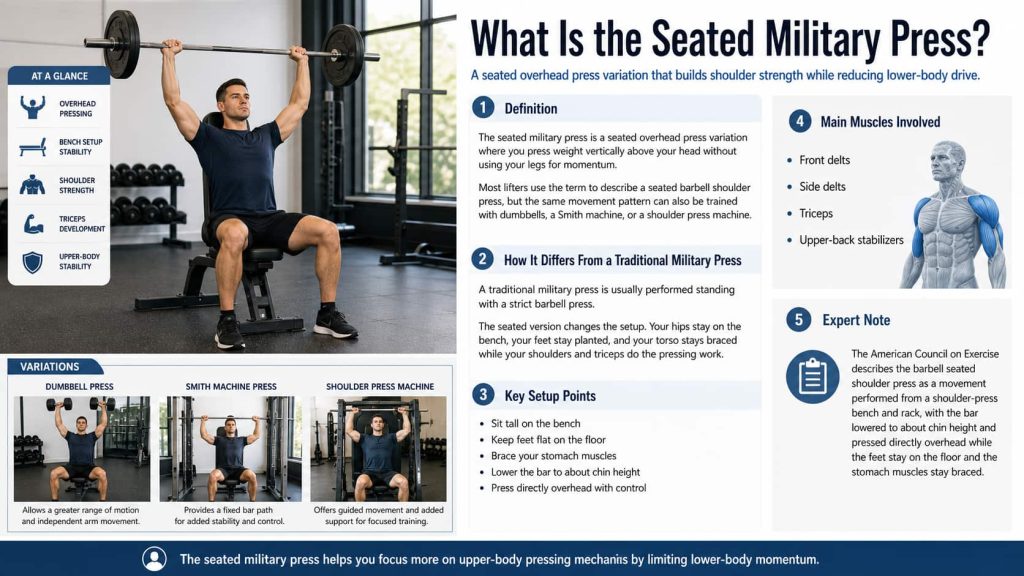
A traditional military press is usually performed standing with a strict barbell press. The seated version changes the setup. Your hips stay on the bench, your feet stay planted, and your torso stays braced while your shoulders and triceps do the pressing work.
The American Council on Exercise describes the barbell seated shoulder press as a movement performed from a shoulder-press bench and rack, with the bar lowered to about chin height and pressed directly overhead while the feet stay on the floor and the stomach muscles stay braced.
Seated Military Press Muscles Worked
The seated military press is a compound upper-body exercise. It uses several muscles at the same time, but the shoulders and triceps do most of the work.
Primary Muscles Worked
Anterior deltoids: The front delts are the main movers during the press. They help raise the upper arms and drive the weight overhead.
Lateral deltoids: The side delts assist during the press and help give the shoulders a wider, more developed look.
Triceps brachii: The triceps extend the elbows as you finish the press. If your lockout feels weak, your triceps may be limiting the lift.
Secondary Muscles Worked
Upper trapezius: The upper traps help support the shoulder blades as the arms move overhead.
Serratus anterior: This muscle helps the shoulder blades rotate upward, which is important for smooth overhead movement.
Upper chest: The clavicular portion of the chest can assist, especially when the bar path is slightly in front of the body.
Rotator cuff and scapular stabilizers: These smaller muscles help control the shoulder joint and keep the press stable.
Core muscles: Even though you are seated, your abs and deep trunk muscles help prevent excessive back arching.
A 2022 electromyography study available through PubMed Central comparing front, behind-the-neck, and machine overhead press variations found that overhead pressing changes muscle demands based on the variation, and that barbell pressing requires the lifter to stabilize the external load path more than a machine press.
How to Do the Seated Military Press With Proper Form
Best for: The seated military press is best for building strict overhead pressing strength, developing the front and side delts, and training the shoulders without using leg drive. It works well for lifters who want a controlled compound shoulder exercise.
How to do it:
- Sit on a shoulder press bench with your feet flat on the floor.
- Set the bar at about upper-chest or shoulder height.
- Grip the bar slightly wider than shoulder-width.
- Keep your wrists stacked over your elbows.
- Unrack the bar and bring it to the front of your shoulders or around chin height.
- Brace your abs and keep your chest tall.
- Press the bar upward until your arms are straight but not aggressively locked.
- Keep the bar close to your natural overhead path instead of pushing it far forward.
- Lower the bar slowly to the starting position.
- Repeat for the desired number of reps.
Suggested sets and reps: For beginners, use 2–3 sets of 8–10 reps with a light to moderate weight. Intermediate lifters can use 3–4 sets of 6–10 reps. Advanced lifters can use 4–5 sets of 4–8 reps for strength or 8–12 reps for muscle growth.
Coaching cue: Think “ribs down, elbows slightly forward, press through the ceiling.”
Benefits of the Seated Military Press
Builds Stronger Shoulders
The seated military press is one of the most direct compound lifts for shoulder strength. Because the weight moves overhead, the delts have to produce force through a large pressing range.
It is especially useful for building the front delts, which are heavily involved in overhead pressing, incline pressing, and many athletic pushing movements.
Reduces Leg Drive
A standing overhead press can turn into a push press if you bend your knees and use your legs. That is not always wrong, but it changes the goal of the exercise.
The seated military press limits that lower-body assistance. This helps keep the focus on your shoulders, triceps, and upper-body pressing strength.
Improves Pressing Control
The seated position gives you a more stable base than standing. That can help you learn how to brace, control the bar path, and press without swaying.
This is one reason the seated version can be helpful for lifters who struggle to keep a strict bar path during standing overhead presses.
Trains the Triceps
Your shoulders start the press, but your triceps help finish it. A strong seated military press can support stronger lockout strength in other pressing exercises.
If your elbows bend too much near the top or you struggle to finish the rep, your triceps may need more direct work.
Fits Well Into Shoulder and Push Workouts
The seated military press works well as the main lift in a shoulder workout or as a secondary press after bench press or incline press.
It can be used for strength, muscle growth, or general upper-body development depending on the load, reps, and rest periods.
Common Seated Military Press Mistakes
Arching the Lower Back Too Much
A small natural arch is normal, but excessive arching turns the lift into more of an incline press and can make the movement harder to control.
Brace your abs before each rep. Keep your ribs down and avoid leaning back as the bar gets heavy.
Lowering the Bar Too Far
Some lifters can lower the bar to the upper chest with good control. Others may feel shoulder discomfort if they force that range.
A practical stopping point is around chin height or upper-chest height, depending on your mobility and comfort. Do not force a deeper range if your shoulders shift forward or your lower back arches hard.
Pressing the Bar Too Far Forward
If the bar drifts forward, the lift feels heavier and your shoulders may lose a strong stacked position.
Keep the bar close to your face on the way up, then finish with the bar stacked over your shoulders, ribs, and hips.
Flaring the Elbows Straight Out
Elbows that flare directly to the sides can make the press feel rough on the shoulders.
Instead, keep your elbows slightly forward in the bottom position. This usually creates a stronger and more shoulder-friendly pressing path.
Using Too Much Weight
The seated military press rewards control. If you have to bounce, lean back, shorten every rep, or twist your torso to move the weight, it is too heavy.
Lower the load and build cleaner reps first.
Letting the Wrists Bend Back
Your wrists should stay mostly stacked over your forearms. If they bend backward, the bar can feel unstable and place extra stress on the wrists.
Grip the bar firmly and keep your knuckles pointed upward.
Seated Military Press vs. Shoulder Press
The seated military press and seated shoulder press are often used interchangeably, but there are small differences in how people use the terms.
A seated military press usually refers to a stricter barbell overhead press performed in front of the body.
A seated shoulder press is a broader term. It can refer to a barbell press, dumbbell press, Smith machine press, or machine press.
The main training idea is the same: press weight overhead while seated. The difference is the equipment and how much stability the lifter has to provide.
Seated Military Press Variations and Modifications
1. Seated Dumbbell Shoulder Press
Best for: This variation is best for lifters who want more freedom of movement than a barbell allows. It can also help identify left-to-right strength differences.
Muscles worked: It trains the front delts, side delts, and triceps while also challenging shoulder stabilizers because each arm must control its own weight.
Equipment needed: You need a pair of dumbbells and a sturdy bench.
Why it stands out: Dumbbells allow a more natural arm path. A neutral or slightly angled grip may feel better for some lifters than a fixed barbell grip.
Suggested sets and reps: Beginners can use 2–3 sets of 8–12 reps. Intermediate lifters can use 3–4 sets of 8–10 reps. Advanced lifters can use 4 sets of 6–10 reps or controlled higher-rep sets.
How to do it:
- Sit on a bench with your feet flat.
- Hold one dumbbell in each hand at shoulder height.
- Brace your core and keep your chest tall.
- Press both dumbbells overhead.
- Stop when your arms are straight but not forcefully locked.
- Lower the dumbbells slowly to shoulder height.
- Repeat with control.
Common mistakes: Avoid letting the dumbbells crash downward, leaning far back, twisting one side up before the other, or letting the elbows drift too far behind the body.
Coaching cue: Press the dumbbells up and slightly inward, but do not slam them together.
Exercise variations: Use a neutral grip, alternating reps, single-arm reps, or a slight incline bench angle.
How to use in a workout: Use it as your main shoulder press if barbells bother your shoulders, or use it after the barbell seated military press for extra volume.
2. Seated Machine Shoulder Press
Best for: The seated machine shoulder press is best for beginners, lifters training close to fatigue, or anyone who wants a more guided pressing path.
Muscles worked: It targets the shoulders and triceps, with less demand on balance and bar control than free-weight pressing.
Equipment needed: You need a shoulder press machine.
Why it stands out: The machine controls the path of the handles, which can make the exercise easier to learn and easier to load safely for higher-rep sets.
Suggested sets and reps: Beginners can use 2–3 sets of 10–12 reps. Intermediate lifters can use 3–4 sets of 8–12 reps. Advanced lifters can use 3–5 sets of 8–15 reps as a main or accessory press.
How to do it:
- Adjust the seat so the handles start around shoulder height.
- Sit with your back supported.
- Keep your feet flat on the floor.
- Grip the handles firmly.
- Brace your abs and keep your wrists neutral.
- Press the handles overhead.
- Lower slowly until the handles return near shoulder level.
- Repeat without bouncing the weight stack.
Common mistakes: Avoid setting the seat too low, shrugging hard at the top, letting the wrists bend, or allowing the weight stack to slam between reps.
Coaching cue: Keep your back against the pad and press smoothly from shoulder level to overhead.
Exercise variations: Use a neutral-grip machine, plate-loaded machine, or single-arm machine press if available.
How to use in a workout: Use it as a beginner-friendly alternative to the seated military press or as a high-rep finisher after free-weight presses. The American Council on Exercise emphasizes a supported back position, neutral wrists, bracing, and controlled pressing mechanics for the machine seated shoulder press.
3. Smith Machine Seated Shoulder Press
Best for: This variation is best for lifters who want a fixed bar path but still prefer a barbell-style press.
Muscles worked: It trains the front delts, side delts, and triceps, with some upper-back and core support.
Equipment needed: You need a Smith machine and an adjustable bench.
Why it stands out: The Smith machine can make setup easier because the bar is guided. However, bench position matters because the fixed track may not match your natural bar path.
Suggested sets and reps: Beginners can use 2–3 sets of 8–12 reps. Intermediate lifters can use 3–4 sets of 6–10 reps. Advanced lifters can use 4 sets of 6–12 reps, depending on the goal.
How to do it:
- Place a bench inside the Smith machine.
- Position the bench so the bar lowers in front of your face and toward your upper chest.
- Sit tall with your feet planted.
- Grip the bar slightly wider than shoulder-width.
- Unrack the bar and brace your core.
- Lower the bar under control.
- Press upward along the machine’s track.
- Lock the bar safely when finished.
Common mistakes: Avoid placing the bench too far forward or too far back, forcing your shoulders into an awkward path, bouncing the bar, or relying on the fixed track instead of controlling the rep.
Coaching cue: Set your bench so the bar path feels natural before you add weight.
Exercise variations: Try a slightly inclined bench, a wide-grip press, or a lighter tempo press.
How to use in a workout: Use it when you want a guided heavy press or when your gym setup makes a free-weight seated military press difficult.
Sets, Reps, and Programming Tips
The best set and rep range depends on your goal.
- For strength, use heavier loads and lower reps. Try 3–5 sets of 4–6 reps with 2–3 minutes of rest.
- For muscle growth, use moderate loads and more total volume. Try 3–4 sets of 8–12 reps with 90–120 seconds of rest.
- For beginner technique, use lighter loads and controlled reps. Try 2–3 sets of 8–10 reps while leaving 2–3 reps in reserve.
- For shoulder endurance or accessory work, use 2–4 sets of 12–15 reps with lighter weights and strict form.
The American College of Sports Medicine notes that resistance training variables should match the goal, with heavier loads supporting strength and higher weekly volume supporting hypertrophy.
Sample Seated Military Press Workout
Beginner Shoulder Workout
- Seated machine shoulder press: 2–3 sets of 10–12 reps
- Seated dumbbell shoulder press: 2 sets of 8–10 reps
- Dumbbell lateral raise: 2 sets of 12–15 reps
- Face pull: 2 sets of 12–15 reps
- Rest: 60–90 seconds between sets
This option is best for learning control and building basic shoulder strength.
Intermediate Push Workout
- Seated military press: 3–4 sets of 6–10 reps
- Incline dumbbell press: 3 sets of 8–10 reps
- Dumbbell lateral raise: 3 sets of 12–15 reps
- Cable triceps pressdown: 3 sets of 10–15 reps
- Rest: 90–180 seconds on presses, 60–90 seconds on accessories
This option works well for lifters who train chest, shoulders, and triceps together.
Advanced Shoulder Strength Workout
- Seated military press: 5 sets of 4–6 reps
- Seated dumbbell shoulder press: 3 sets of 8–10 reps
- Cable lateral raise: 3–4 sets of 12–15 reps
- Rear delt fly: 3 sets of 12–20 reps
- Overhead triceps extension: 3 sets of 10–12 reps
- Rest: 2–3 minutes on heavy presses, 60–90 seconds on accessories
This option is best for lifters with solid overhead mobility and consistent pressing technique.
How to Progress the Seated Military Press
Progress slowly and keep your reps clean. A stronger seated military press should come from better control, better bracing, and gradual loading.
Use these progression methods:
- Add 5 pounds when all sets feel controlled.
- Add 1–2 reps per set before increasing weight.
- Slow down the lowering phase for more control.
- Pause briefly near chin height.
- Keep 1–2 reps in reserve on most working sets.
- Use a machine or dumbbell version when your shoulders need a lighter day.
Do not chase weight at the cost of position. If your lower back arches hard, your wrists fold back, or the bar path drifts forward, reduce the load.
Who Should Use the Seated Military Press?
The seated military press is a good option for:
- Lifters who want stronger shoulders
- Beginners who need a stable pressing setup
- Intermediate lifters building overhead strength
- Bodybuilders training delts and triceps
- Athletes who need upper-body pressing power
- Lifters who want less leg involvement than a standing press
It may not be the best choice if overhead pressing causes sharp pain, your shoulders cannot move overhead comfortably, or you cannot keep your ribs down without arching your lower back. In those cases, use a machine press, landmine press, neutral-grip dumbbell press, or seek guidance from a qualified professional.
Safety Tips for Better Shoulder Pressing
Warm up before heavy sets. Start with light pressing, band pull-aparts, wall slides, or controlled shoulder mobility drills.
Use a weight you can lower smoothly. The lowering phase matters because that is where many lifters lose position.
Do not press behind the neck unless you have the shoulder mobility, control, and coaching experience for it. Most lifters are better served by pressing in front of the body.
Stop the exercise if you feel sharp shoulder pain, numbness, tingling, dizziness, or unusual symptoms. Muscle effort is normal. Joint pain or nerve-like symptoms are not something to push through.
FAQs About the Seated Military Press
Is the seated military press good for shoulders?
Yes. The seated military press is a strong shoulder-building exercise because it trains the delts and triceps through an overhead pressing pattern. It is especially useful for building the front delts and improving strict pressing strength.
Is seated military press better than standing military press?
Neither is automatically better. The seated military press reduces leg drive and helps you focus on the shoulders. The standing military press challenges more full-body stability and core control. Use the seated version for more shoulder-focused pressing and the standing version for a more total-body strict press.
Should the bar touch my chest on seated military press?
It depends on your mobility and comfort. Some lifters can lower the bar to the upper chest with good form. Others should stop around chin height or slightly below if deeper lowering causes shoulder discomfort or back arching.
Is seated military press safe for beginners?
It can be safe for beginners when performed with light weight, proper setup, and controlled reps. Many beginners may start better with a seated dumbbell press or machine shoulder press before moving to a barbell.
How heavy should I go on seated military press?
Use a weight you can control without leaning back, bouncing, or losing wrist position. For strength, use heavier sets of 4–6 reps. For muscle growth, use moderate sets of 8–12 reps. For learning form, stay lighter and leave a few reps in reserve.
Does seated military press work the chest?
It can involve the upper chest slightly, especially when pressing in front of the body, but it is not mainly a chest exercise. The shoulders and triceps do most of the work.
How often should I do seated military press?
Most lifters can train it 1–2 times per week, depending on total shoulder, chest, and triceps volume. If you already bench press and incline press heavily, you may need fewer overhead pressing sets.
Conclusion
The seated military press is a powerful exercise for building stronger shoulders, improving strict overhead pressing strength, and training the triceps without relying on leg drive. Start with a stable setup, use a controlled bar path, keep your core braced, and progress gradually.
Choose one main version, practice it consistently, and pair it with lateral raises, rear delt work, and triceps training for a complete shoulder-focused routine.
References
- American Council on Exercise — Machine Seated Shoulder Press
- PubMed Central — Front vs. Back and Barbell vs. Machine Overhead Press
- PubMed — Effects of Body Position and Loading Modality on Shoulder Press Muscle Activity
- NSCA Strength and Conditioning Journal — Dumbbell Seated Shoulder Press
- PubMed — Electromyographic Analysis of Shoulder-Complex Muscles During Overhead Presses
- PubMed — The Effect of Weight and Equipment Type on Shoulder and Back Muscle Activity During Overhead Press