Sciatica exercises to relieve pain should focus on gentle movement, hip mobility, nerve comfort, and core support—not aggressive stretching or forcing through symptoms. The goal is to help you move better, reduce irritation when possible, and build confidence with safe, low-impact exercises.
Sciatica usually causes pain that travels from the lower back or buttock down one leg. It may also come with tingling, numbness, or weakness. According to the Mayo Clinic, sciatica often happens when a herniated disk or bone overgrowth puts pressure on nerve roots in the lower spine.
This guide covers the best beginner-friendly sciatica exercises, how to perform them safely, common mistakes, and a simple routine you can use at home.
What Is Sciatica?
Sciatica is pain related to irritation or compression of the sciatic nerve or the nerve roots that form it. The sciatic nerve runs from the lower back through the buttocks and down the leg, which is why symptoms often travel instead of staying only in the lower back.
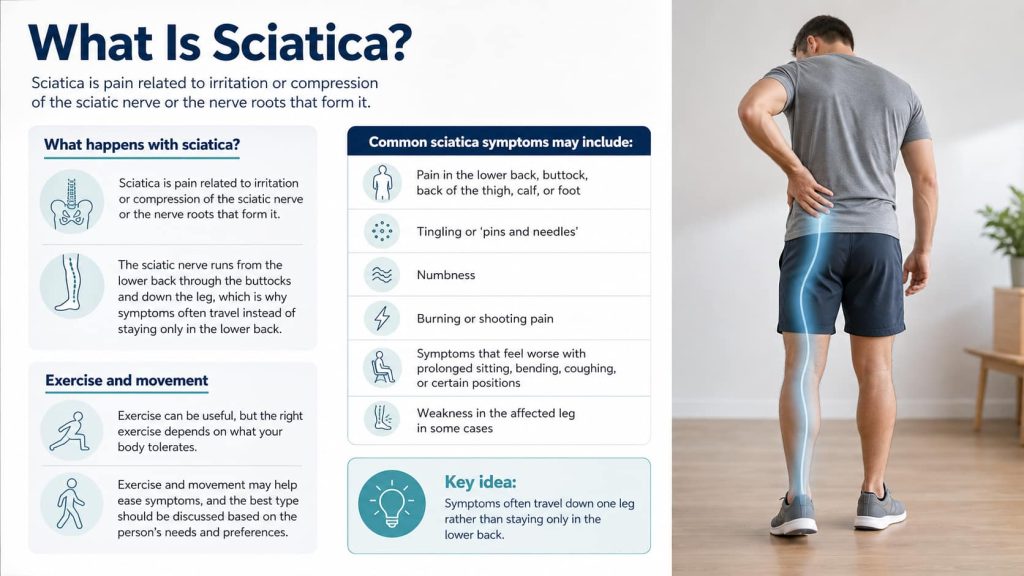
Common sciatica symptoms may include:
- Pain in the lower back, buttock, back of the thigh, calf, or foot
- Tingling or “pins and needles”
- Numbness
- Burning or shooting pain
- Symptoms that feel worse with prolonged sitting, bending, coughing, or certain positions
- Weakness in the affected leg in some cases
Exercise can be useful, but the right exercise depends on what your body tolerates. The NICE guidance on low back pain and sciatica explains that exercise and movement may help ease symptoms, and the best type should be discussed based on the person’s needs and preferences.
How Exercises May Help Sciatica Pain
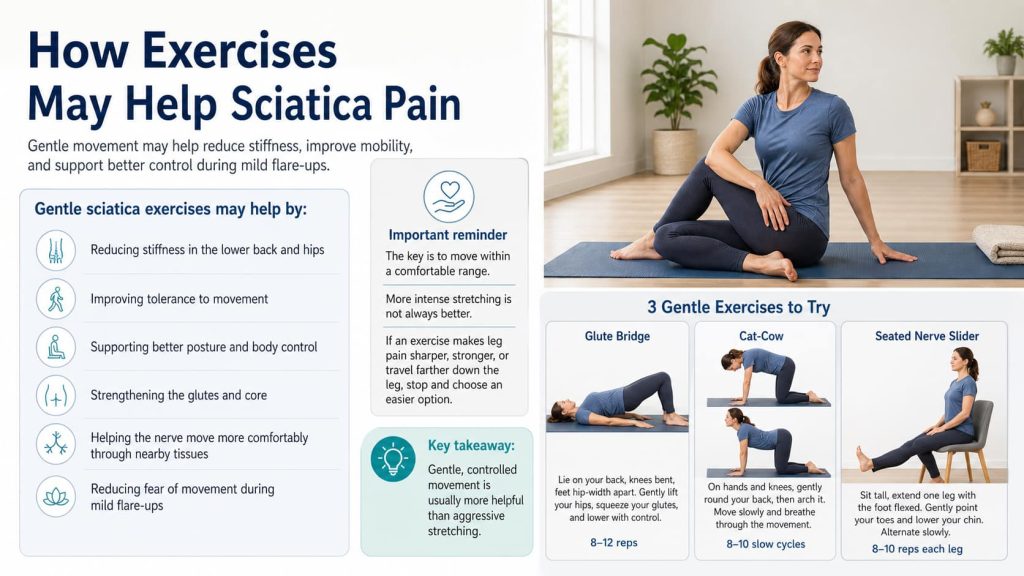
Gentle sciatica exercises may help by:
- Reducing stiffness in the lower back and hips
- Improving tolerance to movement
- Supporting better posture and body control
- Strengthening the glutes and core
- Helping the nerve move more comfortably through nearby tissues
- Reducing fear of movement during mild flare-ups
The key is to move within a comfortable range. More intense stretching is not always better. If an exercise makes leg pain sharper, stronger, or travel farther down the leg, stop and choose an easier option.
Safety Tips Before You Start
Before trying sciatica exercises, follow these rules:
- Move slowly and gently.
- Do not push into sharp pain.
- Avoid bouncing during stretches.
- Start with fewer reps than you think you need.
- Keep symptoms mild and manageable.
- Stop if pain travels farther down your leg.
- Use short sessions instead of long, exhausting routines.
The NHS sciatica exercise guidance provides gentle exercise videos for people in generally good health, while also recommending attention to exercise safety.
Seek medical help urgently if you have severe or worsening leg weakness, numbness around the groin or saddle area, loss of bladder or bowel control, symptoms after a major injury, fever, unexplained weight loss, or pain that is severe and not improving.
Best Sciatica Exercises to Relieve Pain
The following exercises are gentle options often used for sciatica-related discomfort. You do not need to do all of them at once. Start with 3–5 movements that feel comfortable and build from there.
1. Sciatic Nerve Slider
Best for:
The sciatic nerve slider is best for people who feel nerve-like tightness or pulling down the back of the leg. It is not meant to be a deep hamstring stretch. The goal is to gently move the nerve through a comfortable range.
Muscles worked:
This is more of a nerve mobility drill than a strengthening exercise. It lightly involves the hamstrings, calf, ankle, and neck movement while encouraging smoother sciatic nerve motion.
Equipment needed:
A sturdy chair.
Why it stands out
A nerve slider can feel less aggressive than long static hamstring stretching. The South Tees Hospitals NHS Foundation Trust notes that a sciatic nerve slider should be performed slowly and should not cause pain at any point.
Suggested sets and reps
Start with 1–2 sets of 8–10 slow reps per side. Use a small range of motion at first.
How to do it
- Sit tall on the edge of a sturdy chair.
- Keep one foot flat on the floor.
- Slowly straighten the affected leg in front of you.
- At the same time, gently lift your chest and look slightly upward.
- Then bend the knee and lower the foot back down.
- As the foot returns, gently lower your chin toward your chest.
- Repeat slowly without forcing the stretch.
Common mistakes:
Common mistakes include locking the knee aggressively, pulling the toes too hard, slumping the back, moving quickly, or trying to create a strong stretch.
Coaching cue:
Think “easy glide,” not “hard stretch.”
Exercise variations:
Make it easier by straightening the knee only halfway. Make it harder only if symptoms stay calm by adding a gentle ankle flex at the top.
How to use in a workout:
Use this early in your routine after a short walk or warm-up. It works well before bridges, clamshells, or cat-cow.
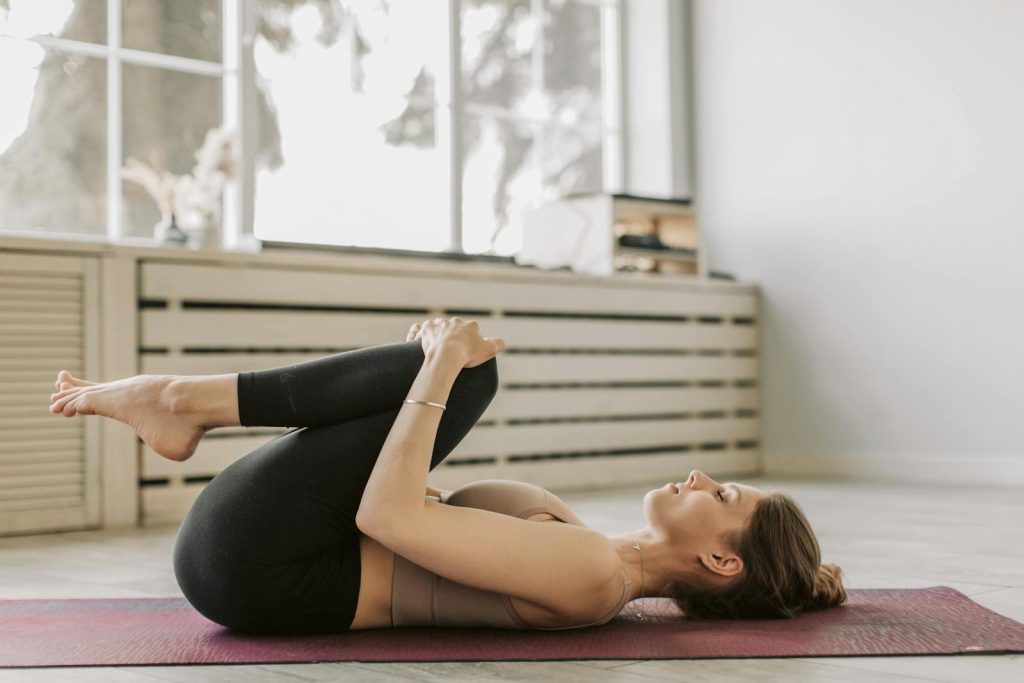
2. Knee-to-Chest Stretch
Best for:
The knee-to-chest stretch is best for gentle lower-back and glute relaxation. It may feel helpful when your lower back feels stiff or compressed.
Muscles worked:
This stretch targets the lower back, glutes, and deep hip muscles. It also gently flexes the lumbar spine.
Equipment needed:
An exercise mat or comfortable floor space.
Why it stands out
It is simple, beginner-friendly, and easy to control. You can adjust the intensity by pulling the knee closer or keeping the stretch lighter.
Suggested sets and reps
Hold for 15–30 seconds per side. Perform 1–3 rounds.
How to do it
- Lie on your back with both knees bent and feet flat.
- Bring one knee toward your chest.
- Hold behind the thigh or over the shin.
- Keep the opposite foot on the floor if that feels better.
- Breathe slowly and avoid pulling aggressively.
- Return the foot to the floor and switch sides.
Common mistakes:
Avoid yanking the knee, lifting the head and neck, holding your breath, or forcing the opposite leg straight if it increases symptoms.
Coaching cue:
Pull only until you feel mild relief or a comfortable stretch.
Exercise variations:
Try double knee-to-chest only if single-leg stretching feels good. Keep the non-working knee bent to reduce tension.
How to use in a workout:
Use it after walking or at the end of a gentle mobility routine.
3. Ankle-over-Knee Piriformis Stretch
Best for:
This stretch is best for people who feel tightness deep in the buttock or outer hip. It may be useful when the piriformis and surrounding hip muscles feel restricted.
Muscles worked:
It targets the glutes, piriformis, deep hip rotators, and outer hip muscles.
Equipment needed:
An exercise mat or firm bed.
Why it stands out
The ankle-over-knee position gives you control. You can keep it very gentle or increase the stretch by bringing the legs closer.
Suggested sets and reps
Hold for 15–30 seconds per side. Perform 1–2 rounds.
How to do it
- Lie on your back with both knees bent.
- Cross the affected-side ankle over the opposite thigh.
- Keep the crossed foot relaxed.
- If comfortable, lift the bottom foot off the floor.
- Hold behind the thigh and gently bring the legs toward you.
- Stop when you feel a mild stretch in the glute or outer hip.
- Lower slowly and switch sides.
Common mistakes:
Avoid pushing the knee down hard, twisting the pelvis, forcing a deep stretch, or continuing if symptoms shoot down the leg.
Coaching cue:
Keep the stretch in the hip, not down the nerve path.
Exercise variations:
For an easier version, do it seated with one ankle crossed over the opposite thigh. For a stronger version, pull the bottom thigh closer while keeping your back relaxed.
How to use in a workout:
Use it after nerve sliders or at the end of your routine when your hips are warmer.
4. Glute Bridge
Best for:
The glute bridge is best for building hip strength and supporting the lower back without heavy loading. It is especially useful if sitting, weak glutes, or poor hip control contribute to discomfort.
Muscles worked:
The glute bridge works the gluteus maximus, hamstrings, deep core, and lower-back stabilizers.
Equipment needed:
An exercise mat.
Why it stands out
Strong glutes help the hips do their job so the lower back does not take over every movement. Bridges are also easy to modify for beginners.
Suggested sets and reps
Start with 2 sets of 8–12 reps. Rest 30–60 seconds between sets.
How to do it
- Lie on your back with knees bent and feet hip-width apart.
- Keep your feet flat and close enough that your shins are almost vertical.
- Brace your core gently.
- Press through your heels and lift your hips.
- Stop when your body forms a straight line from shoulders to knees.
- Squeeze your glutes at the top.
- Lower slowly with control.
Common mistakes:
Avoid arching your lower back, pushing through the toes, lifting too high, letting the knees collapse inward, or rushing the reps.
Coaching cue:
Lift with your glutes, not your lower back.
Exercise variations:
Make it easier by lifting only halfway. Make it harder with a pause at the top or a resistance band around the thighs.
How to use in a workout:
Use bridges as your first strengthening exercise after mobility work.
5. Cat-Cow
Best for:
Cat-cow is best for gentle spinal mobility. It can help you explore comfortable movement without heavy loading.
Muscles worked:
It lightly involves the spinal erectors, abdominal muscles, deep core, shoulders, and hip stabilizers.
Equipment needed:
An exercise mat.
Why it stands out
Cat-cow encourages controlled spinal flexion and extension. It is not a strength exercise, but it can reduce stiffness and help you warm up before other movements.
Suggested sets and reps
Perform 1–2 sets of 6–10 slow reps.
How to do it
- Start on your hands and knees.
- Place your hands under your shoulders and knees under your hips.
- Slowly round your back upward like a stretching cat.
- Let your head and tailbone gently tuck.
- Then slowly drop your belly slightly and lift your chest.
- Move only through a comfortable range.
- Repeat with slow breathing.
Common mistakes:
Avoid forcing end ranges, moving too fast, shrugging your shoulders, or letting the movement create leg symptoms.
Coaching cue:
Move like you are gently warming up your spine, not trying to stretch as far as possible.
Exercise variations:
If wrists bother you, place your forearms on a bench or do a seated cat-cow from a chair.
How to use in a workout:
Use cat-cow near the beginning of your session before bridges, clamshells, or walking.
6. Prone Press-Up
Best for:
The prone press-up is best for people who feel better with gentle back extension. Some people with disc-related symptoms find extension-based movement helpful, but it is not right for everyone.
Muscles worked:
It lightly works the lower-back extensors and stretches the front of the hips and abdomen.
Equipment needed:
An exercise mat.
Why it stands out
This exercise can help some people move symptoms away from the leg and closer to the back, which may be a positive sign. However, if it increases leg pain, skip it.
Suggested sets and reps
Start with 1 set of 5–8 gentle reps. Hold each rep for 1–2 seconds.
How to do it
- Lie on your stomach with your hands under your shoulders.
- Keep your hips and legs relaxed.
- Gently press your chest away from the floor.
- Let your lower back extend only as far as comfortable.
- Keep your hips on the floor if possible.
- Lower slowly and repeat.
- Stop if symptoms worsen down the leg.
Common mistakes:
Avoid clenching the glutes hard, forcing the arms straight, holding your breath, or continuing if pain travels farther down the leg.
Coaching cue:
Only press up as far as your symptoms allow.
Exercise variations:
Start with a prone-on-elbows position if a full press-up is too much. Stay lower and breathe slowly.
How to use in a workout:
Use it early in the routine if extension feels relieving. Skip it if bending backward makes symptoms worse.
7. Clamshell
Best for:
The clamshell is best for hip stability and glute activation. It can be useful for people whose knees, hips, or pelvis collapse inward during walking, squatting, or daily movement.
Muscles worked:
The clamshell mainly works the gluteus medius and other outer hip stabilizers.
Equipment needed:
An exercise mat. A mini band is optional.
Why it stands out
It strengthens the side glutes without loading the spine. The Hospital for Special Surgery includes clamshells and other gentle movements as part of sciatica-focused exercise guidance.
Suggested sets and reps
Start with 2 sets of 10–15 reps per side. Rest 30–45 seconds between sets.
How to do it
- Lie on your side with knees bent.
- Stack your hips and keep your feet together.
- Brace your core gently.
- Lift the top knee without rolling your pelvis backward.
- Pause briefly at the top.
- Lower with control.
- Repeat, then switch sides.
Common mistakes:
Avoid rotating the trunk, opening the knee too high, rushing, or letting the lower back twist.
Coaching cue:
Keep your pelvis still and move only from the hip.
Exercise variations:
Make it easier by using a smaller range of motion. Make it harder by adding a light mini band above the knees.
How to use in a workout:
Use clamshells after bridges or before walking to wake up the hip stabilizers.
8. Short Walks
Best for:
Short walks are best for staying active without heavy loading. Walking may be easier to tolerate than long sitting or intense exercise.
Muscles worked:
Walking uses the glutes, hamstrings, quads, calves, hip stabilizers, core, and postural muscles.
Equipment needed:
Supportive shoes and a flat walking surface.
Why it stands out
Walking is practical, low-impact, and easy to adjust. The AAOS OrthoInfo sciatica guide notes that walking and moving are important while limiting too much bending or twisting.
Suggested sets and reps
Start with 5–10 minutes at an easy pace. Repeat 1–3 times per day if tolerated.
How to do it
- Choose a flat, safe surface.
- Walk at a comfortable pace.
- Keep your steps smooth and relaxed.
- Stand tall without over-arching your back.
- Stop before symptoms become intense.
- Build time gradually only if symptoms stay stable.
Common mistakes:
Avoid walking too far too soon, forcing a fast pace, limping through pain, or choosing hills during a flare-up.
Coaching cue:
Finish the walk feeling better or the same—not worse.
Exercise variations:
Try shorter walks more often during a flare-up. If walking outside bothers you, walk indoors on a flat surface.
How to use in a workout:
Use walking as a warm-up, cool-down, or stand-alone movement break during the day.
Beginner Sciatica Exercise Routine
Use this simple routine 3–5 days per week if it feels comfortable.
Beginner Option
- Short walk — 5 minutes
- Cat-cow — 8 slow reps
- Sciatic nerve slider — 8 reps per side
- Knee-to-chest stretch — 20 seconds per side
- Glute bridge — 2 sets of 8 reps
- Clamshell — 2 sets of 10 reps per side
Keep the whole routine gentle. You should not feel worse afterward.
Intermediate Option
- Short walk — 8–12 minutes
- Cat-cow — 10 slow reps
- Sciatic nerve slider — 10 reps per side
- Ankle-over-knee stretch — 30 seconds per side
- Glute bridge — 3 sets of 10–12 reps
- Clamshell — 2–3 sets of 12–15 reps per side
- Prone press-up — 5–8 reps only if it feels helpful
Flare-Up Option
Use this when symptoms are more sensitive:
- Short walk around the house — 2–5 minutes
- Cat-cow — 5 slow reps
- Sciatic nerve slider — 5 gentle reps per side
- Knee-to-chest stretch — 10–15 seconds per side
Skip anything that increases leg pain.
Common Mistakes to Avoid
Stretching Too Aggressively
Strong stretching can irritate symptoms if the nerve is already sensitive. Keep stretches mild and controlled.
Sitting Too Long After Exercising
If sitting triggers symptoms, break up long sitting periods with short walks or standing breaks.
Forcing Painful Range of Motion
More range is not always better. Stay in a range that feels safe and repeatable.
Doing Too Many Exercises at Once
Start small. A 10-minute routine done consistently is often more useful than a long routine that leaves you sore.
Ignoring Worsening Leg Symptoms
If pain travels farther down the leg, becomes sharper, or causes numbness or weakness, stop the exercise and get professional guidance.
Exercises and Movements to Avoid During a Sciatica Flare-Up
You may not need to avoid these forever, but during a flare-up they can aggravate symptoms for some people:
- Heavy deadlifts
- Heavy squats
- Deep forward folds
- Aggressive hamstring stretching
- High-impact jumping
- Sprinting
- Twisting under load
- Long-distance running if it increases symptoms
- Sit-ups or toe-touch movements that worsen leg pain
The goal is not to fear movement. The goal is to temporarily reduce movements that clearly make symptoms worse, then rebuild gradually.
When Should You See a Professional?
Consider seeing a doctor, physical therapist, or qualified healthcare professional if:
- Symptoms last more than a few weeks
- Pain is severe or worsening
- You have numbness or weakness
- Pain affects walking, sleep, or work
- Symptoms keep returning
- Exercises consistently make pain worse
A physical therapist can help identify which direction of movement, strength work, and daily modifications are best for your specific symptoms.
FAQs About Sciatica Exercises to Relieve Pain
What is the best exercise for sciatica pain?
There is no single best exercise for everyone. Many people do well with gentle walking, sciatic nerve sliders, knee-to-chest stretching, glute bridges, and hip mobility work. The best exercise is one that reduces symptoms or helps you move better without making leg pain worse.
Should I stretch my hamstrings if I have sciatica?
Be careful. Hamstring stretching can feel helpful for some people, but aggressive stretching may irritate sciatic nerve symptoms. Start with gentle nerve sliders instead of long, intense hamstring holds.
Is walking good for sciatica?
Walking can be useful if it does not increase symptoms. Start with short, flat walks and build gradually. Stop or shorten the walk if pain becomes sharper or travels farther down the leg.
How often should I do sciatica exercises?
Many people start with 5–15 minutes per day or 3–5 days per week. During sensitive flare-ups, shorter sessions done more often may feel better than one long routine.
Should sciatica exercises hurt?
No. Mild stretching or muscle effort is okay, but sharp pain, worsening leg pain, numbness, tingling, or weakness is a sign to stop and adjust.
Can exercise cure sciatica?
Exercise may help reduce symptoms, improve mobility, and support recovery, but it should not be treated as a guaranteed cure. Sciatica can have different causes, so persistent or severe symptoms should be evaluated by a professional.
What should I do if sciatica pain gets worse after exercise?
Stop the exercise that triggered symptoms. Return to easier movements, short walks, or rest positions that feel comfortable. If symptoms keep worsening, seek medical or physical therapy guidance.
Conclusion
The best sciatica exercises to relieve pain are gentle, controlled, and matched to your symptoms. Start with simple movements like sciatic nerve sliders, cat-cow, knee-to-chest stretches, glute bridges, clamshells, and short walks.
Choose 3–5 exercises that feel good, keep the intensity low, and progress slowly. If an exercise increases sharp pain, numbness, or leg symptoms, stop and get professional guidance.
This content is for informational purposes only and not medical advice.
References
- Mayo Clinic: Sciatica Symptoms and Causes
- Mayo Clinic: Sciatica Diagnosis and Treatment
- NICE: Exercise and Physical Activity for Low Back Pain and Sciatica
- NHS: Sciatica
- NHS: Exercises for Sciatica Problems
- South Tees Hospitals NHS Foundation Trust: Sciatic Nerve Slider
- Hospital for Special Surgery: Sciatica Stretches and Exercises
1 thought on “8 Best Sciatica Exercises to Relieve Pain and Improve Mobility”