The Russian twist exercise is a seated core movement where you rotate your torso from side to side while keeping your abs braced. It is commonly used to train the obliques, improve rotational core control, and build better trunk stability.
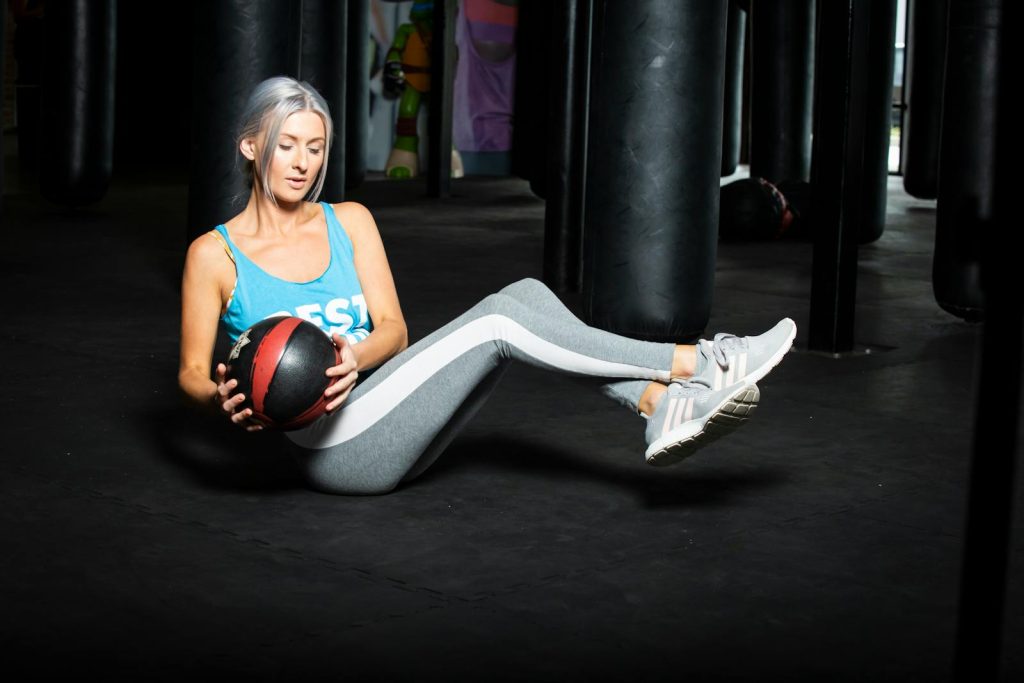
The exercise looks simple, but good form matters. When done too fast, too heavy, or with a rounded lower back, Russian twists can shift stress away from the core and into the spine or hip flexors. The goal is not to swing your arms quickly. The goal is to rotate with control while your core stays tight.
What Is the Russian Twist Exercise?
The Russian twist is a rotational core exercise. You sit on the floor with your knees bent, lean back slightly, brace your abs, and rotate your torso from one side to the other. You can do it with body weight, a dumbbell, a medicine ball, or another light weight.
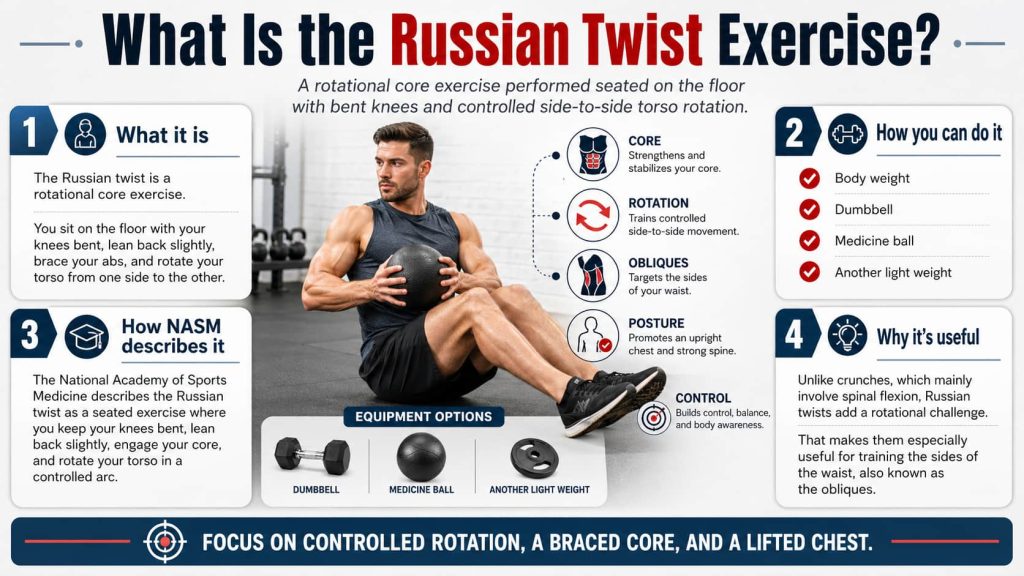
The National Academy of Sports Medicine describes the Russian twist as a seated exercise where you keep your knees bent, lean back slightly, engage your core, and rotate your torso in a controlled arc.
Unlike crunches, which mainly involve spinal flexion, Russian twists add a rotational challenge. That makes them especially useful for training the sides of the waist, also known as the obliques.
Russian Twist Muscles Worked
The Russian twist mainly targets the muscles that help rotate and stabilize your trunk.
Primary muscles worked
- Obliques: The internal and external obliques are the main muscles used during Russian twists. They help rotate your torso and control side-to-side movement.
- Rectus abdominis: This is the front abdominal muscle often called the “six-pack” muscle. It helps keep your trunk braced as you lean back and rotate.
- Transverse abdominis: This deep core muscle helps stabilize your midsection and support your spine during the movement.
Secondary muscles involved
- Hip flexors:
Your hip flexors help hold your legs and torso position, especially when your feet are lifted. - Erector spinae:
These lower-back muscles help support your spine and posture. - Shoulders and upper back:
If you hold a weight, your shoulders and upper back help keep the weight stable in front of your chest.
NASM lists the external obliques and internal obliques as primary muscles in the Russian twist, with the rectus abdominis, transverse abdominis, and core stabilizers working secondarily.
Benefits of the Russian Twist Exercise
1. Strengthens the Obliques
The biggest benefit of Russian twists is oblique training. Your obliques help rotate your torso, resist unwanted movement, and support your body during many daily and athletic movements.
Stronger obliques can help with movements like turning, reaching, throwing, swinging, carrying, and changing direction.
2. Trains Rotational Core Control
Many core exercises train you to hold still, such as planks. Russian twists train controlled rotation. This can be useful because real-life movement often involves turning your torso while keeping your hips, ribs, and spine controlled.
NASM notes that rotational core training can help develop comprehensive core strength and sport-specific power.
3. Improves Core Stability
A strong core is not only about visible abs. Your core includes the muscles around your pelvis, lower back, hips, and stomach. Mayo Clinic explains that core exercises train these muscles to work together, which supports balance and stability.
Russian twists can support this goal when they are performed slowly with good posture and proper bracing.
4. Requires Little Equipment
You can do Russian twists with no equipment. Beginners can start with body weight only. More advanced exercisers can use a dumbbell, medicine ball, kettlebell, or weight plate.
This makes the exercise easy to include in home workouts, gym routines, core circuits, and short ab finishers.
5. Can Fit Into Many Workout Goals
Russian twists can be used for:
- Core strength
- Oblique training
- Ab workouts
- Athletic conditioning
- Bodyweight workouts
- Home workouts
- Medicine ball training
- Rotational control
They are not a complete core program by themselves, but they can be a useful part of a balanced routine.
How to Do the Russian Twist Exercise
Step-by-step instructions
- Sit on the floor with your knees bent.
- Keep your feet flat on the floor.
- Sit tall, then lean your torso back slightly.
- Brace your abs as if you are preparing for a light punch to the stomach.
- Hold your hands together in front of your chest, or hold a light weight.
- Keep your chest lifted and your spine long.
- Rotate your ribs and shoulders to one side.
- Return through the center.
- Rotate to the other side.
- Continue alternating sides with slow, controlled reps.
One turn to the left and one turn to the right can count as one full rep, or each side can count as one rep depending on how your workout is written.
Proper Russian Twist Form Tips
Keep Your Chest Lifted
Avoid collapsing into a rounded back. Your torso should lean back slightly, but your chest should stay open and tall.
Rotate Your Torso, Not Just Your Hands
A common mistake is moving the hands from side to side while the torso barely moves. Instead, think about turning your ribs and shoulders together.
Brace Before You Twist
Your abs should stay active during the full set. Do not relax at the center position.
Move Slowly
Russian twists work best when they are controlled. Fast swinging can reduce core tension and make the movement sloppy.
Keep the Weight Close
If you use a dumbbell or medicine ball, hold it close to your chest. Reaching the weight too far away can make the exercise harder to control.
Start With Feet Down
Beginners should keep both feet on the floor. Lifting the feet makes the exercise harder and can cause the hip flexors to take over.
Common Russian Twist Mistakes
1. Rounding the Lower Back
Rounding your lower back is one of the biggest form mistakes. It can make the exercise feel uncomfortable and reduce core control.
Fix it: Sit tall, lean back only as far as you can control, and keep your chest lifted.
2. Twisting Too Fast
Fast reps often turn Russian twists into a momentum exercise instead of a core exercise.
Fix it: Slow down. Pause briefly at each side and control the return to center.
3. Moving Only the Arms
If your arms move but your torso stays still, your obliques are not doing enough of the work.
Fix it: Rotate your shoulders and ribs together. Your hands should follow your torso, not lead the movement.
4. Using Too Much Weight
A heavy weight can cause swinging, rounding, or pulling through the shoulders.
Fix it: Start with body weight. Add a light weight only when you can control every rep.
5. Leaning Back Too Far
Leaning too far back may overload the hip flexors or make your lower back round.
Fix it: Use a smaller lean. You should feel your abs working, not your lower back straining.
6. Holding Your Breath
Holding your breath can make the exercise feel harder and reduce control.
Fix it: Breathe steadily. Exhale gently as you rotate.
7. Lifting the Feet Too Soon
Feet-elevated Russian twists are harder than they look. They require more balance and hip flexor control.
Fix it: Master the feet-down version first.
Russian Twist Variations
1. Weighted Russian Twist
Best for: The weighted Russian twist is best for intermediate exercisers who can already perform the bodyweight version with good posture and controlled rotation.
Muscles worked: This variation works the obliques, rectus abdominis, transverse abdominis, hip flexors, shoulders, and upper-back stabilizers.
Equipment needed: You can use a light dumbbell, medicine ball, kettlebell, or weight plate.
Why it stands out: Adding weight increases the resistance and makes the obliques and deep core muscles work harder to control the rotation.
Suggested sets and reps: Beginners: Beginners should usually start with the bodyweight version first. If using weight, choose a very light weight and perform 2 sets of 6–8 reps per side.
- Intermediate: Perform 2–3 sets of 8–12 reps per side with a light to moderate weight that does not cause swinging.
- Advanced: Perform 3 sets of 12–15 reps per side with controlled tempo, keeping the weight close to the chest.
- Rest: Rest 45–60 seconds between sets so you can maintain clean form.
How to do it:
- Sit with your knees bent and your feet flat on the floor.
- Hold a light weight close to your chest.
- Lean back slightly while keeping your spine long.
- Brace your abs before you begin.
- Rotate your torso to one side without swinging the weight.
- Return through the center slowly.
- Rotate to the other side and repeat.
Common mistakes: Common mistakes include using too much weight, reaching the weight too far away from the body, twisting too fast, rounding the back, and letting the shoulders do the work instead of the core.
Expert tip: Choose a weight that feels almost too light at first. If you cannot pause briefly at each side, the weight is probably too heavy.
2. Feet-Elevated Russian Twist
Best for: The feet-elevated Russian twist is best for advanced exercisers who already have strong core control, balance, and good posture during the standard version.
Muscles worked: This variation works the obliques, rectus abdominis, transverse abdominis, hip flexors, and spinal stabilizers. The balance demand also increases core engagement.
Equipment needed: No equipment is required, although you may use an exercise mat for comfort.
Why it stands out: Lifting the feet increases the balance challenge and forces your core to work harder to stabilize your body during each twist.
Suggested sets and reps: Beginners: Beginners should avoid this version until they can perform the feet-down Russian twist with excellent control.
- Intermediate: Perform 2 sets of 6–10 reps per side with your feet lifted only slightly off the floor.
- Advanced: Perform 3 sets of 10–15 reps per side while keeping your chest lifted, spine long, and movement controlled.
- Rest: Rest 45–60 seconds between sets, especially if your hip flexors or lower back start to take over.
How to do it:
- Sit on the floor with your knees bent.
- Lean back slightly and brace your abs.
- Lift both feet a few inches off the floor.
- Keep your chest lifted and your spine long.
- Rotate your torso to one side with control.
- Return to the center without dropping your feet.
- Rotate to the other side and continue alternating.
Common mistakes: The most common mistakes are leaning back too far, rounding the lower back, holding the breath, twisting quickly, and letting the hip flexors dominate the movement.
Expert tip: Lift your feet only as high as you can control. A small foot lift with good posture is better than a higher lift with a rounded back.
4. Medicine Ball Russian Twist
Best for: The medicine ball Russian twist is best for core circuits, athletic-style workouts, and exercisers who want a simple weighted variation that is easy to grip and control.
Muscles worked: This variation mainly targets the obliques, rectus abdominis, and transverse abdominis. The shoulders, upper back, hip flexors, and spinal stabilizers also assist.
Equipment needed: You need a medicine ball. Choose a light to moderate ball that lets you rotate smoothly without swinging.
Why it stands out: A medicine ball is comfortable to hold and works well for controlled core training, partner drills, and circuit-style workouts.
Suggested sets and reps: Beginners: Use a very light medicine ball or no weight and perform 2 sets of 6–10 reps per side.
- Intermediate: Perform 2–3 sets of 10–15 reps per side with a light or moderate medicine ball.
- Advanced: Perform 3 sets of 15–20 reps per side using a controlled tempo or brief pause near each side.
- Rest: Rest 30–60 seconds between sets, depending on the intensity of your workout.
How to do it:
- Sit with your knees bent and your feet flat.
- Hold the medicine ball close to your chest.
- Lean back slightly and brace your core.
- Keep your chest lifted and your shoulders relaxed.
- Rotate your torso to one side.
- Bring the ball back through the center.
- Rotate to the other side without swinging.
Common mistakes: Common mistakes include slamming or bouncing the ball, letting the arms move without the torso, using a ball that is too heavy, and rushing through the reps.
Expert tip: Treat the medicine ball as an extension of your chest. Your torso should rotate the ball, not your arms.
5. Stability Ball Russian Twist
Best for: The stability ball Russian twist is best for advanced exercisers with strong balance, trunk control, and comfort using a stability ball.
Muscles worked: This variation works the obliques, rectus abdominis, transverse abdominis, glutes, hips, thighs, shoulders, and spinal stabilizers.
Equipment needed: You need a stability ball and enough open space to move safely. A light dumbbell or medicine ball can be added only after you master the bodyweight version.
Why it stands out: The stability ball version challenges the core differently because your upper back is supported on an unstable surface while your hips and trunk must stay controlled.
Suggested sets and reps: Beginners: Beginners should avoid this version and start with the floor-based bodyweight Russian twist first.
- Intermediate: Perform 2 sets of 6–10 reps per side using body weight only and a small range of motion.
- Advanced: Perform 3 sets of 10–15 reps per side, keeping your hips lifted and your body aligned from shoulders to knees.
- Rest: Rest 60 seconds between sets because this version requires more balance and full-body control.
How to do it:
- Sit on a stability ball and walk your feet forward.
- Let your upper back rest on the ball.
- Keep your knees bent and feet planted firmly.
- Lift your hips so your body forms a straight line from shoulders to knees.
- Hold your hands together or hold a light weight close to your chest.
- Rotate your torso to one side while keeping your hips lifted.
- Return to the center, then rotate to the other side.
Common mistakes: Common mistakes include letting the hips drop, arching the lower back, moving too quickly, using too much weight, and losing control of the ball.
Expert tip: Keep your glutes lightly engaged and your hips level. If your hips drop or the ball rolls too much, reduce the range of motion.
Beginner-Friendly Russian Twist Modification
If the standard version feels too hard, use this easier setup:
- Sit with your knees bent
- Keep both feet flat
- Hold your hands close to your chest
- Lean back only slightly
- Rotate through a smaller range of motion
- Do 6–8 slow reps per side
This version is better than forcing a harder variation with poor form.
Russian Twist Sets and Reps
Beginners
- Do 2 sets of 6–10 reps per side.
- Use body weight only and keep your feet on the floor.
Intermediate exercisers
- Do 2–3 sets of 10–15 reps per side.
- Use a light dumbbell or medicine ball only if your form stays controlled.
Advanced exercisers
- Do 3 sets of 12–20 reps per side.
- You can use a moderate weight, feet-elevated position, or slower tempo.
Rest time
Rest 30–60 seconds between sets.
How often to do Russian twists
You can include Russian twists 2–3 times per week as part of a balanced core or strength routine. The CDC recommends adults do muscle-strengthening activities at least 2 days per week, along with regular aerobic activity.
Are Russian Twists Safe?
Russian twists can be safe for many healthy exercisers when they are done with control, a tall posture, and an appropriate range of motion. However, they are not the best core exercise for everyone.
Be careful with Russian twists if you have:
- Current lower back pain
- A history of disc problems
- Pain with twisting movements
- Poor trunk control
- Pregnancy-related exercise restrictions
- Osteoporosis or spine-related concerns
- Recent abdominal, hip, or back surgery
If twisting causes sharp pain, numbness, tingling, dizziness, or lower-back discomfort, stop the exercise and choose a safer core option.
Better Alternatives If Russian Twists Bother Your Back
If Russian twists do not feel good, you can still train your core effectively with exercises that involve less spinal rotation.
Good alternatives include:
- Dead bug: Builds core control while lying on your back.
- Bird dog: Trains core stability, balance, and hip control.
- Forearm plank: Builds basic trunk endurance.
- Side plank: Targets the obliques without repeated twisting.
- Pallof press: Trains the core to resist rotation instead of creating rotation.
- Suitcase carry: Strengthens the obliques by resisting side bending.
These exercises may be better choices for beginners or people who feel discomfort during twisting movements.
Russian Twist vs Crunches
Russian twists and crunches are both core exercises, but they train the body differently.
- Russian twists focus more on rotation and the obliques.
- Crunches focus more on trunk flexion and the front abdominal muscles.
Neither exercise is automatically better. The better choice depends on your goal, comfort, and form. For a balanced core routine, it is usually smart to include different movement patterns, such as bracing, rotation, anti-rotation, side stability, and hip control.
Russian Twist Workout Example
Here is a simple beginner-friendly core workout:
Beginner Core Circuit
- Dead bug: 8 reps per side
- Bodyweight Russian twist: 8 reps per side
- Forearm plank: 20–30 seconds
- Side plank: 15–20 seconds per side
Repeat for 2–3 rounds.
Move slowly and rest as needed.
Sample Core Finisher With Russian Twists
Use this after a strength workout:
- Russian twists: 12 reps per side
- Mountain climbers: 20 total reps
- Plank shoulder taps: 10 reps per side
- Rest: 45 seconds
Repeat for 2 rounds.
Keep the Russian twists controlled. Do not rush them just because the workout feels like a finisher.
Do Russian Twists Burn Belly Fat?
Russian twists can strengthen your abs and obliques, but they do not directly burn belly fat from one specific area. Fat loss depends mostly on your overall calorie balance, total activity, nutrition habits, sleep, and consistency.
Core exercises can build and strengthen the muscles underneath, but they should be combined with full-body strength training, regular cardio or daily movement, and a realistic eating plan if fat loss is the goal.
Who Should Do Russian Twists?
Russian twists may be a good fit for:
- Beginners who can keep their feet down and move slowly
- Intermediate exercisers who want more oblique work
- Athletes who need rotational core control
- People doing home workouts with limited equipment
- People who want a simple ab exercise that can be progressed over time
They may not be the best fit for people who feel back pain during twisting or who cannot maintain a tall, braced posture.
Quick Form Checklist
Before each set, check these points:
- Feet stable
- Knees bent
- Chest lifted
- Spine long
- Abs braced
- Weight close to chest
- Torso rotates with control
- No swinging
- No lower-back pain
- Steady breathing
If you cannot keep these points, make the exercise easier.
Frequently Asked Questions
Are Russian twists good for abs?
Yes, Russian twists can help strengthen your abs, especially the obliques. They also involve the rectus abdominis and deep core muscles that help stabilize your trunk.
Are Russian twists good for beginners?
They can be beginner-friendly if you keep your feet on the floor, use no weight, and rotate through a small controlled range of motion. Beginners should avoid heavy weights and fast twisting.
Should your feet be up or down during Russian twists?
Start with your feet down. Lifting your feet makes the exercise harder and increases the balance demand. Only lift your feet if you can keep your spine tall and your abs braced.
Can I do Russian twists every day?
You do not need to do them every day. Two to three times per week is enough for most people when combined with other core and strength exercises.
Why do Russian twists hurt my lower back?
Lower-back discomfort may happen if you round your spine, lean back too far, twist too aggressively, use too much weight, or lack enough core control. Stop if the exercise causes pain and use alternatives like dead bugs, side planks, bird dogs, or Pallof presses.
What weight should I use for Russian twists?
Start with no weight. Once your form is solid, use a light dumbbell or medicine ball. The weight should feel challenging but should not make you swing, round your back, or lose control.
Are Russian twists better than planks?
They train different core skills. Russian twists train rotation, while planks train bracing and endurance. A good core routine can include both, along with side planks, dead bugs, carries, and anti-rotation exercises.
Final Thoughts
The Russian twist exercise is a useful core movement for training the obliques, improving rotational control, and adding variety to ab workouts. The key is to move slowly, keep your chest lifted, brace your core, and avoid using momentum.
Start with the bodyweight version and keep your feet on the floor. Add weight or lift your feet only when you can control the movement without rounding your back or feeling lower-back discomfort.
References
- National Academy of Sports Medicine — Russian Twist Exercise Library
- American Council on Exercise — Russian Twist
- Mayo Clinic — Core Exercises: Why You Should Strengthen Your Core Muscles
- Mayo Clinic — Exercises to Improve Your Core Strength
- CDC — What Counts as Physical Activity for Adults
- Mayo Clinic Health System — How to Strengthen Your Core
2 thoughts on “Russian Twist: Benefits, Muscles Worked, Form and Mistakes”