BOSU ball leg exercises are lower-body strength drills that challenge your balance, stability, and control at the same time. Instead of only training your legs in a fixed position, the BOSU forces your feet, ankles, hips, core, and legs to work together so you can stay steady while you squat, lunge, step, bridge, and balance.
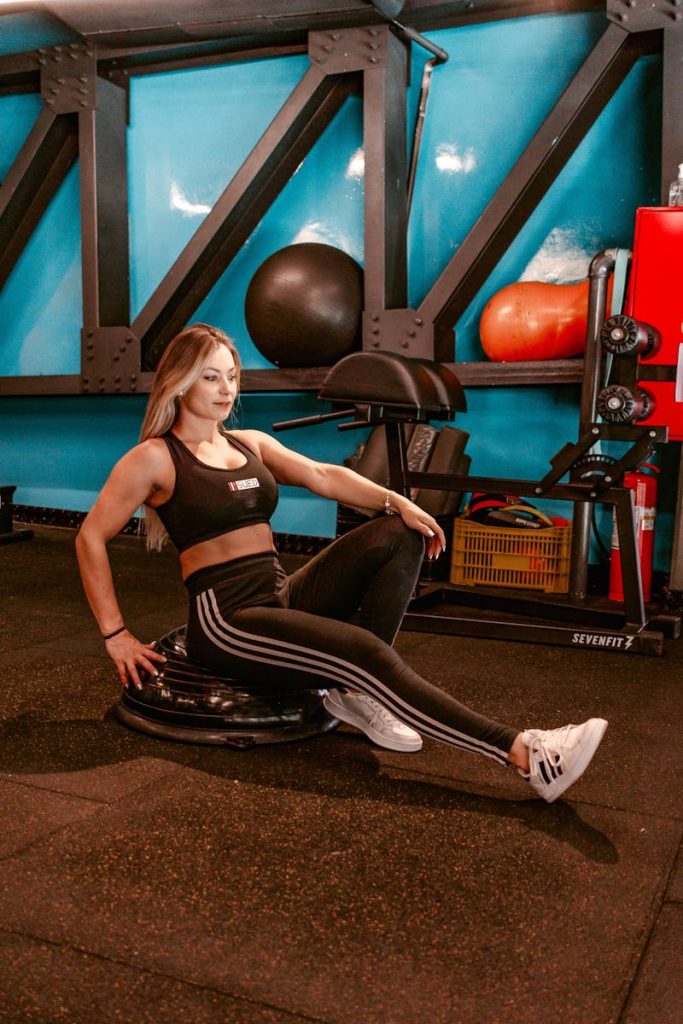
This guide covers the best BOSU ball leg exercises, the muscles they work, how to do each move correctly, common mistakes to avoid, and how to build a simple BOSU leg workout.
What Makes BOSU Ball Leg Exercises Effective?
A BOSU ball changes the feel of basic leg exercises by adding an unstable surface. That instability is useful when the goal is better body control, balance, ankle stability, and lower-body coordination.
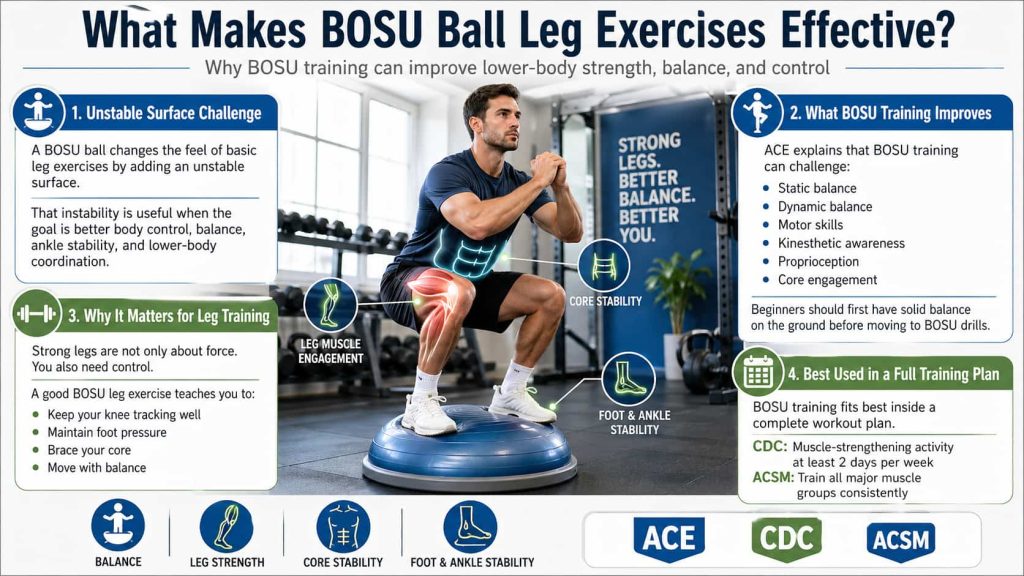
The American Council on Exercise explains that BOSU training can challenge static balance, dynamic balance, motor skills, kinesthetic awareness, proprioception, and core engagement. Beginners should first have solid balance on the ground before moving to BOSU drills.
That matters for leg training because strong legs are not only about force. You also need control. A good BOSU leg exercise teaches you how to keep your knee tracking well, maintain foot pressure, brace your core, and move with balance.
BOSU training also fits best inside a complete workout plan. The CDC recommends adults perform muscle-strengthening activity at least 2 days per week, and the American College of Sports Medicine emphasizes that consistency and training all major muscle groups matter more than chasing an overly complicated program.
Muscles Worked in BOSU Ball Leg Exercises
BOSU ball leg exercises mainly target the lower body, but most moves also require core and hip stability.
The main muscles worked include:
- Quadriceps
- Glutes
- Hamstrings
- Calves
- Hip abductors and adductors
- Ankle and foot stabilizers
- Core muscles, especially during balance-based movements
Squats, lunges, and step-ups focus more on the quads and glutes. Bridges focus more on the glutes and hamstrings. Calf raises target the calves and ankles. Single-leg balance drills challenge the smaller stabilizing muscles around the feet, ankles, knees, and hips.
How to Use a BOSU Ball Safely for Leg Training
For most standing leg exercises, use the BOSU with the dome side up. BOSU says the dome should be inflated to about 8.5 inches high and should not exceed 10 inches. BOSU also says standing on the platform side is not recommended because standing on the dome side offers a balance challenge with less risk.
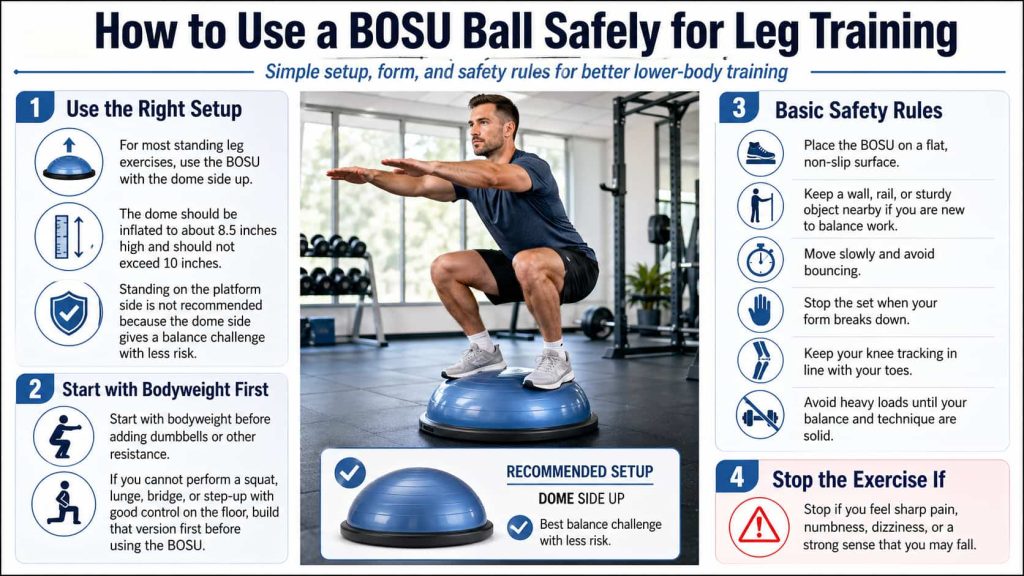
Start with bodyweight before adding dumbbells or other resistance. If you cannot perform a squat, lunge, bridge, or step-up with good control on the floor, build that version first before using the BOSU.
Use these basic safety rules:
- Place the BOSU on a flat, non-slip surface.
- Keep a wall, rail, or sturdy object nearby if you are new to balance work.
- Move slowly and avoid bouncing.
- Stop the set when your form breaks down.
- Keep your knee tracking in line with your toes.
- Avoid heavy loads until your balance and technique are solid.
Stop the exercise if you feel sharp pain, numbness, dizziness, or a strong sense that you may fall.
9 Best BOSU Ball Leg Exercises
Here are the 9 best BOSU ball leg exercises to build lower-body strength, balance, and stability. These moves target your quads, glutes, hamstrings, calves, hips, ankles, and core while helping you improve control on an unstable surface.
1. BOSU Squat
Best for:
The BOSU squat is best for building basic lower-body strength, balance, and control. It is a good starting point for people who already squat well on the floor and want to add a stability challenge.
Muscles worked:
This exercise mainly works the quadriceps, glutes, hamstrings, calves, hip stabilizers, and core.
Equipment needed:
BOSU ball. Dumbbells are optional for advanced users.
Why it stands out
The BOSU squat teaches you to control your foot pressure, knee position, and trunk stability while moving through a familiar lower-body pattern. It is not about squatting as heavy as possible. It is about moving well under a balance challenge.
Suggested sets and reps
Do 2 to 3 sets of 8 to 12 reps. Beginners can start with shallow squats and hand support. Intermediate users can increase depth. Advanced users can hold light dumbbells after they can control the bodyweight version.
How to do it
- Place the BOSU dome side up.
- Stand on top of the dome with your feet about hip- to shoulder-width apart.
- Brace your core and keep your chest tall.
- Bend your knees and hips to lower into a squat.
- Keep your knees tracking in the same direction as your toes.
- Press through your feet to stand back up.
- Reset your balance before the next rep.
Common mistakes:
Avoid letting your knees cave inward, rounding your back, rushing the movement, or going deeper than you can control.
Coaching cue:
Think “spread the floor with your feet” and keep your ribs stacked over your hips.
Exercise variations
Use a supported BOSU squat by holding a wall or rail. Make it harder with a goblet hold, slower tempo, or pause at the bottom.
How to use in a workout:
Use it early in your workout as a main lower-body strength and balance exercise.
2. BOSU Reverse Lunge
Best for:
The BOSU reverse lunge is best for single-leg strength, glute control, and balance. It is usually easier to control than a forward lunge because stepping backward often creates less forward knee stress.
Muscles worked:
This exercise works the glutes, quadriceps, hamstrings, calves, hip stabilizers, and core.
Equipment needed:
BOSU ball. Dumbbells are optional.
Why it stands out
Reverse lunges train one leg at a time, which helps expose side-to-side differences in strength and control. The BOSU adds an extra challenge for the foot and ankle on the working side.
Suggested sets and reps
Do 2 to 3 sets of 8 to 10 reps per leg. Start bodyweight only. Add dumbbells only when your steps are smooth and balanced.
How to do it
- Place the BOSU dome side up.
- Stand with one foot centered on the dome.
- Step the opposite foot backward into a lunge.
- Lower until both knees bend comfortably.
- Keep your front knee aligned with your toes.
- Press through the front foot to return to standing.
- Complete all reps on one side or alternate sides.
Common mistakes:
Avoid stepping too far back, twisting your hips, collapsing into the front knee, or pushing mostly off the back leg.
Coaching cue:
Drive through the full front foot and keep your hips square.
Exercise variations
Hold a wall for support to make it easier. Add a knee drive at the top or light dumbbells to make it harder.
How to use in a workout:
Use this after squats or step-ups as a single-leg strength movement.
3. BOSU Step-Up
Best for:
The BOSU step-up is best for functional leg strength, balance, and stair-climbing control. It is a practical choice for training the legs in a movement pattern that carries over well to daily life.
Muscles worked:
This move works the quadriceps, glutes, hamstrings, calves, hip stabilizers, and core.
Equipment needed:
BOSU ball.
Why it stands out
The BOSU step-up builds strength while teaching you to control your knee and ankle as you transfer your weight from the floor to the dome.
Suggested sets and reps
Do 2 to 3 sets of 8 to 12 reps per leg. Beginners should use a slower pace and light hand support if needed.
How to do it
- Place the BOSU dome side up.
- Stand behind the BOSU.
- Step one foot onto the center of the dome.
- Press through that foot to stand tall on the BOSU.
- Bring the other foot up lightly, or hover it for more balance challenge.
- Step back down with control.
- Repeat on the same leg or alternate sides.
Common mistakes:
Avoid pushing too much off the floor leg, letting the working knee cave inward, or stepping down too quickly.
Coaching cue:
Make the top leg do the work, not the back leg.
Exercise variations
Make it easier by touching the second foot to the dome at the top. Make it harder by adding a knee drive or holding light dumbbells.
How to use in a workout:
Use it as a main lower-body move or as a controlled balance drill in a circuit.
4. BOSU Lateral Lunge
Best for:
The BOSU lateral lunge is best for training side-to-side strength, inner-thigh control, and glute stability. It is useful because many leg workouts focus mostly on forward and backward movement.
Muscles worked:
This exercise works the glutes, quadriceps, hamstrings, adductors, abductors, calves, and core.
Equipment needed:
BOSU ball.
Why it stands out
The lateral lunge challenges the hips in a different plane of motion. This makes it a strong choice for athletes, recreational lifters, and anyone who wants better lower-body control outside of straight-line movement.
Suggested sets and reps
Do 2 to 3 sets of 8 to 10 reps per side. Keep the range of motion smaller at first.
How to do it
- Place the BOSU dome side up.
- Stand beside the BOSU.
- Step one foot onto the center of the dome.
- Push your hips back and bend the BOSU-side knee.
- Keep the opposite leg more extended.
- Press through the BOSU-side foot to return to standing.
- Repeat on one side before switching.
Common mistakes:
Avoid rounding your back, letting your knee collapse inward, or shifting so far that you lose control.
Coaching cue:
Sit your hips back like you are closing a car door with your glutes.
Exercise variations
Use a shallow side lunge for an easier version. Hold a dumbbell at your chest for a harder version.
How to use in a workout:
Use it after your main squat or lunge pattern to train lateral strength and hip stability.
5. BOSU Split Squat
Best for:
The BOSU split squat is best for controlled single-leg strength without needing to step each rep. It is a good option for people who want more stability than a dynamic lunge but more challenge than a regular floor split squat.
Muscles worked:
This exercise works the quads, glutes, hamstrings, calves, hip stabilizers, and core.
Equipment needed:
BOSU ball. Dumbbells are optional.
Why it stands out
Because your feet stay in place, the split squat lets you focus on knee tracking, hip control, and balance without worrying about stepping forward or backward.
Suggested sets and reps
Do 2 to 3 sets of 8 to 12 reps per side. Use bodyweight first, then add light dumbbells if you can stay steady.
How to do it
- Place the BOSU dome side up.
- Put your front foot on the center of the dome.
- Step the other foot back into a split stance.
- Keep your torso tall and brace your core.
- Bend both knees to lower straight down.
- Press through the front foot to stand back up.
- Complete all reps, then switch sides.
Common mistakes:
Avoid leaning too far forward, letting the front knee cave in, or placing your feet too close together.
Coaching cue:
Lower like an elevator, not like you are drifting forward.
Exercise variations
Hold support to make it easier. Add a slow 3-second lowering phase or dumbbells to make it harder.
How to use in a workout:
Use it as your main single-leg strength move or as an accessory exercise after squats.
6. BOSU Glute Bridge
Best for:
The BOSU glute bridge is best for training the glutes and hamstrings with less balance risk than standing BOSU exercises. It is a good choice for beginners, warm-ups, or lower-body finishers.
Muscles worked:
This exercise works the glutes, hamstrings, lower back stabilizers, and core.
Equipment needed:
BOSU ball.
Why it stands out
Because you are lying on the floor, the BOSU glute bridge lets you train posterior-chain strength while still adding a stability challenge through the feet.
Suggested sets and reps
Do 2 to 4 sets of 10 to 15 reps. Hold the top position for 1 to 2 seconds on each rep.
How to do it
- Place the BOSU dome side up.
- Lie on your back with your knees bent.
- Place both feet on the center of the dome.
- Brace your core and keep your ribs down.
- Press through your feet and lift your hips.
- Squeeze your glutes at the top.
- Lower with control and repeat.
Common mistakes:
Avoid arching your lower back, pushing through your toes only, or letting your knees flare or cave excessively.
Coaching cue:
Lift with your glutes, not your lower back.
Exercise variations
Make it easier by placing the BOSU closer to your hips. Make it harder with a single-leg bridge or a longer pause at the top.
How to use in a workout:
Use it as a warm-up activation drill, accessory lift, or finisher after squats and lunges.
7. BOSU Single-Leg Balance Reach
Best for:
The BOSU single-leg balance reach is best for ankle stability, hip control, coordination, and balance. It is a lower-load exercise that can be very useful for control and body awareness.
Muscles worked:
This exercise works the glutes, hamstrings, calves, ankle stabilizers, foot muscles, hip stabilizers, and core.
Equipment needed:
BOSU ball.
Why it stands out
This drill teaches your lower body to stabilize while your upper body or free leg moves. It is especially useful when you want to improve balance without adding heavy resistance.
Suggested sets and reps
Do 2 to 3 sets of 5 to 8 slow reaches per side. Quality matters more than quantity.
How to do it
- Place the BOSU dome side up.
- Stand on the center of the dome with one foot.
- Soften the standing knee.
- Brace your core and keep your hips level.
- Reach your opposite foot or hand slightly forward, sideways, or backward.
- Return to the starting position with control.
- Repeat without rushing.
Common mistakes:
Avoid locking the standing knee, twisting your hips, collapsing your arch, or reaching farther than you can control.
Coaching cue:
Keep your standing foot active and your hips square.
Exercise variations
Use fingertip support on a wall for an easier version. Reach in multiple directions or hold a light medicine ball for a harder version.
How to use in a workout:
Use it near the beginning as a balance primer or near the end as a control-focused finisher.
8. BOSU Calf Raise
Best for:
The BOSU calf raise is best for strengthening the calves while challenging ankle and foot stability. It is simple, but it requires more control than a flat-floor calf raise.
Muscles worked:
This exercise works the gastrocnemius, soleus, foot stabilizers, ankle stabilizers, and core.
Equipment needed:
BOSU ball.
Why it stands out
The calves and ankles play a major role in balance. Doing calf raises on the BOSU forces you to control the wobble while moving through the ankle.
Suggested sets and reps
Do 2 to 3 sets of 12 to 20 reps. Use a slow tempo and pause briefly at the top.
How to do it
- Place the BOSU dome side up.
- Stand on the dome with your feet about hip-width apart.
- Hold a wall or rail if needed.
- Rise onto the balls of your feet.
- Pause briefly at the top.
- Lower your heels with control.
- Repeat without bouncing.
Common mistakes:
Avoid rolling onto the outside of your feet, rushing the reps, or using momentum.
Coaching cue:
Rise straight up and lower slowly.
Exercise variations
Use both legs for the basic version. Try single-leg calf raises only after you can stay balanced with control.
How to use in a workout:
Use it near the end of a lower-body session as a calf and ankle stability finisher.
9. BOSU Lateral Step-Over
Best for:
The BOSU lateral step-over is best for dynamic balance, coordination, and side-to-side lower-body control. It adds more movement than a basic step-up while still being easier to manage than jumping drills.
Muscles worked:
This move works the glutes, quads, hamstrings, calves, hip abductors, adductors, ankle stabilizers, and core.
Equipment needed:
BOSU ball.
Why it stands out
The lateral step-over teaches you to shift weight from one leg to the other while staying controlled. It is a good bridge between slow strength work and more athletic balance drills.
Suggested sets and reps
Do 2 to 3 sets of 8 to 12 step-overs per side. Keep the pace slow at first.
How to do it
- Place the BOSU dome side up.
- Stand beside the BOSU.
- Step your inside foot onto the center of the dome.
- Press through that foot and bring your other foot over to the opposite side.
- Step down softly.
- Reverse the movement back across the BOSU.
- Continue side to side with control.
Common mistakes:
Avoid hopping too early, looking down the whole time, or letting your knees collapse inward.
Coaching cue:
Step softly and control each weight shift.
Exercise variations
Make it easier with side-to-side toe taps. Make it harder by increasing speed slightly or adding a light athletic stance between reps.
How to use in a workout:
Use it as a warm-up drill, balance finisher, or low-impact conditioning move.
Sample BOSU Ball Leg Workout
Use this routine 1 to 2 times per week as part of a balanced strength plan. Rest 45 to 90 seconds between sets depending on your fitness level and how challenging the exercise feels.
Beginner BOSU Leg Workout
- BOSU Glute Bridge — 2 sets of 12 reps
- Supported BOSU Squat — 2 sets of 8 reps
- BOSU Step-Up — 2 sets of 8 reps per leg
- BOSU Calf Raise — 2 sets of 12 reps
- Supported Single-Leg Balance Reach — 2 sets of 5 reps per side
Intermediate BOSU Leg Workout
- BOSU Squat — 3 sets of 10 reps
- BOSU Reverse Lunge — 3 sets of 8 reps per leg
- BOSU Lateral Lunge — 2 sets of 8 reps per side
- BOSU Glute Bridge — 3 sets of 12 reps
- BOSU Lateral Step-Over — 2 sets of 10 reps per side
Advanced BOSU Leg Finisher
Use this after your main strength workout:
- BOSU Split Squat — 10 reps per leg
- BOSU Single-Leg Balance Reach — 6 reps per side
- BOSU Calf Raise — 15 reps
- BOSU Lateral Step-Over — 10 reps per side
Complete 2 to 3 rounds with controlled form.
Common Mistakes to Avoid With BOSU Ball Leg Exercises
Using the BOSU before mastering the floor version
The BOSU should add challenge to a movement you can already control. If your squat, lunge, or step-up is unstable on the floor, fix that first.
Going too heavy too soon
Heavy dumbbells can turn a balance drill into a risky movement. Start with bodyweight, then add light resistance only when your form stays clean.
Moving too fast
Fast reps usually hide poor control. Slow down, pause when needed, and make every rep steady.
Letting the knees cave inward
Keep your knees tracking in line with your toes. This is especially important during squats, lunges, and step-ups.
Standing on the platform side
For standing leg exercises, use the dome side up. BOSU states that standing on the platform side is not recommended because the dome side provides the balance challenge with less risk.
FAQs About BOSU Ball Leg Exercises
Are BOSU ball leg exercises good for building muscle?
They can help build lower-body strength and muscle endurance, especially for beginners and intermediate exercisers. However, they are usually not the best choice for maximum muscle growth because the unstable surface limits how much weight you can use. For muscle size, combine BOSU work with stable strength exercises like squats, deadlifts, leg presses, lunges, and hip thrusts.
Should beginners do BOSU ball leg exercises?
Beginners can use BOSU leg exercises, but they should start with simple drills and support. Good beginner options include BOSU glute bridges, supported squats, step-ups, calf raises, and supported balance reaches. More advanced moves like fast step-overs, loaded lunges, and single-leg drills should come later.
Is it better to use the dome side or flat side for leg exercises?
For most standing BOSU ball leg exercises, the dome side up is the better and safer choice. The platform side can be used for some floor-based or hand-supported exercises, but standing on the platform side is not recommended by BOSU.
How often should I do BOSU ball leg exercises?
Most people can use BOSU ball leg exercises 1 to 2 times per week as part of a lower-body or full-body plan. If the exercises are mostly light balance drills, you may use them more often, but harder leg exercises still need recovery.
Can BOSU ball leg exercises help with balance?
Yes. BOSU exercises can be useful for balance because the unstable surface challenges your body to stabilize through the feet, ankles, knees, hips, and core. Keep the exercises slow and controlled for the best training effect.
Can I use dumbbells with BOSU leg exercises?
Yes, but only after you can control the bodyweight version. Start with light dumbbells and avoid heavy loads that make your balance or knee position break down.
Conclusion
BOSU ball leg exercises are a smart way to train lower-body strength, balance, coordination, and stability in the same workout. The best approach is to start with controlled basics like squats, step-ups, glute bridges, calf raises, and supported balance drills before moving into lunges, lateral work, and advanced variations.
Choose 3 to 5 exercises from this list, keep the reps slow and clean, and build your BOSU leg workout around control before intensity.
References
- American Council on Exercise: 7 Basic BOSU Balance Exercises
- CDC: Adult Physical Activity Guidelines
- CDC: Adding Physical Activity as an Adult
- American College of Sports Medicine: Updated Resistance Training Guidelines
- Mayo Clinic: Core Exercises Improve Balance and Stability
- Mayo Clinic: Exercises to Improve Your Core Strength