BOSU ball exercises for beginners work best when the goal is to improve balance, coordination, core control, and lower-body stability with simple, controlled movements. A BOSU can make basic exercises more challenging by adding instability, and current research published on PubMed suggests unstable-surface training can increase muscle activation and help improve balance, even though it is not the best tool for maximal strength work compared with stable lifting.
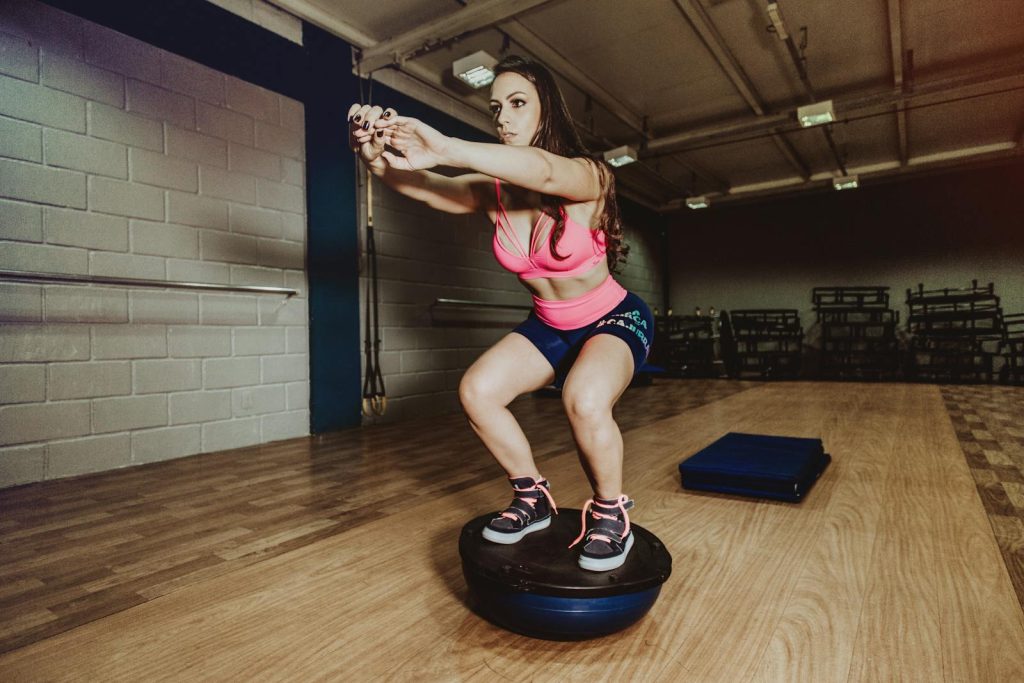
For beginners, that is exactly why the BOSU is useful. It gives you a practical way to learn how to brace, control your feet and ankles, and stay stable while you squat, step, hinge, or hold position. Guidance from BOSU and ACE Fitness also supports starting with basic standing holds, step patterns, and simple balance drills before progressing to harder core work or more dynamic exercises.
Why BOSU ball exercises are useful for beginners
The biggest beginner benefit is not that the BOSU makes everything “hardcore.” It is that the unstable surface forces you to slow down, stay aware of posture, and organize your body better from the feet up. BOSU and ACE both emphasize simple static and dynamic balance drills first, with small progressions such as changing eye focus, reducing support, or adding movement only after you can control the easier version.
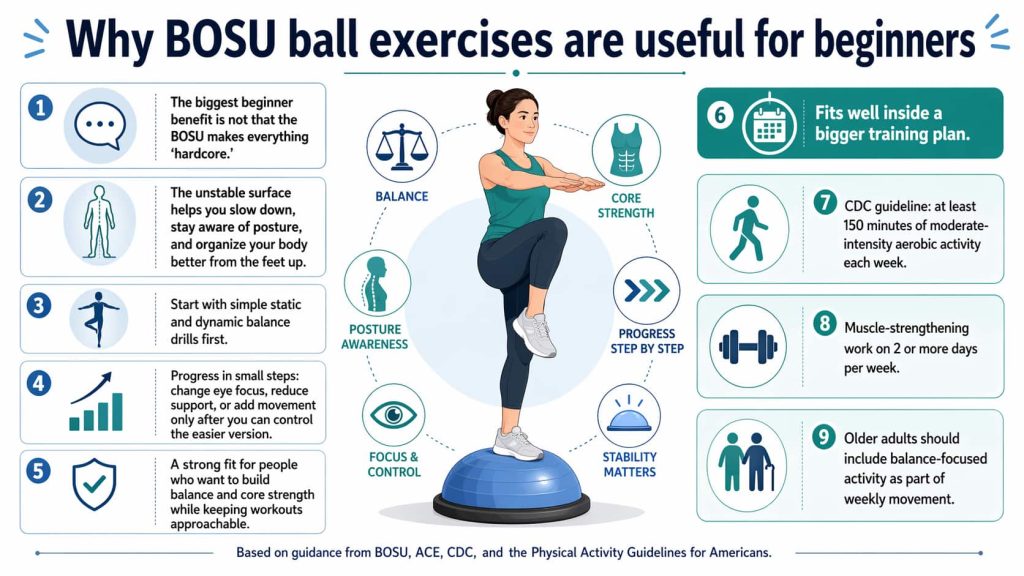
That makes BOSU training a strong fit for people who want to build balance and core strength while still keeping workouts approachable. It also fits well inside a bigger training plan. The CDC recommends adults get at least 150 minutes of moderate-intensity aerobic activity each week plus muscle-strengthening work on 2 or more days per week, and the federal guidelines also note that older adults should include balance-focused activity as part of weekly movement.
How to use a BOSU ball safely as a beginner
Start with the dome side up for most beginner drills. That setup is usually more manageable than flipping the BOSU over and standing on the platform side. Keep the BOSU on a non-slip surface, place it near a wall if needed, and wear shoes with good grip unless you already know you balance well barefoot. BOSU’s own beginner balance instructions specifically recommend using a wall for assistance during early standing work.
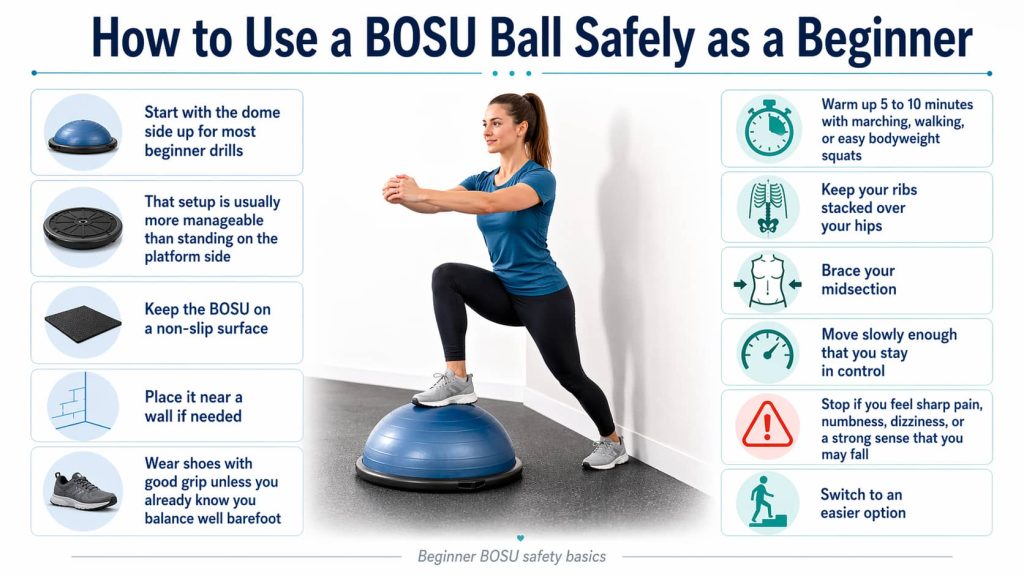
Before each session, do 5 to 10 minutes of light movement such as marching, walking, or easy bodyweight squats. During the workout, keep your ribs stacked over your hips, brace your midsection, and move slowly enough that you stay in control. If a drill causes sharp pain, numbness, dizziness, or a strong sense that you may fall, stop and switch to an easier option.
11 best BOSU ball exercises for beginners
These 11 BOSU ball exercises for beginners are designed to help you build balance, core strength, and full-body stability with simple, controlled movements. Start with the easiest drills, focus on good form, and progress gradually as your confidence and coordination improve.
1. Supported BOSU Stand
Best for: Learning how the BOSU feels under your feet and building basic confidence.
Muscles worked: Core, calves, feet and ankle stabilizers, glutes, and postural muscles.
Equipment needed: BOSU ball and a wall or sturdy support.
Why it stands out: This is the safest place to start. BOSU’s beginner balance guidance uses a wall-assisted standing balance drill as an entry point because it teaches control without forcing you into a rushed movement pattern.
Suggested sets and reps: 2 to 4 sets of 15 to 30 seconds.
How to do it:
- Place the BOSU dome side up next to a wall.
- Step one foot onto the dome, then the other.
- Lightly hold the wall as needed.
- Stand tall with feet about hip-width apart.
- Brace your core and keep your eyes fixed on one point ahead.
- Gradually reduce how much support you use.
Common mistakes: Looking down constantly, locking your knees, gripping the wall too hard, or rushing to let go before you are stable.
Coaching cue: “Stand tall and let your feet stay active.”
Exercise variations:
- Easier: keep one hand on the wall the whole set.
- Harder: hover the hands or hold for longer.
How to use in a workout: Put this first in your BOSU session as your first balance drill.
2. Static Awareness Balance Hold
Best for: Improving quiet balance and core engagement without adding movement.
Muscles worked: Core, calves, intrinsic foot muscles, glutes, and spinal stabilizers.
Equipment needed: BOSU ball.
Why it stands out: ACE uses this type of upright static hold to build awareness of the unstable surface, foot pressure, breathing, and core contraction before more dynamic work.
Suggested sets and reps: 2 to 3 sets of 20 to 40 seconds.
How to do it:
- Stand on the dome with feet hip-width apart.
- Let your arms hang by your sides.
- Focus your eyes on a point straight ahead.
- Breathe normally and keep your torso stacked over your hips.
- Hold the position without shifting side to side.
Common mistakes: Holding your breath, shrugging your shoulders, or wobbling aggressively instead of settling into position.
Coaching cue: “Find the middle of the dome and own it.”
Exercise variations:
- Easier: hold near a wall.
- Harder: narrow your stance slightly or extend the hold.
How to use in a workout: Use after the supported stand or as a quick reset between harder drills.
3. BOSU Walk-Ups
Best for: Teaching rhythm, balance in motion, and controlled stepping.
Muscles worked: Quads, glutes, calves, core, and ankle stabilizers.
Equipment needed: BOSU ball.
Why it stands out: ACE includes walk-ups as a practical dynamic balance drill because they help beginners transition from static holds to repeated stepping on and off the dome.
Suggested sets and reps: 2 to 3 sets of 20 to 40 seconds.
How to do it:
- Stand behind the BOSU with the dome side up.
- Step one foot onto the dome, then the other.
- Step back down with control.
- Continue in a smooth rhythm.
- Alternate which foot leads every few reps or every set.
Common mistakes: Stomping onto the dome, going too fast, or leaning too far forward.
Coaching cue: “Step softly and stay tall.”
Exercise variations:
- Easier: use a wall or support.
- Harder: pause briefly at the top before stepping down.
How to use in a workout: Great as an early lower-body movement or as a light conditioning interval.
4. BOSU Step-Up
Best for: Building single-leg control and beginner lower-body strength.
Muscles worked: Quads, glutes, calves, core, and hip stabilizers.
Equipment needed: BOSU ball.
Why it stands out: BOSU’s beginner workout uses step-ups once you are comfortable standing on the dome, making this a logical next step after holds and walk-ups.
Suggested sets and reps: 2 to 4 sets of 6 to 10 reps per side.
How to do it:
- Stand behind the BOSU.
- Place one foot on the dome.
- Drive through that foot and step up under control.
- Bring the other foot to the dome or hover it lightly.
- Step back down slowly.
- Complete all reps, then switch sides.
Common mistakes: Pushing off too hard from the back foot, collapsing the knee inward, or crashing down on the way back.
Coaching cue: “Drive through the whole foot and control the return.”
Exercise variations:
- Easier: use a fingertip hold on the wall.
- Harder: add a pause at the top.
How to use in a workout: Pair with a squat pattern for a beginner leg circuit.
5. Standing Toe Taps
Best for: Improving single-leg balance and hip control.
Muscles worked: Glute medius, glutes, core, calves, and foot stabilizers.
Equipment needed: BOSU ball.
Why it stands out: ACE’s standing abduction toe taps are a smart beginner progression because one foot stays planted while the other moves, which challenges balance without turning the exercise into a full single-leg stand.
Suggested sets and reps: 2 to 3 sets of 6 to 10 taps per side.
How to do it:
- Stand on the dome with both feet hip-width apart.
- Shift your weight into one foot.
- Lift the other foot and tap it lightly to the side of the dome or floor.
- Return to center with control.
- Repeat on one side, then switch.
Common mistakes: Letting the stance knee cave inward, swaying the torso, or tapping too far out.
Coaching cue: “Keep the standing leg quiet and strong.”
Exercise variations:
- Easier: keep the tap small.
- Harder: tap farther away or add a slight squat.
How to use in a workout: Use after step-ups to introduce more single-leg demand.
6. BOSU Athletic Stance Hold
Best for: Teaching posture, bracing, and ready-position stability.
Muscles worked: Quads, glutes, hamstrings, calves, and core.
Equipment needed: BOSU ball.
Why it stands out: ACE uses an athletic stance on the dome to help people stabilize in a partial squat position before they try bigger movement challenges.
Suggested sets and reps: 2 to 3 sets of 15 to 30 seconds.
How to do it:
- Stand on the dome with feet about hip-width apart.
- Push your hips back slightly and bend your knees into a shallow squat.
- Keep your chest up and arms in front for balance.
- Hold the position while breathing steadily.
Common mistakes: Knees collapsing inward, rounding the upper back, or sitting too deep too soon.
Coaching cue: “Soft knees, proud chest, tight midsection.”
Exercise variations:
- Easier: shallower bend.
- Harder: move the hands slowly side to side.
How to use in a workout: Use before BOSU squats or as a primer for sport-style lower-body work.
7. BOSU Squat
Best for: Building lower-body strength with a balance challenge.
Muscles worked: Quads, glutes, hamstrings, calves, and core.
Equipment needed: BOSU ball.
Why it stands out: This is one of the first true strength-oriented BOSU patterns beginners can use once they can hold an athletic stance without losing posture. It teaches you to stay braced while your hips and knees move together.
Suggested sets and reps: 2 to 4 sets of 6 to 10 reps.
How to do it:
- Stand on the dome with feet about hip-width apart.
- Brace your core and keep your eyes forward.
- Push your hips back slightly and bend your knees into a controlled squat.
- Stop at a depth you can control without wobbling.
- Press through your feet to stand tall.
Common mistakes: Dropping too low, knees caving in, folding forward, or bouncing at the bottom.
Coaching cue: “Sit down a little, then stand up strong.”
Exercise variations:
- Easier: hold onto a wall lightly or do a bodyweight squat on the floor.
- Harder: add a 2-second pause at the bottom.
How to use in a workout: Put this in the middle of the session as your main lower-body strength move.
8. BOSU Static Lunge
Best for: Improving unilateral balance and leg strength.
Muscles worked: Quads, glutes, hamstrings, calves, and core.
Equipment needed: BOSU ball.
Why it stands out: ACE includes the static lunge as a progression from simple standing work because it adds a split stance and more control demand without requiring jumping or fast direction changes.
Suggested sets and reps: 2 to 3 sets of 6 to 8 reps per side.
How to do it:
- Place one foot on the center of the dome.
- Step the other foot back into a split stance.
- Keep your torso upright.
- Lower your back knee toward the floor with control.
- Press back up without wobbling onto the front knee.
- Finish all reps, then switch sides.
Common mistakes: Front knee diving inward, stepping too narrow, or dropping too quickly.
Coaching cue: “Track the front knee over the mid-foot.”
Exercise variations:
- Easier: hold a wall or shorten the range.
- Harder: pause at the bottom for 1 second.
How to use in a workout: Pair with step-ups for a beginner-friendly unilateral leg block.
9. Seated Sit-and-Tap
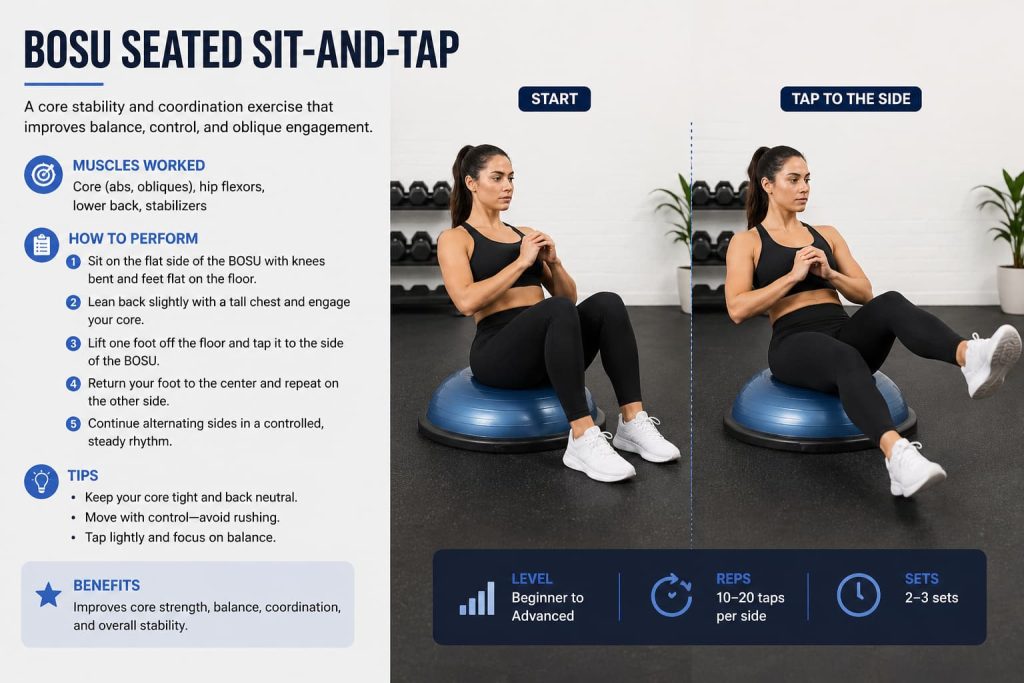
Best for: Beginner core work and learning how to stabilize on the dome.
Muscles worked: Abdominals, hip flexors, deep core stabilizers, and postural muscles.
Equipment needed: BOSU ball.
Why it stands out: BOSU’s beginner workout includes a sit-and-tap drill on the dome, which gives newer trainees a lower-risk way to challenge balance and core control.
Suggested sets and reps: 2 to 3 sets of 8 to 12 reps.
How to do it:
- Sit in the center of the dome.
- Place your hands on the sides lightly for balance.
- Lift one foot a few inches off the floor, then lower it.
- Alternate sides, or lift both feet briefly if you can control it.
- Stay tall instead of slumping back.
Common mistakes: Leaning too far back, yanking the knees up, or holding your breath.
Coaching cue: “Sit tall and move from a braced trunk.”
Exercise variations:
- Easier: one foot at a time with hands down.
- Harder: hands at chest height.
How to use in a workout: Place this after lower-body work as your first BOSU core drill.
10. BOSU Fire Hydrant
Best for: Glute activation, hip stability, and beginner core control.
Muscles worked: Glute medius, glute max, deep core muscles, shoulders, and hip stabilizers.
Equipment needed: BOSU ball.
Why it stands out: BOSU’s own beginner sequence includes the fire hydrant in a tabletop position, making it a useful bridge between easy seated drills and harder anti-rotation work.
Suggested sets and reps: 2 to 3 sets of 8 to 12 reps per side.
How to do it:
- Kneel behind the BOSU and place your hands on the dome.
- Set your spine neutral and brace your core.
- Keep one knee bent and lift it out to the side.
- Stop before your torso twists.
- Lower slowly and repeat.
- Switch sides after the set.
Common mistakes: Rotating the hips, dumping into the lower back, or rushing the rep.
Coaching cue: “Move the leg, not the torso.”
Exercise variations:
- Easier: reduce the range.
- Harder: add a short pause at the top.
How to use in a workout: Use as an accessory glute and core movement near the end of the session.
11. BOSU Shin Balance or Forearm Plank Hold
Best for: Beginner-to-intermediate core stability progression.
Muscles worked: Abdominals, obliques, shoulders, glutes, and spinal stabilizers.
Equipment needed: BOSU ball.
Why it stands out: ACE includes shin balances as an early BOSU progression, and BOSU and ACE materials consistently frame unstable core work as something to add after you can control simpler positions first. This makes shin balances the better true beginner option, while a BOSU forearm plank is best used only after you already own a solid floor plank.
Suggested sets and reps: 2 to 3 sets of 15 to 25 seconds.
How to do it:
- For shin balance, kneel with your shins on the dome and hands on the floor in front.
- Brace your core and keep a neutral spine.
- Hold the position without letting your trunk sway.
- For the forearm plank progression, place forearms on the BOSU and extend your legs behind you.
- Hold a straight line from head to heels.
Common mistakes: Sagging through the low back, lifting the hips too high, or trying the plank before you are ready.
Coaching cue: “Ribs down, glutes tight, body still.”
Exercise variations:
- Easier: shin balance with toes touching the floor.
- Harder: shin balance with toes lifted, or short BOSU forearm plank holds.
How to use in a workout: Finish with this as your hardest core drill of the day.
Common beginner mistakes with BOSU ball exercises
One of the biggest mistakes is starting with exercises that are too advanced. Jumping, burpees, fast lateral drills, and long plank variations may look impressive, but most beginners get better results by mastering static balance and simple step patterns first. BOSU and ACE both build their beginner progressions that way.
Another common mistake is chasing wobble instead of control. If every rep looks shaky and rushed, the exercise is too hard. Use a wall, shorten the range of motion, widen your stance, or slow the tempo. Better reps on an easier variation will usually help more than messy reps on a harder one.
The last big mistake is treating the BOSU like a complete training program. It is a useful tool, but you still need regular walking, cardio, and stable strength training. That bigger-picture approach lines up with the weekly activity and strength recommendations from the CDC.
How to progress BOSU ball exercises for beginners
A smart way to progress is to change only one variable at a time. ACE highlights four useful ways to adjust BOSU balance work: movement, eye gaze, external support, and contact points. In plain English, that means you can make an exercise harder by moving more, using less support, changing where you look, or balancing on fewer points of contact.
A simple progression ladder looks like this:
- Use wall assistance.
- Remove some wall assistance.
- Hold the position longer.
- Add controlled movement.
- Shift more load to one leg.
- Add harder core positions like shin balance or short plank holds.
That order tends to work better than jumping straight from an easy stand to an advanced exercise.
Beginner BOSU ball workout routine
Here is a simple beginner routine you can use 2 to 3 times per week.
Beginner option
- Supported BOSU Stand — 2 sets of 20 seconds
- BOSU Walk-Ups — 2 sets of 30 seconds
- BOSU Step-Up — 2 sets of 8 reps per side
- BOSU Squat — 2 sets of 8 reps
- Seated Sit-and-Tap — 2 sets of 10 reps
- BOSU Fire Hydrant — 2 sets of 8 reps per side
Rest about 30 to 60 seconds between exercises. Keep the whole session controlled and stop each set before balance breaks down.
Intermediate beginner option
- Static Awareness Balance Hold — 3 sets of 30 seconds
- Standing Toe Taps — 3 sets of 8 reps per side
- BOSU Step-Up — 3 sets of 8 to 10 reps per side
- BOSU Static Lunge — 3 sets of 6 to 8 reps per side
- BOSU Shin Balance — 3 sets of 20 seconds
Accessory finisher option
- BOSU Athletic Stance Hold — 20 seconds
- BOSU Walk-Ups — 30 seconds
- Seated Sit-and-Tap — 10 reps
Repeat 2 to 3 rounds.
Use BOSU work as part of a bigger weekly plan rather than your only training. Most adults still need regular aerobic activity and 2 or more weekly strength sessions that cover the major muscle groups.
Are BOSU ball exercises good for core strength?
Yes, but mostly because they force your trunk to stabilize while the rest of your body moves or balances. That is a helpful way to train core control, especially in beginner drills such as step-ups, athletic stance holds, shin balances, and seated balance work. Research on unstable training also supports that these setups can increase activation in core and other stabilizing muscles.
What BOSU work does not automatically do is replace all traditional strength training. A BOSU can complement squats, rows, presses, carries, and other stable exercises, but it should not replace them entirely if your goal is broad strength development.
FAQ
Are BOSU ball exercises good for beginners?
Yes. BOSU and ACE both provide beginner-specific balance progressions that start with simple standing and stepping drills, which is a good fit for new exercisers who want to build balance and core control gradually.
How often should beginners do BOSU ball exercises?
For most people, 2 to 3 sessions per week is a practical place to start. That leaves enough time to practice the skill without turning BOSU work into your only form of exercise. It also fits well with broader weekly activity guidance from the CDC.
What side of the BOSU should beginners use?
Most beginners should start with the dome side up. That setup is commonly used in BOSU’s beginner balance drills and is usually easier to control than standing on the flat platform side.
Do BOSU ball exercises help with balance?
Yes. Improving balance is one of the clearest reasons to use a BOSU, and unstable-surface training is often used specifically for that purpose. Reviews and coaching guidance support BOSU-style work as a useful balance-training tool.
Can beginners do planks on a BOSU?
They can, but only after they can hold a strong floor plank with good form. For many beginners, shin balances, tabletop drills, and seated balance work are better first choices because they teach bracing with less risk of losing posture.
Are BOSU ball exercises enough for a full workout?
They can be part of a full workout, but they should not be your only training method long term. Use them alongside walking, cardio, and standard strength exercises to cover all the basics the CDC recommends.
Conclusion
The best BOSU ball exercises for beginners are the ones that teach control first. Start with standing holds, walk-ups, step-ups, and simple core drills. Once those feel steady, add squats, lunges, and harder balance work.
Pick 3 to 5 of the exercises above, practice them consistently for a few weeks, and focus on cleaner reps before harder progressions. That is usually the fastest way to build real balance and core strength with a BOSU.
References
- BOSU – BOSU Balance Workout on the Balance Trainer
- ACE Fitness – 7 Basic BOSU Balance Exercises
- CDC – Physical Activity Guidelines for Adults
- Physical Activity Guidelines for Americans, 2nd Edition
- PubMed – Effects of Strength Training Using Unstable Surfaces on Strength, Power and Balance Performance Across the Lifespan: A Systematic Review and Meta-analysis
- PubMed – Instability Resistance Training for Health and Performance
- ACE Fitness – Complete Core BOSU Workout