Medicine ball ab exercises are core moves that use a weighted ball to build stronger abs, better trunk control, and more athletic power. The best options train more than crunching — they challenge your abs to brace, rotate, resist movement, and transfer force through your whole body.

This guide covers the best medicine ball core exercises, how to do them correctly, which muscles they work, how to choose the right ball weight, and how to build a simple ab workout.
What Are Medicine Ball Ab Exercises?
Medicine ball ab exercises are core exercises performed with a weighted ball. Some are slow and controlled, like dead bugs, crunches, and planks. Others are more dynamic, like Russian twists, wood chops, and overhead slams.
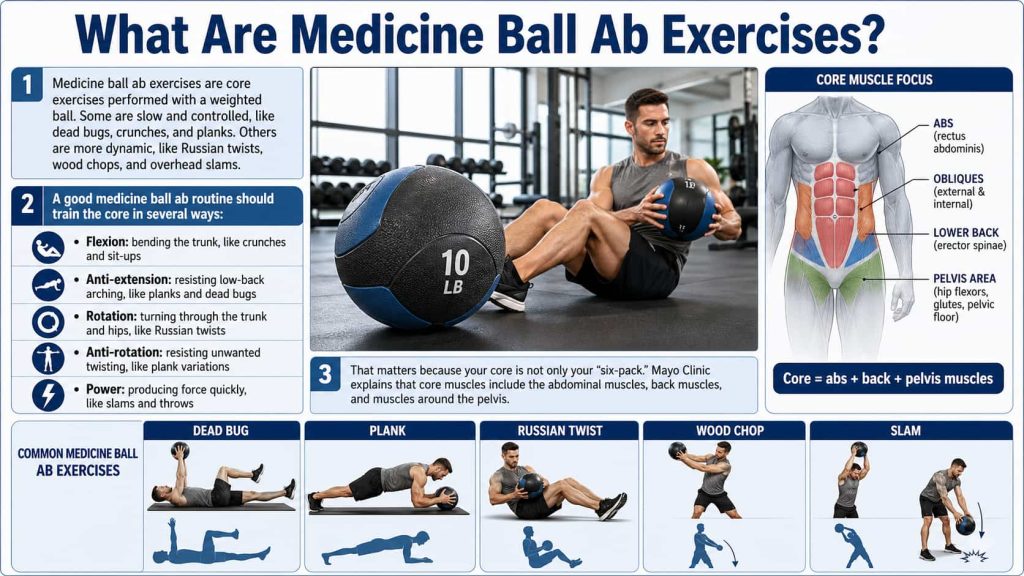
A good medicine ball ab routine should train the core in several ways:
- Flexion: bending the trunk, like crunches and sit-ups
- Anti-extension: resisting low-back arching, like planks and dead bugs
- Rotation: turning through the trunk and hips, like Russian twists
- Anti-rotation: resisting unwanted twisting, like plank variations
- Power: producing force quickly, like slams and throws
That matters because your core is not only your “six-pack.” Mayo Clinic explains that core muscles include the abdominal muscles, back muscles, and muscles around the pelvis.
Benefits of Medicine Ball Ab Exercises
Medicine ball ab exercises are useful because they make common core movements more practical, loaded, and athletic.
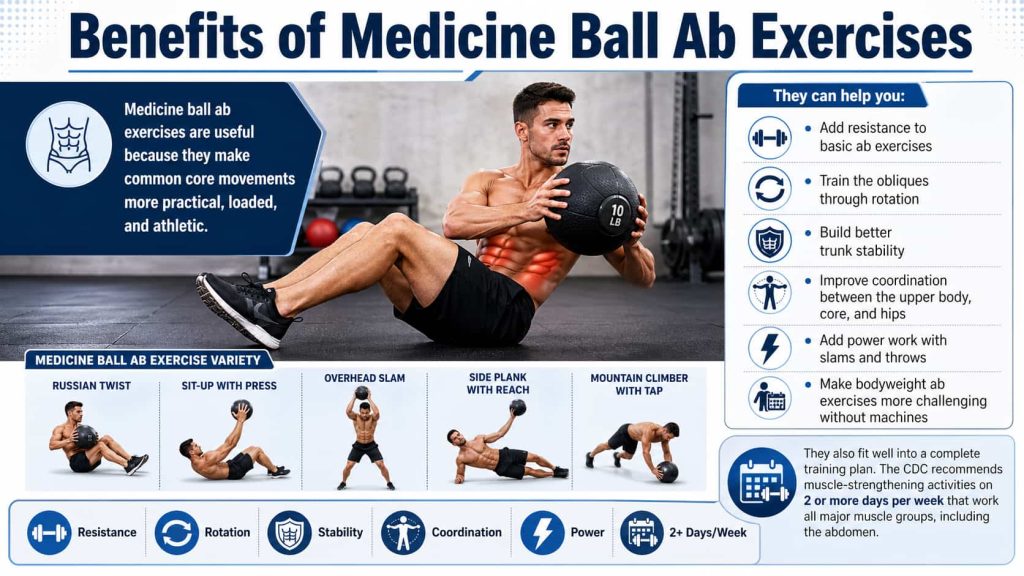
They can help you:
- Add resistance to basic ab exercises
- Train the obliques through rotation
- Build better trunk stability
- Improve coordination between the upper body, core, and hips
- Add power work with slams and throws
- Make bodyweight ab exercises more challenging without machines
They also fit well into a complete training plan. The CDC recommends muscle-strengthening activities on 2 or more days per week that work all major muscle groups, including the abdomen.
How to Choose the Right Medicine Ball Weight
Start lighter than you think. A medicine ball should make the exercise harder without forcing you to lose posture, yank through your neck, or arch your lower back.
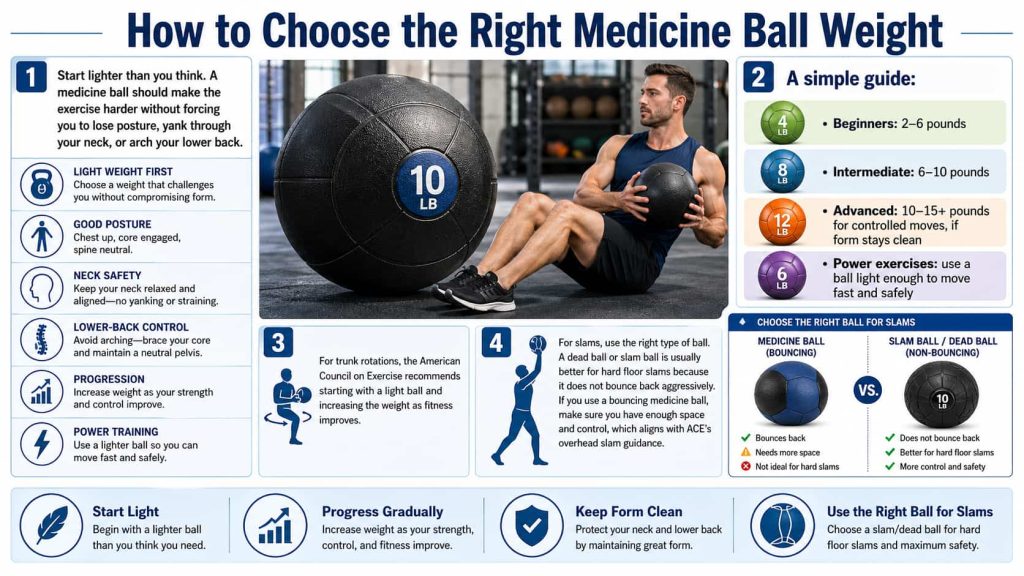
A simple guide:
- Beginners: 2–6 pounds
- Intermediate: 6–10 pounds
- Advanced: 10–15+ pounds for controlled moves, if form stays clean
- Power exercises: use a ball light enough to move fast and safely
For trunk rotations, the American Council on Exercise recommends starting with a light ball and increasing the weight as fitness improves.
For slams, use the right type of ball. A dead ball or slam ball is usually better for hard floor slams because it does not bounce back aggressively. If you use a bouncing medicine ball, make sure you have enough space and control, which aligns with ACE’s overhead slam guidance.
11 Best Medicine Ball Ab Exercises for a Stronger Core
Below are 11 medicine ball ab exercises that train your abs, obliques, and deep core muscles with resistance, rotation, and stability. Use them to build a stronger, more powerful core while improving control, balance, and workout variety.
1. Medicine Ball Crunch
- Best for: Beginners who want to add light resistance to a classic ab exercise.
- Muscles worked: Rectus abdominis, transverse abdominis, hip flexors.
- Equipment needed: Medicine ball and exercise mat.
Why it stands out
The medicine ball crunch is simple, controlled, and easy to scale. It teaches you to curl your ribs toward your pelvis without using momentum.
Suggested sets and reps
Do 2–3 sets of 10–15 reps.
How to do it
- Lie on your back with your knees bent and feet flat.
- Hold the medicine ball at your chest or slightly above your chest.
- Brace your core.
- Lift your head, shoulders, and upper back off the floor.
- Pause briefly at the top.
- Lower slowly with control.
Common mistakes: Pulling the neck forward, swinging the ball, and sitting up too high.
Coaching cue: Think “ribs down toward hips,” not “head toward knees.”
Exercise variations
- Easier: Hold the ball close to your chest.
- Harder: Hold the ball with arms extended above your chest.
How to use in a workout: Use it early in a beginner ab circuit or near the end as a controlled finisher.
2. Medicine Ball Russian Twist
- Best for: Training rotational core strength and oblique endurance.
- Muscles worked: Obliques, rectus abdominis, transverse abdominis, hip flexors.
- Equipment needed: Medicine ball and mat.
Why it stands out
This is one of the most popular medicine ball ab exercises because it trains rotation. It is useful for athletes and general fitness because many real movements involve turning, bracing, and controlling the trunk.
Suggested sets and reps
Do 2–4 sets of 8–16 reps per side.
How to do it
- Sit on the floor with knees bent.
- Hold the medicine ball close to your chest.
- Lean back slightly while keeping your spine long.
- Brace your core.
- Rotate your torso to one side.
- Bring the ball back through the center.
- Rotate to the other side.
Common mistakes: Rounding the lower back, moving only the arms, twisting too fast, and using a ball that is too heavy.
Coaching cue: Turn your chest and shoulders together instead of just swinging the ball.
Exercise variations
- Easier: Keep your feet on the floor.
- Harder: Lift your feet slightly while maintaining control.
How to use in a workout: Place it after a stability move like dead bugs or planks.
3. Medicine Ball Sit-Up and Press
- Best for: Building ab strength with an upper-body pressing challenge.
- Muscles worked: Rectus abdominis, hip flexors, shoulders, transverse abdominis.
- Equipment needed: Medicine ball and mat.
Why it stands out
This exercise makes a sit-up more demanding by adding a press at the top. It also teaches you to keep your ribs down while moving the ball overhead.
Suggested sets and reps
Do 2–3 sets of 8–12 reps.
How to do it
- Lie on your back with knees bent.
- Hold the medicine ball at your chest.
- Brace your core.
- Sit up while keeping the ball close.
- At the top, press the ball forward or slightly overhead.
- Bring the ball back to your chest.
- Lower slowly to the floor.
Common mistakes: Throwing the body upward, arching the low back, and pressing the ball too far behind the head.
Coaching cue: Sit tall at the top before you press.
Exercise variations
- Easier: Do a partial sit-up and press.
- Harder: Hold the ball overhead during the lowering phase.
How to use in a workout: Use it as a main strength move for the abs.
4. Medicine Ball Dead Bug
- Best for: Learning core control without stressing the lower back.
- Muscles worked: Transverse abdominis, rectus abdominis, hip flexors, deep spinal stabilizers.
- Equipment needed: Light medicine ball and mat.
Why it stands out
The medicine ball dead bug teaches anti-extension strength. That means your abs work to stop your lower back from arching as your arms and legs move.
Suggested sets and reps
Do 2–3 sets of 6–10 reps per side.
How to do it
- Lie on your back.
- Hold the medicine ball above your chest.
- Bring your knees over your hips.
- Brace your core and keep your lower back gently controlled.
- Extend one leg slowly toward the floor.
- Bring it back to the starting position.
- Switch sides.
Common mistakes: Letting the low back arch, moving too quickly, and using a ball that is too heavy.
Coaching cue: Move slower than you want to.
Exercise variations
- Easier: Keep the ball still above your chest and only move the legs.
- Harder: Reach the ball slightly overhead as one leg extends.
How to use in a workout: Use it at the beginning as a core activation drill.
5. Medicine Ball Toe Touch
- Best for: Training the upper abs with a simple loaded reach.
- Muscles worked: Rectus abdominis, transverse abdominis, hip flexors.
- Equipment needed: Medicine ball and mat.
Why it stands out
This move keeps the legs vertical, which helps many people focus more on the abdominal curl instead of turning the exercise into a full sit-up.
Suggested sets and reps
Do 2–3 sets of 10–15 reps.
How to do it
- Lie on your back.
- Raise your legs toward the ceiling.
- Hold the medicine ball above your chest.
- Brace your core.
- Reach the ball toward your toes.
- Lift your upper back off the floor.
- Lower slowly.
Common mistakes: Swinging the ball, bending the knees too much, and straining the neck.
Coaching cue: Reach up, not forward.
Exercise variations
- Easier: Bend your knees slightly.
- Harder: Hold the ball farther from your chest.
How to use in a workout: Use it after a lower-ab or stability exercise for a strong ab-focused pairing.
6. Medicine Ball V-Up
- Best for: Intermediate and advanced core strength.
- Muscles worked: Rectus abdominis, hip flexors, transverse abdominis, obliques.
- Equipment needed: Medicine ball and mat.
Why it stands out
The medicine ball V-up is challenging because the arms and legs move together. It demands strength, timing, and control.
Suggested sets and reps
Do 2–3 sets of 6–12 reps.
How to do it
- Lie on your back with legs straight.
- Hold the medicine ball overhead.
- Brace your core.
- Lift your legs and upper body at the same time.
- Reach the ball toward your feet.
- Pause briefly.
- Lower slowly without flopping to the floor.
Common mistakes: Using momentum, letting the low back slam into the floor, and choosing a ball that is too heavy.
Coaching cue: Fold from the middle, then control the way down.
Exercise variations
- Easier: Do bent-knee medicine ball tuck-ups.
- Harder: Keep legs straight and arms long throughout the rep.
How to use in a workout: Use it as a higher-intensity ab strength exercise, not as a warm-up.
7. Medicine Ball Plank
- Best for: Anti-extension strength and shoulder stability.
- Muscles worked: Transverse abdominis, rectus abdominis, shoulders, glutes, spinal stabilizers.
- Equipment needed: Medicine ball and mat.
Why it stands out
Placing your hands on the ball makes the plank less stable. Your abs, shoulders, and glutes have to work harder to keep your body still.
Suggested sets and reps
Hold for 15–40 seconds for 2–4 sets.
How to do it
- Place both hands on top of the medicine ball.
- Step your feet back into a plank.
- Keep your body in a straight line.
- Squeeze your glutes.
- Brace your core.
- Hold without letting the ball roll.
Common mistakes: Letting the hips sag, shrugging the shoulders, and placing the ball too far forward.
Coaching cue: Push the ball into the floor and keep your ribs tucked.
Exercise variations
- Easier: Do the plank with knees on the floor.
- Harder: Add small shoulder taps while keeping the ball steady.
How to use in a workout: Use it as a stability exercise between dynamic ab moves.
8. Medicine Ball Mountain Climber
- Best for: Core conditioning and anti-extension control.
- Muscles worked: Transverse abdominis, rectus abdominis, hip flexors, shoulders, glutes.
- Equipment needed: Medicine ball.
Why it stands out
This move combines a plank with knee drive. The ball adds instability, so the goal is not just speed — it is staying braced while your legs move.
Suggested sets and reps
Do 2–4 sets of 20–40 total reps.
How to do it
- Place both hands on the medicine ball.
- Step into a strong plank.
- Brace your core.
- Drive one knee toward your chest.
- Return that foot to the floor.
- Switch sides.
- Continue alternating while keeping the ball steady.
Common mistakes: Bouncing the hips, rushing, and letting the shoulders collapse.
Coaching cue: Move your legs, but keep your torso quiet.
Exercise variations
- Easier: Place hands on the floor and tap one knee forward at a time.
- Harder: Increase speed while keeping clean plank alignment.
How to use in a workout: Use it as a conditioning finisher or between slower core exercises.
9. Medicine Ball Wood Chop
- Best for: Rotational strength and athletic core training.
- Muscles worked: Obliques, rectus abdominis, transverse abdominis, shoulders, glutes, hips.
- Equipment needed: Medicine ball.
Why it stands out
The wood chop trains the core, hips, and shoulders together. It is especially useful for learning how to rotate through the whole body instead of twisting only through the lower back.
Suggested sets and reps
Do 2–4 sets of 8–12 reps per side.
How to do it
- Stand with feet about shoulder-width apart.
- Hold the medicine ball with both hands.
- Start with the ball near one hip.
- Brace your core.
- Rotate and lift the ball diagonally across your body.
- Finish with the ball above the opposite shoulder.
- Return with control.
- Repeat, then switch sides.
Common mistakes: Over-rotating the low back, locking the knees, and swinging the arms without using the hips.
Coaching cue: Let the hips and shoulders turn together.
Exercise variations
- Easier: Use a lighter ball and smaller range of motion.
- Harder: Add more speed while keeping the movement controlled.
How to use in a workout: Use it in the middle of a core workout after basic bracing exercises.
10. Medicine Ball Overhead Slam
- Best for: Core power, conditioning, and full-body explosiveness.
- Muscles worked: Abs, obliques, lats, shoulders, glutes, quads, hips.
- Equipment needed: Slam ball or medicine ball suitable for slams.
Why it stands out
The overhead slam is one of the most powerful medicine ball core exercises. It trains your abs to brace hard while your whole body produces force.
Suggested sets and reps
Do 3–5 sets of 5–10 reps.
How to do it
- Stand with feet about shoulder-width apart.
- Hold the ball at your chest.
- Raise it overhead.
- Brace your core.
- Drive the ball down toward the floor as hard as you can.
- Hinge or squat slightly as you slam.
- Pick the ball up safely and repeat.
Common mistakes: Arching the lower back overhead, slamming with only the arms, and using a ball that bounces unpredictably.
Coaching cue: Slam with your whole body, not just your shoulders.
Exercise variations
- Easier: Use a lighter ball and perform controlled slams.
- Harder: Use rotational slams or perform short power intervals.
How to use in a workout: Use it near the beginning for power or at the end as a conditioning finisher.
11. Medicine Ball Side Plank Reach-Through
- Best for: Oblique strength, shoulder stability, and rotational control.
- Muscles worked: Obliques, transverse abdominis, rectus abdominis, glutes, shoulders.
- Equipment needed: Light medicine ball and mat.
Why it stands out
This exercise combines side-plank stability with controlled rotation. It is excellent for training the side body without relying on fast twisting.
Suggested sets and reps
Do 2–3 sets of 6–10 reps per side.
How to do it
- Set up in a side plank on your forearm.
- Stack or stagger your feet.
- Hold a light medicine ball in your top hand.
- Brace your core and lift your hips.
- Reach the ball under your torso.
- Rotate slightly without collapsing.
- Return to the starting position.
- Complete all reps, then switch sides.
Common mistakes: Dropping the hips, twisting too far, and using a ball that is too heavy.
Coaching cue: Keep your hips lifted while your upper body rotates.
Exercise variations
- Easier: Do the side plank from your knees without the ball.
- Harder: Use a full side plank with a slower reach-through.
How to use in a workout: Use it after planks or dead bugs to target the obliques.
Sample Medicine Ball Ab Workout
Beginner Medicine Ball Ab Workout
Do this 2 times through:
- Medicine ball dead bug — 8 reps per side
- Medicine ball crunch — 12 reps
- Medicine ball Russian twist — 8 reps per side
- Medicine ball plank — 20 seconds
Rest 30–60 seconds between exercises.
Intermediate Medicine Ball Ab Workout
Do this 3 times through:
- Medicine ball sit-up and press — 10 reps
- Medicine ball wood chop — 10 reps per side
- Medicine ball mountain climber — 30 total reps
- Medicine ball toe touch — 12 reps
Rest 45–75 seconds between rounds.
Advanced Medicine Ball Core Finisher
Do this after your main workout:
- Medicine ball overhead slam — 8 reps
- Medicine ball V-up — 10 reps
- Medicine ball side plank reach-through — 8 reps per side
- Medicine ball Russian twist — 12 reps per side
Complete 2–3 rounds with clean form.
Common Mistakes to Avoid
Using a Ball That Is Too Heavy
A heavy ball can make your form worse. If you cannot brace, breathe, and control the movement, the ball is too heavy.
Moving Too Fast on Control Exercises
Dead bugs, crunches, planks, toe touches, and side planks should be controlled. Save speed for power exercises like slams.
Pulling on the Neck
During crunches and sit-ups, keep your neck relaxed. Your abs should lift your upper body, not your hands, shoulders, or neck.
Letting the Lower Back Arch
If your lower back arches during dead bugs, V-ups, planks, or overhead movements, reduce the range of motion or use a lighter ball.
Twisting Only Through the Low Back
For Russian twists, wood chops, and reach-throughs, rotate with control. Your hips, ribs, shoulders, and trunk should work together.
How Often Should You Do Medicine Ball Ab Exercises?
Most people can do medicine ball ab exercises 2–4 days per week, depending on intensity and recovery.
A simple plan:
- Beginners: 2 days per week
- Intermediate: 2–3 days per week
- Advanced: 3–4 days per week with varied intensity
You do not need to destroy your abs every day. Train your core with quality, then give your muscles time to recover. For best results, combine medicine ball ab training with full-body strength training, walking or cardio, mobility work, and enough rest.
Safety Tips for Medicine Ball Ab Training
Start with a light ball and master the bodyweight version first. Keep your ribs stacked over your hips, brace before each rep, and stop the set when your form breaks down.
Avoid explosive slams if you are not comfortable hinging, squatting, and bracing under speed. Use a safe floor surface, keep enough space around you, and make sure the ball is designed for the movement you are doing.
Stop exercising and get professional guidance if you feel sharp pain, numbness, dizziness, unusual symptoms, or pain that worsens as you continue.
FAQs
Are medicine ball ab exercises good for beginners?
Yes, but beginners should start with simple moves like medicine ball crunches, dead bugs, toe touches, and seated Russian twists with feet on the floor. Avoid heavy balls and fast slams until basic core control feels solid.
What weight medicine ball should I use for abs?
Most beginners do well with a 2–6 pound medicine ball. Intermediate users may use 6–10 pounds. Advanced users can go heavier if they can keep proper form, but heavier is not always better for core training.
Can medicine ball exercises build visible abs?
Medicine ball exercises can strengthen and build the abdominal muscles, but visible abs also depend on overall body fat, nutrition, genetics, and total training consistency. Use them as part of a complete strength and conditioning plan.
Are medicine ball Russian twists safe?
They can be useful when done with control, a light-to-moderate ball, and a tall spine. They are not ideal if you twist aggressively, round your back, or feel low-back discomfort. Beginners can keep their feet down and use a smaller range of motion.
Should I do medicine ball abs every day?
Most people do not need daily medicine ball ab training. Two to four focused sessions per week is enough for most goals, especially if you also train compound lifts, cardio, and other full-body movements.
What is the best medicine ball ab exercise?
There is no single best exercise for everyone. For beginners, the medicine ball dead bug is one of the best for control. For obliques, Russian twists and wood chops are strong choices. For power, overhead slams are excellent when performed safely.
Conclusion
Medicine ball ab exercises are a practical way to build a stronger, more powerful core because they train your abs through resistance, rotation, stability, and explosive movement. Start with a light ball, choose exercises that match your level, and focus on clean reps before adding speed or weight.
Pick 3–5 exercises from this list, build a short routine, and progress gradually as your control improves.
References
- Mayo Clinic — Exercises to Improve Your Core Strength
- American Council on Exercise — Seated Medicine Ball Trunk Rotations
- American Council on Exercise — Overhead Slams
- American Council on Exercise — Rotational Slam
- American Council on Exercise — Medicine Ball Exercise Library
- NASM — Russian Twist Exercise Guide
1 thought on “11 Best Medicine Ball Ab Exercises for a Strong, Powerful Core”