Chair exercises can help you lose weight by making it easier to move more, raise your heart rate, and keep strength work in your routine, especially if high-impact workouts do not feel realistic right now. For meaningful fat loss, they work best when paired with consistent weekly activity and a calorie-controlled eating pattern rather than treated like a magic fix.

The good news is that a chair workout can still be useful. The CDC’s adult activity guidance recommends at least 150 minutes of moderate-intensity activity per week plus 2 days of muscle-strengthening work, and it also notes that the 150 minutes can be broken up across the week. That makes chair workouts a practical starting point for beginners, people with joint irritation, and anyone who needs a low-impact home option.
Why Chair Exercises Can Help With Weight Loss
Chair workouts support weight loss in three main ways. First, they help you accumulate more total movement, which matters because aerobic exercise is linked with reductions in body weight, waist size, and body-fat measures, with stronger effects as weekly exercise duration increases. Second, they let you add muscle-strengthening work, which helps you keep or build lean mass while dieting. Third, they lower the barrier to entry, which makes consistency more realistic.
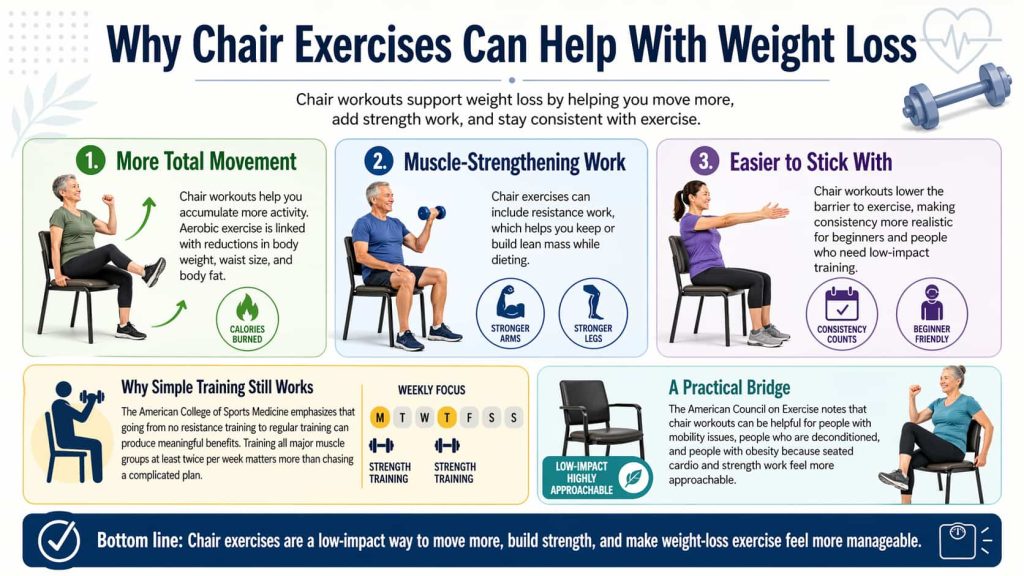
This is why chair training is worth doing even if it looks simple. The American College of Sports Medicine emphasizes that the biggest gains often come from moving from no resistance training to regular resistance training, and that training all major muscle groups at least twice per week matters more than chasing a complicated plan.
If full standing workouts feel intimidating, chair exercise can be a very practical bridge. The American Council on Exercise notes that seated workouts can be especially helpful for people with mobility issues, people who are deconditioned, and people with obesity because they make strength and cardio work more approachable.
What Makes a Good Chair Workout for Weight Loss
A good chair workout for fat loss is not just random arm movements. It should include:
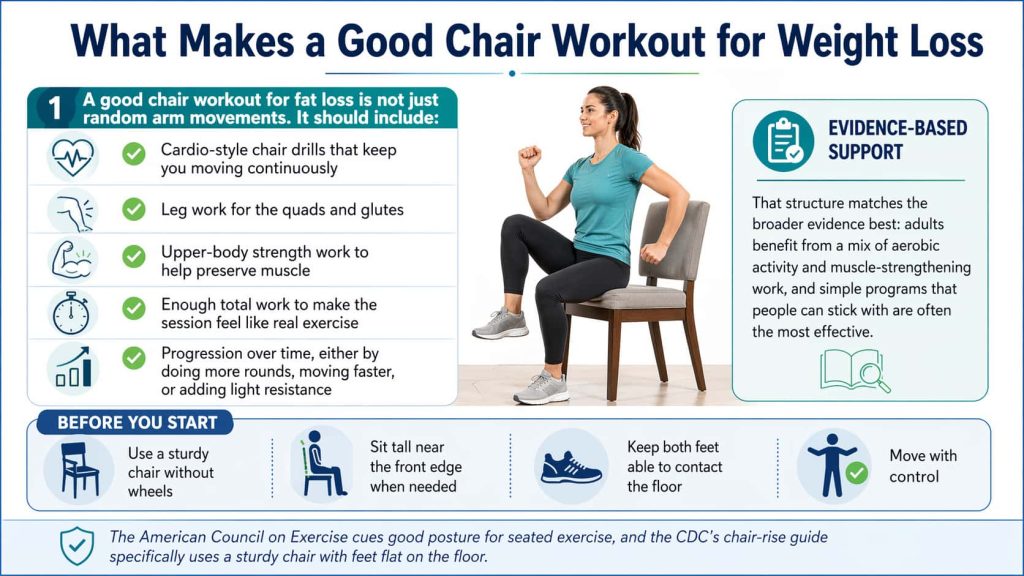
- Cardio-style chair drills that keep you moving continuously
- Leg work for the quads and glutes
- Upper-body strength work to help preserve muscle
- Enough total work to make the session feel like real exercise
- Progression over time, either by doing more rounds, moving faster, or adding light resistance
That structure matches the broader evidence best: adults benefit from a mix of aerobic activity and muscle-strengthening work, and simple programs that people can stick with are often the most effective.
Before you start, use a sturdy chair without wheels, sit tall near the front edge when needed, keep both feet able to contact the floor, and move with control. The American Council on Exercise cues good posture for seated exercise, and the CDC’s chair-rise guide specifically uses a sturdy chair with feet flat on the floor.
10 Best Chair Exercises to Lose Weight at Home
These chair exercises to lose weight at home combine low-impact cardio and simple strength work, making them a practical option for beginners and anyone who needs a joint-friendly workout. Done consistently, they can help you burn more calories, build strength, and make weight-loss exercise feel more manageable.
1. Seated March
Best for: Beginners who need an easy cardio entry point and a warm-up move that can also become a full workout drill.
Muscles worked: Hip flexors, quads, calves, shoulders, core.
Why it stands out: Seated march is one of the best starting exercises because it is simple, scalable, and easy to keep moving with. The American Council on Exercise specifically uses it as a seated cardio starter and cues a straight back with the core engaged.
Suggested sets and reps: 2–4 rounds of 30–60 seconds.
How to do it:
- Sit tall near the front of the chair.
- Plant your feet under your knees.
- Lift one knee, then the other, like you are marching.
- Swing the opposite arm naturally.
- Keep your chest up and move briskly.
Common mistakes: Leaning back into the chair, slouching, making the range too tiny, and moving so slowly that it stops feeling like cardio.
Coaching cue: Think “tall posture, fast feet.”
Exercise variations:
- Make it easier by marching slowly with hands on the chair.
- Make it harder by lifting the knees higher or increasing speed.
How to use in a workout: Use it in your warm-up, between strength exercises, or as part of a cardio interval circuit.
2. Seated Jacks
Best for: Low-impact cardio when you want a bigger whole-body movement without jumping.
Muscles worked: Shoulders, hip abductors, quads, calves, core.
Why it stands out: Seated jacks are one of the most effective chair-based calorie-burning moves because they involve both the upper and lower body at the same time. The American Council on Exercise includes them as a seated cardio option performed from the edge of the seat.
Suggested sets and reps: 2–4 rounds of 20–45 seconds.
How to do it:
- Sit near the edge of the chair with knees together.
- Start with your arms bent out to the sides.
- Open both legs out as you raise both arms overhead.
- Return to the start under control.
- Keep a steady rhythm.
Common mistakes: Rounding the shoulders, collapsing through the torso, rushing so much that form falls apart, and barely moving the legs.
Coaching cue: Reach wide and tall, then snap back to center.
Exercise variations:
- Make it easier by moving only the arms or only the legs first.
- Make it harder by increasing speed or holding light hand weights.
How to use in a workout: Place it early in the workout when you want heart rate up fast.
3. Seated Side Skater
Best for: Cardio with extra core involvement and side-to-side movement.
Muscles worked: Obliques, shoulders, upper back, glutes, outer hips, core.
Why it stands out: This move adds frontal-plane motion, which many basic chair workouts miss. The American Council on Exercise uses the seated side skater as a cardio drill that also engages the core, arms, and shoulders.
Suggested sets and reps: 2–3 rounds of 20–40 seconds per side or alternating continuously.
How to do it:
- Sit tall with arms out to your sides.
- Extend your right leg out to the side.
- Reach your right hand toward the opposite foot.
- Return to center.
- Repeat on the other side in a smooth rhythm.
Common mistakes: Turning it into a lazy side bend, collapsing the chest, or moving only the arms while the trunk stays dead still.
Coaching cue: Reach across your body, not down into a slump.
Exercise variations:
- Make it easier by shortening the reach.
- Make it harder by moving continuously side to side with no pause.
How to use in a workout: Pair it with seated jacks or punches for a cardio block.
4. Chair Sit-to-Stand
Best for: Building practical lower-body strength and raising the training effect of the workout.
Muscles worked: Quads, glutes, hamstrings, calves, core.
Why it stands out: This is the most important strength move in most chair workouts because it trains the same pattern used to get up from a chair in daily life. The CDC’s chair-rise exercise says it strengthens the muscles in the thighs and buttocks, and the guide cues sitting toward the front of a sturdy chair, feet flat, leaning forward, standing with as little hand help as possible, and lowering under control.
Suggested sets and reps: 2–4 sets of 6–15 reps.
How to do it:
- Sit toward the front of the chair.
- Place your feet flat and about shoulder-width apart.
- Lean slightly forward from the hips.
- Press through your feet and stand up.
- Lower back down slowly without dropping.
Common mistakes: Rocking wildly, pushing too hard with the hands, knees caving inward, and plopping back into the seat.
Coaching cue: Nose over toes, then drive the floor away.
Exercise variations:
- Make it easier by using your hands lightly on the chair.
- Make it harder by slowing the lowering phase or holding one light dumbbell at the chest.
How to use in a workout: Put it near the beginning of the session when your legs are fresh.
5. Seated Knee Lifts
Best for: Adding core work without lying on the floor.
Muscles worked: Hip flexors, lower abs, deep core muscles, quads.
Why it stands out: Seated knee lifts are useful because they train the front of the core while also keeping the workout moving. They are especially good in beginner chair circuits because they are easy to learn and easy to progress.
Suggested sets and reps: 2–3 sets of 10–20 total reps or 20–40 seconds.
How to do it:
- Sit tall and hold the sides of the chair lightly.
- Brace your midsection.
- Lift one knee toward your chest.
- Lower it with control.
- Alternate sides, or lift both knees together if you can stay upright.
Common mistakes: Leaning way back, swinging the legs, yanking with the arms, and turning the move into hip-only motion with no trunk control.
Coaching cue: Lift from the abs, not from momentum.
Exercise variations:
- Make it easier by doing one leg at a time slowly.
- Make it harder by lifting both knees together or adding a pause at the top.
How to use in a workout: Place it after a cardio drill to keep intensity up without needing to stand.
6. Seated Punches
Best for: Low-impact cardio and upper-body endurance.
Muscles worked: Shoulders, chest, triceps, upper back, core.
Why it stands out: Seated punches are a simple way to make a chair workout feel more athletic. When done in fast intervals with a braced torso, they can raise heart rate quickly without any jumping.
Suggested sets and reps: 3–5 rounds of 20–45 seconds.
How to do it:
- Sit tall with your feet planted.
- Bring your hands up near chest height.
- Punch one arm straight forward.
- Return it and punch the other arm.
- Rotate slightly through the upper torso without losing posture.
Common mistakes: Shrugging the shoulders up, flaring the ribs, locking the elbows hard, and punching with no speed or intent.
Coaching cue: Fast hands, tight core.
Exercise variations:
- Make it easier by slowing the tempo.
- Make it harder by using light dumbbells or adding hooks and uppercuts.
How to use in a workout: Use it as a calorie-burning interval between leg and arm strength moves.
7. Seated Leg Extensions
Best for: Extra quad work and knee-dominant leg volume.
Muscles worked: Quads, hip flexors.
Why it stands out: If sit-to-stands are your main leg exercise, leg extensions help add more time under tension for the quads without much coordination demand. That can be useful for beginners who need more lower-body work but are not ready for longer standing sets.
Suggested sets and reps: 2–4 sets of 10–15 reps per leg.
How to do it:
- Sit upright with both feet flat.
- Extend one leg until it is almost straight.
- Squeeze the front of the thigh briefly.
- Lower slowly.
- Repeat all reps, then switch legs.
Common mistakes: Snapping the knee straight, leaning backward, and rushing through the lowering phase.
Coaching cue: Lift, squeeze, lower slowly.
Exercise variations:
- Make it easier by reducing range of motion.
- Make it harder by adding ankle weights or a pause at the top.
How to use in a workout: Pair it with sit-to-stands for a lower-body block.
8. Seated Overhead Press
Best for: Upper-body strength and shoulder endurance.
Muscles worked: Deltoids, triceps, upper chest, upper back, core.
Equipment needed: Light dumbbells, water bottles, or canned goods.
Why it stands out: Chair workouts should not be all cardio. Adding resistance training is important for a more complete program, and the American College of Sports Medicine emphasizes that consistent strength training across major muscle groups matters more than complicated methods.
Suggested sets and reps: 2–4 sets of 8–15 reps.
How to do it:
- Sit tall with weights at shoulder height.
- Brace your abs.
- Press both hands overhead.
- Lower back to shoulder level with control.
- Repeat without arching your low back.
Common mistakes: Flaring the ribs, pressing too far behind the head, using weights that are too heavy, and slamming the weights down.
Coaching cue: Ribs down, press tall.
Exercise variations:
- Make it easier by pressing one arm at a time.
- Make it harder by slowing the lowering phase or increasing the weight slightly.
How to use in a workout: Place it after a cardio interval so the workout alternates heart rate work and strength work.
9. Seated Biceps Curl
Best for: Beginner-friendly arm strength and extra training volume.
Muscles worked: Biceps, forearms.
Equipment needed: Light dumbbells, resistance bands, or household items.
Why it stands out: Arm training will not drive weight loss by itself, but it helps make the workout more complete and can improve adherence because many beginners like feeling their arms work. It is also easy to learn and easy to recover from.
Suggested sets and reps: 2–4 sets of 10–15 reps.
How to do it:
- Sit tall with a weight in each hand.
- Start with arms by your sides.
- Curl the weights toward your shoulders.
- Lower slowly.
- Keep your elbows close to your body.
Common mistakes: Swinging the torso, letting elbows drift forward, and using momentum to cheat the rep.
Coaching cue: Curl with the arms, not the back.
Exercise variations:
- Make it easier by using one arm at a time.
- Make it harder by slowing the lowering phase or adding a squeeze at the top.
How to use in a workout: Use it after a bigger movement like sit-to-stands or overhead press.
10. Seated Cross-Body Reach
Best for: Finishing the workout with core-focused movement and light cardio.
Muscles worked: Obliques, shoulders, upper back, hip flexors, core.
Why it stands out: This move ties together posture, rotation, and steady movement. It is a good finisher because it keeps the body moving without needing heavy equipment.
Suggested sets and reps: 2–3 rounds of 20–40 seconds.
How to do it:
- Sit tall with both feet down.
- Reach your right hand across toward the outside of your left knee or foot.
- Return to center.
- Repeat to the other side.
- Keep the movement rhythmic and controlled.
Common mistakes: Collapsing into a rounded back, yanking through the neck, and turning the move into a sloppy twist.
Coaching cue: Reach across with a long spine.
Exercise variations:
- Make it easier by reaching toward the knee instead of the foot.
- Make it harder by increasing tempo or adding a knee lift each rep.
How to use in a workout: Use it at the end of a circuit to keep the core involved while your heart rate stays up.
How to Build a Chair Workout to Lose Weight
The simplest setup is a circuit. Pick 3 to 5 exercises, alternate cardio-style moves with strength moves, and keep rest periods short enough that the session stays active.
A good beginner formula looks like this:
- 30 seconds of work
- 20 to 30 seconds of rest
- 1 to 3 rounds total
A stronger intermediate formula looks like this:
- 40 seconds of work
- 15 to 20 seconds of rest
- 3 to 5 rounds total
This works well because it helps you accumulate enough aerobic activity while still keeping muscle-strengthening work in the plan. The CDC notes that aerobic minutes can be broken up across the week, and the American College of Sports Medicine emphasizes that simple, sustainable strength programming works.
Sample Chair Workout Routine
Beginner option
- Seated march — 30 seconds
- Chair sit-to-stand — 8 reps
- Seated punches — 30 seconds
- Seated leg extensions — 10 reps per leg
- Seated cross-body reach — 30 seconds
Complete 1 to 3 rounds. Rest 30 to 60 seconds between rounds.
Intermediate option
- Seated jacks — 40 seconds
- Chair sit-to-stand — 10 to 15 reps
- Seated side skater — 40 seconds
- Seated overhead press — 10 to 12 reps
- Seated knee lifts — 40 seconds
- Seated biceps curl — 12 to 15 reps
Complete 3 to 4 rounds. Rest 20 to 40 seconds between rounds.
Accessory finisher option
- Seated march — 30 seconds
- Seated punches — 30 seconds
- Seated jacks — 30 seconds
- Seated cross-body reach — 30 seconds
Repeat for 2 to 3 rounds at the end of another workout or after a walk.
How Often Should You Do Chair Exercises for Weight Loss?
For most beginners, 3 to 5 chair workouts per week is a practical target, especially if you are also trying to walk more, hit a daily step goal, or improve general activity levels. A good long-term goal is still to build toward the CDC recommendation of 150 minutes of moderate-intensity activity each week plus 2 muscle-strengthening days.
A chair workout does not need to be long to count. Ten to twenty minutes done consistently is far more useful than a perfect plan you never follow. The CDC also notes that some physical activity is better than none, which is an important mindset for beginners.
Common Mistakes That Make Chair Workouts Less Effective
Doing only tiny arm movements
A lot of “chair workouts” are too easy to meaningfully raise heart rate. Use bigger motions, faster intervals, and leg-driven exercises like sit-to-stands and knee lifts.
Skipping lower-body work
Leg training matters because the quads and glutes are large muscle groups and help make the session more demanding.
Resting too long
If fat loss is the goal, keep the workout moving. You do not need to rush, but you do want the session to feel like exercise, not a few isolated reps with long breaks.
Never progressing
Over time, add reps, time, rounds, speed, or light weights. Progression is one of the main reasons simple training keeps working. The American College of Sports Medicine supports this simple progression-first approach.
Expecting chair exercise to outwork an unstructured diet
Chair workouts can help create momentum, but weight loss still works best when exercise is paired with nutrition habits that support a calorie deficit.
Safety Tips Before You Start
Use a chair that does not roll or slide, and place it on a stable surface. Start with a light warm-up and finish with a brief cool-down. The National Institute on Aging advises listening to your body, warming up and cooling down, and stopping if aerobic exercise causes dizziness, chest pain or pressure, or nausea.
If you have been inactive, have a disability, have overweight, or have a chronic condition such as heart disease, arthritis, or diabetes, the CDC advises checking with your doctor before starting vigorous activity and discussing what kinds of exercise are appropriate for you. Stop the workout and get medical help if you feel sharp pain, chest pain, dizziness, numbness, or other unusual symptoms.
FAQ
Do chair exercises really help with weight loss?
Yes, they can help by increasing daily activity, adding some calorie burn, and making it easier to stay consistent with exercise. They work best when combined with a calorie-controlled eating pattern and enough weekly activity overall.
How long should a chair workout be?
A useful chair workout can be as short as 10 to 20 minutes. The bigger goal is building toward enough total weekly movement, not chasing one perfect session. The CDC notes that aerobic activity can be broken up across the week.
Are chair exercises good for beginners?
Yes. Chair workouts are one of the most beginner-friendly ways to start because they reduce impact and make exercise feel more manageable. The American Council on Exercise specifically highlights seated workouts as a good option for deconditioned clients and people with mobility issues.
What is the best chair exercise for weight loss?
There is not one single best move, but the most useful choices are usually the ones that involve a lot of muscle mass or keep your body moving continuously. Chair sit-to-stands, seated jacks, seated march, and seated punches are strong options.
Can I do chair exercises every day?
You can do some chair-based movement daily, especially light cardio or mobility-style work. For harder strength sessions, it is smart to vary intensity and give sore muscle groups some recovery time. The American College of Sports Medicine still favors regular but sustainable training.
Do I need equipment for a chair workout?
No. You can do a full beginner chair workout with just a sturdy chair. Light dumbbells, resistance bands, or household items can help you progress later.
Conclusion
The best chair exercises to lose weight at home are the ones that help you move consistently, train major muscle groups, and gradually do more over time. Start with 3 to 5 exercises, mix cardio and strength work, and aim to make each week a little better than the last.
If you are not sure where to start, choose seated march, seated jacks, chair sit-to-stand, seated punches, and seated leg extensions and build a simple circuit around them. Done regularly, that is enough to turn chair exercise into a real training habit instead of just another plan you never use.
References
- CDC — Adult Activity: An Overview
- CDC — Chair Rise Exercise PDF
- National Institute on Aging — Three Types of Exercise Can Improve Your Health and Physical Ability
- National Institute on Aging — Health Benefits of Exercise and Physical Activity
- American Council on Exercise — Seated Workouts for Beginners
- PubMed — Aerobic Exercise and Weight Loss in Adults: A Systematic Review and Dose-Response Meta-Analysis