Chair exercises with weights for seniors can be a safe, effective way to build strength, support balance, and make daily tasks feel easier. When you use a sturdy chair, start with manageable resistance, and progress gradually, seated strength training can help improve physical function without demanding as much balance as standing lifts, as supported by a PubMed review on chair-based exercise in older adults.
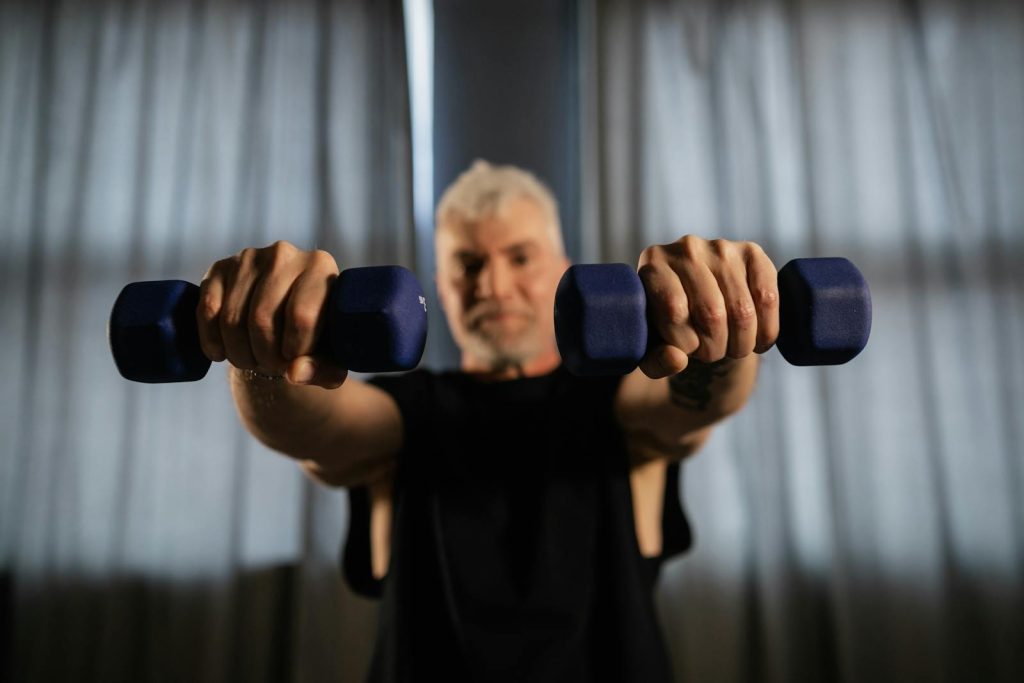
This guide covers the best chair exercises with weights for seniors, how to do each move with good form, the muscles worked, common mistakes, and how to turn these exercises into a practical routine.
Why chair exercises with weights can work so well for seniors
A chair gives you a stable base, which makes it easier to focus on controlled strength work instead of worrying about balance on every rep. That matters because older adults are still advised to train all the major muscle groups at least twice per week, and chair-based exercise can be a practical way to do that. A 2021 systematic review found that chair-based exercise programs improved upper-extremity strength and lower-extremity function in older adults, while the CDC older adult activity guidelines recommend regular muscle-strengthening work for all major muscle groups.
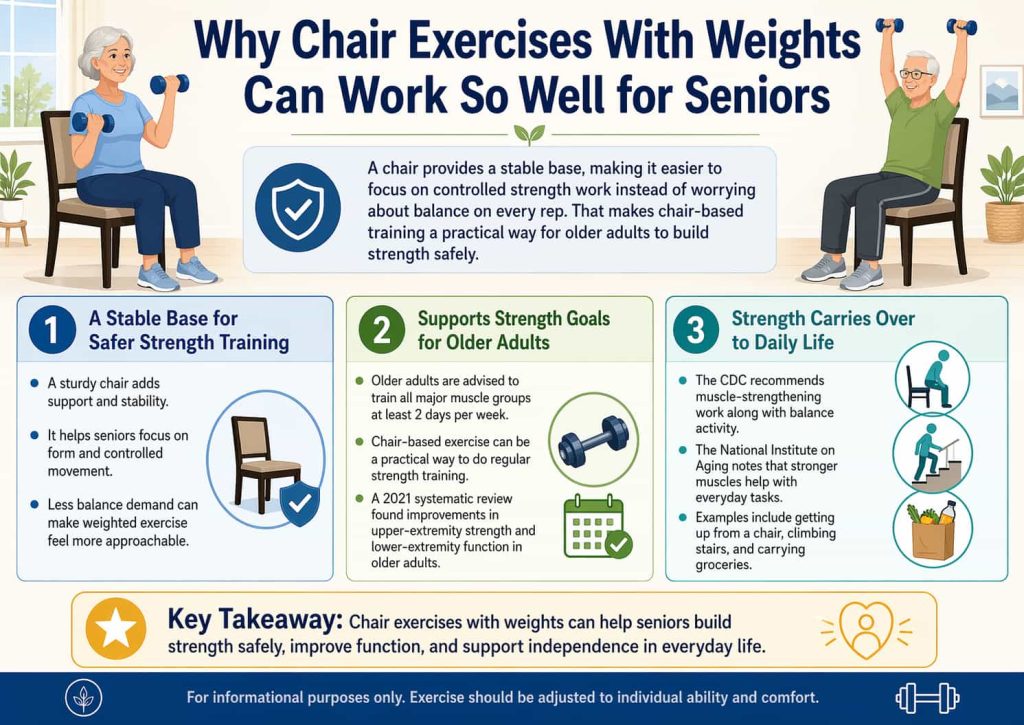
That strength carries over to real life. The CDC recommends muscle-strengthening work along with balance activity, and the National Institute on Aging notes that stronger muscles help with everyday tasks like getting up from a chair, climbing stairs, and carrying groceries.
Safety rules before you start
Use a sturdy chair that does not roll or slide. Sit tall with both feet flat on the floor, and keep the movement slow and controlled. The National Institute on Aging recommends warming up with less weight, breathing out during the effort, avoiding locked joints, and asking a doctor or physical therapist for guidance if you are unsure about a movement.
If you are new to strength training, start without weights first or use very light dumbbells or ankle weights. The CDC Growing Stronger guide says many older adults do well starting with about 2- to 3-pound dumbbells or ankle weights, then increasing only when the current load feels controlled.
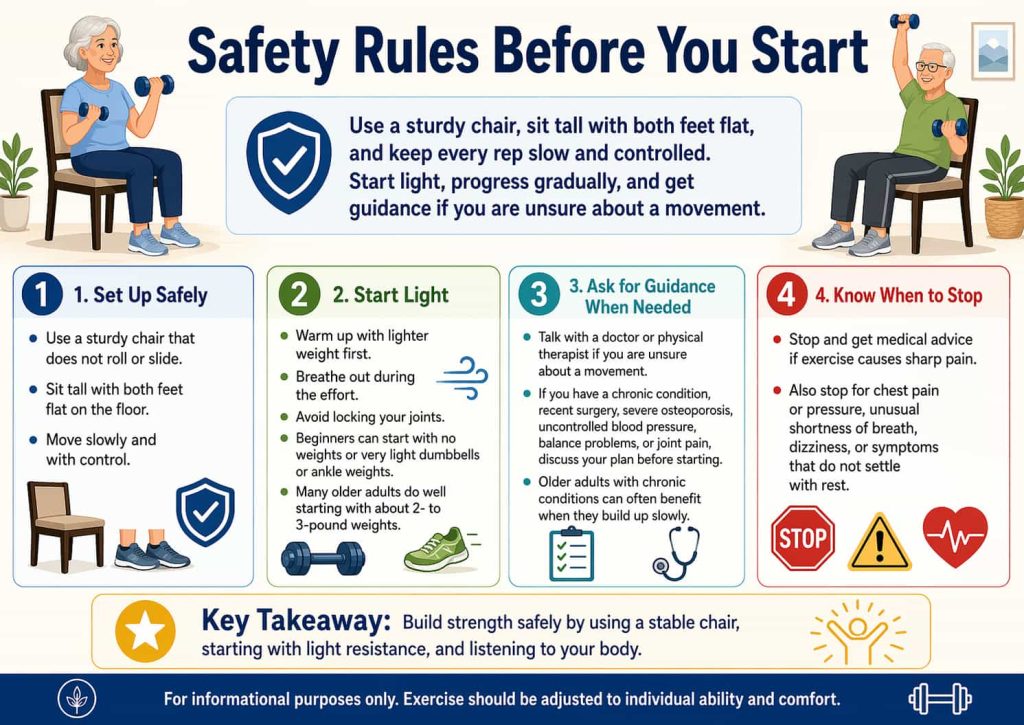
If you have a chronic condition, recent surgery, severe osteoporosis, uncontrolled blood pressure, balance problems, or joint pain that limits movement, it is smart to discuss your plan with a clinician before you start. The National Institute on Aging notes that older adults with chronic conditions can usually benefit from exercise, especially when they build up slowly and use a plan that fits their health status.
Stop the session and get medical advice if exercise causes sharp pain, chest pain or pressure, unusual shortness of breath, dizziness, or symptoms that do not settle with rest, as advised by the National Institute on Aging.
How to choose the right weight
The right weight lets you move with clean form for the full set while still feeling like the last few reps are work. For most seniors, that means finishing a set with effort but without swinging, shrugging, arching the back, or rushing the rep. The CDC also emphasizes slow, controlled motion rather than fast lifting.
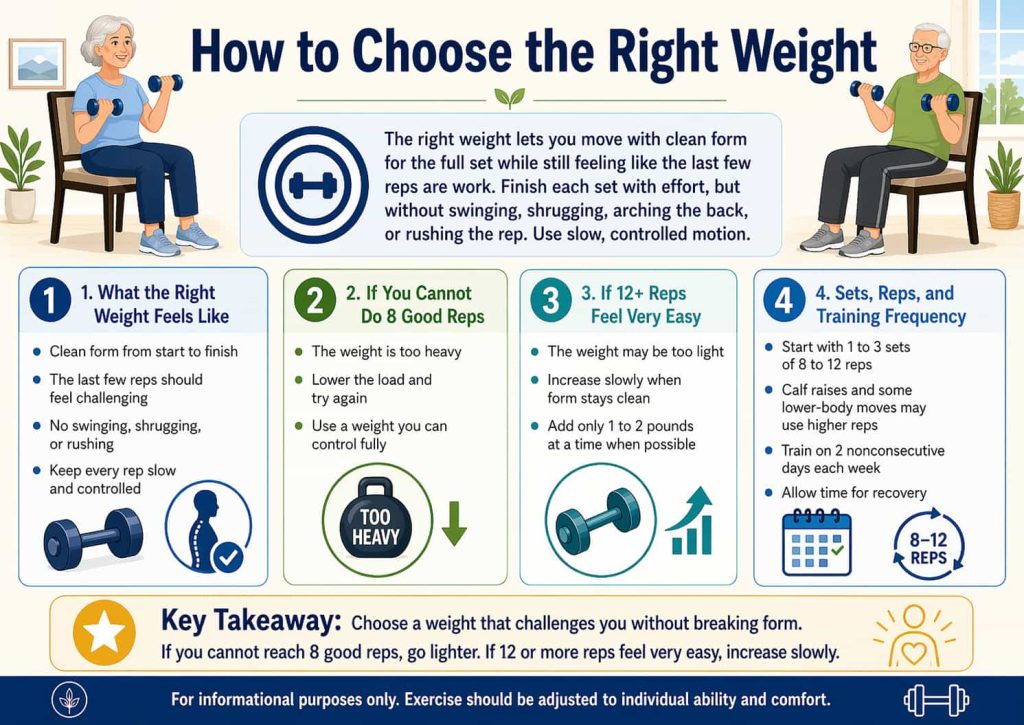
A simple rule works well:
- If you cannot do at least 8 good reps, the weight is too heavy.
- If you can do 12 or more reps very easily on every set, the weight may be too light.
- Increase slowly, usually by 1 to 2 pounds at a time for dumbbells when available.
For most exercises in this article, 1 to 3 sets of 8 to 12 reps is a strong starting range. Calf raises and some lower-body moves may work better with slightly higher reps. Train on 2 nonconsecutive days each week so the muscles can recover, which aligns with the CDC older adult guidelines.
10 Best Chair Exercises With Weights for Seniors to Build Strength Safely
Build strength safely with these 10 best chair exercises with weights for seniors, designed to improve muscle strength, mobility, and everyday function. These seated exercises are simple to follow, beginner-friendly, and a practical way to stay active and independent at home.
1. Seated Biceps Curl
Best for: Building arm strength for carrying bags, lifting small items, and improving grip-related confidence.
Muscles worked: Biceps, brachialis, forearm flexors.
Equipment needed: A sturdy chair and a pair of light dumbbells.
Why it stands out: This is one of the simplest weighted chair exercises to learn, and it lets you train the arms with very little balance demand. ACE Fitness emphasizes back support, feet flat on the floor, neutral wrists, and keeping the elbows from drifting forward during the seated curl.
Suggested sets and reps:
Beginners: 1–2 sets of 8–10 reps
Intermediate: 2–3 sets of 8–12 reps
Advanced: 3 sets of 10–12 reps
How to do it:
- Sit tall with your back supported and feet flat.
- Hold the dumbbells at your sides with palms facing forward.
- Keep your elbows close to your ribs.
- Curl the weights up toward your shoulders.
- Lower slowly until your arms are straight but not locked.
Common mistakes: Swinging the torso, letting the elbows drift forward, bending the wrists back, and dropping the weights too fast.
Coaching cue: “Pin your elbows to your sides and move only at the elbow.”
Exercise variations:
Easier variation: Use one arm at a time or use no weight while learning the pattern.
Harder variation: Slow the lowering phase to 3 seconds.
How to use in a workout: Pair it with seated overhead triceps extensions for a simple arm-strength superset.
2. Seated Hammer Curl
Best for: Seniors who want a wrist-friendly curl variation that also builds grip and forearm strength.
Muscles worked: Biceps, brachialis, brachioradialis, forearms.
Equipment needed: A sturdy chair and light dumbbells.
Why it stands out: The neutral grip is often more comfortable for people who do not love palms-up curls. It is also a practical option when regular curls bother the wrists or elbows.
Suggested sets and reps:
Beginners: 1–2 sets of 8–10 reps
Intermediate: 2–3 sets of 8–12 reps
Advanced: 3 sets of 10–12 reps
How to do it:
- Sit tall with shoulders down and back.
- Hold the dumbbells at your sides with palms facing each other.
- Curl the weights up without letting the elbows swing forward.
- Lower with control.
Common mistakes: Leaning back to help the rep, shrugging the shoulders, and rushing the lowering phase.
Coaching cue: “Thumbs up, chest tall, no body swing.”
Exercise variations:
Easier variation: Alternate one arm at a time.
Harder variation: Pause for 1 second at the top of each rep.
How to use in a workout: Use it as your second arm exercise after standard curls or rotate it in place of curls every other workout.
3. Seated Shoulder Press
Best for: Building overhead strength for putting light items on shelves, pressing up from armrests, and maintaining shoulder function.
Muscles worked: Deltoids, triceps, upper chest.
Equipment needed: A sturdy chair with back support and light dumbbells.
Why it stands out: This move trains the shoulders and triceps through an important pressing pattern while the chair helps stabilize your torso. ACE Fitness emphasizes feet pressed into the floor, a braced midsection, and controlled overhead motion without excessive back arching.
Suggested sets and reps:
Beginners: 1–2 sets of 6–8 reps
Intermediate: 2–3 sets of 8–10 reps
Advanced: 3 sets of 8–12 reps
How to do it:
- Sit tall with dumbbells at shoulder height.
- Keep your wrists stacked over your elbows.
- Press the weights overhead.
- Stop before your shoulders shrug up.
- Lower back to shoulder height with control.
Common mistakes: Arching the low back, pressing too high and shrugging, flaring the ribs, and holding your breath.
Coaching cue: “Ribs down, press up, and exhale as the weights move.”
Exercise variations:
Easier variation: Press one arm at a time.
Harder variation: Add a brief pause at shoulder height between reps.
How to use in a workout: Put this early in the session when you are freshest, especially on upper-body-focused days.
4. Seated Lateral Raise
Best for: Improving shoulder strength and control without heavy loading.
Muscles worked: Middle deltoids, upper traps, supraspinatus.
Equipment needed: A sturdy chair and very light dumbbells.
Why it stands out: You do not need much weight for this exercise to feel challenging. It is useful for building shoulder capacity, but it should stay light and controlled for most seniors.
Suggested sets and reps:
Beginners: 1 set of 8–10 reps
Intermediate: 2 sets of 10–12 reps
Advanced: 2–3 sets of 10–15 reps
How to do it:
- Sit tall with dumbbells at your sides.
- Keep a slight bend in the elbows.
- Raise the arms out to the sides until about shoulder height.
- Lower slowly.
Common mistakes: Using weights that are too heavy, shrugging the shoulders, turning it into a swing, and lifting above a pain-free range.
Coaching cue: “Lift with the shoulders, not the neck.”
Exercise variations:
Easier variation: Do one arm at a time or reduce the range of motion.
Harder variation: Add a 1-second pause at shoulder height.
How to use in a workout: Use it after shoulder presses as lighter accessory work.
5. Seated Bent-Over Row
Best for: Strengthening the upper back and improving posture-related pulling strength.
Muscles worked: Upper back, lats, rhomboids, rear shoulders, biceps.
Equipment needed: A sturdy chair and light to moderate dumbbells.
Why it stands out: Many chair-based programs overemphasize pressing and arm work. A row balances that out by training the muscles that help you stay tall and pull the shoulders back.
Suggested sets and reps:
Beginners: 1–2 sets of 8 reps
Intermediate: 2–3 sets of 8–12 reps
Advanced: 3 sets of 10–12 reps
How to do it:
- Sit near the front of the chair.
- Hinge forward from the hips with a long spine.
- Let the weights hang under your shoulders.
- Pull the elbows back toward your ribs.
- Squeeze the shoulder blades gently together.
- Lower slowly.
Common mistakes: Rounding the upper back, yanking the weights, lifting the chin too high, and turning the rep into a shrug.
Coaching cue: “Pull your elbows toward your back pockets.”
Exercise variations:
Easier variation: Row one arm at a time with the other hand supporting you on the chair.
Harder variation: Pause for 1 second at the top.
How to use in a workout: Pair it with seated chest presses or seated shoulder presses for a balanced upper-body block.
6. Seated Chest Press or Chest Punch
Best for: Building pressing strength when floor push-ups or bench work are not practical.
Muscles worked: Chest, front shoulders, triceps.
Equipment needed: A sturdy chair and light dumbbells.
Why it stands out: This is a simple seated pressing pattern that trains the chest and arms without asking you to get on the floor. It also fits well into home workouts with minimal equipment.
Suggested sets and reps:
Beginners: 1–2 sets of 8–10 reps
Intermediate: 2–3 sets of 8–12 reps
Advanced: 3 sets of 10–12 reps
How to do it:
- Sit tall with dumbbells held at chest height.
- Keep elbows bent and slightly below shoulder level.
- Press both weights forward until the arms are nearly straight.
- Bring them back slowly.
Common mistakes: Reaching too high, locking the elbows hard, jutting the head forward, and losing back support.
Coaching cue: “Press straight out from the chest, then return with control.”
Exercise variations:
Easier variation: Do alternating single-arm presses.
Harder variation: Add a 1-second squeeze in the fully pressed position.
How to use in a workout: Use it after rows or between lower-body chair exercises to keep the session moving.
7. Seated Overhead Triceps Extension
Best for: Improving arm strength for pushing tasks and supporting total upper-arm development.
Muscles worked: Triceps.
Equipment needed: A sturdy chair and one light dumbbell or two lighter dumbbells.
Why it stands out: Many seniors train curls but forget the triceps, even though the triceps are heavily involved in pressing and pushing. This move is effective with very light resistance when done slowly.
Suggested sets and reps:
Beginners: 1 set of 8 reps
Intermediate: 2 sets of 8–12 reps
Advanced: 2–3 sets of 10–12 reps
How to do it:
- Sit tall and hold one dumbbell overhead with both hands.
- Keep the upper arms mostly still.
- Bend the elbows to lower the weight behind the head.
- Press the weight back up without flaring the ribs.
Common mistakes: Arching the low back, letting the elbows flare too wide, and lowering deeper than your shoulder mobility allows.
Coaching cue: “Keep the ribs down and point the elbows mostly forward.”
Exercise variations:
Easier variation: Use one dumbbell and a smaller range.
Harder variation: Use two light dumbbells independently if shoulder control allows.
How to use in a workout: Pair it with curls for balanced arm work at the end of the session.
8. Seated Knee Extension With Ankle Weights
Best for: Strengthening the front of the thighs to support walking, standing up, and stair work.
Muscles worked: Quadriceps.
Equipment needed: A sturdy chair and light ankle weights.
Why it stands out: This is one of the easiest chair-based weighted lower-body exercises to learn. It targets the quads directly, which are important for standing up and controlling your descent into a chair.
Suggested sets and reps:
Beginners: 1–2 sets of 8 reps per leg
Intermediate: 2–3 sets of 8–12 reps per leg
Advanced: 3 sets of 10–15 reps per leg
How to do it:
- Sit tall with ankle weights secured.
- Straighten one knee until the lower leg is almost parallel to the floor.
- Pause briefly.
- Lower with control.
- Repeat on the other side.
Common mistakes: Snapping the knee straight, leaning too far back, and using too much weight too soon.
Coaching cue: “Lift smoothly, pause, and lower slower than you lifted.”
Exercise variations:
Easier variation: Do the move without ankle weights first.
Harder variation: Hold the top position for 2 seconds.
How to use in a workout: Use it after sit-to-stands or calf raises to finish lower-body work without much fatigue to balance.
9. Seated Calf Raise With Weights on the Knees
Best for: Improving lower-leg strength and ankle stiffness for walking and getting up from the chair more powerfully.
Muscles worked: Calves, especially the soleus.
Equipment needed: A sturdy chair and one or two dumbbells placed across the knees.
Why it stands out: The seated position puts more emphasis on the soleus, a calf muscle that matters for walking and posture. This move is simple, low impact, and easy to progress slowly.
Suggested sets and reps:
Beginners: 1–2 sets of 10–15 reps
Intermediate: 2–3 sets of 12–20 reps
Advanced: 3 sets of 15–20 reps
How to do it:
- Sit with feet flat and knees bent about 90 degrees.
- Rest light weights across the thighs just above the knees.
- Raise the heels as high as you can.
- Pause briefly at the top.
- Lower slowly until the heels touch down.
Common mistakes: Bouncing the reps, letting the feet roll outward, and moving too quickly to feel the calves work.
Coaching cue: “Press the balls of your feet into the floor and grow tall through the top.”
Exercise variations:
Easier variation: Bodyweight only.
Harder variation: One leg at a time or a longer pause at the top.
How to use in a workout: Add it near the end of the session for extra lower-leg work that does not overly fatigue the rest of the body.
10. Chair-Assisted Sit-to-Stand With Light Weights
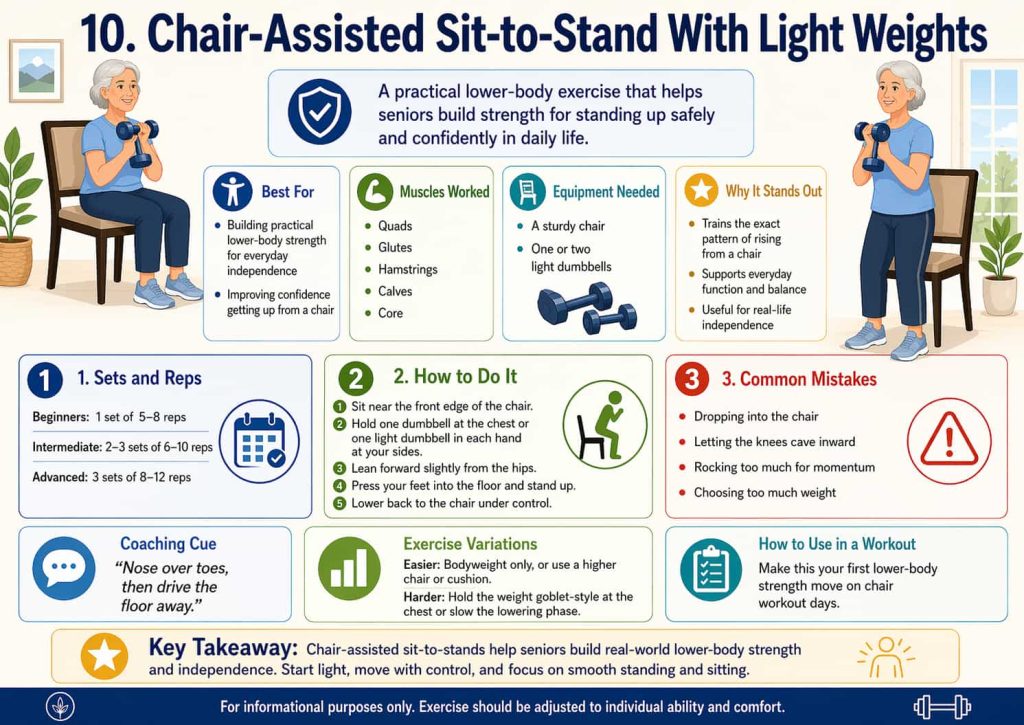
Best for: Building practical lower-body strength for everyday independence.
Muscles worked: Quads, glutes, hamstrings, calves, core.
Equipment needed: A sturdy chair and one or two light dumbbells.
Why it stands out: This is the most functional exercise in the group because it trains the exact pattern of rising from a chair. The National Institute on Aging highlights strength work as important for tasks like getting up from a chair, and the CDC includes standing from a sitting position as a useful real-life movement tied to older-adult function and balance.
Suggested sets and reps:
Beginners: 1 set of 5–8 reps
Intermediate: 2–3 sets of 6–10 reps
Advanced: 3 sets of 8–12 reps
How to do it:
- Sit near the front edge of the chair.
- Hold one dumbbell at the chest or one light dumbbell in each hand at your sides.
- Lean forward slightly from the hips.
- Press your feet into the floor and stand up.
- Lower back to the chair under control.
Common mistakes: Dropping into the chair, letting the knees cave inward, rocking excessively for momentum, and choosing too much weight.
Coaching cue: “Nose over toes, then drive the floor away.”
Exercise variations:
Easier variation: Bodyweight only, or use a higher chair or cushion.
Harder variation: Hold the weight goblet-style at the chest or slow the lowering phase.
How to use in a workout: Make this your first lower-body strength move on chair workout days.
Common mistakes seniors make with chair exercises and weights
The biggest mistake is going too heavy too soon. The second is treating chair exercises like quick, casual movement instead of real strength training. Older adults usually get better results from controlled reps, repeatable form, and gradual progression than from chasing fatigue or using momentum, which is consistent with the CDC Growing Stronger guide.
Another common problem is forgetting posture. Even in a chair, you still need your feet planted, ribs controlled, shoulders relaxed, and breathing steady. Both ACE Fitness and the National Institute on Aging reinforce stable posture, controlled motion, and exhaling during the effort.
It is also a mistake to train only the arms. Seniors do best when the weekly plan includes upper body, lower body, and some balance work, which reflects the CDC older adult guidelines. That is why chair-assisted sit-to-stands, knee extensions, and calf raises belong in the same routine as curls and presses.
Sample chair exercises with weights routine for seniors
A good chair routine should be simple enough to repeat and progressive enough to matter. For most people, 2 nonconsecutive strength days per week is the best place to start, based on the CDC older adult activity guidelines.
Beginner option
Do this 2 times per week:
- Chair-assisted sit-to-stand: 1–2 sets of 5–8
- Seated biceps curl: 1–2 sets of 8–10
- Seated chest press: 1–2 sets of 8–10
- Seated knee extension: 1–2 sets of 8 per leg
- Seated calf raise: 1–2 sets of 10–15
Rest about 45 to 90 seconds between sets. Use a weight you can fully control.
Intermediate option
Do this 2 to 3 times per week on nonconsecutive days:
- Chair-assisted sit-to-stand: 2–3 sets of 6–10
- Seated bent-over row: 2–3 sets of 8–12
- Seated shoulder press: 2–3 sets of 8–10
- Seated hammer curl: 2 sets of 8–12
- Seated overhead triceps extension: 2 sets of 8–12
- Seated knee extension: 2–3 sets of 8–12 per leg
- Seated calf raise: 2–3 sets of 12–20
Accessory finisher option
At the end of the workout, add:
- Seated lateral raise: 1–2 sets of 10–15
- Seated calf raise: 1 set of 15–20
- Sit tall breathing reset: 3 slow breaths
How to progress safely over time
Stay with the same weight until you can complete all your sets with steady tempo and clean form. Then add a small amount of weight, one or two reps per set, or one extra set. The National Institute on Aging highlights gradual progression as the path to stronger muscles over time.
A simple 4-week approach works well:
- Week 1: Learn the movements with bodyweight or very light weights
- Week 2: Add one more set to the main exercises
- Week 3: Add a little weight where form stays clean
- Week 4: Keep the load and try to make the reps smoother and more controlled
That kind of steady progress is more useful than constantly changing exercises.
FAQ
Are chair exercises with weights effective for seniors?
Yes. Chair-based exercise programs have been shown to improve upper-extremity strength and lower-extremity function in older adults, as shown in a PubMed review on chair-based exercise.
What weight should seniors start with for chair exercises?
Many seniors do best starting with no weight first or with about 2- to 3-pound dumbbells or ankle weights, then adjusting up or down based on control and comfort. The goal is not to lift heavy right away. The goal is to own the movement first, which is consistent with the CDC Growing Stronger guide.
How often should seniors do chair exercises with weights?
Most older adults should aim for muscle-strengthening activities at least 2 days per week, ideally working the major muscle groups and avoiding hard training for the same muscle group on back-to-back days, according to the CDC.
Can chair exercises with weights help build muscle?
They can help seniors build or maintain muscle, especially if the exercises become gradually more challenging over time. The National Institute on Aging notes that increasing weight, reps, sets, or training days over time is how strength improves.
Are ankle weights safe for seniors?
They can be useful for seated strength work like knee extensions when used lightly and with control. The CDC Growing Stronger guide includes ankle weights as an option for older-adult strength training, but the load should be conservative and the movement should stay slow and controlled.
What should I do if an exercise hurts?
Stop that movement right away. Mild muscle effort is normal, but sharp pain, dizziness, chest symptoms, or symptoms that linger are not. If a movement repeatedly causes pain, get advice from a clinician or physical therapist before continuing, as advised by the National Institute on Aging.
Conclusion
The best chair exercises with weights for seniors are the ones you can perform safely, consistently, and with enough resistance to challenge your muscles without losing control. Start light, master the basics, and build around practical moves like curls, rows, presses, knee extensions, calf raises, and sit-to-stands.
Pick 4 to 6 of these exercises, do them twice a week, and focus on slow, steady progress. That approach is simple, sustainable, and much more effective than trying to do too much too soon.
References
- Centers for Disease Control and Prevention (CDC) — Older Adult Activity: An Overview
- National Institute on Aging (NIA) — Exercise and Physical Activity
- National Institute on Aging (NIA) — Three Types of Exercise Can Improve Your Health and Physical Ability
- National Institute on Aging (NIA) — Health Benefits of Exercise and Physical Activity
- PubMed — The Effect of Chair-Based Exercise on Physical Function in Older Adults: A Systematic Review and Meta-Analysis
- PubMed — Effects of Chair-Based Resistance Band Exercise on Physical Functioning, Sleep Quality, and Depression of Older Adults in Long-Term Care Facilities: Systematic Review and Meta-Analysis
- CDC — Growing Stronger: Strength Training for Older Adults
- ACE Fitness — Seated Biceps Curl Exercise Library