The best BOSU ball exercises for seniors are the simple, supported ones that build balance, leg strength, and confidence without turning the workout into a risky challenge. For adults 65 and older, the CDC older-adult activity guidelines recommend weekly aerobic activity, muscle-strengthening work, and balance activities, which is exactly why BOSU training can be useful when it is scaled correctly.
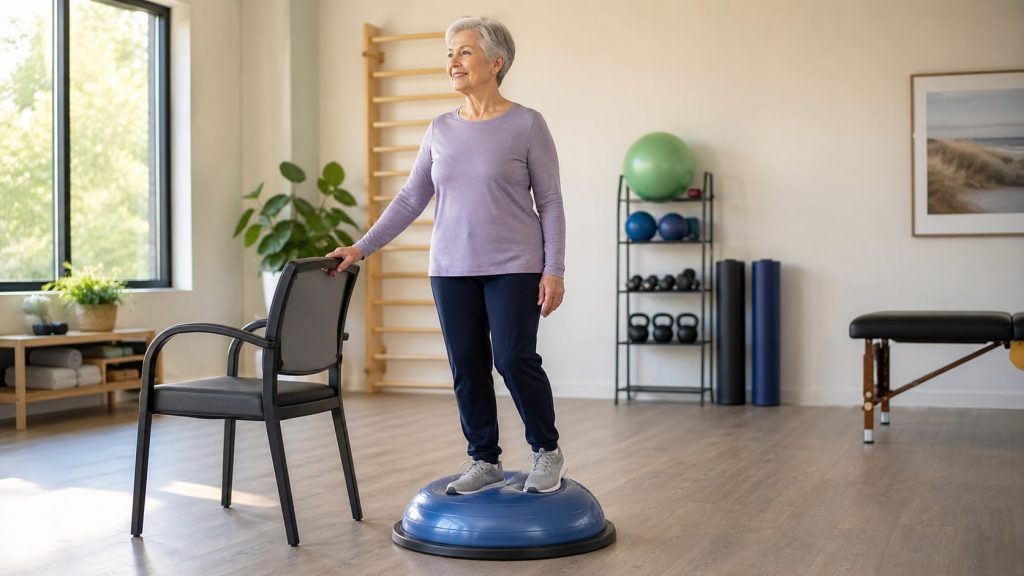
A BOSU ball can be a smart tool for older adults because it adds just enough instability to challenge the feet, ankles, hips, and core. But it should be used as a progression, not as the first step. The safest approach is to start with supported standing drills, short work periods, and movements you can already do comfortably on the floor. The National Institute on Aging recommends going slowly, using a sturdy chair, wall, or person for support, and choosing movements that match your current ability.
Why BOSU Ball Exercises for Seniors Can Work
BOSU ball exercises for seniors make the most sense when the goal is better balance, steadier walking, stronger legs, and more confidence during daily movement. Falls are a major issue in older adults. The CDC says falls are the leading cause of injury for adults 65 and older, and over 14 million older adults report falling each year. That makes balance and lower-body strength training especially practical, not optional extras.
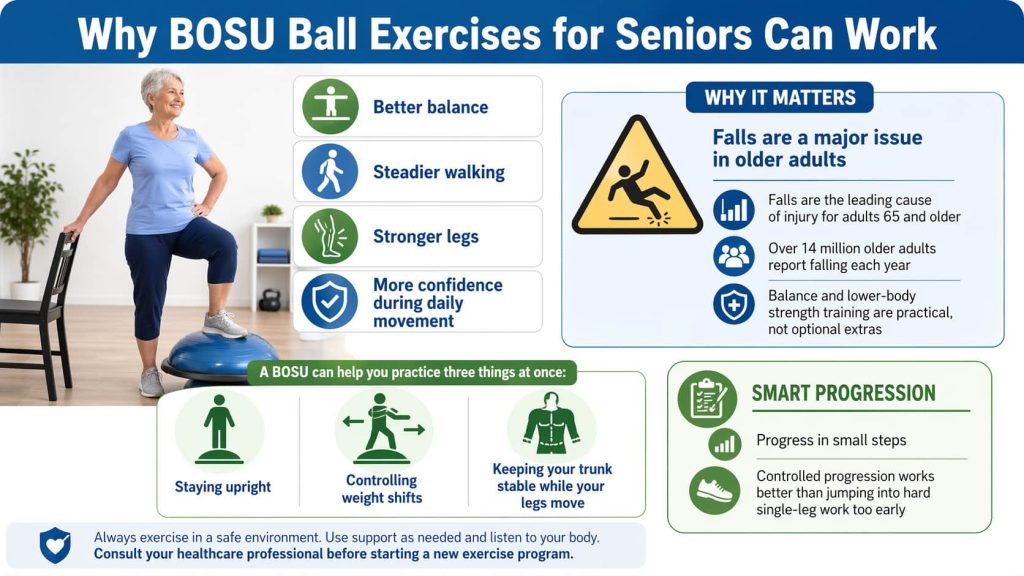
Used well, a BOSU can help you practice three things at once: staying upright, controlling weight shifts, and keeping your trunk stable while your legs move. The American Council on Exercise notes that BOSU balance drills can be regressed or progressed in small steps, which is important for seniors because the best results usually come from controlled progression rather than jumping into hard single-leg work too early.
How to Use a BOSU Ball Safely as a Senior
Start with the dome side up and place the BOSU near a wall, sturdy rail, or heavy chair. Wear stable shoes unless you have been specifically advised otherwise and feel safer barefoot on a non-slip surface. Keep the area around you clear. The National Institute on Aging specifically recommends going slowly and keeping support nearby, and the official BOSU beginner balance guide also emphasizes using a wall and starting with basic movements.
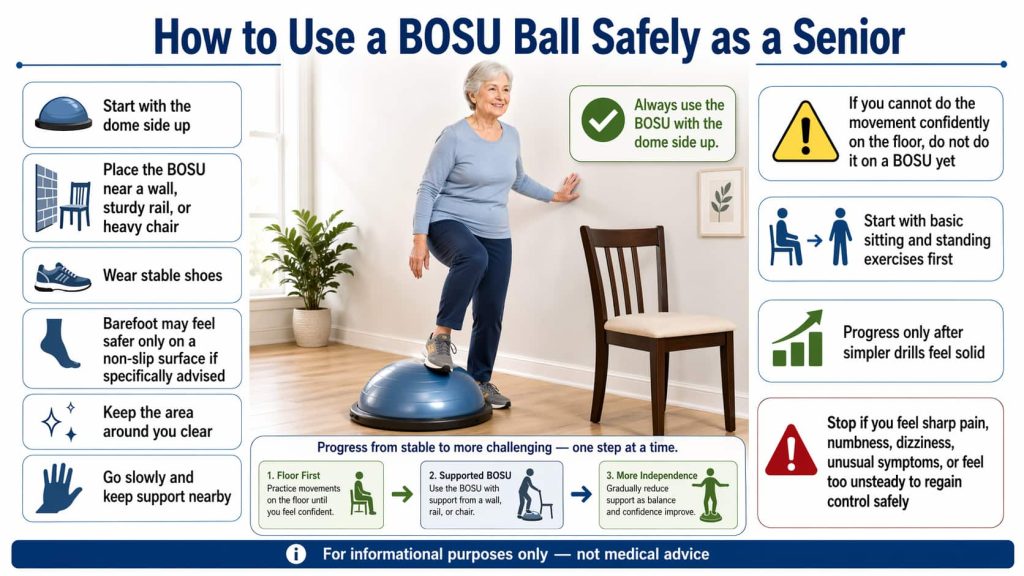
A good rule is this: if you cannot do the same movement confidently on the floor, you are probably not ready to do it on a BOSU yet. The American Council on Exercise recommends starting with basic sitting and standing exercises, then progressing to more challenging surfaces like a BOSU only after simpler drills feel solid.
Stop the exercise and get individual advice if you feel sharp pain, numbness, dizziness, or unusual symptoms, or if you feel so unsteady that you cannot regain control safely. This content is for informational purposes only and not medical advice.
How to Choose the Best BOSU Ball Exercises for Seniors
The best BOSU moves for seniors usually have four traits:
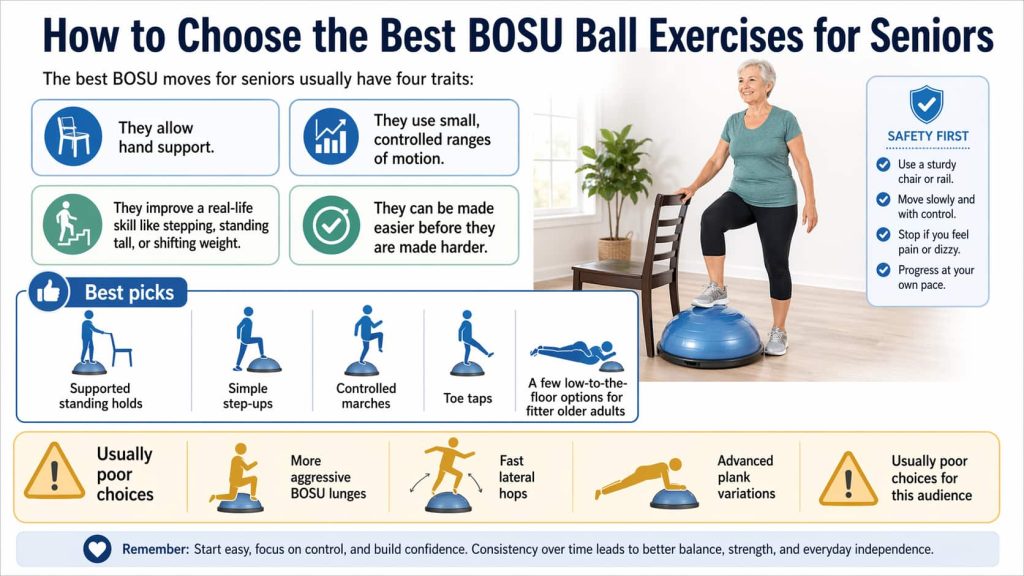
- They allow hand support.
- They use small, controlled ranges of motion.
- They improve a real-life skill like stepping, standing tall, or shifting weight.
- They can be made easier before they are made harder.
That is why the best picks are usually supported standing holds, simple step-ups, controlled marches, toe taps, and a few low-to-the-floor options for fitter older adults. More aggressive BOSU lunges, fast lateral hops, and advanced plank variations are usually poor choices for this audience.
9 Best BOSU Ball Exercises for Seniors
Improve balance, build lower-body strength, and move with more confidence using these senior-friendly BOSU ball exercises. These 9 moves focus on safe, practical training to help support stability, coordination, and everyday function.
1. Supported BOSU Stand and Balance
Best for: First-time BOSU users, seniors who want to improve basic standing balance, and anyone who needs a safe introduction to the dome.
Muscles worked: Feet and ankle stabilizers, calves, glutes, and deep core stabilizers.
Equipment needed: BOSU ball and a wall or sturdy support.
Why it stands out: This is the most important BOSU starting point for seniors because it teaches you how the dome feels under both feet before you add stepping or marching. The official BOSU beginner guide uses this as a foundational drill.
Suggested sets and reps: Start with 3 to 5 holds of 10 to 20 seconds.
How to do it:
- Stand beside the BOSU with the dome facing up.
- Place one hand on a wall or sturdy support.
- Step one foot onto the dome, then the other.
- Stand tall with your feet about hip-width apart.
- Brace your core and keep your eyes fixed on a spot in front of you.
- Hold for a few seconds, then step down carefully.
Common mistakes: Looking down the whole time, locking the knees, rushing the step up, or letting the body sway too far before using support.
Coaching cue: “Stand tall, soften your knees, and grip the dome with your feet.”
Exercise variations:
- Easier variation: keep one or both hands lightly on the wall.
- Harder variation: reduce hand pressure or hold the top position longer.
How to use in a workout: Put this first in the balance section of your workout as the warm-up movement.
2. Static Awareness Balance
Best for: Seniors who can already stand on the BOSU and want to improve posture, foot control, and body awareness.
Muscles worked: Core, calves, foot stabilizers, glute medius, and postural muscles.
Equipment needed: BOSU ball and optional wall support nearby.
Why it stands out: The American Council on Exercise describes this as a way to bring awareness to the unstable surface, the movement of the feet and ankles, and core engagement. That makes it an excellent bridge between beginner standing and more dynamic BOSU drills.
Suggested sets and reps: 2 to 4 holds of 15 to 30 seconds.
How to do it:
- Stand upright on the dome with feet hip-width apart.
- Let your arms rest by your sides.
- Focus your eyes on a point straight ahead.
- Breathe steadily and try to stay quiet through the ankles and hips.
- Step down when the hold ends.
Common mistakes: Holding your breath, standing too stiffly, or shifting too much weight into the toes.
Coaching cue: “Quiet feet, tall spine, steady breathing.”
Exercise variations:
- Easier variation: keep a fingertip on the wall.
- Harder variation: fold your arms across your chest.
How to use in a workout: Use after supported standing holds or between more dynamic BOSU drills to reset posture and control.
3. BOSU Step-Up
Best for: Building confidence stepping onto the dome while also training practical leg strength.
Muscles worked: Quads, glutes, calves, and core.
Equipment needed: BOSU ball and optional wall support.
Why it stands out: Step-ups are one of the most functional BOSU options for seniors because they blend balance with lower-body strength. The official BOSU balance workout includes this as one of its core beginner exercises.
Suggested sets and reps: 1 to 3 sets of 5 to 8 reps per lead leg.
How to do it:
- Stand behind the BOSU with the dome up.
- Step one foot onto the dome.
- Bring the second foot up so both feet are on the dome.
- Pause briefly at the top.
- Step down under control.
- Repeat, alternating which foot leads.
Common mistakes: Stepping too fast, slamming the foot down, or leaning heavily forward from the waist.
Coaching cue: “Step softly, stand tall, step down with control.”
Exercise variations:
- Easier variation: use the same lead leg for all reps and hold support.
- Harder variation: pause for 2 to 3 seconds at the top.
How to use in a workout: Pair with supported standing holds or marches for a lower-body balance block.
4. BOSU Walk-Ups
Best for: Seniors who are ready for repeated stepping practice and want to improve balance during transitions.
Muscles worked: Quads, glutes, calves, hip stabilizers, and core.
Equipment needed: BOSU ball and a wall, rail, or body bar for support if needed.
Why it stands out: The American Council on Exercise uses walk-ups as a dynamic progression from static standing because they train getting on and off the dome repeatedly, which is a more realistic balance challenge than simply holding still.
Suggested sets and reps: 2 to 3 rounds of 20 to 40 seconds.
How to do it:
- Stand facing the BOSU.
- Step up onto the dome with one foot, then the other.
- Step back down one foot at a time.
- Continue in a smooth, controlled rhythm.
- Switch the lead foot halfway through the set.
Common mistakes: Going too long, letting fatigue ruin form, or using momentum instead of control.
Coaching cue: “Move smoothly and keep every step quiet.”
Exercise variations:
- Easier variation: hold the wall and shorten the set.
- Harder variation: alternate lead feet every rep.
How to use in a workout: Use as the most dynamic exercise in a beginner BOSU circuit.
5. Standing Abduction Toe Taps
Best for: Seniors who want better single-leg control and hip stability without a full single-leg stand.
Muscles worked: Glute medius, hip stabilizers, calves, and core.
Equipment needed: BOSU ball and optional wall support.
Why it stands out: The American Council on Exercise includes this drill to challenge balance while the opposite leg moves, which is highly relevant for walking, stepping, and recovering balance during daily life.
Suggested sets and reps: 1 to 3 sets of 5 to 8 taps per side.
How to do it:
- Stand on the dome with feet hip-width apart.
- Hold support lightly if needed.
- Shift weight onto one foot.
- Lift the other foot and tap it gently to the side of the dome or floor.
- Return to center and repeat.
- Switch sides.
Common mistakes: Letting the standing knee collapse inward, moving too fast, or leaning the torso too much.
Coaching cue: “Stay tall on the standing leg and move the other leg slowly.”
Exercise variations:
- Easier variation: tap to the floor beside the BOSU.
- Harder variation: reduce hand support.
How to use in a workout: Use after static holds and before faster stepping drills.
6. Lateral Walk-Overs
Best for: Improving side-to-side balance, coordination, and confidence moving in the frontal plane.
Muscles worked: Glutes, quads, calves, inner thighs, and core.
Equipment needed: BOSU ball and optional nearby support.
Why it stands out: The American Council on Exercise highlights lateral walk-overs because they train side-to-side movement, which many people neglect even though real life often demands it when you change direction, step around objects, or recover from a wobble.
Suggested sets and reps: 1 to 3 sets of 4 to 8 passes each direction.
How to do it:
- Stand beside the BOSU.
- Step the near foot onto the dome.
- Bring the second foot up.
- Step off the other side.
- Reverse direction and repeat.
Common mistakes: Crossing the feet awkwardly, rushing the transition, or stepping too wide.
Coaching cue: “Step over, do not jump over.”
Exercise variations:
- Easier variation: pause on top before stepping off.
- Harder variation: continue smoothly without long pauses.
How to use in a workout: Use in the middle or end of the balance block once your basic up-and-down stepping feels solid.
7. BOSU Sit and Tap
Best for: Seniors who are not ready for full standing BOSU work or who want a lower-risk core balance drill.
Muscles worked: Core, hip flexors, postural muscles, and deep trunk stabilizers.
Equipment needed: BOSU ball.
Why it stands out: This is one of the best BOSU regressions for older adults because it lets you train balance while seated. The official BOSU beginner guide includes it as a basic exercise, which makes it a smart entry point for less confident users.
Suggested sets and reps: 2 to 3 sets of 6 to 10 taps or foot lifts.
How to do it:
- Sit in the center of the dome.
- Place your hands lightly beside you on the dome.
- Lift one foot a few inches off the floor.
- Lower it with control.
- Repeat on the other side, or lift both feet briefly if safe.
Common mistakes: Slumping through the chest, leaning too far back, or lifting the legs too high.
Coaching cue: “Sit tall and make the movement small.”
Exercise variations:
- Easier variation: lift one foot at a time.
- Harder variation: bring the hands off the dome for a brief moment.
How to use in a workout: Use as a regression on lower-confidence days or as a core finisher after standing work.
8. Supported BOSU March
Best for: Seniors who want to improve balance during gait-like movement.
Muscles worked: Hip flexors, glutes, calves, core, and standing-leg stabilizers.
Equipment needed: BOSU ball and wall or rail support.
Why it stands out: This is a safer senior-friendly adaptation of the official BOSU active-aging guidance knee-raise pattern. It teaches you to stay tall on one leg for a moment while the other leg moves, which closely matches the control needed during walking.
Suggested sets and reps: 1 to 3 sets of 5 to 8 marches per side.
How to do it:
- Stand on the dome with one hand on support.
- Brace your core and stand tall.
- Lift one knee a few inches.
- Lower it slowly.
- Repeat on the other side.
- Keep the movement controlled and small.
Common mistakes: Pulling the knee too high, leaning back, or trying to remove support too soon.
Coaching cue: “Tall body, slow knee lift, quiet landing.”
Exercise variations:
- Easier variation: shift weight without fully lifting the foot.
- Harder variation: reduce hand support.
How to use in a workout: Use after static standing and before step-ups if your goal is walking confidence.
9. Kneeling Balance with Rotation
Best for: Fitter seniors who can get on and off the floor comfortably and want a lower-to-the-ground balance challenge.
Muscles worked: Core, glutes, hips, shoulders, and postural stabilizers.
Equipment needed: BOSU ball and an exercise mat.
Why it stands out: The official BOSU active-aging content uses kneeling balance to challenge trunk control and postural stability. Because you are closer to the floor, it can feel less intimidating than standing for some people, though it is only appropriate if kneeling and floor transitions are comfortable.
Suggested sets and reps: 1 to 2 sets of 5 to 8 slow rotations per side.
How to do it:
- Kneel on the dome with toes on the floor behind you if needed.
- Sit tall and brace your core.
- Raise one arm and rotate gently toward that side.
- Return to center.
- Repeat on the other side.
Common mistakes: Arching the low back, rotating too fast, or forcing a kneeling position that hurts.
Coaching cue: “Rotate through the upper body, not by collapsing the low back.”
Exercise variations:
- Easier variation: keep both toes grounded and make the rotation small.
- Harder variation: reduce toe pressure.
How to use in a workout: Add this at the end of the session if you tolerate kneeling well and want extra core control work.
Common Mistakes to Avoid
One of the biggest mistakes is treating the BOSU like a test instead of a tool. The goal is not to prove you can stand on something unstable. The goal is to improve balance and strength safely enough that you can train consistently.
Other common mistakes include starting without support, moving too fast, trying eyes-closed versions too early, doing BOSU work when already tired, and choosing advanced single-leg or floor-transfer drills before basic standing control is solid. The American Council on Exercise emphasizes changing one challenge at a time, while the National Institute on Aging recommends moving slowly and keeping support nearby.
Sample BOSU Ball Workout for Seniors
The American Council on Exercise recommends putting balance work early in the session while you are still fresh, then progressing from stable surfaces to more challenging setups only as needed.
Beginner option
- Supported BOSU Stand and Balance: 3 x 10 to 20 seconds
- BOSU Sit and Tap: 2 x 6 to 8 reps per side
- BOSU Step-Up: 2 x 5 reps per lead leg
Intermediate option
- Static Awareness Balance: 3 x 20 to 30 seconds
- BOSU Walk-Ups: 2 x 30 seconds
- Standing Abduction Toe Taps: 2 x 6 to 8 reps per side
- Lateral Walk-Overs: 2 x 4 to 6 passes each direction
Accessory finisher option
- Supported BOSU March: 2 x 6 reps per side
- BOSU Fire Hydrant: 2 x 8 reps per side
Train BOSU balance work 2 to 3 days per week to start, and keep the total amount modest enough that your form stays crisp. The official BOSU active-aging guidance suggests aiming for 3 or more days per week when tolerated, and the broader CDC guidance says older adults should regularly include balance work alongside strength and aerobic activity.
FAQ
Are BOSU ball exercises safe for seniors?
They can be safe for seniors when they are scaled correctly. The safest approach is to start with supported drills, short holds, and simple stepping patterns near a wall or sturdy chair, as recommended by the National Institute on Aging.
How often should seniors do BOSU ball exercises?
A practical starting point is 2 to 3 times per week. That fits well with broader older-adult balance recommendations, and you can increase frequency only if recovery and control stay good, in line with the CDC.
Which side of the BOSU should seniors use?
Most seniors should start with the dome side up. That is how the basic BOSU standing, stepping, and seated balance drills are commonly taught in the official BOSU beginner material.
Can BOSU ball exercises help improve balance?
They can be useful for improving balance because they challenge your body to control an unstable surface. They work best when combined with regular strength training and walking or other aerobic activity, which fits the broader guidance from the CDC.
What if I cannot stand on the BOSU yet?
Start with seated drills like BOSU Sit and Tap or practice the same movements on the floor first. You do not need to stand on the BOSU right away for the training to be useful.
Are BOSU exercises good for knees?
They can be fine for some people, but they are not automatically better for sore knees. Choose pain-free ranges, use support, and avoid stepping drills that feel unstable or aggravating. If knee pain is significant or worsening, get individual advice before continuing.
Conclusion
BOSU ball exercises for seniors work best when they are simple, supported, and built around real-life movement. Start with standing holds, step-ups, and seated balance work. Then add marches, toe taps, and lateral patterns only when your control improves.
Choose 3 to 5 exercises from this list, practice them consistently, and keep the focus on quality rather than difficulty. That is the fastest way to build better balance, stronger legs, and more confidence without making the workout riskier than it needs to be.
References
- CDC — Older Adult Falls Data and Research
- National Institute on Aging — Three Types of Exercise Can Improve Your Health and Physical Ability
- National Institute on Aging — Older Adults and Balance Problems
- American Council on Exercise — 7 Basic BOSU Balance Exercises
- American Council on Exercise — Designing Balance Exercise Programs for Older Adults
- BOSU — Basic Balance