The plank exercise is a bodyweight core exercise that trains your abs, hips, shoulders, and lower back to stay stable while your body holds a straight position. It is simple to learn, requires no equipment, and can be adjusted for beginners, intermediate lifters, and advanced athletes.
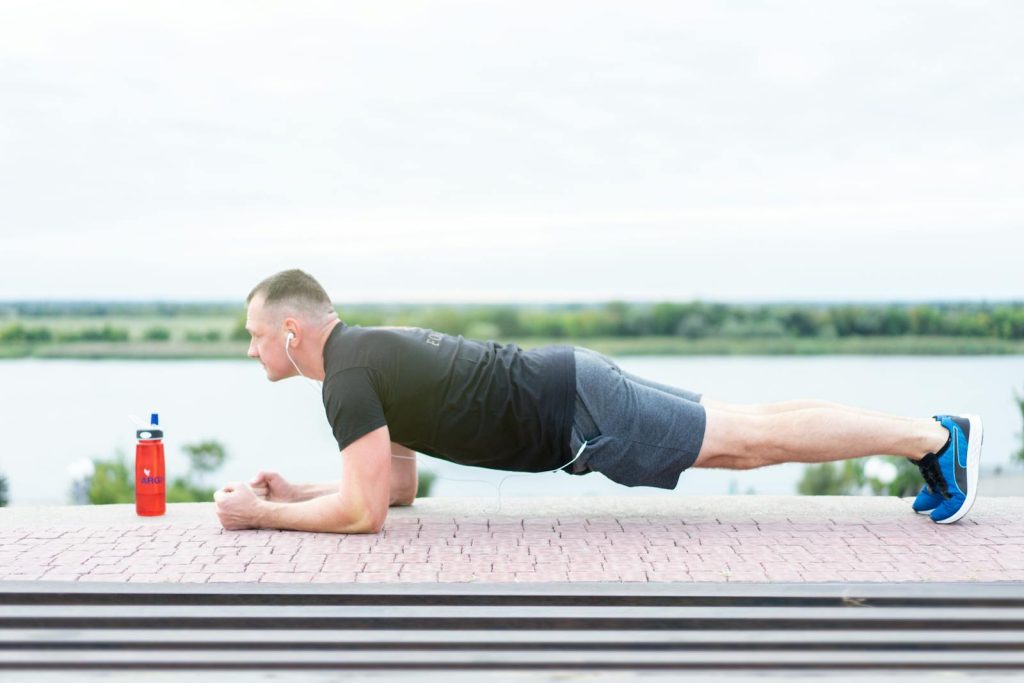
In this guide, you will learn how to do a plank correctly, which muscles it works, the main benefits, common mistakes, the best plank variations, and how to add planks to your workout routine.
What Is the Plank Exercise?
The plank exercise is an isometric core-strength exercise. That means your muscles contract to hold your body still instead of moving through a large range of motion.
In a standard forearm plank, you support your body on your forearms and toes while keeping your torso, hips, and legs in one straight line. The goal is not just to “stay up.” The goal is to brace your core, control your pelvis, keep your spine neutral, and hold tension through your whole body.
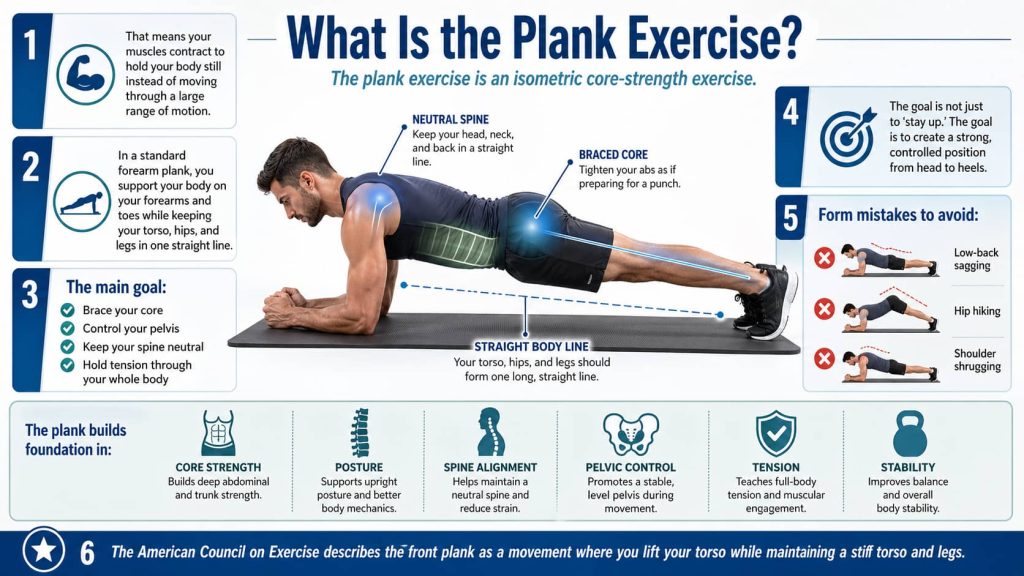
The American Council on Exercise describes the front plank as a movement where you lift your torso while maintaining a stiff torso and legs, avoiding low-back sagging, hip hiking, and shoulder shrugging.
How to Do the Plank Exercise With Proper Form
Best for:
Building basic core stability, learning proper trunk control, and strengthening the abs without needing equipment.
Why it stands out
The forearm plank is one of the best starting points because it teaches you how to brace your core while keeping your ribs, pelvis, and spine controlled.
Suggested sets and reps
Start with 2–3 sets of 10–20 seconds. As your form improves, build toward 20–45 seconds per set. Advanced lifters can use harder variations instead of simply chasing longer holds.
How to do it
- Start on your stomach with your elbows under your shoulders.
- Place your forearms on the floor with your palms facing down.
- Step your feet back and balance on your toes.
- Brace your abs as if you are about to take a light punch to the stomach.
- Squeeze your glutes and keep your legs active.
- Keep your body in a straight line from head to heels.
- Look slightly down so your neck stays neutral.
- Breathe slowly while holding the position.
- Stop the set before your hips sag, your lower back arches, or your shoulders shrug.
Coaching cue:
Think: “Ribs down, glutes tight, push the floor away.”
How to use in a workout:
Use the forearm plank near the end of your warm-up, after strength training, or as part of a core circuit.
Muscles Worked by the Plank Exercise
The plank is often called an ab exercise, but it trains more than the front of your stomach.
The main muscles worked include:
- Rectus abdominis: The front abdominal muscle that helps resist spinal extension.
- Transverse abdominis: A deep core muscle that helps create trunk stiffness and bracing.
- Internal and external obliques: Side abdominal muscles that help resist rotation and side bending.
- Erector spinae: Back muscles that help support spinal position.
- Glutes: Help keep the hips extended and prevent low-back sagging.
- Quadriceps: Help keep the knees straight and legs active.
- Shoulders and serratus anterior: Help stabilize the upper body and shoulder blades.
- Chest and upper back: Assist with holding the plank position.
The National Academy of Sports Medicine lists the rectus abdominis and transverse abdominis as key muscles in the straight-arm plank, with the obliques, erector spinae, serratus anterior, and shoulder stabilizers also contributing.
Benefits of the Plank Exercise
Builds core stability
The plank trains your core to resist movement. This is useful because your core often works to keep your trunk stable while your arms and legs move during daily activity, lifting, running, and sports.
Strengthens more than your abs
A good plank requires tension through your shoulders, glutes, quads, and trunk. That makes it a full-body stability exercise, not just a stomach exercise.
Helps teach better body control
The plank teaches you how to keep your ribs and pelvis controlled. This can carry over to push-ups, squats, deadlifts, rows, overhead presses, and many athletic movements.
Requires no equipment
You can do planks almost anywhere. All you need is enough floor space and, if needed, an exercise mat.
Easy to modify or progress
Beginners can start with knee planks or incline planks. Advanced lifters can use harder variations such as RKC planks, shoulder taps, plank reaches, or suspension trainer planks.
Supports a balanced strength routine
The CDC recommends adults perform muscle-strengthening activity at least 2 days per week. Planks can fit into that goal as part of a complete strength program that also trains the legs, hips, back, chest, shoulders, and arms.
Common Plank Mistakes to Avoid
Letting your hips sag
This is one of the most common plank mistakes. When your hips drop, your lower back may arch too much.
Fix it:
Squeeze your glutes, brace your abs, and shorten the hold.
Lifting your hips too high
A high-hip plank may feel easier, but it reduces the core challenge and changes the position.
Fix it:
Create a straight line from shoulders to hips to heels.
Holding your breath
Breath-holding can make the plank feel more tense and harder to control.
Fix it:
Breathe slowly through your nose or mouth while keeping your abs braced.
Placing your elbows too far forward
If your elbows are too far in front of your shoulders, your plank may become harder to control and more stressful on the shoulders.
Fix it:
Place your elbows directly under your shoulders.
Shrugging your shoulders
Shrugging can create unnecessary neck and upper-trap tension.
Fix it:
Push your forearms into the floor and keep space between your shoulders and ears.
Holding the plank too long
A long plank with poor form is not better than a short plank with strong form.
Fix it:
End the set when your position breaks. Build time slowly.
How Long Should You Hold a Plank?
A good plank does not need to last several minutes. For most people, clean sets of 10–45 seconds are enough to build useful core strength.
A practical guide:
- Beginner: 2–3 sets of 10–20 seconds
- Intermediate: 2–4 sets of 20–45 seconds
- Advanced: 3–5 sets of harder variations for 10–30 seconds
The National Academy of Sports Medicine recommends starting with shorter holds and increasing gradually, while emphasizing that quality matters more than duration. A shorter plank with strong form is more useful than a longer plank with sagging hips or poor alignment.
Best Plank Exercise Variations
1. Knee Plank
Best for:
Beginners, people learning core bracing, and anyone who cannot yet hold a full plank with good form.
Muscles worked:
Abs, obliques, shoulders, glutes, and lower back stabilizers.
Why it stands out
The knee plank reduces the amount of bodyweight you need to support, making it easier to practice good alignment.
Suggested sets and reps
Do 2–3 sets of 10–30 seconds.
How to do it
- Start on your forearms with your elbows under your shoulders.
- Keep your knees on the floor.
- Walk your knees back until your body forms a straight line from shoulders to knees.
- Brace your abs and squeeze your glutes.
- Hold without letting your hips sag.
Common mistakes:
- Letting the hips drop
- Sitting the hips too far back
- Relaxing the core
- Looking forward too much
Coaching cue:
Keep your body straight from shoulders to knees.
Exercise variations
- Easier: incline knee plank
- Harder: full forearm plank
How to use in a workout:
Use it as your first plank variation until you can hold a strong position for at least 20–30 seconds.
2. High Plank
Best for:
Push-up strength, shoulder stability, and full-body core control.
Muscles worked:
Abs, obliques, shoulders, chest, triceps, serratus anterior, glutes, and quads.
Why it stands out
The high plank looks like the top of a push-up. It is useful if you want your plank training to carry over to push-ups, mountain climbers, and crawling movements.
Suggested sets and reps
Do 2–4 sets of 15–45 seconds.
How to do it
- Start on your hands and knees.
- Place your hands under your shoulders.
- Step your feet back into a push-up position.
- Brace your core and squeeze your glutes.
- Push the floor away without rounding your upper back excessively.
- Hold a straight line from head to heels.
Common mistakes:
- Hands too far ahead of the shoulders
- Hips sagging
- Locking the elbows too aggressively
- Letting the shoulder blades collapse
Coaching cue:
Push the floor away and keep your ribs pulled down.
Exercise variations
- Easier: incline high plank
- Harder: high plank shoulder tap
How to use in a workout:
Use it before push-ups, in a bodyweight circuit, or as a core finisher.
3. Side Plank
Best for:
Training the obliques, lateral core strength, hip stability, and anti-side-bending control.
Muscles worked:
Obliques, transverse abdominis, glute medius, shoulder stabilizers, and quadratus lumborum.
Why it stands out
The side plank trains your core from the side, which the standard plank does not emphasize as much.
Suggested sets and reps
Do 2–3 sets of 10–30 seconds per side.
How to do it
- Lie on one side with your elbow under your shoulder.
- Stack your feet or place one foot in front of the other.
- Lift your hips off the floor.
- Keep your body in a straight line.
- Brace your abs and avoid rotating forward or backward.
- Hold, then switch sides.
Common mistakes:
- Letting the hips drop
- Twisting the torso
- Placing the elbow too far from the shoulder
- Holding tension in the neck
Coaching cue:
Lift your bottom hip away from the floor.
Exercise variations
- Easier: side plank from knees
- Harder: side plank with top-leg raise
How to use in a workout:
Pair side planks with front planks to train the core from multiple angles.
4. Plank Shoulder Tap
Best for:
Anti-rotation strength, shoulder stability, and core control during movement.
Muscles worked:
Abs, obliques, shoulders, serratus anterior, glutes, and quads.
Why it stands out
This variation teaches your body to resist rotation while one hand leaves the floor.
Suggested sets and reps
Do 2–3 sets of 8–16 total taps.
How to do it
- Start in a high plank.
- Place your feet slightly wider than hip-width.
- Brace your abs and squeeze your glutes.
- Lift one hand and tap the opposite shoulder.
- Return the hand to the floor.
- Repeat on the other side without rocking your hips.
Common mistakes:
- Rotating the hips side to side
- Moving too fast
- Letting the low back sag
- Shifting the shoulders too much
Coaching cue:
Move slowly and keep your hips quiet.
Exercise variations
- Easier: wider-feet shoulder tap
- Harder: feet-together shoulder tap
How to use in a workout:
Use it as a core exercise in bodyweight circuits or upper-body workouts.
5. Plank With Leg Lift
Best for:
Glute activation, posterior-chain control, and advanced plank stability.
Muscles worked:
Abs, glutes, hamstrings, shoulders, obliques, and lower back stabilizers.
Why it stands out
Lifting one leg increases the demand on your core and hips because your body must resist rotation and extension.
Suggested sets and reps
Do 2–3 sets of 6–10 controlled lifts per side.
How to do it
- Start in a forearm plank.
- Brace your abs and squeeze both glutes.
- Lift one foot a few inches off the floor.
- Keep your hips level.
- Lower with control.
- Repeat on the other side.
Common mistakes:
- Lifting the leg too high
- Arching the lower back
- Rotating the hips
- Losing core tension
Coaching cue:
Lift from the glute, not the lower back.
Exercise variations
- Easier: plank with alternating toe lift
- Harder: long-lever plank with leg lift
How to use in a workout:
Use it after mastering the basic plank and side plank.
6. Plank Reach
Best for:
Core stability, shoulder control, and anti-rotation training.
Muscles worked:
Abs, obliques, shoulders, serratus anterior, glutes, and spinal stabilizers.
Why it stands out
The reach makes your core work harder because one arm moves away from the floor while your trunk stays stable.
Suggested sets and reps
Do 2–3 sets of 6–10 reaches per side.
How to do it
- Start in a high plank or forearm plank.
- Brace your core.
- Reach one arm forward slowly.
- Keep your hips level.
- Return the hand or forearm to the floor.
- Repeat on the other side.
Common mistakes:
- Reaching too far
- Twisting the hips
- Moving quickly
- Letting the ribs flare
Coaching cue:
Reach long without letting your torso move.
Exercise variations
- Easier: reach from a knee plank
- Harder: reach with feet closer together
How to use in a workout:
Use it as an intermediate core drill when regular planks become too easy.
7. Plank to Push-Up
Best for:
Core strength, shoulder stability, triceps strength, and conditioning.
Muscles worked:
Abs, shoulders, chest, triceps, obliques, glutes, and quads.
Why it stands out
This movement combines plank stability with upper-body pressing strength.
Suggested sets and reps
Do 2–4 sets of 4–10 reps per side.
How to do it
- Start in a forearm plank.
- Place one hand under your shoulder.
- Press up onto that hand.
- Place the other hand down and move into a high plank.
- Lower back down to your forearms one arm at a time.
- Alternate the lead arm each rep.
Common mistakes:
- Rocking the hips
- Letting the elbows flare too much
- Moving too fast
- Losing core tension
Coaching cue:
Keep your hips square to the floor.
Exercise variations
- Easier: plank to push-up from knees
- Harder: slow-tempo plank to push-up
How to use in a workout:
Use it in a bodyweight strength circuit or as a core-and-shoulder finisher.
8. RKC Plank
Best for:
Advanced core bracing, short intense holds, and learning full-body tension.
Muscles worked:
Abs, glutes, quads, lats, shoulders, obliques, and deep core muscles.
Why it stands out
The RKC plank is harder than a normal plank because you intentionally create more full-body tension.
Suggested sets and reps
Do 3–5 sets of 8–20 seconds.
How to do it
- Start in a forearm plank.
- Place your elbows under your shoulders.
- Squeeze your glutes hard.
- Tighten your quads.
- Pull your elbows slightly toward your toes without actually moving them.
- Keep your ribs down and breathe with control.
- Hold for a short, intense set.
Common mistakes:
- Holding too long
- Losing tension
- Arching the lower back
- Forgetting to breathe
Coaching cue:
Create maximum tension without changing your position.
Exercise variations
- Easier: standard forearm plank
- Harder: long-lever RKC plank
How to use in a workout:
Use it for short, high-quality core sets after your main strength work.
Beginner Plank Modifications
If a full plank feels too hard, do not force it. Start with a version that lets you keep clean form.
Incline plank
Place your hands on a bench, box, or sturdy surface. The higher the surface, the easier the plank becomes.
Knee plank
Keep your knees on the floor while maintaining a straight line from shoulders to knees.
Short-hold plank
Hold for 5–10 seconds, rest, then repeat. This works well if your form breaks quickly.
Wide-feet plank
Move your feet wider than hip-width. This gives you a more stable base.
Dead bug
If planks bother your wrists, shoulders, or lower back, dead bugs can help you practice core control while lying on your back.
Bird dog
Bird dogs train opposite arm-and-leg control from an all-fours position and can be a useful starting point before harder plank variations.
How to Add Planks to Your Workout Routine
Planks work best when they support your full training plan. They should not replace squats, hinges, rows, presses, carries, or other core movements.
Use planks:
- At the end of a warm-up
- After strength training
- In a core circuit
- On active recovery days
- As a finisher after upper-body or lower-body workouts
A simple weekly target is 2–3 plank sessions per week, especially if you are also doing other strength training.
Sample Plank Workout for Core Strength
Beginner option
Perform 2–3 rounds:
- Knee plank — 15–20 seconds
- Side plank from knees — 10–15 seconds per side
- Dead bug — 6–8 reps per side
- Rest — 45–60 seconds
Intermediate option
Perform 3 rounds:
- Forearm plank — 30 seconds
- Side plank — 20 seconds per side
- Plank shoulder tap — 10–12 total reps
- Bird dog — 8 reps per side
- Rest — 45–75 seconds
Advanced option
Perform 3–4 rounds:
- RKC plank — 10–20 seconds
- Plank with leg lift — 8 reps per side
- Side plank with reach-through — 6–8 reps per side
- Plank to push-up — 6–10 reps
- Rest — 60–90 seconds
Plank Exercise Safety Tips
The plank should feel challenging in your abs, shoulders, glutes, and legs. It should not create sharp pain.
Use these safety tips:
- Stop the set when your lower back starts to sag.
- Do not hold your breath.
- Keep your elbows or hands under your shoulders.
- Choose an easier variation if your form breaks quickly.
- Use a mat if your elbows are uncomfortable.
- Avoid long plank challenges if they cause poor form.
- Stop if you feel sharp pain, numbness, dizziness, or unusual symptoms.
If planks cause low-back pain, shoulder pain, wrist pain, or symptoms that do not feel normal, stop and ask a qualified professional to check your form.
FAQs About the Plank Exercise
Is the plank exercise good for beginners?
Yes. The plank exercise can be good for beginners when it is modified correctly. Start with a knee plank, incline plank, or short 5–10 second holds. Focus on form before increasing time.
How long should I hold a plank?
Most people can start with 10–20 seconds per set. As you get stronger, build toward 30–45 seconds. Once you can hold a strong plank for that long, harder variations may be more useful than simply holding longer.
Is a forearm plank or high plank better?
Both are useful. A forearm plank is often better for learning basic core bracing. A high plank is useful if you want more carryover to push-ups, shoulder stability, and bodyweight training.
Do planks build abs?
Planks can strengthen the abdominal muscles, especially the rectus abdominis, transverse abdominis, and obliques. However, visible abs also depend on body fat level, nutrition, overall training, and genetics.
Should I do planks every day?
You can practice easy plank variations often, but hard plank training does not need to be done every day. For most people, 2–3 focused core sessions per week is enough when combined with a balanced strength routine.
Why does my lower back hurt during planks?
Your lower back may hurt if your hips sag, your ribs flare, your glutes are relaxed, or the variation is too hard. Shorten the hold or switch to a knee plank or incline plank. Stop if the pain is sharp or does not feel normal.
What is the best plank variation for core strength?
The best variation depends on your level. Beginners may get the most from knee planks and incline planks. Intermediate lifters can use forearm planks, side planks, and shoulder taps. Advanced lifters can use RKC planks, long-lever planks, and suspension-based plank variations.
Conclusion
The plank exercise is a simple but powerful way to build core stability, improve body control, and strengthen the abs, shoulders, hips, and trunk together. The key is to focus on position, breathing, and tension instead of chasing the longest hold possible.
Start with a variation you can control, use short clean sets, and progress only when your form stays strong. Choose 3–5 plank variations from this guide and add them to your weekly core routine.
References
- American Council on Exercise: Front Plank
- National Academy of Sports Medicine: Straight-Arm Plank
- National Academy of Sports Medicine: Plank
- Harvard Health Publishing: Straight Talk on Planking
- PubMed: Progression of Core Stability Exercises Based on the Extent of Muscle Activity
- PubMed: Trunk Muscle Activation in Prone Plank Exercises With Different Body Tilts