The bird dog exercise is a simple bodyweight move that trains core stability, balance, and spinal control from a hands-and-knees position. It is often used in beginner core workouts, warm-ups, rehab-style training, and low-back-friendly strength routines because it teaches your trunk to stay steady while your arms and legs move.
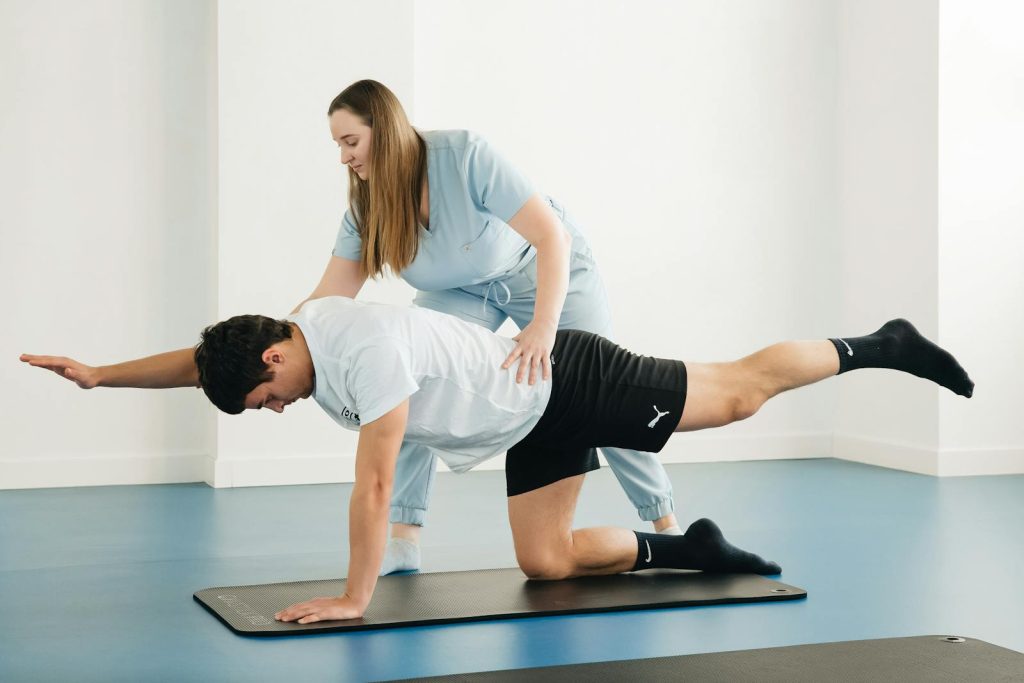
Unlike crunches or sit-ups, the bird dog is not about bending the spine. The goal is to resist rotation, keep your hips level, and build control through your deep core, glutes, lower back, and shoulder stabilizers.
What Is the Bird Dog Exercise?
The bird dog exercise is a quadruped core exercise, meaning you perform it on all fours. From that position, you extend one arm and the opposite leg at the same time, pause with control, then return to the starting position.
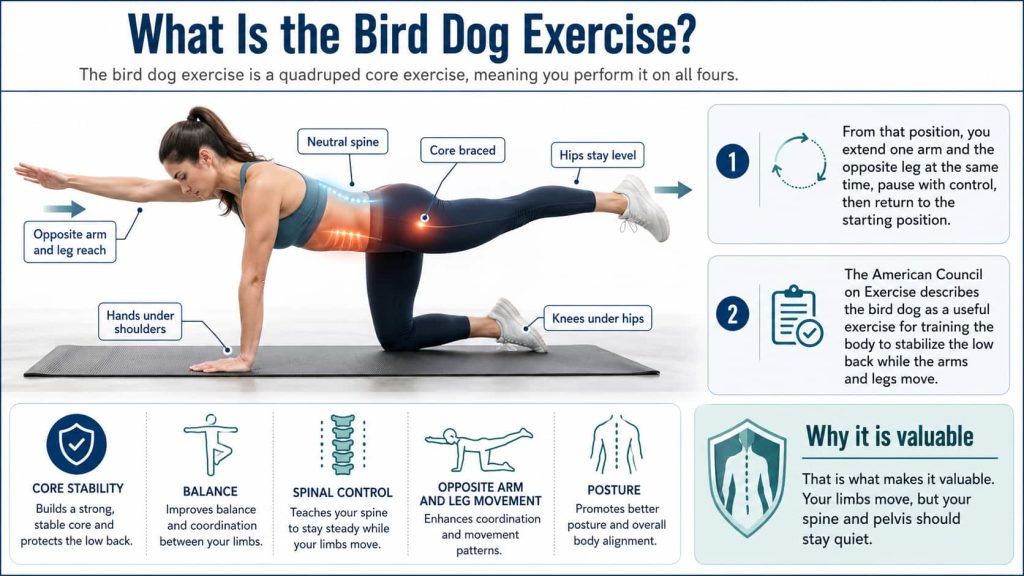
The American Council on Exercise describes the bird dog as a useful exercise for training the body to stabilize the low back while the arms and legs move.
That is what makes it valuable. Your limbs move, but your spine and pelvis should stay quiet.
Bird Dog Exercise at a Glance
Best for:
Core stability, balance, coordination, glute activation, low-back-friendly core training, and warm-ups.
Why it stands out
The bird dog trains your core the way it often works in real life: by keeping your trunk stable while your arms and legs move. It helps you practice a neutral spine, level hips, controlled breathing, and smooth coordination without needing weights.
How to Do the Bird Dog Exercise With Proper Form
- Start on your hands and knees on a mat or comfortable floor.
- Place your hands under your shoulders and your knees under your hips.
- Keep your neck long and look down between your hands.
- Brace your core gently as if preparing for a light punch to the stomach.
- Extend your right arm forward and your left leg backward at the same time.
- Reach long through your fingertips and heel without lifting too high.
- Keep your hips square to the floor.
- Pause for 2–6 seconds while breathing normally.
- Slowly return your hand and knee to the floor.
- Repeat on the opposite side.
How to use in a workout:
Use the bird dog in a warm-up, beginner core routine, low-impact strength session, or as an accessory drill before squats, deadlifts, lunges, rows, or loaded carries.
Muscles Worked During the Bird Dog Exercise
The bird dog exercise looks simple, but it trains several muscle groups at once.
Deep Core Muscles
The transverse abdominis helps brace your midsection and reduce unwanted movement through your trunk. This is one of the key muscles involved in core stability.
Rectus Abdominis
The rectus abdominis helps control your rib position and prevents your lower back from sagging as you extend your arm and leg.
Obliques
Your internal and external obliques help resist twisting. This is why the bird dog is often described as an anti-rotation core exercise.
Erector Spinae
The erector spinae muscles run along your spine and help maintain a neutral back position. During the bird dog, they work to stabilize rather than aggressively extend the spine.
Glutes and Hamstrings
The glutes help extend the hip as you reach one leg behind you. Your hamstrings assist with hip extension and lower-body control.
Shoulder and Upper-Back Stabilizers
The shoulder of the planted arm works hard to support your body. The reaching arm also trains controlled shoulder flexion while your upper back stays steady.
The National Academy of Sports Medicine highlights the bird dog as a core stability movement that develops anti-rotation strength, coordinated movement, spinal control, and functional core strength.
Benefits of the Bird Dog Exercise
Builds Core Stability Without Crunching the Spine
The bird dog trains your core to resist movement instead of creating movement. That makes it a smart option for people who want a core exercise that does not rely on repeated spinal flexion.
Helps Improve Balance and Coordination
Because you lift the opposite arm and leg at the same time, your body has to coordinate movement across the left and right sides. This makes the exercise useful for beginners, athletes, older adults, and anyone rebuilding basic movement control.
Trains Anti-Rotation Strength
A good bird dog rep should not include hip twisting or shoulder dipping. Your core has to resist rotation while your limbs move. This is useful for running, walking, lifting, carrying, and many sports movements.
Strengthens the Glutes and Low Back
The bird dog is not just an ab exercise. Your glutes and spinal stabilizers work together to keep your pelvis and lower back controlled.
Works Well as a Warm-Up Exercise
The bird dog can prepare your core, hips, and shoulders before bigger lifts. It is especially useful before deadlifts, squats, lunges, rows, and full-body strength workouts.
Beginner-Friendly and Easy to Modify
You do not need equipment, heavy loading, or advanced mobility to start. You can reduce the range of motion, lift only one limb at a time, or use shorter holds until your control improves.
Proper Bird Dog Form: Key Coaching Cues
Keep Your Spine Neutral
Do not let your lower back sag or arch. Your spine should stay long from your head to your tailbone.
Reach Long, Not High
The goal is not to lift your hand and foot as high as possible. Reach forward and backward as if you are trying to make your body longer.
Keep Your Hips Level
Your pelvis should not rotate open. Imagine balancing a glass of water on your lower back.
Move Slowly
Fast reps usually hide poor control. Slow reps make your core work harder and help you feel whether your hips are shifting.
Breathe Through the Rep
Do not hold your breath. Exhale gently as you extend, then inhale as you return to the starting position.
Suggested Sets, Reps, and Holds
Beginner
Do 2 sets of 6–8 reps per side.
Hold each rep for 2–3 seconds. Focus on keeping your hips level and your lower back still.
Intermediate
Do 2–3 sets of 8–12 reps per side.
Hold each rep for 3–6 seconds. Move slowly and avoid rushing between sides.
Advanced
Do 3 sets of 10–15 reps per side.
Use longer pauses, slower lowering, a resistance band, or a bird dog crunch variation if your form stays clean.
The MyHealth Alberta bird dog guide suggests holding the position for about 6 seconds and repeating 8–12 times with each leg, then gradually building longer holds as control improves.
Common Bird Dog Exercise Mistakes
Arching the Lower Back
This usually happens when you lift the leg too high. Keep your ribs down and reach the heel back instead of kicking upward.
Rotating the Hips
If one hip opens toward the side, the core is no longer controlling the movement well. Shorten your range of motion and move slower.
Moving Too Fast
Speed makes the exercise easier and less effective. Use a controlled tempo and pause at the top.
Letting the Head Drop or Lift
Your neck should stay neutral. Look down at the floor, not forward at the wall.
Holding Your Breath
Breath-holding can create unnecessary tension. Keep breathing while maintaining a gentle brace.
Reaching Too Far Before You Are Ready
A full arm-and-leg extension is not required on day one. Start with smaller reaches and increase the range as your control improves.
Bird Dog Exercise Variations and Modifications
Easier Variation: Legs-Only Bird Dog
Start on all fours and extend one leg behind you while both hands stay on the floor. This is a good option if the full version makes your hips twist.
Easier Variation: Arms-Only Bird Dog
Keep both knees on the floor and reach one arm forward at a time. This helps you practice shoulder control and core bracing.
Easier Variation: Short-Range Bird Dog
Extend the arm and leg only halfway. Use this if you feel your lower back arching or your hips rotating.
Standard Bird Dog
Extend the opposite arm and leg at the same time, pause, then return with control. This is the main version most people should master first.
Bird Dog Crunch
Extend the opposite arm and leg, then bring your elbow and knee toward each other under your body. This adds more abdominal work, but it should not turn into a rushed crunch.
Pause Bird Dog
Hold the top position for 5–10 seconds per rep. This increases time under tension and makes your stabilizers work harder.
Resistance Band Bird Dog
Loop a light resistance band around one foot and hold the other end in the opposite hand. Extend with control. This is more advanced and should only be used after you can perform clean bodyweight reps.
Bird Dog Row
Set up in a bird dog position on a bench with one hand planted and the opposite leg extended. Row a dumbbell with the free hand. This is an advanced variation that challenges core stability, back strength, and anti-rotation control.
How to Add the Bird Dog Exercise to Your Workout
The bird dog is best used as a control-focused exercise, not a max-effort strength move. Place it where good technique matters most.
As a Warm-Up
Use it before lower-body or full-body training.
Do 1–2 sets of 6–8 reps per side with slow, controlled pauses.
As a Core Exercise
Place it in the core section of your workout.
Do 2–3 sets of 8–12 reps per side.
As a Low-Impact Stability Drill
Use it on recovery days, beginner training days, or mobility-focused sessions.
Do 2 sets of 6–10 reps per side, focusing on smooth breathing and level hips.
As Part of a Full-Body Strength Plan
The bird dog can support your bigger training plan, but it should not replace full-body strength work. The CDC recommends muscle-strengthening activities on 2 or more days per week that work all major muscle groups.
Sample Bird Dog Workout Routine
Beginner Core Stability Routine
Perform 2–3 rounds:
- Bird dog — 6 reps per side
- Glute bridge — 10 reps
- Dead bug — 6 reps per side
- Side plank from knees — 15–20 seconds per side
Rest 30–60 seconds between exercises.
Intermediate Core and Glute Routine
Perform 3 rounds:
- Bird dog — 8–12 reps per side
- Plank — 20–40 seconds
- Glute bridge march — 8 reps per side
- Side plank — 20–30 seconds per side
Rest 45–60 seconds between exercises.
Warm-Up Before Strength Training
Perform 1–2 rounds:
- Cat-cow — 5 slow reps
- Bird dog — 6 reps per side
- Bodyweight squat — 10 reps
- Hip hinge drill — 10 reps
Use this before squats, deadlifts, lunges, or full-body workouts.
Who Should Use the Bird Dog Exercise?
The bird dog exercise can be useful for:
- Beginners learning core control
- Lifters warming up before strength training
- Athletes improving coordination and trunk control
- People who want a low-impact core exercise
- Anyone practicing better hip, spine, and shoulder stability
It may also be included in low-back-friendly exercise programs, but it should not be treated as a guaranteed fix for pain. Research on core stabilization exercises suggests they may be useful for nonspecific low back pain, but exercise selection should match the individual, their symptoms, and their tolerance. A systematic review in the Journal of Physical Therapy Science found that core stabilization exercises can be considered a favorable option for nonspecific low back pain, but this does not mean one exercise is right for everyone.
Stop the exercise if you feel sharp pain, numbness, dizziness, radiating symptoms, or unusual discomfort. If symptoms persist, work with a qualified healthcare or fitness professional.
Bird Dog Exercise FAQs
Is the bird dog exercise good for beginners?
Yes. The bird dog is beginner-friendly because it uses bodyweight only and can be modified easily. Beginners should start with short holds, slow reps, and a smaller range of motion.
What muscles does the bird dog exercise work?
The bird dog works the deep core, rectus abdominis, obliques, erector spinae, glutes, hamstrings, shoulders, and upper-back stabilizers. It is especially useful for training core stability and anti-rotation control.
How many bird dogs should I do?
Start with 2 sets of 6–8 reps per side. As your form improves, progress to 2–3 sets of 8–12 reps per side with controlled pauses.
Should I do bird dogs every day?
You can do light bird dogs often if they feel good and your form stays clean. For most people, 2–4 times per week is enough when combined with other strength, mobility, and core exercises.
Why does my lower back hurt during bird dogs?
Your leg may be lifting too high, your lower back may be arching, or your core may not be braced well enough. Reduce the range of motion, move slower, and try legs-only bird dogs first. Stop if the pain is sharp, radiating, or unusual.
Is the bird dog better than crunches?
It depends on your goal. Crunches train spinal flexion more directly, while bird dogs train core stability, anti-rotation control, and coordination. For many beginners, bird dogs are a better starting point for learning controlled core engagement.
How long should I hold a bird dog?
A good starting point is 2–3 seconds per rep. As you improve, hold each rep for about 5–10 seconds while keeping your hips level and breathing normally.
Conclusion
The bird dog exercise is one of the most practical bodyweight drills for building core stability, balance, glute control, and better spinal awareness. The key is not to rush or lift higher. The key is to move slowly, keep your hips level, brace your core, and reach long through the opposite arm and leg.
Start with 2–3 sets of controlled reps per side, master the basic version first, then progress with longer holds or harder variations when your form is solid.
References
- American Council on Exercise: Bird Dog Exercise
- National Academy of Sports Medicine: Bird Dog
- CDC: Adult Physical Activity Guidelines
- World Health Organization: Physical Activity
- Journal of Physical Therapy Science: Core Stability Exercises and Nonspecific Low Back Pain
- MedlinePlus: Exercise and Physical Fitness
3 thoughts on “Bird Dog Exercise: Benefits, Muscles Worked, and Proper Form”