The dumbbell chest fly is a chest isolation exercise that trains your pecs through a wide “hugging” motion. It is best used as an accessory move after presses, helping you build better chest control, improve muscle tension, and train the pecs through a deep but controlled stretch.
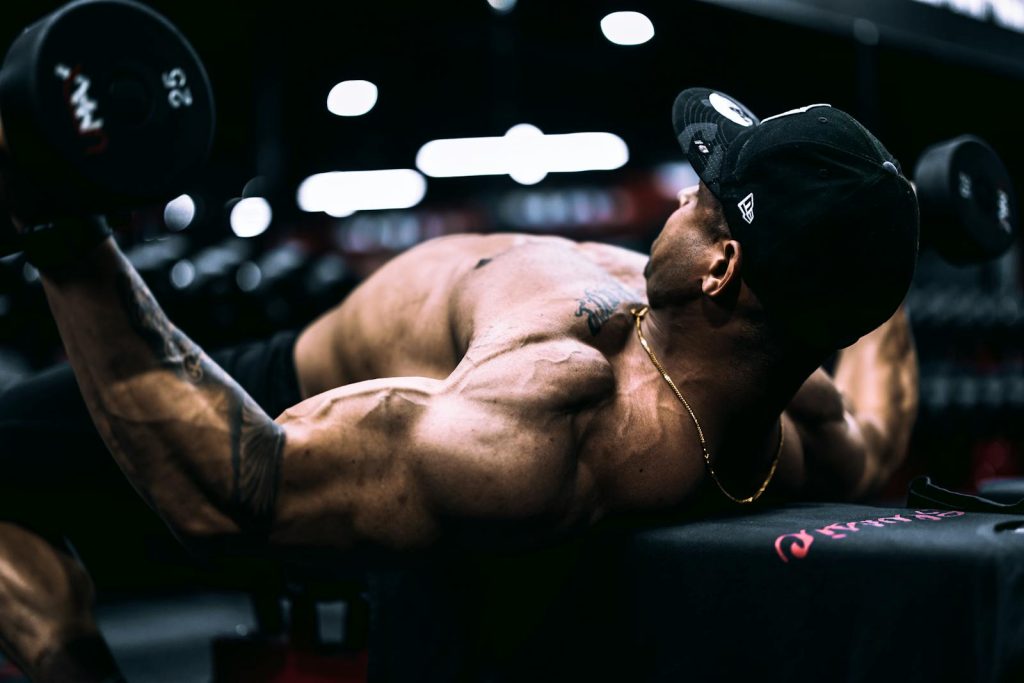
This guide explains how to do the dumbbell chest fly with proper form, which muscles it works, the biggest mistakes to avoid, the best variations, and how to add it to a smart chest workout.
What Is the Dumbbell Chest Fly?
The dumbbell chest fly is an upper-body exercise performed while lying on a flat, incline, or decline bench with a dumbbell in each hand. Instead of pressing the weights up and down, you open your arms out to the sides and bring them back together in a controlled arc.
The movement looks similar to hugging a large tree. Your elbows stay slightly bent, your shoulders stay controlled, and your chest does most of the work.
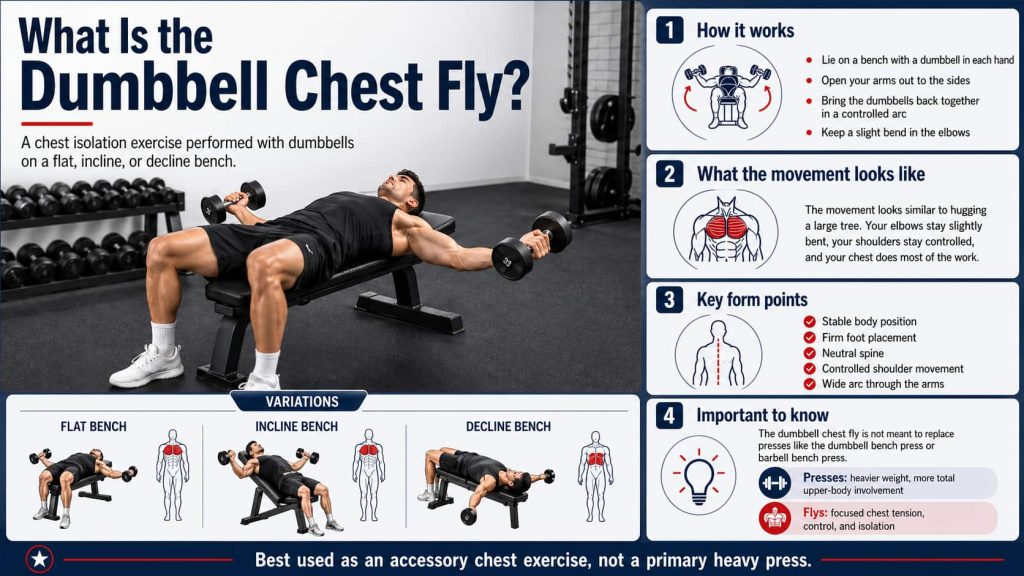
The American Council on Exercise describes the lying chest fly as a dumbbell-and-bench exercise that emphasizes a stable body position, firm foot placement, a neutral spine, controlled shoulder movement, and a wide arc through the arms.
The dumbbell chest fly is not meant to replace presses like the dumbbell bench press or barbell bench press. Presses let you move heavier weight and train the chest, shoulders, and triceps together. Flys are better for focused chest tension, control, and isolation.
How to Do the Dumbbell Chest Fly With Proper Form
Step 1: Set Up on the Bench
Lie on a flat bench with a dumbbell in each hand. Keep your head, upper back, and hips supported.
Your feet should stay planted on the floor. If your feet do not reach the floor comfortably, use a stable platform under your feet.
Keep your spine neutral. A small natural arch is fine, but your lower back should not lift aggressively off the bench.
Step 2: Start With the Dumbbells Over Your Chest
Hold the dumbbells above your chest with your palms facing each other. Keep your wrists straight and stacked over your elbows.
Do not start with the dumbbells over your face or neck. They should be positioned over your chest.
Step 3: Set Your Shoulders
Pull your shoulder blades gently down and back. Think about creating a stable base on the bench.
This helps protect your shoulders and keeps the focus on your chest.
Avoid shrugging your shoulders toward your ears.
Step 4: Keep a Soft Bend in Your Elbows
Your elbows should be slightly bent throughout the movement. Do not fully lock them.
The elbow angle should stay mostly the same from start to finish. If your elbows bend a lot on the way down and straighten on the way up, you are turning the movement into a press.
Step 5: Lower Slowly in a Wide Arc
Lower the dumbbells out to your sides in a smooth arc. Move slowly and stay in control.
Stop when your upper arms are around chest level or when you feel a comfortable stretch across the pecs.
Do not chase an extreme stretch. If your shoulders feel pinched, strained, or unstable, reduce the range of motion.
Step 6: Bring the Dumbbells Back Together
Squeeze your chest to bring the dumbbells back above your chest. Keep the same soft elbow bend.
At the top, stop when the dumbbells are close together. You do not need to slam them together.
Step 7: Control Every Rep
Use a slow lowering phase and a steady lifting phase. A good tempo is:
Lower: 2–3 seconds
Pause: brief control at the bottom
Lift: 1–2 seconds
Top position: squeeze without relaxing completely
Dumbbell Chest Fly Muscles Worked
The dumbbell chest fly mainly targets the chest, but several muscles help stabilize the movement.
Pectoralis Major
The pectoralis major is the large chest muscle that gives the chest most of its size and shape. Its main actions include flexion, adduction, and medial rotation of the arm at the shoulder joint, according to the NCBI Bookshelf anatomy review on the pectoralis major.
During the dumbbell chest fly, the pecs work to bring your arms from a wide position back toward the midline of your body. That is why the exercise feels like a chest “squeeze.”
Anterior Deltoids
The anterior deltoids are the front shoulder muscles. They assist during the fly, especially when the dumbbells are lowered too far or when the bench is set at an incline.
If you feel the exercise mostly in your shoulders, the weight may be too heavy, your range of motion may be too deep, or your shoulder blades may not be stable.
Biceps and Forearms
The biceps do not curl the weight during a proper chest fly, but they help stabilize the elbow joint. Your forearms and grip also work to keep the dumbbells steady.
Upper Back and Core
Your upper back helps keep your shoulder blades stable on the bench. Your core helps you maintain a strong torso position and avoid excessive arching.
Benefits of the Dumbbell Chest Fly
It Helps Isolate the Chest
The dumbbell chest fly is useful when you want to focus on the pecs without relying heavily on the triceps. Pressing exercises are excellent for strength, but they also involve the shoulders and triceps more.
Flys let you slow down, control the movement, and feel the chest working through a different pattern.
It Trains the Chest Through a Stretch
One of the biggest benefits of the dumbbell chest fly is the controlled stretch at the bottom of the movement. This can be useful for building chest awareness and improving control through a larger range of motion.
The key word is controlled. A deeper stretch is not always better. The best range is the one you can control without shoulder pain, bouncing, or losing tension.
It Can Improve Mind-Muscle Connection
Many lifters struggle to feel their chest during presses. The dumbbell chest fly can help because the movement is slower and more isolated.
Instead of thinking about lifting the dumbbells, think about bringing your upper arms together using your chest.
It Adds Chest Volume Without Heavy Pressing
If your shoulders or triceps get tired during pressing movements, flys can add extra chest work with lighter weights. This makes them useful near the end of a chest workout.
They are especially helpful for lifters who want more chest volume but do not want every chest exercise to be a heavy press.
It Offers Simple Variations
A flat bench targets the overall chest. An incline bench shifts more work toward the upper chest. A decline bench can place more emphasis on the lower chest area.
Changing the bench angle gives you different ways to train the pecs without needing many machines.
Common Dumbbell Chest Fly Mistakes
Going Too Heavy
The dumbbell chest fly is not a max-strength exercise. Heavy dumbbells can pull your shoulders into a weak position and make your form break down.
Use a weight you can control for every rep.
A good test: if you cannot lower the dumbbells slowly, stop at the right depth, and bring them back without swinging, the weight is too heavy.
Lowering the Dumbbells Too Deep
More range of motion is not always better. Lowering too far can place unnecessary stress on the shoulders, especially if your mobility or control is limited.
Stop when you feel a chest stretch without joint discomfort.
Locking the Elbows
Locked elbows turn the arms into long levers, making the movement harder to control. This can increase stress on the elbows and shoulders.
Keep a slight bend in your elbows from start to finish.
Turning It Into a Press
If your elbows bend deeply on the way down and straighten on the way up, you are doing a hybrid press instead of a fly.
That is not always dangerous, but it changes the purpose of the exercise. For a true fly, keep the elbow angle mostly fixed.
Shrugging the Shoulders
Shrugging shifts tension away from the chest and can make the shoulders feel irritated.
Keep your shoulders away from your ears. Think “chest open, shoulder blades stable.”
Rushing the Reps
Fast reps reduce control and make it easier to overstretch at the bottom.
Slow down. The lowering phase is where many lifters get the most value from this exercise.
Letting the Wrists Bend Back
Your wrists should stay neutral. Do not let the dumbbells pull your wrists backward.
Think about keeping your knuckles pointed toward the ceiling at the top and your wrists firm throughout the movement.
How Heavy Should You Go on Dumbbell Chest Fly?
Choose a weight that lets you complete clean reps without shoulder strain.
For most people, dumbbell chest flys work best with lighter to moderate weights and higher control. You should feel your chest working, not your joints fighting the weight.
A practical rep range is 8–15 reps per set. Beginners may do better with 10–15 reps while learning the movement.
The American Heart Association notes that one set of 8–12 repetitions can be enough for each muscle group in general strength training, while also recommending strength training at least twice per week.
For muscle growth, many lifters benefit from multiple controlled sets, especially when the exercise is used after pressing work.
Best Dumbbell Chest Fly Variations
1. Flat Dumbbell Chest Fly
Best for: Overall chest development and learning the basic fly pattern.
The flat dumbbell chest fly is the standard version. It works well for most lifters because the bench position is simple and easy to control.
Use this variation first before moving to incline or decline versions.
How to use it:
Perform 2–4 sets of 8–15 reps after dumbbell bench press, barbell bench press, or push-ups.
2. Incline Dumbbell Fly
Best for: Upper chest emphasis.
The incline dumbbell fly is performed on an adjustable bench set at a low to moderate incline. A 20- to 30-degree incline is often enough for most lifters.
If the bench is too steep, the movement may shift too much work into the front shoulders.
How to use it:
Use this variation on upper-chest days or when your routine already includes flat pressing.
3. Decline Dumbbell Fly
Best for: Lower chest emphasis and lifters who feel better with a slight decline.
The decline angle can feel more comfortable for some shoulders, but it still requires control. Use lighter weights at first.
How to use it:
Pair it with incline pressing or flat pressing for a more complete chest session.
4. Dumbbell Floor Fly
Best for: Beginners and shoulder-friendly range control.
The floor limits how deep your arms can lower. This makes the dumbbell floor fly a useful regression for people who need a shorter range of motion.
The downside is that the floor reduces the chest stretch. Still, it can be a smart option when learning control.
How to use it:
Perform 2–3 sets of 10–15 reps with light dumbbells.
5. Single-Arm Dumbbell Chest Fly
Best for: Fixing side-to-side control and improving stability.
This variation trains one side at a time. It can help you notice if one arm moves differently or if one shoulder is less stable.
Keep the non-working dumbbell safely down or use one dumbbell only.
How to use it:
Use light weight and slow reps. Perform 2–3 sets of 10–12 reps per side.
6. Cable Chest Fly
Best for: Constant tension.
Cables keep tension on the chest through more of the movement. With dumbbells, tension is highest in the stretched position and lower at the top.
Cable flys are not better for everyone, but they are a useful alternative if you have access to a cable machine.
How to use it:
Use cable flys as a finisher for 2–4 sets of 12–15 reps.
7. Machine Chest Fly
Best for: Stability and beginner-friendly chest isolation.
The machine chest fly or pec deck supports your body and makes the movement path easier to control.
This can be helpful for beginners, lifters training near fatigue, or anyone who struggles to stabilize dumbbells.
How to use it:
Use it at the end of a workout for controlled reps and a strong chest squeeze.
Dumbbell Chest Fly vs Dumbbell Bench Press
The dumbbell chest fly and dumbbell bench press both train the chest, but they are not the same exercise.
Dumbbell Chest Fly
The dumbbell chest fly is an isolation movement. It mainly focuses on bringing the arms across the body. The elbows stay slightly bent, and the triceps do much less work.
Best for:
- Chest isolation
- Controlled stretch
- Mind-muscle connection
- Accessory volume
- Higher-rep chest work
Dumbbell Bench Press
The dumbbell bench press is a compound pressing movement. It trains the chest, shoulders, and triceps together. It also lets most people use more weight than a fly.
Best for:
- Upper-body strength
- Heavier loading
- Chest, shoulder, and triceps development
- Main chest workout movement
- Progressive overload
Which One Should You Do?
Most lifters should use both.
Start with a press when you are fresh. Then use dumbbell chest flys afterward to add focused chest work.
A simple order looks like this:
- Dumbbell bench press
- Incline dumbbell press
- Dumbbell chest fly
- Push-ups or cable fly finisher
How to Add Dumbbell Chest Fly Into a Workout
The dumbbell chest fly usually works best in the middle or end of a chest workout. Since it uses a long lever and requires shoulder control, it is not ideal as your heaviest first exercise.
The CDC recommends muscle-strengthening activity at least 2 days per week for all major muscle groups, including the chest, shoulders, back, arms, legs, hips, and abdomen.
For chest training, dumbbell chest flys can fit into your routine 1–2 times per week, depending on your total volume, recovery, and goals.
For Beginners
Use dumbbell chest flys once per week after a basic chest press or push-up variation.
Example:
- Dumbbell bench press: 3 sets of 8–10 reps
- Dumbbell chest fly: 2 sets of 10–12 reps
- Incline push-up: 2 sets of 8–12 reps
For Intermediate Lifters
Use dumbbell chest flys 1–2 times per week with different bench angles.
Example:
- Barbell or dumbbell bench press: 3–4 sets of 6–10 reps
- Incline dumbbell press: 3 sets of 8–12 reps
- Flat dumbbell chest fly: 3 sets of 10–15 reps
- Cable fly or push-up finisher: 2 sets of 12–15 reps
For Advanced Lifters
Use flys strategically to add chest volume without overloading the triceps.
Example:
- Heavy press variation: 4 sets of 4–8 reps
- Secondary press variation: 3 sets of 8–10 reps
- Incline dumbbell fly: 3 sets of 10–15 reps
- Machine or cable fly: 2–3 sets of 12–20 reps
Advanced lifters can also use slow eccentrics, pauses, or single-arm flys, but only when control stays strong.
Sample Dumbbell Chest Fly Workout
Beginner Chest Workout
Goal: Learn control and build basic chest strength.
- Dumbbell bench press — 3 sets of 8–10 reps
- Dumbbell floor fly — 2 sets of 10–12 reps
- Incline push-up — 2 sets of 8–12 reps
- Plank — 2 sets of 20–30 seconds
Rest 60–90 seconds between sets.
Intermediate Chest Workout
Goal: Build chest size and improve chest isolation.
- Incline dumbbell press — 3 sets of 8–10 reps
- Flat dumbbell bench press — 3 sets of 8–12 reps
- Flat dumbbell chest fly — 3 sets of 10–15 reps
- Push-up — 2 sets close to technical failure
Rest 60–120 seconds between sets.
Accessory Chest Finisher
Goal: Add controlled chest volume at the end of a workout.
- Dumbbell chest fly — 2 sets of 12–15 reps
- Push-up — 2 sets of 8–15 reps
- Cable or machine fly — 1–2 sets of 12–20 reps
Use light to moderate weight and stop before your form breaks down.
Safety Tips Before You Start
The dumbbell chest fly can be effective, but it needs control. The bottom position places the shoulders in a stretched position, so poor form or heavy weight can increase discomfort.
Use these safety rules:
- Warm up with light pressing or band work before heavy chest training.
- Start with lighter dumbbells than you think you need.
- Keep your elbows slightly bent.
- Lower slowly.
- Stop at a comfortable chest stretch.
- Do not bounce at the bottom.
- Keep your shoulder blades stable.
- Avoid training through sharp pain.
- Use a spotter if you struggle to get into position with heavier dumbbells.
Stop the exercise if you feel sharp shoulder pain, chest pain, numbness, dizziness, or unusual symptoms. If discomfort continues, get guidance from a qualified professional.
Who Should Be Careful With Dumbbell Chest Flys?
Some people may need to modify or avoid the dumbbell chest fly, especially if the movement causes shoulder discomfort.
Be careful if you have:
- A current shoulder injury
- Pain in the front of the shoulder
- Poor control in the bottom position
- A history of pec or shoulder strain
- Trouble getting dumbbells safely into position
- Limited shoulder mobility
A floor fly, machine fly, or cable fly with a shorter range of motion may be a better starting point.
Dumbbell Chest Fly Form Checklist
Use this checklist during your next set:
- Feet planted
- Head, upper back, and hips supported
- Dumbbells start over the chest
- Palms face each other
- Wrists stay neutral
- Elbows stay slightly bent
- Shoulder blades stay down and back
- Dumbbells lower in a wide arc
- Chest feels stretched, not shoulders
- Reps stay slow and controlled
If you cannot check every box, reduce the weight or shorten the range of motion.
FAQs About the Dumbbell Chest Fly
Is the dumbbell chest fly good for building chest muscle?
Yes, the dumbbell chest fly can help build chest muscle when performed with proper form, enough effort, and progressive overload. It is best used as an accessory exercise along with pressing movements like the dumbbell bench press, barbell bench press, or push-ups.
Should dumbbell chest flys be heavy or light?
Dumbbell chest flys should usually be light to moderate. This is not the best exercise for maximum loading. Choose a weight you can lower slowly, control at the bottom, and lift without shoulder strain or swinging.
How low should I go on dumbbell chest flys?
Lower the dumbbells until you feel a comfortable stretch across your chest. For many lifters, that means the upper arms stop around chest level. Do not force a deeper range if your shoulders feel strained or unstable.
Why do I feel dumbbell chest flys in my shoulders?
You may feel flys in your shoulders if the weight is too heavy, the bench angle is too steep, your arms go too low, or your shoulder blades are not stable. Try lighter dumbbells, a shorter range of motion, and a stronger shoulder blade position.
Are dumbbell chest flys better than bench press?
No. They serve different purposes. The bench press is better for heavy pressing strength and overall upper-body loading. The dumbbell chest fly is better for chest isolation, stretch, and controlled accessory volume.
Can beginners do dumbbell chest flys?
Yes, beginners can do dumbbell chest flys, but they should start light. A dumbbell floor fly or machine chest fly may be easier to control at first. Beginners should focus on smooth reps, stable shoulders, and a comfortable range of motion.
How many sets and reps should I do?
A good starting point is 2–3 sets of 10–12 reps. Intermediate and advanced lifters can use 3–4 sets of 8–15 reps. Keep the reps controlled and stop the set when your form starts to break down.
Conclusion
The dumbbell chest fly is a useful chest isolation exercise when you treat it as a controlled accessory movement, not a heavy ego lift. Use a slight elbow bend, keep your shoulder blades stable, lower slowly, and stop before your shoulders feel strained.
For the best results, pair dumbbell chest flys with pressing exercises and use them to add focused chest volume. Choose 1–2 fly variations, keep the reps clean, and build your chest workout around control before weight.
References
- American Council on Exercise — Lying Chest Fly
- NCBI Bookshelf — Anatomy, Thorax, Pectoralis Major
- NCBI Bookshelf — Anatomy, Shoulder and Upper Limb, Pectoral Muscles
- CDC — Adult Physical Activity Guidelines
- American Heart Association — Strength and Resistance Training Exercise
- NCBI Bookshelf — Pectoralis Major Tear
- CDC — What Counts as Physical Activity for Adults
1 thought on “Dumbbell Chest Fly: Form, Muscles Worked, Benefits & Mistakes”