Resistance band rows are a back-strengthening exercise that trains your upper back, lats, rear shoulders, arms, and core using an elastic resistance band. They are useful for home workouts, warm-ups, beginner strength training, and anyone who wants a portable pulling exercise without a cable machine.

The main goal is simple: pull the band toward your body while keeping your chest tall, shoulders controlled, and spine neutral. In this guide, you’ll learn how to do resistance band rows correctly, which muscles they work, the biggest benefits, common mistakes, best variations, and how to add them to your workout.
What Are Resistance Band Rows?
Resistance band rows are a horizontal pulling exercise. Instead of pulling a cable handle, dumbbell, or barbell, you pull against the tension of a resistance band.
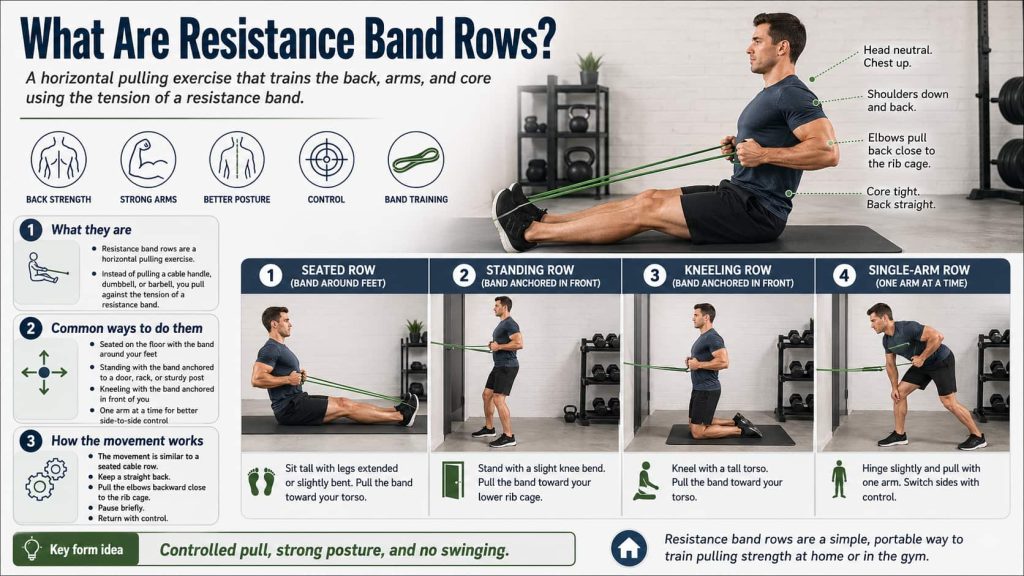
You can do them in several ways:
- Seated on the floor with the band around your feet
- Standing with the band anchored to a door, rack, or sturdy post
- Kneeling with the band anchored in front of you
- One arm at a time for better side-to-side control
The movement is similar to a seated cable row. The American Council on Exercise describes the seated row as a movement where you keep a straight back, pull the elbows backward close to the rib cage, pause briefly, and return with control.
That same idea applies to resistance band rows: controlled pull, strong posture, and no swinging.
Resistance Band Rows Muscles Worked
Resistance band rows mainly train the back and arms, but your core also works to keep your body stable.
Primary muscles worked
Latissimus dorsi: The lats are large back muscles that help pull your upper arms down and back. They are a major target during row variations.
Rhomboids: These muscles sit between your shoulder blades and help pull the shoulder blades together.
Middle trapezius: The mid traps support scapular retraction, which is the “squeeze your shoulder blades together” action.
Rear deltoids: The back part of your shoulders helps move your arms behind your body.
Biceps: Your biceps assist as you bend your elbows and pull the band toward you.
Supporting muscles
Core muscles: Your abs, obliques, and deeper trunk muscles help keep your torso still.
Forearms and grip: Your hands and forearms work to hold the band handles or band ends.
Lower back stabilizers: These muscles help maintain a neutral spine, especially during standing or seated versions.
NASM notes that row variations can work the lats, traps, rhomboids, and obliques while helping build upper-back strength and spinal stability.
Benefits of Resistance Band Rows
1. They Train an Important Pulling Pattern
Many workouts include pushing exercises like push-ups, bench presses, and shoulder presses. Resistance band rows help balance that with pulling work.
Pulling exercises strengthen the muscles that bring your arms back, support your shoulder blades, and train your upper back. This makes resistance band rows useful in full-body workouts, upper-body routines, and posture-focused training.
2. They Are Easy to Do at Home
Resistance band rows do not require a machine, bench, or heavy weights. A band and a safe anchor point are enough.
This makes them a strong choice for:
- Home workouts
- Travel workouts
- Beginner strength training
- Warm-ups before lifting
- Light accessory work after heavy back exercises
3. They Are Beginner-Friendly
Resistance band rows are easy to scale. You can use a lighter band, sit closer to the anchor point, or reduce the range of motion until your form improves.
As you get stronger, you can use a thicker band, step farther away from the anchor, slow down the lowering phase, or add more sets and reps.
4. They Can Build Strength With Progressive Resistance
Resistance bands can be effective when you train with enough effort and progress over time. A systematic review and meta-analysis in SAGE Open Medicine found that elastic resistance training can produce similar strength gains to conventional resistance training across different populations and protocols.
That does not mean bands are always better than weights. It means they can work well when you use them seriously, apply enough tension, and make the exercise harder over time.
5. They Help Improve Shoulder Blade Control
Good rows are not just about pulling with your arms. They also teach you to move and control your shoulder blades.
During a proper resistance band row, your shoulder blades move back as you pull and move forward with control as your arms extend. This can help you build better upper-back awareness and cleaner pulling mechanics.
6. They Fit General Strength Training Guidelines
The CDC recommends adults do muscle-strengthening activities at least 2 days per week that work all major muscle groups, including the back, shoulders, and arms. Resistance band rows can be one simple way to train those upper-body pulling muscles.
How to Do Resistance Band Rows With Proper Form
Best for:
Resistance band rows are best for building beginner-friendly back strength, improving pulling mechanics, and adding a portable back exercise to home or gym workouts.
How to do it:
- Sit on the floor with your legs extended and knees slightly bent.
- Loop the band around the middle of your feet.
- Hold one end or handle in each hand.
- Sit tall with your chest lifted, ribs stacked, and core lightly braced.
- Start with your arms extended and shoulders relaxed.
- Pull your elbows back toward your ribs.
- Squeeze your shoulder blades gently at the end of the row.
- Pause for a moment without leaning backward.
- Slowly straighten your arms and let your shoulder blades move forward with control.
- Repeat for the desired number of reps.
Suggested sets and reps:
Beginners can start with 2–3 sets of 10–15 reps. Intermediate lifters can use 3–4 sets of 8–15 reps. Advanced lifters can use heavier bands, slower tempo, pauses, or single-arm versions for 3–5 sets of 8–12 reps per side.
Coaching cue:
Pull your elbows back, keep your chest tall, and move the band with your back instead of your lower body.
Best Resistance Band Row Variations
1. Seated Resistance Band Row
The seated resistance band row is the most common version. It is simple, stable, and easy for beginners to learn.
Best for: Beginners, home workouts, and learning basic row form.
Muscles worked: Lats, rhomboids, traps, rear delts, biceps, and core.
How to do it:
- Sit on the floor with your legs in front of you.
- Loop the band around your feet.
- Hold the band with both hands.
- Sit tall and brace your core.
- Pull your elbows back toward your sides.
- Pause, then return slowly.
Common mistake: Leaning backward to create momentum instead of using the back muscles.
Coaching cue: Keep your torso still from the first rep to the last rep.
2. Standing Resistance Band Row
The standing version uses an anchor point in front of you. It feels more like a cable row and allows a bigger range of setup options.
Best for: Home gyms, warm-ups, and full-body workouts.
Muscles worked: Lats, mid traps, rhomboids, rear delts, biceps, abs, and glutes.
How to do it:
- Anchor the band at about lower-chest height.
- Hold the handles and step back until the band has light tension.
- Stand tall with feet hip-width apart.
- Brace your abs and keep your ribs down.
- Pull your elbows back toward your ribs.
- Pause, then return with control.
Common mistake: Letting the hips shift, ribs flare, or lower back arch.
Coaching cue: Stand like you are holding a plank from your head to your heels.
3. Single-Arm Resistance Band Row
The single-arm version trains each side separately. It is useful if one side is stronger or if you want more core challenge.
Best for: Fixing side-to-side differences and improving control.
Muscles worked: Lats, rhomboids, traps, rear delts, biceps, obliques, and deep core muscles.
How to do it:
- Anchor the band in front of you.
- Hold the band with one hand.
- Step back until the band is lightly stretched.
- Square your shoulders and hips.
- Pull your elbow back without rotating your torso.
- Pause, then return slowly.
- Repeat all reps on one side before switching.
Common mistake: Twisting the torso to pull the band farther back.
Coaching cue: Keep your zipper, sternum, and nose facing forward.
4. High Resistance Band Row
A high band row uses a higher elbow path. It places more emphasis on the upper back and rear shoulders.
Best for: Upper-back strength, rear delt work, and shoulder-blade control.
Muscles worked: Rear delts, rhomboids, middle traps, upper back, biceps, and forearms.
How to do it:
- Anchor the band at about chest or shoulder height.
- Hold the handles with arms extended.
- Keep your chest tall and shoulders down.
- Pull your elbows back slightly away from your sides.
- Squeeze your upper back.
- Return slowly.
Common mistake: Shrugging the shoulders toward the ears.
Coaching cue: Pull back, not up.
5. Low Resistance Band Row
A low band row uses a lower anchor point or a band around the feet. It often feels stronger through the lats.
Best for: Lat-focused pulling and controlled seated rows.
Muscles worked: Lats, rhomboids, lower traps, biceps, and core.
How to do it:
- Anchor the band low or loop it around your feet.
- Start with your arms extended.
- Keep your chest lifted.
- Pull your elbows down and back toward your lower ribs.
- Pause, then return with control.
Common mistake: Pulling the shoulders forward at the end of each rep.
Coaching cue: Finish with your elbows near your ribs and your neck relaxed.
Common Resistance Band Row Mistakes
Rounding Your Back
A rounded back usually happens when the band is too heavy, your setup is too far away, or you are rushing reps.
Keep your spine neutral, chest lifted, and core lightly braced. If you cannot row without rounding, use a lighter band or reduce the tension.
Shrugging Your Shoulders
Shrugging shifts tension away from your mid-back and can make the movement feel tight in your neck.
Think about keeping your shoulders away from your ears. Pull your elbows back while keeping your neck long.
Leaning Back to Finish the Rep
A small amount of natural body movement is normal, but turning the exercise into a backward lean reduces the work your back has to do.
Your torso should stay mostly still. If you need to lean back on every rep, the band is probably too heavy.
Letting the Band Snap Forward
The return phase matters. If the band yanks your arms forward, you lose control and miss an important part of the exercise.
Return slowly. Let your arms straighten, but keep tension through your back and shoulders.
Pulling With Only Your Arms
Your biceps help, but they should not dominate the exercise.
Start the pull by drawing your shoulder blades slightly back, then drive your elbows behind you.
Using an Unsafe Anchor Point
Never attach a band to something unstable, sharp, weak, or likely to move. A loose anchor can snap back toward you.
Use a sturdy door anchor, rack, post, or heavy fixed object. Check the band for tears before training.
How to Make Resistance Band Rows Easier
Use these regressions if you are new or struggling to control the movement:
- Use a lighter band.
- Sit or stand closer to the anchor point.
- Perform fewer reps.
- Use a slower, smaller range of motion.
- Keep both arms working together before trying single-arm rows.
- Pause between reps to reset your posture.
A good beginner set should feel challenging, but you should still control every rep.
How to Make Resistance Band Rows Harder
Use these progressions when regular band rows become too easy:
- Use a thicker band.
- Step farther away from the anchor point.
- Add a 1–2 second pause at the squeezed position.
- Slow the return phase to 3 seconds.
- Try single-arm rows.
- Add more sets.
- Combine rows with squats, lunges, or hinges.
- Use mechanical drop sets by stepping closer after reaching fatigue.
The best progression is the one that makes the exercise harder without ruining your form.
How Many Sets and Reps Should You Do?
Your sets and reps should match your training goal.
| Goal | Sets | Reps | Rest |
|---|---|---|---|
| Beginner practice | 2–3 | 10–15 | 45–60 seconds |
| Muscle building | 3–4 | 8–15 | 60–90 seconds |
| Strength focus | 4–5 | 6–10 | 90–120 seconds |
| Warm-up or activation | 1–2 | 12–20 | 30–45 seconds |
| Finisher | 2–3 | 15–25 | 30–60 seconds |
For most people, the best starting point is 3 sets of 10–15 controlled reps.
The final few reps should feel challenging, but you should not need to jerk your body, shrug, or lose posture.
Sample Resistance Band Rows Workout
Beginner Back Workout
Do this 2–3 times per week with at least one day of recovery between sessions.
| Exercise | Sets | Reps |
|---|---|---|
| Seated resistance band row | 3 | 10–15 |
| Wall push-up or incline push-up | 3 | 8–12 |
| Band pull-apart | 2 | 12–15 |
| Bodyweight squat | 3 | 10–15 |
| Forearm plank | 2 | 20–30 seconds |
Intermediate Upper-Body Workout
Use this routine when you want a simple push-pull upper-body session.
| Exercise | Sets | Reps |
|---|---|---|
| Standing resistance band row | 4 | 10–15 |
| Push-up | 3 | 8–15 |
| Single-arm resistance band row | 3 | 10–12 per side |
| Band overhead press | 3 | 8–12 |
| Band face pull | 2–3 | 12–20 |
Resistance Band Row Finisher
Use this at the end of a back workout.
- Seated band row: 15 reps
- High band row: 12 reps
- Single-arm band row: 10 reps per side
- Band pull-apart: 15 reps
Rest 60 seconds and repeat for 2–3 rounds.
Resistance Band Rows vs Cable Rows
Resistance band rows and cable rows train a similar pulling pattern, but they do not feel exactly the same.
Cable rows usually provide more consistent resistance throughout the movement. Resistance bands become harder as the band stretches, so the hardest part is usually near the end of the pull.
Both can be useful. Cable rows are great for heavier loading and precise weight jumps. Resistance band rows are better for portability, home training, warm-ups, and high-rep accessory work.
Resistance Band Rows vs Dumbbell Rows
Dumbbell rows use free weight and gravity. Resistance band rows use elastic tension.
Dumbbell rows often allow heavier loading and are excellent for building back strength. Band rows are easier to set up, easier to travel with, and often more comfortable for beginners who are learning the rowing pattern.
You do not have to choose only one. A strong back routine can include both.
Who Should Do Resistance Band Rows?
Resistance band rows are useful for:
- Beginners learning back exercises
- Home exercisers
- People without access to cable machines
- Lifters warming up before rows or pulldowns
- People who want more upper-back volume
- Travelers who need portable workouts
- Anyone building a simple full-body strength routine
They may not be enough by themselves for advanced strength goals if the band does not provide enough resistance. In that case, combine them with dumbbell rows, cable rows, pull-ups, pulldowns, or barbell rows.
Safety Tips for Resistance Band Rows
Check your band before each workout. Do not use a band that has cracks, tears, weak spots, or damaged handles.
Make sure the anchor point is secure. If you are using a door anchor, the door should close firmly and open away from you when possible.
Stop the exercise if you feel sharp pain, numbness, dizziness, unusual tingling, or discomfort that does not feel like normal muscle effort. Get professional guidance if symptoms continue or worsen.
FAQs About Resistance Band Rows
Are resistance band rows good for building back muscle?
Yes, resistance band rows can help build back muscle when you use enough tension, train close enough to fatigue, and progress over time. They are especially useful for beginners, home workouts, and higher-rep back training.
Do resistance band rows work the lats?
Yes. Resistance band rows work the lats, especially when you pull your elbows down and back toward your lower ribs. They also train the rhomboids, traps, rear delts, and biceps.
Can I do resistance band rows every day?
You can do light rows often, but hard sets should usually have recovery time. Most people do well training rows 2–4 times per week, depending on total workout volume and recovery.
Should I do resistance band rows seated or standing?
Both are useful. Seated rows are easier to control and beginner-friendly. Standing rows add more core and full-body stability. Start seated if you are new, then add standing rows later.
Why do I feel resistance band rows in my biceps more than my back?
This usually happens when you pull with your hands instead of your elbows, use too much tension, or fail to move your shoulder blades. Lighten the band and focus on driving your elbows back while keeping your shoulders down.
How tight should the band be?
The band should have light tension at the start and strong tension at the end. If it feels loose for half the movement, step farther away or use a stronger band. If you cannot control the return, use less tension.
Are resistance band rows better than cable rows?
Not necessarily. Cable rows are usually better for heavier, more measurable loading. Resistance band rows are better for portability, home workouts, warm-ups, and easy setup. Both can be effective.
Conclusion
Resistance band rows are a simple, effective way to train your back, arms, shoulders, and core without a machine. The key is to keep your posture strong, pull with control, avoid shrugging, and progress the exercise over time.
Start with 2–3 sets of seated or standing resistance band rows. Once your form feels solid, add single-arm rows, high rows, pauses, or a stronger band to keep improving.
Choose one or two resistance band row variations and add them to your next upper-body or full-body workout.
References
- American Council on Exercise — Seated Row Exercise Library
- American Council on Exercise — Resistance Bands/Cables Exercise Library
- NASM — Three Awesome Row Exercise Variations
- NASM — Corrective Exercises for the Upper Back
- PubMed Central — Effects of Training With Elastic Resistance Versus Conventional Resistance
- American College of Sports Medicine — Resistance Training for Health and Fitness
7 thoughts on “Resistance Band Rows: Muscles Worked, Benefits, and Form”