Lat stretches are mobility exercises that help lengthen the latissimus dorsi, the large back muscle that runs from the upper arm down through the side and lower back. When your lats feel tight, reaching overhead, pressing, pulling, and even maintaining a relaxed shoulder position can feel restricted.
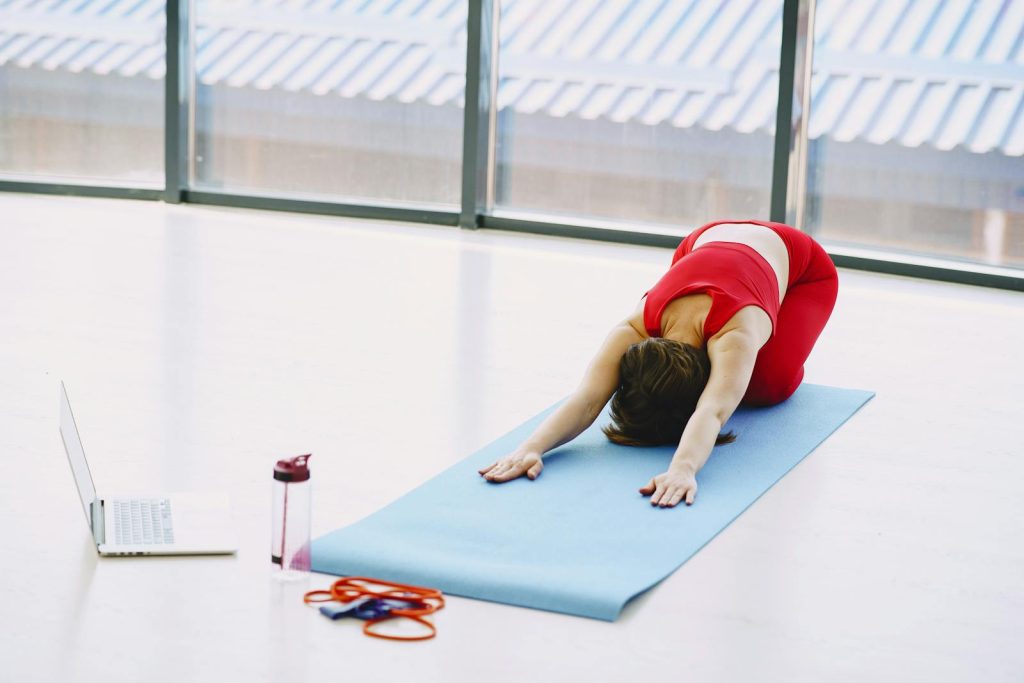
This guide covers the best lat stretches for tight lats, shoulders, and upper back stiffness, with step-by-step form cues, common mistakes, beginner options, progressions, and a simple lat mobility routine you can use after workouts or on recovery days.
What Are Lat Stretches?
Lat stretches are exercises that place the latissimus dorsi in a lengthened position, usually by reaching the arms forward, overhead, or slightly across the body while keeping the ribs and spine controlled.
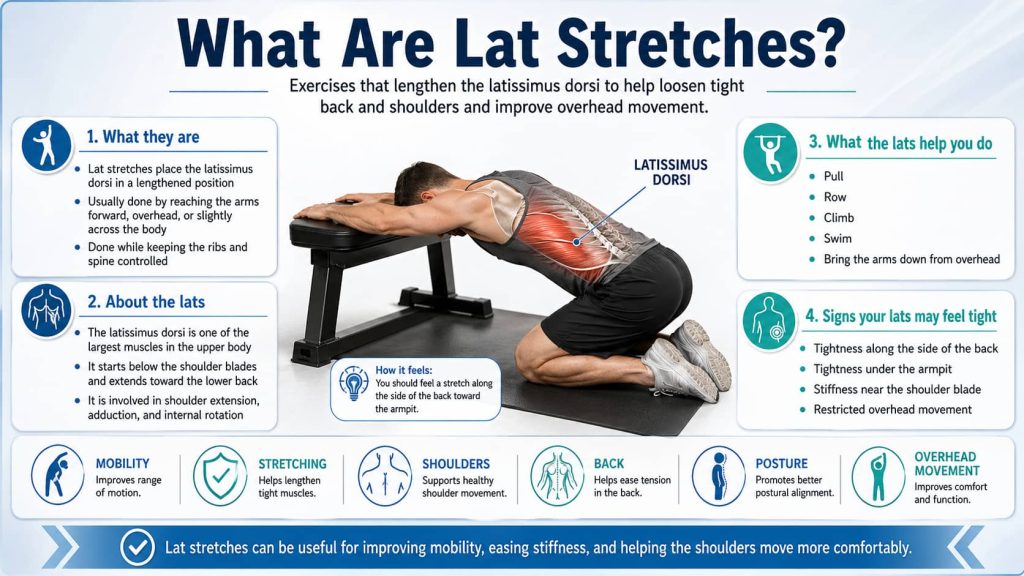
The latissimus dorsi is one of the largest muscles in the upper body. The Cleveland Clinic explains that the lats start below the shoulder blades and extend toward the lower back, while NCBI Bookshelf describes the latissimus dorsi as a broad, flat muscle involved in shoulder extension, adduction, and internal rotation.
In simple terms, your lats help you pull, row, climb, swim, and bring your arms down from an overhead position. When they feel stiff, you may notice tightness along the side of your back, under your armpit, or near your shoulder blade.
Why Tight Lats Can Affect Your Back and Shoulders
Tight lats can limit how freely your arms move overhead. If your lats do not lengthen well, your body may compensate by arching your lower back, flaring your ribs, shrugging your shoulders, or moving your arms forward instead of straight overhead.
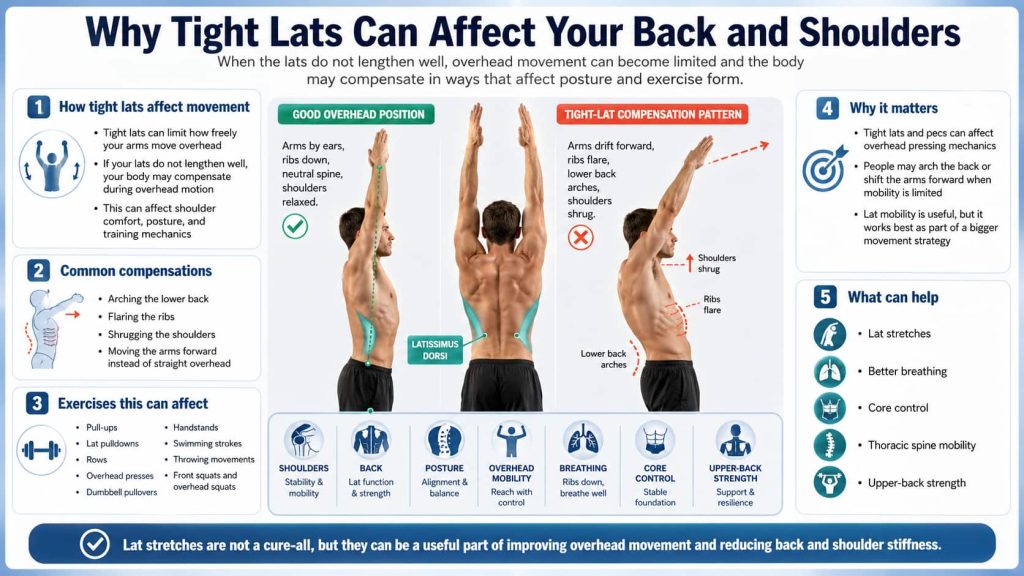
This matters for exercises such as:
- Pull-ups
- Lat pulldowns
- Rows
- Overhead presses
- Dumbbell pullovers
- Handstands
- Swimming strokes
- Throwing movements
- Front squats and overhead squats
The National Academy of Sports Medicine notes that tight pecs and lats can affect overhead pressing mechanics because people may arch the back or shift the arms forward when these muscles lack mobility.
Lat stretches are not a cure-all, but they can be useful when paired with better breathing, core control, thoracic spine mobility, and upper-back strength.
Muscles Worked During Lat Stretches
Lat stretches mainly target the latissimus dorsi, but depending on the variation, you may also feel a stretch or gentle movement through:
- Teres major
- Rear shoulder
- Serratus anterior
- Thoracic spine
- Obliques
- Lower back fascia
- Triceps long head
- Chest and rib cage area
You should usually feel lat stretches along the side of your torso, under the armpit, or through the outer upper back. You should not feel sharp pain inside the shoulder joint.
How Lat Stretches Should Feel
A good lat stretch should feel like mild to moderate tension, not pain. You should be able to breathe slowly and keep your ribs, neck, and shoulders relaxed.
Use these simple rules:
- Keep the stretch intensity around 3 to 6 out of 10.
- Avoid bouncing or forcing the position.
- Keep your ribs from flaring upward.
- Breathe into the side of your rib cage.
- Stop if you feel sharp pain, numbness, tingling, dizziness, or unusual symptoms.
The American Academy of Orthopaedic Surgeons uses gentle shoulder-stretching guidance such as holding stretches around 30 seconds and avoiding painful pressure, which fits well for safe lat mobility work.
11 Best Lat Stretches to Release Tight Back and Shoulders
Discover the 11 best lat stretches to help loosen tight lats, release back and shoulder stiffness, and improve overhead mobility.
These stretches include beginner-friendly, supported, and deeper variations you can use after workouts, on recovery days, or whenever your upper body feels tight.
1. Standing 90 Lat Stretch
Best for:
The standing 90 lat stretch is best for beginners who want a simple, no-equipment stretch for tight lats, shoulders, and upper back stiffness.
Muscles worked:
This stretch mainly targets the latissimus dorsi. It may also involve the teres major, rear shoulder, thoracic spine, and lower back fascia.
Equipment needed:
No equipment is required, but you can place your hands on a wall, countertop, squat rack, or sturdy bench for support.
Why it stands out:
This is one of the easiest lat stretches to learn because you can control how deep the stretch feels by changing your hip position. The American Council on Exercise describes a 90 lat stretch using a braced core, stable spine, straight arms, and controlled hip movement.
Suggested sets and reps:
Hold for 20–30 seconds. Repeat 2–4 times.
How to do it:
- Stand facing a wall, rack, or bench.
- Place your hands on the surface about shoulder-width apart.
- Step back until your arms are straight.
- Push your hips back and lower your chest slightly.
- Keep your spine long and your ribs controlled.
- Breathe slowly and feel the stretch along the sides of your back.
- Return to standing with control.
Common mistakes:
Rounding the upper back too much, shrugging the shoulders, locking the knees hard, letting the ribs flare, or forcing the chest too low.
Coaching cue:
“Reach long through your arms while pulling your ribs gently down.”
Exercise variations:
Try it with palms facing down, thumbs up, or one arm at a time to find the best angle for your shoulders.
How to use in a workout:
Use this after upper-body training, after pull-ups or rows, or during a short mobility break after sitting.
2. Kneeling Bench Lat Stretch
Best for:
The kneeling bench lat stretch is best for people who want a deeper lat stretch with more support than a standing version.
Muscles worked:
This stretch targets the lats, teres major, triceps long head, thoracic spine, and shoulder flexion range.
Equipment needed:
A flat bench, box, couch, chair, or sturdy elevated surface.
Why it stands out:
The bench gives your arms a fixed support point, allowing you to sit your hips back and lengthen the lats more gradually. The American Council on Exercise recommends bracing the core, placing the hands on a bench, keeping the arms straight, and leaning back into the hips with a controlled spine.
Suggested sets and reps:
Hold for 20–40 seconds. Repeat 2–3 times.
How to do it:
- Kneel on the floor in front of a bench.
- Place both hands on the bench with your arms straight.
- Keep your knees about hip-width apart.
- Brace your core lightly.
- Shift your hips back toward your heels.
- Let your chest lower slightly without collapsing your spine.
- Hold the stretch while breathing slowly.
Common mistakes:
Dropping the head too far, arching the low back, pushing into shoulder pain, or letting the elbows bend too much.
Coaching cue:
“Send your hips back, not your lower back down.”
Exercise variations:
Hold a dowel, PVC pipe, or light stick between both hands to increase the stretch through the lats and triceps.
How to use in a workout:
Use it after back day, pull day, swimming, climbing, or any workout with heavy pulling volume.
3. Child’s Pose Lat Stretch
Best for:
Child’s pose lat stretch is best for beginners, recovery days, and people who want a relaxing stretch for the back and shoulders.
Muscles worked:
This stretch targets the lats, mid-back, lower back, shoulders, and hips.
Equipment needed:
No equipment is needed. A mat can make it more comfortable.
Why it stands out:
Child’s pose is easy to scale and naturally encourages slow breathing. It is a good option when your shoulders feel stiff but you do not want an aggressive overhead stretch.
Suggested sets and reps:
Hold for 30–60 seconds. Repeat 1–3 times.
How to do it:
- Start on your hands and knees.
- Bring your big toes together and open your knees slightly.
- Walk your hands forward.
- Sit your hips back toward your heels.
- Reach your arms long in front of you.
- Keep your forehead near the floor or on a block.
- Breathe into your upper back and side ribs.
Common mistakes:
Holding your breath, forcing the shoulders down, letting the hands go soft, or trying to make the stretch painful.
Coaching cue:
“Reach your fingertips forward while your hips move back.”
Exercise variations:
Place a pillow under your chest, a yoga block under your forehead, or a folded towel behind your knees for comfort.
How to use in a workout:
Use it as part of a cooldown after upper-body training or as a gentle evening mobility drill.
4. Side-Reach Child’s Pose
Best for:
Side-reach child’s pose is best for stretching one lat at a time and finding tightness on the left or right side.
Muscles worked:
This stretch targets the latissimus dorsi, obliques, side body, lower back, and thoracic spine.
Equipment needed:
No equipment is needed.
Why it stands out:
The side reach changes the angle of the stretch, which can help you feel the lat more clearly than a standard child’s pose.
Suggested sets and reps:
Hold for 20–40 seconds per side. Repeat 2 times per side.
How to do it:
- Start in child’s pose with your arms reaching forward.
- Walk both hands to the right.
- Keep your hips heavy toward your heels.
- Let the left side of your back lengthen.
- Breathe slowly for the full hold.
- Return to center.
- Repeat on the other side.
Common mistakes:
Lifting one hip too much, twisting instead of side-bending, or jamming the shoulder into the floor.
Coaching cue:
“Reach diagonally through your hands while keeping both hips heavy.”
Exercise variations:
Cross one hand over the other to increase the stretch, or place your hands on a yoga block to reduce shoulder pressure.
How to use in a workout:
Use it after lat pulldowns, rows, pull-ups, or any workout where one side feels tighter than the other.
5. Wall Lat Stretch
Best for:
The wall lat stretch is best for improving overhead reach and practicing shoulder control while standing.
Muscles worked:
This stretch targets the lats, shoulders, upper back, serratus anterior, and rib cage area.
Equipment needed:
A wall.
Why it stands out:
The wall gives you feedback. If your ribs flare, your lower back arches, or your shoulders shrug, you can feel it and correct your position.
Suggested sets and reps:
Hold for 20–30 seconds. Repeat 2–3 times.
How to do it:
- Stand facing a wall.
- Place both hands on the wall above shoulder height.
- Step back slightly.
- Keep your arms straight but not locked.
- Shift your hips back and lower your chest gently.
- Keep your ribs down and neck relaxed.
- Hold while breathing slowly.
Common mistakes:
Overarching the lower back, shrugging the shoulders, bending the elbows, or placing the hands too high too soon.
Coaching cue:
“Keep your ribs stacked over your pelvis.”
Exercise variations:
Do one arm at a time to focus on the tighter side, or turn your thumb upward to make the shoulder position more comfortable.
How to use in a workout:
Use it before overhead pressing as a gentle mobility drill or after training as a cooldown stretch.
6. Doorway Lat Stretch
Best for:
The doorway lat stretch is best for people who need a quick standing stretch at home, in the gym, or at work.
Muscles worked:
This stretch targets the lats, teres major, shoulder, and side body.
Equipment needed:
A doorway, doorframe, rack, or sturdy post.
Why it stands out:
The doorway gives you a firm anchor point, which makes it easy to lean back and stretch one side at a time.
Suggested sets and reps:
Hold for 20–30 seconds per side. Repeat 2–3 times per side.
How to do it:
- Stand beside a doorway or sturdy post.
- Hold the frame with one hand at about head height.
- Step your feet slightly away from the frame.
- Sit your hips back.
- Let your torso lean away from your gripping hand.
- Keep your shoulder relaxed.
- Breathe into the side of your back.
Common mistakes:
Pulling too hard with the hand, twisting aggressively, shrugging the shoulder, or letting the lower back collapse.
Coaching cue:
“Lean your hips away, but keep your shoulder out of your ear.”
Exercise variations:
Change your hand height. A higher hand position may stretch more overhead range, while a lower hand position may feel gentler.
How to use in a workout:
Use it as a quick stretch between long desk sessions or after back and shoulder training.
7. Foam Roller Lat Stretch
Best for:
The foam roller lat stretch is best for people who want a combination of gentle pressure, soft-tissue work, and side-body mobility.
Muscles worked:
This stretch targets the lats, teres major, outer back, rear shoulder, and rib cage area.
Equipment needed:
A foam roller.
Why it stands out:
This variation lets you place gentle pressure along the side of the back while also reaching the arm overhead. It can be helpful before mobility drills or after upper-body workouts.
Suggested sets and reps:
Spend 30–60 seconds per side. Use slow, controlled movement.
How to do it:
- Lie on your side with a foam roller under the outer upper back.
- Position the roller below the armpit, not directly in the armpit.
- Extend your top arm overhead.
- Use your legs to control pressure.
- Slowly roll a few inches up and down the side of your back.
- Pause on tight spots and breathe.
- Switch sides.
Common mistakes:
Rolling too fast, pressing directly into the armpit, holding your breath, or using painful pressure.
Coaching cue:
“Move slowly and breathe into the area you are stretching.”
Exercise variations:
Keep your bottom knee bent for support, or place your top hand on the floor if the overhead position feels too intense.
How to use in a workout:
Use it before lat stretches to reduce tension or after training as part of a recovery routine.
8. Thread-the-Needle Lat Stretch
Best for:
Thread-the-needle lat stretch is best for people who want a stretch that combines lat lengthening with upper-back rotation.
Muscles worked:
This stretch targets the lats, thoracic spine, rear shoulder, rhomboids, and upper back.
Equipment needed:
No equipment is needed.
Why it stands out:
The lats connect into the trunk and influence shoulder movement, so adding controlled rotation can make this stretch feel more complete for the upper back.
Suggested sets and reps:
Hold for 20–30 seconds per side or perform 6–8 slow reps per side.
How to do it:
- Start on your hands and knees.
- Reach your right arm under your left arm.
- Let your right shoulder and side of your head move toward the floor.
- Keep your hips stacked over your knees.
- Breathe into your upper back.
- Return to the starting position.
- Repeat on the other side.
Common mistakes:
Shifting the hips too far back, collapsing onto the shoulder, forcing the neck down, or rushing the movement.
Coaching cue:
“Rotate through your upper back, not your lower back.”
Exercise variations:
Place a yoga block under your shoulder or head if the floor feels too far away.
How to use in a workout:
Use it during a warm-up before upper-body training or as a cooldown stretch after pulling exercises.
9. Stability Ball Lat Stretch
Best for:
The stability ball lat stretch is best for people who want a supported stretch with a smooth range of motion.
Muscles worked:
This stretch targets the lats, shoulders, triceps long head, thoracic spine, and side body.
Equipment needed:
A stability ball.
Why it stands out:
The ball allows your arms to glide forward as your hips shift back, which can make the stretch feel smoother than a fixed bench or wall.
Suggested sets and reps:
Hold for 20–40 seconds. Repeat 2–3 times.
How to do it:
- Kneel in front of a stability ball.
- Place both hands or forearms on the ball.
- Brace your core lightly.
- Roll the ball forward as you sit your hips back.
- Lower your chest gently.
- Keep your spine long.
- Breathe slowly and return with control.
Common mistakes:
Letting the ball roll too far away, dropping the lower back, shrugging the shoulders, or losing balance.
Coaching cue:
“Let the ball move, but keep your ribs under control.”
Exercise variations:
Perform it one arm at a time or angle the ball slightly to one side for a stronger stretch through one lat.
How to use in a workout:
Use it after a back workout, shoulder workout, or full-body session that includes pulling and pressing.
10. Hanging Lat Stretch
Best for:
The hanging lat stretch is best for intermediate exercisers who can safely support their body weight from a pull-up bar.
Muscles worked:
This stretch targets the lats, shoulders, grip, upper back, and trunk.
Equipment needed:
A pull-up bar or sturdy overhead bar.
Why it stands out:
A controlled hang can create a strong stretch through the lats because the arms are overhead and the body is gently lengthened by gravity.
Suggested sets and reps:
Hold for 10–30 seconds. Repeat 2–4 times.
How to do it:
- Hold a pull-up bar with both hands.
- Use a grip slightly wider than shoulder-width.
- Let your body hang with control.
- Keep your shoulders active instead of completely loose.
- Keep your ribs down and legs quiet.
- Breathe slowly.
- Step down carefully.
Common mistakes:
Dropping into a passive hang too aggressively, shrugging painfully, holding too long, or using this stretch when the shoulder feels unstable.
Coaching cue:
“Hang tall, but keep control in your shoulders.”
Exercise variations:
Keep your feet on a box or the floor to reduce body weight. Advanced exercisers can use a gentle side-to-side shift, but only if it feels controlled.
How to use in a workout:
Use it after pull-ups, climbing, deadlifts, or back training. Avoid using long passive hangs right before heavy pressing if it makes your shoulders feel loose or unstable.
11. Overhead Band Lat Stretch
Best for:
The overhead band lat stretch is best for people who want a deeper, assisted lat stretch with more control than a hanging stretch.
Muscles worked:
This stretch targets the lats, teres major, shoulders, triceps long head, upper back, and side body.
Equipment needed:
A resistance band and a sturdy overhead anchor, such as a pull-up bar or squat rack.
Why it stands out:
The band gently pulls the arm overhead and forward, helping you find a strong lat stretch without needing to support your full body weight. It is especially useful after pull-ups, rows, lat pulldowns, or overhead training.
Suggested sets and reps:
Hold for 20–30 seconds per side. Repeat 2–3 times per side.
How to do it:
- Attach a resistance band to a sturdy overhead anchor.
- Hold the band with your right hand.
- Step back until there is light tension in the band.
- Hinge your hips back slightly.
- Let your right arm reach forward and overhead.
- Keep your ribs down and shoulder relaxed.
- Breathe into the right side of your back.
- Switch sides.
Common mistakes:
Using too much band tension, shrugging the shoulder, twisting the torso, arching the lower back, or letting the band pull the arm into discomfort.
Coaching cue:
“Let the band lengthen your arm while you keep your ribs controlled.”
Exercise variations:
Use a lighter band for a gentler stretch, kneel instead of standing for more control, or angle your body slightly to target one side more strongly.
How to use in a workout:
Use it after back training, pull-ups, lat pulldowns, or overhead lifting as part of a cooldown or mobility routine.
How Long Should You Hold Lat Stretches?
For most static lat stretches, hold each position for 20–30 seconds and repeat 2–4 times. That is enough for most people to feel a useful stretch without turning the session into a long mobility workout.
General stretching guidance often recommends holding static stretches for about 10–30 seconds, while older adults may benefit from slightly longer holds. The VA Whole Health Library summarizes American College of Sports Medicine guidance by noting that adults can perform stretching at least two days per week and spend about one minute total on each major muscle-tendon group.
A practical starting point:
| Goal | Hold Time | Sets |
|---|---|---|
| Quick desk break | 15–20 seconds | 1–2 |
| Post-workout cooldown | 20–30 seconds | 2–3 |
| Dedicated mobility session | 30–45 seconds | 2–4 |
| Gentle recovery day | 30–60 seconds | 1–3 |
Do not chase extreme range of motion. Better breathing, control, and consistency matter more than forcing a deep stretch.
When to Do Lat Stretches: Warm-Up or Cooldown?
You can use lat stretches before or after training, but the style should change depending on the goal.
Before a workout
Use lighter, more active lat mobility. Keep holds short and controlled. Good options include:
- Wall lat stretch
- Thread-the-needle
- Standing 90 lat stretch
- Stability ball lat stretch
Hold each stretch for 10–20 seconds or move through slow reps. The goal is to improve movement, not relax the muscle completely before heavy lifting.
After a workout
Use longer static holds. Good options include:
- Kneeling bench lat stretch
- Child’s pose lat stretch
- Side-reach child’s pose
- Doorway lat stretch
- Half-kneeling side-bend lat stretch
Hold each stretch for 20–40 seconds and breathe slowly.
On recovery days
Use a relaxed routine with 3–5 stretches. Move slowly, avoid pain, and focus on breathing into the side ribs and upper back.
Common Lat Stretch Mistakes
Arching the lower back
This is the most common mistake. If your lower back arches every time you reach overhead, you may not be stretching the lats as well as you think. Keep your ribs down and your core lightly braced.
Shrugging the shoulders
If your shoulders climb toward your ears, your neck and upper traps may take over. Keep your shoulders relaxed and your neck long.
Forcing the shoulder joint
Lat stretches should not feel like pinching, sharpness, or deep joint pain in the front of the shoulder. Adjust the angle, reduce the range, or choose a gentler variation.
Holding your breath
Slow breathing helps your ribs move and your trunk relax. Try a slow inhale through the nose and a longer exhale through the mouth.
Going too intense too soon
A mild stretch done consistently is better than one aggressive stretch that irritates your shoulder or back.
Stretching only one way
The lats are large muscles. Use a mix of forward reach, overhead reach, side reach, and supported positions for better coverage.
Sample Lat Mobility Routine
Use this routine after training or on a recovery day.
Beginner Lat Stretch Routine
- Child’s Pose Lat Stretch — 30 seconds
- Standing 90 Lat Stretch — 20 seconds
- Wall Lat Stretch — 20 seconds
- Side-Reach Child’s Pose — 20 seconds per side
Repeat for 1–2 rounds.
Intermediate Lat Stretch Routine
- Foam Roller Lat Stretch — 45 seconds per side
- Kneeling Bench Lat Stretch — 30 seconds
- Thread-the-Needle Lat Stretch — 6 slow reps per side
- Half-Kneeling Side-Bend Lat Stretch — 30 seconds per side
Repeat for 2 rounds.
Post-Workout Lat Cooldown
- Doorway Lat Stretch — 30 seconds per side
- Kneeling Bench Lat Stretch — 30 seconds
- Side-Reach Child’s Pose — 30 seconds per side
Repeat for 1–3 rounds.
How Often Should You Stretch Your Lats?
Most people can stretch their lats 2–4 days per week. If your lats feel very tight from lifting, swimming, climbing, or sitting with poor posture, you may benefit from short daily mobility work.
Start with 5 minutes. Choose 3 stretches and stay consistent for a few weeks. If your overhead reach improves and your shoulders feel better during training, you are on the right track.
If stretching does not help, or if your shoulder feels painful, unstable, weak, numb, or limited on one side, get individual guidance from a qualified professional.
Who Should Be Careful With Lat Stretches?
Be careful with lat stretches if you have:
- Current shoulder pain
- Recent shoulder, back, rib, or neck injury
- Shoulder instability
- Numbness or tingling down the arm
- Pain that gets worse with overhead movement
- Dizziness during stretching
- Recent surgery or medical restrictions
Lat stretches should feel controlled and comfortable. Stop if symptoms feel sharp, unusual, or nerve-like.
FAQs About Lat Stretches
What is the best stretch for tight lats?
The kneeling bench lat stretch is one of the best options for tight lats because it gives you support and allows a strong but controlled stretch. Beginners may prefer the standing 90 lat stretch or child’s pose lat stretch.
How do I know if my lats are tight?
You may notice limited overhead reach, tightness under the armpit, stiffness along the side of your back, rib flare when you raise your arms, or low-back arching during overhead exercises. Tight lats can be one reason, but shoulder, rib, and upper-back mobility can also play a role.
Should lat stretches hurt?
No. Lat stretches should create mild to moderate tension, not sharp pain. If you feel pinching in the shoulder, numbness, tingling, or pain that travels down the arm, stop and choose a gentler position.
How long should I hold a lat stretch?
Most people can hold lat stretches for 20–30 seconds and repeat them 2–4 times. Longer holds may be useful during recovery work, but they should still feel comfortable and controlled.
Can tight lats cause shoulder problems?
Tight lats may contribute to restricted overhead movement and compensations such as low-back arching or forward arm position. They are not the only factor, so it is also important to train shoulder strength, upper-back control, and thoracic mobility.
Are lat stretches good before pull-ups?
Yes, but keep them light before training. Use short holds or active mobility drills before pull-ups. Save longer static lat stretches for after your workout.
What is the fastest way to loosen tight lats?
Use a simple combination of foam rolling, supported lat stretching, slow breathing, and consistent practice. A quick routine could include foam roller lat work, kneeling bench lat stretch, and side-reach child’s pose for 5 minutes.
Conclusion
Lat stretches can help release tightness through the sides of your back, improve overhead comfort, and support better shoulder movement during training. The key is to stretch with control, breathe slowly, and avoid forcing painful positions.
Choose 3–5 stretches from this guide and use them after workouts, during recovery days, or whenever your back and shoulders feel stiff. Start with gentle options, stay consistent, and progress only when your movement feels smooth and pain-free.
References
- NCBI Bookshelf — Anatomy, Back, Latissimus Dorsi
- NCBI Bookshelf — Anatomy, Shoulder and Upper Limb, Scapulohumeral Muscles
- American Council on Exercise — 90 Lat Stretch
- American Council on Exercise — Kneeling Lat Stretch With Bench
- NASM — Smart Moves for Strong Shoulders
- PMC — Current Concepts in Muscle Stretching for Exercise and Rehabilitation