The barbell hack squat is a quad-focused lower-body exercise where you lift a barbell from behind your legs instead of placing it on your back. It trains your legs with a squat-style movement while keeping the load lower and behind the body.
This guide explains how to do the barbell hack squat with proper form, which muscles it works, the main benefits, common mistakes, useful variations, and how to add it to your leg workout.
What Is the Barbell Hack Squat?
The barbell hack squat is an old-school squat variation performed with the barbell behind your legs. You stand in front of the bar, squat down to grip it from behind, then stand up while keeping the bar close to the backs of your legs.
It looks like a mix between a squat and a deadlift, but the goal is different. A conventional deadlift usually emphasizes the hips, hamstrings, glutes, and back more. The barbell hack squat uses more knee bend and a more upright torso, which can shift more work toward the quadriceps.
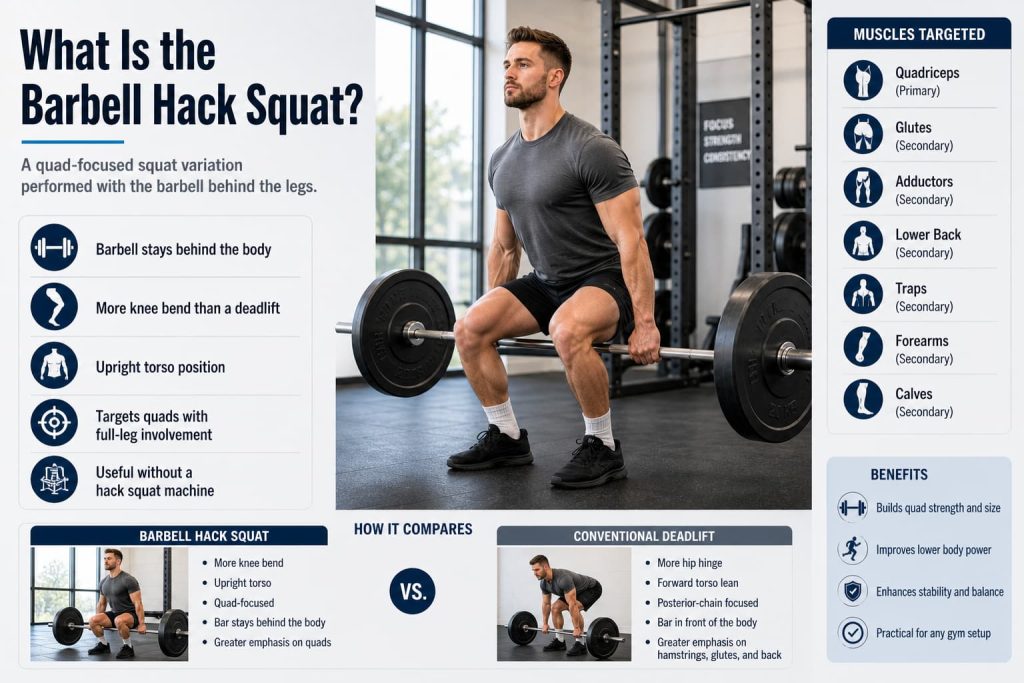
According to StrengthLog, the barbell hack squat mainly targets the quads while also involving the glutes, adductors, lower back, traps, forearms, and calves.
It is especially useful if you want a quad-focused leg exercise but do not have access to a hack squat machine.
Barbell Hack Squat Muscles Worked
The barbell hack squat is a compound lower-body exercise. That means several joints and muscle groups work together during the movement.
Primary Muscle Worked
Quadriceps:
The quads are the main target. They work hard to straighten your knees as you stand up from the bottom position. The more upright your torso stays and the more your knees travel forward with control, the more quad-focused the exercise usually feels.
Secondary Muscles Worked
Glutes:
Your glutes help extend your hips as you stand tall.
Adductors:
The inner thigh muscles assist with hip control and help stabilize your legs during the squat.
Hamstrings:
The hamstrings assist with hip extension and help control your lower-body position, though they are usually not the main target.
Calves:
Your calves help stabilize the ankle and support the lower-body drive from the floor.
Core:
Your abs, obliques, and deep core muscles help keep your torso braced and stable.
Lower back and upper back:
Your spinal erectors and upper back muscles help maintain posture and keep the bar path controlled.
Forearms and grip:
Because you hold the bar behind your legs, your grip and forearms work to keep the bar secure.
The National Academy of Sports Medicine explains that squat movements involve coordinated action at the hips, knees, and ankles, with muscles such as the quadriceps, glutes, hamstrings, adductors, calves, erector spinae, and core all playing a role.
Benefits of the Barbell Hack Squat
It Builds Quad Strength
The barbell hack squat is one of the more quad-dominant barbell leg exercises. Because the bar sits behind your body, many lifters naturally stay more upright than they would during a conventional deadlift.
That upright position can make the movement feel more like a squat and less like a hip hinge.
It Requires Minimal Equipment
You only need a barbell and plates. That makes it a useful option for garage gyms, small gyms, or lifters who do not have access to a hack squat machine.
It Trains a Strong Squat Pattern
The exercise trains knee extension, hip extension, core bracing, and full-body control. These are all useful for building stronger legs and improving general lower-body training performance.
It Can Be a Useful Accessory Lift
The barbell hack squat works well after your main heavy lift. For example, you can perform it after back squats, front squats, deadlifts, or leg press to add more quad-focused volume.
It Adds Variety to Leg Training
Some lifters get bored doing only back squats, leg press, and lunges. The barbell hack squat gives you another way to train the quads without needing a machine.
How to Do the Barbell Hack Squat With Proper Form
How to do it:
- Place a loaded barbell on the floor behind your legs.
- Stand in front of the bar with your feet about shoulder-width apart.
- Turn your toes slightly outward if that feels natural.
- Squat down and grip the bar behind your body with an overhand grip.
- Brace your core, lift your chest, and keep your back neutral.
- Push through your feet and stand up by extending your knees and hips together.
- Keep the bar close to the backs of your legs as you lift.
- Stand tall at the top without leaning backward.
- Lower the bar under control by bending your knees and hips.
- Reset your brace before the next rep.
The Weight Training Guide describes the movement with a shoulder-width stance, slightly turned-out feet, an overhand grip behind the body, a straight back, and the bar traveling up the backs of the legs.
Suggested sets and reps:
For beginners, start with 2–3 sets of 8–10 reps using a light load. For muscle growth, use 3–4 sets of 8–15 reps. For strength-focused accessory work, use 3–5 sets of 5–8 reps with clean form.
Coaching cue:
“Push the floor away, keep your chest tall, and drag the bar straight up the backs of your legs.”
Common Barbell Hack Squat Mistakes
Rounding Your Back
A rounded back usually means you are losing your brace, starting too low, or using more weight than you can control.
Keep your chest up, brace your core before each rep, and stop the set if your back position breaks down.
Letting the Bar Drift Away
The bar should stay close to your legs. If it drifts backward or swings away, the lift becomes harder to control and may pull you out of position.
Think about keeping the bar close without scraping aggressively against your legs.
Turning It Into a Deadlift
If your hips shoot up first and your torso folds forward, the exercise becomes more like a deadlift. That reduces the quad focus.
Your knees and hips should extend together as you stand.
Lifting Your Heels
Your feet should stay flat on the floor. If your heels rise, you may be forcing too much depth, using a stance that does not fit you, or lacking ankle mobility.
The American Council on Exercise teaches squatters to keep the heels flat and the knees aligned over the toes during the upward phase of a squat.
Letting Your Knees Collapse Inward
Your knees should track in the same general direction as your toes. If they collapse inward, reduce the weight and focus on controlled knee alignment.
The National Academy of Sports Medicine notes that knee valgus during squatting is often linked with ankle mobility limitations and weakness in hip and core stabilizers.
Going Too Heavy Too Soon
The barbell hack squat can feel awkward at first. Starting too heavy often leads to poor posture, short reps, or the bar drifting away from the body.
Learn the movement with an empty bar or light plates first.
Forcing Too Much Range of Motion
Deeper is not always better if your form falls apart. Lower until you can maintain a neutral spine, flat feet, and controlled knee tracking.
Barbell Hack Squat vs Machine Hack Squat
The barbell hack squat and machine hack squat train similar muscles, but they feel very different.
Barbell Hack Squat
The barbell version requires more balance, grip strength, coordination, and body control. The bar path is not fixed, so you must control the movement yourself.
It is more accessible if you only have basic equipment, but it can feel awkward for beginners.
Machine Hack Squat
The machine hack squat uses a guided track. This gives you more stability and lets you focus more directly on your legs without worrying as much about balance or grip.
The machine version is often easier to load heavily and may feel more comfortable for lifters who struggle with the behind-the-body bar path.
Which One Is Better?
Neither is automatically better. Choose based on your equipment, comfort, goal, and form quality.
Use the barbell hack squat if you want a simple equipment option and can perform it with control.
Use the machine hack squat if you want more stability, easier loading, and a more guided quad-focused movement.
Barbell Hack Squat vs Back Squat
The back squat places the bar on your upper back. The barbell hack squat places the bar behind your legs.
Back Squat
The back squat is usually better for overall lower-body strength because it lets most lifters use heavier loads. It trains the quads, glutes, adductors, back, and core in a powerful full-body pattern.
Barbell Hack Squat
The barbell hack squat is usually better as a quad-focused accessory exercise. It does not replace the back squat for most lifters, but it can help add extra leg volume.
Best Use
Use back squats as a main strength lift if they feel good and match your goals. Use barbell hack squats as an accessory movement to add more quad work.
Best Barbell Hack Squat Variations and Alternatives
1. Heel-Elevated Barbell Hack Squat
Best for: Quad focus, upright posture, and better squat depth.
Muscles worked: Quads, glutes, adductors, calves, core, back, and forearms.
Equipment needed: Barbell, weight plates, and a heel wedge or small plates.
Why it stands out: Elevating the heels can make it easier to keep the torso upright and let the knees travel forward with control. This often makes the exercise feel more quad-focused than the standard version.
Suggested sets and reps: Beginners: Start with 2 sets of 8–10 reps using a light load and a small heel elevation.
- Intermediate: Use 3–4 sets of 8–12 reps with a moderate load and controlled depth.
- Advanced: Use 3–5 sets of 6–12 reps, or use slower eccentrics to increase quad tension without adding too much weight.
- Rest: Rest 90–180 seconds between sets depending on the load and effort.
How to do it:
- Place a stable wedge or small plates under your heels.
- Set the barbell on the floor behind your legs.
- Stand with your feet about shoulder-width apart and toes slightly turned out.
- Squat down and grip the bar behind your body with an overhand grip.
- Brace your core, lift your chest, and keep your back neutral.
- Push through your feet and stand up while keeping the bar close to your legs.
- Lower under control until you reach a strong position without your back rounding.
- Repeat for the target reps.
Common mistakes: Common mistakes include using an unstable heel lift, letting the knees collapse inward, rounding the back, leaning too far forward, or forcing more depth than you can control.
Expert tip: Use the smallest heel elevation that helps your form. A higher wedge is not automatically better if it makes you lose balance or control.
2. Tempo Barbell Hack Squat
Best for: Better control, stronger technique, and more quad tension.
Muscles worked: Quads, glutes, adductors, calves, core, back, and grip.
Equipment needed: Barbell and weight plates.
Why it stands out: Slowing down the lowering phase increases time under tension and helps you feel whether your bar path, bracing, and knee tracking are staying consistent.
Suggested sets and reps: Beginners: Use 2–3 sets of 6–8 reps with a 3-second lowering phase and light weight.
- Intermediate: Use 3–4 sets of 8–10 reps with a 3–4 second lowering phase.
- Advanced: Use 3–4 sets of 6–10 reps with a slow eccentric, brief pause, and controlled drive up.
- Rest: Rest 90–180 seconds between sets because tempo reps create more fatigue than normal reps.
How to do it:
- Set the barbell on the floor behind your legs.
- Stand in front of the bar with your feet about shoulder-width apart.
- Squat down and grip the bar behind your body.
- Brace your core and keep your chest tall.
- Stand up with control while keeping the bar close.
- Lower for 3–4 seconds without bouncing or rushing.
- Pause briefly if needed, then stand up smoothly.
- Repeat each rep with the same tempo.
Common mistakes: Common mistakes include counting the tempo too quickly, relaxing at the bottom, letting the hips shoot up first, or using a load that is too heavy to control.
Expert tip: Think “slow down, stay tight, then drive.” The goal is not just moving slowly; it is staying strong in every position.
3. Goblet Squat
Best for: Beginners, squat practice, and easier setup.
Muscles worked: Quads, glutes, adductors, hamstrings, calves, core, upper back, and arms.
Equipment needed: Dumbbell or kettlebell.
Why it stands out: Holding the weight in front of your chest helps many lifters stay upright, brace better, and learn proper squat depth and knee tracking.
Suggested sets and reps: Beginners: Use 2–3 sets of 8–12 reps with a light dumbbell or kettlebell.
- Intermediate: Use 3–4 sets of 10–15 reps with a moderate load.
- Advanced: Use 3–4 sets of 12–20 reps as a warm-up, accessory lift, or quad-focused finisher.
- Rest: Rest 60–120 seconds between sets.
How to do it:
- Hold a dumbbell or kettlebell close to your chest.
- Stand with your feet about shoulder-width apart.
- Brace your core and keep your chest tall.
- Bend your knees and hips to squat down.
- Keep your feet flat and knees tracking with your toes.
- Lower as far as you can control.
- Push through your feet to stand tall.
- Repeat with smooth, controlled reps.
Common mistakes: Common mistakes include letting the weight pull the chest down, lifting the heels, collapsing the knees inward, rushing the descent, or relaxing the core at the bottom.
Expert tip: Keep the weight close to your body. If it drifts forward, your torso will usually follow.
4. Dumbbell Squat
Best for: Simple leg training without a barbell setup.
Muscles worked: Quads, glutes, adductors, hamstrings, calves, core, grip, and upper back.
Equipment needed: One or two dumbbells.
Why it stands out: Dumbbell squats are easier to set up than barbell hack squats and are more beginner-friendly. They still train the legs effectively while allowing a natural range of motion.
Suggested sets and reps: Beginners: Use 2–3 sets of 8–12 reps with light dumbbells.
- Intermediate: Use 3–4 sets of 8–15 reps with moderate dumbbells.
- Advanced: Use 4 sets of 10–20 reps, slower tempo, or heel elevation for more quad focus.
- Rest: Rest 60–150 seconds between sets.
How to do it:
- Hold one dumbbell at your chest or two dumbbells at your sides.
- Stand with your feet about shoulder-width apart.
- Brace your core and keep your chest lifted.
- Squat down by bending your knees and hips.
- Keep your feet flat and knees aligned with your toes.
- Lower until you reach a controlled depth.
- Push through the floor to stand back up.
- Repeat without swinging the dumbbells.
Common mistakes: Common mistakes include leaning too far forward, letting the dumbbells swing, rounding the back, cutting the depth too short, or letting the knees collapse inward.
Expert tip: Use dumbbell squats to build clean squat mechanics before moving to more awkward variations like the barbell hack squat.
5. Machine Hack Squat
Best for: Stable quad training and easier heavy loading.
Muscles worked: Quads, glutes, adductors, hamstrings, calves, and core.
Equipment needed: Hack squat machine.
Why it stands out: The machine provides a guided path, which reduces balance demands and lets you focus more directly on leg drive and quad tension.
Suggested sets and reps: Beginners: Use 2–3 sets of 8–12 reps with a light load and controlled depth.
- Intermediate: Use 3–4 sets of 8–15 reps for quad growth.
- Advanced: Use 4–5 sets of 6–12 reps, or higher-rep sets of 12–20 reps as a leg-day finisher.
- Rest: Rest 90–180 seconds between sets depending on load and effort.
How to do it:
- Set your back and shoulders against the pads.
- Place your feet on the platform about shoulder-width apart.
- Brace your core and unlock the safety handles.
- Lower under control by bending your knees and hips.
- Keep your knees tracking in line with your toes.
- Stop before your hips tuck or your lower back loses position.
- Push through your feet to return to the top.
- Re-lock the safety handles when finished.
Common mistakes: Common mistakes include placing the feet too high or too low for your goal, bouncing at the bottom, locking the knees aggressively at the top, using too much weight, or letting the knees cave inward.
Expert tip: Adjust foot placement based on comfort and goal. A slightly lower foot position usually feels more quad-focused, but it should never cause knee pain or loss of control.
6. Leg Press
Best for: Building leg strength and quad volume with less balance demand.
Muscles worked: Quads, glutes, adductors, hamstrings, and calves.
Equipment needed: Leg press machine.
Why it stands out: The leg press allows controlled lower-body loading without holding a barbell. This makes it a useful alternative for lifters who want to train the legs hard while reducing technical complexity.
Suggested sets and reps: Beginners: Use 2–3 sets of 10–12 reps with a light to moderate load.
- Intermediate: Use 3–4 sets of 8–15 reps.
- Advanced: Use 4–5 sets of 6–15 reps, or higher-rep sets of 15–25 reps for a demanding finisher.
- Rest: Rest 90–180 seconds between sets.
How to do it:
- Sit on the machine with your back flat against the pad.
- Place your feet on the platform about shoulder-width apart.
- Brace your core and unlock the safety handles.
- Lower the platform under control.
- Keep your knees tracking with your toes.
- Stop before your hips lift or your lower back rounds.
- Press the platform away without locking your knees aggressively.
- Re-rack the machine safely after your final rep.
Common mistakes: Common mistakes include lowering too far and rounding the lower back, using partial reps with too much weight, locking the knees hard at the top, or letting the knees collapse inward.
Expert tip: Control the bottom position. The goal is strong leg tension, not just moving the heaviest possible weight through a short range of motion.
7. Front Squat
Best for: Quad strength, upright squatting, and core control.
Muscles worked: Quads, glutes, adductors, core, upper back, spinal erectors, calves, and hamstrings.
Equipment needed: Barbell, weight plates, and a squat rack.
Why it stands out: The front-loaded bar position encourages a more upright torso and strong bracing. It is more technical than many squat variations, but it carries over well to overall squat strength and athletic movement.
Suggested sets and reps: Beginners: Start with 2–3 sets of 5–8 reps using light weight and a controlled range of motion.
- Intermediate: Use 3–5 sets of 4–8 reps for strength or 3–4 sets of 8–10 reps for muscle.
- Advanced: Use 4–6 sets of 3–6 reps for strength, or moderate-load volume work for quad development.
- Rest: Rest 2–3 minutes for heavier sets and 90–150 seconds for moderate accessory work.
How to do it:
- Set the barbell at upper-chest height in a squat rack.
- Place the bar across the front of your shoulders.
- Use a clean grip or cross-arm grip.
- Step back and set your feet about shoulder-width apart.
- Brace your core and keep your elbows lifted.
- Squat down by bending your knees and hips.
- Keep your torso tall and knees tracking with your toes.
- Drive through your feet to stand back up.
Common mistakes: Common mistakes include letting the elbows drop, losing upper-back tension, leaning forward, rounding the lower back, lifting the heels, or using more weight than your front rack position can support.
Expert tip: Keep your elbows high throughout the rep. When the elbows drop, the chest usually drops too, and the lift becomes much harder to control.
How to Add the Barbell Hack Squat to Your Leg Workout
The barbell hack squat usually works best as a secondary exercise, not the first movement of the day. Place it after your main compound lift when your body is warm but before smaller isolation exercises.
The American College of Sports Medicine emphasizes that consistency, effort, and training all major muscle groups at least twice per week matter more than chasing a perfect program.
Beginner Barbell Hack Squat Workout
Use this if you are new to the movement.
Workout:
- Goblet squat: 3 sets of 8–10 reps
- Barbell hack squat: 2–3 sets of 8–10 reps
- Dumbbell Romanian deadlift: 3 sets of 10 reps
- Step-up: 2 sets of 8 reps per leg
- Standing calf raise: 2–3 sets of 12–15 reps
Rest 90–120 seconds between sets.
Intermediate Quad-Focused Leg Workout
Use this if you already train legs consistently.
Workout:
- Back squat or front squat: 3–4 sets of 5–8 reps
- Barbell hack squat: 3–4 sets of 8–12 reps
- Walking lunge: 3 sets of 10 steps per leg
- Leg extension: 2–3 sets of 12–15 reps
- Seated or standing calf raise: 3 sets of 10–15 reps
Rest 2–3 minutes after heavier sets and 60–90 seconds after accessory sets.
Barbell Hack Squat Finisher
Use this at the end of a leg workout when you want a simple quad pump.
Finisher:
- Barbell hack squat: 2–3 sets of 12–15 reps
- Use light to moderate weight
- Lower slowly
- Stop 1–2 reps before your form breaks
Who Should Do the Barbell Hack Squat?
The barbell hack squat can be useful for:
- Lifters who want stronger quads
- People training in a basic barbell setup
- Intermediate lifters who want a new squat accessory
- Lifters who do not have a hack squat machine
- People who want a squat variation that does not place the bar on the upper back
Who Should Avoid or Modify the Barbell Hack Squat?
This exercise may not be the best choice if:
- The setup causes knee, hip, back, or shoulder discomfort
- You cannot keep your feet flat
- You cannot grip the bar comfortably behind your legs
- Your back rounds on every rep
- You are brand new to strength training and have not learned a basic squat pattern yet
If the movement feels awkward, start with goblet squats, dumbbell squats, leg press, or machine hack squats instead.
Safety Tips Before You Start
Start light. The barbell hack squat is not an ego lift.
Warm up with bodyweight squats, light goblet squats, or empty-bar reps before adding weight. Keep your reps controlled and avoid bouncing out of the bottom.
Stop the exercise if you feel sharp pain, numbness, dizziness, or unusual joint discomfort. If symptoms continue, speak with a qualified healthcare or fitness professional before continuing.
FAQs About the Barbell Hack Squat
Is the barbell hack squat good for quads?
Yes. The barbell hack squat is a strong quad-focused exercise because it uses a squat-style knee extension pattern. It also trains the glutes, adductors, calves, core, back, and grip.
Is the barbell hack squat the same as a deadlift?
No. It may look similar because the bar starts on the floor, but the goal is different. A deadlift is usually more hip-dominant, while the barbell hack squat uses more knee bend and is often performed to target the quads more directly.
Should beginners do the barbell hack squat?
Beginners can do it, but it is often better to learn bodyweight squats, goblet squats, and dumbbell squats first. The behind-the-body bar position can feel awkward, so beginners should start very light.
Why does the bar hit my legs during barbell hack squats?
The bar should stay close to your legs, but it should not crash into them. If it keeps catching, check your stance, grip width, and bar path. You may also need to slow down and use less weight.
Can barbell hack squats replace back squats?
They can replace back squats in some programs, but they are usually better as an accessory exercise. Back squats are generally easier to load heavily, while barbell hack squats are useful for extra quad volume.
How many sets and reps should I do?
For most lifters, 3–4 sets of 8–12 reps works well. Beginners can start with 2–3 sets of 8–10 reps. Use a weight that lets you keep your back neutral, feet flat, and bar path controlled.
Are barbell hack squats safe?
They can be safe when performed with proper form, appropriate weight, and controlled reps. Like any loaded lower-body exercise, they become riskier when you use too much weight, round your back, rush the setup, or ignore pain.
Conclusion
The barbell hack squat is a practical, old-school leg exercise that can help build stronger quads with only a barbell and plates. It works best when you keep your chest tall, brace your core, keep the bar close, and move with control.
Use it as a secondary leg exercise after your main squat or press, or add it as a quad-focused finisher. Start light, master the bar path, and build gradually.
References
- National Academy of Sports Medicine — Biomechanics of the Squat
- American Council on Exercise — Bodyweight Squat Exercise Guide
- American College of Sports Medicine — Updated Resistance Training Guidelines
- PMC — A Biomechanical Review of the Squat Exercise
- PMC — American College of Sports Medicine Position Stand on Resistance Training