The tricep pushdown, often searched as the tricep pull down, is a cable or resistance-band exercise that trains the back of your upper arms by extending your elbows against resistance. It is one of the best beginner-friendly exercises for isolating the triceps, improving arm definition, and building stronger lockout strength for pressing movements.
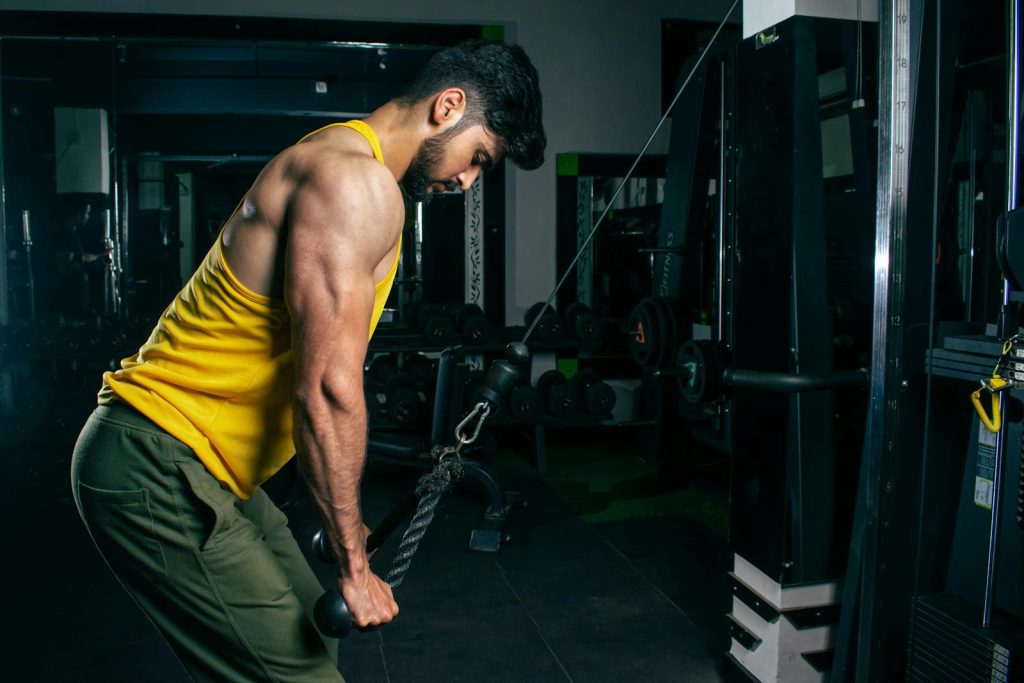
In this guide, you will learn which muscles the tricep pushdown works, how to do it with proper form, which mistakes to avoid, the best variations, and how to add it to your workout routine.
What Is the Tricep Pushdown?
The tricep pushdown is an isolation exercise performed on a high cable pulley using a rope, straight bar, V-bar, or single handle. You stand facing the cable machine, keep your elbows close to your sides, and press the attachment down by straightening your arms.
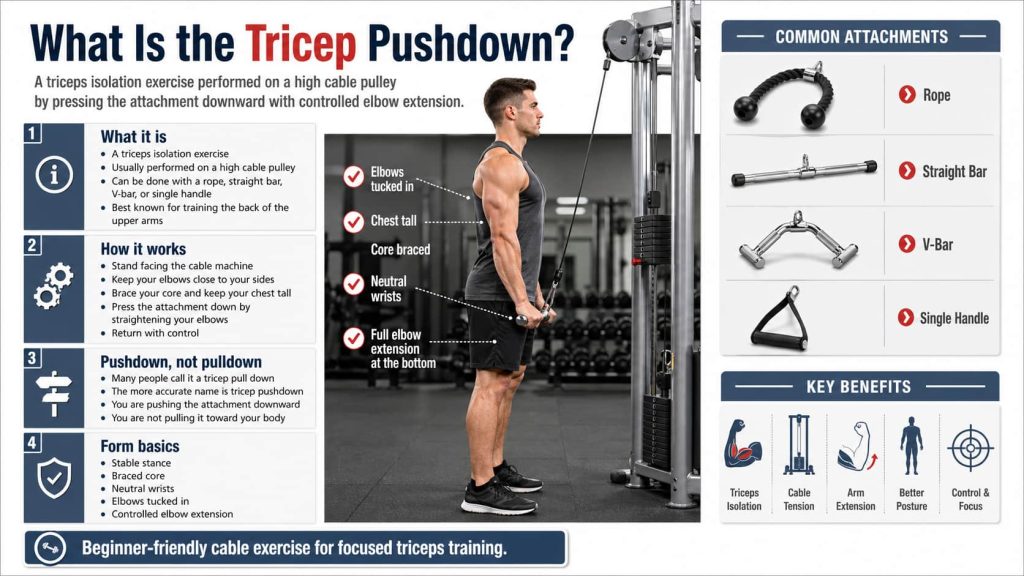
Even though many people call it a “tricep pull down,” the more accurate name is tricep pushdown because you are pushing the attachment downward, not pulling it toward your body.
The American Council on Exercise describes the triceps pushdown as a beginner-level arm exercise performed with a cable or selectorized machine, using a stable stance, braced core, neutral wrists, and controlled elbow extension.
Tricep Pushdown Muscles Worked
The main muscle worked during the tricep pushdown is the triceps brachii. This is the large muscle on the back of your upper arm.
The triceps has three heads:
Long Head
The long head runs along the inner-back portion of the upper arm. It also crosses the shoulder joint, which means it can be influenced by shoulder position. In a standard pushdown, it helps extend the elbow and contributes to overall triceps size.
Lateral Head
The lateral head sits on the outer side of the upper arm and often creates the visible “horseshoe” shape when the triceps are well developed. It is heavily involved when you press the handle down with control.
Medial Head
The medial head lies deeper and assists with elbow extension through most pressing and arm-extension movements. It may not be as visible as the lateral head, but it is important for strong, stable reps.
According to NCBI Bookshelf, the triceps brachii is made of the long, lateral, and medial heads, and its primary function is elbow extension.
Secondary Muscles Involved
The tricep pushdown is not a full-body exercise, but several muscles help you stay stable:
- Core muscles help brace your torso.
- Upper back muscles help keep your shoulders down and back.
- Forearm muscles help maintain a firm grip.
- Shoulder stabilizers help keep your upper arms steady.
The goal is to keep the triceps doing most of the work. If your lats, shoulders, or lower back take over, the weight is probably too heavy or your setup needs fixing.
Benefits of the Tricep Pushdown
Builds Stronger Triceps
The tricep pushdown lets you train elbow extension directly. This makes it useful for building strength in the back of the upper arms without needing heavy compound lifts.
Helps Improve Arm Size and Shape
Because the triceps make up a large portion of the upper arm, training them consistently can help your arms look fuller and stronger. The pushdown is especially useful because it keeps tension on the triceps through a controlled range of motion.
Supports Pressing Strength
Stronger triceps can help with the lockout portion of pressing exercises like bench presses, push-ups, dips, and overhead presses. If your elbows struggle to finish a press, direct triceps work may help support better strength in that position.
Beginner-Friendly and Easy to Control
The cable machine gives steady resistance and makes the movement easier to learn than some free-weight triceps exercises. You do not need to balance dumbbells overhead or support your body weight like you would during dips.
Easy to Adjust for Different Goals
You can use lighter weight for high-rep muscle endurance, moderate weight for hypertrophy, or heavier controlled sets for strength-focused accessory work. You can also switch attachments to change grip comfort and training feel.
Useful for High-Quality Arm Training
The pushdown is easy to add after chest, shoulder, or arm workouts. It does not require a complicated setup, and it is usually less fatiguing than heavy pressing movements.
How to Do the Tricep Pushdown With Proper Form
How to do it
- Set the cable pulley to a high position.
- Attach a rope, straight bar, V-bar, or single handle.
- Stand facing the cable machine with your feet hip-width apart.
- Hold the attachment with a firm grip.
- Brace your core and keep your chest tall.
- Pull your shoulders slightly down and back.
- Tuck your elbows close to your sides.
- Start with your elbows bent and your forearms angled upward.
- Press the attachment down by straightening your elbows.
- Pause briefly near the bottom without aggressively locking your elbows.
- Slowly return to the starting position.
- Repeat while keeping your upper arms still.
Suggested sets and reps:
Beginners can start with 2–3 sets of 10–15 reps. Intermediate lifters can use 3–4 sets of 8–15 reps. Advanced lifters can use 3–5 sets of 8–20 reps depending on the workout goal. Rest 45–90 seconds between sets for most muscle-building work.
Coaching cue:
Pin your elbows to your sides and think, “Only my forearms move.”
Common Tricep Pushdown Mistakes
Using Too Much Weight
If the weight is too heavy, you may start leaning forward, swinging your torso, shrugging your shoulders, or using momentum. This reduces triceps tension and makes the movement less effective.
Choose a weight you can control for the full set. The last few reps should feel challenging, but your elbows and torso should still stay stable.
Letting the Elbows Drift Forward
Your elbows should stay close to your sides. A small amount of natural movement is fine, but if your elbows travel far forward and back on every rep, the exercise becomes less focused.
Think about keeping your upper arms quiet while your forearms move.
Flaring the Elbows Out
When your elbows flare outward, you may lose tension in the triceps and place more stress on the shoulders or wrists. Keep your elbows pointed down and close to your ribs.
Bending the Wrists
Your wrists should stay neutral, meaning your knuckles, wrists, and forearms stay aligned. Avoid curling the handle down with your wrists at the bottom.
Grip the attachment firmly, but do not let your wrists collapse.
Leaning Too Far Forward
A slight forward lean is not always wrong, especially if it helps you stay balanced. But if you fold over the attachment and use your body weight to push it down, you are no longer training the triceps effectively.
Stay tall, brace your core, and move with control.
Rushing the Eccentric
The return phase matters. If you let the cable snap upward, you lose tension and control.
Raise the attachment slowly until your elbows bend and your triceps stretch slightly, then press back down.
Locking Out Too Aggressively
You can straighten your elbows near the bottom, but do not slam into the lockout. Use a strong squeeze without forcing the joint.
Best Tricep Pushdown Variations
1. Rope Tricep Pushdown
Best for:
The rope tricep pushdown is best for lifters who want a natural wrist position and a strong triceps squeeze at the bottom of each rep.
Muscles worked:
It trains all three heads of the triceps, with a strong focus on controlled elbow extension.
Equipment needed:
Cable machine and rope attachment.
Why it stands out:
The rope lets your hands separate slightly at the bottom, which can help you finish the rep with better triceps contraction.
Suggested sets and reps:
Use 2–4 sets of 10–15 reps with controlled tempo.
How to do it:
- Attach a rope to a high cable.
- Hold one end of the rope in each hand.
- Keep your elbows close to your sides.
- Press the rope down.
- Separate the rope ends slightly at the bottom.
- Squeeze your triceps.
- Return slowly and repeat.
Common mistakes:
Do not swing your torso, pull the rope apart too early, or let your elbows move forward.
Coaching cue:
Push the rope down first, then gently spread the ends at the bottom.
Exercise variations:
You can use a neutral-grip rope pushdown, kneeling rope pushdown, or single-arm rope pushdown.
How to use in a workout:
Use it as a main triceps isolation exercise after bench press, dumbbell press, dips, or shoulder press.
2. Straight-Bar Tricep Pushdown
Best for:
The straight-bar pushdown is best for lifters who want a stable grip and a simple, strong setup.
Muscles worked:
It primarily trains the triceps brachii while your forearms and upper back help stabilize the movement.
Equipment needed:
Cable machine and straight-bar attachment.
Why it stands out:
The straight bar allows a firm two-hand grip and is easy to load progressively.
Suggested sets and reps:
Use 3–4 sets of 8–12 reps when training with moderate to heavier loads.
How to do it:
- Attach a straight bar to the high cable.
- Grip the bar with palms facing down.
- Stand tall with your elbows close to your ribs.
- Press the bar down until your arms are nearly straight.
- Pause briefly.
- Return with control.
Common mistakes:
Avoid bending your wrists, leaning into the bar, or bouncing the weight at the bottom.
Coaching cue:
Drive your hands toward the floor while keeping your elbows pinned.
Exercise variations:
You can use a short straight bar, long straight bar, or angled bar if your wrists feel better with a slightly different grip.
How to use in a workout:
Use it when you want a straightforward triceps movement that is easy to track and progress.
3. V-Bar Tricep Pushdown
Best for:
The V-bar pushdown is best for lifters who want a strong grip with a slightly more comfortable wrist angle than a straight bar.
Muscles worked:
It targets the triceps while allowing the wrists and elbows to stay in a strong, stable position.
Equipment needed:
Cable machine and V-bar attachment.
Why it stands out:
The angled handles often feel comfortable for heavier pushdown sets.
Suggested sets and reps:
Use 3–4 sets of 8–15 reps.
How to do it:
- Attach the V-bar to the high pulley.
- Hold the angled handles firmly.
- Brace your core.
- Keep your elbows tight to your sides.
- Press the bar down until your elbows are nearly straight.
- Return slowly.
Common mistakes:
Do not overload the weight stack so much that you have to use your shoulders and torso.
Coaching cue:
Keep your shoulders quiet and let your elbows do the work.
Exercise variations:
Try a close-grip V-bar pushdown or use slower negatives for more time under tension.
How to use in a workout:
Use it for moderate-to-heavy accessory work after compound pressing.
4. Reverse-Grip Tricep Pushdown
Best for:
The reverse-grip pushdown is best for lifters who want a lighter, controlled variation that may help them focus on clean elbow extension.
Muscles worked:
It trains the triceps, especially through a strict range of motion, while also challenging grip and forearm control.
Equipment needed:
Cable machine and straight-bar or EZ-bar attachment.
Why it stands out:
The palms-up grip usually requires lighter weight, which can help reduce cheating and improve control.
Suggested sets and reps:
Use 2–3 sets of 12–15 reps.
How to do it:
- Attach a straight bar or EZ-bar to the high cable.
- Hold the bar with palms facing up.
- Keep your elbows close to your sides.
- Press the bar down by straightening your elbows.
- Pause near the bottom.
- Return slowly.
Common mistakes:
Avoid using too much weight, letting the wrists bend backward, or losing your grip position.
Coaching cue:
Use lighter weight and make every rep strict.
Exercise variations:
You can perform this with one arm using a single handle for better control.
How to use in a workout:
Use it as a lighter finishing movement after heavier pushdowns or close-grip presses.
5. Single-Arm Cable Pushdown
Best for:
The single-arm cable pushdown is best for correcting side-to-side strength differences and improving control in each arm.
Muscles worked:
It targets the triceps on one side at a time while your core helps keep your torso stable.
Equipment needed:
Cable machine and single handle, rope, or no-handle cable grip.
Why it stands out:
Training one arm at a time can help you feel the triceps working and reduce the chance of your stronger arm taking over.
Suggested sets and reps:
Use 2–4 sets of 10–15 reps per arm.
How to do it:
- Attach a single handle to the high cable.
- Stand facing the machine.
- Hold the handle with one hand.
- Keep your working elbow close to your side.
- Press the handle down until your arm is nearly straight.
- Return slowly.
- Complete all reps before switching sides.
Common mistakes:
Avoid rotating your torso, hiking your shoulder, or pressing across your body instead of straight down.
Coaching cue:
Keep your ribs stacked and your working elbow glued to your side.
Exercise variations:
Try a single-arm reverse-grip pushdown or single-arm rope pushdown.
How to use in a workout:
Use it near the end of your workout to add focused volume to each triceps muscle individually.
6. Resistance Band Tricep Pushdown
Best for:
The resistance band pushdown is best for home workouts, travel workouts, beginners, or anyone without access to a cable machine.
Muscles worked:
It targets the triceps through elbow extension, with tension increasing as the band stretches.
Equipment needed:
Resistance band and a secure overhead anchor.
Why it stands out:
It is portable, simple, and joint-friendly when performed with control.
Suggested sets and reps:
Use 2–4 sets of 12–20 reps.
How to do it:
- Anchor a resistance band above head height.
- Hold the band with both hands.
- Step back until the band has light tension.
- Keep your elbows close to your sides.
- Press down until your arms are nearly straight.
- Squeeze your triceps.
- Return slowly.
Common mistakes:
Do not anchor the band to an unstable object, rush the reps, or stand too far back if it pulls your shoulders forward.
Coaching cue:
Control the band both down and up.
Exercise variations:
Use a thicker band for more resistance, a lighter band for higher reps, or one arm at a time for better control.
How to use in a workout:
Use it as a home-friendly substitute for cable pushdowns or as a high-rep finisher.
Which Attachment Is Best for Tricep Pushdowns?
There is no single best attachment for everyone. The best choice depends on your comfort, goal, and ability to keep good form.
| Attachment | Best For | Main Advantage |
|---|---|---|
| Rope | Muscle squeeze and wrist comfort | Allows hands to separate at the bottom |
| Straight bar | Simple progressive overload | Easy to load and track |
| V-bar | Heavier controlled sets | Comfortable angled grip |
| Reverse grip bar | Strict lighter reps | Helps reduce cheating |
| Single handle | One-arm control | Helps address side-to-side differences |
| Resistance band | Home training | Portable and easy to set up |
For most lifters, the rope tricep pushdown is the best all-around option because it allows a natural grip and strong finish. The straight bar and V-bar are also excellent when you want to use slightly heavier loads.
Tricep Pushdown Sets, Reps, and Programming Tips
The right sets and reps depend on your training level and goal.
For Beginners
Start with 2–3 sets of 10–15 reps. Use a light to moderate weight and focus on clean technique. Your goal is to learn how to keep your elbows still and control the full movement.
For Muscle Growth
Use 3–4 sets of 8–15 reps. Choose a weight that makes the last few reps challenging without causing your elbows to flare or your torso to swing.
The American College of Sports Medicine notes that for muscle growth, higher weekly volume can be useful, with about 10 sets per muscle group per week as a practical target.
For Strength Support
Use 3–5 sets of 6–10 controlled reps with a heavier but manageable load. This works best if you already have solid form and want stronger lockout support for pressing exercises.
For Arm Finishers
Use 2–3 sets of 15–25 reps with lighter weight. Keep the reps smooth and avoid swinging. This is a good option at the end of an upper-body or arm workout.
How Often Should You Do Tricep Pushdowns?
Most people can train triceps 1–3 times per week depending on their full workout plan. If you already do a lot of bench presses, push-ups, dips, or overhead presses, you may need less direct triceps volume.
The CDC recommends adults perform muscle-strengthening activities at least 2 days per week that work all major muscle groups, including the arms.
Sample Tricep Pushdown Workout
Beginner Triceps Finisher
Use this after a chest or upper-body workout.
| Exercise | Sets | Reps | Rest |
|---|---|---|---|
| Rope tricep pushdown | 2–3 | 12–15 | 60 sec |
| Resistance band pushdown | 2 | 15–20 | 45 sec |
Keep the weight light enough to control every rep.
Intermediate Push-Day Add-On
Use this after bench press, dumbbell press, or shoulder press.
| Exercise | Sets | Reps | Rest |
|---|---|---|---|
| V-bar tricep pushdown | 3 | 8–12 | 75 sec |
| Rope tricep pushdown | 3 | 10–15 | 60 sec |
| Single-arm cable pushdown | 2 | 12–15 each arm | 45–60 sec |
Focus on smooth reps and a strong squeeze at the bottom.
Advanced Arm Workout Option
Use this when triceps are a main focus.
| Exercise | Sets | Reps | Rest |
|---|---|---|---|
| Straight-bar tricep pushdown | 4 | 8–10 | 90 sec |
| Rope tricep pushdown | 3 | 10–15 | 60 sec |
| Reverse-grip pushdown | 3 | 12–15 | 60 sec |
| Band pushdown finisher | 2 | 20–25 | 45 sec |
Do not turn every set into a max-effort set. Keep at least some reps clean and controlled.
How to Progress the Tricep Pushdown
Progression does not always mean adding more weight every workout. Better progress often comes from improving control first.
Use one of these methods:
- Add 1–2 reps per set.
- Add a small amount of weight when you can complete the top end of your rep range.
- Slow down the lowering phase.
- Add one extra set.
- Switch to a stricter variation.
- Improve your range of motion.
- Reduce body swing and momentum.
A simple progression rule: when you can complete all sets at the top of your target rep range with good form, increase the weight slightly next time.
Who Should Do the Tricep Pushdown?
The tricep pushdown is useful for:
- Beginners learning triceps isolation work.
- Lifters who want bigger arms.
- People who want stronger pressing lockout.
- Bodybuilders adding arm volume.
- Home trainees using bands.
- Lifters who want a controlled alternative to dips or skull crushers.
It may not be the best choice if the movement causes sharp elbow, wrist, or shoulder pain. Stop the exercise if you feel sharp pain, numbness, dizziness, or unusual symptoms. If discomfort continues, get guidance from a qualified professional.
Tricep Pushdown vs. Tricep Pulldown: Are They the Same?
Most people use “tricep pull down” to mean the same exercise as the tricep pushdown. In strict exercise terminology, “pushdown” is more accurate because the hands press the attachment downward by extending the elbows.
A “pulldown” usually refers to back exercises like the lat pulldown, where you pull a bar toward your body. For this arm exercise, use tricep pushdown in your workout plan.
Tricep Pushdown FAQs
Is the tricep pushdown good for beginners?
Yes. The tricep pushdown is one of the best beginner triceps exercises because the cable machine helps guide the movement. Start light, keep your elbows close to your sides, and control each rep.
Is it called tricep pushdown or tricep pull down?
The correct name is usually tricep pushdown or triceps pushdown. Many people search for “tricep pull down,” but the movement is technically a pushdown because you press the attachment down.
What attachment is best for tricep pushdowns?
The rope is a great all-around option because it allows a natural wrist position and a strong squeeze at the bottom. The straight bar and V-bar are also useful for heavier, more stable sets.
Should I lock out my elbows on tricep pushdowns?
You can straighten your arms near the bottom, but do not snap or slam into the lockout. Aim for a strong triceps squeeze while keeping the movement controlled.
Why do I feel tricep pushdowns in my shoulders?
You may be using too much weight, letting your elbows drift forward, shrugging, or leaning too much. Lower the weight and focus on keeping your shoulders down, elbows tucked, and upper arms still.
How many reps should I do for tricep pushdowns?
Most lifters do well with 8–15 reps for muscle growth. Beginners can start with 10–15 reps, while advanced lifters may also use higher-rep sets of 15–25 as a finisher.
Can I do tricep pushdowns at home?
Yes. Use a resistance band anchored securely overhead. Band pushdowns are a good home-friendly alternative to cable pushdowns.
Conclusion
The tricep pushdown is a simple, effective exercise for building stronger and better-developed triceps. Keep your elbows close, wrists neutral, shoulders steady, and reps controlled. Start with a rope or V-bar, use a weight you can handle cleanly, and add it after your main pressing exercises or into an arm-focused routine.
For a practical starting point, choose 1–2 pushdown variations, perform 2–4 sets of 8–15 reps, and progress only when your form stays solid.
References
- American Council on Exercise — Tricep Pressdown Exercise Library
- American Council on Exercise — Triceps Pushdowns Exercise Library
- PubMed Central — Functions of the Triceps Brachii in Humans: A Review
- PubMed Central — The Different Role of Each Head of the Triceps Brachii Muscle in Elbow Extension
- PubMed — ACSM Position Stand: Progression Models in Resistance Training for Healthy Adults