Dumbbell tricep exercises help you build stronger, more defined arms using simple equipment and controlled elbow extension. The best moves train the triceps through different arm positions, including overhead, lying, pressing, and kickback variations.
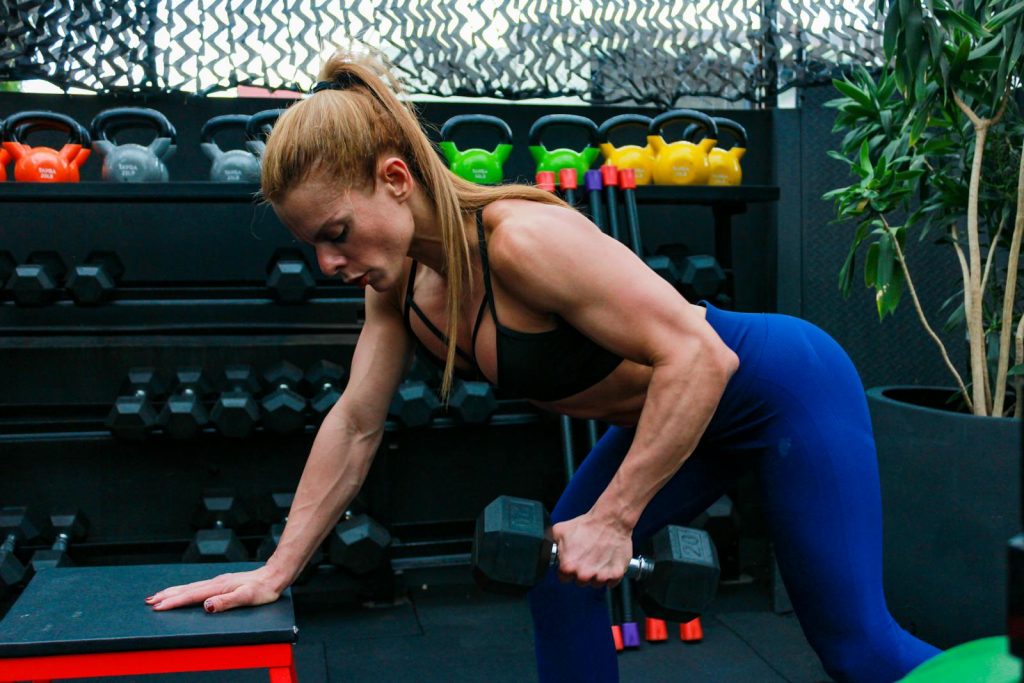
This guide covers the best dumbbell tricep exercises, muscles worked, proper form, common mistakes, workout programming, and beginner-friendly tips so you can train your arms more effectively.
What Are Dumbbell Tricep Exercises?
Dumbbell tricep exercises are upper-body strength movements that target the muscles on the back of your upper arm. Most of them involve straightening your elbow against resistance, which is the main action of the triceps.
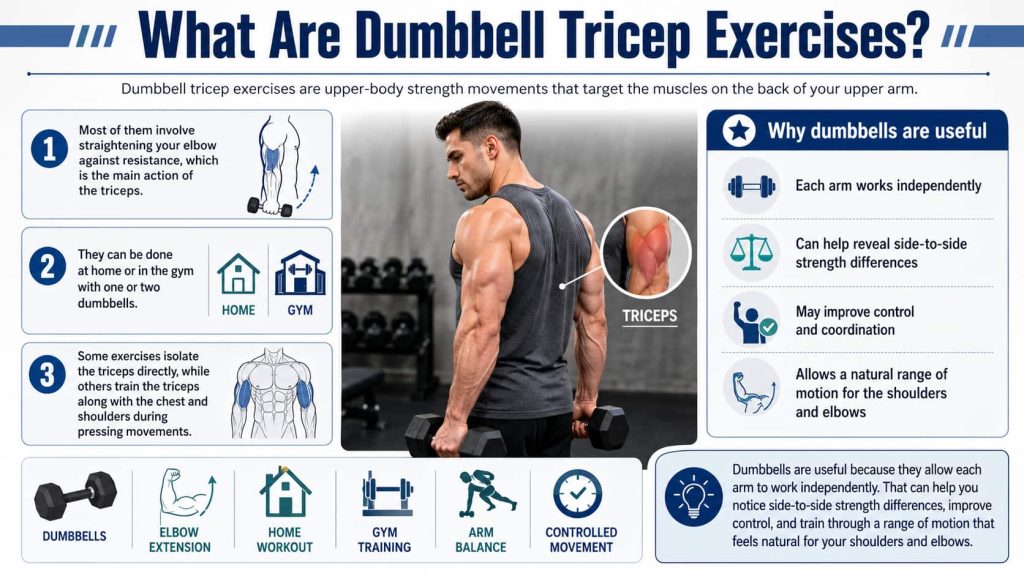
They can be done at home or in the gym with one or two dumbbells. Some exercises isolate the triceps directly, while others train the triceps along with the chest and shoulders during pressing movements.
Dumbbells are useful because they allow each arm to work independently. That can help you notice side-to-side strength differences, improve control, and train through a range of motion that feels natural for your shoulders and elbows.
Benefits of Dumbbell Tricep Exercises
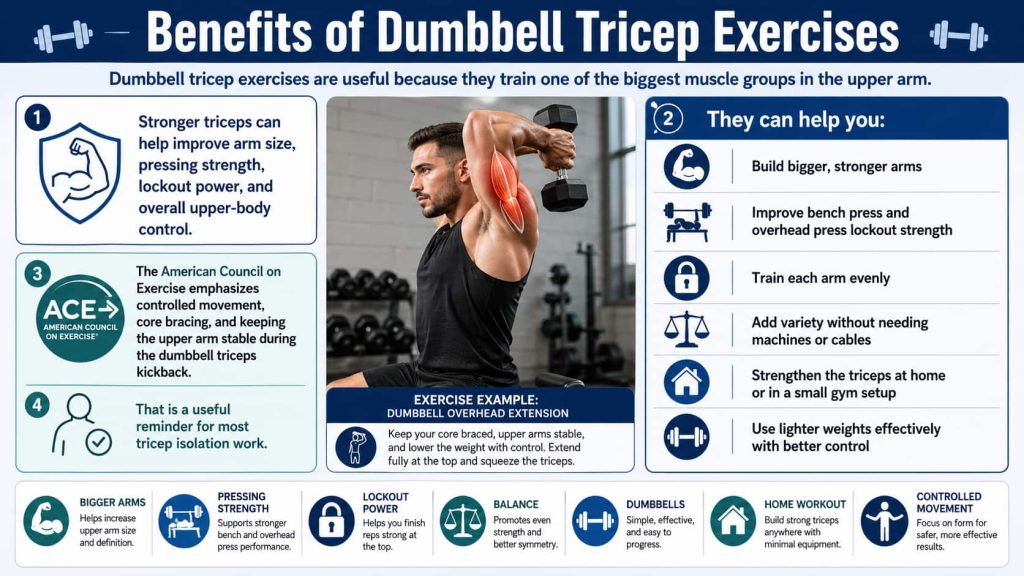
Dumbbell tricep exercises are useful because they train one of the biggest muscle groups in the upper arm. Stronger triceps can help improve arm size, pressing strength, lockout power, and overall upper-body control.
They can help you:
- Build bigger, stronger arms
- Improve bench press and overhead press lockout strength
- Train each arm evenly
- Add variety without needing machines or cables
- Strengthen the triceps at home or in a small gym setup
- Use lighter weights effectively with better control
The American Council on Exercise emphasizes controlled movement, core bracing, and keeping the upper arm stable during the dumbbell triceps kickback, which is a useful reminder for most tricep isolation work.
How to Choose the Right Dumbbell Weight
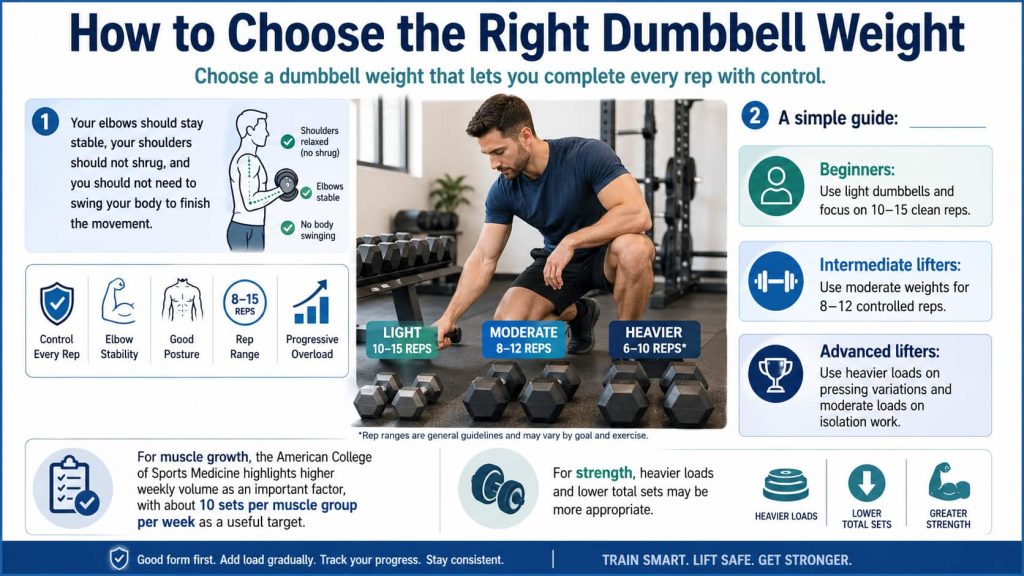
Choose a dumbbell weight that lets you complete every rep with control. Your elbows should stay stable, your shoulders should not shrug, and you should not need to swing your body to finish the movement.
A simple guide:
- Beginners: use light dumbbells and focus on 10–15 clean reps.
- Intermediate lifters: use moderate weights for 8–12 controlled reps.
- Advanced lifters: use heavier loads on pressing variations and moderate loads on isolation work.
For muscle growth, the American College of Sports Medicine highlights higher weekly volume as an important factor, with about 10 sets per muscle group per week as a useful target. For strength, heavier loads and lower total sets may be more appropriate.
10 Best Dumbbell Tricep Exercises for Bigger, Stronger Arms
1. Two-Hand Overhead Dumbbell Tricep Extension
Best for:
Training the long head of the triceps and building arm size with one dumbbell.
Muscles worked:
Triceps brachii, especially the long head, plus core and shoulder stabilizers.
Equipment needed:
One dumbbell.
Why it stands out
The two-hand overhead dumbbell tricep extension places your arms overhead, which stretches the long head of the triceps. This makes it one of the best dumbbell tricep exercises for building fullness in the back of the upper arm.
Suggested sets and reps
Do 3–4 sets of 8–15 reps. Use a slower lowering phase and avoid rushing the bottom position.
How to do it
- Stand or sit tall and hold one dumbbell with both hands.
- Lift the dumbbell overhead with your arms extended.
- Keep your elbows pointing mostly forward.
- Lower the dumbbell behind your head by bending your elbows.
- Stop when you feel a controlled triceps stretch.
- Extend your elbows to lift the dumbbell back overhead.
- Squeeze your triceps at the top without locking out harshly.
Common mistakes:
- Flaring the elbows too wide
- Arching the lower back
- Dropping the dumbbell too fast
- Turning it into a shoulder movement
- Using a weight that pulls the arms out of position
Coaching cue:
Keep your ribs down and think, “bend and straighten the elbows.”
Exercise variations
- Easier: seated overhead dumbbell extension
- Harder: slow-tempo overhead extension
- Alternative: single-arm overhead dumbbell extension
How to use in a workout:
Use this as your first tricep isolation exercise after pressing movements or as the main tricep builder in an arm-focused workout.
2. Single-Arm Overhead Dumbbell Tricep Extension
Best for:
Fixing side-to-side strength differences and improving control.
Muscles worked:
Triceps brachii, especially the long head, plus core and shoulder stabilizers.
Equipment needed:
One dumbbell.
Why it stands out
Training one arm at a time helps you focus on clean elbow position and full range of motion. It also makes it harder for your stronger arm to take over.
Suggested sets and reps
Do 2–4 sets of 10–15 reps per arm.
How to do it
- Sit or stand tall with one dumbbell in one hand.
- Press the dumbbell overhead.
- Keep your upper arm near your ear.
- Bend your elbow and lower the dumbbell behind your head.
- Keep your wrist stacked and controlled.
- Extend your elbow to return to the top.
- Complete all reps on one side before switching arms.
Common mistakes:
- Letting the elbow drift outward
- Leaning sideways
- Cutting the range of motion short
- Using too much weight
- Moving too quickly
Coaching cue:
Keep your upper arm still and move only at the elbow.
Exercise variations
- Easier: seated single-arm overhead extension
- Harder: paused single-arm overhead extension
- Alternative: alternating single-arm overhead extension
How to use in a workout:
Use it after heavier pressing or as a second triceps exercise when you want extra long-head work.
3. Lying Dumbbell Tricep Extension
Best for:
Building triceps size with a stable body position.
Muscles worked:
Triceps brachii, with emphasis on elbow extension strength.
Equipment needed:
Two dumbbells and a flat bench or floor.
Why it stands out
The lying dumbbell tricep extension, often called a dumbbell skull crusher, lets you train both arms through a deep elbow bend while keeping your torso supported.
Suggested sets and reps
Do 3–4 sets of 8–12 reps.
How to do it
- Lie on a flat bench with one dumbbell in each hand.
- Hold the dumbbells above your chest with palms facing each other.
- Keep your upper arms mostly still.
- Bend your elbows and lower the dumbbells toward the sides of your head.
- Pause briefly when your triceps are stretched.
- Extend your elbows to press the dumbbells back up.
- Keep the movement smooth and controlled.
Common mistakes:
- Letting the elbows flare too much
- Lowering the dumbbells toward the face without control
- Turning the movement into a chest press
- Bouncing out of the bottom
- Losing wrist alignment
Coaching cue:
Point your elbows toward the ceiling and let the dumbbells travel beside your head.
Exercise variations
- Easier: lying dumbbell tricep extension on the floor
- Harder: incline lying dumbbell tricep extension
- Alternative: one-dumbbell lying extension
How to use in a workout:
Place this early in your triceps routine when your elbows and shoulders feel fresh.
4. Incline Dumbbell Tricep Extension
Best for:
Training the triceps through a bigger stretch.
Muscles worked:
Triceps brachii, especially the long head.
Equipment needed:
Two dumbbells and an incline bench.
Why it stands out
The incline angle places your arms slightly behind your body, which can increase the stretch on the triceps. This makes the exercise useful for muscle-building work when performed with control.
Suggested sets and reps
Do 2–4 sets of 10–15 reps.
How to do it
- Set a bench to a low or moderate incline.
- Lie back with one dumbbell in each hand.
- Extend your arms above your shoulders.
- Bend your elbows and lower the dumbbells behind your head.
- Keep your upper arms steady.
- Extend your elbows to return to the start.
- Stop if your elbows or shoulders feel uncomfortable.
Common mistakes:
- Using too steep of an incline
- Letting the shoulders roll forward
- Going too heavy
- Losing control in the stretched position
- Flaring the elbows aggressively
Coaching cue:
Use a lighter weight than you use for regular lying extensions.
Exercise variations
- Easier: flat lying dumbbell tricep extension
- Harder: slow eccentric incline extension
- Alternative: one-arm incline dumbbell extension
How to use in a workout:
Use this as a controlled hypertrophy exercise in the middle or end of an arm workout.
5. Dumbbell Tricep Kickback
Best for:
Finishing the triceps with strict isolation and a strong squeeze.
Muscles worked:
Triceps brachii, rear shoulder stabilizers, upper back, and core.
Equipment needed:
One or two dumbbells.
Why it stands out
The dumbbell tricep kickback is simple, but it works best when done strictly. It is not a heavy-lifting exercise. It is better for controlled reps, full elbow extension, and a hard triceps contraction.
Suggested sets and reps
Do 2–4 sets of 12–20 reps.
How to do it
- Hold a dumbbell in one hand.
- Hinge forward with a flat back.
- Place your free hand on a bench or your thigh for support.
- Keep your upper arm close to your torso.
- Start with your elbow bent about 90 degrees.
- Extend your elbow until your arm is straight behind you.
- Pause briefly, then lower with control.
Common mistakes:
- Swinging the dumbbell
- Dropping the elbow during the set
- Rounding the back
- Shrugging the shoulder
- Using a weight that is too heavy
Coaching cue:
Pin your upper arm in place and squeeze the triceps at the top.
Exercise variations
- Easier: supported one-arm dumbbell kickback
- Harder: two-arm dumbbell kickback
- Alternative: chest-supported dumbbell kickback
How to use in a workout:
Use it near the end of your workout for higher reps and a strong triceps pump.
6. Chest-Supported Dumbbell Tricep Kickback
Best for:
Reducing body swing and improving triceps isolation.
Muscles worked:
Triceps brachii, rear shoulders, upper back stabilizers.
Equipment needed:
Two dumbbells and an incline bench.
Why it stands out
The chest-supported version removes much of the cheating that happens during regular kickbacks. Because your torso is supported, it is easier to keep your upper arms still and focus on elbow extension.
Suggested sets and reps
Do 2–4 sets of 12–20 reps.
How to do it
- Set a bench to a low incline.
- Lie chest-down on the bench with a dumbbell in each hand.
- Pull your elbows up beside your ribs.
- Keep your upper arms still.
- Extend your elbows until your arms are straight behind you.
- Pause and squeeze your triceps.
- Lower the dumbbells slowly.
Common mistakes:
- Letting the elbows drop
- Lifting the chest off the bench
- Moving too fast
- Turning it into a row
- Using too much weight
Coaching cue:
Think “row the elbows up, then freeze them there.”
Exercise variations
- Easier: one-arm chest-supported kickback
- Harder: paused chest-supported kickback
- Alternative: standing two-arm kickback
How to use in a workout:
Use it as a strict finisher after overhead extensions, lying extensions, or close-grip pressing.
7. Close-Grip Dumbbell Floor Press
Best for:
Building triceps pressing strength with less shoulder stress than some bench variations.
Muscles worked:
Triceps, chest, front shoulders, and core.
Equipment needed:
Two dumbbells and floor space.
Why it stands out
The floor limits how far your elbows can travel, which can make the movement easier to control. Keeping the dumbbells close also shifts more work toward the triceps compared with a wider press.
Suggested sets and reps
Do 3–4 sets of 6–12 reps.
How to do it
- Lie on the floor with one dumbbell in each hand.
- Bend your knees and plant your feet.
- Hold the dumbbells close together above your chest.
- Lower your elbows toward the floor.
- Keep your elbows close to your sides.
- Lightly touch your upper arms to the floor.
- Press the dumbbells back up until your arms are straight.
Common mistakes:
- Letting the elbows flare wide
- Bouncing the arms off the floor
- Pressing with loose wrists
- Letting the dumbbells drift apart
- Losing upper-back tightness
Coaching cue:
Keep your elbows tucked and press through the triceps.
Exercise variations
- Easier: single-dumbbell close-grip floor press
- Harder: paused close-grip floor press
- Alternative: close-grip dumbbell bench press
How to use in a workout:
Use this as a heavier tricep-focused movement before isolation exercises.
8. Close-Grip Dumbbell Bench Press
Best for:
Training triceps strength with chest and shoulder support.
Muscles worked:
Triceps, chest, front shoulders, and upper back stabilizers.
Equipment needed:
Two dumbbells and a flat bench.
Why it stands out
This exercise lets you use more load than most isolation movements. It is a good choice if you want bigger arms and stronger pressing power.
Suggested sets and reps
Do 3–5 sets of 6–12 reps.
How to do it
- Lie on a flat bench with one dumbbell in each hand.
- Hold the dumbbells close together over your chest.
- Keep your shoulder blades pulled back and down.
- Lower the dumbbells with your elbows close to your ribs.
- Stop when the dumbbells reach chest level or a comfortable depth.
- Press back up by extending your elbows.
- Keep the dumbbells controlled throughout the set.
Common mistakes:
- Going too wide
- Losing shoulder blade position
- Letting the elbows flare
- Touching the dumbbells too hard together
- Using a range of motion that irritates the shoulders
Coaching cue:
Press the dumbbells up and slightly together without banging them.
Exercise variations
- Easier: close-grip dumbbell floor press
- Harder: slow-tempo close-grip bench press
- Alternative: neutral-grip dumbbell bench press
How to use in a workout:
Use it near the beginning of your workout when you want to train the triceps with heavier weight.
9. Dumbbell Tate Press
Best for:
Advanced triceps isolation and lockout strength.
Muscles worked:
Triceps brachii, especially elbow extension strength near the top range.
Equipment needed:
Two dumbbells and a flat bench.
Why it stands out
The Tate press is a unique dumbbell tricep exercise that targets the triceps from a different angle. It can be useful for lifters who already have good control with lying extensions and close-grip presses.
Suggested sets and reps
Do 2–4 sets of 8–15 reps.
How to do it
- Lie on a flat bench with one dumbbell in each hand.
- Hold the dumbbells above your chest with palms facing forward or slightly inward.
- Bend your elbows and lower the dumbbells toward the center of your chest.
- Keep your upper arms angled out but controlled.
- Stop before the dumbbells rest heavily on your chest.
- Extend your elbows to press the dumbbells back up.
- Squeeze the triceps at the top.
Common mistakes:
- Going too heavy too soon
- Letting the dumbbells crash into the chest
- Losing wrist control
- Moving through the shoulders instead of the elbows
- Flaring without control
Coaching cue:
Lower the dumbbells like you are closing a pair of gates toward your chest.
Exercise variations
- Easier: light dumbbell Tate press
- Harder: paused Tate press
- Alternative: dumbbell JM press
How to use in a workout:
Use this after heavier presses or lying extensions. Keep the weight moderate and the reps clean.
10. Dumbbell JM Press
Best for:
Advanced triceps strength and pressing carryover.
Muscles worked:
Triceps, chest, front shoulders, and upper back stabilizers.
Equipment needed:
Two dumbbells and a flat bench or floor.
Why it stands out
The dumbbell JM press blends a close-grip press with a tricep extension. It can be useful for lifters who want stronger lockout power, but it requires good control and should not be rushed.
Suggested sets and reps
Do 3–4 sets of 6–12 reps.
How to do it
- Lie on a bench with one dumbbell in each hand.
- Start with the dumbbells above your upper chest.
- Bend your elbows and lower the dumbbells toward your upper chest or throat area.
- Keep your elbows tucked but not pinned tightly.
- Let the movement feel like a mix of a press and extension.
- Press back up by driving through the triceps.
- Keep the reps smooth and controlled.
Common mistakes:
- Lowering too close to the face without control
- Using too much weight
- Letting the wrists bend backward
- Turning it into a regular bench press
- Forcing a painful elbow angle
Coaching cue:
Use moderate weight and make every rep smooth, not aggressive.
Exercise variations
- Easier: close-grip dumbbell floor press
- Harder: paused dumbbell JM press
- Alternative: lying dumbbell tricep extension
How to use in a workout:
Use this as a heavier tricep strength movement before lighter isolation exercises.
Dumbbell Tricep Workout Routine
Use these routines 1–2 times per week depending on your full training plan. Leave at least one day between hard tricep sessions if your elbows feel sore or your pressing workouts are already heavy.
Beginner Dumbbell Tricep Workout
Do this routine if you are new to direct triceps training.
| Exercise | Sets | Reps |
|---|---|---|
| Close-Grip Dumbbell Floor Press | 3 | 8–12 |
| Two-Hand Overhead Dumbbell Tricep Extension | 2–3 | 10–15 |
| Supported Dumbbell Tricep Kickback | 2 | 12–15 each arm |
Rest 60–90 seconds between sets.
Intermediate Dumbbell Tricep Workout
Do this routine if you already train consistently and want more arm size.
| Exercise | Sets | Reps |
|---|---|---|
| Close-Grip Dumbbell Bench Press | 4 | 6–10 |
| Incline Dumbbell Tricep Extension | 3 | 10–12 |
| Chest-Supported Dumbbell Tricep Kickback | 3 | 12–20 |
Rest 60–120 seconds depending on the exercise.
Advanced Dumbbell Tricep Workout
Use this routine if your elbows tolerate direct tricep work well and you have good form.
| Exercise | Sets | Reps |
|---|---|---|
| Dumbbell JM Press | 4 | 6–10 |
| Lying Dumbbell Tricep Extension | 3 | 8–12 |
| Single-Arm Overhead Dumbbell Tricep Extension | 3 | 10–15 each arm |
| Dumbbell Tate Press | 2–3 | 10–15 |
Rest 90–120 seconds on heavier movements and 45–75 seconds on isolation exercises.
Common Dumbbell Tricep Exercise Mistakes
Going Too Heavy
The triceps do not need sloppy, swinging reps to grow. If the dumbbell pulls your elbows out of position or forces you to arch your back, the weight is too heavy.
Letting the Elbows Move Too Much
Some elbow movement is normal, but the goal of most isolation exercises is to keep the upper arm stable. If your whole arm is swinging, your shoulders and momentum are doing too much work.
Cutting the Range of Motion Short
Half reps can limit the training effect. Use a full, controlled range of motion that feels comfortable on your elbows and shoulders.
Ignoring the Overhead Position
If every tricep exercise you do is a press or kickback, you may miss some useful long-head training. Overhead extensions are a simple way to train the triceps in a stretched position.
Training Through Sharp Pain
Muscle fatigue and burning are normal during hard sets. Sharp pain, numbness, tingling, dizziness, or unusual joint discomfort are not. Stop the exercise and seek professional guidance if those symptoms occur.
Beginner Tips for Training Triceps With Dumbbells
Start with two or three exercises per workout. You do not need every variation at once.
A good beginner session includes:
- One pressing exercise
- One overhead extension
- One kickback or lighter isolation exercise
Train with smooth reps and leave 1–3 reps in reserve on most sets. Add weight only when you can complete the top end of your rep range with clean form.
For example, if your goal is 3 sets of 10–12 reps and you can perform all 12 reps with control, increase the dumbbell weight slightly next time.
How Often Should You Train Dumbbell Tricep Exercises?
Most lifters can train triceps directly 1–2 times per week. If you also bench press, overhead press, or do push-ups often, your triceps are already getting extra work.
A practical weekly target:
- Beginners: 4–6 direct tricep sets per week
- Intermediate lifters: 6–10 direct tricep sets per week
- Advanced lifters: 10–14 direct tricep sets per week if recovery is good
More is not always better. If your elbows feel irritated or your pressing strength drops, reduce volume and improve recovery.
Dumbbell Tricep Exercise FAQs
What is the best dumbbell exercise for triceps?
The two-hand overhead dumbbell tricep extension is one of the best dumbbell tricep exercises because it trains the long head in a stretched position. Close-grip dumbbell presses are also excellent for heavier tricep strength.
Can I build big triceps with only dumbbells?
Yes. Dumbbells can build bigger triceps if you train consistently, use good form, increase volume over time, and eat enough to support muscle growth. Use a mix of overhead extensions, lying extensions, kickbacks, and close-grip presses.
Are dumbbell tricep kickbacks worth doing?
Yes, but they work best with light to moderate weight and strict form. Kickbacks are not ideal for maximum loading, but they are useful for higher-rep triceps isolation and improving the squeeze at full elbow extension.
How many dumbbell tricep exercises should I do in one workout?
Most people only need 2–4 tricep exercises in one workout. A simple structure is one heavier press, one overhead extension, and one lighter isolation exercise.
Should I train triceps with chest or biceps?
Both can work. Training triceps with chest makes sense because pressing exercises already involve the triceps. Training triceps with biceps is useful for an arm-focused day. Choose the split that fits your weekly routine best.
Why do my elbows hurt during tricep extensions?
Elbow discomfort can happen from too much weight, too much volume, poor control, or forcing a range of motion that does not suit your joints. Reduce the load, slow down the reps, adjust your elbow angle, or switch to a more comfortable variation. Stop if pain is sharp or unusual.
Conclusion
Dumbbell tricep exercises are a simple and effective way to build bigger, stronger arms without needing machines or cables. For the best results, combine overhead extensions, lying extensions, kickbacks, and close-grip pressing variations.
Start with 3–5 exercises from this guide, train with clean form, and gradually increase reps, sets, or weight as your strength improves.
References
- Kenhub — Triceps Brachii Muscle Anatomy
- Physio-Pedia — Triceps Brachii
- American Council on Exercise — Triceps Kickback
- American Council on Exercise — ACE Study Identifies Best Triceps Exercises
- NSCA — Foundations of Fitness Programming
- PMC — The Different Role of Each Head of the Triceps Brachii Muscle
- PMC — Loading Recommendations for Muscle Strength, Hypertrophy, and Local Endurance
2 thoughts on “10 Best Dumbbell Tricep Exercises for Bigger, Stronger Arms”