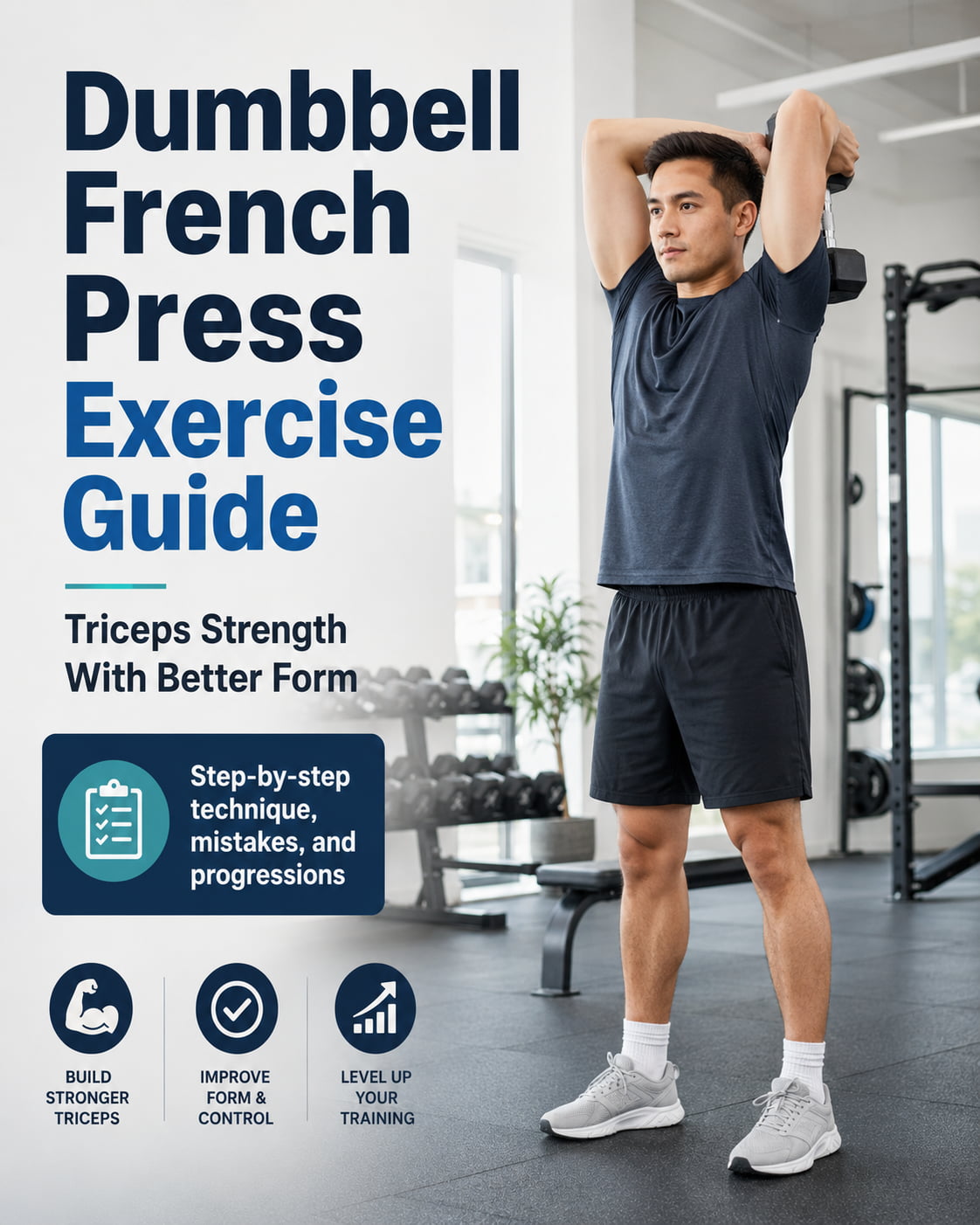
The dumbbell French press is an overhead triceps exercise that helps build stronger arms by training elbow extension with a controlled dumbbell movement. It is most useful when you want to isolate the triceps, train the long head of the triceps in a stretched position, and add focused arm work after pressing exercises.
This guide explains how to do the dumbbell French press with proper form, which muscles it works, the best variations, common mistakes, sets and reps, and how to use it in a real workout.
What Is the Dumbbell French Press?
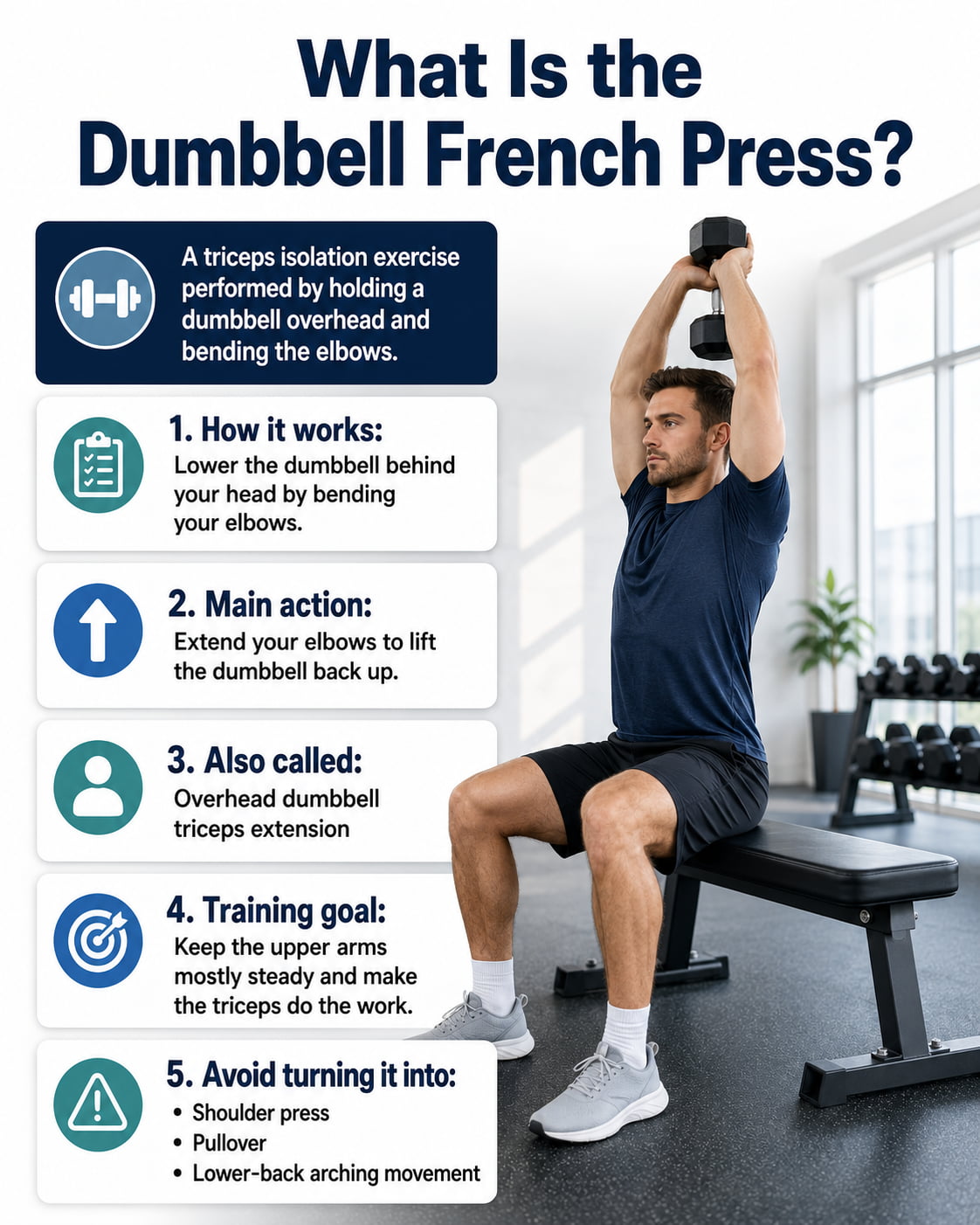
The dumbbell French press is a triceps isolation exercise where you hold a dumbbell overhead, bend your elbows to lower the weight behind your head, then extend your elbows to lift the dumbbell back up.
It is also commonly called an overhead dumbbell triceps extension. The “French press” name is often used when the movement is done with both arms at the same time, either seated or standing.
The main training goal is simple: keep the upper arms mostly steady and make the triceps do the work of straightening the elbows. It should not turn into a shoulder press, pullover, or lower-back arching movement.
Dumbbell French Press Muscles Worked
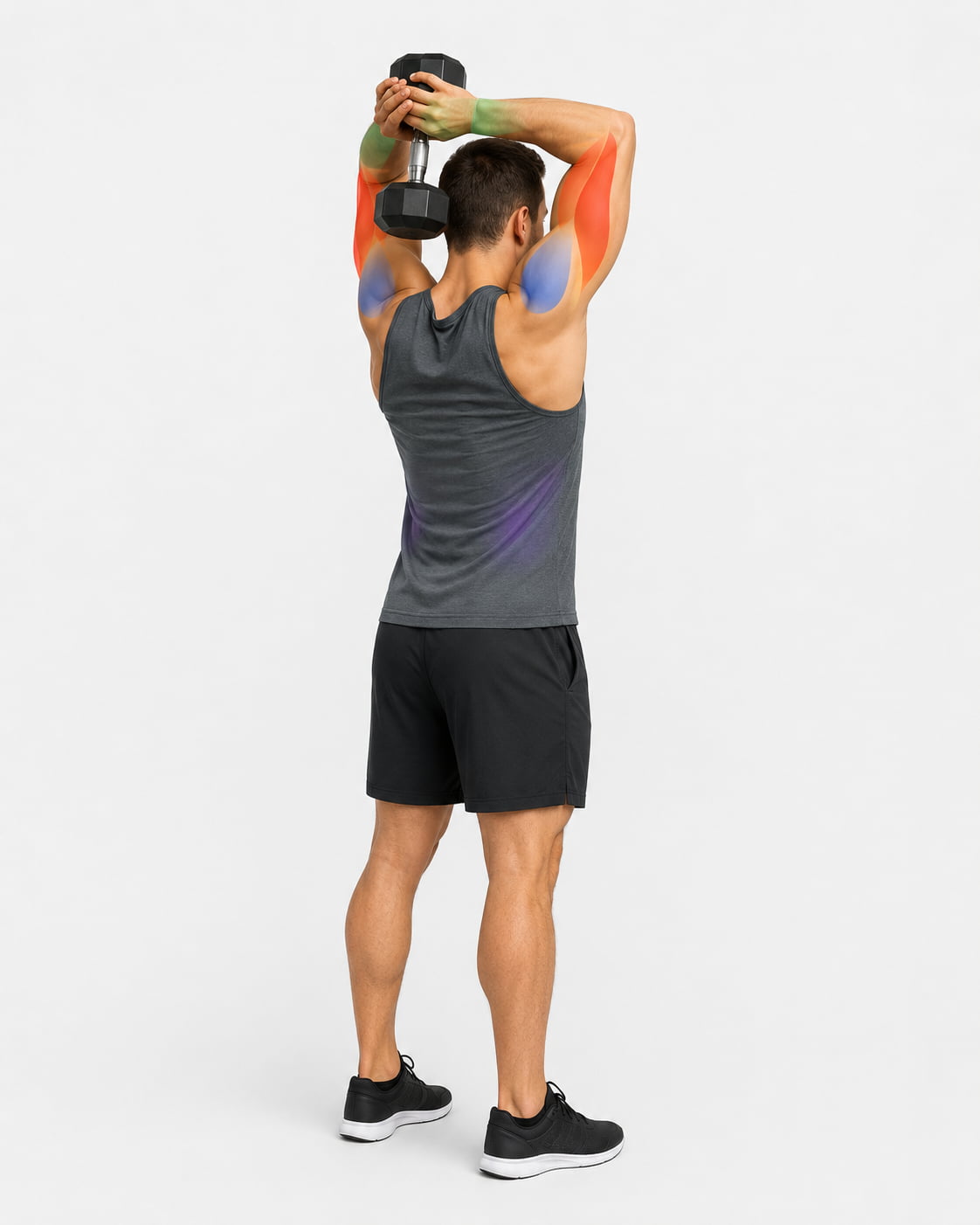
The dumbbell French press mainly works the triceps brachii, the large muscle on the back of the upper arm. According to NCBI StatPearls, the triceps’ primary function is elbow extension, and the muscle has three heads: the long head, lateral head, and medial head.
The dumbbell French press trains all three heads, but the overhead arm position makes the long head especially important because it crosses the shoulder joint. When your arms are overhead and your elbows bend, the long head is placed in a more lengthened position.
A study indexed in PubMed found greater triceps hypertrophy after overhead cable elbow-extension training compared with neutral-position cable elbow extensions, especially in the long head. That does not prove the dumbbell French press is automatically better than every other triceps exercise, but it does support the value of overhead triceps work.
Secondary muscles also help. Your shoulders help keep the upper arms stable. Your upper back helps control posture. Your forearms and grip hold the dumbbell securely. If you perform the exercise standing, your core works harder to keep your ribs and lower back from flaring.
Benefits of the Dumbbell French Press
The dumbbell French press is useful because it gives you a direct way to train the triceps with minimal equipment. One dumbbell is enough, which makes it easy to use at home, in a commercial gym, or as part of a simple upper-body workout.
It can also help strengthen the triceps for pressing exercises. Stronger triceps support the lockout portion of movements such as push-ups, dumbbell presses, bench presses, and overhead presses. The French press should not replace compound pressing, but it works well as an accessory exercise after heavier upper-body lifts.
Another benefit is the overhead position. Many triceps exercises train the arms closer to the body, such as pushdowns and kickbacks. The French press gives you a different angle and a deep, controlled stretch when done properly.
The exercise is also easy to scale. Beginners can use a light dumbbell and perform it seated. Intermediate lifters can use a slower lowering phase. More advanced lifters can add volume, use two dumbbells, or include it in a focused triceps workout.
The American Council on Exercise has compared several common triceps exercises in an ACE-sponsored triceps study. The dumbbell French press does not need to be labeled the single best triceps exercise to be valuable. It is one strong option when you want controlled overhead triceps training.
Dumbbell French Press Exercise Guide
Dumbbell French Press
Equipment needed: One dumbbell and an optional bench or seat.
Suggested sets and reps: Start with 2–4 sets of 8–15 reps. Use a weight you can control without swinging, arching your back, or flaring your elbows too wide.
Beginners: Use a light dumbbell and perform the exercise seated. Aim for 2–3 sets of 10–15 reps with smooth control. Stop each set with 2–3 reps in reserve.
Intermediate: Use 3–4 sets of 8–12 reps. Lower the dumbbell for 2–3 seconds, keep the elbows controlled, and progress only when all reps feel stable.
Advanced: Use 3–4 sets of 10–15 reps as a triceps accessory after heavier pressing. You can add a slower eccentric, a brief controlled pause in the bottom position, or two-dumbbell variations if your shoulders and elbows tolerate them well.
Rest: Rest 60–120 seconds between sets. Use the longer end if the weight is heavier or your form starts to break down.
How to do it:
- Sit on a bench or stand tall with your feet about hip-width apart.
- Hold one dumbbell with both hands under the top plate or around the handle.
- Press the dumbbell overhead so your elbows point mostly forward and your upper arms stay close to your head.
- Brace your core, keep your ribs down, and avoid arching your lower back.
- Bend your elbows and lower the dumbbell behind your head under control.
- Lower only as far as you can while keeping your shoulders comfortable and your elbows stable.
- Extend your elbows to lift the dumbbell back overhead without turning it into a shoulder press.
- Repeat for the target reps while keeping each rep smooth and controlled.
Common mistakes: The most common mistakes are using too much weight, flaring the elbows too wide, arching the lower back, lowering too fast, and letting the shoulders move too much. The exercise should come mainly from bending and straightening the elbows.
Expert tip: Think “elbows bend, triceps lift.” Your upper arms do not need to be perfectly frozen, but they should not swing back and forth on every rep. Keep the movement strict enough that the triceps stay loaded.
Exercise variations: Useful variations include the seated dumbbell French press, standing dumbbell French press, single-arm dumbbell French press, two-dumbbell French press, and lying dumbbell triceps extension.
Easier variation: The seated dumbbell French press is usually easier because it reduces the need for full-body balance. A single-arm version with the free hand supporting the working arm can also help you control elbow position.
Harder variation: The two-dumbbell French press is harder because each arm must control its own dumbbell. A slow eccentric version is also more challenging because the triceps stay under tension longer.
Seated vs Standing Dumbbell French Press
The seated dumbbell French press is usually the best starting point. Sitting gives you more stability and makes it easier to focus on the triceps. It also reduces the chance of leaning back too much to finish reps.
The standing dumbbell French press adds more core demand. It can be useful if you want a more athletic version, but it also makes it easier to compensate by arching your lower back. If your ribs flare or your lower back takes over, return to the seated version.
For most lifters, the seated version is better for learning. The standing version is better once your form is consistent.
Single-Arm vs Two-Arm Dumbbell French Press
The two-arm dumbbell French press lets you use one dumbbell with both hands. This is simple, stable, and beginner-friendly.
The single-arm dumbbell French press trains one side at a time. It is useful if one arm feels less coordinated or if you want to focus on elbow position. It usually requires a lighter dumbbell.
The two-dumbbell version is more advanced. Each hand holds its own dumbbell, so the arms cannot hide behind each other. It can be effective, but it demands more control and may feel less comfortable for some shoulders.
Common Dumbbell French Press Mistakes to Avoid
Going Too Heavy
The dumbbell French press is not a max-strength lift. If the weight is too heavy, you will usually see elbow flare, shoulder movement, back arching, or short reps.
Use a weight that lets you lower the dumbbell smoothly and finish the set without forcing the last few reps.
Letting the Elbows Flare Too Wide
Some elbow movement is normal, but excessive flare can shift tension away from the triceps and make the exercise harder to control. Keep your elbows pointing mostly forward instead of letting them drift far out to the sides.
A helpful cue is to keep your elbows about shoulder-width or slightly narrower.
Arching the Lower Back
When the dumbbell feels heavy, many people lean back to move it. This turns the exercise into a poor overhead movement and may irritate the lower back.
Keep your ribs down, brace your abs, and squeeze your glutes lightly if standing. If you still arch, switch to the seated version.
Moving the Shoulders Instead of the Elbows
The dumbbell French press should be an elbow-extension exercise. Your shoulders help stabilize, but they should not do most of the movement.
If the dumbbell travels too far back and your upper arms swing, reduce the weight and shorten the range of motion slightly.
Lowering Too Fast
Dropping the dumbbell quickly removes control and can make the bottom position feel rough on the elbows or shoulders. Lower the weight with a 2–3 second tempo and lift with steady force.
Forcing an Uncomfortable Range of Motion
A deep stretch can be useful, but it should not feel sharp or pinchy. Lower the dumbbell only as far as your shoulders and elbows allow with control.
If the overhead position does not feel right, use a lying dumbbell triceps extension, cable overhead extension, or band overhead extension instead.
Dumbbell French Press Sets, Reps, and Programming Tips
Use the dumbbell French press as an accessory exercise. It fits best after compound pressing movements such as dumbbell bench presses, push-ups, or overhead presses.
For general triceps strength and muscle growth, use 2–4 sets of 8–15 reps. Most people will get more from clean reps than from chasing heavy weight.
For beginners, 2–3 sets of 10–15 reps works well. For intermediate lifters, 3–4 sets of 8–12 reps is a strong starting point. For higher-volume arm training, 3–4 sets of 12–15 reps can work well if your elbows feel good.
Use 1–3 reps in reserve on most sets. That means you stop before your form breaks. You can train closer to failure occasionally, but the dumbbell French press is not the best exercise for ugly grinding reps.
The ACSM resistance training progression model recommends gradually increasing load when you can perform more reps than your target range with good form. For this exercise, a simple rule is to add reps first, then add a small amount of weight once you can complete every set cleanly.
How Often Should You Do the Dumbbell French Press?
Most lifters can train the dumbbell French press 1–3 times per week, depending on total triceps volume and recovery.
If you already do a lot of pressing, start with once per week. If your elbows and shoulders feel good and your recovery is solid, you can use it twice per week.
The CDC physical activity guidelines recommend muscle-strengthening activity at least 2 days per week for adults. That does not mean you need to do the dumbbell French press every session. It means your weekly plan should include enough resistance training for the major muscle groups.
Sample Dumbbell French Press Triceps Workout
Use this workout after your main upper-body pressing exercise or as a short arm-focused session.
| Exercise | Sets | Reps | Rest |
|---|---|---|---|
| Close-Grip Dumbbell Floor Press | 3 | 8–12 | 90 seconds |
| Seated Dumbbell French Press | 3 | 10–15 | 60–90 seconds |
| Dumbbell Triceps Kickback | 2 | 12–15 | 60 seconds |
| Close-Grip Push-Up | 2 | 6–12 | 90 seconds |
Use a controlled tempo on every exercise. For the dumbbell French press, lower the weight for 2–3 seconds and lift with steady control.
Do this workout 1–2 times per week. When you can complete all sets at the top of the rep range with clean form, increase the dumbbell weight slightly or add one extra set to the French press.
Best Dumbbell French Press Variations
Seated Dumbbell French Press
The seated version is the best choice for most beginners. It gives you more stability and makes it easier to keep the focus on your triceps.
Use this variation if you struggle with balance, back arching, or controlling the dumbbell overhead.
Standing Dumbbell French Press
The standing version adds more core demand. It is useful for lifters who can keep the ribs down and avoid leaning back.
Use this variation when you want a stricter full-body position, but reduce the weight if your lower back starts doing the work.
Single-Arm Dumbbell French Press
The single-arm version lets you train each arm separately. It can help you notice side-to-side differences and improve control.
Use a lighter dumbbell and keep the free hand near the working arm if you need extra guidance.
Two-Dumbbell French Press
The two-dumbbell version is more demanding because each arm must control its own weight. It can be useful for intermediate and advanced lifters.
Use this version only if you can keep both elbows stable and move through a comfortable range of motion.
Lying Dumbbell Triceps Extension
The lying version is not exactly the same as the French press, but it is a useful alternative. Lying on a bench or the floor reduces the overhead stability demand and may feel easier to control.
Use this variation if the fully overhead position feels awkward.
Dumbbell French Press Alternatives
A cable overhead triceps extension is a good alternative because the cable provides steady tension and allows small setup changes. It can feel smoother than a dumbbell for some lifters.
A band overhead triceps extension is useful for home workouts. It is light at the bottom and harder near lockout, which can make it joint-friendly for some people.
A lying dumbbell triceps extension is a strong choice if overhead mobility is limited. It still trains elbow extension but changes the shoulder position.
A triceps pushdown is easier to learn and often feels comfortable because the arms stay closer to the body. It is a good option if overhead triceps exercises bother your shoulders.
A close-grip push-up trains the triceps with body weight while also involving the chest, shoulders, and core. It is not as isolated, but it is practical and effective.
Safety Tips for the Dumbbell French Press
Start lighter than you think. The overhead position often feels harder than pushdowns or presses.
Warm up your shoulders and elbows before loading the movement. A few light sets of push-ups, band pressdowns, or very light overhead extensions can help you feel the pattern before heavier sets.
Keep the movement controlled. Avoid bouncing at the bottom or snapping your elbows hard at the top.
Stop the exercise if you feel sharp pain, numbness, dizziness, chest pain, or unusual symptoms. MedlinePlus advises stopping exercise and seeking help if you do not feel right, have pain, extreme shortness of breath, or dizziness.
If you have a history of shoulder, elbow, neck, or back problems, get guidance from a qualified professional before using heavy overhead triceps work.
FAQs About the Dumbbell French Press
Is the dumbbell French press good for triceps?
Yes. The dumbbell French press is a good triceps isolation exercise because it trains elbow extension through an overhead position. It is especially useful as an accessory exercise after pressing movements.
Is the dumbbell French press the same as an overhead triceps extension?
In most gym settings, yes. The dumbbell French press is commonly used to describe a two-hand overhead dumbbell triceps extension. Some coaches may use “French press” more broadly for different triceps extension variations.
Should I do the dumbbell French press seated or standing?
Most beginners should start seated because it is easier to control. Standing is useful once you can keep your core braced, ribs down, and elbows stable.
How heavy should I go on the dumbbell French press?
Use a weight you can control for 8–15 clean reps. If your elbows flare, your lower back arches, or your shoulders swing, the weight is too heavy.
Why do my elbows hurt during the dumbbell French press?
Elbow discomfort can happen if the load is too heavy, the range of motion is forced, or the reps are too fast. Reduce the weight, slow down, shorten the range slightly, or try a cable or band version. Stop if the pain is sharp or unusual.
Can beginners do the dumbbell French press?
Yes, beginners can do it with a light dumbbell and strict form. The seated version is usually the best starting point. Beginners should focus on control before adding weight.
Where should I put the dumbbell French press in a workout?
Place it after compound pressing exercises. For example, do your dumbbell bench press, overhead press, or push-ups first, then use the dumbbell French press as focused triceps work.
Conclusion
The dumbbell French press is a practical overhead triceps exercise for building stronger arms, improving elbow-extension strength, and adding focused accessory work to your upper-body training. Keep the weight controlled, lower slowly, avoid excessive elbow flare, and progress gradually.
Use the seated version first, master clean reps, then choose harder variations only when your form stays solid. A well-done dumbbell French press should feel like controlled triceps work, not a shoulder, neck, or lower-back struggle.
This content is for informational purposes only and is not a substitute for professional medical advice.
References
- NCBI StatPearls: Anatomy, Shoulder and Upper Limb, Triceps Muscle
- PubMed: Triceps Brachii Hypertrophy After Overhead Versus Neutral Elbow Extension Training
- American Council on Exercise: ACE Study Identifies Best Triceps Exercises
- PubMed: ACSM Progression Models in Resistance Training for Healthy Adults
- MedlinePlus: Exercise and Physical Fitness