Dumbbell trap exercises help strengthen the trapezius muscles across your upper back, including the upper, middle, and lower trap regions. The best plan does more than repeat heavy shrugs. It combines shrugs, carries, rows, reverse flyes, and Y-raise variations so your traps can support posture, shoulder-blade control, pulling strength, and upper-back development.
In this guide, you will learn the best dumbbell trap exercises, which muscles they train, how to perform each movement, common mistakes to avoid, and how to build a complete dumbbell trap workout.
What Are Dumbbell Trap Exercises?
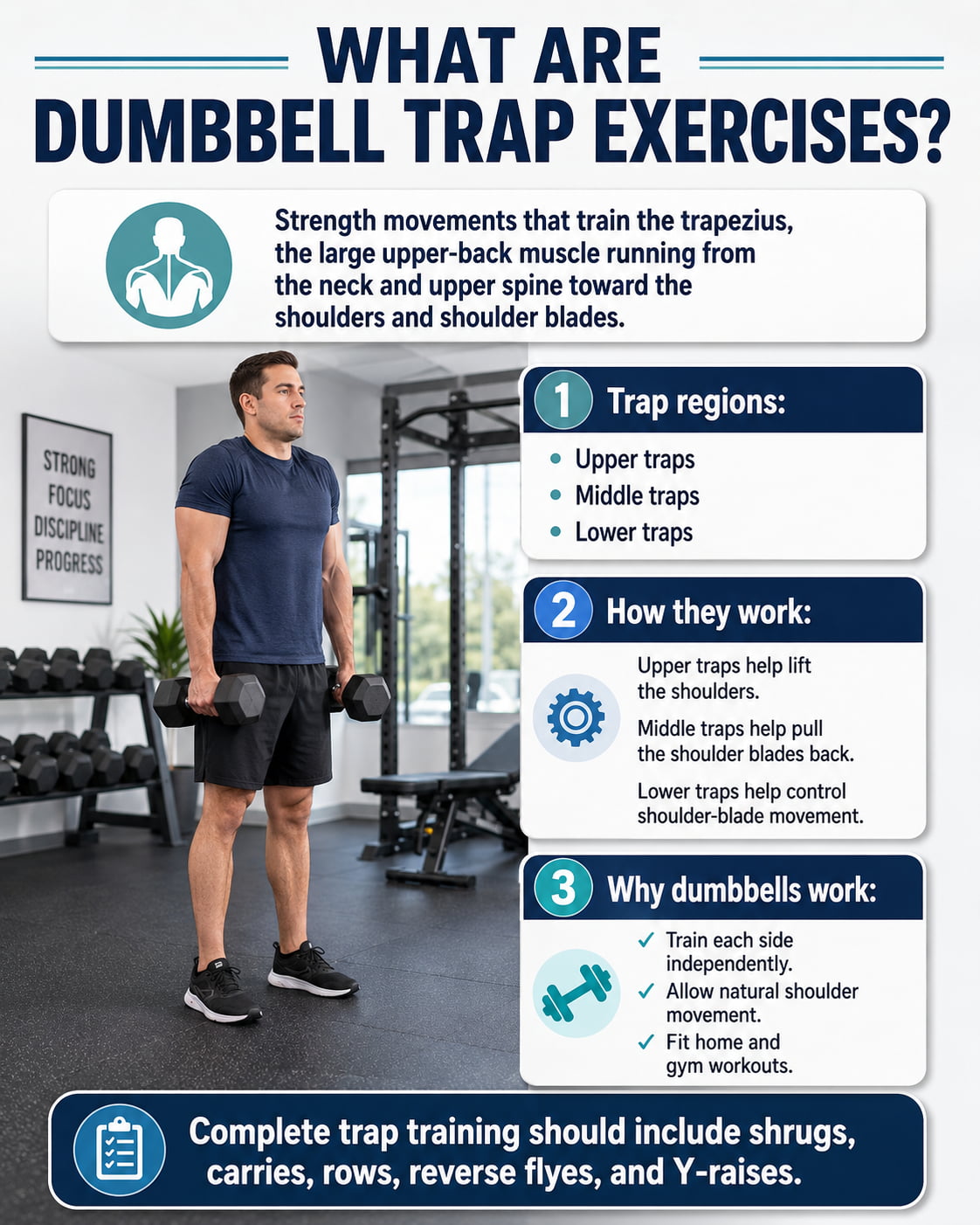
Dumbbell trap exercises are strength movements that train the trapezius, a large upper-back muscle that runs from the neck and upper spine toward the shoulders and shoulder blades. The Cleveland Clinic explains that the trapezius has upper, middle, and lower parts that help move and stabilize the head, neck, shoulders, upper back, and shoulder blades.
That matters because the traps do not work in only one direction. The upper traps help with shoulder elevation, the middle traps help pull the shoulder blades back, and the lower traps help control shoulder-blade movement during overhead and angled arm positions.
For complete trap training, dumbbells are useful because they let each side work independently, allow natural shoulder movement, and fit both home and gym workouts.
Muscles Worked by Dumbbell Trap Exercises
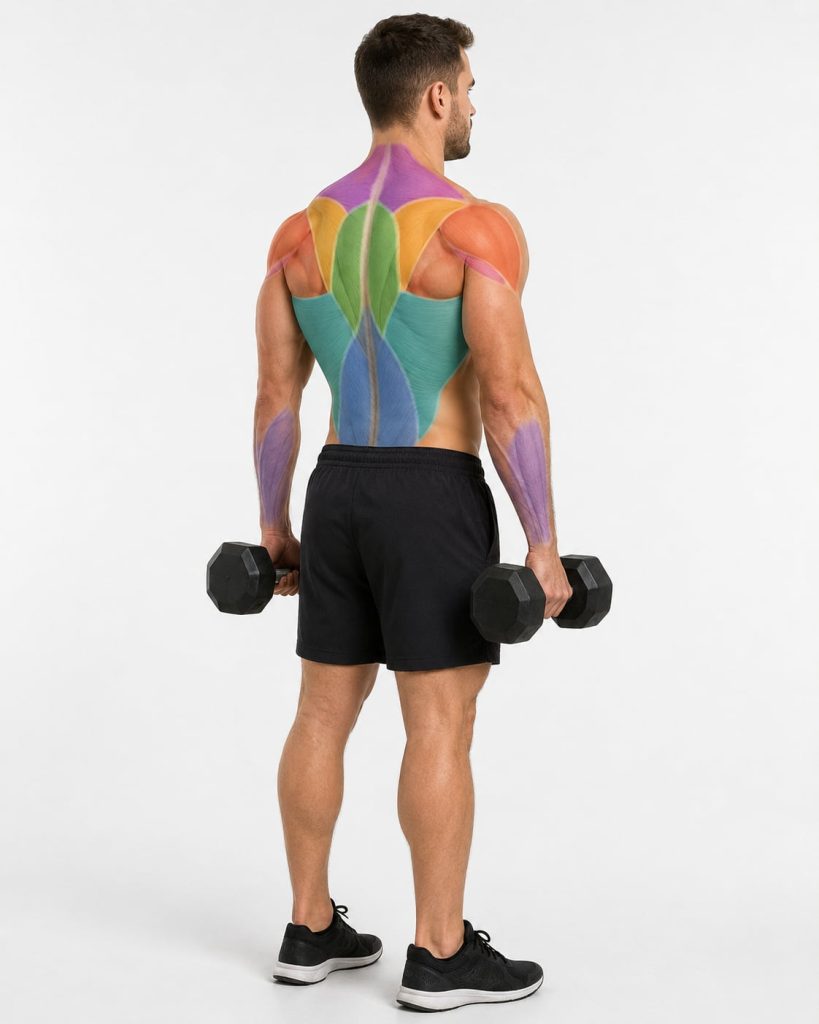
Upper Traps
The upper traps sit near the neck and top of the shoulders. They work hard during shrugs, loaded carries, high pulls, and heavy pulling exercises. Their main role in trap training is shoulder elevation and helping support the shoulder girdle under load.
Middle Traps
The middle traps sit across the upper back between the shoulder blades. They are strongly involved in scapular retraction, which means pulling the shoulder blades toward each other. Rows, reverse flyes, seal rows, and chest-supported rowing variations are useful for this area.
Lower Traps
The lower traps run farther down the upper back and help control the shoulder blades during upward rotation, depression, and stable overhead movement. Incline Y-raises, prone Y-T raises, and controlled angled raises are better choices for lower-trap work than heavy shrugs.
Supporting Muscles
Dumbbell trap exercises also train the rhomboids, rear delts, rotator cuff muscles, lats, spinal erectors, forearms, and core. Rows and carries especially require strong bracing, grip, and trunk control.
11 Best Dumbbell Trap Exercises for Upper, Mid, and Lower Traps
Build stronger traps with dumbbell exercises that target the upper, middle, and lower trapezius muscles.
These moves help improve upper-back strength, shoulder-blade control, posture support, and complete trap development.
1. Standing Dumbbell Shrug
Best for: Heavy upper-trap strength and simple trap loading.
Muscles worked: Upper traps, levator scapulae, forearms, grip muscles, and core.
Equipment needed: Dumbbells.
Why it stands out: The standing dumbbell shrug is one of the most direct upper-trap exercises. It is easy to load, easy to learn, and useful for lifters who want stronger traps without needing a barbell. The American Council on Exercise emphasizes keeping the arms straight, torso stable, and movement controlled during shrug variations.
Suggested sets and reps: Use 3–4 sets of 8–15 reps.
Beginners: Start light and pause for one second at the top of each rep. Focus on lifting the shoulders straight up instead of rolling them.
Intermediate: Use a heavier pair of dumbbells and control the lowering phase for 2 seconds.
Advanced: Use heavy dumbbells for 6–10 reps, then reduce the load and perform a controlled back-off set.
Rest: Rest 60–90 seconds between sets.
How to do it:
- Stand tall with a dumbbell in each hand at your sides.
- Keep your feet about hip-width apart and brace your core.
- Let your arms hang straight with your palms facing your body.
- Lift your shoulders straight up toward your ears.
- Pause briefly at the top without bending your elbows.
- Lower the dumbbells under control and repeat.
Common mistakes: The biggest mistake is rolling the shoulders in circles. Shrugs should move mostly up and down. Avoid bending the elbows, bouncing the weight, leaning back, or jutting the head forward.
Expert tip: Think “shoulders to ears, then slow down.” The lowering phase is where many lifters lose control.
Exercise variations: You can use a neutral-grip shrug, paused shrug, tempo shrug, or alternating dumbbell shrug.
Easier variation: Use lighter dumbbells and perform the movement seated.
Harder variation: Add a 2-second pause at the top or use slower eccentrics.
2. Single-Arm Dumbbell Shrug
Best for: Fixing side-to-side trap strength differences and improving unilateral control.
Muscles worked: Upper traps, grip muscles, obliques, core, and shoulder stabilizers.
Equipment needed: One dumbbell.
Why it stands out: The single-arm dumbbell shrug forces each side to work on its own. It also challenges your core because the weight pulls you toward one side. This makes it useful for building balanced trap strength and cleaner shoulder elevation.
Suggested sets and reps: Use 2–4 sets of 10–15 reps per side.
Beginners: Hold a stable object with your free hand if balance is difficult.
Intermediate: Keep your torso completely still while shrugging one side at a time.
Advanced: Use a heavy dumbbell and add a top pause without leaning sideways.
Rest: Rest 45–75 seconds between sides or sets.
How to do it:
- Stand tall with one dumbbell at your side.
- Brace your core and keep your shoulders level.
- Let the loaded arm hang straight.
- Shrug the loaded shoulder straight up.
- Pause briefly at the top.
- Lower slowly and repeat before switching sides.
Common mistakes: Avoid leaning away from the dumbbell, twisting your torso, or using your legs to bounce the weight. Keep the movement strict and controlled.
Expert tip: Your ribs and hips should stay stacked. If your torso shifts every rep, the weight is too heavy.
Exercise variations: Try a suitcase shrug, seated single-arm shrug, or slow-tempo single-arm shrug.
Easier variation: Use a lighter dumbbell and shorten the range slightly until control improves.
Harder variation: Hold the top position for 2–3 seconds on every rep.
3. Incline Dumbbell Shrug
Best for: Training the upper traps with more upper-back and shoulder-blade control.
Muscles worked: Upper traps, middle traps, rhomboids, rear delts, and grip muscles.
Equipment needed: Dumbbells and an incline bench.
Why it stands out: The incline position changes the pull angle and reduces body English. Because your chest is supported, it becomes harder to cheat with momentum. This makes the exercise useful for lifters who feel regular shrugs mostly in the neck instead of the upper back.
Suggested sets and reps: Use 3 sets of 10–15 reps.
Beginners: Use a low-to-moderate bench angle and light dumbbells.
Intermediate: Add a 1-second squeeze at the top.
Advanced: Use heavier dumbbells while keeping the chest glued to the bench.
Rest: Rest 60–90 seconds between sets.
How to do it:
- Set an incline bench to about 30–45 degrees.
- Lie chest-down on the bench with a dumbbell in each hand.
- Let your arms hang toward the floor.
- Keep your neck neutral and your chest supported.
- Shrug your shoulders upward and slightly back.
- Lower under control and repeat.
Common mistakes: Avoid lifting your chest off the bench, bending the elbows too much, or turning the exercise into a row.
Expert tip: Move your shoulder blades, not your hands. The dumbbells should rise because your traps are working.
Exercise variations: Use a neutral grip, slightly angled grip, or paused incline shrug.
Easier variation: Perform the exercise with very light dumbbells and a shorter range of motion.
Harder variation: Use a 3-second lowering phase.
4. Dumbbell Farmer’s Carry
Best for: Loaded trap endurance, grip strength, posture, and full-body bracing.
Muscles worked: Upper traps, forearms, grip muscles, shoulders, core, glutes, calves, and spinal erectors.
Equipment needed: Dumbbells and walking space.
Why it stands out: The farmer’s carry trains the traps in a practical way because the muscles must support load while you move. It also builds grip strength, trunk stiffness, and posture under tension.
Suggested sets and reps: Use 3–5 carries of 20–60 seconds.
Beginners: Start with moderate dumbbells and short walks of 20–30 seconds.
Intermediate: Increase the walking distance or total carry time before increasing weight.
Advanced: Use heavy dumbbells and keep every step controlled.
Rest: Rest 60–120 seconds between carries.
How to do it:
- Stand between two dumbbells and pick them up with a strong hip hinge.
- Hold one dumbbell in each hand at your sides.
- Stand tall with your ribs down and shoulders controlled.
- Walk with short, steady steps.
- Keep your head neutral and your grip strong.
- Set the dumbbells down with control.
Common mistakes: Avoid shrugging aggressively while walking, leaning back, rushing your steps, or letting the dumbbells swing.
Expert tip: Think “tall posture, quiet steps.” The goal is controlled tension, not speed.
Exercise variations: Try suitcase carries, march-in-place carries, or trap-focused heavy holds.
Easier variation: Use lighter dumbbells and walk for shorter distances.
Harder variation: Use heavier dumbbells or extend the carry time.
5. Chest-Supported Dumbbell Row
Best for: Middle-trap strength with less lower-back fatigue.
Muscles worked: Middle traps, rhomboids, lats, rear delts, biceps, and lower traps.
Equipment needed: Dumbbells and an incline bench.
Why it stands out: A chest-supported row helps you focus on the upper back because the bench limits swinging and lower-back compensation. The Mayo Clinic teaches controlled rowing with a braced trunk and a straight spine, and the supported version makes those cues easier to maintain.
Suggested sets and reps: Use 3–4 sets of 8–12 reps.
Beginners: Use light dumbbells and focus on smooth shoulder-blade movement.
Intermediate: Pull the elbows slightly out from the body to emphasize the upper back.
Advanced: Pause at the top for 1–2 seconds without lifting your chest.
Rest: Rest 60–90 seconds between sets.
How to do it:
- Set an incline bench to about 30–45 degrees.
- Lie chest-down with a dumbbell in each hand.
- Let your arms hang straight toward the floor.
- Pull the dumbbells toward your lower ribs.
- Squeeze your shoulder blades together at the top.
- Lower slowly until your arms are straight again.
Common mistakes: Avoid yanking the dumbbells, lifting your chest off the bench, or shrugging your shoulders toward your ears.
Expert tip: Keep your neck long. If your shoulders creep up, reset before the next rep.
Exercise variations: Use a neutral grip, elbows-out row, or paused chest-supported row.
Easier variation: Use one dumbbell at a time.
Harder variation: Use a slower tempo or hold the top position longer.
6. Single-Arm Dumbbell Row
Best for: Unilateral upper-back strength and middle-trap control.
Muscles worked: Middle traps, lats, rhomboids, rear delts, biceps, grip muscles, and core.
Equipment needed: One dumbbell and a bench.
Why it stands out: The single-arm dumbbell row lets you train each side separately and use a strong range of motion. The American Council on Exercise highlights the importance of torso control, scapular positioning, and avoiding rotation during this movement.
Suggested sets and reps: Use 3–4 sets of 8–12 reps per side.
Beginners: Place one hand and one knee on a bench for extra support.
Intermediate: Keep the torso still while pulling through a full range.
Advanced: Use heavier dumbbells while maintaining a controlled top squeeze.
Rest: Rest 60–90 seconds between sets.
How to do it:
- Place one hand and one knee on a bench.
- Hold a dumbbell in the opposite hand.
- Keep your spine neutral and your core braced.
- Let the dumbbell hang below your shoulder.
- Pull the dumbbell toward your hip or lower ribs.
- Lower under control and repeat.
Common mistakes: Avoid twisting your torso, rounding your back, pulling only with the arm, or letting the shoulder drop hard at the bottom.
Expert tip: Start the pull by moving the shoulder blade, then drive the elbow back.
Exercise variations: Try a tripod row, bench-supported row, or elbow-out row.
Easier variation: Use a lighter dumbbell and a supported bench setup.
Harder variation: Use a 2-second pause at the top of each rep.
7. Dumbbell Seal Row
Best for: Strict middle-trap work with very little momentum.
Muscles worked: Middle traps, rhomboids, rear delts, lats, biceps, and lower traps.
Equipment needed: Dumbbells and a high bench setup.
Why it stands out: The seal row is one of the strictest dumbbell rowing options because your torso stays supported and your legs cannot help. This makes it excellent for lifters who want cleaner upper-back work and less cheating.
Suggested sets and reps: Use 3–4 sets of 8–12 reps.
Beginners: Use a chest-supported incline row first if your bench setup is not high enough.
Intermediate: Pull with a controlled squeeze at the top.
Advanced: Use a wider elbow angle to make the upper back work harder.
Rest: Rest 75–120 seconds between sets.
How to do it:
- Lie face-down on a flat bench that is high enough for your arms to hang.
- Hold a dumbbell in each hand below your shoulders.
- Keep your chest pressed into the bench.
- Row the dumbbells toward your ribs.
- Squeeze your shoulder blades together.
- Lower the dumbbells under control.
Common mistakes: Avoid kicking the legs, lifting the chest, or shortening the range because the dumbbells are too heavy.
Expert tip: If you cannot pause at the top, reduce the weight.
Exercise variations: Use a neutral grip, wide row, or alternating seal row.
Easier variation: Do chest-supported rows on an incline bench.
Harder variation: Add a 3-second eccentric on every rep.
8. Bent-Over Dumbbell Reverse Fly
Best for: Middle traps, rear delts, and upper-back balance.
Muscles worked: Middle traps, rhomboids, rear delts, lower traps, and rotator cuff muscles.
Equipment needed: Dumbbells.
Why it stands out: The reverse fly trains the upper back with lighter loads and stricter control than rows. The Mayo Clinic describes the reverse fly as a dumbbell exercise that targets the upper back and warns against swinging or hunching during the movement.
Suggested sets and reps: Use 2–4 sets of 12–20 reps.
Beginners: Use very light dumbbells and keep the range controlled.
Intermediate: Pause briefly when your arms reach shoulder height.
Advanced: Use a slow 3-second lowering phase.
Rest: Rest 45–75 seconds between sets.
How to do it:
- Stand with a dumbbell in each hand.
- Hinge at your hips until your torso leans forward.
- Keep your back flat and knees slightly bent.
- Let your arms hang below your shoulders with soft elbows.
- Raise the dumbbells out to the sides.
- Lower slowly and repeat.
Common mistakes: Avoid swinging, shrugging, rounding your back, or lifting the dumbbells too high.
Expert tip: Lead with the elbows, not the hands. Keep the movement wide and controlled.
Exercise variations: Try seated reverse flyes, incline reverse flyes, or alternating reverse flyes.
Easier variation: Perform the exercise chest-supported on an incline bench.
Harder variation: Add a pause at the top of every rep.
9. Incline Dumbbell Y-Raise
Best for: Lower-trap strength and shoulder-blade control.
Muscles worked: Lower traps, middle traps, rear delts, rotator cuff muscles, and shoulder stabilizers.
Equipment needed: Light dumbbells and an incline bench.
Why it stands out: The incline Y-raise trains the traps from a different angle than shrugs and rows. It is especially useful for lifters who want better lower-trap involvement and controlled shoulder-blade movement. The ACE incline reverse fly guide supports the use of chest-supported angled arm raises with controlled positioning and light loads.
Suggested sets and reps: Use 2–3 sets of 10–15 reps.
Beginners: Start with very light dumbbells or no weight.
Intermediate: Use a small top pause and keep the neck relaxed.
Advanced: Use a slow tempo while maintaining clean arm angle and shoulder control.
Rest: Rest 45–75 seconds between sets.
How to do it:
- Set an incline bench to about 30–45 degrees.
- Lie chest-down with a light dumbbell in each hand.
- Let your arms hang toward the floor.
- Raise your arms diagonally into a Y shape.
- Keep your thumbs slightly up and your neck relaxed.
- Lower slowly and repeat.
Common mistakes: Avoid using heavy dumbbells, shrugging hard, arching your back, or turning the raise into a front raise.
Expert tip: This is not a max-load exercise. Small weights and clean control work best.
Exercise variations: Try prone Y-raises, one-arm Y-raises, or Y-raise holds.
Easier variation: Perform the movement with no dumbbells.
Harder variation: Hold the top position for 2 seconds on every rep.
10. Prone Dumbbell Y-T Raise
Best for: Lower and middle trap control with light resistance.
Muscles worked: Lower traps, middle traps, rear delts, rhomboids, and rotator cuff muscles.
Equipment needed: Light dumbbells and a bench or mat.
Why it stands out: The Y-T raise combines two arm angles. The Y position emphasizes lower-trap control, while the T position trains the middle traps and rear delts. It works best as a light accessory drill, warm-up movement, or upper-back finisher.
Suggested sets and reps: Use 2–3 sets of 8–12 reps per position.
Beginners: Perform the movement without dumbbells until you can control both positions.
Intermediate: Use very light dumbbells and slow reps.
Advanced: Add pauses in both the Y and T positions.
Rest: Rest 45–75 seconds between sets.
How to do it:
- Lie face-down on an incline bench or flat bench.
- Hold very light dumbbells with your arms hanging down.
- Raise your arms diagonally into a Y shape.
- Lower under control.
- Raise your arms out to the sides into a T shape.
- Lower again and repeat the sequence.
Common mistakes: Avoid rushing, using heavy weights, shrugging toward your ears, or arching your lower back.
Expert tip: Make each rep smooth. If you need momentum, the dumbbells are too heavy.
Exercise variations: Try Y-only raises, T-only raises, incline Y-T raises, or floor-based Y-T raises.
Easier variation: Use bodyweight only.
Harder variation: Add a 2-second pause at the top of each raise.
11. Modified Dumbbell High Pull
Best for: Advanced trap training with a more athletic pull.
Muscles worked: Upper traps, middle traps, shoulders, rear delts, forearms, glutes, hamstrings, and core.
Equipment needed: Dumbbells.
Why it stands out: The dumbbell high pull can train the traps through a powerful pulling pattern, but it is not the best choice for everyone. Some lifters feel shoulder irritation with upright-row-style movements. Use this exercise only if it feels smooth, controlled, and pain-free. Keep the range moderate and avoid forcing the elbows too high.
Suggested sets and reps: Use 2–4 sets of 6–10 reps.
Beginners: Skip this exercise at first and use shrugs, rows, and carries instead.
Intermediate: Use light-to-moderate dumbbells and stop around lower-chest to shoulder height.
Advanced: Use a crisp hip drive and controlled pull without turning it into a sloppy upright row.
Rest: Rest 90–120 seconds between sets.
How to do it:
- Stand with a dumbbell in each hand in front of your thighs.
- Hinge slightly at the hips with your chest tall.
- Drive through your legs and extend your hips.
- Pull the dumbbells upward close to your body.
- Keep your elbows angled out but do not force them high.
- Lower the dumbbells under control and reset.
Common mistakes: Avoid pulling too high, shrugging the neck aggressively, using excessive weight, or forcing a range that pinches the shoulders.
Expert tip: If the movement feels awkward or uncomfortable, replace it with farmer’s carries or incline shrugs.
Exercise variations: Try a one-arm dumbbell high pull, hang high pull, or light dumbbell pull from mid-thigh.
Easier variation: Use a standing dumbbell shrug.
Harder variation: Use a controlled dumbbell hang high pull with a strong hip drive.
Dumbbell Trap Workout for Upper, Mid, and Lower Traps
Use this workout 1–2 times per week after your main upper-body, pull, or full-body training. Keep 1–3 reps in reserve on most sets. The goal is strong, controlled trap work, not rushed reps.
| Exercise | Sets | Reps or Time | Rest |
|---|---|---|---|
| Standing Dumbbell Shrug | 3 | 8–12 reps | 60–90 sec |
| Chest-Supported Dumbbell Row | 3 | 8–12 reps | 60–90 sec |
| Dumbbell Farmer’s Carry | 3 | 30–45 sec | 90 sec |
| Incline Dumbbell Y-Raise | 2 | 10–15 reps | 45–75 sec |
| Bent-Over Dumbbell Reverse Fly | 2 | 12–20 reps | 45–75 sec |
Progress by adding reps first. When you can complete the top of the rep range with clean form, increase the dumbbell weight slightly. ACSM’s resistance training guidance supports gradually progressing load, volume, and exercise difficulty based on training level and goal.
How Often Should You Train Traps With Dumbbells?
Most lifters can train traps directly 1–2 times per week. If you already do heavy deadlifts, rows, pull-ups, cleans, or loaded carries, you may not need a large amount of extra trap work.
For beginners, 2–3 dumbbell trap exercises per week is enough. For intermediate lifters, 4–8 direct trap sets per week can work well. Advanced lifters may use more volume, but only if recovery, shoulder comfort, and form stay solid.
A smart weekly setup is one heavier upper-trap exercise, one row or reverse fly for the middle traps, and one light lower-trap exercise such as an incline Y-raise.
Common Dumbbell Trap Exercise Mistakes
Training Only Shrugs
Shrugs are useful, but they mainly train the upper traps. If you want more complete trap development, include rows, reverse flyes, and Y-raises so the middle and lower traps get direct work too.
Rolling the Shoulders During Shrugs
Rolling the shoulders does not make shrugs more effective. It often reduces control and can make the movement feel awkward. Lift the shoulders up, pause, and lower them straight down.
Going Too Heavy on Small Raise Exercises
Reverse flyes, Y-raises, and Y-T raises are not heavy ego lifts. If the dumbbells are too heavy, the movement usually turns into swinging, shrugging, or lower-back extension.
Letting the Neck Take Over
Trap exercises should not feel like you are jamming your neck into your shoulders. Keep your head neutral, ribs stacked, and shoulders controlled. Stop if you feel sharp pain, numbness, dizziness, chest pain, or unusual symptoms.
Ignoring Shoulder Comfort
Not every lifter needs high pulls or upright-row-style movements. If a high pull causes pinching or discomfort, choose safer options such as farmer’s carries, incline shrugs, chest-supported rows, or Y-raises.
Tips for Better Trap Training With Dumbbells
Use controlled reps. Most trap exercises work better when you pause briefly and lower the dumbbells with control.
Use different angles. Heavy shrugs and carries build the upper traps, rows train the middle traps, and Y-raises support lower-trap control.
Match the load to the exercise. Heavy dumbbells work for shrugs and carries. Moderate weights work for rows. Light weights work best for reverse flyes and Y-raises.
Train your traps with your back and shoulders. Trap work fits well after rows, pulldowns, overhead presses, or full-body strength sessions.
Warm up first. Use light rows, arm circles, scapular retractions, and easy shrug reps before heavier trap training.
FAQs About Dumbbell Trap Exercises
What are the best dumbbell trap exercises?
The best dumbbell trap exercises include standing dumbbell shrugs, single-arm shrugs, incline shrugs, farmer’s carries, chest-supported rows, single-arm rows, seal rows, reverse flyes, incline Y-raises, prone Y-T raises, and modified dumbbell high pulls.
Can you build traps with only dumbbells?
Yes. Dumbbells can train the traps effectively when you use a mix of heavy loaded movements, rows, reverse flyes, and lower-trap raise variations. The key is to train more than one trap function instead of relying only on shrugs.
Are dumbbell shrugs enough for traps?
Dumbbell shrugs are useful, but they are not enough for complete trap training. They mainly target the upper traps. Add rows and reverse flyes for the middle traps and Y-raises for the lower traps.
How heavy should dumbbell trap exercises be?
Use heavier dumbbells for shrugs, carries, and some rows. Use moderate weights for chest-supported rows and single-arm rows. Use light weights for reverse flyes, Y-raises, and Y-T raises because these movements require more control.
Should I train traps on back day or shoulder day?
Both can work. Trap exercises fit naturally on back day because rows and pulling movements already involve the upper back. They can also fit on shoulder day if you keep volume balanced and avoid overloading the neck and shoulders.
Why do I feel shrugs in my neck?
You may be using too much weight, jutting your head forward, shrugging too aggressively, or holding tension in your neck. Use a lighter weight, keep your head neutral, lift straight up, and lower slowly.
Conclusion
Dumbbell trap exercises are most effective when you train the traps from several angles. Use shrugs and carries for the upper traps, rows and reverse flyes for the middle traps, and Y-raises for the lower traps. Start with clean form, progress gradually, and choose exercises that feel strong, controlled, and comfortable for your shoulders.