Dumbbell back exercises can help you build a stronger, wider back with simple equipment, whether you train at home or in the gym. The best moves combine rows, pullovers, rear-delt work, hip-hinge patterns, shrugs, and carries so you train your lats, traps, rhomboids, rear delts, spinal erectors, and grip from multiple angles.
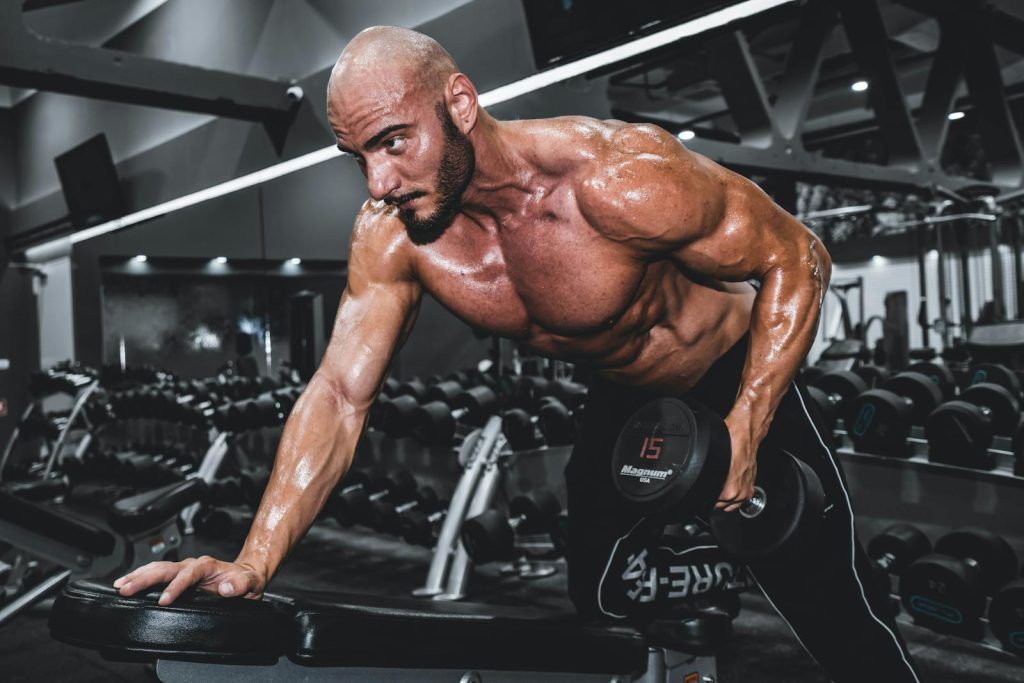
Dumbbells are especially useful because they let each side of your body work independently. That can help you notice strength differences, improve control, and train around limited equipment. In this guide, you’ll learn the best dumbbell back exercises, how to do them correctly, common mistakes to avoid, and how to build a complete dumbbell back workout.
What Makes Dumbbell Back Exercises Effective?
Dumbbell back training works because it gives you freedom of movement while still allowing progressive overload. You can row with one arm, support your chest on a bench, hinge with two dumbbells, or carry heavy weights to challenge your back, core, and grip together.
A strong dumbbell back workout should include several movement patterns:
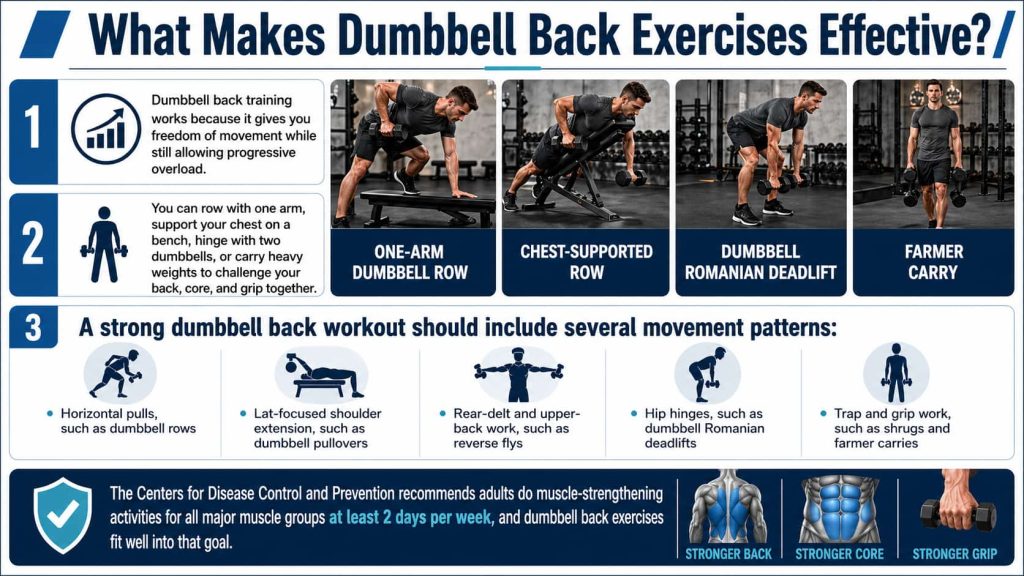
- Horizontal pulls, such as dumbbell rows
- Lat-focused shoulder extension, such as dumbbell pullovers
- Rear-delt and upper-back work, such as reverse flys
- Hip hinges, such as dumbbell Romanian deadlifts
- Trap and grip work, such as shrugs and farmer carries
The Centers for Disease Control and Prevention recommends adults do muscle-strengthening activities for all major muscle groups at least 2 days per week, and dumbbell back exercises fit well into that goal.
Muscles Worked by Dumbbell Back Exercises
Dumbbell back exercises can train several muscles depending on the angle, grip, and movement pattern.
The main muscles include:
- Latissimus dorsi: The large muscles on the sides of your back that help create width.
- Rhomboids: Upper-back muscles that help pull your shoulder blades together.
- Middle and lower traps: Important for shoulder blade control and posture.
- Upper traps: Trained heavily during shrugs and carries.
- Rear delts: The back part of your shoulders, used in rows and reverse flys.
- Spinal erectors: Lower-back muscles that help support your spine during hinges and carries.
- Biceps and forearms: Assist during rows and help with grip.
The Cleveland Clinic notes that dumbbell rows target muscles such as the lats, traps, and rhomboids while also training the shoulders, arms, and core.
11 Best Dumbbell Back Exercises for a Stronger, Wider Back
Build a stronger, wider back with these 11 dumbbell back exercises that target your lats, traps, rhomboids, rear delts, lower back, and grip. These moves include rows, pullovers, deadlift variations, shrugs, and carries so you can train back width, thickness, strength, and stability with minimal equipment.
1. Single-Arm Dumbbell Row
Best for: Building lat strength, fixing side-to-side imbalances, and learning proper rowing mechanics.
Muscles worked: Lats, rhomboids, traps, rear delts, biceps, forearms, and core.
Equipment needed: One dumbbell and a flat bench or sturdy support.
Why it stands out
The single-arm dumbbell row is one of the best dumbbell back exercises because it lets you train each side separately. It also gives you a strong support point, making it easier to focus on pulling with your back instead of swinging your torso.
The American Council on Exercise teaches the single-arm row with a braced torso, flat back, and head aligned with the spine. That makes it a strong choice for beginners and experienced lifters who want better control.
Suggested sets and reps
Do 3–4 sets of 8–12 reps per side. Beginners can start with 2 sets of 10–12 reps using a lighter dumbbell.
How to do it
- Place one hand and one knee on a bench.
- Hold a dumbbell in your opposite hand with your arm hanging straight down.
- Brace your core and keep your back flat.
- Pull the dumbbell toward your hip.
- Squeeze your back at the top without twisting your torso.
- Lower the dumbbell slowly until your arm is straight again.
- Complete all reps, then switch sides.
Common mistakes:
- Rotating your torso to lift the weight
- Pulling the dumbbell toward your shoulder instead of your hip
- Shrugging your shoulder toward your ear
- Rounding your lower back
- Dropping the dumbbell too quickly
Coaching cue:
Think, “Pull your elbow into your back pocket.”
Exercise variations
- Easier: Bench-supported single-arm row with a lighter dumbbell
- Harder: Dead-stop single-arm row from the floor
- Advanced: Single-arm row with a pause at the top
How to use in a workout:
Use this as your main back exercise early in the workout when you have the most energy.
2. Chest-Supported Dumbbell Row
Best for: Training the upper and mid-back without overloading the lower back.
Muscles worked: Lats, rhomboids, middle traps, rear delts, biceps, and forearms.
Equipment needed: Two dumbbells and an incline bench.
Why it stands out
The chest-supported dumbbell row reduces the need to hold a bent-over position. That makes it helpful if your lower back fatigues before your upper back during regular rows.
Because your chest stays on the bench, it is harder to cheat with momentum. This makes the exercise excellent for strict back training and muscle-building work.
Suggested sets and reps
Do 3–4 sets of 8–15 reps. Use slightly higher reps if your goal is muscle growth and control.
How to do it
- Set an incline bench to about 30–45 degrees.
- Lie chest-down on the bench with a dumbbell in each hand.
- Let your arms hang toward the floor.
- Keep your chest connected to the bench.
- Row both dumbbells toward your ribs.
- Squeeze your shoulder blades together.
- Lower the dumbbells slowly.
Common mistakes:
- Lifting your chest off the bench
- Using too much weight
- Flaring your elbows too wide
- Turning the row into a shrug
- Cutting the range of motion short
Coaching cue:
Keep your chest glued to the bench and pull your elbows behind you.
Exercise variations
- Easier: Use a lower incline and lighter dumbbells
- Harder: Pause for 1–2 seconds at the top
- Advanced: Use a neutral grip and slow eccentric lowering
How to use in a workout:
Use this after a heavier row or as your main row if you want a lower-back-friendly option.
3. Bent-Over Dumbbell Row
Best for: Building overall back thickness with both arms working together.
Muscles worked: Lats, rhomboids, traps, rear delts, spinal erectors, biceps, and forearms.
Equipment needed: Two dumbbells.
Why it stands out
The bent-over dumbbell row trains your back and your ability to hold a strong hip-hinge position. Unlike the chest-supported row, your lower back and core must work harder to stabilize your torso.
This exercise is great for lifters who want a simple, effective row without needing a bench.
Suggested sets and reps
Do 3–4 sets of 8–12 reps. Keep the reps controlled and avoid going so heavy that your torso rises on every rep.
How to do it
- Hold a dumbbell in each hand.
- Stand with your feet about hip-width apart.
- Push your hips back and slightly bend your knees.
- Keep your spine neutral and chest angled toward the floor.
- Let the dumbbells hang under your shoulders.
- Row both dumbbells toward your hips or lower ribs.
- Lower with control and repeat.
Common mistakes:
- Standing too upright
- Rounding the back
- Swinging the weights
- Pulling with only the arms
- Letting the shoulders roll forward at the bottom
Coaching cue:
Hold the hinge first, then row from that strong position.
Exercise variations
- Easier: Supported bent-over row with one hand on a bench
- Harder: Tempo bent-over dumbbell row
- Advanced: Wide-elbow bent-over row for more upper-back emphasis
How to use in a workout:
Use this as a main strength movement on a dumbbell pull day or upper-body day.
4. Dumbbell Renegade Row
Best for: Training the back, core, and anti-rotation strength together.
Muscles worked: Lats, traps, rhomboids, rear delts, abs, obliques, shoulders, chest, triceps, and forearms.
Equipment needed: Two dumbbells, preferably flat-sided dumbbells for stability.
Why it stands out
The renegade row is part back exercise and part core stability drill. Your back pulls the dumbbell, but your abs and obliques must work hard to keep your hips from twisting.
This is not the best choice for maximum back loading, but it is excellent for full-body control, athletic strength, and conditioning.
Suggested sets and reps
Do 2–4 sets of 6–10 reps per side. Start light and prioritize body control.
How to do it
- Place two dumbbells on the floor about shoulder-width apart.
- Grip the dumbbells and get into a high plank.
- Set your feet wider than hip-width for balance.
- Brace your abs and squeeze your glutes.
- Row one dumbbell toward your ribs.
- Keep your hips square to the floor.
- Lower the dumbbell slowly.
- Repeat on the other side.
Common mistakes:
- Rotating the hips
- Letting the lower back sag
- Using dumbbells that roll
- Rushing the reps
- Turning the movement into a sloppy plank
Coaching cue:
Pretend there is a glass of water on your lower back and do not let it spill.
Exercise variations
- Easier: Renegade row from the knees
- Harder: Renegade row with a push-up
- Advanced: Slow eccentric renegade row
How to use in a workout:
Use this as a core-focused back accessory or as part of a full-body circuit.
5. Dumbbell Reverse Fly
Best for: Strengthening the rear delts, upper back, and shoulder blade control.
Muscles worked: Rear delts, rhomboids, middle traps, lower traps, and rotator cuff muscles.
Equipment needed: Two light dumbbells.
Why it stands out
The reverse fly trains smaller upper-back muscles that are often undertrained. These muscles help support better shoulder positioning during rows, presses, and daily movement.
This is not an exercise for heavy weights. It works best when performed slowly with strict control.
Suggested sets and reps
Do 2–4 sets of 12–20 reps with light dumbbells.
How to do it
- Hold a dumbbell in each hand.
- Hinge at your hips with a soft bend in your knees.
- Let your arms hang below your shoulders.
- Keep a slight bend in your elbows.
- Raise the dumbbells out to the sides.
- Stop when your arms are roughly in line with your torso.
- Lower slowly and repeat.
Common mistakes:
- Going too heavy
- Swinging the dumbbells
- Shrugging during the raise
- Turning the palms too far upward
- Rounding the back
Coaching cue:
Reach wide, not high.
Exercise variations
- Easier: Seated dumbbell reverse fly
- Harder: Incline bench reverse fly
- Advanced: Reverse fly with a 2-second top hold
How to use in a workout:
Use this near the end of your workout after heavier rows.
6. Incline Dumbbell Rear Delt Row
Best for: Building the rear delts and upper back with more load than a reverse fly.
Muscles worked: Rear delts, rhomboids, middle traps, lower traps, and biceps.
Equipment needed: Two dumbbells and an incline bench.
Why it stands out
This exercise sits between a row and a reverse fly. It allows more weight than a reverse fly while still emphasizing the rear delts and upper-back muscles.
It is especially useful for lifters who want a stronger upper back and better shoulder balance.
Suggested sets and reps
Do 3–4 sets of 10–15 reps.
How to do it
- Set an incline bench to about 30–45 degrees.
- Lie chest-down with a dumbbell in each hand.
- Let your arms hang straight down.
- Pull the dumbbells up with your elbows angled out.
- Squeeze your upper back at the top.
- Lower slowly until your arms are straight again.
Common mistakes:
- Pulling the elbows too close to the ribs
- Lifting the chest off the bench
- Using momentum
- Shrugging at the top
- Going too heavy and losing rear-delt tension
Coaching cue:
Drive your elbows out and back, not straight down toward your hips.
Exercise variations
- Easier: Use lighter dumbbells and a higher incline
- Harder: Add a pause at the top
- Advanced: Use a slow 3-second lowering phase
How to use in a workout:
Use this after your main row to build upper-back detail and rear-delt strength.
7. Dumbbell Pullover
Best for: Training the lats through shoulder extension and adding a stretch-focused back movement.
Muscles worked: Lats, teres major, chest, serratus anterior, triceps long head, and core.
Equipment needed: One dumbbell and a bench or floor space.
Why it stands out
The dumbbell pullover trains the lats differently from rows. Instead of pulling your elbows back, you move your arms from overhead toward your torso. This can make it a useful accessory for people trying to build a wider-looking back.
The key is control. You should feel a stretch through your lats and upper body without forcing your shoulders beyond a comfortable range.
Suggested sets and reps
Do 2–4 sets of 10–15 reps.
How to do it
- Lie on a bench with one dumbbell held over your chest.
- Hold the inside of one dumbbell head with both hands.
- Keep a slight bend in your elbows.
- Brace your core and keep your ribs from flaring.
- Lower the dumbbell behind your head until you feel a controlled stretch.
- Pull the dumbbell back over your chest.
- Repeat with slow, smooth reps.
Common mistakes:
- Arching the lower back
- Bending and straightening the elbows too much
- Lowering beyond shoulder comfort
- Moving too fast
- Using a weight that is too heavy
Coaching cue:
Keep your ribs down and move from your shoulders, not your lower back.
Exercise variations
- Easier: Floor dumbbell pullover
- Harder: Bench pullover with a slower lowering phase
- Advanced: Single-dumbbell pullover with a pause in the stretched position
How to use in a workout:
Use this after rows as a lat-focused accessory movement.
8. Dumbbell Romanian Deadlift
Best for: Strengthening the lower back, glutes, hamstrings, and posterior chain.
Muscles worked: Spinal erectors, glutes, hamstrings, lats, traps, forearms, and core.
Equipment needed: Two dumbbells.
Why it stands out
The dumbbell Romanian deadlift is not a pure upper-back exercise, but it is important for building the back side of your body. Your spinal erectors help keep your torso stable while your glutes and hamstrings drive the movement.
It also teaches a strong hip hinge, which carries over to bent-over rows and other back exercises.
Suggested sets and reps
Do 3–4 sets of 8–12 reps.
How to do it
- Stand tall with a dumbbell in each hand.
- Hold the dumbbells in front of your thighs.
- Keep your knees slightly bent.
- Push your hips back as the dumbbells move down your legs.
- Keep your back neutral and your chest proud.
- Lower until you feel a strong hamstring stretch.
- Drive your hips forward to stand tall again.
Common mistakes:
- Squatting instead of hinging
- Rounding the lower back
- Letting the dumbbells drift away from the body
- Locking the knees
- Looking too far up
Coaching cue:
Push your hips back like you are closing a car door behind you.
Exercise variations
- Easier: Short-range dumbbell RDL
- Harder: Single-leg dumbbell RDL
- Advanced: Tempo dumbbell RDL with a 3-second lowering phase
How to use in a workout:
Use this early in your workout if you want to train lower back and posterior-chain strength.
9. Dumbbell Deadlift
Best for: Building full-body pulling strength with a beginner-friendly setup.
Muscles worked: Spinal erectors, glutes, hamstrings, quads, traps, lats, forearms, and core.
Equipment needed: Two dumbbells.
Why it stands out
The dumbbell deadlift is easier to set up than a barbell deadlift and can be less intimidating for beginners. It trains your back as part of a full-body lift, especially your spinal erectors, traps, and lats as they stabilize the weight.
This exercise is best when used to learn good lifting mechanics, not when rushed for high-rep fatigue.
Suggested sets and reps
Do 3–4 sets of 6–10 reps.
How to do it
- Stand with two dumbbells at your sides or in front of your thighs.
- Set your feet about hip-width apart.
- Brace your core.
- Push your hips back and bend your knees.
- Lower the dumbbells toward the floor while keeping your back neutral.
- Drive through your feet to stand tall.
- Squeeze your glutes at the top without leaning back.
Common mistakes:
- Rounding the back
- Letting the dumbbells swing forward
- Starting with the hips too low
- Jerking the weights off the floor
- Leaning back at the top
Coaching cue:
Push the floor away and keep the dumbbells close.
Exercise variations
- Easier: Dumbbell deadlift from blocks or a raised surface
- Harder: Dumbbell suitcase deadlift
- Advanced: Deficit dumbbell deadlift
How to use in a workout:
Use this as a main strength movement in a full-body workout or back-focused session.
10. Dumbbell Shrug
Best for: Building the upper traps and improving loaded shoulder stability.
Muscles worked: Upper traps, levator scapulae, forearms, and grip muscles.
Equipment needed: Two dumbbells.
Why it stands out
The dumbbell shrug is simple, but it can be very effective when performed correctly. It targets the upper traps directly and pairs well with rows, deadlifts, and carries.
The goal is not to roll your shoulders. The goal is to elevate your shoulders under control, pause briefly, and lower slowly.
Suggested sets and reps
Do 3–4 sets of 10–15 reps.
How to do it
- Stand tall with a dumbbell in each hand.
- Let the dumbbells hang at your sides.
- Brace your core and keep your neck neutral.
- Lift your shoulders straight up toward your ears.
- Pause briefly at the top.
- Lower slowly until your shoulders are relaxed.
- Repeat.
Common mistakes:
- Rolling the shoulders
- Bending the elbows
- Using too much momentum
- Leaning backward
- Looking down during the set
Coaching cue:
Lift straight up, pause, then lower under control.
Exercise variations
- Easier: Light dumbbell shrug with a slow tempo
- Harder: Heavy dumbbell shrug with a 2-second hold
- Advanced: Single-arm dumbbell shrug
How to use in a workout:
Use this near the end of your workout after rows and hinges.
11. Dumbbell Farmer Carry
Best for: Building traps, grip strength, core stability, and full-body tension.
Muscles worked: Traps, forearms, lats, spinal erectors, abs, obliques, glutes, and calves.
Equipment needed: Two dumbbells and open walking space.
Why it stands out
The farmer carry trains your back in a practical way. Your traps and upper back hold the dumbbells, your lats help keep the weights stable, your core resists side-to-side movement, and your grip works the entire time.
It is simple, but it is not easy. Heavy carries can be one of the best finishers for a dumbbell back workout.
Suggested sets and reps
Do 3–5 carries of 20–60 seconds or 20–40 yards.
How to do it
- Place two dumbbells at your sides.
- Hinge down and pick them up with a flat back.
- Stand tall with your shoulders down and back.
- Brace your core.
- Walk slowly with controlled steps.
- Keep the dumbbells from swinging.
- Set the dumbbells down with good form.
Common mistakes:
- Leaning backward
- Letting the shoulders round forward
- Taking rushed, sloppy steps
- Holding your breath too long
- Dropping the dumbbells carelessly
Coaching cue:
Walk tall like you are carrying heavy suitcases through a narrow hallway.
Exercise variations
- Easier: Light farmer carry for short distance
- Harder: Heavy farmer carry
- Advanced: Single-arm suitcase carry
How to use in a workout:
Use this as a finisher after your main back exercises.
Beginner Tips for Dumbbell Back Training
Start with exercises that are easier to control. The single-arm dumbbell row, chest-supported row, dumbbell RDL, and light reverse fly are usually better starting points than heavy bent-over rows or renegade rows.
The Mayo Clinic recommends beginners start with a weight they can lift comfortably for 12–15 repetitions and increase gradually as technique improves.
Use these beginner rules:
- Keep your spine neutral during rows and hinges.
- Pull with your elbows instead of curling with your biceps.
- Control the lowering phase of each rep.
- Stop the set when your form breaks down.
- Train your back 1–3 times per week depending on your full workout plan.
- Rest at least 48 hours before training the same muscles hard again.
Common Dumbbell Back Exercise Mistakes
Using Too Much Weight
If you have to jerk, twist, or swing the dumbbell, the weight is too heavy. Back exercises work best when the target muscles control the movement.
Rounding the Lower Back
Rows, RDLs, and deadlifts require a strong torso position. If your lower back rounds, reduce the weight, shorten the range of motion, or choose a chest-supported exercise.
Pulling Only With the Arms
Your arms will help during rows, but they should not do all the work. Think about driving your elbows back and squeezing your shoulder blades.
Shrugging During Rows
Many lifters turn rows into trap-dominant movements by shrugging the shoulder toward the ear. Keep your shoulder down and pull your elbow toward your hip for more lat focus.
Rushing the Reps
Fast reps often reduce tension on the back muscles. Use a controlled lift, a brief squeeze, and a slow lower.
Skipping Warm-Ups
Cold muscles may not move as well under load. The Mayo Clinic recommends warming up with 5–10 minutes of light aerobic activity before lifting weights.
Sample Dumbbell Back Workout
Beginner Dumbbell Back Workout
Use this workout 1–2 times per week.
- Chest-Supported Dumbbell Row — 3 sets of 10–12 reps
- Single-Arm Dumbbell Row — 2 sets of 10 reps per side
- Dumbbell Romanian Deadlift — 3 sets of 10 reps
- Dumbbell Reverse Fly — 2 sets of 12–15 reps
- Farmer Carry — 3 carries of 20–30 seconds
Rest 60–90 seconds between sets.
Intermediate Dumbbell Back Workout
Use this workout once per week as a focused back session.
- Bent-Over Dumbbell Row — 4 sets of 8–10 reps
- Single-Arm Dumbbell Row — 3 sets of 10–12 reps per side
- Dumbbell Pullover — 3 sets of 10–15 reps
- Incline Dumbbell Rear Delt Row — 3 sets of 12 reps
- Dumbbell Shrug — 3 sets of 12–15 reps
- Farmer Carry — 4 carries of 30–45 seconds
Rest 90 seconds after heavy rows and 45–60 seconds after accessories.
Advanced Dumbbell Back Finisher
Use this at the end of a back or pull workout.
Complete 3 rounds:
- Renegade Row — 8 reps per side
- Dumbbell Reverse Fly — 15 reps
- Dumbbell Shrug — 15 reps
- Farmer Carry — 40 seconds
Rest 60–90 seconds between rounds.
How Often Should You Train Back With Dumbbells?
Most people can train their back with dumbbells 1–3 times per week, depending on total volume, recovery, and the rest of their training plan.
A simple weekly structure could look like this:
- 1 day per week: Best for beginners or people who already do other pulling exercises.
- 2 days per week: Best for most people who want steady strength and muscle growth.
- 3 days per week: Best for advanced lifters using different intensities and exercise variations.
Avoid training heavy rows, deadlifts, and carries hard every day. Your back muscles, grip, elbows, and lower back need recovery to perform well.
How to Progress Dumbbell Back Exercises
Progression does not always mean grabbing the heaviest dumbbells right away. You can make dumbbell back exercises harder in several ways:
- Add 1–2 reps per set.
- Add another set.
- Increase dumbbell weight gradually.
- Slow down the lowering phase.
- Pause at the top of rows.
- Improve range of motion.
- Use stricter form with less momentum.
- Move from supported variations to unsupported variations.
A good rule: increase weight only when you can complete all reps with solid form and no twisting, swinging, or pain.
Safety Tips Before You Start
Dumbbell back exercises should challenge your muscles, not irritate your joints or spine. Stop the exercise if you feel sharp pain, numbness, dizziness, or unusual symptoms.
Use these safety basics:
- Warm up before lifting.
- Start lighter than you think.
- Keep your core braced.
- Maintain a neutral spine.
- Avoid sudden twisting under load.
- Use a bench or support if your lower back gets tired.
- Do not force shoulder range of motion during pullovers or reverse flys.
If you have a current back, shoulder, or neck injury, get guidance from a qualified professional before adding new loaded exercises.
FAQs About Dumbbell Back Exercises
Can you build a big back with only dumbbells?
Yes, you can build a stronger and more muscular back with dumbbells if you train consistently, use good form, and progress over time. Rows, pullovers, RDLs, shrugs, reverse flys, and carries can train most major back muscles without machines or a barbell.
What is the best dumbbell exercise for back width?
The single-arm dumbbell row and dumbbell pullover are two of the best dumbbell exercises for back width because they emphasize the lats. For best results, pull with control, keep your shoulder from shrugging, and use a full range of motion that you can control.
What is the best dumbbell exercise for back thickness?
Bent-over dumbbell rows and chest-supported dumbbell rows are excellent for back thickness. They train the rhomboids, traps, rear delts, and lats, especially when you squeeze your shoulder blades and control the lowering phase.
Are dumbbell rows enough for back training?
Dumbbell rows are a great foundation, but they are not the only exercise you need. A complete dumbbell back workout should also include rear-delt work, hip-hinge movements, trap training, and grip-focused carries.
How heavy should dumbbells be for back exercises?
Use a weight you can control through the full range of motion. For beginners, that often means choosing a dumbbell you can lift for 10–15 clean reps. If your torso twists, your shoulders shrug, or your lower back rounds, the weight is too heavy.
Can beginners do dumbbell back exercises?
Yes. Beginners can start with chest-supported rows, single-arm rows, light reverse flys, and dumbbell Romanian deadlifts. These exercises teach control and strength without requiring complex equipment.
Should I train back and biceps together?
Back and biceps are often trained together because most rowing movements also use the biceps. A simple pull workout can include dumbbell rows, reverse flys, shrugs, carries, and 1–2 biceps exercises.
Conclusion
Dumbbell back exercises are one of the most practical ways to build a stronger, wider, and more balanced upper body. Start with rows as your foundation, then add pullovers, reverse flys, RDLs, shrugs, and carries to train your back from multiple angles.
Choose 4–6 exercises from this list, train with clean form, and progress slowly. A strong back is built through consistent reps, controlled movement, and smart exercise selection.
References
- American Council on Exercise — Single-Arm Row
- Cleveland Clinic — Dumbbell Rows: Proper Form, Benefits, and Muscles Worked
- Centers for Disease Control and Prevention — Adult Physical Activity Guidelines
- Mayo Clinic — Weight Training: Do’s and Don’ts of Proper Technique
- Mayo Clinic Health System — 10 Weight Training Tips for Beginners
3 thoughts on “11 Best Dumbbell Back Exercises for a Stronger, Wider Back”