The close grip bench press is a triceps-focused bench press variation that uses a narrower grip to train pressing strength, arm drive, and upper-body muscle. It still works your chest and shoulders, but the closer hand position shifts more demand toward the triceps, especially through the lockout portion of the press.
In this guide, you’ll learn how to do the close grip bench press with proper form, which muscles it works, the main benefits, common mistakes, safer grip-width tips, useful variations, and how to program it into a real workout.
What Is the Close Grip Bench Press?
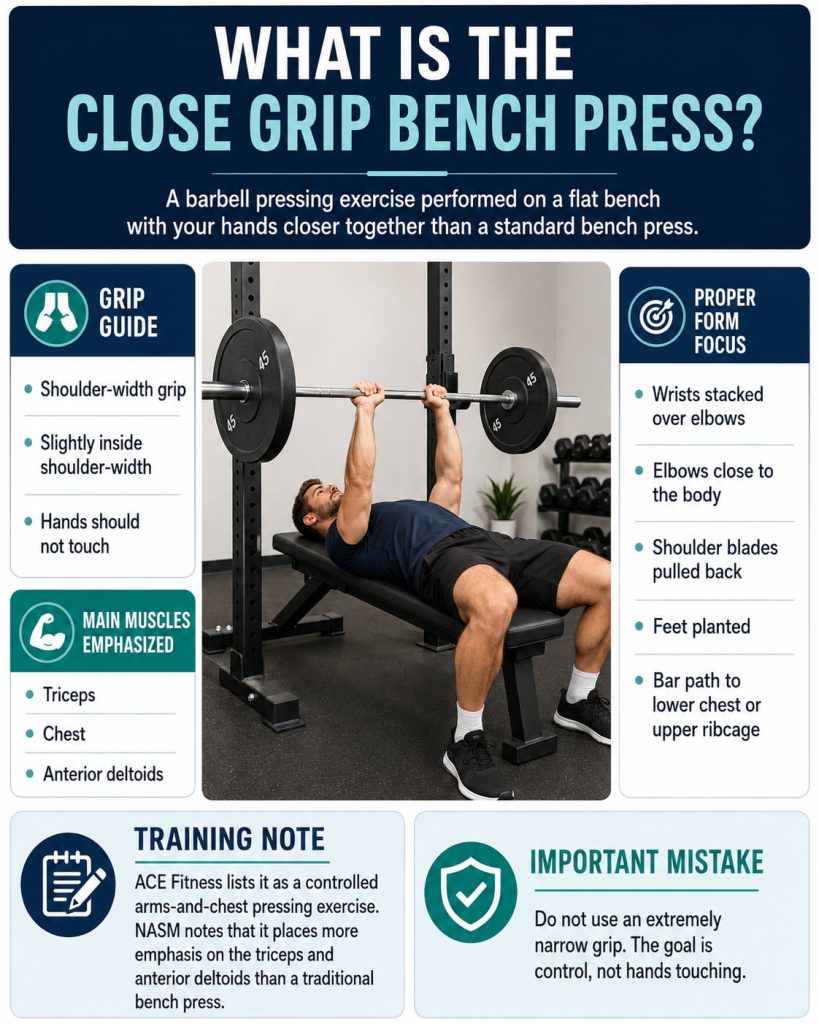
The close grip bench press is a barbell pressing exercise performed on a flat bench with your hands closer together than a standard bench press. Instead of using a wide or moderate bench grip, you place your hands around shoulder-width or slightly inside shoulder-width.
The goal is not to make your hands touch. That is one of the biggest mistakes lifters make.
A good close grip bench press should still look strong, stable, and controlled. Your wrists stay stacked over your elbows, your shoulder blades stay pulled back against the bench, and the bar travels toward the lower chest or upper ribcage instead of straight down to your neck.
According to the ACE Fitness exercise library, the close-grip bench press targets the arms and chest and uses a controlled barbell pressing pattern. NASM also describes the close grip bench press as placing more emphasis on the triceps and anterior deltoids compared with a traditional bench press.
Close Grip Bench Press Muscles Worked
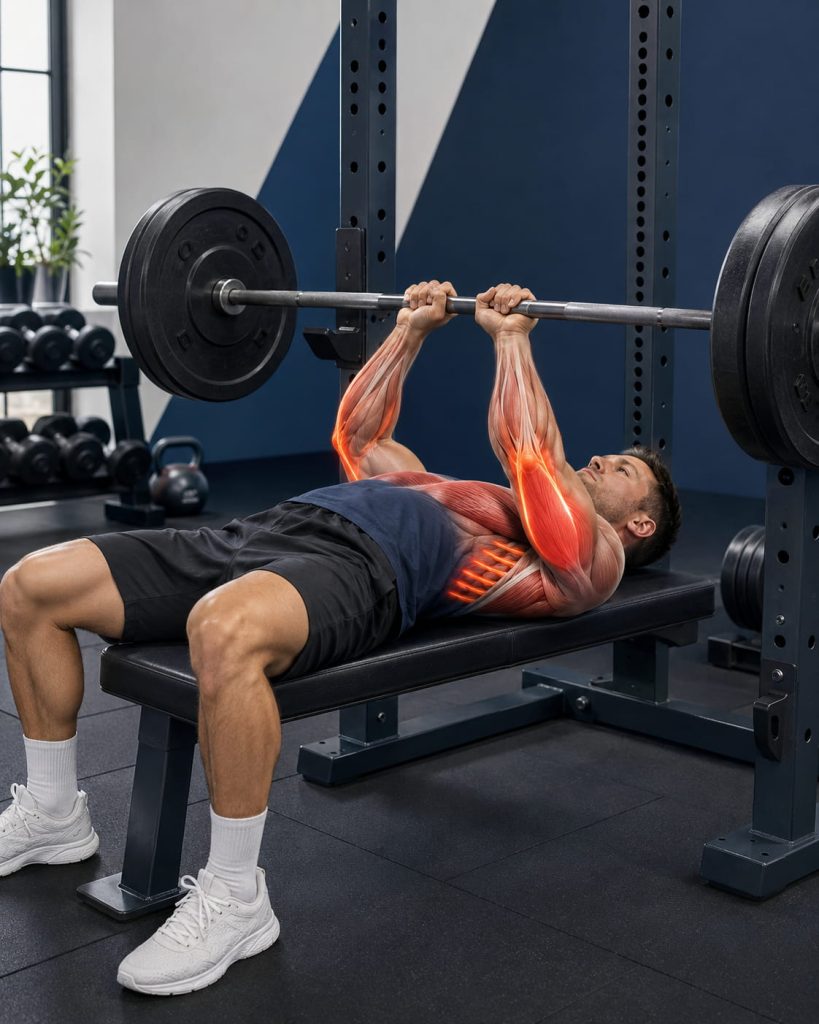
The close grip bench press is a compound upper-body lift. That means several joints and muscle groups work together to move the bar.
Primary Muscles Worked
Triceps brachii
The triceps are the main reason most lifters use this exercise. They extend the elbows as you press the bar up. The close grip position generally increases the demand on elbow extension compared with a wider bench press.
The triceps are especially important during the top half of the lift, where you finish the press and lock out the elbows.
Secondary Muscles Worked
Pectoralis major
Your chest still works hard during the close grip bench press. The pecs help move the upper arms across the body and contribute to the press off the chest.
The closer grip may reduce chest emphasis compared with a standard bench press, but this is not an isolation exercise. Your chest is still involved.
Anterior deltoids
The front shoulders help flex the arms and support the press. Many lifters feel the close grip bench press in the front delts, especially if they lower the bar too high on the chest or let the elbows drift forward too much.
Serratus anterior and upper-back stabilizers
Your upper back does not press the bar, but it helps create the stable base you press from. The shoulder blades should stay pulled back and down against the bench.
Forearms and grip muscles
Your forearms help keep the wrists stacked and the bar controlled. A stable wrist position makes the lift stronger and more comfortable.
Close Grip Bench Press Benefits
The close grip bench press is useful because it lets you train the triceps with heavier loads than most isolation exercises while still building general pressing strength.
1. Builds Stronger Triceps
The closer hand position increases the role of the triceps during the press. This makes the movement a strong choice for lifters who want to build triceps strength without relying only on pushdowns, skull crushers, or overhead extensions.
A peer-reviewed bench press grip-width study published on PubMed Central found that triceps activity was lower with a wide grip compared with medium and narrow grips in the merged analysis. That supports the close grip bench press as a triceps-biased pressing variation.
2. Helps Improve Bench Press Lockout
If you struggle near the top of your regular bench press, weak triceps may be part of the issue. The close grip bench press trains the elbow extension strength needed to finish heavy presses.
This makes it a useful accessory lift for powerlifting, strength training, football training, and general upper-body development.
3. Trains Pressing Strength With a Different Grip
The close grip bench press gives you a way to train horizontal pressing without using the exact same grip and joint angles as your regular bench press.
That can be useful when organizing a program. For example, you might train regular bench press heavy earlier in the week and use close grip bench press later as a triceps-focused accessory.
4. May Be More Shoulder-Friendly for Some Lifters
A closer grip can reduce shoulder abduction compared with a wider grip. In simple terms, your upper arms do not have to flare as far away from your body.
That does not mean the exercise is automatically safe for everyone or that it fixes shoulder pain. But for some lifters, a shoulder-width grip with tucked elbows can feel more controlled than a wide bench press.
Stop the exercise if you feel sharp pain, numbness, dizziness, chest pain, or unusual symptoms.
5. Works Well for Strength and Muscle
The close grip bench press can be trained in several rep ranges.
Use heavier sets of 3–6 reps for strength, moderate sets of 6–10 reps for strength and muscle, or higher-rep sets of 10–15 reps for triceps-focused accessory work.
For general resistance-training structure, ACSM emphasizes matching load, volume, and progression to the person’s goal and training level.
Close Grip Bench Press: Proper Form
Equipment needed: Flat bench, barbell, weight plates, rack, and safety arms or a spotter when using challenging loads
Why it stands out: The close grip bench press lets you train the triceps with a heavier compound movement. Unlike pushdowns or other isolation exercises, it also strengthens your pressing mechanics, shoulder control, and upper-body stability.
Suggested sets and reps: Beginners can start with 2–3 sets of 8–10 reps using a light to moderate load. For muscle building, use 3–4 sets of 6–12 reps. For strength, use 3–5 sets of 3–6 reps only if your form is consistent.
Beginners: Start light and focus on grip width, wrist position, elbow path, and controlled bar speed. Stop each set with about 2–4 reps in reserve.
Intermediate: Use the close grip bench press as a main accessory lift after regular bench press or overhead press. Most lifters do well with 3–4 sets of 6–10 reps.
Advanced: Use heavier sets, paused reps, close grip floor presses, or training blocks where the close grip bench press becomes the main press for 4–6 weeks.
Rest: Rest 90–120 seconds for beginner technique work, 90–150 seconds for hypertrophy, and 2–3 minutes for heavier strength sets.
How to do it:
- Set the bar height so you can unrack it without reaching too far or losing shoulder position.
- Lie on the bench with your eyes slightly under the bar and your feet planted on the floor.
- Pull your shoulder blades back and down to create a stable upper-back position.
- Grip the bar around shoulder-width or slightly inside shoulder-width.
- Keep your wrists stacked and place the bar over the heel of your palm.
- Unrack the bar with control and bring it over your shoulders.
- Lower the bar toward your lower chest or upper ribcage while keeping your elbows close.
- Press the bar up and slightly back until your arms are straight.
- Reset your upper back, wrist position, and elbow path before the next rep.
Common mistakes: The most common mistakes are gripping too narrow, letting the elbows flare, lowering the bar too high, bending the wrists back, bouncing the bar, losing upper-back tightness, and going too heavy too soon.
Expert tip: Think, “Elbows close, wrists stacked, press through the triceps.” This keeps the lift focused and helps prevent the movement from turning into a sloppy regular bench press.
Exercise variations: Useful variations include the dumbbell close grip bench press, close grip push-up, close grip floor press, Smith machine close grip bench press, and paused close grip bench press.
Easier variation: Use a close grip push-up with your hands elevated on a bench or perform a dumbbell close grip bench press with lighter weights.
Harder variation: Use a paused close grip bench press, heavier low-rep sets, slower eccentrics, or a close grip floor press for lockout strength.
How Close Should Your Grip Be?
Your close grip bench press grip should usually be around shoulder-width or slightly narrower.
A common mistake is going too close. When the hands are only a few inches apart, the wrists often bend awkwardly, the elbows lose position, and the bar path becomes harder to control.
Use this simple test:
At the bottom of the rep, your forearms should look mostly vertical when viewed from the front. If your hands are too close, your forearms may angle inward. If your grip is too wide, the movement starts looking like a normal bench press.
Good Grip Width
A good grip usually keeps your hands around shoulder-width, wrists stacked over elbows, elbows close to the ribs, and the bar path smooth and controlled. You should feel strong triceps involvement without wrist discomfort.
Too Narrow
A grip that is too narrow often makes the hands nearly touch, bends the wrists back or inward, crowds the elbows, and makes the bar path feel unstable. It may also create shoulder, wrist, or elbow discomfort.
Too Wide
A grip that is too wide allows the elbows to flare, shifts more work to the chest, reduces triceps emphasis, and makes the lift feel almost identical to your regular bench press.
Common Close Grip Bench Press Mistakes
Mistake 1: Using a Grip That Is Too Narrow
A super-narrow grip does not automatically train the triceps better. It often just makes the lift weaker and less comfortable.
Fix: Start at shoulder-width. Adjust slightly inward only if your wrists, elbows, and shoulders still feel good.
Mistake 2: Letting the Elbows Flare
The close grip bench press works best when the elbows stay closer to the body. If they flare wide, the lift starts shifting away from the triceps and may place more stress on the shoulders.
Fix: Think about pointing your elbows toward your feet as you lower the bar.
Mistake 3: Lowering the Bar Too High
Lowering the bar toward the upper chest, collarbone, or neck can make the shoulders work harder in a poor position.
Fix: Lower the bar toward the lower chest or upper ribcage. The exact spot depends on your arm length and grip width, but it should feel natural and controlled.
Mistake 4: Bending the Wrists Back
Bent wrists leak force and can make the lift uncomfortable.
Fix: Keep the bar low in the palm, directly above the forearm. Your wrists should stay stacked, not folded back.
Mistake 5: Bouncing the Bar
Bouncing the bar off your chest removes control and can increase risk.
Fix: Lower with a smooth tempo. Lightly touch the chest or pause just above it, then press.
Mistake 6: Losing Upper-Back Tightness
If your shoulders roll forward at the bottom, you lose your pressing base.
Fix: Pull your shoulder blades back and down before unracking. Keep your upper back tight through the whole set.
Mistake 7: Going Too Heavy Too Soon
The close grip bench press is usually weaker than your standard bench press. Trying to use the same load can break down your form fast.
Fix: Start lighter than your normal bench press and build up gradually.
Close Grip Bench Press Sets, Reps, and Programming
The best way to program the close grip bench press depends on your goal.
For Triceps Muscle Growth
Use moderate reps and controlled technique.
Programming option:
3–4 sets of 8–12 reps with 90–150 seconds of rest. Stop each set with about 1–3 reps in reserve.
This works well after your main bench press or overhead press. You can also pair it with a triceps isolation exercise like rope pushdowns or overhead cable extensions.
For Bench Press Strength
Use lower reps and longer rest.
Programming option:
3–5 sets of 3–6 reps with 2–3 minutes of rest. Stop each set with about 1–2 reps in reserve.
Place it after your main bench press or use it as the main press on a secondary upper-body day.
For Beginners
Use lighter weight and more practice reps.
Programming option:
2–3 sets of 8–10 reps with 90–120 seconds of rest. Stop each set with about 2–4 reps in reserve.
Beginners should focus on grip width, wrist position, elbow path, and smooth bar control before adding heavy weight.
For Intermediate Lifters
Intermediate lifters can use the close grip bench press as a main accessory lift.
Programming option:
Day 1 can include regular bench press as the heavier main lift. Day 2 can include close grip bench press for 3–4 sets of 6–10 reps.
This gives you extra pressing volume without repeating the exact same bench press pattern.
For Advanced Lifters
Advanced lifters can rotate the close grip bench press in blocks.
Examples include using the close grip bench press as a heavy main lift for 4–6 weeks, adding paused close grip bench press for control off the chest, using close grip floor press for lockout strength, or using slower eccentrics for hypertrophy.
Advanced lifters should still avoid sloppy reps. More load only helps if the movement stays clean.
How to Progress the Close Grip Bench Press
Progression should be steady, not rushed.
A simple method is the double-progression approach:
- Choose a rep range, such as 6–10 reps.
- Start with a weight you can control for 3 sets of 6–8 reps.
- Add reps over time while keeping the same weight.
- Once you can complete all sets at the top of the range with good form, add a small amount of weight.
- Repeat the process.
Example:
Week 1: 135 pounds for 3 sets of 7
Week 2: 135 pounds for 3 sets of 8
Week 3: 135 pounds for 3 sets of 9
Week 4: 135 pounds for 3 sets of 10
Week 5: 140 pounds for 3 sets of 6–8
Do not increase weight if your wrists bend, elbows flare, the bar bounces, or your shoulder position falls apart.
Close Grip Bench Press Variations
1. Dumbbell Close Grip Bench Press
Best for: Beginners, lifters with wrist discomfort from a straight bar, and those who want a more natural hand position
Muscles worked: Triceps, chest, anterior deltoids
Equipment needed: Flat bench and dumbbells
Hold two dumbbells close together over your chest with a neutral grip. Lower them under control, keeping the elbows close, then press back up.
Why it’s useful: Dumbbells allow the wrists and shoulders to move more naturally. This can be a good regression before using the barbell version.
Common mistake: Letting the dumbbells drift apart and turning it into a regular dumbbell bench press.
2. Close Grip Push-Up
Best for: No-equipment training, beginners, and warm-ups
Muscles worked: Triceps, chest, shoulders, core
Equipment needed: None
Place your hands slightly inside shoulder-width. Keep your body in a straight line and lower under control. Press back up while keeping the elbows close.
Why it’s useful: It trains a similar close-elbow pressing pattern without a barbell.
Regression: Perform it with hands elevated on a bench or sturdy surface.
Progression: Add a slow lowering phase, a pause at the bottom, or a weighted vest if appropriate.
3. Close Grip Floor Press
Best for: Lockout strength, shoulder control, and lifters who want a shorter range of motion
Muscles worked: Triceps, chest, anterior deltoids
Equipment needed: Barbell or dumbbells
Lie on the floor and press from a close grip. Your elbows touch the floor lightly at the bottom before you press back up.
Why it’s useful: The floor limits the bottom range of motion, which can make the lift easier to control and more focused on the top half of the press.
Common mistake: Relaxing at the bottom when the elbows touch the floor.
4. Smith Machine Close Grip Bench Press
Best for: Controlled bar path, machine-based training, and accessory work
Muscles worked: Triceps, chest, anterior deltoids
Equipment needed: Smith machine and bench
Set a flat bench under the Smith machine and use a close grip. Lower under control and press up smoothly.
Why it’s useful: The fixed bar path can help some lifters focus on triceps effort, though it does not train stabilization the same way as a free-weight barbell.
Common mistake: Setting the bench in the wrong position so the bar lowers too high on the chest.
5. Paused Close Grip Bench Press
Best for: Better control, strength off the chest, and cleaner technique
Muscles worked: Triceps, chest, anterior deltoids
Equipment needed: Flat bench, barbell, rack
Lower the bar, pause briefly on or just above the chest, then press.
Why it’s useful: The pause removes bouncing and forces you to stay tight at the bottom.
Common mistake: Relaxing during the pause. Stay braced and keep the shoulder blades tight.
Close Grip Bench Press Alternatives
Use these alternatives when the close grip bench press is not available, does not fit your program, or feels uncomfortable.
Dips
Dips train the triceps, chest, and shoulders. Keep the movement controlled and avoid forcing deep reps if your shoulders do not tolerate them well.
JM Press
The JM press is a hybrid between a close grip bench press and a triceps extension. It is more advanced and should be learned with light weight.
Cable Triceps Pushdown
Pushdowns are easier to recover from and useful after close grip bench press work. They are a good option for extra triceps volume.
Skull Crusher
Skull crushers train elbow extension directly. Use controlled reps and avoid letting the elbows drift too much.
Machine Chest Press With Narrow Handles
Some machines offer a closer neutral grip that can train a similar pressing pattern with more stability.
Sample Close Grip Bench Press Workout
Here is a simple upper-body workout using the close grip bench press as the main triceps-focused press.
Beginner Close Grip Bench Press Workout
Frequency: 1 time per week
Effort level: Stop with 2–4 reps in reserve
Goal: Learn form and build basic pressing strength
- Close Grip Bench Press
3 sets of 8 reps
Rest 90–120 seconds - One-Arm Dumbbell Row
3 sets of 10 reps per side
Rest 60–90 seconds - Dumbbell Incline Press
2–3 sets of 10 reps
Rest 90 seconds - Cable Triceps Pushdown
2 sets of 12–15 reps
Rest 60 seconds - Face Pull
2 sets of 12–15 reps
Rest 60 seconds
Progression: Add 1 rep per set over time. When you can perform 3 sets of 10 with clean form, add a small amount of weight and return to 3 sets of 8.
Intermediate Close Grip Bench Press Workout
Frequency: 1–2 times per week
Effort level: Stop with 1–3 reps in reserve
Goal: Build triceps strength and pressing volume
- Barbell Bench Press
4 sets of 4–6 reps
Rest 2–3 minutes - Close Grip Bench Press
3–4 sets of 6–10 reps
Rest 2 minutes - Chest-Supported Row
3 sets of 8–12 reps
Rest 90 seconds - Dumbbell Lateral Raise
3 sets of 12–15 reps
Rest 60 seconds - Overhead Cable Triceps Extension
2–3 sets of 10–15 reps
Rest 60–90 seconds
Progression: Add reps first, then load. Keep the close grip bench press lighter than your main bench press unless you are specifically using it as your main lift for that training block.
Advanced Close Grip Bench Press Strength Block
Frequency: 1 time per week as a main press or secondary press
Effort level: Stop with 1–2 reps in reserve on most sets
Goal: Improve triceps strength and lockout power
- Close Grip Bench Press
5 sets of 3–5 reps
Rest 2–3 minutes - Paused Close Grip Bench Press
3 sets of 5–6 reps
Rest 2 minutes - Weighted Pull-Up or Lat Pulldown
4 sets of 6–10 reps
Rest 2 minutes - Dumbbell Bench Press
3 sets of 8–10 reps
Rest 90 seconds - Rope Triceps Pushdown
3 sets of 12–15 reps
Rest 60 seconds
Progression: Add 2.5–5 pounds when all sets are completed with stable wrists, controlled elbows, and no bouncing.
Close Grip Bench Press Safety Tips
The close grip bench press is a loaded barbell exercise, so setup matters.
Use safety arms or a spotter when lifting heavy. Do not use collars if you are benching alone without safety arms, because you may need to tilt the bar in an emergency. A better option is to bench inside a rack with properly set safeties.
Keep the bar controlled at all times. Avoid bouncing it off your chest, twisting during the press, or forcing reps when your elbows and wrists are no longer aligned.
Stop the set if you feel sharp pain, numbness, dizziness, chest pain, shortness of breath, or unusual symptoms. The American Heart Association lists chest discomfort, shortness of breath, lightheadedness, and upper-body discomfort as warning signs that should be taken seriously.
Who Should Use the Close Grip Bench Press?
The close grip bench press is a good option for:
- Lifters who want stronger triceps
- People trying to improve bench press lockout
- Intermediate lifters adding upper-body accessory work
- Bodybuilders training triceps with heavier compound lifts
- Athletes who need pressing strength
- Lifters who want variety from standard bench pressing
It may not be the best choice for someone who cannot keep the wrists stacked, has pain with barbell pressing, or does not yet have basic bench press control.
Beginners can still use it, but they should start light and treat it as a skill first.
Close Grip Bench Press vs. Regular Bench Press
Both exercises train the chest, shoulders, and triceps. The difference is emphasis.
Regular Bench Press
A regular bench press usually uses a moderate or wider grip. This often allows heavier loads and more chest involvement.
Best for:
- General upper-body strength
- Chest development
- Powerlifting bench press practice
- Heavier pressing volume
Close Grip Bench Press
The close grip bench press uses a narrower grip and usually places more emphasis on the triceps.
Best for:
- Triceps strength
- Bench press lockout
- Accessory pressing work
- Lifters who want a narrower-grip pressing variation
You do not need to choose only one. Many lifters use both in the same program.
Close Grip Bench Press vs. Skull Crushers
The close grip bench press and skull crushers both train the triceps, but they feel very different.
The close grip bench press is a compound press. You can usually use more weight, and the chest and shoulders assist the movement.
Skull crushers are an isolation exercise. They place more direct tension on the triceps through elbow extension, but they typically use lighter loads.
For a balanced triceps workout, you can use both:
- Close grip bench press for heavier pressing strength
- Skull crushers or cable extensions for direct triceps work
FAQ
Is the close grip bench press good for triceps?
Yes. The close grip bench press is one of the best compound pressing exercises for the triceps. It trains elbow extension under heavier loads than most isolation exercises while still involving the chest and shoulders.
How close should my grip be on close grip bench press?
Use a grip around shoulder-width or slightly inside shoulder-width. Your hands should not be touching. At the bottom of the rep, your wrists should stay stacked and your forearms should be close to vertical.
Is close grip bench press better than regular bench press?
It depends on your goal. The close grip bench press is usually better for triceps emphasis and lockout strength. The regular bench press is usually better for overall bench press strength and chest-focused pressing.
Should the close grip bench press touch my chest?
Most lifters should lower the bar under control until it lightly touches the lower chest or upper ribcage. Do not bounce the bar. If touching the chest causes discomfort or breaks your position, use a controlled range of motion and consider a floor press or dumbbell variation.
Why do my wrists hurt during close grip bench press?
Wrist discomfort often comes from gripping too narrow or letting the wrists bend back. Try widening your grip to shoulder-width, keep the bar lower in your palm, and stack your wrists over your forearms. Stop if the pain continues.
Can beginners do the close grip bench press?
Yes, but beginners should use light weight and focus on control. A close grip push-up or dumbbell close grip press may be a better starting point if the barbell version feels unstable.
How often should I do close grip bench press?
Most lifters can train it 1–2 times per week, depending on total pressing volume. If you already bench press and overhead press often, start with one close grip bench press session per week and adjust based on recovery.
Conclusion
The close grip bench press is a practical, triceps-focused pressing exercise that can help build stronger arms, improve bench press lockout, and add useful variety to upper-body training. Keep the grip around shoulder-width, control the elbows, stack the wrists, and use a weight you can move with clean technique.
Start light, build reps first, and progress only when your form stays consistent from the first rep to the last.
This content is for informational purposes only and is not a substitute for professional medical advice.
References
- ACE Fitness: Close-Grip Bench Press
- NASM: Close Grip Bench Press
- PubMed Central: The Effect of Grip Width on Muscle Strength and EMG Activity in Bench Press
- ACSM: Progression Models in Resistance Training for Healthy Adults
- American Heart Association: Heart Attack, Stroke and Cardiac Arrest Symptoms
1 thought on “Close Grip Bench Press Guide: Form, Muscles, Benefits”