The barbell bench press is a compound chest exercise that trains your upper body by pressing a loaded barbell from your chest while lying on a flat bench. It is one of the most effective lifts for building chest strength, pressing power, and upper-body muscle when performed with controlled form.

This guide covers proper barbell bench press technique, muscles worked, key benefits, common mistakes, beginner modifications, progressions, and how to program it into your workouts.
What Is the Barbell Bench Press?
The barbell bench press is a horizontal pressing exercise performed on a flat bench with a barbell. You lower the bar toward your mid-chest, then press it back up until your arms are straight without losing shoulder, wrist, or torso control.
Unlike isolation chest exercises, the bench press uses several joints and muscles at once. The chest produces most of the pressing force, while the triceps extend the elbows and the front shoulders assist the press. NASM emphasizes a stable setup with the feet flat, core engaged, shoulder blades retracted, and hands slightly wider than shoulder-width apart.
Barbell Bench Press Muscles Worked
The barbell bench press mainly targets the chest, but it is not only a chest exercise.
Primary Muscles Worked
Pectoralis major: The main chest muscle. It helps bring the upper arms across the body during the press.
Triceps brachii: The muscles on the back of the upper arms. They straighten the elbows at the top of the movement.
Anterior deltoids: The front shoulder muscles. They assist the chest during pressing.
Supporting Muscles Worked
Rotator cuff: Helps stabilize the shoulder joint.
Serratus anterior: Helps support shoulder blade control.
Upper back muscles: Help keep the shoulder blades stable on the bench.
Core muscles: Help maintain torso tension and prevent unnecessary movement.
Forearms and grip muscles: Help keep the bar secure and the wrists stacked.
NASM’s bench press biomechanics guide explains that the exercise involves shoulder horizontal adduction and elbow extension during the press, which is why the chest, triceps, and front shoulders all contribute.
Benefits of the Barbell Bench Press
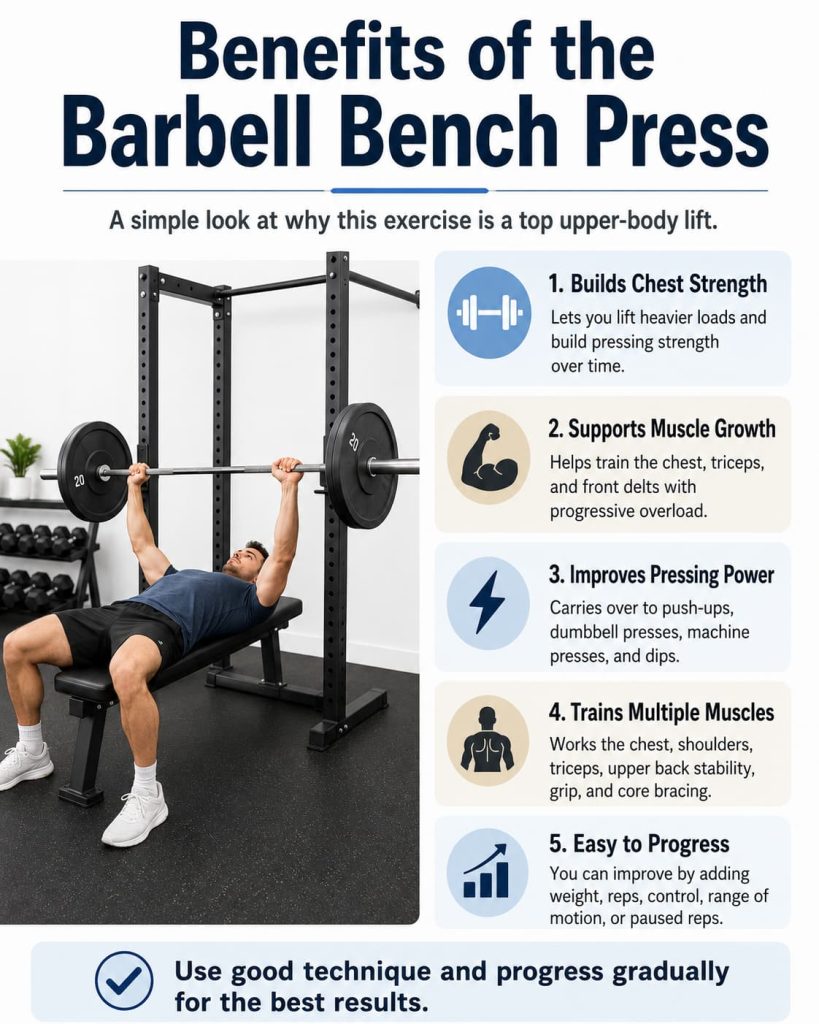
1. Builds Chest Strength
The barbell bench press lets you train the chest with heavier loads than many dumbbell, cable, or bodyweight chest exercises. This makes it useful for building pressing strength over time.
Because the barbell is stable and both arms work together, many lifters can progressively add weight in small, measurable jumps.
2. Supports Upper-Body Muscle Growth
The bench press can help build muscle in the chest, triceps, and front delts when you use enough volume, good technique, and progressive overload.
An ACE chest exercise study found that the barbell bench press produced the highest pectoralis major activation among the chest exercises tested. That does not mean it is the only chest exercise you need, but it does support its value as a main chest-builder.
3. Improves Pressing Power
The bench press carries over to other upper-body pressing movements, including push-ups, dumbbell presses, machine chest presses, dips, and some athletic pushing actions.
If your goal is stronger pressing, the barbell bench press gives you a clear way to track load, reps, and progress.
4. Trains Multiple Muscles Efficiently
The bench press is efficient because it trains the chest, shoulders, triceps, upper back stability, grip, and core bracing in one movement.
That makes it a strong main lift in upper-body, push-day, chest, and full-body strength programs.
5. Easy to Progress
The barbell bench press is simple to measure. You can progress by adding weight, adding reps, improving control, increasing range of motion, slowing the lowering phase, or adding paused reps.
This makes it useful for beginners learning basic strength training and experienced lifters chasing long-term progress.
Barbell Bench Press Exercise Guide
Best for: Building chest strength, upper-body pressing power, and measurable barbell strength.
How to do it:
- Lie on a flat bench with your eyes slightly under the bar.
- Plant your feet flat on the floor and keep them stable.
- Grip the bar slightly wider than shoulder-width with your thumbs wrapped around the bar.
- Pull your shoulder blades back and down into the bench.
- Keep your chest lifted, core braced, and wrists stacked over your elbows.
- Unrack the bar with control and hold it above your chest.
- Lower the bar toward your lower-to-mid chest under control.
- Keep your elbows angled slightly away from your torso, not flared straight out.
- Lightly touch the chest without bouncing the bar.
- Press the bar back up until your arms are straight.
- Finish with the bar over your shoulders, not drifting toward your face.
Suggested sets and reps:
- For beginners, use 2–3 sets of 6–10 reps with a light to moderate weight.
- For muscle growth, use 3–5 sets of 6–12 reps.
- For strength, use 3–6 sets of 3–6 reps with longer rest.
- For technique practice, use 2–4 sets of 5–8 controlled reps with a lighter load.
Coaching cue: Think “feet planted, shoulder blades back, wrists stacked, lower with control, press the bar up and slightly back.”
Common Barbell Bench Press Mistakes
1. Using Too Much Weight
The most common bench press mistake is loading the bar before your technique is ready.
If your hips lift, bar path changes, elbows flare, or the bar bounces off your chest, the weight is too heavy for clean reps.
Use a load you can control through the full range of motion.
2. Flaring the Elbows Too Wide
Letting the elbows flare straight out to the sides can make the shoulders feel less stable and often shifts stress away from the chest.
A better position is to keep the elbows angled slightly below shoulder level. Your exact angle depends on your grip width and body structure, but most lifters should avoid a hard 90-degree elbow flare.
3. Bouncing the Bar Off the Chest
Bouncing the bar may help you lift more weight, but it reduces control and can irritate the chest, shoulders, or sternum.
Lower the bar with control, touch lightly, then press.
4. Letting the Wrists Bend Back
Your wrists should stay stacked over your forearms. If the wrists bend far backward, the bar becomes harder to control and the elbows may drift out of position.
Think about keeping your knuckles pointed toward the ceiling.
5. Lifting the Hips Off the Bench
Your hips should stay on the bench. If your hips rise during the press, you are likely using too much weight or losing leg drive control.
Keep your feet planted and glutes in contact with the bench.
6. Losing Shoulder Blade Position
If your shoulders roll forward at the bottom, your upper back is no longer giving you a stable base.
Reset your shoulder blades before each set. If you lose that position mid-set, stop the set instead of forcing reps.
7. Lowering the Bar Too High
Lowering the bar toward the neck can put the shoulders in a poor position for many lifters.
Aim for the lower-to-mid chest while keeping the wrists and elbows stacked.
8. Training to Failure Too Often
The bench press is a heavy compound lift. Taking every set to failure can increase fatigue and make your technique break down.
Most working sets should end with 1–3 good reps left in reserve, especially if you bench more than once per week.
How Much Should You Bench Press?
There is no single weight everyone should bench press. The right weight depends on your training age, body size, technique, mobility, goal, and recovery.
A good working weight is one you can lift with clean form for your target rep range. You should be able to control the lowering phase, touch the chest without bouncing, keep the wrists stacked, and finish each rep without twisting or lifting your hips.
For beginners, the best goal is not a specific number. The goal is to build a repeatable technique and add weight gradually.
Barbell Bench Press Sets and Reps
Your sets and reps should match your goal.
For Beginners
Use 2–3 sets of 6–10 reps.
Choose a light weight that lets you practice form. Rest 90–120 seconds between sets.
For Muscle Growth
Use 3–5 sets of 6–12 reps.
Train close to failure, but do not let form break down. Rest 1–3 minutes between sets.
For Strength
Use 3–6 sets of 3–6 reps.
Use heavier loads with longer rest, usually 2–5 minutes between sets. Keep reps crisp and controlled.
For Technique Practice
Use 2–4 sets of 5–8 reps.
Use lighter weight, slower lowering, and consistent pauses. This is especially useful if you are fixing bar path, shoulder position, or wrist control.
ACSM notes that heavier loads around 80% of one-repetition maximum are useful for strength, while muscle growth is supported by higher weekly volume.
Beginner Modifications for the Barbell Bench Press
If the standard barbell bench press feels too difficult or uncomfortable, use a simpler variation first.
Push-Up
Push-ups teach basic pressing strength, core tension, and shoulder control. Start with incline push-ups if floor push-ups are too difficult.
Dumbbell Bench Press
Dumbbells allow each arm to move more freely. This can feel more comfortable for some shoulders and can help expose strength differences between sides.
Machine Chest Press
A chest press machine provides more stability and is easier to learn. It is useful for beginners who are not ready to control a barbell.
Floor Press
The floor press limits range of motion because your upper arms touch the floor before the bar reaches your chest. This can help beginners learn pressing control and triceps strength.
Light Barbell Bench Press
Some gyms have lighter fixed bars or training bars. These are useful if a standard 45-pound barbell is too heavy.
Barbell Bench Press Progressions
Once your form is consistent, use progressions to build strength and control.
Paused Bench Press
Pause the bar lightly on your chest for 1–2 seconds before pressing.
This removes the bounce and teaches tightness at the bottom.
Tempo Bench Press
Lower the bar for 3–4 seconds, touch the chest lightly, then press up.
This builds control and helps you feel the correct bar path.
Close-Grip Bench Press
Use a narrower grip to shift more work toward the triceps while still training the chest and shoulders.
Keep the wrists stacked and avoid letting the elbows flare.
Incline Barbell Bench Press
Set the bench to a moderate incline to place more emphasis on the upper chest and front delts.
Avoid setting the bench too steep, or the movement may turn into more of a shoulder press.
Pin Press
Set safety pins so the bar starts from a fixed height above the chest.
This variation helps train pressing strength from specific sticking points.
Spoto Press
Lower the bar close to the chest but stop just above it, pause, then press.
This builds control, tension, and bottom-position strength.
Barbell Bench Press Workout Routine
Beginner Bench Press Workout
Use this if you are new to bench pressing or rebuilding form.
Workout:
- Barbell bench press: 3 sets of 6–8 reps
- Incline push-up: 2 sets of 8–12 reps
- Seated cable row or machine row: 3 sets of 10–12 reps
- Dumbbell shoulder external rotation: 2 sets of 12–15 reps
- Plank: 2 sets of 20–40 seconds
Rest 90–120 seconds between main sets.
Muscle-Building Bench Press Workout
Use this if your goal is chest size and upper-body muscle.
Workout:
- Barbell bench press: 4 sets of 6–10 reps
- Incline dumbbell press: 3 sets of 8–12 reps
- Cable fly or pec deck: 2–3 sets of 10–15 reps
- Chest-supported row: 3 sets of 8–12 reps
- Triceps pressdown: 2–3 sets of 10–15 reps
Rest 1–3 minutes between pressing sets.
Strength-Focused Bench Press Workout
Use this if your goal is heavier bench press performance.
Workout:
- Barbell bench press: 5 sets of 3–5 reps
- Paused bench press: 3 sets of 3–5 reps
- Close-grip bench press: 3 sets of 5–8 reps
- Barbell or cable row: 4 sets of 6–10 reps
- Face pull: 2–3 sets of 12–15 reps
Rest 2–5 minutes on heavy sets.
How Often Should You Barbell Bench Press?
Most lifters can bench press 1–3 times per week, depending on experience, recovery, and total training volume.
Beginners usually do well with 1–2 bench press sessions per week. Intermediate lifters may benefit from 2–3 weekly exposures using different rep ranges or variations.
For example, one day can focus on heavier strength work, while another day uses lighter paused or tempo reps for technique and volume.
Barbell Bench Press Safety Tips
Use a spotter or safety arms when lifting heavy. This is especially important if you train alone.
Secure the plates with collars. Keep your thumbs wrapped around the bar. Do not attempt a max lift when tired, distracted, or unsure of your setup.
Stop the exercise if you feel sharp pain, numbness, dizziness, sudden weakness, or unusual symptoms. Mild muscle effort is normal during training, but pain or symptoms are not something to push through.
Barbell Bench Press vs. Dumbbell Bench Press
The barbell bench press usually allows heavier loading and easier progression. It is better for testing and building maximum pressing strength.
The dumbbell bench press allows more freedom of movement and can help train each side independently. It may also feel more natural for some shoulders.
You do not have to choose only one. Many effective chest programs use the barbell bench press as the main lift and dumbbell presses as accessory work.
Barbell Bench Press vs. Push-Up
The bench press is easier to load in small increases. That makes it better for structured strength progression.
Push-ups are more accessible, require no equipment, and train core control along with upper-body pressing.
Beginners can use push-ups to build a foundation before bench pressing. Advanced lifters can still use push-ups as a warm-up, finisher, or higher-rep accessory exercise.
Who Should Use the Barbell Bench Press?
The barbell bench press is a good option for lifters who want to build chest strength, improve pressing performance, or follow a structured strength program.
It may not be the best first choice for someone who cannot control the empty bar, has shoulder discomfort during pressing, or does not have access to a safe rack setup.
If the movement causes pain, switch to a more comfortable variation and consider getting coaching from a qualified trainer or healthcare professional.
Frequently Asked Questions
Is the barbell bench press good for building chest?
Yes. The barbell bench press is one of the most effective compound exercises for building chest strength and muscle. It also trains the triceps and front shoulders, which help with pressing power.
Should the bar touch my chest during bench press?
For most lifters, the bar should lightly touch the lower-to-mid chest. Do not bounce it. If you cannot touch your chest without losing shoulder position or control, reduce the weight and improve your setup.
How wide should my bench press grip be?
Most lifters do well with a grip slightly wider than shoulder-width. At the bottom of the rep, your forearms should be close to vertical. Very wide grips may feel harder on the shoulders, while very narrow grips shift more work to the triceps.
Is bench press enough for chest growth?
The bench press is a strong main chest exercise, but it is not the only exercise you need. Many lifters get better chest development by combining bench press with incline presses, dumbbell presses, cable flys, push-ups, or machine chest presses.
Why do my shoulders hurt during bench press?
Shoulder discomfort can happen from poor setup, flared elbows, excessive weight, lack of upper-back tightness, lowering the bar too high, or using a range of motion that does not fit your body. Stop if you feel sharp pain and use a more comfortable variation if needed.
Should beginners bench press?
Beginners can bench press if they can control the bar and use safe technique. If the standard barbell is too heavy, start with push-ups, dumbbells, a machine chest press, or a lighter training bar.
How many times per week should I bench press?
Most people can bench press 1–3 times per week. Beginners often do well with 1–2 sessions. More advanced lifters may bench more often, but they should manage volume, intensity, and recovery carefully.
Conclusion
The barbell bench press is a powerful upper-body lift for building chest strength, triceps power, and pressing performance. The key is not just adding weight. The key is using a stable setup, controlled reps, smart progression, and enough recovery.
Start with a weight you can control, master your bar path, keep your shoulder blades tight, and choose sets and reps that match your goal. Then build your routine around consistent, high-quality pressing instead of rushed max-effort sets.
References
- NASM: Bench Press Targeted Muscles, Grips, and Movement Biomechanics
- NASM: Maximize Bench Press Form by Addressing These Issues
- ACE: Top 3 Chest Exercises Identified by ACE Research
- ACE: Be a Chest Day Champion: An Evidence-Based Approach to Training the Chest
- ACSM: Updated Resistance Training Guidelines
- NASM: Close-Grip Bench Press Exercise Library
4 thoughts on “Barbell Bench Press: Form, Muscles, Benefits & Mistakes”