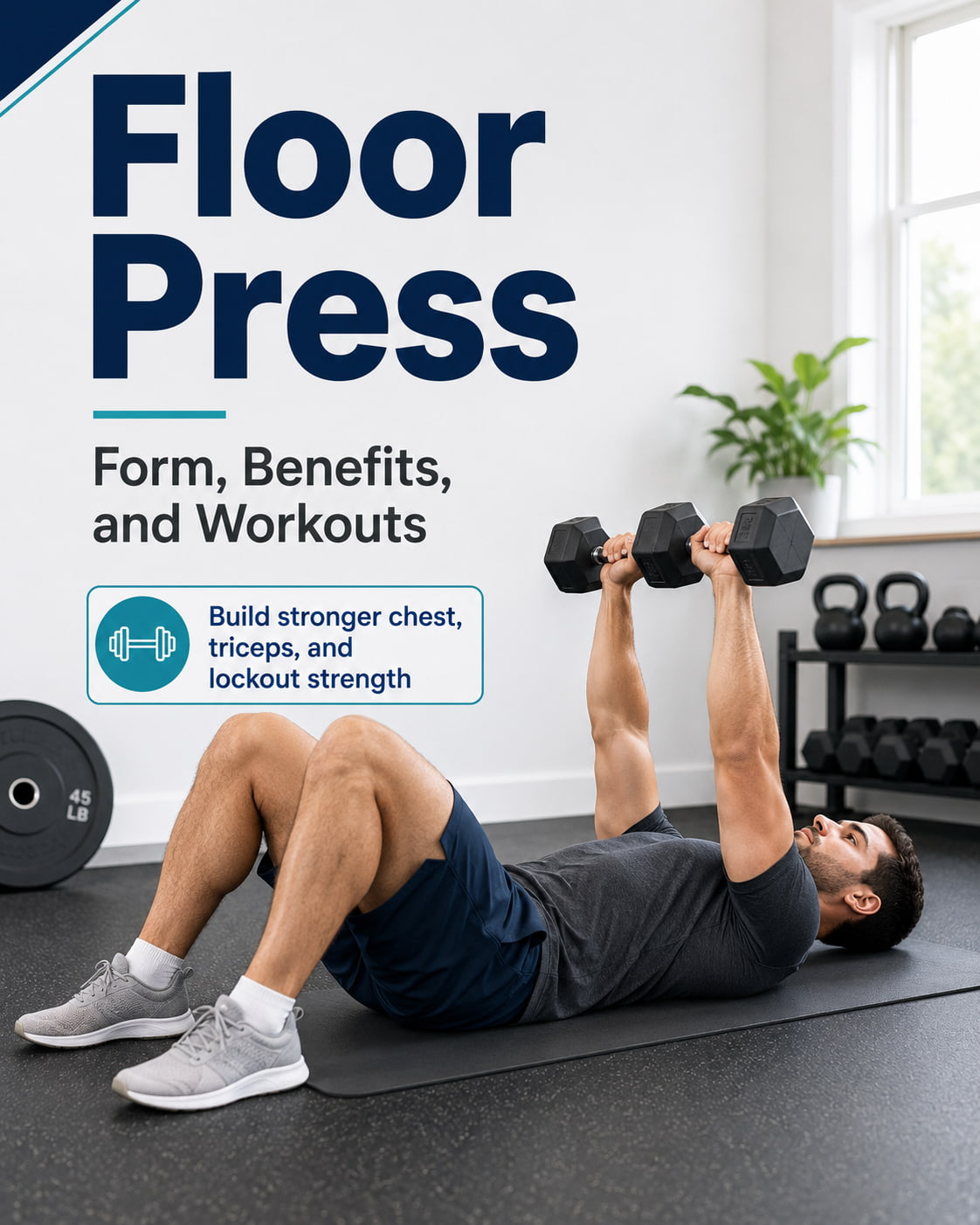
The floor press is a bench press variation performed on the floor to build chest, triceps, shoulder, and lockout strength with a shorter range of motion. It is one of the most practical pressing exercises you can do when you do not have a bench, want better control, or need a pressing option that limits how deep your elbows travel.
In this floor press guide, you will learn proper form, muscles worked, key benefits, common mistakes, useful variations, and simple workouts for beginner, intermediate, and advanced training.
What Is the Floor Press?
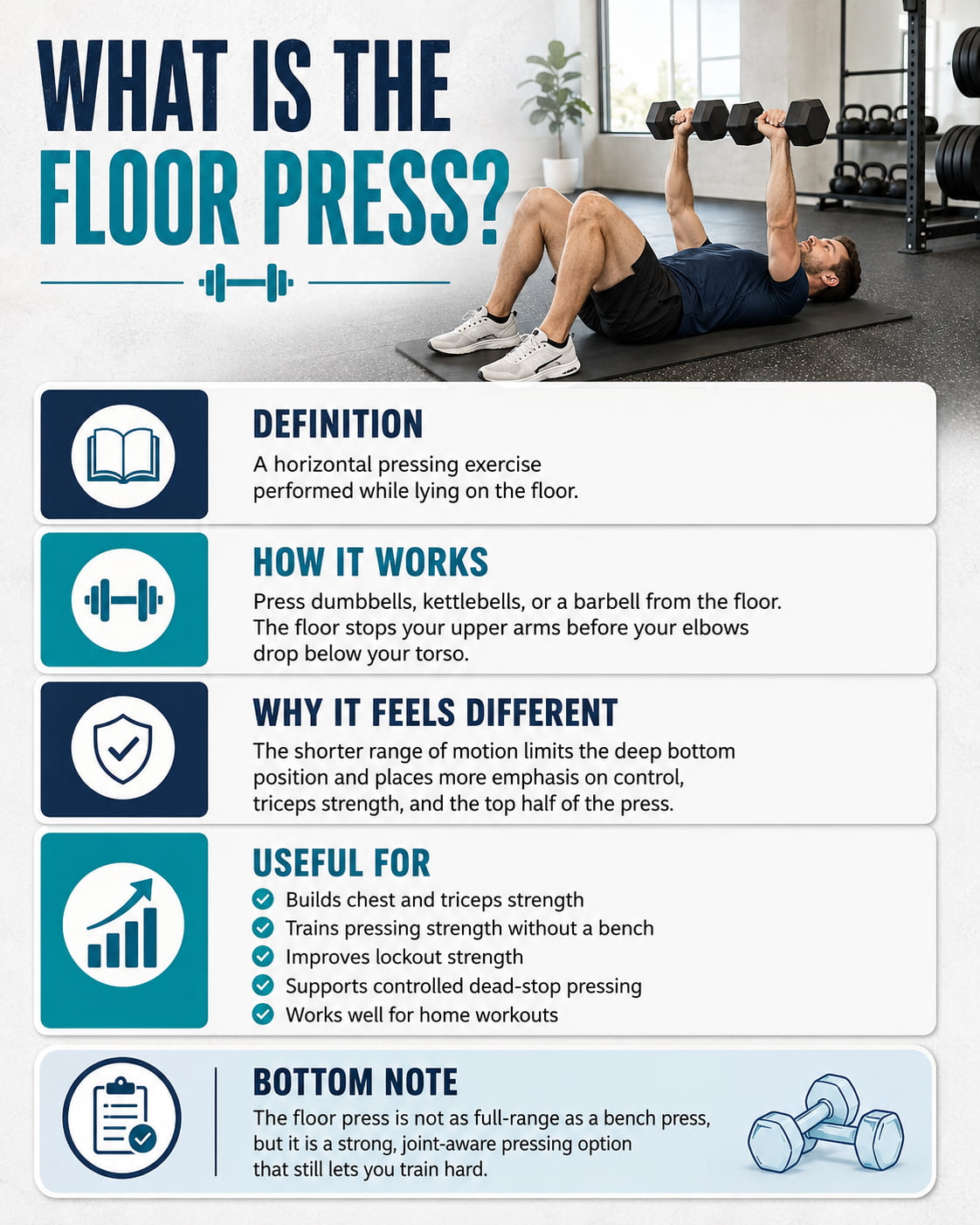
The floor press is a horizontal pressing exercise where you lie on your back and press dumbbells, kettlebells, or a barbell from the floor. The movement looks similar to a bench press, but the floor stops your upper arms before your elbows drop below your torso.
That shorter range of motion changes the exercise.
A regular bench press allows the elbows to travel lower, which increases the stretch on the chest and shoulders. The floor press limits that bottom position, so the movement often feels more controlled and places strong emphasis on the triceps and top half of the press.
This makes the floor press useful for:
Building chest and triceps strength
Training pressing strength without a bench
Practicing a controlled press from a dead-stop position
Improving lockout strength for the bench press
Using dumbbells safely in a home workout
Reducing deep bottom-range pressing for some lifters
The floor press does not replace every chest exercise. It is not as full-range as a bench press or push-up. But it is a strong option when you want a simple, joint-aware press that still lets you train hard.
Floor Press Muscles Worked
The floor press mainly trains the chest, triceps, and front shoulders. It also uses the upper back and core to keep the body stable.
Pectoralis Major
The pectoralis major is the main chest muscle used in horizontal pressing. During the floor press, it helps bring the upper arm across the body as you press the weight upward.
Because the floor limits the bottom range, the chest may not get as deep of a stretch as it does in a full bench press. Still, the pecs work strongly through the press, especially when you control the lowering phase and keep your upper back tight.
Triceps Brachii
The triceps are heavily involved in the floor press because they straighten the elbows at the top of each rep. The shorter range of motion often makes the floor press feel more triceps-focused than a standard bench press.
This is one reason lifters use the floor press to build lockout strength. If you struggle near the top of your bench press, the floor press can be a useful accessory lift.
Anterior Deltoids
The anterior deltoids, or front shoulder muscles, assist the press. They help move the upper arms forward and upward as you press.
Good form matters here. If your shoulders roll forward or your elbows flare too wide, the front shoulders may take over too much. Keeping the shoulder blades set against the floor helps the chest and triceps contribute better.
Upper Back and Shoulder Stabilizers
The upper back does not press the weight, but it gives your shoulders a stable base. Your rhomboids, traps, rear delts, and smaller shoulder stabilizers help control shoulder-blade position.
A strong setup makes the floor press feel smoother and safer. Think of your upper back as the platform you press from.
Core
Your core helps keep your ribs down, lower back controlled, and torso stable. This becomes even more important during single-arm floor presses, where the body has to resist rotation.
NASM identifies the pectoralis major, anterior deltoid, and triceps as key muscles in pressing mechanics, while research comparing pressing variations also commonly examines these same muscle groups during horizontal press exercises. You can learn more from NASM’s bench press biomechanics guide and this peer-reviewed study on muscle activity during chest pressing variations.
How to Do the Floor Press With Proper Form
Best for: Building chest, triceps, and pressing strength without needing a bench.
Equipment needed: Dumbbells, kettlebells, or a barbell. A rack or spotter is helpful for heavy barbell floor presses.
Suggested sets and reps: Use 2–4 sets of 6–12 reps for general strength and muscle. Use 3–5 sets of 3–6 reps for heavier strength work.
Beginners: Start with a neutral-grip dumbbell floor press. Use light weights and focus on slow, controlled reps.
Intermediate: Use heavier dumbbells or a barbell. Add a brief pause when your upper arms touch the floor.
Advanced: Use close-grip barbell floor presses, paused reps, single-arm floor presses, or heavier strength sets.
Rest: Rest 60–90 seconds for moderate muscle-building sets and 2–3 minutes for heavier strength sets.
How to do it:
- Lie on your back with your knees bent and feet flat on the floor.
- Hold the weights above your chest with your wrists stacked over your elbows.
- Pull your shoulder blades gently back and down into the floor.
- Brace your core and keep your ribs from flaring up.
- Lower the weights under control until your upper arms lightly touch the floor.
- Pause for a moment without relaxing your shoulders.
- Press the weights back up until your elbows are straight but not harshly locked.
- Keep the weights over your mid-chest area and repeat with control.
Common mistakes: The biggest mistakes are bouncing the elbows off the floor, letting the shoulders roll forward, flaring the elbows too wide, bending the wrists backward, and using weights that are too heavy to control.
Expert tip: Treat the floor as a range-of-motion limit, not a trampoline. Lightly touch the floor, stay tight, pause, and press with control.
Exercise variations: Dumbbell floor press, barbell floor press, kettlebell floor press, single-arm floor press, alternating floor press, close-grip floor press, and glute bridge floor press.
Easier variation: Use one dumbbell at a time or perform a neutral-grip dumbbell floor press with a lighter load.
Harder variation: Use a paused barbell floor press or single-arm dumbbell floor press to challenge strength, stability, and control.
Floor Press Benefits
Builds Upper-Body Pressing Strength
The floor press trains the same general pressing pattern used in the bench press, push-up, and many chest press machines. Your chest, triceps, and shoulders work together to move the weight.
This makes it useful for strength training, home workouts, and accessory work after heavier presses.
Strengthens the Triceps
The triceps work hard during the top half of the press. Since the floor press reduces the deepest part of the movement, many lifters feel more triceps demand compared with a full-range dumbbell bench press.
A close-grip floor press can increase this effect even more.
Helps Improve Bench Press Lockout
If your bench press slows down near the top, the floor press can help because it trains the middle-to-top pressing range. The pause on the floor also teaches you to press from a controlled stop instead of relying on bounce.
Use it as an accessory lift after bench press work or as your main press during a training block.
Useful When You Do Not Have a Bench
One of the biggest advantages of the floor press is simplicity. You can do it with dumbbells, kettlebells, or a barbell in a home gym, garage gym, or small training space.
This makes it a strong option for lifters who want chest and triceps work without a bench setup.
May Be More Comfortable for Some Shoulders
The floor limits how far your upper arms travel behind your torso. That shorter range of motion may feel more comfortable for some lifters than deep bench pressing.
This does not mean the floor press fixes shoulder pain. It simply changes the range of motion. The NSCA notes that the dumbbell floor press uses the floor to limit horizontal abduction, which can be useful when modifying pressing exercises for shoulder considerations. You can read more in the NSCA’s discussion of exercise modifications for shoulder considerations.
Teaches Control
The floor press removes the temptation to lower too deep or bounce the weight. Each rep has a clear stopping point.
That makes it useful for learning better pressing control, especially with dumbbells.
Common Floor Press Mistakes to Avoid
Bouncing Your Elbows Off the Floor
The floor press should be controlled. If your elbows hit the ground hard, you lose tension and may irritate your elbows or shoulders.
Fix it by lowering slowly and touching the floor lightly.
Letting Your Shoulders Roll Forward
If your shoulders round forward at the bottom, your pressing base becomes unstable.
Before each set, pull your shoulder blades gently back and down. Keep your upper back connected to the floor as you press.
Flaring Your Elbows Too Wide
Elbows straight out to the sides can make the press less comfortable for many lifters.
Aim for a moderate elbow angle. For most people, keeping the elbows about 30–60 degrees from the torso feels stronger and more controlled.
Pressing Over Your Face
The weights should not drift toward your neck or face. Keep the press path over your mid-chest to lower-chest area.
This helps keep your wrists, elbows, and shoulders stacked.
Overarching Your Lower Back
Some arch is normal, but excessive rib flare and lower-back arching can make the press unstable.
Brace your abs, keep your ribs down, and use your legs for light stability without turning the movement into a bridge unless you are intentionally doing the glute bridge variation.
Going Too Heavy Too Soon
The floor press can feel strong because the range of motion is shorter. That does not mean you should overload it immediately.
Start with a weight you can pause and press cleanly for every rep.
Floor Press vs Bench Press
The floor press and bench press are similar, but they are not the same exercise.
| Feature | Floor Press | Bench Press |
|---|---|---|
| Setup | Lying on the floor | Lying on a bench |
| Range of motion | Shorter | Longer |
| Bottom position | Upper arms stop on floor | Elbows can travel below torso |
| Chest stretch | Less | More |
| Triceps emphasis | Often higher | Moderate to high |
| Shoulder demand | Often less deep-range stress | More bottom-range shoulder demand |
| Equipment | Floor plus weights | Bench plus weights |
| Best use | Lockout strength, control, home workouts | Full-range pressing strength and chest development |
The bench press is usually better when you want a full range of motion and more chest stretch. The floor press is better when you want controlled pressing, less equipment, and stronger midrange-to-lockout work.
A complete program can use both.
Dumbbell Floor Press vs Barbell Floor Press
Dumbbell Floor Press
The dumbbell floor press is usually the best starting point. Each arm works independently, which can help you notice side-to-side strength differences. Dumbbells also allow a neutral grip, which many lifters find comfortable.
Use dumbbells if you are a beginner, training at home, or want a shoulder-friendly setup.
Barbell Floor Press
The barbell floor press lets you use heavier loads and is often better for strength work. It is a strong accessory lift for bench press lockout.
Use a rack, safety pins, or spotter when lifting heavy. Getting a heavy barbell into position from the floor can be awkward without proper setup.
Kettlebell Floor Press
The kettlebell floor press challenges grip, wrist control, and shoulder stability. The weight sits differently than a dumbbell, so start lighter than expected.
Use kettlebells for variety, unilateral training, and control-focused pressing.
Best Floor Press Variations
Neutral-Grip Dumbbell Floor Press
Hold the dumbbells with your palms facing each other. This often feels comfortable for the wrists, elbows, and shoulders.
Use this as your main beginner variation.
Barbell Floor Press
Use a barbell when your goal is heavier strength work. Set up inside a rack if possible, and position the hooks low enough that you can unrack the bar safely from the floor.
This variation is best for intermediate and advanced lifters.
Single-Arm Dumbbell Floor Press
Press one dumbbell at a time while keeping your body still. Do not let your torso rotate as you press.
This variation trains chest and triceps strength while adding an anti-rotation core challenge.
Alternating Dumbbell Floor Press
Hold both dumbbells up, then lower and press one side at a time. This increases time under tension and teaches control.
Use it with moderate loads rather than maximum strength weights.
Close-Grip Floor Press
Use a narrower grip with a barbell or keep the dumbbells close to your torso. This variation shifts more work toward the triceps.
Keep your wrists stacked and elbows controlled.
Glute Bridge Floor Press
Hold a glute bridge while pressing. This adds glute tension and increases whole-body stability.
Use it as an accessory variation, not as your heaviest press.
Paused Floor Press
Pause for one to two seconds when your upper arms touch the floor. Stay tight, then press up.
This is one of the best variations for improving control and strength from a dead stop.
How to Program the Floor Press
The best floor press setup depends on your goal.
| Goal | Sets | Reps | Rest | Effort |
|---|---|---|---|---|
| Beginner technique | 2–3 | 8–12 | 60–90 sec | 2–3 reps in reserve |
| Muscle growth | 3–4 | 8–12 | 60–120 sec | 1–3 reps in reserve |
| Strength | 3–5 | 3–6 | 2–3 min | 1–3 reps in reserve |
| Triceps accessory | 2–4 | 10–15 | 60–90 sec | Controlled fatigue |
| Bench lockout | 3–5 | 3–8 | 2–3 min | Strong, crisp reps |
For most lifters, training the floor press 1–2 times per week is enough. If it is your main upper-body press, use it earlier in the workout. If it is an accessory lift, place it after bench press, overhead press, push-ups, or rows.
The American College of Sports Medicine emphasizes that resistance-training variables should match the goal, and that consistency is a major driver of progress. Their updated guidance on resistance training programming is a useful reference for building strength and muscle over time.
Sample Floor Press Workouts
Beginner Dumbbell Floor Press Workout
Use this workout if you are learning the movement or training at home.
Dumbbell floor press: 3 sets of 8–10 reps
One-arm dumbbell row: 3 sets of 10 reps per side
Incline push-up: 2 sets of 8–12 reps
Dead bug: 2 sets of 8 reps per side
Rest 60–90 seconds between sets. Use a weight that leaves 2–3 reps in reserve. When you can complete all reps with clean form, increase the weight slightly.
Intermediate Upper-Body Workout
Use this workout if you want chest, triceps, and upper-back balance.
Barbell or dumbbell floor press: 4 sets of 6–8 reps
Pull-up or lat pulldown: 4 sets of 6–10 reps
Seated dumbbell shoulder press: 3 sets of 8–10 reps
Cable row or chest-supported row: 3 sets of 10–12 reps
Triceps rope pressdown: 2–3 sets of 10–15 reps
Rest 90–120 seconds after the main lift and 60–90 seconds on accessories.
Floor Press Lockout Strength Workout
Use this as a bench press accessory day.
Paused barbell floor press: 5 sets of 3–5 reps
Close-grip floor press: 3 sets of 6–8 reps
Single-arm dumbbell row: 4 sets of 8–10 reps per side
Face pull: 3 sets of 12–15 reps
Plank: 3 sets of 30–45 seconds
Use strong, controlled reps. Do not grind every set. Keep 1–2 reps in reserve on most working sets.
Who Should Use the Floor Press?
The floor press is a good option for:
Home gym lifters without a bench
Beginners learning dumbbell pressing
Intermediate lifters building chest and triceps strength
Powerlifters working on bench press lockout
Lifters who want a controlled pressing variation
People who prefer a shorter pressing range of motion
It may not be the best choice if your main goal is maximum chest stretch or full-range chest development. In that case, combine it with push-ups, bench press variations, chest press machines, or cable presses.
Safety Tips
Use a weight you can control through the full rep. Do not drop your elbows into the floor or let the dumbbells fall outward.
For heavy barbell floor presses, use a rack, safety pins, or a spotter. Avoid trying to roll a heavy bar into place across your body.
Stop the exercise if you feel sharp pain, numbness, dizziness, chest pain, or unusual symptoms. If pressing causes ongoing discomfort, work with a qualified coach, physical therapist, or medical professional.
The floor press may be more comfortable than full-range bench pressing for some lifters, but it should not be used to ignore pain.
Floor Press FAQs
Is the floor press good for chest growth?
Yes, the floor press can help build the chest, especially when you use enough load, controlled reps, and progressive overload. However, it uses a shorter range of motion than the bench press, so it may be best combined with other chest exercises that train a deeper range.
Is the floor press better for triceps than chest?
The floor press trains both, but many lifters feel strong triceps involvement because the movement emphasizes the midrange and lockout. A close-grip floor press makes the triceps work even harder.
Can beginners do the floor press?
Yes. Beginners can start with a light dumbbell floor press or neutral-grip dumbbell floor press. The floor gives a clear stopping point, which can make the exercise easier to control than some bench press variations.
Is the floor press safer than the bench press?
It depends on the lifter, setup, load, and form. The floor press limits the bottom range of motion, which may feel better for some shoulders. But heavy barbell floor presses still require careful setup, control, and proper safety equipment.
Should I use dumbbells or a barbell?
Use dumbbells if you want an easier setup, more natural arm movement, or home-friendly training. Use a barbell if your goal is heavier strength work or bench press carryover.
How heavy should I go on the floor press?
Start lighter than your bench press. Use a load you can pause on the floor and press smoothly. For muscle growth, use a weight that leaves 1–3 reps in reserve. For strength, use heavier sets of 3–6 reps while keeping form clean.
Can the floor press replace the bench press?
It can replace the bench press temporarily or in a home workout plan, but it is not exactly the same. The bench press trains a longer range of motion. The floor press is better viewed as a useful variation, not a complete replacement for every lifter.
Conclusion
The floor press is a simple, effective pressing exercise for building chest, triceps, and upper-body strength without needing a bench. It limits the bottom range of motion, teaches control, and works well with dumbbells, kettlebells, or a barbell.
Start with clean form, use a weight you can control, and progress slowly. For the best results, use the floor press alongside rows, push-ups, bench press variations, and triceps work so your upper-body training stays balanced.
This content is for informational purposes only and is not a substitute for professional medical advice.
References
- ACE Fitness: Chest Press Exercise Library
- NASM: Bench Press Targeted Muscles, Grips, and Movement Patterns
- NSCA: Modification of Exercises to Allow Injured Individuals to Continue Training
- ACSM: Updated Resistance Training Guidelines
- Journal of Human Kinetics: Muscle Activity During Chest Pressing Variations
10 thoughts on “Floor Press Form Guide: Benefits, Tips, and Workouts”