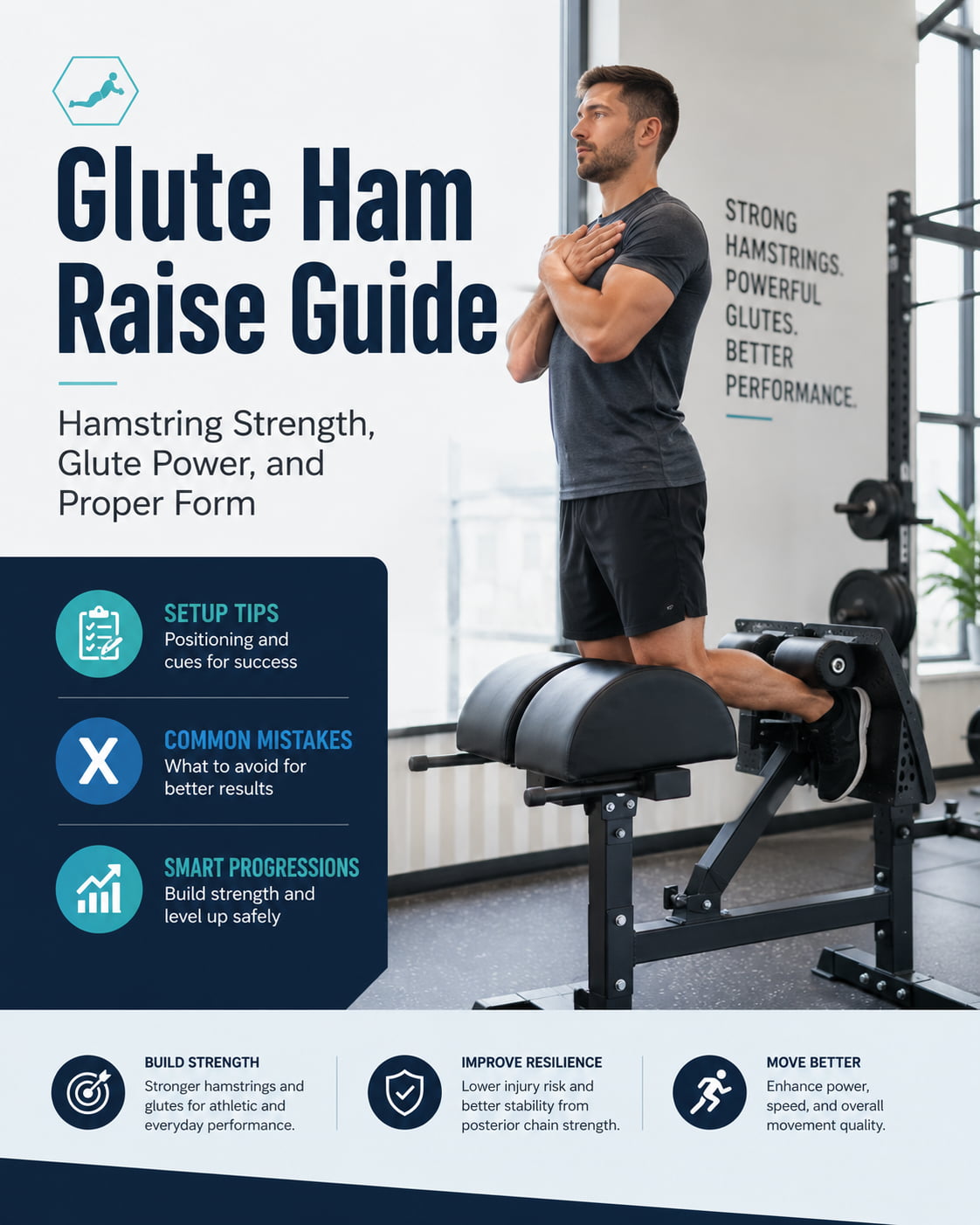
The glute ham raise is a posterior-chain exercise that strengthens the hamstrings, glutes, and supporting muscles of the hips and trunk. It is usually performed on a glute-ham developer, also called a GHD, where your lower legs are anchored and your body moves under control through knee flexion and hip extension.
The glute ham raise is not an easy exercise. Done well, it teaches you to control your body with your hamstrings instead of simply swinging from the lower back. In this guide, you will learn proper form, muscles worked, benefits, mistakes, progressions, regressions, and how to use the exercise in a real workout.
What Is the Glute Ham Raise?
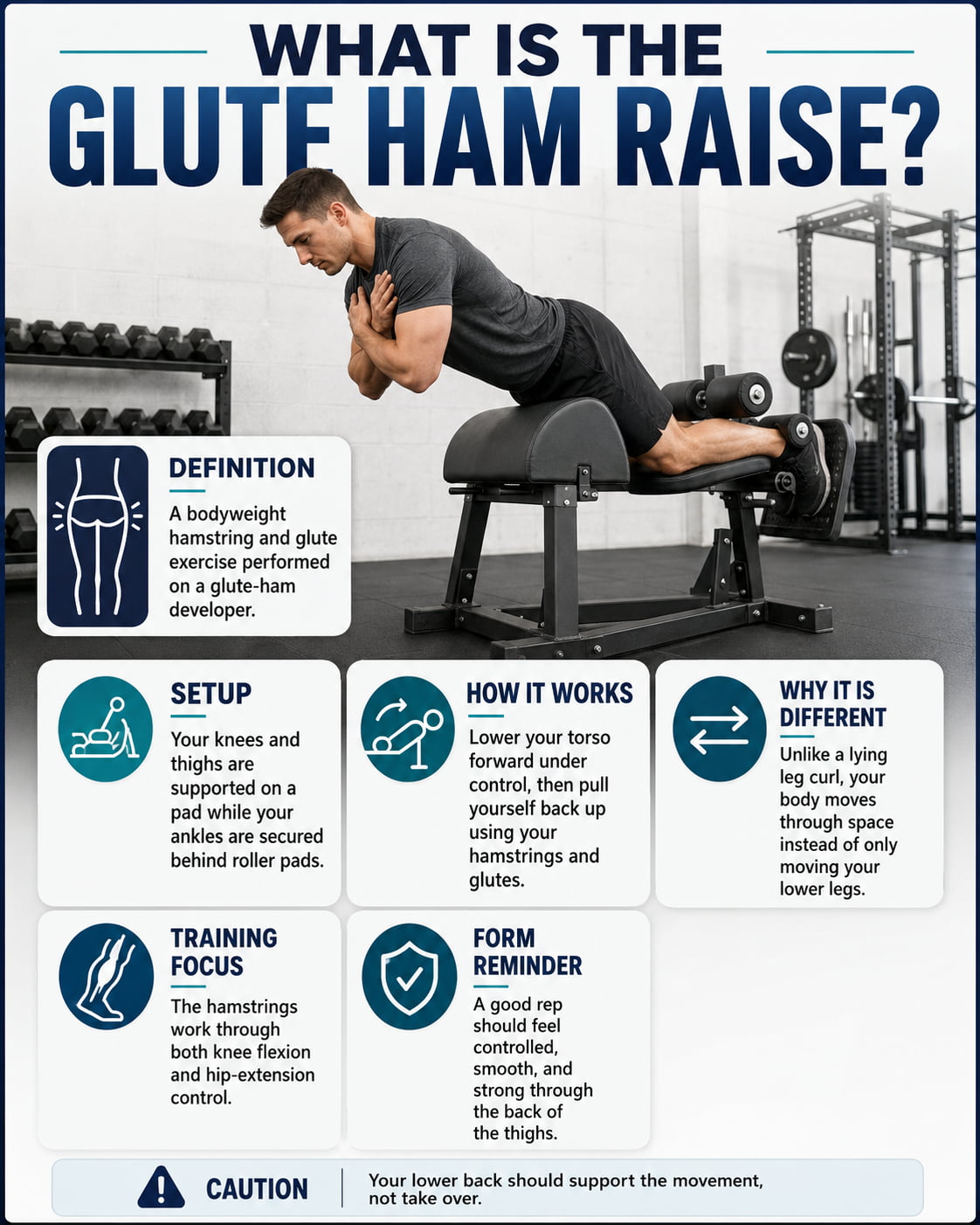
The glute ham raise is a bodyweight hamstring and glute exercise performed with your knees and thighs supported on a pad while your ankles are secured behind roller pads. From there, you lower your torso forward under control, then pull yourself back up by using your hamstrings and glutes.
The exercise is different from a lying leg curl because your body moves through space instead of only moving your lower legs. It is also different from a Romanian deadlift because the hamstrings work hard through both knee flexion and hip-extension control.
A well-performed glute ham raise should feel controlled, smooth, and strong through the back of the thighs. You may feel your glutes, calves, and trunk working too, but your lower back should not take over the movement.
Glute Ham Raise Muscles Worked
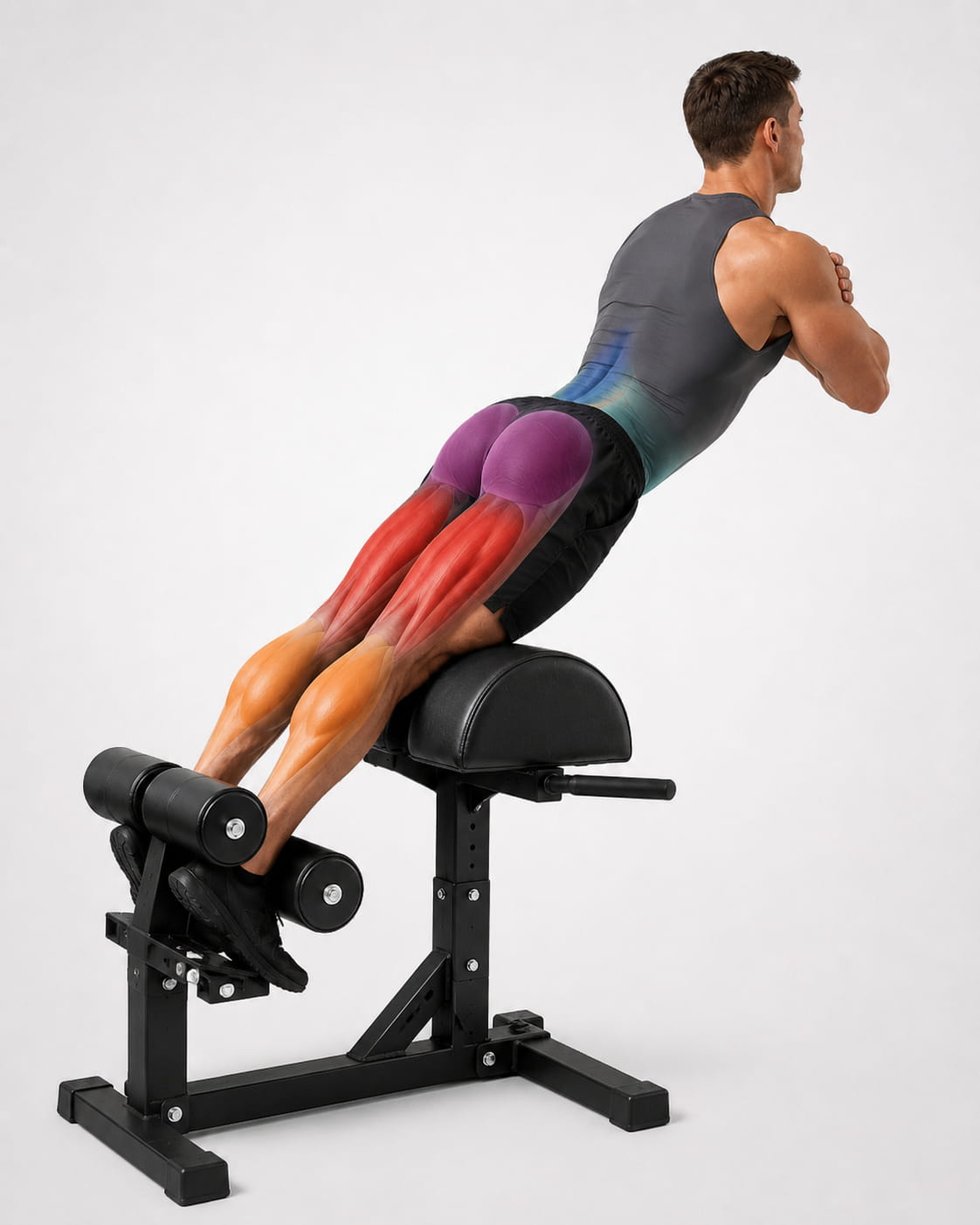
The glute ham raise mainly trains the hamstrings and glutes, with help from the calves, spinal erectors, and core.
The hamstrings include the biceps femoris, semitendinosus, and semimembranosus. According to the Cleveland Clinic hamstring anatomy guide, the hamstrings help bend the knee and extend the thigh at the hip. That makes them highly involved in the glute ham raise because the exercise challenges knee flexion and hip control at the same time.
The gluteus maximus helps extend the hips as you return to the top position. The glutes are especially important when you keep your hips extended and avoid folding at the waist too early.
The calves assist because the gastrocnemius crosses the knee joint and can help support knee flexion. The spinal erectors and deep core muscles help keep your torso stable, but they should support the movement rather than dominate it.
Glute Ham Raise Benefits for Strength and Training
The glute ham raise can help build stronger hamstrings because it challenges the back of the thighs through a demanding bodyweight pattern. A study published in the Journal of Strength and Conditioning Research compared several hamstring exercises and reported high hamstring activity during the glute-ham raise and Romanian deadlift.
It can also help build posterior-chain strength. The posterior chain includes the muscles along the back side of the body, including the hamstrings, glutes, and spinal erectors. These muscles play an important role in squats, deadlifts, sprinting, jumping, hinging, and athletic movement.
The glute ham raise may also improve body control because it forces you to resist gravity while keeping your hips, ribs, and spine organized. Instead of rushing through reps, you have to control the lowering phase, maintain tension, and finish the rep without excessive swinging.
For lifters who already squat, deadlift, lunge, or sprint, the glute ham raise can work well as an accessory exercise. It gives the hamstrings direct attention without needing a heavy barbell.
Glute Ham Raise
Equipment needed: A glute-ham developer is the standard option. You can also use a secure GHD-style setup in some gyms, but avoid unsafe homemade setups that do not firmly anchor your legs or support your body.
Why it stands out: The glute ham raise trains the hamstrings in a way that feels different from leg curls and hip hinges. Your hamstrings have to help control the knee while your hips and trunk stay organized. This makes it a strong accessory exercise for lifters who want more hamstring strength without always adding more heavy deadlift volume.
Suggested sets and reps: Use 2 to 4 sets of 4 to 10 controlled reps. Start on the lower end if you are learning the movement. Add reps only when you can control the lowering phase and return to the top without swinging or losing position.
Beginners: Start with band-assisted reps, partial range of motion, or slow eccentric-only reps. You can also place your hands in front of your body and use a light push from the floor or a box to help return to the top. The goal is control, not forcing full reps too early.
Intermediate: Use full bodyweight reps for 3 sets of 6 to 8. Keep the tempo slow and smooth, especially on the way down. Stop each set when your form starts to break.
Advanced: Use 3 to 5 sets of 6 to 12 reps. You can add a small weight plate held at the chest, use a slower eccentric, pause near the hardest point, or increase range of motion if your setup allows it. Only add load after your bodyweight reps are clean.
Rest: Rest 60 to 120 seconds for accessory work. Use 2 to 3 minutes if you are doing harder strength-focused sets or weighted reps.
How to do it:
- Adjust the GHD so your thighs are supported on the pad and your ankles are secured between the roller pads.
- Place your feet firmly against the footplate and keep your knees close to the pad.
- Start tall with your shoulders, hips, and knees aligned.
- Brace your core and keep your ribs down.
- Lower your body forward slowly by allowing your knees to extend while keeping your hips controlled.
- Continue lowering until you reach your manageable range without losing tension.
- Drive your toes into the footplate and use your hamstrings to pull your body back up.
- Finish tall without overextending your lower back at the top.
Common mistakes: The most common mistake is arching the lower back to finish the rep. Another mistake is folding too much at the hips and turning the movement into a back extension. Many lifters also drop too fast, use momentum, or set the machine poorly so the exercise feels awkward instead of controlled.
Expert tip: Think “long body, tight hamstrings, quiet lower back.” Your torso should move as one strong unit, and the back of your thighs should control the rep.
Exercise variations: Useful variations include assisted glute ham raises, eccentric-only glute ham raises, band-assisted glute ham raises, weighted glute ham raises, and slow-tempo glute ham raises. Nordic hamstring curls, stability ball hamstring curls, slider hamstring curls, and seated or lying leg curls can also work as alternatives when a GHD is not available.
Easier variation: The band-assisted glute ham raise is the best starting option for most lifters. Attach a resistance band securely in front of you, hold it for assistance, and use it to reduce the amount of bodyweight your hamstrings must lift.
Harder variation: The weighted glute ham raise is a strong advanced option. Hold a light plate across your chest and keep the same controlled form. Do not add weight if you have to swing, shorten the range of motion, or arch your lower back.
How to Set Up the Glute Ham Raise Correctly
Good setup makes the exercise safer and more effective. The National Strength and Conditioning Association describes the glute ham raise setup with the ankles secured between roller pads, feet against the platform, and thighs positioned on the pad.
Start by adjusting the footplate so your knees and thighs feel supported. If the footplate is too far away, the movement may feel impossible to control. If it is too close, you may feel cramped and unable to move smoothly.
Watch how to adjust the GHD setup so your knees, thighs, ankles, and foot position support a controlled glute ham raise.
Your knees should be near the pad, your thighs should be supported, and your feet should press firmly into the footplate. Before each rep, check that your ribs are down, your glutes are lightly engaged, and your head stays neutral.
A simple setup test is this: you should be able to hold the top position without your lower back arching or your hips drifting backward. If you cannot control the start position, use an easier version.
Common Glute Ham Raise Mistakes to Avoid
The first mistake is moving too fast. The glute ham raise becomes much less useful when you drop into the bottom and bounce back up. Control the lowering phase and make your hamstrings do the work.
The second mistake is letting the lower back take over. A small amount of spinal erector involvement is normal, but the exercise should not feel like a lower-back extension. Keep your ribs down and finish tall instead of leaning back hard at the top.
The third mistake is losing hip position. If your hips fold too much, the movement shifts away from a true glute ham raise. A little hip motion may happen depending on your setup and strength level, but the goal is to keep the body long and controlled.
The fourth mistake is skipping regressions. Many lifters are not ready for full bodyweight reps right away. Assisted reps, eccentric reps, and partial reps are not “cheating.” They are smart ways to build the strength needed for clean full reps.
Glute Ham Raise Progressions and Regressions
Start with a version that lets you control the movement. For many lifters, that means assisted reps or eccentric-only reps.
A beginner can use a band-assisted glute ham raise or perform only the lowering phase, then use the hands to help return to the top. Once you can lower slowly for 3 to 5 seconds without collapsing, you can start working toward full reps.
An intermediate lifter can perform full reps through a comfortable range of motion. The main goal is smooth control. Do not rush to add weight. First, build consistent sets of clean bodyweight reps.
An advanced lifter can use weighted reps, pauses, slower tempo, or higher total volume. The best progression is the one that makes the exercise harder without changing the movement into a swing or back extension.
Glute Ham Raise Alternatives
The Nordic hamstring curl is one of the closest alternatives because it also challenges the hamstrings hard through knee flexion. It is usually very difficult, so most lifters need assistance or a limited range of motion.
The seated leg curl and lying leg curl are easier to control and can be useful for building direct hamstring strength. They do not challenge the trunk the same way as a glute ham raise, but they are effective options when you want a simpler hamstring isolation movement.
The Romanian deadlift is another strong posterior-chain exercise. It trains the hamstrings mostly through a hip-hinge pattern, so it pairs well with the glute ham raise rather than replacing it completely.
Slider hamstring curls and stability ball hamstring curls are useful home-friendly alternatives. They train knee flexion and hip control without requiring a GHD.
How to Add Glute Ham Raises to Your Workout
Use the glute ham raise after your main lower-body lift, not before heavy squats or deadlifts. For most lifters, it works best as a hamstring accessory exercise after squats, deadlifts, lunges, hip thrusts, or leg presses.
For strength, use 3 to 5 sets of 4 to 6 controlled reps with longer rest. For muscle-building accessory work, use 2 to 4 sets of 6 to 10 reps with moderate rest. For beginners, use 2 to 3 sets of 3 to 6 assisted reps and focus on clean movement.
Train the movement 1 to 2 times per week. The American College of Sports Medicine emphasizes consistency and training all major muscle groups at least twice per week as part of a balanced resistance-training plan. The glute ham raise can fit into that plan, but it should not be the only lower-body exercise you do.
Sample Glute Ham Raise Workout
Use this as a lower-body accessory plan after your main lift.
Begin with 5 to 10 minutes of easy cardio, hip hinges, bodyweight squats, and light hamstring curls. Then perform your main lower-body exercise, such as squats or Romanian deadlifts.
After that, perform glute ham raises for 3 sets of 6 to 8 reps. Rest 90 seconds between sets and stop each set with 1 to 2 reps in reserve. Follow with a quad exercise such as split squats or leg presses, then finish with a lighter hamstring or core movement if needed.
Progress by adding one rep per set until you can complete 3 sets of 10 with clean form. After that, make the exercise slightly harder with a slower lowering phase, a pause, or a small amount of external load.
Who Should Use the Glute Ham Raise?
The glute ham raise is a good option for lifters who want to build stronger hamstrings and glutes, improve posterior-chain training, or add a challenging accessory movement to leg day.
It is especially useful for people who already have some lower-body training experience. Beginners can still use it, but they should start with assistance and avoid forcing full reps before they are ready.
You should be cautious with the exercise if you cannot control your trunk position, if the machine does not fit your body well, or if the movement causes sharp pain. Stop the exercise and seek professional guidance if you feel sharp pain, numbness, dizziness, chest pain, or unusual symptoms.
Frequently Asked Questions
Is the glute ham raise good for hamstrings?
Yes. The glute ham raise is a strong hamstring exercise because it challenges the hamstrings through knee flexion and hip control. It is demanding, so beginners should start with assisted or partial versions.
Is the glute ham raise for glutes or hamstrings?
It trains both, but the hamstrings usually do the most noticeable work. The glutes help extend and stabilize the hips, especially when you keep your body aligned instead of folding at the waist.
How many glute ham raises should I do?
Most lifters can start with 2 to 4 sets of 4 to 10 reps. Use fewer reps if you are learning the movement or using a difficult variation. Quality matters more than chasing high reps.
Why is the glute ham raise so hard?
It is hard because your hamstrings have to control your bodyweight while your legs are anchored. Many lifters are strong in hip-hinge exercises but not as strong in this knee-flexion pattern.
Can I do glute ham raises without a GHD?
You can train similar patterns without a GHD using Nordic curls, slider hamstring curls, stability ball hamstring curls, or leg curl machines. These alternatives are not identical, but they can build useful hamstring strength.
Should beginners do glute ham raises?
Beginners can use glute ham raise regressions, but most should not start with full unassisted reps. Band assistance, eccentric-only reps, and partial reps are better starting points.
Conclusion
The glute ham raise is one of the most challenging and useful bodyweight exercises for the hamstrings and glutes. It works best when you set up the GHD correctly, move with control, and choose a variation that matches your current strength level.
Start with clean reps, progress gradually, and use the exercise as part of a balanced lower-body plan. If full reps are too hard, use assisted versions until your hamstrings can control the movement safely and smoothly.
This content is for informational purposes only and is not a substitute for professional medical advice.
References
- National Strength and Conditioning Association: Glute Ham Raise
- PubMed: Muscle Activation During Various Hamstring Exercises
- Cleveland Clinic: Hamstring Muscles Anatomy and Function
- Australian Strength and Conditioning Association: The Glute-Ham Raise and Variations
- American College of Sports Medicine: Resistance Training Guidelines Update