Nordic hamstring alternatives are exercises that train your hamstrings when full Nordic curls are too difficult, uncomfortable, or not practical with your current setup. The best options help you build stronger knee flexion, hip-hinge strength, eccentric control, and posterior-chain stability.
Full Nordic curls are excellent, but they are not beginner-friendly for everyone. They require a stable ankle anchor, strong hamstrings, good trunk control, and smart progression. This guide covers the best Nordic hamstring alternatives, how to do them, which muscles they work, common mistakes, and how to use them in real workouts.
Nordic Hamstring Alternatives: What Makes One Good?
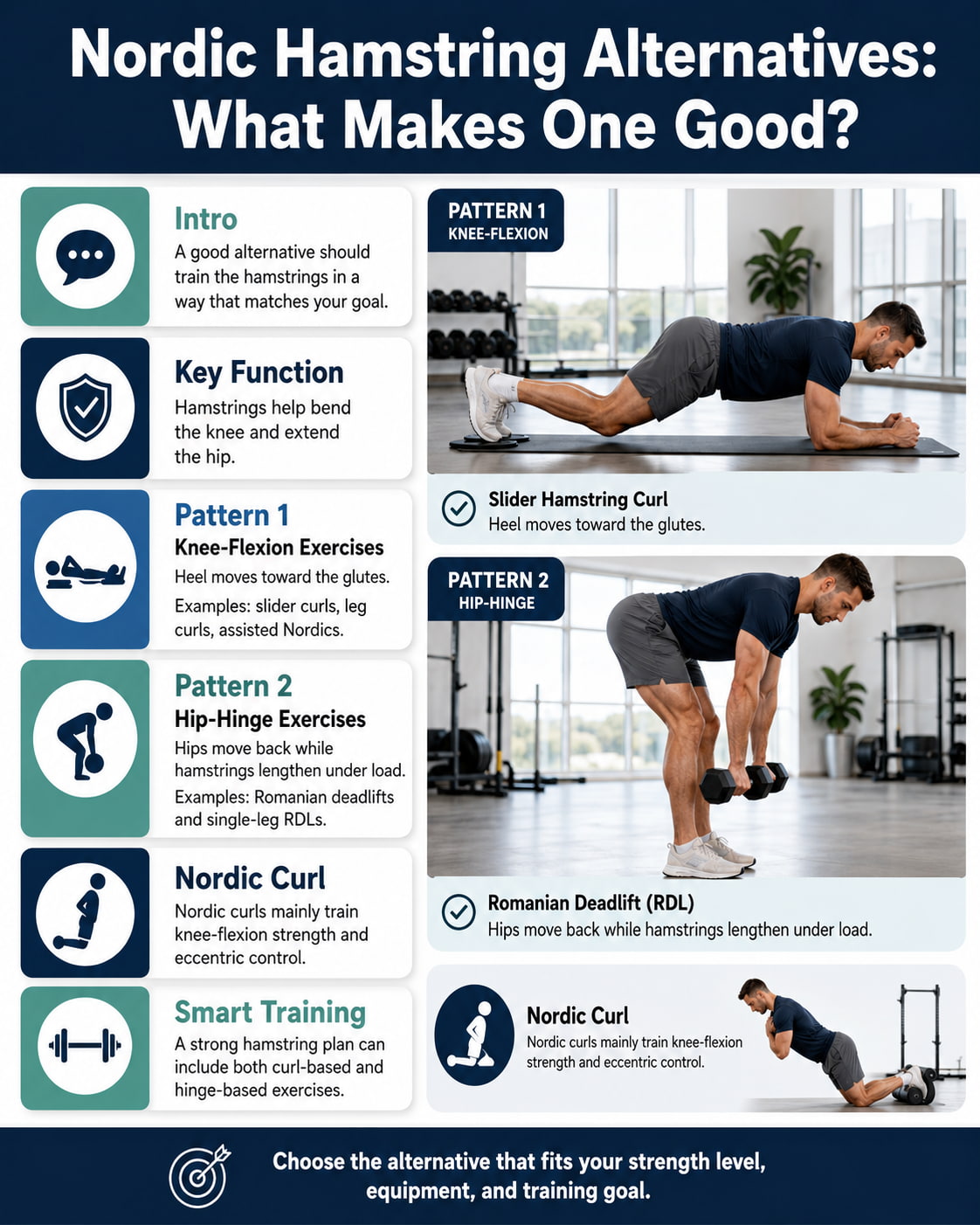
A good Nordic hamstring alternative should train the hamstrings in a way that matches your goal.
The hamstrings help bend the knee and extend the hip. That means hamstring training should include two main patterns: knee-flexion exercises, where the heel moves toward the glutes, and hip-hinge exercises, where the hips move back while the hamstrings lengthen under load. The Cleveland Clinic’s hamstring anatomy overview explains that the hamstrings help flex the knee and extend the thigh at the hip.
Nordic curls are mostly a knee-flexion and eccentric-control exercise. A Human Kinetics Nordic hamstring curl guide describes the movement as a controlled forward lowering exercise where the hamstrings resist the body as it falls toward the floor.
That does not mean every alternative must look exactly like a Nordic curl. Some exercises, such as slider hamstring curls and leg curls, are close replacements because they train knee flexion. Others, such as Romanian deadlifts, are better described as complementary hamstring builders because they train the hip hinge.
A smart hamstring plan can include both.
Quick Comparison of the Best Nordic Hamstring Alternatives
| Exercise | Best For | Equipment | Difficulty |
|---|---|---|---|
| Assisted Nordic Hamstring Curl | Closest Nordic regression | Anchor, band, or partner | Intermediate |
| Slider Hamstring Curl | Low-equipment knee flexion | Sliders or towels | Beginner to Intermediate |
| Stability Ball Hamstring Curl | Home hamstring training | Stability ball | Beginner to Intermediate |
| Suspension Trainer Hamstring Curl | Adjustable bodyweight curls | Suspension trainer | Beginner to Intermediate |
| Hamstring Walkout | Beginner no-machine option | Mat | Beginner |
| Seated Leg Curl | Controlled hamstring isolation | Leg curl machine | Beginner to Advanced |
| Lying Leg Curl | Strict knee-flexion strength | Leg curl machine | Beginner to Advanced |
| Glute-Ham Raise | Advanced posterior-chain strength | GHD machine | Advanced |
| Razor Curl | Advanced Nordic-style strength | GHD or secure setup | Advanced |
| Romanian Deadlift | Heavy hip-hinge strength | Barbell or dumbbells | Intermediate |
| Single-Leg Romanian Deadlift | Unilateral hamstring control | Dumbbells optional | Intermediate |
11 Best Nordic Hamstring Alternatives
1. Assisted Nordic Hamstring Curl
Best for: Building toward full Nordic curls while reducing the amount of bodyweight your hamstrings must control.
Muscles worked: Hamstrings, glutes, calves, and core. The hamstrings do most of the work as they resist knee extension during the lowering phase.
Equipment needed: A stable ankle anchor, resistance band, partner, Nordic bench, or heavy object that safely secures your lower legs.
Why it stands out: This is the closest regression to the full Nordic curl because it keeps the same kneeling position, straight-body lowering pattern, and eccentric hamstring demand.
Suggested sets and reps: Do 2–4 sets of 3–6 controlled reps. Use a slow 3–5 second lowering phase and stop before your form breaks.
Beginners: Use a strong resistance band or hand support so you can control only a short range of motion.
Intermediate: Lower with less assistance and increase the range gradually.
Advanced: Use a lighter band, pause halfway down, or attempt controlled unassisted eccentrics.
Rest: Rest 90–150 seconds between sets.
How to do it:
- Kneel on a pad with your ankles secured under a stable anchor.
- Brace your core, squeeze your glutes, and keep a straight line from shoulders to knees.
- Slowly lean forward from the knees while keeping your hips extended.
- Use your hamstrings to resist the lowering phase.
- Catch yourself with your hands, then push lightly off the floor to return.
Common mistakes: The biggest mistakes are bending at the hips, dropping too fast, losing core tension, and forcing a range you cannot control.
Expert tip: Think of your body as a long plank from shoulders to knees. The movement should come from the knees, not from folding at the hips.
Exercise variations: Band-assisted Nordic curl, partner-assisted Nordic curl, partial-range Nordic curl, and incline Nordic curl.
Easier variation: Try hamstring walkouts or slider hamstring curls first.
Harder variation: Progress to full Nordic hamstring curls with a slow eccentric and minimal push-off.
2. Slider Hamstring Curl
Best for: Training knee-flexion strength at home with minimal equipment.
Muscles worked: Hamstrings, glutes, calves, and deep core muscles. The hamstrings curl the heels toward the body while the glutes keep the hips lifted.
Equipment needed: Exercise sliders, furniture sliders, or towels on a smooth floor.
Why it stands out: Slider hamstring curls train the same general hamstring curl pattern as machine curls, but they also challenge hip stability and core control.
Suggested sets and reps: Do 2–4 sets of 6–12 reps. Use a controlled tempo and avoid rushing the lowering phase.
Beginners: Start with two-leg curls and keep the range short.
Intermediate: Use a full range of motion and slow eccentrics.
Advanced: Try single-leg slider curls or two-leg up, one-leg down reps.
Rest: Rest 60–120 seconds between sets.
How to do it:
- Lie on your back with your heels on sliders and knees bent.
- Lift your hips until your body forms a straight line from shoulders to knees.
- Slowly slide your heels away until your legs are almost straight.
- Curl your heels back toward your glutes while keeping your hips lifted.
- Reset your hips if your lower back starts to arch.
Common mistakes: Common errors include letting the hips drop, arching the lower back, sliding too far too soon, and turning the movement into a fast, sloppy rep.
Expert tip: Keep your ribs down and push your heels into the sliders. This helps your hamstrings stay active instead of letting your lower back take over.
Exercise variations: Short-range slider curl, long-range slider curl, eccentric-only slider curl, and single-leg slider curl.
Easier variation: Do hamstring walkouts or reduce the sliding range.
Harder variation: Try single-leg slider curls with a slow 3-second lowering phase.
3. Stability Ball Hamstring Curl
Best for: Home workouts, beginner-friendly hamstring training, and improving hip control.
Muscles worked: Hamstrings, glutes, calves, and core. The hamstrings bend the knees while the glutes help hold the hips up.
Equipment needed: Stability ball.
Why it stands out: The stability ball hamstring curl is a strong alternative because it trains knee flexion while forcing the hips and trunk to stay stable. The ACE stability ball hamstring curl guide also emphasizes controlled hip position and core bracing.
Suggested sets and reps: Do 2–4 sets of 8–15 reps. Keep the movement smooth and controlled.
Beginners: Start with hips on the floor and practice curling the ball in and out.
Intermediate: Lift the hips and use a full two-leg curl.
Advanced: Try single-leg stability ball curls or slow eccentric reps.
Rest: Rest 60–120 seconds between sets.
How to do it:
- Lie on your back with your heels and lower legs on top of a stability ball.
- Brace your core and lift your hips off the floor.
- Curl the ball toward your glutes by bending your knees.
- Pause briefly, then slowly roll the ball back out.
- Keep your hips level throughout the rep.
Common mistakes: Avoid lifting the hips so high that your lower back arches. Also avoid letting the ball wobble, rushing the curl, or dropping the hips between reps.
Expert tip: Move slower than you think you need to. The ball should roll because your hamstrings control it, not because momentum pulls it.
Exercise variations: Hips-down ball curl, hips-up ball curl, eccentric ball curl, and single-leg ball curl.
Easier variation: Perform the curl with hips down or use hamstring walkouts.
Harder variation: Use a single-leg stability ball hamstring curl.
4. Suspension Trainer Hamstring Curl
Best for: Adjustable bodyweight hamstring training when you have straps available.
Muscles worked: Hamstrings, glutes, calves, and core. The core works hard to stop the body from swinging.
Equipment needed: Suspension trainer or gym rings set low.
Why it stands out: The suspension trainer makes it easy to adjust difficulty. You can bend the knees less for an easier version or extend the legs farther for a harder one.
Suggested sets and reps: Do 2–4 sets of 8–12 reps. Use a slow return to the starting position.
Beginners: Keep the range short and focus on holding the hips steady.
Intermediate: Use a full two-leg curl with hips lifted.
Advanced: Try single-leg reps or eccentric-focused reps.
Rest: Rest 60–120 seconds between sets.
How to do it:
- Lie on your back and place your heels in the suspension trainer straps.
- Lift your hips and brace your core.
- Bend your knees to pull your heels toward your glutes.
- Pause briefly at the top.
- Slowly extend your legs without letting your hips sag.
Common mistakes: The most common mistakes are swinging, losing hip height, pulling unevenly, and allowing the straps to drift side to side.
Expert tip: Keep the straps quiet. If they swing a lot, slow down and reduce your range.
Exercise variations: Short-range suspension curl, full-range suspension curl, eccentric suspension curl, and single-leg suspension curl.
Easier variation: Keep your hips on the floor or shorten the range.
Harder variation: Perform single-leg suspension trainer hamstring curls.
5. Hamstring Walkout
Best for: Beginners who need a simple no-machine alternative before trying harder curls.
Muscles worked: Hamstrings, glutes, calves, and core. The hamstrings work as the feet walk away from the body and return.
Equipment needed: Exercise mat.
Why it stands out: Hamstring walkouts are simple, scalable, and useful for teaching beginners how to keep the hips lifted while the hamstrings lengthen.
Suggested sets and reps: Do 2–3 sets of 5–8 slow walkouts. Each walkout should feel controlled, not rushed.
Beginners: Take small steps and keep the walkout short.
Intermediate: Walk the feet farther away while keeping the hips up.
Advanced: Add a longer pause at the farthest point or use a single-leg bridge return.
Rest: Rest 60–90 seconds between sets.
How to do it:
- Lie on your back with knees bent and feet flat.
- Lift your hips into a glute bridge.
- Slowly walk your heels away from your body one small step at a time.
- Stop before your hips drop or your back arches.
- Walk your heels back in and reset.
Common mistakes: Avoid taking steps that are too large, letting your hips sag, overextending the lower back, or holding your breath.
Expert tip: Keep your hips lifted but not exaggerated. You should feel the back of your thighs working, not your lower back cramping.
Exercise variations: Short walkout, long walkout, pause walkout, and bridge-to-walkout.
Easier variation: Do regular glute bridges first.
Harder variation: Use slider hamstring curls or eccentric slider curls.
6. Seated Leg Curl
Best for: Controlled hamstring isolation, progressive overload, and gym-based training.
Muscles worked: Hamstrings, especially the biceps femoris, semitendinosus, and semimembranosus. The calves may assist slightly depending on foot position.
Equipment needed: Seated leg curl machine.
Why it stands out: The seated leg curl is one of the easiest Nordic hamstring alternatives to load, track, and progress. NASM describes the seated leg curl as a machine-based hamstring exercise that targets knee flexion.
Suggested sets and reps: Do 2–4 sets of 8–15 reps. For strength, use 6–10 reps. For muscle-building, use 10–15 reps.
Beginners: Use a light weight and learn full control through the complete range.
Intermediate: Add load gradually while keeping the hips pinned down.
Advanced: Use slow eccentrics, pauses, or single-leg sets.
Rest: Rest 60–120 seconds between sets.
How to do it:
- Adjust the machine so your knees line up with the machine’s pivot point.
- Set the lower pad just above your heels or lower calves.
- Sit tall and keep your hips against the pad.
- Curl the pad down by bending your knees.
- Slowly return to the start without letting the weight stack slam.
Common mistakes: Do not use too much weight, shorten the range, lift your hips off the seat, or swing the pad down with momentum.
Expert tip: Control the top half of the return. That is where many lifters lose tension.
Exercise variations: Two-leg seated leg curl, single-leg seated leg curl, slow eccentric seated leg curl, and pause reps.
Easier variation: Use a lighter weight and a smaller range while you learn the setup.
Harder variation: Try two-leg concentric reps with one-leg eccentric lowering.
7. Lying Leg Curl
Best for: Strict knee-flexion training and building hamstring strength with machine support.
Muscles worked: Hamstrings, with assistance from the calves. The glutes and core help stabilize the body against the bench.
Equipment needed: Lying leg curl machine.
Why it stands out: Lying leg curls train the hamstrings without requiring balance, ankle anchoring, or advanced bodyweight strength. ACE’s lying hamstrings curl guide emphasizes aligning the knee joint with the machine axis and controlling the pad through the movement.
Suggested sets and reps: Do 2–4 sets of 8–15 reps. Use slow, clean reps instead of heavy swinging.
Beginners: Start light and focus on machine setup.
Intermediate: Add weight while keeping your hips down.
Advanced: Use pauses, single-leg reps, or eccentric overload sets.
Rest: Rest 60–120 seconds between sets.
How to do it:
- Lie face down on the machine with your knees aligned with the pivot point.
- Place the pad near the lower calves, above the heels.
- Brace lightly and keep your hips against the bench.
- Curl the pad toward your glutes.
- Lower the pad slowly until your knees are almost straight.
Common mistakes: Avoid lifting the hips, arching the lower back, using a partial range, or letting the weight drop too fast.
Expert tip: Keep your thighs heavy against the pad. If your hips pop up, the weight is probably too heavy.
Exercise variations: Two-leg lying curl, single-leg lying curl, pause lying curl, and slow eccentric lying curl.
Easier variation: Use a lighter weight and stop short of any uncomfortable range.
Harder variation: Use one-leg eccentric lowering after curling with both legs.
8. Glute-Ham Raise
Best for: Advanced hamstring and posterior-chain strength.
Muscles worked: Hamstrings, glutes, spinal erectors, calves, and core. The hamstrings work through knee flexion while the glutes and trunk help maintain position.
Equipment needed: Glute-ham developer, also called a GHD machine.
Why it stands out: The glute-ham raise is one of the strongest gym-based alternatives because it trains the hamstrings through a large range while also challenging the glutes and trunk.
Suggested sets and reps: Do 2–4 sets of 5–10 reps. Keep reps controlled and avoid grinding to failure.
Beginners: Use assistance from your hands or a band.
Intermediate: Perform full bodyweight reps with a controlled lowering phase.
Advanced: Add a slow eccentric, pause, or light external load.
Rest: Rest 90–150 seconds between sets.
How to do it:
- Set up on the GHD with your feet secured and knees supported.
- Start with your torso upright and core braced.
- Lower your body under control while keeping tension through your hamstrings.
- Use your hamstrings and glutes to pull yourself back up.
- Finish tall without overextending your lower back.
Common mistakes: Common errors include bending at the hips too much, overusing the lower back, rushing the bottom position, and setting the machine incorrectly.
Expert tip: Start with assistance. A clean assisted rep is more useful than a sloppy unassisted rep.
Exercise variations: Assisted glute-ham raise, eccentric glute-ham raise, band-assisted glute-ham raise, and weighted glute-ham raise.
Easier variation: Use a band or push lightly with your hands.
Harder variation: Add a slow 5-second lowering phase or hold a light plate.
9. Razor Curl
Best for: Advanced lifters who want a difficult Nordic-style hamstring challenge.
Muscles worked: Hamstrings, glutes, calves, and core. The hamstrings work hard as the knees extend and then flex again.
Equipment needed: GHD machine, secure ankle anchor, or specialized setup.
Why it stands out: The razor curl combines hip position control with a powerful hamstring curl pattern. It is more advanced than most alternatives and should be earned with good strength and control.
Suggested sets and reps: Do 2–4 sets of 3–8 reps. Keep the range short at first and focus on quality.
Beginners: Skip this exercise until slider curls, leg curls, and assisted Nordics are strong and pain-free.
Intermediate: Use assistance and a short range.
Advanced: Use full-range reps with a slow eccentric.
Rest: Rest 90–180 seconds between sets.
How to do it:
- Secure your feet and set your knees comfortably on the pad or floor.
- Start with your hips slightly flexed and your torso controlled.
- Slowly let your body move forward as your knees extend.
- Use your hamstrings to curl yourself back toward the start.
- Keep the movement smooth and controlled.
Common mistakes: Avoid starting too advanced, collapsing into the bottom, cranking through the knees, or losing hip and core control.
Expert tip: Treat this like a strength skill. Use a small range first and only increase range when every rep looks the same.
Exercise variations: Assisted razor curl, short-range razor curl, eccentric razor curl, and GHD razor curl.
Easier variation: Use assisted Nordic curls or glute-ham raises.
Harder variation: Use a slower eccentric or reduce assistance.
10. Romanian Deadlift
Best for: Heavy hip-hinge hamstring strength and posterior-chain development.
Muscles worked: Hamstrings, glutes, spinal erectors, adductors, upper back, and grip. The hamstrings lengthen as the hips move back.
Equipment needed: Barbell, dumbbells, kettlebells, or trap bar.
Why it stands out: Romanian deadlifts are not a perfect Nordic replacement because they train hip extension more than knee flexion. However, they are one of the best complementary hamstring exercises. NASM’s barbell Romanian deadlift guide describes the RDL as a hip-hinge movement that loads the hamstrings and posterior chain.
Suggested sets and reps: Do 3–5 sets of 5–10 reps for strength or 2–4 sets of 8–12 reps for muscle-building.
Beginners: Start with dumbbells and learn the hinge pattern before going heavy.
Intermediate: Use moderate loads and stop around mid-shin or when you feel a strong hamstring stretch.
Advanced: Use heavier loading, tempo reps, or paused reps near the bottom.
Rest: Rest 90–180 seconds between sets.
How to do it:
- Stand tall with the weight in front of your thighs.
- Brace your core and keep your shoulders pulled back.
- Push your hips back while keeping a slight bend in your knees.
- Lower until you feel a strong hamstring stretch without rounding your back.
- Drive your hips forward to return to standing.
Common mistakes: Avoid squatting the weight down, rounding your back, letting the weight drift away, locking the knees, or chasing more depth than your mobility allows.
Expert tip: Keep the weight close to your legs. The farther it drifts away, the harder it is to keep good position.
Exercise variations: Barbell RDL, dumbbell RDL, kettlebell RDL, and tempo RDL.
Easier variation: Use a dumbbell RDL from a higher starting position.
Harder variation: Use a deficit RDL or paused RDL with excellent control.
11. Single-Leg Romanian Deadlift
Best for: Unilateral hamstring strength, balance, hip control, and fixing side-to-side strength gaps.
Muscles worked: Hamstrings, glutes, spinal erectors, calves, foot stabilizers, and core. The stance-leg hamstring and glute do most of the work.
Equipment needed: Dumbbells, kettlebell, barbell, cable, or bodyweight.
Why it stands out: The single-leg RDL trains the hamstrings while also challenging hip stability and balance. It is especially useful for athletes, runners, and lifters who need better single-leg control.
Suggested sets and reps: Do 2–4 sets of 6–10 reps per side.
Beginners: Hold a wall, rack, or bench for balance and use bodyweight.
Intermediate: Hold one dumbbell or kettlebell on the opposite side of the working leg.
Advanced: Use heavier dumbbells, a barbell, or a slow eccentric tempo.
Rest: Rest 60–120 seconds between sides or sets.
How to do it:
- Stand on one leg with a soft bend in the knee.
- Brace your core and keep your hips square.
- Hinge forward as your back leg moves behind you.
- Lower until you feel tension in the stance-leg hamstring.
- Drive through the foot and return to standing with control.
Common mistakes: Avoid twisting the hips open, reaching too far with the weight, bending the knee too much, or turning the exercise into a balance struggle instead of a hinge.
Expert tip: Imagine both hip bones pointing toward the floor. This keeps the movement focused on the hamstrings and glutes.
Exercise variations: Bodyweight single-leg RDL, supported single-leg RDL, dumbbell single-leg RDL, and cable single-leg RDL.
Easier variation: Use a kickstand RDL or hold a support for balance.
Harder variation: Use a loaded single-leg RDL with a slow 3-second lowering phase.
How to Choose the Right Nordic Hamstring Alternative
Choose the exercise based on what you need most.
If you want the closest Nordic replacement, use assisted Nordic curls, slider hamstring curls, suspension trainer curls, glute-ham raises, or razor curls.
If you want a beginner-friendly option, start with hamstring walkouts, stability ball hamstring curls, or light seated leg curls.
If you train at home, use sliders, towels, a stability ball, suspension straps, or bodyweight walkouts.
If you train in a gym, use seated leg curls, lying leg curls, Romanian deadlifts, and glute-ham raises.
If your goal is stronger, more complete hamstrings, combine one knee-flexion exercise with one hip-hinge exercise. For example, pair seated leg curls with Romanian deadlifts or slider curls with single-leg RDLs.
Common Mistakes When Training Nordic Hamstring Alternatives
The first mistake is treating every hamstring exercise as the same. A leg curl and an RDL both train the hamstrings, but they do not challenge the body in the same way. Use both patterns when possible.
The second mistake is progressing too fast. Nordic-style exercises create high tension through the hamstrings. Add volume gradually and avoid training to failure every session.
The third mistake is losing hip position. During slider curls, stability ball curls, and suspension curls, the hips should stay controlled. If the hips drop or the lower back arches, reduce the range or difficulty.
The fourth mistake is skipping warm-ups. Before hard hamstring work, use light hip hinges, glute bridges, bodyweight leg curls, and easy ramp-up sets.
The fifth mistake is ignoring pain. Muscle effort is normal. Sharp pain, cramping that does not settle, numbness, dizziness, chest pain, or unusual symptoms are not something to push through.
Sample Nordic Hamstring Alternative Workouts
Beginner Home Workout
Use this workout 1–2 times per week with at least one rest day between sessions.
| Exercise | Sets | Reps | Rest |
|---|---|---|---|
| Glute Bridge | 2 | 10–15 | 45–60 sec |
| Hamstring Walkout | 2–3 | 5–8 | 60–90 sec |
| Stability Ball Hamstring Curl | 2–3 | 8–12 | 60–90 sec |
| Bodyweight RDL | 2 | 10–12 | 60 sec |
Keep the effort around 6–7 out of 10. Progress by adding reps first, then range of motion, then harder variations.
Gym Hamstring Strength Workout
Use this workout 1–2 times per week after your main lower-body lift or as a hamstring-focused accessory session.
| Exercise | Sets | Reps | Rest |
|---|---|---|---|
| Romanian Deadlift | 3–4 | 6–10 | 2 min |
| Seated Leg Curl | 3 | 8–12 | 90 sec |
| Assisted Nordic Hamstring Curl | 2–3 | 3–6 | 2 min |
| Single-Leg RDL | 2 | 8 per side | 90 sec |
Keep 1–3 reps in reserve on most sets. Add load only when your form stays consistent.
Advanced Eccentric Hamstring Workout
Use this workout once per week if you already tolerate hamstring training well.
| Exercise | Sets | Reps | Rest |
|---|---|---|---|
| Assisted or Full Nordic Curl | 3–4 | 3–5 | 2–3 min |
| Glute-Ham Raise | 3 | 5–8 | 2 min |
| Lying Leg Curl, Slow Eccentric | 2–3 | 6–10 | 90 sec |
| Romanian Deadlift | 3 | 6–8 | 2 min |
This workout is demanding. Start with less volume and build gradually over several weeks.
Safety Tips for Nordic Hamstring Alternatives
Warm up before hard hamstring training. Use light glute bridges, hip hinges, easy leg curls, and dynamic lower-body movement.
Start with a version you can control. You do not need to force full Nordic curls if your hamstrings are not ready yet.
Keep volume moderate at first. Eccentric hamstring work can create soreness, especially when you are new to it.
Stop if an exercise causes sharp pain, numbness, dizziness, chest pain, or unusual symptoms. Seek help from a qualified healthcare professional if symptoms continue or feel unusual.
If you are returning from a hamstring strain, knee pain, or a sports injury, get individual guidance before using aggressive Nordic-style progressions.
FAQs About Nordic Hamstring Alternatives
What is the best alternative to Nordic hamstring curls?
The assisted Nordic hamstring curl is the closest alternative because it uses the same kneeling position and forward-lowering pattern. Slider hamstring curls and stability ball hamstring curls are also strong choices if you do not have a secure ankle anchor.
Are Romanian deadlifts a good Nordic hamstring alternative?
Romanian deadlifts are excellent hamstring exercises, but they are not a one-for-one Nordic replacement. RDLs mainly train the hip-hinge pattern, while Nordic curls emphasize knee-flexion strength and eccentric control. A complete plan can include both.
What can beginners do instead of Nordic curls?
Beginners can start with hamstring walkouts, stability ball hamstring curls, light seated leg curls, and short-range slider curls. These options are easier to control and help build strength before harder Nordic-style movements.
Can I train Nordic hamstring alternatives at home?
Yes. Slider hamstring curls, hamstring walkouts, stability ball curls, suspension trainer curls, and single-leg RDLs can all be done at home with minimal equipment.
How often should I train these exercises?
Most people can train hamstrings 1–3 times per week, depending on workout intensity, soreness, and total lower-body volume. Hard eccentric exercises like assisted Nordics, glute-ham raises, and razor curls usually need more recovery than light machine curls.
Which Nordic hamstring alternatives are best for athletes?
Assisted Nordic curls, slider curls, glute-ham raises, razor curls, Romanian deadlifts, and single-leg RDLs are strong choices for athletes. Use them progressively and avoid adding too much eccentric volume too quickly.
Do Nordic hamstring alternatives prevent hamstring injuries?
They may help support stronger, more resilient hamstrings when used as part of a complete program. Research on programs that include the Nordic hamstring exercise is promising, including a British Journal of Sports Medicine review, but no single exercise can guarantee injury prevention.
Conclusion
The best Nordic hamstring alternatives depend on your strength level, equipment, and goal. If you want the closest replacement, start with assisted Nordics, slider curls, suspension curls, or glute-ham raises. If you want complete hamstring development, combine knee-flexion exercises with hip-hinge movements like Romanian deadlifts.
Train with control, progress slowly, and choose exercises you can perform with strong form. Over time, these alternatives can help you build stronger hamstrings and prepare your body for more advanced Nordic-style work.