The smith machine shoulder press is a guided overhead press that trains your shoulders with a fixed bar path, making it useful for lifters who want more control than a free-weight barbell press. It mainly targets the front delts while also training the side delts, triceps, upper chest, traps, and upper-back support muscles.
Used correctly, it can be a strong shoulder-building exercise for beginners, hypertrophy-focused lifters, and anyone who wants a stable pressing option. The key is setup. Because the bar moves on rails, your bench angle, body position, grip, and range of motion need to match the machine instead of forcing your shoulders into an awkward path.
What Is the Smith Machine Shoulder Press?
The smith machine shoulder press is an overhead pressing exercise performed with the bar attached to a Smith machine. Instead of controlling a free barbell in every direction, you press a guided bar up and down along the machine’s track.
Most lifters perform it seated on an adjustable bench, but it can also be done standing. The seated version is usually more stable and easier to control because your torso is supported and your lower body cannot create as much momentum.
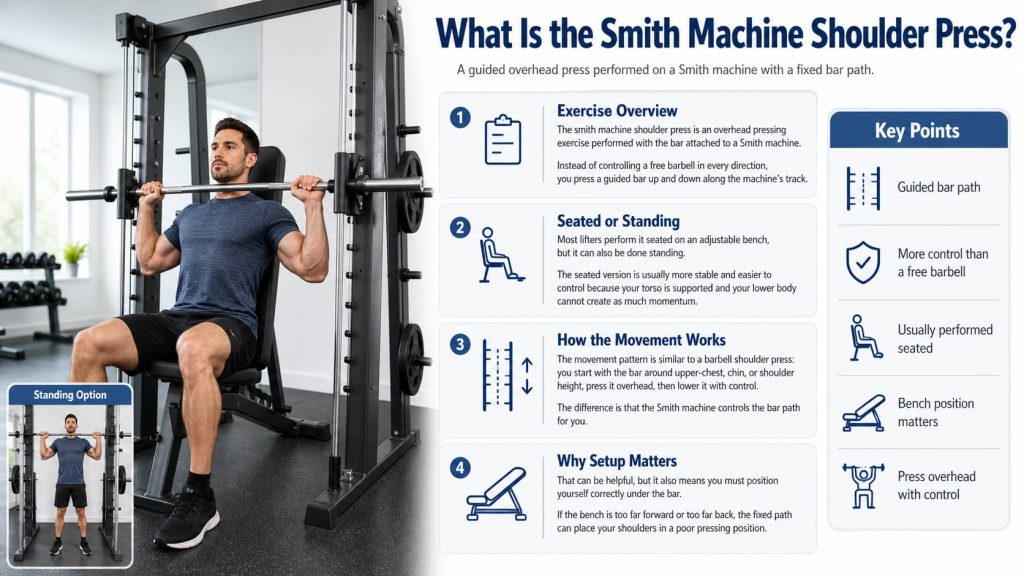
The movement pattern is similar to a barbell shoulder press: you start with the bar around upper-chest, chin, or shoulder height, press it overhead, then lower it with control. The difference is that the Smith machine controls the bar path for you.
That can be helpful, but it also means you must position yourself correctly under the bar. If the bench is too far forward or too far back, the fixed path can place your shoulders in a poor pressing position.
Smith Machine Shoulder Press Muscles Worked
The smith machine shoulder press is a compound upper-body push exercise. It trains several muscles at once, but the shoulders do most of the work.
Primary muscles worked
Anterior deltoids: The front part of your shoulders is the main target. It helps lift your arms forward and overhead during the press.
Lateral deltoids: The side delts assist the press and help create the rounded shoulder look many lifters want.
Triceps brachii: Your triceps extend the elbows as you press the bar upward.
Secondary muscles worked
Upper chest: The clavicular head of the pectoralis major assists the press, especially when the elbows are slightly forward.
Trapezius: The traps help support upward shoulder movement and upper-back positioning.
Serratus anterior: This muscle helps your shoulder blades move and stabilize as your arms press overhead.
Core muscles: Your abs and deep trunk muscles help keep your ribs down and reduce excessive lower-back arching.
The American Council on Exercise teaches shoulder press technique with a slightly wider-than-shoulder-width grip, feet pressed into the floor, stomach muscles braced, elbows pointed forward, and a controlled lower to about chin height.
Smith Machine Shoulder Press Benefits
It helps build stronger shoulders
The smith machine shoulder press lets you train the delts with a stable overhead pressing pattern. Because the machine reduces some balance demands, many lifters can focus more on pressing effort and controlled reps.
This can make it useful for shoulder hypertrophy, especially when paired with lateral raises, rear delt work, and upper-back training.
It provides a more controlled bar path
The guided rail system can help beginners learn the basic overhead press pattern without worrying as much about the bar drifting forward, backward, or sideways.
This does not mean the exercise is automatically safer than free weights. It simply means the movement is more controlled. You still need good shoulder mobility, a strong brace, and proper bench placement.
It can be easier to load progressively
The Smith machine makes it simple to add small amounts of weight and repeat the same pressing path each session. That can help lifters track progress over time.
For muscle growth, the American College of Sports Medicine notes that weekly training volume is important, while strength-focused training usually benefits from heavier loading and lower-rep work.
It can reduce balance demands
A free-weight overhead press requires you to stabilize the bar in multiple directions. The Smith machine removes much of that free-path demand.
A study published in Sports found that machine overhead press variations can create a different training stimulus than free-weight overhead presses because the machine helps stabilize the load path.
This makes the Smith machine shoulder press useful when your goal is controlled pressing volume rather than maximum stabilization challenge.
It works well for shoulder-focused workouts
The Smith machine shoulder press fits well as a main shoulder exercise on push day, upper-body day, or a shoulder-specific workout. You can use it before isolation exercises such as lateral raises, rear delt flyes, and face pulls.
How to Do the Smith Machine Shoulder Press With Proper Form
How to do it
- Place an adjustable bench inside the Smith machine and set it close to vertical.
- Set the bar around upper-chest or chin height when seated.
- Adjust the safety stops so the bar cannot drop below a safe range.
- Sit with your feet flat on the floor and your back supported by the bench.
- Grip the bar slightly wider than shoulder width with your palms facing forward.
- Stack your wrists over your elbows and keep your elbows slightly forward, not flared straight out.
- Brace your abs, keep your ribs down, and avoid over-arching your lower back.
- Unlock the bar and lower it under control to around chin, upper-chest, or comfortable shoulder height.
- Press the bar upward until your arms are extended overhead without shrugging aggressively or losing your brace.
- Lower the bar slowly and repeat for the desired reps.
- Rotate the bar back into the hooks when finished.
Suggested sets and reps:
- For beginners, use 2–3 sets of 8–12 reps with a light to moderate weight.
- For muscle growth, use 3–4 sets of 6–12 reps.
- For higher-rep shoulder volume, use 2–4 sets of 10–15 reps.
- For strength emphasis, use 3–5 sets of 3–6 reps only if your form, shoulder mobility, and setup are solid.
Coaching cue: Think “elbows slightly forward, ribs down, press tall.” This keeps the lift shoulder-focused without turning it into a lower-back arching contest.
Best Setup Tips for the Smith Machine Shoulder Press
Set the bench correctly
Your bench should place the bar slightly in front of your face at the bottom and over your shoulders at the top. If the bar feels like it is pulling your shoulders backward or forcing you to press too far forward, adjust the bench.
On some Smith machines, the rails are angled. In that case, test the empty bar first and position your bench so the bar path feels natural.
Use a high bench angle
A nearly vertical bench is usually best. A slight backward angle can be okay, but if the bench is too reclined, the movement becomes more like a high-incline press and shifts more work toward the upper chest.
Start with the bar around chin or upper-chest height
You do not need to lower the bar as deep as possible. Lowering too far can irritate the shoulders for some lifters, especially if mobility is limited.
A practical stopping point is around chin height or the lowest position you can control without shoulder discomfort.
Keep your wrists stacked
Your wrists should stay in line with your forearms. If your wrists bend far backward, the press can feel unstable and uncomfortable.
Grip the bar firmly and think about driving your knuckles toward the ceiling.
Keep your elbows slightly forward
Do not force your elbows straight out to the sides. A slightly forward elbow position usually feels more natural for overhead pressing and may reduce shoulder irritation.
The National Academy of Sports Medicine notes that overhead pressing alignment matters, and tight pecs or lats may cause people to arch the back or shift the arms forward during pressing.
Common Smith Machine Shoulder Press Mistakes
Setting the bench too far forward or backward
This is the biggest Smith machine-specific mistake. If your body is not lined up with the fixed bar path, the press can feel awkward even with light weight.
Fix it by testing the empty bar first. The bar should move smoothly without forcing your shoulders into an uncomfortable position.
Lowering the bar too low
A deeper range is not always better. If lowering to the upper chest causes pinching, pain, or loss of control, stop around chin height or slightly above shoulder level.
Use the range of motion you can control without discomfort.
Flaring the elbows straight out
Elbows flared directly to the sides can make the press feel harsher on the shoulders. Keep your elbows slightly forward at the bottom.
This usually creates a stronger, more natural pressing path.
Arching the lower back
A little natural curve in the lower back is normal. Excessive arching is not.
If your ribs flare up and your lower back takes over, reduce the weight, brace harder, or use a more upright bench position.
Using too much weight
The Smith machine can make the lift feel more stable, which may tempt you to load it too heavily. If you cannot lower the bar slowly and press without bouncing, the weight is too heavy.
Bouncing the bar
Do not bounce the bar off your chest, chin-level position, or shoulder range. Lower with control, pause briefly if needed, then press smoothly.
Locking into a painful bar path
The Smith machine does not adjust to your body the way dumbbells do. If the movement feels wrong after adjusting the bench and grip, choose a different shoulder press variation.
Smith Machine Shoulder Press Variations
1. Standing Smith Machine Shoulder Press
Best for: The standing smith machine shoulder press is best for lifters who want more full-body bracing and a stronger core challenge while still using a guided bar path. It can also be useful for lifters who prefer standing overhead press variations.
Muscles worked: This variation works the anterior deltoids, lateral deltoids, triceps, upper chest, traps, serratus anterior, core, glutes, and upper back. The standing position increases the need for trunk and hip stability.
Why it stands out: The standing version feels more athletic than the seated press because your whole body must stay tight while you press. It can build overhead pressing control, but it requires more discipline to avoid leaning back.
Suggested sets and reps:
- Beginners: Perform 2–3 sets of 8–10 reps with light weight while learning how to brace.
- Intermediate: Perform 3–4 sets of 6–10 reps with controlled reps and a stable torso.
- Advanced: Perform 3–5 sets of 4–8 reps, or use paused reps to build stronger pressing control.
- Rest: Rest 90–150 seconds between working sets, especially if the weight is challenging.
How to do it:
- Stand inside the Smith machine with the bar around upper-chest or shoulder height.
- Place your feet about hip-width apart.
- Grip the bar slightly wider than shoulder width.
- Squeeze your glutes and brace your abs.
- Keep your ribs down and avoid leaning backward.
- Unlock the bar and lower it to a comfortable starting position.
- Press overhead while keeping your torso stable.
- Lower the bar with control.
- Repeat for the target reps.
- Hook the bar safely when finished.
Common mistakes: Common mistakes include leaning back too much, turning the movement into a standing incline press, relaxing the glutes, flaring the ribs, pressing too far forward, and using momentum to finish reps.
Expert tip: Squeeze your glutes before every rep. This helps keep your pelvis and ribs stacked so your shoulders do the work instead of your lower back.
2. Close-Grip Smith Machine Shoulder Press
Best for: The close-grip smith machine shoulder press is best for lifters who want more triceps involvement or a pressing position that feels slightly more tucked and controlled. It may also feel better for lifters who dislike wide-grip overhead pressing.
Muscles worked: This variation works the anterior deltoids, triceps, lateral deltoids, upper chest, traps, and serratus anterior. The closer grip usually increases the demand on the triceps during the lockout.
Why it stands out: The close-grip version changes the pressing feel without needing a new machine or extra equipment. It can help lifters train the shoulders and triceps together while keeping the elbows in a slightly more forward position.
Suggested sets and reps:
- Beginners: Perform 2–3 sets of 8–12 reps with a light load and a grip just inside your normal press grip.
- Intermediate: Perform 3–4 sets of 8–12 reps, focusing on clean elbow tracking and a strong lockout.
- Advanced: Perform 3–4 sets of 6–10 reps, or use it as a triceps-heavy shoulder accessory after your main press.
- Rest: Rest 60–120 seconds depending on the weight and how close you train to failure.
How to do it:
- Set up seated or standing under the Smith machine bar.
- Take a grip slightly narrower than your regular shoulder press grip.
- Keep your wrists straight and elbows under the bar.
- Brace your core and keep your chest controlled.
- Unlock the bar and lower it smoothly.
- Keep your elbows slightly forward as the bar descends.
- Press the bar upward until your elbows extend.
- Lower with control and repeat.
- Re-rack the bar safely after your set.
Common mistakes: Common mistakes include gripping too narrow, letting the wrists bend back, allowing the elbows to collapse inward, cutting the range of motion too short, and using a weight that makes the press feel jammed.
Expert tip: Do not turn this into an extreme narrow-grip press. A slightly closer grip is enough to change the emphasis while keeping your shoulders and wrists in a stronger position.
3. Wide-Grip Smith Machine Shoulder Press
Best for: The wide-grip smith machine shoulder press is best for lifters who want a more shoulder-dominant pressing feel and already have comfortable overhead mobility. It should be used carefully because going too wide can increase shoulder stress.
Muscles worked: This variation mainly works the anterior and lateral deltoids, with help from the triceps, upper chest, traps, serratus anterior, and shoulder stabilizers. The wider grip may reduce triceps involvement slightly compared with a close grip.
Why it stands out: The wide-grip version can increase the shoulder-focused feel of the press for some lifters. It may also reduce the total pressing distance, which can allow controlled shoulder loading when used with good form.
Suggested sets and reps:
- Beginners: This variation is usually not the best starting option. If used, perform 2 sets of 10–12 light reps with a moderate grip width.
- Intermediate: Perform 3 sets of 8–12 reps with controlled lowering and no shoulder pinching.
- Advanced: Perform 3–4 sets of 6–10 reps, using a grip that feels strong rather than extreme.
- Rest: Rest 60–120 seconds between sets, or longer if using heavier loads.
How to do it:
- Set up on the Smith machine with the bench close to vertical.
- Take a grip slightly wider than your normal shoulder press grip.
- Keep your wrists stacked and your shoulders pulled down away from your ears.
- Brace your core before unlocking the bar.
- Lower the bar only as far as your shoulders can control comfortably.
- Press upward smoothly without bouncing.
- Keep the bar path controlled through the full rep.
- Repeat for the target reps.
- Re-rack the bar with control.
Common mistakes: Common mistakes include gripping too wide, lowering too deep, flaring the elbows aggressively, shrugging during every rep, and forcing the shoulders into a painful range.
Expert tip: Use a “wide but strong” grip, not the widest grip possible. If your shoulders feel pinched at the bottom, narrow your grip or choose a standard seated version.
5. Paused Smith Machine Shoulder Press
Best for: The paused smith machine shoulder press is best for lifters who want to improve control, reduce bouncing, and build strength from the bottom portion of the press. It is also useful for lifters who rush their reps.
Muscles worked: This variation works the anterior deltoids, lateral deltoids, triceps, upper chest, traps, serratus anterior, rotator cuff muscles, and core. The pause increases the demand on the shoulders because momentum is removed.
Why it stands out: The pause forces you to stay tight and press from a dead stop instead of relying on bounce. This makes the exercise more controlled and can help improve pressing technique.
Suggested sets and reps:
- Beginners: Perform 2–3 sets of 6–8 reps with a light weight and a short one-second pause.
- Intermediate: Perform 3–4 sets of 6–10 reps, pausing briefly at the bottom without relaxing your shoulders.
- Advanced: Perform 3–5 sets of 4–8 reps with heavier weight, or use longer pauses for more difficulty.
- Rest: Rest 90–150 seconds between sets because paused reps are more demanding than regular reps.
How to do it:
- Set up in the Smith machine with your bench and bar position aligned.
- Grip the bar slightly wider than shoulder width.
- Brace your core and keep your wrists stacked.
- Unlock the bar and lower it under control.
- Pause for one second near chin or upper-chest height.
- Stay tight during the pause without resting the bar on your body.
- Press the bar up smoothly.
- Lower again with control and repeat.
- Re-rack the bar safely after the final rep.
Common mistakes: Common mistakes include relaxing during the pause, resting the bar on the chest, pausing too low, losing core tension, bouncing after the pause, and using the same weight as regular reps.
Expert tip: Treat the pause as an active hold. Keep tension in your shoulders and triceps, then press from a still position without jerking the bar.
5. Tempo Smith Machine Shoulder Press
Best for: The tempo smith machine shoulder press is best for lifters who want more time under tension, better control, and a stronger mind-muscle connection without needing very heavy weight. It works well for hypertrophy-focused shoulder training.
Muscles worked: This variation works the anterior deltoids, lateral deltoids, triceps, upper chest, traps, serratus anterior, and core. The slow lowering phase increases shoulder tension and control.
Why it stands out: Tempo reps make lighter weights feel harder by increasing time under tension. This can be helpful for shoulder growth, technique practice, and reducing sloppy reps.
Suggested sets and reps:
- Beginners: Perform 2–3 sets of 8–10 reps with a light load and a 2–3 second lowering phase.
- Intermediate: Perform 3–4 sets of 8–12 reps using a 3-second lowering phase and a smooth press.
- Advanced: Perform 3–4 sets of 6–10 reps with a 3–4 second lowering phase, or add a short pause at the bottom for extra control.
- Rest: Rest 60–120 seconds between sets, depending on the tempo and how close you train to failure.
How to do it:
- Set up under the Smith machine bar with your bench aligned correctly.
- Grip the bar slightly wider than shoulder width.
- Brace your core and keep your elbows slightly forward.
- Unlock the bar and begin the rep from the starting position.
- Lower the bar for about 3 seconds.
- Pause briefly if needed while staying tight.
- Press the bar upward with control.
- Repeat each rep using the same slow lowering tempo.
- Re-rack the bar safely when finished.
Common mistakes: Common mistakes include rushing the lowering phase, using too much weight, losing tension at the bottom, arching the lower back, and turning the final reps into normal-speed reps.
Expert tip: Count the lowering phase honestly. A true 3-second descent should feel controlled from top to bottom, not slow at first and rushed near the shoulders.
Smith Machine Shoulder Press vs. Free-Weight Shoulder Press
The smith machine shoulder press and free-weight shoulder press are both useful, but they are not the same exercise.
Smith machine shoulder press
The Smith machine version gives you a fixed bar path. It is more controlled and may be easier to repeat from set to set. It can be useful for hypertrophy, machine-based training, and beginners who want a stable pressing option.
The downside is that the machine does not allow the bar to naturally adjust to your shoulder structure. Poor setup can make the movement feel uncomfortable.
Barbell shoulder press
The barbell press requires more control because the bar can move forward, backward, and sideways. It can be better for developing full-body bracing and free-weight pressing skill.
The downside is that it can be harder to learn and less forgiving if your bar path is inconsistent.
Dumbbell shoulder press
Dumbbells allow each arm to move more freely. This can feel more natural for many shoulders and helps reveal side-to-side strength differences.
The downside is that dumbbells require more stability and can be harder to set up as the weight gets heavy.
Which one should you choose?
- Choose the smith machine shoulder press if you want a stable, repeatable shoulder press.
- Choose dumbbells if you want more freedom of movement and balanced side-to-side training.
- Choose the barbell press if you want to build traditional overhead pressing strength and full-body control.
The best option is the one you can perform with strong form, no sharp pain, and consistent progression.
Who Should Use the Smith Machine Shoulder Press?
The smith machine shoulder press can be useful for:
- Beginners learning basic overhead pressing
- Lifters who want more controlled shoulder training
- Bodybuilders using machine-based hypertrophy work
- Lifters training close to fatigue without balancing a free bar
- People who prefer a stable pressing path
- Advanced lifters using it after heavier free-weight presses
It may not be the best option for:
- Lifters whose shoulders feel pinched during fixed-path pressing
- People who cannot press overhead without excessive back arching
- Anyone with current shoulder pain that worsens during the movement
- Lifters who need sport-specific free-weight stability
- People who force a behind-the-neck range without enough mobility
Stop the exercise if you feel sharp pain, numbness, dizziness, sudden weakness, or unusual symptoms. Use a different variation and consider working with a qualified coach or healthcare professional if overhead pressing consistently causes discomfort.
Smith Machine Shoulder Press Sets, Reps, and Programming Tips
For beginners
Start with 2–3 sets of 8–12 reps. Use a weight that lets you control every rep and finish with 2–3 reps in reserve.
Rest 60–90 seconds between sets.
For muscle growth
Use 3–4 sets of 6–12 reps. Train close to technical failure, but do not let your lower back arch or your elbows flare just to complete more reps.
Rest 90–150 seconds between sets.
For strength
Use 3–5 sets of 3–6 reps. This works best for experienced lifters who already have strong overhead pressing form.
Rest 2–3 minutes between sets.
For shoulder endurance or pump work
Use 2–4 sets of 12–15 reps with a smooth tempo. This works well later in a workout after heavier pressing.
Rest 45–90 seconds between sets.
How often should you do it?
Most lifters can train the smith machine shoulder press 1–2 times per week. If you already do a lot of bench pressing, incline pressing, dips, and overhead work, you may need less direct front-delt volume.
A good shoulder program should also include side-delt and rear-delt work, not just pressing.
Sample Smith Machine Shoulder Press Workout
Beginner shoulder workout
- Smith Machine Shoulder Press: 3 sets of 8–10 reps
- Dumbbell Lateral Raise: 2 sets of 12–15 reps
- Cable or Band Face Pull: 2 sets of 12–15 reps
- Plank: 2 sets of 30–45 seconds
Rest 60–90 seconds between sets.
Intermediate push-day option
- Smith Machine Shoulder Press: 4 sets of 6–10 reps
- Incline Dumbbell Press: 3 sets of 8–10 reps
- Cable Lateral Raise: 3 sets of 12–15 reps
- Triceps Rope Pressdown: 3 sets of 10–15 reps
- Rear Delt Fly: 2–3 sets of 12–20 reps
Rest 90–150 seconds on presses and 45–75 seconds on isolation exercises.
Shoulder accessory finisher
- Paused Smith Machine Shoulder Press: 2 sets of 8–10 reps
- Dumbbell Lateral Raise: 2 sets of 15 reps
- Rear Delt Cable Fly: 2 sets of 15–20 reps
Use this after your main upper-body workout when you want extra shoulder volume without turning the session into a long workout.
How to Progress the Smith Machine Shoulder Press
Add reps first
Before adding weight, try to add reps within your target range. For example, if your goal is 8–12 reps, keep the same weight until you can perform all sets for 12 controlled reps.
Add small weight increases
Once you reach the top of your rep range, add a small amount of weight. Do not jump too aggressively. Shoulder presses often progress slower than lower-body lifts.
Improve control
Progress is not only about adding weight. You can also improve by lowering the bar more slowly, pausing at the bottom, or using cleaner reps with less back arch.
Track your setup
Because the Smith machine is fixed, write down your bench angle, seat position, grip width, and bar height. This makes your reps more consistent from workout to workout.
FAQs
Is the smith machine shoulder press good for shoulders?
Yes, the smith machine shoulder press can be good for building shoulder strength and size when it is set up correctly. It mainly targets the front delts, with help from the side delts and triceps. It works best when you use a controlled range of motion, stable bench position, and strong core brace.
Is the smith machine shoulder press better than dumbbells?
It depends on your goal. The Smith machine is better for a fixed, controlled pressing path. Dumbbells are better for freedom of movement, side-to-side control, and shoulder stability. Many lifters can benefit from using both.
Should the bar touch my chest?
Not always. Some lifters can comfortably lower the bar to the upper chest, but others feel better stopping around chin height or slightly above shoulder level. Use the deepest range you can control without shoulder pain or form breakdown.
Is the smith machine shoulder press safe?
It can be safe when performed with proper setup, controlled reps, and an appropriate weight. The main risk comes from forcing your body into a fixed bar path that does not match your shoulder mechanics. If the movement feels painful or unnatural, choose another press variation.
Can beginners do the smith machine shoulder press?
Yes. Beginners can use the Smith machine shoulder press to learn the overhead pressing pattern with more control. Start light, set the safety stops, and focus on bench position, wrist alignment, elbow position, and core bracing.
Does the smith machine shoulder press work the side delts?
Yes, the side delts assist during the press, but the front delts usually do more of the work. For better side-delt growth, pair the smith machine shoulder press with lateral raises.
Should I do smith machine shoulder press seated or standing?
The seated version is better for most lifters because it provides more support and reduces lower-body momentum. The standing version adds more core demand but also makes it easier to lean back if the weight is too heavy.
Conclusion
The smith machine shoulder press is a useful shoulder-building exercise when you treat setup as part of the lift. Keep the bench aligned with the bar path, brace your core, keep your elbows slightly forward, and press with smooth control.
Use it as your main shoulder press or as a controlled accessory lift after free-weight pressing. For a balanced shoulder routine, combine it with lateral raises, rear delt work, and upper-back exercises.
Choose a weight you can control, progress gradually, and stop if the movement causes sharp pain or unusual symptoms.
References
- American Council on Exercise — Seated Shoulder Press
- American Council on Exercise — Seated Overhead Press
- American College of Sports Medicine — Updated Resistance Training Guidelines
- Sports Journal / PubMed Central — Front vs. Back and Barbell vs. Machine Overhead Press
- National Academy of Sports Medicine — Smart Moves for Strong Shoulders
- American Academy of Orthopaedic Surgeons — Rotator Cuff and Shoulder Conditioning Program
2 thoughts on “Smith Machine Shoulder Press: Form, Benefits, and Tips”