Bodyweight tricep exercises help you train the back of your upper arms without dumbbells, cables, or gym machines. The best options use push-up, dip, plank, and extension patterns to challenge elbow extension, pressing strength, and upper-body control at home.
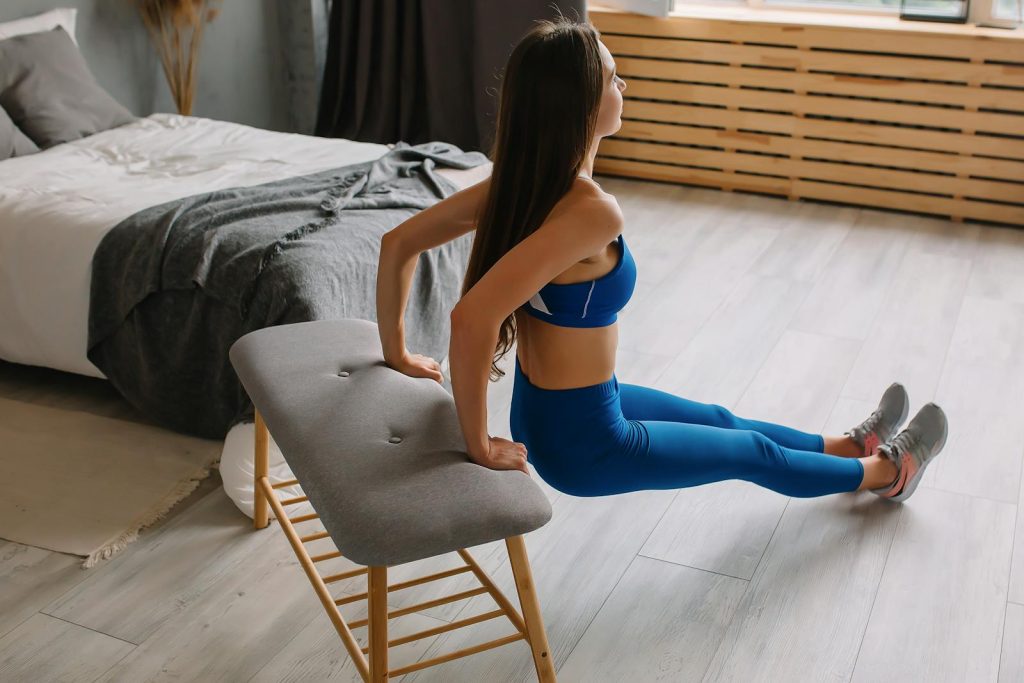
This guide breaks down the best no-equipment tricep exercises, how to do them correctly, common mistakes to avoid, and how to build a simple workout based on your current strength level.
What Muscles Do Bodyweight Tricep Exercises Work?
Bodyweight tricep exercises mainly target the triceps brachii, the large muscle on the back of the upper arm. The triceps has three heads: the long head, lateral head, and medial head. Its main role is elbow extension, which means straightening the arm against resistance.
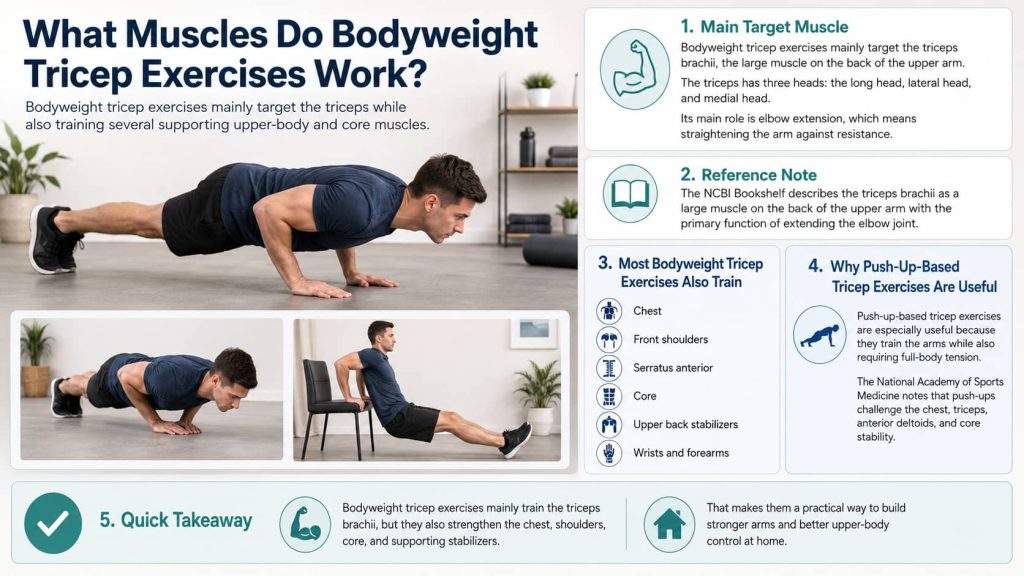
The NCBI Bookshelf describes the triceps brachii as a large muscle on the back of the upper arm with the primary function of extending the elbow joint.
Most bodyweight tricep exercises also train:
- Chest
- Front shoulders
- Serratus anterior
- Core
- Upper back stabilizers
- Wrists and forearms
Push-up-based tricep exercises are especially useful because they train the arms while also requiring full-body tension. The National Academy of Sports Medicine notes that push-ups challenge the chest, triceps, anterior deltoids, and core stability.
How to Choose the Right Bodyweight Tricep Exercises
Choose your exercise based on your current strength, wrist comfort, shoulder control, and ability to maintain good form.
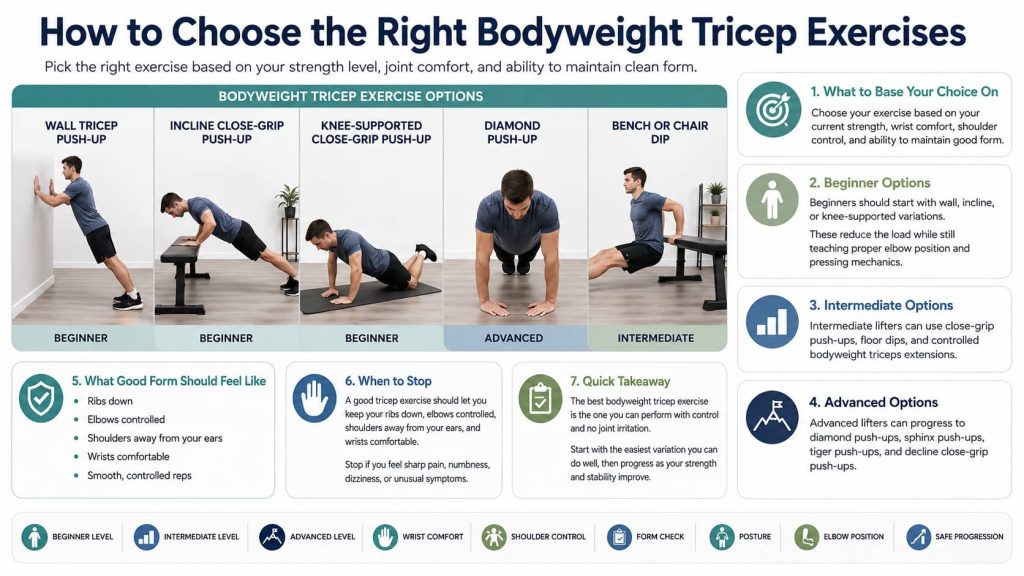
Beginners should start with wall, incline, or knee-supported variations. These reduce the load while still teaching proper elbow position and pressing mechanics.
Intermediate lifters can use close-grip push-ups, floor dips, and controlled bodyweight triceps extensions.
Advanced lifters can progress to diamond push-ups, sphinx push-ups, tiger push-ups, and decline close-grip push-ups.
A good tricep exercise should let you keep your ribs down, elbows controlled, shoulders away from your ears, and wrists comfortable. Stop if you feel sharp pain, numbness, dizziness, or unusual symptoms.
13 Best Bodyweight Tricep Exercises
Below are 13 effective bodyweight tricep exercises you can do at home to build stronger arms without weights. These moves target the triceps through push-up, dip, plank, and extension patterns while helping improve upper-body strength and control.
1. Wall Tricep Push-Up
Best for: Beginners, warm-ups, and learning elbow control
Muscles worked: Triceps, chest, front shoulders, core
Equipment needed: Wall
Why it stands out
The wall tricep push-up is the easiest way to start training your triceps with bodyweight. Because your body is upright, the load is lighter than a floor push-up, making it ideal for beginners or anyone rebuilding upper-body strength.
Suggested sets and reps
Do 2–3 sets of 10–15 reps.
How to do it
- Stand facing a wall with your hands at chest height.
- Place your hands close together, about shoulder-width or slightly narrower.
- Step your feet back so your body forms a straight line.
- Bend your elbows and lower your chest toward the wall.
- Keep your elbows close to your sides.
- Press through your palms and straighten your arms.
Common mistakes: Standing too close to the wall, flaring the elbows, shrugging the shoulders, or letting the hips sag.
Coaching cue: Think about pushing the wall away while keeping your elbows pointed down and back.
Exercise variations
Make it easier by standing closer to the wall. Make it harder by stepping farther back or using a lower surface.
How to use in a workout: Use it as a beginner strength move or as a warm-up before harder push-up variations.
2. Incline Close-Grip Push-Up
Best for: Beginners moving toward floor push-ups
Muscles worked: Triceps, chest, front shoulders, core
Equipment needed: Bench, sturdy chair, countertop, or table
Why it stands out
The incline close-grip push-up lets you train the triceps with more resistance than a wall push-up but less than a floor push-up. The elevated hand position makes it easier to control your body line and elbow angle.
Suggested sets and reps
Do 3 sets of 8–12 reps.
How to do it
- Place your hands on a sturdy elevated surface.
- Position your hands close to shoulder-width.
- Step your feet back until your body forms a straight line.
- Brace your core and squeeze your glutes lightly.
- Lower your chest toward the surface with elbows close to your ribs.
- Press back up until your arms are straight.
Common mistakes: Letting the elbows flare wide, dropping the hips, craning the neck, or using an unstable surface.
Coaching cue: Keep your body moving as one unit from head to heels.
Exercise variations
Use a higher surface to make it easier. Use a lower surface to make it harder.
How to use in a workout: Use this as your main tricep exercise if full floor push-ups are too difficult.
3. Knee Close-Grip Push-Up
Best for: Building floor pressing strength
Muscles worked: Triceps, chest, front shoulders, core
Equipment needed: Exercise mat optional
Why it stands out
The knee close-grip push-up bridges the gap between incline push-ups and full close-grip push-ups. It keeps the movement on the floor while reducing the load your arms have to press.
Suggested sets and reps
Do 2–4 sets of 6–12 reps.
How to do it
- Start in a kneeling push-up position.
- Place your hands under your shoulders or slightly narrower.
- Keep your body straight from shoulders to knees.
- Bend your elbows and lower your chest toward the floor.
- Keep your elbows close to your sides.
- Press back up with control.
Common mistakes: Bending at the hips, dropping the head, letting the elbows flare, or stopping halfway without control.
Coaching cue: Lower your chest between your hands, not your face.
Exercise variations
Make it easier by using a slightly wider hand position. Make it harder by pausing at the bottom.
How to use in a workout: Use it after incline push-ups or as a finisher after harder tricep work.
4. Close-Grip Push-Up
Best for: Intermediate tricep strength
Muscles worked: Triceps, chest, front shoulders, serratus anterior, core
Equipment needed: None
Why it stands out
The close-grip push-up is one of the most practical bodyweight tricep exercises because it requires no equipment and can be progressed easily. Keeping the hands closer than a standard push-up increases the demand on the triceps.
Suggested sets and reps
Do 3–4 sets of 6–12 reps.
How to do it
- Start in a high plank position.
- Place your hands under your shoulders or slightly inside shoulder-width.
- Brace your abs and keep your legs straight.
- Lower your chest toward the floor.
- Keep your elbows tracking close to your ribs.
- Press up until your elbows are fully extended.
Common mistakes: Flaring the elbows, sagging the hips, shortening the range of motion, or rushing reps.
Coaching cue: Keep your elbows tucked like you are trying to brush your arms against your ribs.
Exercise variations
Use knees for a regression. Add a slow lowering phase for a progression.
How to use in a workout: Use it as a main strength movement early in your workout.
5. Diamond Push-Up
Best for: Advanced tricep activation
Muscles worked: Triceps, chest, front shoulders, core
Equipment needed: None
Why it stands out
The diamond push-up, also called the triangle push-up, is one of the most tricep-focused bodyweight exercises. In an ACE-sponsored study, the American Council on Exercise reported that triangle push-ups produced the highest triceps muscle activity among the exercises tested.
Suggested sets and reps
Do 3–4 sets of 5–10 reps.
How to do it
- Start in a high plank.
- Bring your hands close together under your chest.
- Form a diamond or triangle shape with your thumbs and index fingers if comfortable.
- Lower your chest toward your hands.
- Keep your elbows angled back, not straight out to the sides.
- Press the floor away and return to the starting position.
Common mistakes: Forcing the hands into a painful diamond shape, flaring the elbows, collapsing the shoulders, or losing core tension.
Coaching cue: The hands do not have to touch if that bothers your wrists. Keep them close enough to challenge your triceps while staying pain-free.
Exercise variations
Do diamond push-ups from the knees to make them easier. Add a 2–3 second lowering phase to make them harder.
How to use in a workout: Use it after close-grip push-ups or as your main advanced tricep movement.
6. Floor Tricep Dip
Best for: Beginners learning dip mechanics
Muscles worked: Triceps, shoulders, chest
Equipment needed: None
Why it stands out
The floor tricep dip is a beginner-friendly dip variation because the floor limits how far your shoulders can move. This can make it easier to control than bench dips.
Suggested sets and reps
Do 2–3 sets of 10–15 reps.
How to do it
- Sit on the floor with your knees bent.
- Place your hands behind your hips with fingers pointing forward or slightly outward.
- Lift your hips slightly off the floor.
- Bend your elbows and lower your hips toward the floor.
- Keep your chest open and shoulders away from your ears.
- Press through your palms to straighten your elbows.
Common mistakes: Letting the shoulders roll forward, shrugging, using only the hips instead of bending the elbows, or rushing.
Coaching cue: Think “bend and straighten the elbows” rather than bouncing your hips.
Exercise variations
Keep your feet closer to make it easier. Walk your feet farther away to make it harder.
How to use in a workout: Use it as a low-impact tricep finisher or beginner accessory exercise.
7. Bench or Chair Tricep Dip
Best for: Intermediate bodyweight tricep training
Muscles worked: Triceps, chest, front shoulders
Equipment needed: Stable bench, chair, or step
Why it stands out
Bench dips can train the triceps effectively with minimal equipment. They are easy to do at home, but they require good shoulder control and a stable setup.
Suggested sets and reps
Do 3 sets of 8–12 reps.
How to do it
- Sit on the edge of a sturdy chair or bench.
- Place your hands beside your hips.
- Walk your feet forward and move your hips just off the edge.
- Bend your elbows and lower your body under control.
- Stop before your shoulders roll forward or feel strained.
- Press through your hands to return to the top.
Common mistakes: Going too deep, letting the shoulders glide forward, using a wobbly chair, or locking out aggressively.
Coaching cue: Keep your chest open and lower only as far as your shoulders feel comfortable.
Exercise variations
Keep knees bent for an easier version. Straighten the legs to increase difficulty.
How to use in a workout: Use it after push-up variations or as part of a home arm circuit.
8. Bodyweight Triceps Extension
Best for: Training the triceps through a longer range
Muscles worked: Triceps, shoulders, core, chest
Equipment needed: Table, countertop, bench, bar, or sturdy elevated surface
Why it stands out
The bodyweight triceps extension mimics the feel of a skull crusher or cable triceps extension without weights. Because the elbows bend deeply, it can create a strong tricep challenge when done with control.
Suggested sets and reps
Do 3–4 sets of 6–12 reps.
How to do it
- Place your hands on a sturdy surface about shoulder-width apart.
- Step your feet back so your body forms a straight line.
- Keep your elbows pointing forward.
- Bend your elbows and lower your forehead toward your hands.
- Keep your core tight and shoulders stable.
- Extend your elbows to push your body back to the start.
Common mistakes: Letting the elbows flare, bending at the hips, dropping the head, or choosing a surface that is too low too soon.
Coaching cue: Move from the elbows, not the shoulders or lower back.
Exercise variations
Use a higher surface to make it easier. Use a lower surface to make it harder.
How to use in a workout: Use it as your main tricep isolation-style bodyweight movement.
9. Sphinx Push-Up
Best for: Intermediate tricep endurance and elbow extension strength
Muscles worked: Triceps, chest, shoulders, core
Equipment needed: Exercise mat optional
Why it stands out
The sphinx push-up starts from a forearm plank and finishes in a high plank. It strongly challenges the triceps because you must extend the elbows while keeping your torso stable.
Suggested sets and reps
Do 3 sets of 6–10 reps.
How to do it
- Start in a forearm plank.
- Keep your elbows under your shoulders.
- Brace your core and squeeze your glutes.
- Press your palms into the floor.
- Straighten your elbows to lift into a high plank.
- Lower back to your forearms with control.
Common mistakes: Letting the hips sag, pressing unevenly, shrugging the shoulders, or rushing the lowering phase.
Coaching cue: Push the floor away while keeping your ribs pulled down.
Exercise variations
Do it from the knees to make it easier. Add a slow negative to make it harder.
How to use in a workout: Use it in a tricep and core circuit.
10. Plank-to-Triceps Push-Up
Best for: Triceps, core control, and shoulder stability
Muscles worked: Triceps, shoulders, chest, abs, serratus anterior
Equipment needed: None
Why it stands out
This exercise combines plank strength with tricep pressing. It trains each arm to press from the floor while your core resists rotation.
Suggested sets and reps
Do 2–3 sets of 6–10 reps per side.
How to do it
- Start in a forearm plank.
- Place one palm on the floor under your shoulder.
- Press that arm straight.
- Place the other palm down and press into a high plank.
- Lower one forearm back to the floor.
- Alternate the lead arm each rep.
Common mistakes: Rocking the hips, placing the hands too far forward, rushing, or letting the shoulders shrug.
Coaching cue: Keep your hips as still as possible while your arms do the work.
Exercise variations
Widen your feet to make it easier. Bring your feet closer to increase the core challenge.
How to use in a workout: Use it as a tricep and core accessory after your main pressing exercise.
11. Tiger Push-Up
Best for: Advanced tricep strength
Muscles worked: Triceps, chest, shoulders, core
Equipment needed: Exercise mat optional
Why it stands out
The tiger push-up is a demanding push-up variation that moves between a forearm-loaded position and a push-up position. It places a strong challenge on the triceps and requires excellent body control.
Suggested sets and reps
Do 3 sets of 4–8 reps.
How to do it
- Start in a high plank.
- Lower your body toward the floor.
- Shift your weight back slightly as your forearms move toward the floor.
- Keep your elbows close and core tight.
- Press through your palms and extend your elbows.
- Return to the starting plank position.
Common mistakes: Collapsing onto the forearms, losing core tension, flaring the elbows, or forcing the movement before you are ready.
Coaching cue: Treat each rep like a slow, controlled press instead of a drop-and-push movement.
Exercise variations
Start with sphinx push-ups first. Progress to full tiger push-ups only when you can control the transition.
How to use in a workout: Use it as an advanced strength move early in your session.
12. Close-Grip Decline Push-Up
Best for: Advanced home tricep and shoulder strength
Muscles worked: Triceps, upper chest, shoulders, core
Equipment needed: Step, chair, or bench
Why it stands out
Elevating your feet increases the challenge by shifting more load toward the upper body. Using a close-grip position makes the triceps work harder than in a standard decline push-up.
Suggested sets and reps
Do 3–4 sets of 5–10 reps.
How to do it
- Place your feet on a stable elevated surface.
- Set your hands under your shoulders or slightly narrower.
- Brace your core and keep your body straight.
- Lower your chest toward the floor.
- Keep your elbows close to your sides.
- Press back up without letting your hips sag.
Common mistakes: Choosing a surface that is too high, arching the lower back, flaring the elbows, or lowering the head instead of the chest.
Coaching cue: Keep your body in one strong line from shoulders to heels.
Exercise variations
Use a lower step to make it easier. Add a pause near the bottom to make it harder.
How to use in a workout: Use it as a main advanced pressing exercise.
13. Assisted Straight-Bar or Table Triceps Extension
Best for: Home tricep training with adjustable difficulty
Muscles worked: Triceps, shoulders, chest, core
Equipment needed: Sturdy table, railing, straight bar, or countertop
Why it stands out
This exercise lets you adjust difficulty by changing your body angle. The more upright you stand, the easier it becomes. The farther your feet step back, the harder it gets.
Suggested sets and reps
Do 3 sets of 8–15 reps.
How to do it
- Hold a sturdy edge, bar, or table with both hands.
- Step your feet back and lean forward slightly.
- Keep your body straight and elbows pointing forward.
- Bend your elbows and lower your head toward your hands.
- Pause briefly when you feel your triceps working.
- Extend your elbows to press yourself back up.
Common mistakes: Using an unstable surface, letting elbows flare, bending at the waist, or turning it into a chest push-up.
Coaching cue: Keep your elbows fixed in place and only bend and straighten them.
Exercise variations
Stand more upright to make it easier. Step farther back to make it harder.
How to use in a workout: Use it as a high-rep tricep builder or finisher.
Beginner Bodyweight Tricep Workout at Home
Use this if you are new to upper-body training or still building toward full push-ups.
| Exercise | Sets | Reps |
|---|---|---|
| Wall Tricep Push-Up | 2–3 | 10–15 |
| Incline Close-Grip Push-Up | 2–3 | 8–12 |
| Floor Tricep Dip | 2–3 | 10–15 |
| Assisted Table Triceps Extension | 2 | 8–12 |
Rest 45–75 seconds between sets. Focus on smooth reps and good elbow position.
Intermediate Bodyweight Tricep Workout
Use this if you can do regular push-ups with control.
| Exercise | Sets | Reps |
|---|---|---|
| Close-Grip Push-Up | 3–4 | 6–12 |
| Bench or Chair Tricep Dip | 3 | 8–12 |
| Bodyweight Triceps Extension | 3 | 8–12 |
| Plank-to-Triceps Push-Up | 2–3 | 6–10 per side |
Rest 60–90 seconds between sets. Keep 1–2 reps in reserve on most sets.
Advanced Bodyweight Tricep Workout
Use this if you already have strong push-up mechanics and good shoulder control.
| Exercise | Sets | Reps |
|---|---|---|
| Diamond Push-Up | 3–4 | 5–10 |
| Close-Grip Decline Push-Up | 3–4 | 5–10 |
| Sphinx Push-Up | 3 | 6–10 |
| Tiger Push-Up | 2–3 | 4–8 |
Rest 90–120 seconds between hard sets. Prioritize control over speed.
How Often Should You Train Triceps With Bodyweight Exercises?
Most people can train triceps 2–3 times per week as part of a balanced upper-body routine. If your workouts include push-ups, dips, planks, and shoulder exercises, your triceps may already be getting a lot of work.
The Centers for Disease Control and Prevention recommends muscle-strengthening activities on 2 or more days per week that work all major muscle groups, including the arms.
A simple weekly plan could look like this:
- Monday: Chest, shoulders, and triceps
- Wednesday: Back, biceps, and core
- Friday: Full upper-body bodyweight workout
Give your elbows and shoulders time to recover between hard pressing sessions. If your joints feel irritated, reduce volume, choose easier variations, or use a higher incline.
Common Mistakes to Avoid
Letting the Elbows Flare Too Wide
When the elbows flare straight out to the sides, the movement often shifts away from the triceps and may feel less stable on the shoulders. Keep your elbows angled back and close to your body.
Going Too Deep on Dips
Dips are useful, but deeper is not always better. Lower only as far as you can control without shoulder discomfort or forward shoulder rolling.
Losing Core Tension
Tricep push-up variations are still full-body exercises. Brace your core, keep your ribs down, and avoid letting your hips sag.
Using Exercises That Are Too Advanced
Diamond push-ups, tiger push-ups, and decline close-grip push-ups are effective, but they are not beginner moves. Start with easier variations and progress gradually.
Rushing Every Rep
Fast reps often reduce tension on the triceps. Use a controlled lowering phase, press with intent, and finish each rep with the elbows straight but not slammed into lockout.
How to Progress Bodyweight Tricep Exercises
You can make bodyweight tricep exercises harder without adding weights.
Try these progression methods:
- Lower your hand position from wall to incline to floor.
- Move from knee push-ups to full push-ups.
- Use a closer hand position.
- Add a 2–4 second lowering phase.
- Pause near the bottom.
- Add more total sets.
- Use harder variations like diamond push-ups or sphinx push-ups.
- Elevate your feet for decline close-grip push-ups.
Progress only when you can complete your current version with clean form and no joint discomfort.
FAQs
Are bodyweight tricep exercises enough to build stronger arms?
Yes, bodyweight tricep exercises can build stronger arms if you choose challenging variations, train consistently, and progress over time. Beginners may build strength with wall or incline push-ups, while advanced lifters may need harder options like diamond push-ups, sphinx push-ups, and decline close-grip push-ups.
What is the best bodyweight exercise for triceps?
The diamond push-up is one of the best bodyweight tricep exercises because it strongly emphasizes elbow extension. However, the best exercise for you depends on your level. Beginners may get better results from incline close-grip push-ups because they can perform them with cleaner form.
Can I train triceps at home without equipment?
Yes. Close-grip push-ups, diamond push-ups, floor dips, sphinx push-ups, and plank-to-triceps push-ups require no equipment. A chair, bench, table, or countertop can also expand your options.
How many bodyweight tricep exercises should I do in one workout?
Most people only need 3–4 tricep-focused exercises in one workout. Choose one push-up variation, one dip or extension variation, and one finisher. More exercises are not always better if your form breaks down.
Why do my wrists hurt during tricep push-ups?
Wrist discomfort can happen if your hands are too narrow, your wrists lack tolerance for loaded extension, or you force a diamond hand shape. Try a slightly wider hand position, use an incline surface, or do tricep extensions on a stable edge instead.
Are dips safe for triceps?
Dips can be useful when performed with control, but they are not ideal for everyone. Avoid going too deep, keep your shoulders down and back, and stop if you feel shoulder pain or pinching.
Should I do bodyweight tricep exercises every day?
Daily hard tricep training is usually unnecessary. Your triceps need recovery to get stronger. Training them 2–3 times per week works well for most people.
Conclusion
Bodyweight tricep exercises are a simple and effective way to build stronger arms at home. Start with a variation you can control, keep your elbows close, use a full but comfortable range of motion, and progress gradually.
Choose 3–5 exercises from this list, match them to your strength level, and build a consistent routine you can repeat each week.
References
- NCBI Bookshelf: Anatomy, Shoulder and Upper Limb, Triceps Muscle
- Functions of the Triceps Brachii in Humans: A Review
- The Different Role of Each Head of the Triceps Brachii Muscle in Elbow Extension
- NASM: Push-Up Exercise Guide
- NASM: Exploring Proper Push-Up Form and Technique
- American Council on Exercise: ACE Study Identifies Best Triceps Exercises