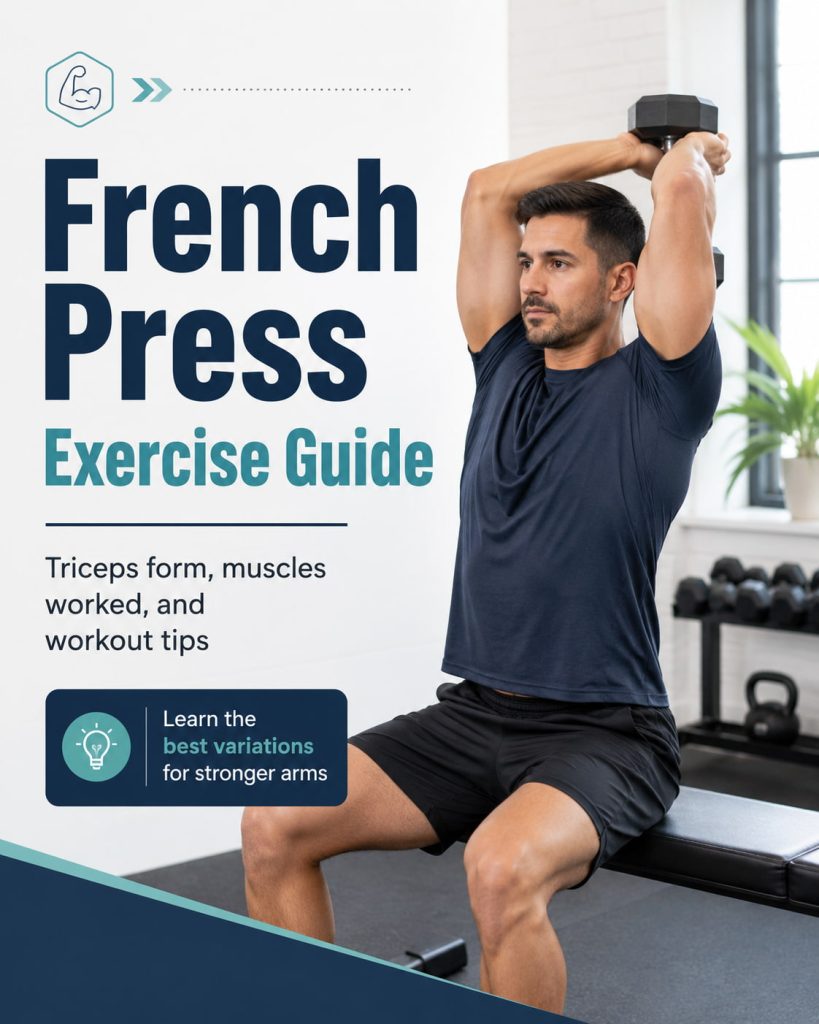
The French press exercise is an overhead triceps extension used to build stronger arms by training elbow extension through a deep, controlled range of motion. It mainly targets the triceps, especially the long head, and can be performed with an EZ bar, dumbbell, barbell, or cable.
In this guide, you will learn how to do the French press exercise with proper form, which muscles it works, the main benefits, common mistakes, the best variations, and how to program it into a real workout.
What Is the French Press Exercise?
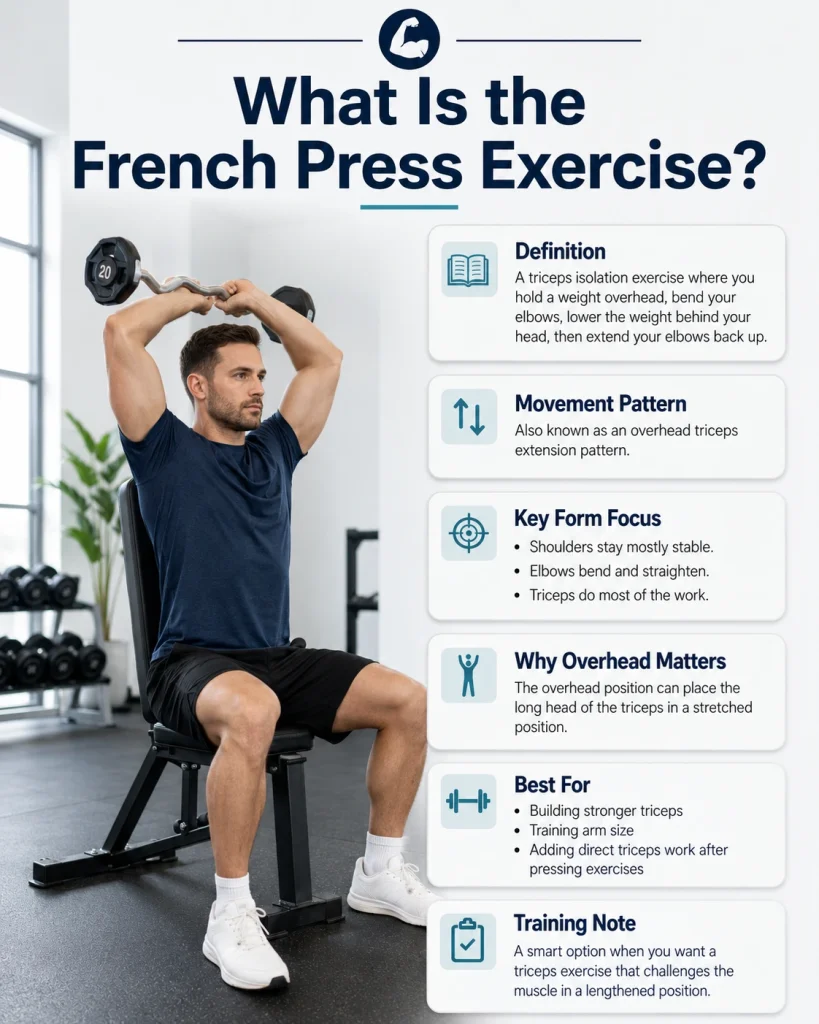
The French press exercise is a triceps isolation movement where you hold a weight overhead, bend your elbows to lower the weight behind your head, then extend your elbows to lift it back up.
It is often grouped with overhead triceps extensions because the movement pattern is the same: the shoulders stay mostly stable while the elbows bend and straighten. Unlike close-grip bench presses or dips, the French press does not rely heavily on the chest. The goal is to make the triceps do most of the work.
The overhead position is important. Since the long head of the triceps crosses the shoulder joint, raising the arms overhead places that part of the muscle in a stretched position. A PubMed-listed study on triceps training found greater triceps growth after overhead cable elbow-extension training compared with elbow-extension training in a neutral arm position.
That does not mean the French press is the only triceps exercise you need. It means it can be a smart choice when you want a triceps movement that challenges the muscle in a lengthened position.
French Press Exercise Muscles Worked
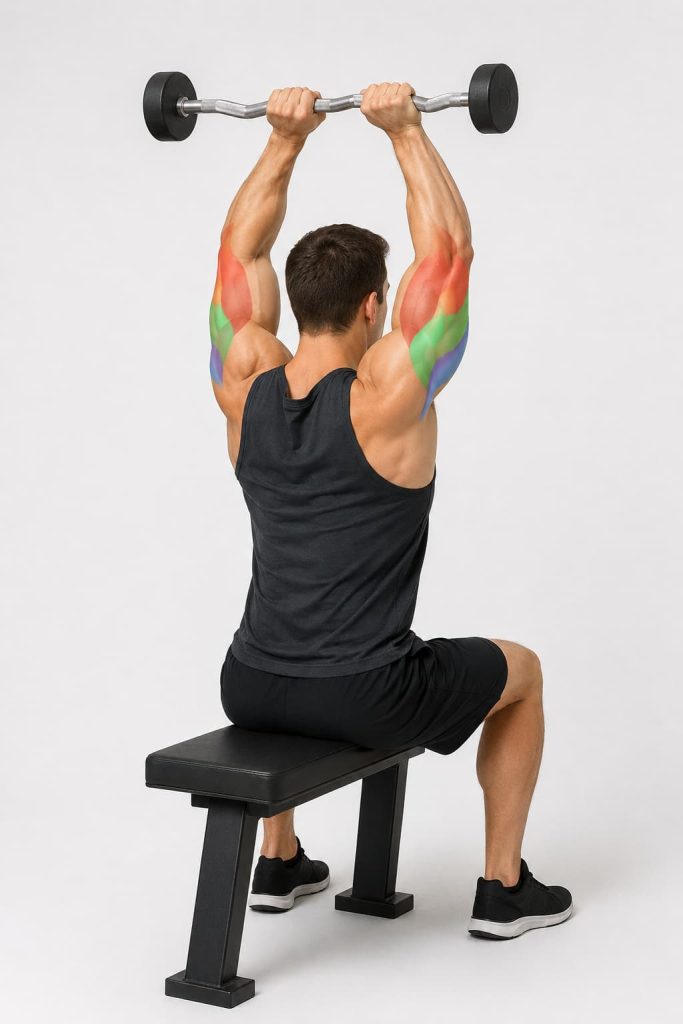
The French press exercise mainly works the triceps brachii, the large muscle on the back of the upper arm. According to NCBI Bookshelf anatomy information, the triceps brachii has three heads and its primary function is elbow extension.
Triceps Brachii
The triceps are the main target. They straighten the elbow at the top of every rep and control the lowering phase as the weight moves behind your head.
Long Head of the Triceps
The long head is especially important in the French press because your arms are overhead. This position places the long head under a strong stretch, which is one reason overhead triceps work is popular for arm-building programs.
Lateral Head of the Triceps
The lateral head contributes to elbow extension and helps create the outer “horseshoe” look of the upper arm. It works throughout the press, especially as you lock the elbows out under control.
Medial Head of the Triceps
The medial head assists with elbow extension and helps stabilize the movement. It may not be as visible as the other heads, but it plays an important role in controlled reps.
Supporting Muscles
Your shoulders, upper back, forearms, grip, and core help stabilize the weight. They should support the movement, not take over. If your shoulders are moving a lot or your lower back is arching hard, the weight is probably too heavy or your setup needs adjusting.
Benefits of the French Press Exercise
1. Builds Stronger Triceps
The French press directly trains elbow extension, which is the main job of the triceps. Stronger triceps can support pressing exercises such as bench presses, overhead presses, push-ups, and dips.
2. Trains the Triceps in a Stretched Position
Because the weight lowers behind your head, the triceps work through a deep range of motion. This can make the French press useful for lifters who already do pushdowns and want a different triceps stimulus.
3. Helps Target the Long Head
The long head of the triceps crosses the shoulder, so overhead triceps work gives it a different challenge than exercises performed with the arms by your sides. This makes the French press a useful addition to a balanced arm-training plan.
4. Works With Several Equipment Options
You can perform the French press with an EZ bar, dumbbell, barbell, cable, or resistance band. That makes it easy to adjust based on your equipment, wrist comfort, shoulder mobility, and training level.
5. Easy to Add After Pressing Work
The French press works well as an accessory exercise after heavier upper-body lifts. You can place it after bench presses, shoulder presses, push-ups, or dips when your main goal is to add more direct triceps work.
French Press Exercise Form Guide
Equipment needed: You can use an EZ bar, dumbbell, straight barbell, cable rope, or resistance band. The EZ bar is often the most wrist-friendly free-weight option.
Suggested sets and reps: For most lifters, use 2 to 4 sets of 8 to 15 reps. Beginners can start with 2 sets of 10 to 15 reps. Intermediate and advanced lifters can use 3 to 5 sets depending on the rest of the workout.
Beginners: Start with a light dumbbell, EZ bar, or cable rope. Use a controlled range of motion and stop each set with 2 to 3 reps in reserve. Do not chase a deep stretch if your shoulders or elbows feel uncomfortable.
Intermediate: Use 3 to 4 working sets and focus on clean reps. Add load only when your elbows stay controlled, your ribs stay down, and you can lower the weight without rushing.
Advanced: Use slower eccentrics, a short pause in the stretched position, or cable tension to increase difficulty. Advanced lifters can train closer to failure, but form should stay strict.
Rest: Rest 60 to 120 seconds between sets. Use shorter rest for lighter pump work and longer rest when using heavier loads.
How to do it:
- Hold an EZ bar, dumbbell, or cable attachment with a secure grip.
- Bring the weight overhead with your arms extended.
- Stand or sit tall with your ribs down, core braced, and shoulders controlled.
- Keep your upper arms mostly fixed and point your elbows forward or slightly inward.
- Bend your elbows and lower the weight behind your head under control.
- Stop when you feel a strong triceps stretch without shoulder or elbow discomfort.
- Extend your elbows to press the weight back overhead.
- Squeeze the triceps at the top without aggressively snapping the elbows.
- Repeat for the target reps while keeping the torso still.
Common mistakes: The most common mistakes are flaring the elbows too wide, arching the lower back, using too much weight, letting the shoulders move excessively, rushing the lowering phase, bending the wrists backward, and locking out too hard at the top.
Expert tip: Think “bend the elbows, not the shoulders.” Your upper arms should stay mostly in place while your forearms move.
Exercise variations: The main variations are the EZ bar French press, dumbbell French press, seated French press, cable French press, single-arm French press, and lying French press.
Easier variation: Use a single dumbbell held with both hands or a cable rope with light weight. Both options are easier to control than a heavy straight bar.
Harder variation: Use a slow 3-second lowering phase, add a pause near the bottom, or perform the cable French press to keep constant tension on the triceps.
Common French Press Exercise Mistakes
Letting the Elbows Flare Too Wide
A little elbow movement is normal, but excessive flaring shifts tension away from the triceps and can make the lift feel less stable. Keep your elbows pointed mostly forward instead of letting them drift out to the sides.
Using Too Much Weight
The French press is not a max-strength lift. If the weight is too heavy, you will usually compensate by arching your back, moving your shoulders, shortening the range of motion, or bouncing out of the bottom. Choose a load you can control for every rep.
Arching the Lower Back
Many lifters turn the French press into a full-body lean-back movement. Keep your ribs down, brace your core, and squeeze your glutes lightly if standing. If you still arch too much, try the seated version.
Dropping Too Deep Too Soon
A deep range of motion can be useful, but only if your shoulders and elbows tolerate it. Lower until you feel a strong triceps stretch, not until your joints feel strained.
Moving the Shoulders Instead of the Elbows
The French press should be driven by elbow flexion and extension. If your upper arms swing forward and backward on every rep, reduce the weight and slow down.
Rushing the Eccentric
The lowering phase builds control. Lower the weight slowly for about 2 to 3 seconds, then press up smoothly. Avoid bouncing at the bottom.
Best French Press Exercise Variations
EZ Bar French Press
The EZ bar French press is one of the most common versions. The angled grip can feel more comfortable on the wrists than a straight bar.
Use this version if you want a balanced free-weight option that is easier to load than a single dumbbell. Keep the elbows controlled and lower the bar behind your head instead of straight down onto the top of your skull.
Dumbbell French Press
The dumbbell French press is beginner-friendly because it allows a simple two-hand grip. Hold one dumbbell vertically with both hands around the inside of the top plate.
This version is useful if you train at home or do not have an EZ bar. It also allows the elbows to find a more natural path.
Seated French Press
The seated French press reduces lower-body movement and may help you keep your torso more stable. Sit tall on a bench with your feet planted and your ribs down.
This is a good choice if you tend to lean back during the standing version. You can use a dumbbell, EZ bar, or cable.
Cable French Press
The cable French press keeps tension on the triceps throughout the movement. It is often performed with a rope attachment and a low cable setup.
The ACE Fitness triceps extension guide gives useful setup cues for overhead dumbbell triceps extension, including stable posture, controlled elbow movement, and avoiding excessive torso movement. Those same principles apply well to cable overhead extension variations.
Single-Arm French Press
The single-arm version lets you train each side separately. It can help you notice strength differences between arms and may feel smoother for some shoulders.
Use lighter weight and move slowly. Keep the elbow stacked and avoid twisting your torso.
Lying French Press
The lying French press is similar to a skull crusher, but the weight usually travels slightly behind the head instead of straight toward the forehead. This can create a stronger triceps stretch.
Use this version carefully. Start light and keep the shoulders stable.
French Press Exercise Sets Reps and Programming
The French press works best as an accessory exercise, not the first heavy lift of the session. Place it after compound pressing movements or in the middle of an arm workout.
For muscle growth, NASM hypertrophy guidance commonly uses moderate-to-hard sets in the 6 to 12 rep range, with higher reps also useful depending on the person and exercise. For the French press, many lifters do best in the 8 to 15 rep range because it is easier on the elbows than very heavy low-rep work.
Beginner Programming
Do 2 to 3 sets of 10 to 15 reps. Rest 60 to 90 seconds. Use a light dumbbell, EZ bar, or cable rope. Focus on learning the movement before adding weight.
Intermediate Programming
Do 3 to 4 sets of 8 to 12 reps. Rest 90 to 120 seconds. Use a controlled tempo and stop most sets with 1 to 3 reps in reserve.
Advanced Programming
Do 3 to 5 sets of 6 to 12 reps or 10 to 15 reps. Rest 90 to 120 seconds. Use slower eccentrics, pauses, or cable tension instead of simply chasing heavier weight.
Weekly Frequency
Train the French press 1 to 2 times per week. The American College of Sports Medicine emphasizes training major muscle groups at least twice weekly as part of a consistent resistance-training plan. For triceps, that weekly work can come from presses, push-ups, dips, pushdowns, and overhead extensions.
French Press Exercise Progression
Progress slowly. The elbows usually do not respond well to sudden jumps in load on overhead triceps work.
A simple progression plan:
Start with a weight you can lift for 10 clean reps. Build up to 15 clean reps on all sets. Then increase the weight slightly and return to 8 to 10 reps. Repeat the process while keeping your elbows, wrists, and shoulders controlled.
You can also progress by slowing the lowering phase, adding a pause near the bottom, using a cable for constant tension, or adding one extra set.
Do not progress if your reps become sloppy. Better triceps training comes from clean tension, not from forcing heavier weights through poor form.
French Press vs Skull Crusher vs Triceps Pushdown
The French press, skull crusher, and triceps pushdown all train the triceps, but they feel different and fit different goals.
| Exercise | Arm position | Best use | Main advantage |
|---|---|---|---|
| French press | Overhead | Long-head triceps focus and deep stretch | Strong stretched-position challenge |
| Skull crusher | Lying, arms angled upward | Triceps strength and size | Easy to load with EZ bar or dumbbells |
| Triceps pushdown | Arms by sides | Joint-friendly triceps volume | Easy to control and beginner-friendly |
If your elbows or shoulders do not like the French press, use cable pushdowns or lighter cable overhead extensions. If you want complete triceps development, combine one overhead triceps exercise with one elbows-by-sides triceps exercise.
Sample French Press Triceps Workout
Use this after a push workout, upper-body workout, or arm day.
Beginner Triceps Finisher
Close-grip push-up: 2 sets of 8 to 12 reps
Dumbbell French press: 2 sets of 10 to 15 reps
Cable or band pushdown: 2 sets of 12 to 15 reps
Rest: 60 to 90 seconds between sets
Effort: Stop with 2 to 3 reps in reserve
Frequency: 1 to 2 times per week
Intermediate Arm Workout
Close-grip bench press: 3 sets of 6 to 8 reps
EZ bar French press: 3 sets of 8 to 12 reps
Cable rope pushdown: 3 sets of 10 to 15 reps
Single-arm overhead cable extension: 2 sets of 12 to 15 reps per side
Rest: 90 to 120 seconds on heavier sets and 60 to 90 seconds on isolation sets
Effort: Stop with 1 to 3 reps in reserve
Progression Advice
When you can complete the top end of the rep range on every set with clean form, increase the load slightly. If your elbows feel irritated, reduce the load, slow the tempo, shorten the range slightly, or switch to a cable variation.
Who Should Use the French Press Exercise?
The French press is useful for lifters who want more direct triceps work, better arm development, or stronger pressing support. It is especially helpful for people who already do pushdowns and want a triceps exercise that trains the muscle from an overhead position.
It may not be the best first choice for people with limited shoulder mobility, recurring elbow discomfort, or trouble controlling overhead positions. In those cases, cable pushdowns, close-grip push-ups, or light rope overhead extensions may be better starting points.
Safety Tips for the French Press Exercise
Use a weight you can control from the first rep to the last. Keep your ribs down, brace your core, and avoid forcing the elbows into a painful position.
Warm up before heavier sets. A few light pushdowns, band pressdowns, or easy overhead extensions can help prepare the elbows and shoulders.
Stop the exercise and seek professional help if you feel sharp pain, numbness, dizziness, chest pain, or unusual symptoms. Mild muscle effort is normal. Sharp joint pain is not something to push through.
FAQ
Is the French press exercise good for triceps?
Yes. The French press is a strong triceps exercise because it trains elbow extension and places the triceps in an overhead position. It is especially useful for targeting the long head of the triceps.
Is the French press the same as an overhead triceps extension?
They are very similar. The French press is commonly used as a name for an overhead triceps extension, especially when performed with an EZ bar, barbell, or dumbbell.
Is the French press better than triceps pushdowns?
Neither is automatically better. The French press trains the triceps overhead and may emphasize the long head more. Pushdowns are usually easier to learn and may feel more comfortable on the elbows. Many lifters benefit from using both.
Should I do the French press standing or seated?
Use the version you can control best. Standing requires more core stability. Seated can reduce body movement and help you focus on the triceps.
Why do my elbows hurt during the French press?
Elbow discomfort can happen if the weight is too heavy, the range of motion is too deep, the elbows flare too much, or you increase volume too quickly. Reduce the load, slow down, try a cable or dumbbell version, and stop if pain continues.
How many sets and reps should I do?
Most lifters do well with 2 to 4 sets of 8 to 15 reps. Beginners should start lighter and use higher reps to learn control. Advanced lifters can use heavier loads, but strict form matters more than weight.
Can beginners do the French press exercise?
Yes, but beginners should start with a light dumbbell or cable rope. The goal is to learn stable overhead positioning and controlled elbow movement before increasing weight.
Conclusion
The French press exercise is a practical triceps-building movement that trains the arms through a deep overhead range of motion. Use controlled form, keep the elbows stable, choose the variation that fits your joints and equipment, and progress gradually.
Start light, master the movement, then build volume and load over time. When used correctly, the French press can be a valuable part of a stronger, more complete upper-body workout.
This content is for informational purposes only and is not a substitute for professional medical advice.
References
- NCBI Bookshelf: Anatomy, Shoulder and Upper Limb, Triceps Muscle
- PubMed: Triceps Brachii Hypertrophy After Overhead Versus Neutral Arm Position Training
- European Journal of Sport Science: Triceps Brachii Hypertrophy Is Greater After Overhead Elbow Extension Training
- ACE Fitness: Triceps Extension Exercise Guide
- NASM: Defining Muscular Hypertrophy and Training Growth Best Practices