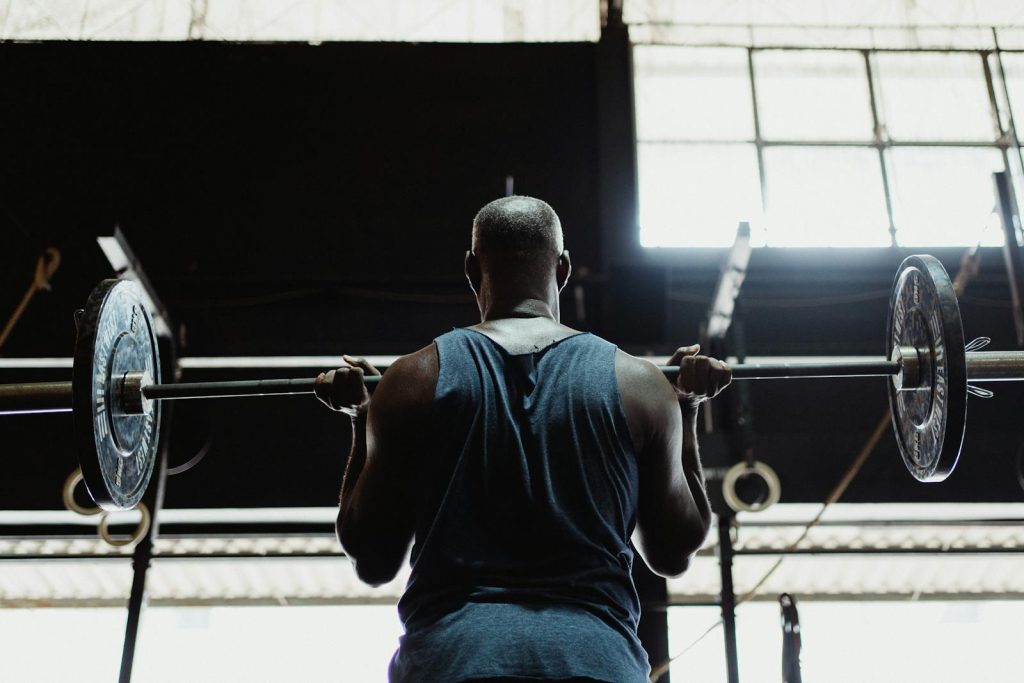
The barbell overhead press is a classic vertical pressing exercise used to build stronger shoulders, triceps, upper-back stability, and full-body bracing. It looks simple, but good technique matters because the bar has to travel overhead while your ribs, spine, wrists, elbows, and shoulders stay controlled.
In this guide, you’ll learn how to do the barbell overhead press with proper form, which muscles it works, why it belongs in a strength program, the most common mistakes to avoid, and how to progress it safely.
What Is the Barbell Overhead Press?
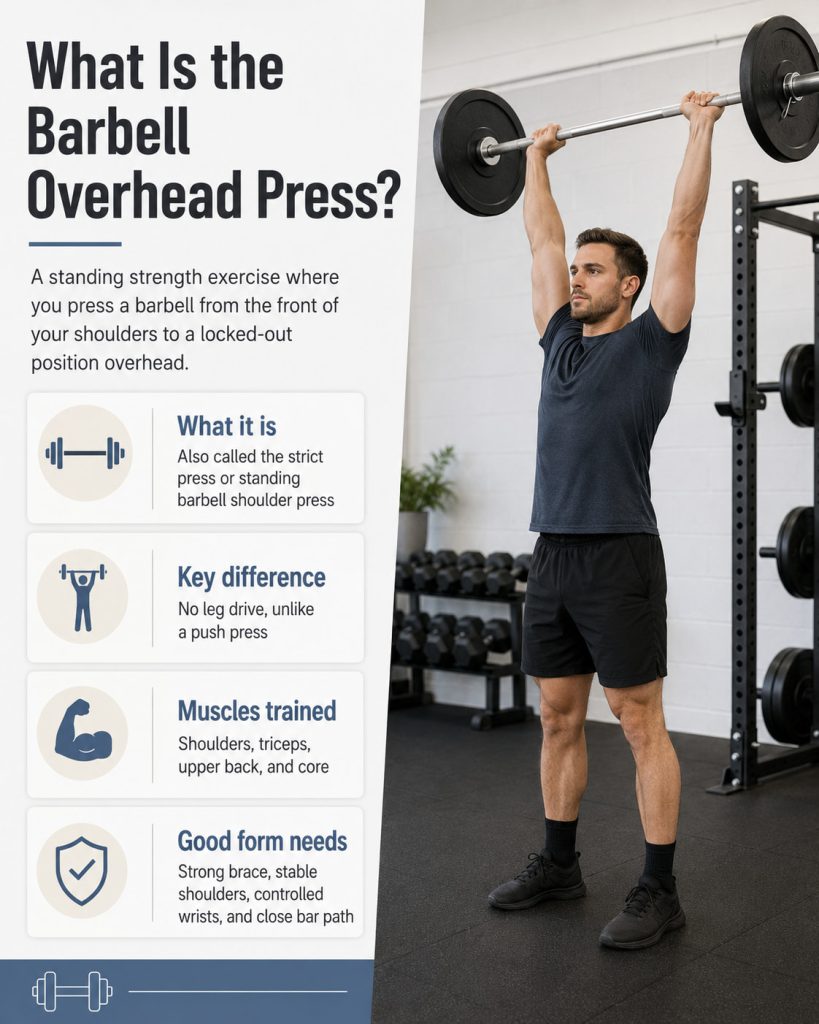
The barbell overhead press is a standing strength exercise where you press a barbell from the front of your shoulders to a locked-out position overhead.
It is also called the standing barbell shoulder press or strict press. Unlike a push press, the standard barbell overhead press does not use leg drive. Your legs stay still while your shoulders, triceps, upper back, and core do the work.
The exercise is useful because it trains more than shoulder strength. To press a barbell overhead well, you need a strong brace, stable shoulder blades, controlled wrists, and a bar path that stays close to your body.
The American Council on Exercise describes the standing shoulder press as a movement where the bar starts at the shoulders and is pressed directly overhead while maintaining a tall, stable posture.
Muscles Worked in the Barbell Overhead Press
The barbell overhead press mainly trains the shoulders and triceps, but it also challenges several supporting muscles that help stabilize the body under load.
Primary Muscles Worked
- Front deltoids: These do much of the work as you press the bar upward.
- Side deltoids: These assist with shoulder abduction and help build shoulder width.
- Triceps: The triceps extend the elbows and help finish the lockout.
- Upper chest: The upper portion of the chest assists during the early part of the press.
Supporting Muscles Worked
- Upper traps: Help support the shoulder blades as the bar moves overhead.
- Serratus anterior: Helps the shoulder blades rotate upward so the arms can reach overhead.
- Core muscles: The abs, obliques, and deep trunk muscles help prevent your lower back from overextending.
- Glutes: The glutes help keep the pelvis stable and reduce excessive lower-back arching.
- Forearms and grip muscles: These help keep the wrists and barbell controlled.
A study published in Frontiers in Physiology found that overhead pressing variations involve the deltoids, triceps, upper trapezius, and pectoralis major, with free-weight pressing requiring more stabilization than machine-based pressing.
Benefits of the Barbell Overhead Press
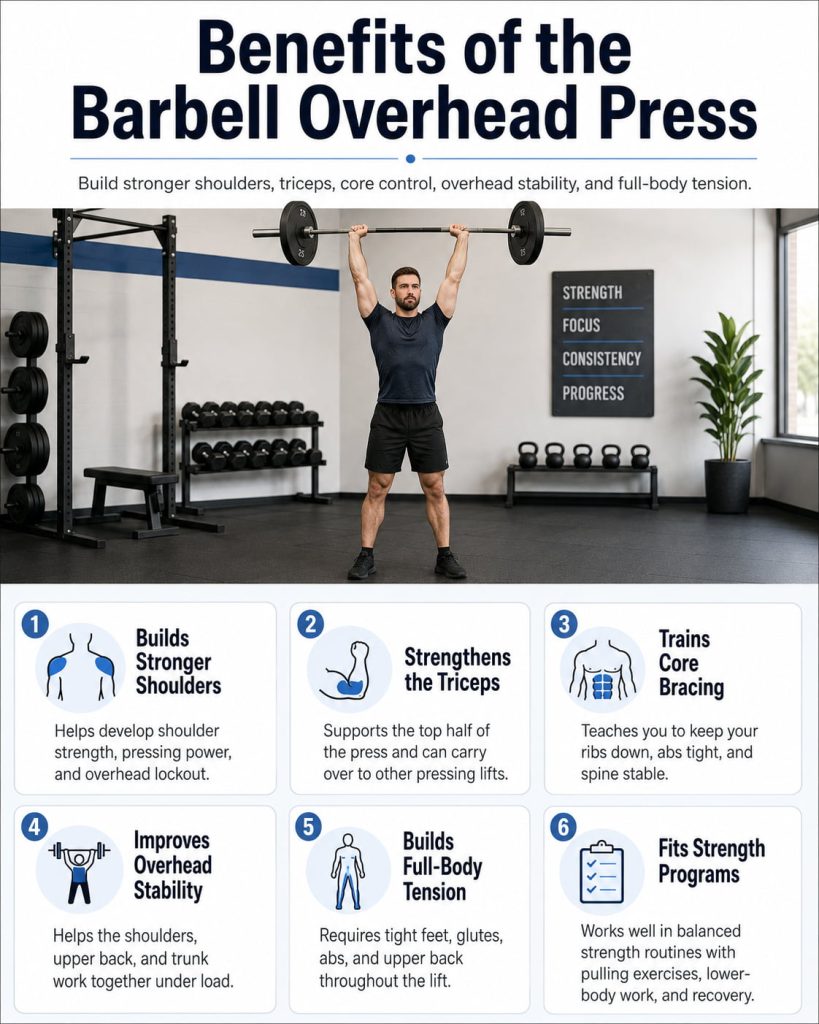
Builds Stronger Shoulders
The barbell overhead press is one of the most effective compound lifts for building shoulder strength. Because you press the bar overhead while standing, the movement trains the shoulders through a large range of motion and requires strong control from start to finish.
It is especially useful for lifters who want stronger front delts, better pressing power, and a stronger overhead lockout.
Strengthens the Triceps
Your triceps work hard during the second half of the press. If you often struggle to lock out pressing movements, the overhead press can help improve that top-end strength.
This can carry over to other lifts, including the bench press, close-grip bench press, push press, and dips.
Trains Core Bracing
A good overhead press is not just an upper-body exercise. Your core has to keep your ribs down and your spine stable as the bar moves overhead.
If your brace is weak, you may lean back too much, turn the lift into a standing incline press, or feel pressure in your lower back. Learning to brace properly makes the exercise safer and more effective.
Improves Overhead Stability
The barbell overhead press teaches your shoulders, upper back, and trunk to work together under load. This can be useful for athletes, lifters, and anyone who wants better control in overhead positions.
Overhead stability also matters for exercises like pull-ups, push presses, snatches, handstand work, loaded carries, and overhead holds.
Builds Practical Full-Body Tension
Although the barbell overhead press targets the upper body, your whole body must stay tight. Your feet press into the floor, glutes stay engaged, abs stay braced, and upper back stays active.
That full-body tension is one reason the strict press is harder than it looks.
Fits Well Into Strength Training Programs
The CDC recommends that adults include muscle-strengthening activity at least 2 days per week. The barbell overhead press can be part of a balanced strength plan when paired with pulling exercises, lower-body training, and enough recovery.
How to Do the Barbell Overhead Press With Proper Form
Best for: Building shoulder strength, triceps strength, overhead stability, and full-body bracing
How to do it
- Set a barbell in a rack around upper-chest or shoulder height.
- Grip the bar slightly wider than shoulder-width.
- Step under the bar so it rests across the front of your shoulders or upper chest.
- Keep your wrists stacked over your elbows as much as possible.
- Unrack the bar and take one or two small steps back.
- Stand with your feet about hip-width apart.
- Squeeze your glutes, brace your abs, and keep your ribs down.
- Start with your elbows slightly in front of the bar.
- Move your head slightly back as the bar passes your face.
- Press the bar upward in a close, nearly straight line.
- Once the bar clears your forehead, bring your head through slightly.
- Finish with the bar stacked over your shoulders, hips, and midfoot.
- Lower the bar with control back to the front of your shoulders.
- Reset your brace before the next rep.
Suggested sets and reps
- For beginners, start with 2–3 sets of 6–10 reps using a light weight.
- For muscle building, use 3–4 sets of 6–12 reps.
- For strength, use 3–5 sets of 3–6 reps.
Rest 1–3 minutes between sets depending on the load and your training goal.
Coaching cue:
Press the bar close to your face, then “push your head through the window” once the bar clears your forehead.
Common Barbell Overhead Press Mistakes
Leaning Back Too Much
A small amount of torso movement is normal, but excessive leaning turns the lift into a standing incline press. This usually happens when the weight is too heavy, the core is not braced, or the bar path is too far forward.
Fix it by squeezing your glutes, bracing your abs, and using a weight you can press without losing posture.
Pressing Around the Face Instead of Moving the Head
The bar should travel close to your body. If you press the bar around your face in a curved path, the lift becomes less efficient and harder to control.
Move your head slightly back as the bar passes, then bring it through under the bar at the top.
Letting the Elbows Flare Too Wide
If your elbows point straight out to the sides at the start, you may lose power and shoulder control. Start with the elbows slightly in front of the bar so your forearms can drive upward.
Using Too Much Weight Too Soon
The overhead press is usually weaker than the bench press. Many lifters add weight too quickly and compensate by leaning back, bending the knees, or cutting the range of motion short.
Start lighter than you think you need. Clean reps build better long-term strength.
Turning Every Rep Into a Push Press
A push press is a useful exercise, but it is not the same as a strict overhead press. If your knees bend and your legs drive the bar upward, you are no longer training the strict press the same way.
Keep your knees locked softly and your legs still unless you are intentionally doing a push press.
Losing the Lockout Position
At the top, the bar should be stacked over your shoulders and midfoot. If the bar finishes forward, your shoulders and lower back have to work harder to hold it.
Think about pressing up and slightly back once the bar clears your forehead.
Ignoring Shoulder Mobility
Some lifters cannot reach a strong overhead position without arching the lower back or pushing the bar forward. Tight lats, pecs, or limited shoulder flexion can make the lift harder to perform well.
The National Academy of Sports Medicine notes that tight pecs and lats can affect overhead position and may contribute to compensation patterns during pressing.
Barbell Overhead Press Form Checklist
Use this quick checklist before each set:
- Feet about hip-width apart
- Bar resting on the front shoulders or upper chest
- Grip slightly wider than shoulder-width
- Wrists stacked and controlled
- Elbows slightly in front of the bar
- Glutes squeezed
- Abs braced
- Ribs down
- Bar path close to the face
- Head moves back, then through
- Bar finishes over the midfoot
- Lower under control
If you cannot keep most of these points consistent, reduce the load or use a simpler variation.
Beginner Modifications for the Barbell Overhead Press
Empty-Bar Overhead Press
Start with the empty bar if you are new to the lift. This helps you learn the setup, bar path, breathing, and lockout position before adding weight.
If a standard 45-pound barbell is too heavy, use a lighter training bar or fixed-weight bar.
Seated Dumbbell Shoulder Press
The seated dumbbell shoulder press is a good option if you need a more beginner-friendly pressing variation. Dumbbells allow each arm to move more freely, and the seated position reduces some lower-body demands.
Use a bench with back support if you are still learning how to press without leaning back.
Landmine Press
The landmine press is one of the best alternatives for lifters who struggle with straight overhead pressing. The bar moves on an angled path, which can feel more comfortable for the shoulders.
It is also easier to control for beginners.
Half-Kneeling Dumbbell Press
This variation teaches core control and pressing mechanics at the same time. The half-kneeling position makes it harder to arch the lower back, so you have to brace and press with control.
Machine Shoulder Press
A machine shoulder press can help beginners build basic pressing strength. It does not require the same stabilization as a barbell, but it can still train the shoulders and triceps effectively.
Use it as a stepping stone, not a complete replacement, if your goal is to improve the barbell overhead press.
Progressions and Variations
Paused Barbell Overhead Press
Pause for 1–2 seconds at the shoulders before each rep. This removes momentum and improves starting strength.
It is useful if you struggle to press smoothly from the bottom position.
Tempo Overhead Press
Lower the bar slowly for 3–4 seconds, pause briefly, then press up with control. Tempo reps increase time under tension and help you feel where your form breaks down.
This is a good muscle-building and technique variation.
Seated Barbell Overhead Press
The seated barbell overhead press reduces lower-body involvement and increases the demand on your shoulders and triceps.
It can be useful for hypertrophy, but it still requires strong bracing and good shoulder mobility.
Push Press
The push press uses a small knee dip and leg drive to help press heavier weight overhead. It is a power-focused variation, not a strict press replacement.
Use it after you have already learned proper overhead pressing mechanics.
Pin Press
Set the bar on safety pins around chin, nose, or forehead height and press from a dead stop. This can help improve specific sticking points.
Use lighter weight at first because starting from pins can feel different from a normal press.
Dumbbell Overhead Press
Dumbbells allow a more natural arm path and can help balance strength between sides. They are also useful when you want a shoulder press variation that requires less technical setup than a barbell.
Behind-the-Neck Press
The behind-the-neck press is not the best default option for most lifters. It requires enough shoulder mobility, trunk stability, and control to press safely from behind the head.
A study in the Journal of Sport and Health Science found that behind-the-head overhead pressing requires appropriate shoulder range of motion and trunk stability. For most general strength programs, the front barbell overhead press is the better starting point.
How Many Sets and Reps Should You Do?
Your sets and reps should match your training goal.
For Strength
Do 3–5 sets of 3–6 reps.
Use heavier loads, longer rest periods, and clean technique. Stop the set before your form breaks down.
For Muscle Growth
Do 3–4 sets of 6–12 reps.
Use moderate weight and controlled reps. Pair the press with lateral raises, rear delt work, rows, and triceps training for a complete shoulder and upper-body session.
For Beginners
Do 2–3 sets of 6–10 reps.
Use light weight and focus on learning the bar path, bracing, and overhead lockout. Do not rush to add weight until your reps look consistent.
For Technique Practice
Do 3–5 sets of 3–5 reps with a lighter load.
This works well when you are practicing pauses, tempo reps, or better overhead positioning.
The American College of Sports Medicine recommends adjusting resistance-training volume and load based on goals, experience level, and recovery. For the barbell overhead press, that means your program should match your strength level, shoulder tolerance, and total weekly pressing volume.
How Often Should You Train the Barbell Overhead Press?
Most lifters can train the barbell overhead press 1–2 times per week.
If you also bench press, incline press, dip, or do a lot of shoulder isolation work, start with one overhead pressing day per week. Your shoulders and triceps already receive pressing volume from other exercises.
A simple weekly setup could look like this:
Option 1: Once per week
- Barbell overhead press
- Pull-ups or lat pulldowns
- Rows
- Lateral raises
- Rear delt flyes
- Triceps extensions
Option 2: Twice per week
Day 1: Heavy overhead press for 3–5 sets of 3–6 reps
Day 2: Lighter dumbbell or tempo press for 2–4 sets of 8–12 reps
This gives you one strength-focused day and one technique or muscle-building day.
Sample Barbell Overhead Press Workout
Beginner Shoulder Strength Workout
- Barbell overhead press: 3 sets of 6–8 reps
- Lat pulldown: 3 sets of 8–12 reps
- Seated cable row: 3 sets of 8–12 reps
- Dumbbell lateral raise: 2 sets of 12–15 reps
- Face pull: 2 sets of 12–15 reps
- Plank: 2 sets of 30–45 seconds
Intermediate Upper-Body Pressing Workout
- Barbell overhead press: 4 sets of 4–6 reps
- Incline dumbbell press: 3 sets of 8–10 reps
- Pull-ups or assisted pull-ups: 3 sets of 6–10 reps
- Chest-supported row: 3 sets of 8–12 reps
- Dumbbell lateral raise: 3 sets of 12–20 reps
- Rope triceps pressdown: 3 sets of 10–15 reps
Accessory Shoulder Finisher
Use this after your main workout when you want extra shoulder volume:
- Dumbbell lateral raise: 2–3 sets of 12–20 reps
- Rear delt fly: 2–3 sets of 12–20 reps
- Light face pull: 2 sets of 15–20 reps
Keep the finisher controlled. The goal is shoulder volume and stability, not sloppy reps.
Barbell Overhead Press vs. Shoulder Press
The barbell overhead press is one type of shoulder press. “Shoulder press” is a broader term that can include dumbbell presses, machine presses, seated presses, Arnold presses, and landmine presses.
The barbell overhead press is usually better for building strict vertical pressing strength because it is easier to load progressively. Dumbbells and machines may be better when you want more freedom of movement, less setup, or a more beginner-friendly option.
Barbell Overhead Press vs. Push Press
The barbell overhead press uses strict upper-body pressing. Your legs do not help drive the bar upward.
The push press uses a small dip and leg drive to move heavier weight. It trains power, timing, and overhead strength, but it does not isolate strict shoulder and triceps strength the same way.
Use the strict overhead press when your goal is controlled strength. Use the push press when your goal is power or heavier overhead loading.
Safety Tips for the Barbell Overhead Press
The barbell overhead press should feel challenging, but it should not cause sharp pain or unusual symptoms.
Stop the exercise if you feel sharp shoulder pain, neck pain, numbness, dizziness, tingling, or pain that changes your movement. If you have current shoulder, neck, or back issues, get guidance from a qualified professional before heavy overhead pressing.
Use a rack set at the right height so you do not waste energy lifting the bar from the floor. Start light, warm up gradually, and avoid max-effort attempts until your technique is consistent.
FAQs About the Barbell Overhead Press
Is the barbell overhead press good for building shoulders?
Yes. The barbell overhead press is one of the best compound exercises for building shoulder strength, especially in the front delts. It also trains the side delts, triceps, upper traps, serratus anterior, and core.
Is the barbell overhead press better standing or seated?
The standing version trains more full-body stability because your core, glutes, and legs must help keep you balanced. The seated version can place more focus on the shoulders and triceps because there is less lower-body involvement. Both are useful.
Should the bar touch my chest on every rep?
The bar should usually lower to the front of the shoulders or upper chest, depending on your mobility and body structure. Do not force the bar lower if it causes shoulder discomfort or makes your wrists collapse.
Why does my lower back hurt during overhead press?
Lower-back discomfort often happens when you lean back too much, use too much weight, or fail to brace your core. Try squeezing your glutes, keeping your ribs down, reducing the load, and pressing the bar closer to your face. Stop if the discomfort feels sharp or unusual.
Is the overhead press enough for side delts?
The overhead press trains the side delts, but it usually emphasizes the front delts more. If your goal is wider-looking shoulders, add lateral raises or cable lateral raises after your main pressing work.
Can beginners do the barbell overhead press?
Yes, but beginners should start light and focus on technique. If the barbell feels too heavy or awkward, start with a landmine press, dumbbell press, machine shoulder press, or lighter training bar.
How heavy should I go on the barbell overhead press?
Use a weight you can press without leaning back, flaring your ribs, bending your knees, or losing the lockout position. For most lifters, clean technique matters more than chasing heavy weight too quickly.
Conclusion
The barbell overhead press is a powerful exercise for building shoulder strength, triceps strength, overhead stability, and full-body bracing. The key is to keep the bar close, brace hard, control your ribs, and finish with the bar stacked over your midfoot.
Start with a weight you can control, practice clean reps, and build gradually. For a complete upper-body routine, pair the barbell overhead press with rows, pull-ups or pulldowns, lateral raises, rear delt work, and triceps accessories.
References
- American Council on Exercise — Standing Shoulder Press
- Frontiers in Physiology — Front vs Back and Barbell vs Machine Overhead Press
- National Academy of Sports Medicine — Smart Moves for Strong Shoulders
- American College of Sports Medicine — Resistance Training Guidelines Update
- PubMed — ACSM Position Stand: Progression Models in Resistance Training for Healthy Adults
- Cleveland Clinic — Deltoid Muscle Anatomy
2 thoughts on “Barbell Overhead Press: Form, Muscles, Benefits, Mistakes”