Bodyweight cardio exercises are no-equipment movements that raise your heart rate, challenge your muscles, and help you build conditioning anywhere. The best options combine simple form, repeatable rhythm, and scalable intensity so you can train at home, in a hotel room, or in a small workout space.
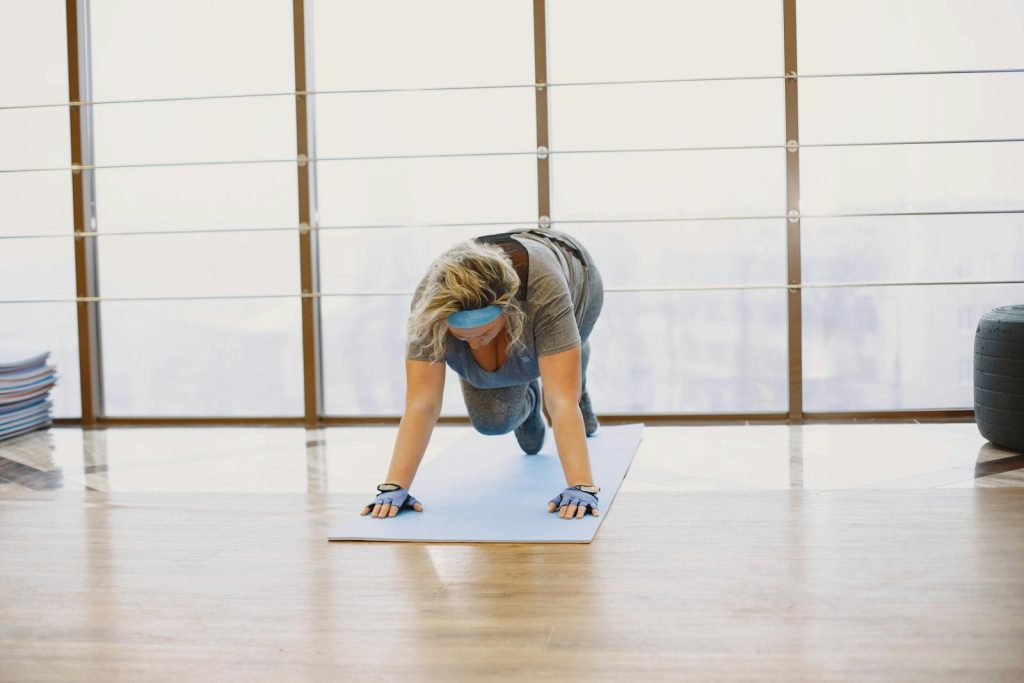
This guide covers the best bodyweight cardio exercises, how to do them correctly, muscles worked, common mistakes, beginner-friendly modifications, progressions, and sample no-equipment workouts.
What Are Bodyweight Cardio Exercises?
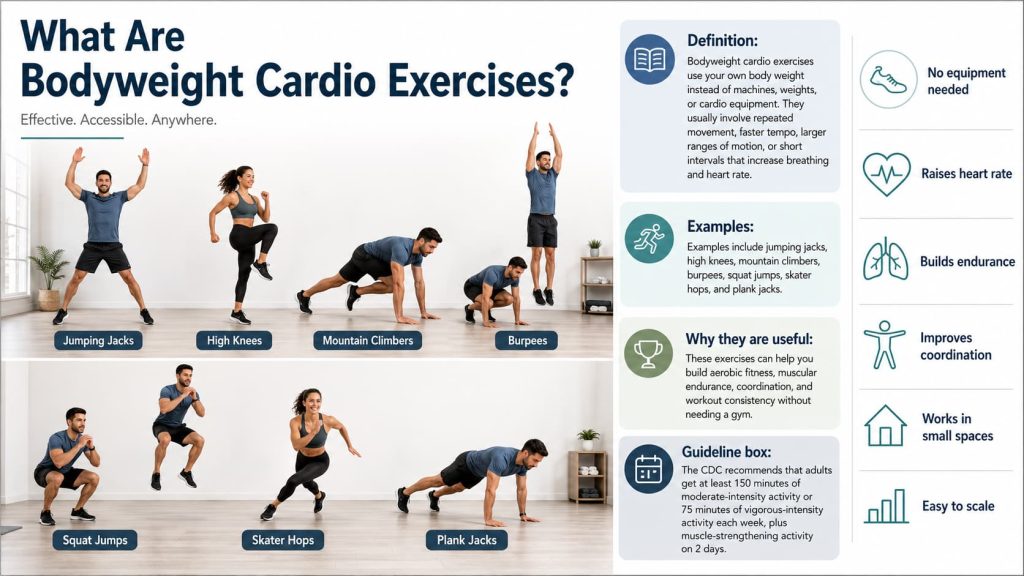
Bodyweight cardio exercises use your own body weight instead of machines, weights, or cardio equipment. They usually involve repeated movement, faster tempo, larger ranges of motion, or short intervals that increase breathing and heart rate.
Examples include jumping jacks, high knees, mountain climbers, burpees, squat jumps, skater hops, and plank jacks.
These exercises can help you build aerobic fitness, muscular endurance, coordination, and workout consistency without needing a gym. The CDC recommends that adults get at least 150 minutes of moderate-intensity activity or 75 minutes of vigorous-intensity activity each week, plus muscle-strengthening activity on 2 days.
How to Judge Intensity During Bodyweight Cardio
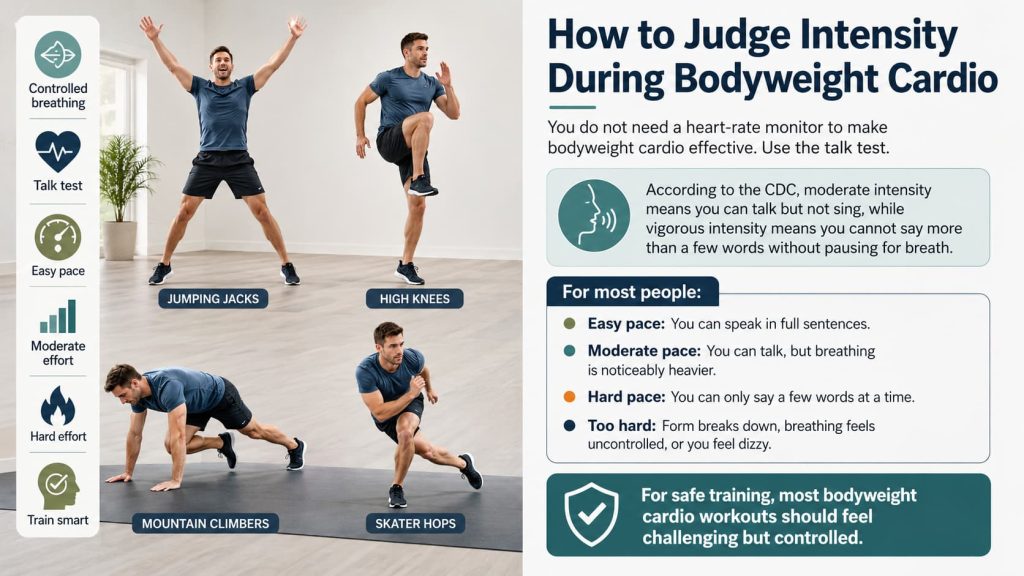
You do not need a heart-rate monitor to make bodyweight cardio effective. Use the talk test.
According to the CDC, moderate intensity means you can talk but not sing, while vigorous intensity means you cannot say more than a few words without pausing for breath.
For most people:
- Easy pace: You can speak in full sentences.
- Moderate pace: You can talk, but breathing is noticeably heavier.
- Hard pace: You can only say a few words at a time.
- Too hard: Form breaks down, breathing feels uncontrolled, or you feel dizzy.
For safe training, most bodyweight cardio workouts should feel challenging but controlled.
Before You Start: Warm Up First
A short warm-up helps your joints, muscles, and breathing pattern prepare for faster movement. The American Council on Exercise notes that dynamic warm-ups often use integrated movements that support mobility, stability, balance, coordination, agility, and power.
Try this 4-minute warm-up before the exercises:
- March in place for 45 seconds.
- Do arm circles for 30 seconds.
- Do bodyweight squats for 45 seconds.
- Step side to side for 45 seconds.
- Do slow high knees for 45 seconds.
- Finish with 30 seconds of easy jumping jacks or step-out jacks.
10 Best Bodyweight Cardio Exercises
Below are 10 of the best bodyweight cardio exercises you can do without equipment. These moves raise your heart rate, train multiple muscle groups, and can be adjusted for beginner, intermediate, or advanced workouts.
1. Jumping Jacks
- Best for: Beginners, warm-ups, full-body cardio, low-skill conditioning
- Muscles worked: Calves, quads, glutes, shoulders, upper back, core
Why it stands out
Jumping jacks are simple, rhythmic, and easy to scale. They raise your heart rate quickly without requiring floor work, advanced coordination, or much space.
Suggested sets and reps
Do 2–4 rounds of 30–60 seconds. Rest 20–40 seconds between rounds.
How to do it
- Stand tall with your feet together and arms by your sides.
- Jump both feet out while raising your arms overhead.
- Land softly with knees slightly bent.
- Jump your feet back together while lowering your arms.
- Repeat at a steady rhythm.
Common mistakes
- Landing with stiff knees
- Shrugging the shoulders
- Moving too fast before finding rhythm
- Letting the knees collapse inward
Coaching cue
Land quietly and keep your ribs stacked over your hips.
Exercise variations
- Beginner: Step-out jacks
- Intermediate: Standard jumping jacks
- Advanced: Seal jacks or squat jacks
How to use in a workout
Use jumping jacks as a warm-up move, active recovery exercise, or first exercise in a bodyweight cardio circuit.
2. High Knees
- Best for: Fast cardio intervals, running-style conditioning, athletic warm-ups
- Muscles worked: Hip flexors, quads, calves, glutes, core
Why it stands out
High knees train quick foot turnover and upright posture while raising your heart rate fast. They work well in short intervals because intensity is easy to control by changing speed and knee height.
Suggested sets and reps
Do 3–5 rounds of 20–40 seconds. Rest 20–40 seconds between rounds.
How to do it
- Stand tall with your feet hip-width apart.
- Brace your core and keep your chest lifted.
- Drive one knee toward hip height.
- Switch legs quickly while pumping your arms.
- Stay light on the balls of your feet.
Common mistakes
- Leaning backward
- Slapping the feet into the floor
- Letting the arms swing across the body
- Lifting the knees so high that posture breaks
Coaching cue
Think “quick feet, tall chest, soft landing.”
Exercise variations
- Beginner: Marching high knees
- Intermediate: Standard high knees
- Advanced: High knees with sprint-style arm drive
How to use in a workout
Use high knees for 20–30 second bursts between strength moves such as squats, push-ups, or lunges.
3. Mountain Climbers
- Best for: Core-focused cardio, plank strength, small-space workouts
- Muscles worked: Core, hip flexors, shoulders, chest, quads, glutes
Why it stands out
Mountain climbers combine a high plank with alternating knee drives. They challenge your cardio system while forcing your shoulders and core to stabilize your body. The American Council on Exercise emphasizes bracing the abdominals and stabilizing the spine, which makes control more important than speed.
Suggested sets and reps
Do 3–4 rounds of 20–45 seconds. Rest 30–45 seconds between rounds.
How to do it
- Start in a high plank with your hands under your shoulders.
- Brace your core and keep your body in a straight line.
- Drive one knee toward your chest.
- Return that foot and switch sides.
- Continue alternating legs at a controlled pace.
Common mistakes
- Letting the hips bounce up and down
- Dropping the lower back
- Placing the hands too far forward
- Rushing until the feet stomp the floor
Coaching cue
Keep your shoulders stacked over your hands and move your knees without letting your hips sway.
Exercise variations
- Beginner: Slow mountain climbers
- Intermediate: Standard mountain climbers
- Advanced: Cross-body mountain climbers
How to use in a workout
Use mountain climbers in the middle of a circuit after standing exercises to increase intensity without needing more space.
4. Burpees
- Best for: Full-body conditioning, advanced cardio circuits, short high-effort intervals
- Muscles worked: Quads, glutes, hamstrings, calves, chest, shoulders, triceps, core
Why it stands out
Burpees train multiple movement patterns in one exercise: squat, plank, push-up option, jump-back, and vertical jump. They are demanding, so they should be performed with clean mechanics rather than rushed reps.
Suggested sets and reps
Do 2–4 rounds of 5–10 reps or 20–40 seconds. Rest 45–90 seconds between rounds.
How to do it
- Stand with your feet about shoulder-width apart.
- Bend your knees and place your hands on the floor.
- Step or jump your feet back into a plank.
- Keep your core braced.
- Step or jump your feet forward.
- Stand tall or jump lightly at the top.
Common mistakes
- Letting the lower back sag in the plank
- Crashing into the floor
- Jumping back before the hands are stable
- Turning every rep into sloppy speed work
Coaching cue
Move smoothly from position to position before adding speed.
Exercise variations
- Beginner: Step-back burpee without a jump
- Intermediate: Standard burpee
- Advanced: Burpee with push-up or tuck jump
How to use in a workout
Use burpees sparingly. Place them near the end of a circuit or use them as a short finisher for 4–6 minutes.
5. Squat Jumps
- Best for: Lower-body power, calorie-burning intervals, athletic conditioning
- Muscles worked: Quads, glutes, hamstrings, calves, core
Why it stands out
Squat jumps build explosive leg power while increasing heart rate. They work best when the landing is controlled. The American Council on Exercise cues a braced core, controlled shoulder position, and proper hip-and-knee movement before jumping.
Suggested sets and reps
Do 3–5 rounds of 6–12 reps or 15–30 seconds. Rest 45–60 seconds between rounds.
How to do it
- Stand with your feet about hip- to shoulder-width apart.
- Push your hips back and bend your knees into a squat.
- Keep your chest lifted and core braced.
- Drive through your feet and jump upward.
- Land softly with knees and hips bent.
- Reset your position before the next rep.
Common mistakes
- Landing with locked knees
- Letting the knees cave inward
- Turning the squat into a shallow bounce
- Jumping before learning a strong bodyweight squat
Coaching cue
Land like you are trying not to make noise.
Exercise variations
- Beginner: Squat to calf raise
- Intermediate: Standard squat jump
- Advanced: 180-degree squat jump
How to use in a workout
Use squat jumps early in a workout while your legs are fresh, or keep the reps low inside a cardio circuit.
6. Skater Hops
- Best for: Lateral movement, balance, athletic cardio, glute activation
- Muscles worked: Glutes, quads, hamstrings, calves, hip abductors, core
Why it stands out
Most cardio exercises move forward and backward. Skater hops train side-to-side power and control, which makes them useful for building athletic movement and hip stability.
Suggested sets and reps
Do 3–4 rounds of 20–45 seconds. Rest 30–45 seconds between rounds.
How to do it
- Stand with your feet hip-width apart.
- Hop to your right and land on your right foot.
- Let your left leg move behind you naturally.
- Push off and hop to your left.
- Keep your chest up and land with a soft knee.
Common mistakes
- Twisting the knee inward on landing
- Reaching too far before balance is ready
- Rounding the back
- Rushing side to side without control
Coaching cue
Stick the landing for a split second before pushing to the other side.
Exercise variations
- Beginner: Step-behind skaters
- Intermediate: Standard skater hops
- Advanced: Power skaters with a deeper landing
How to use in a workout
Use skater hops after a forward-and-back exercise, such as high knees, to add lateral movement to your cardio session.
7. Butt Kicks
- Best for: Warm-ups, low-skill cardio, running prep, active recovery
- Muscles worked: Hamstrings, calves, quads, glutes, core
Why it stands out
Butt kicks are easy to learn and useful for increasing heart rate without dropping to the floor. They also work well as a lighter movement between harder exercises.
Suggested sets and reps
Do 2–4 rounds of 30–60 seconds. Rest 20–40 seconds between rounds.
How to do it
- Stand tall with your feet hip-width apart.
- Bend one knee and bring your heel toward your glutes.
- Switch legs in a jogging rhythm.
- Pump your arms naturally.
- Keep your torso upright.
Common mistakes
- Leaning forward too much
- Kicking so high that the lower back arches
- Landing heavily
- Forgetting to use the arms
Coaching cue
Keep your knees pointing down and your steps quick.
Exercise variations
- Beginner: Alternating heel curls
- Intermediate: Standard butt kicks
- Advanced: Fast butt kicks with stronger arm drive
How to use in a workout
Use butt kicks during a warm-up, between hard intervals, or as a low-impact substitute for high knees.
8. Plank Jacks
- Best for: Core cardio, shoulder endurance, plank progressions
- Muscles worked: Core, shoulders, chest, triceps, glutes, hip abductors, calves
Why it stands out
Plank jacks combine the trunk control of a plank with the rhythm of jumping jacks. They challenge your shoulders and core while adding a strong cardio effect.
Suggested sets and reps
Do 3–4 rounds of 15–30 seconds. Rest 30–45 seconds between rounds.
How to do it
- Start in a high plank with hands under shoulders.
- Brace your abs and squeeze your glutes lightly.
- Jump both feet out wider than hip-width.
- Jump both feet back together.
- Keep your hips as steady as possible.
Common mistakes
- Letting the hips sag
- Piking the hips too high
- Holding the breath
- Moving too fast and losing plank alignment
Coaching cue
Imagine balancing a glass of water on your lower back.
Exercise variations
- Beginner: Step-out plank jacks
- Intermediate: Standard plank jacks
- Advanced: Plank jack to shoulder tap
How to use in a workout
Use plank jacks after standing cardio moves to train the core while keeping the heart rate elevated.
9. Lateral Shuffles
- Best for: Agility, low-impact cardio, sports-style movement, small spaces
- Muscles worked: Glutes, quads, hamstrings, calves, hip abductors, core
Why it stands out
Lateral shuffles are joint-friendlier than many jumping moves because you can keep the steps low and controlled. They train side-to-side movement, quick feet, and lower-body endurance.
Suggested sets and reps
Do 3–5 rounds of 20–45 seconds. Rest 20–45 seconds between rounds.
How to do it
- Stand with your feet slightly wider than hip-width.
- Bend your knees and sit your hips back slightly.
- Shuffle 2–4 steps to one side.
- Stay low and keep your chest lifted.
- Shuffle back in the opposite direction.
Common mistakes
- Standing too upright
- Crossing the feet
- Letting the knees cave inward
- Looking down the entire time
Coaching cue
Stay low, keep your feet quick, and push the floor away.
Exercise variations
- Beginner: Slow side steps
- Intermediate: Lateral shuffle
- Advanced: Lateral shuffle with floor tap
How to use in a workout
Use lateral shuffles as a lower-impact cardio move between jumping exercises or as part of an athletic conditioning circuit.
10. Reverse Lunge to Knee Drive
- Best for: Low-impact cardio, leg strength, balance, beginner-to-intermediate training
- Muscles worked: Glutes, quads, hamstrings, calves, hip flexors, core
Why it stands out
Reverse lunge to knee drive is a strong alternative to jumping lunges. It raises heart rate, trains single-leg control, and builds lower-body endurance without requiring a high-impact landing.
Suggested sets and reps
Do 2–4 rounds of 8–12 reps per side or 30–45 seconds. Rest 30–60 seconds between rounds.
How to do it
- Stand tall with your feet hip-width apart.
- Step your right foot back into a reverse lunge.
- Bend both knees while keeping your front foot planted.
- Drive through your front foot to stand.
- Bring your back knee forward and upward.
- Repeat on one side or alternate legs.
Common mistakes
- Pushing off the back foot instead of the front leg
- Letting the front knee collapse inward
- Leaning too far forward
- Rushing through the knee drive
Coaching cue
Push the floor away with your front foot and finish tall.
Exercise variations
- Beginner: Reverse lunge only
- Intermediate: Reverse lunge to knee drive
- Advanced: Jumping lunges
How to use in a workout
Use this move when you want leg-focused cardio without the impact of squat jumps or jumping lunges.
Best Beginner Modifications for Bodyweight Cardio Exercises
You do not need to jump to get a good cardio workout. Beginners can reduce impact and still train effectively.
Use these swaps:
| Instead of This | Try This |
|---|---|
| Jumping jacks | Step-out jacks |
| High knees | Marching high knees |
| Mountain climbers | Slow mountain climbers |
| Burpees | Step-back burpees |
| Squat jumps | Squat to calf raise |
| Skater hops | Step-behind skaters |
| Plank jacks | Step-out plank jacks |
| Jumping lunges | Reverse lunge to knee drive |
The goal is not to make every move harder. The goal is to keep moving with good form.
How to Build a No-Equipment Bodyweight Cardio Workout
Bodyweight cardio works best when you organize exercises into intervals or circuits. NASM describes HIIT as short bouts of high effort followed by recovery, and notes that rest can be active, such as walking until your heart rate comes down.
For most people, a good structure is:
- Choose 4–6 exercises.
- Work for 20–40 seconds.
- Rest for 20–60 seconds.
- Repeat for 2–5 rounds.
- Keep form clean on every round.
Do not treat every session like an all-out test. NASM also notes that adequate recovery matters and recommends limiting HIIT-style sessions to up to 3 times per week with at least a day of recovery between sessions.
Sample Bodyweight Cardio Workout Routines
Beginner Bodyweight Cardio Workout
Do 2–3 rounds.
| Exercise | Work | Rest |
|---|---|---|
| Step-out jacks | 30 seconds | 30 seconds |
| Marching high knees | 30 seconds | 30 seconds |
| Slow mountain climbers | 20 seconds | 40 seconds |
| Squat to calf raise | 30 seconds | 30 seconds |
| Reverse lunge to knee drive | 30 seconds | 45 seconds |
Intermediate No-Equipment Cardio Workout
Do 3–4 rounds.
| Exercise | Work | Rest |
|---|---|---|
| Jumping jacks | 40 seconds | 20 seconds |
| Mountain climbers | 30 seconds | 30 seconds |
| Skater hops | 30 seconds | 30 seconds |
| Squat jumps | 20 seconds | 40 seconds |
| Lateral shuffles | 40 seconds | 20 seconds |
Advanced Bodyweight Cardio Finisher
Do 4 rounds.
| Exercise | Work | Rest |
|---|---|---|
| Burpees | 30 seconds | 30 seconds |
| High knees | 30 seconds | 20 seconds |
| Plank jacks | 30 seconds | 30 seconds |
| Squat jumps | 20 seconds | 40 seconds |
Keep this finisher short. If your form breaks down, reduce the work time or switch to lower-impact variations.
Common Mistakes to Avoid
Skipping the Warm-Up
Jumping straight into burpees, squat jumps, or high knees can make the workout feel harder than it needs to. Start with light movement first.
Going Too Fast Too Soon
Speed only helps if you can control your body. Sloppy reps reduce training quality and may increase strain.
Landing Too Stiff
For jumping moves, bend your knees and hips when you land. Soft landings help you control force.
Letting the Knees Cave In
During squat jumps, lunges, and skater hops, keep your knees tracking in the same general direction as your toes.
Losing Core Control
In mountain climbers and plank jacks, avoid sagging your lower back. Keep your ribs, hips, and shoulders controlled.
Doing High-Intensity Cardio Every Day
Hard intervals need recovery. Mix bodyweight cardio with walking, mobility, strength training, or easier conditioning days.
How Often Should You Do Bodyweight Cardio Exercises?
Most people can do bodyweight cardio 2–4 days per week depending on intensity, fitness level, and recovery.
A simple weekly setup:
- Beginner: 2–3 sessions per week, 10–20 minutes each
- Intermediate: 3–4 sessions per week, 20–30 minutes each
- Advanced: 2–3 hard sessions plus easier conditioning or strength days
If your workout includes many jumping exercises, allow more recovery for your calves, knees, hips, and lower back.
Who Should Choose Low-Impact Bodyweight Cardio?
Low-impact variations are a better starting point if you are new to exercise, returning after time off, training in an apartment, or trying to reduce joint stress.
Choose low-impact options when:
- Jumping feels uncomfortable.
- Your knees or ankles feel irritated.
- You cannot land quietly.
- You lose balance during fast moves.
- You are still learning the exercise pattern.
Low-impact does not mean easy. You can still make the workout challenging by increasing duration, reducing rest, or using larger controlled ranges of motion.
Safety Tips for Bodyweight Cardio
Stop the workout if you feel sharp pain, chest pain, dizziness, faintness, numbness, unusual shortness of breath, or symptoms that feel unsafe.
Use a slower pace if your form starts to break down. Choose step-based variations before jumping variations if you are a beginner or have trouble controlling landings.
If you have a medical condition, injury, or have been inactive for a long time, consider getting guidance from a qualified healthcare or fitness professional before starting high-intensity workouts.
FAQ
Are bodyweight cardio exercises good for weight loss?
Bodyweight cardio exercises can support weight loss by helping you burn calories, improve conditioning, and stay consistent with physical activity. For best results, combine them with strength training, enough daily movement, and a nutrition plan that matches your goal.
Can I do bodyweight cardio every day?
You can do light bodyweight cardio often, but hard HIIT-style workouts should not be done every day. Most people do better with 2–4 cardio sessions per week and easier movement or recovery days between intense workouts.
What is the best bodyweight cardio exercise?
There is no single best exercise for everyone. Jumping jacks are great for beginners, mountain climbers are excellent for core-focused cardio, and burpees are effective for advanced full-body conditioning. The best choice is the one you can perform safely and consistently.
How long should a bodyweight cardio workout be?
A good bodyweight cardio workout can last 10–30 minutes. Beginners can start with 10–15 minutes, while intermediate and advanced exercisers can use longer circuits or harder intervals.
Are bodyweight cardio exercises better than running?
They are different. Running is a repetitive forward-moving cardio activity, while bodyweight cardio can train more movement patterns, including squatting, planking, jumping, and lateral movement. Many people benefit from using both.
Can beginners do bodyweight cardio exercises?
Yes. Beginners should start with low-impact variations such as step-out jacks, marching high knees, slow mountain climbers, bodyweight squats, and reverse lunges. Add jumping only after you can control the basic movement.
Do bodyweight cardio exercises build muscle?
They can build muscular endurance and may help beginners gain some strength, especially in the legs, core, shoulders, and hips. For major muscle growth, you will usually need progressive strength training with harder variations, added resistance, or more structured overload.
Conclusion
Bodyweight cardio exercises are practical, effective, and easy to use anywhere. Start with simple moves like jumping jacks, high knees, mountain climbers, and lateral shuffles, then progress to harder options like squat jumps, plank jacks, and burpees when your form is ready.
Choose 3–5 exercises, set a timer, and build a short no-equipment workout you can repeat consistently.
2 thoughts on “10 Best Bodyweight Cardio Exercises for Home Workouts”