Barbell hip thrusts are one of the best loaded exercises for training the glutes through hip extension. They are especially useful if your goal is to build stronger glutes, improve lower-body power, and add focused glute volume without relying only on squats or deadlifts.
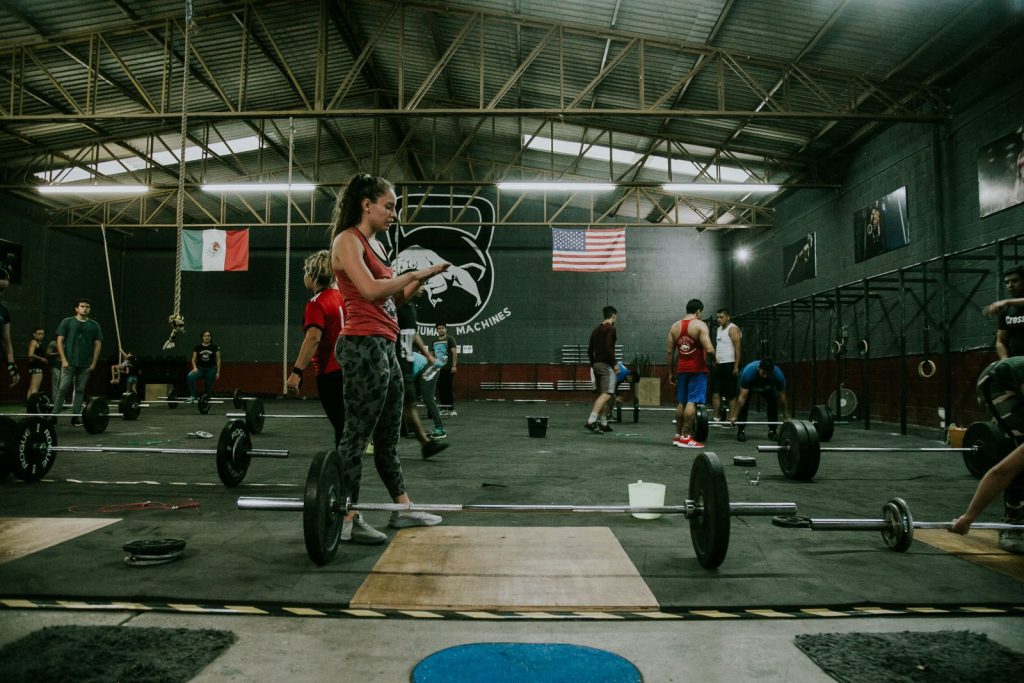
In this guide, you’ll learn how to do barbell hip thrusts with proper form, which muscles they work, the main benefits, common mistakes, beginner modifications, progressions, and how to add them to your workout routine.
What Are Barbell Hip Thrusts?
Barbell hip thrusts are a loaded hip-extension exercise performed with your upper back supported on a bench, your feet on the floor, and a barbell placed across your hips.
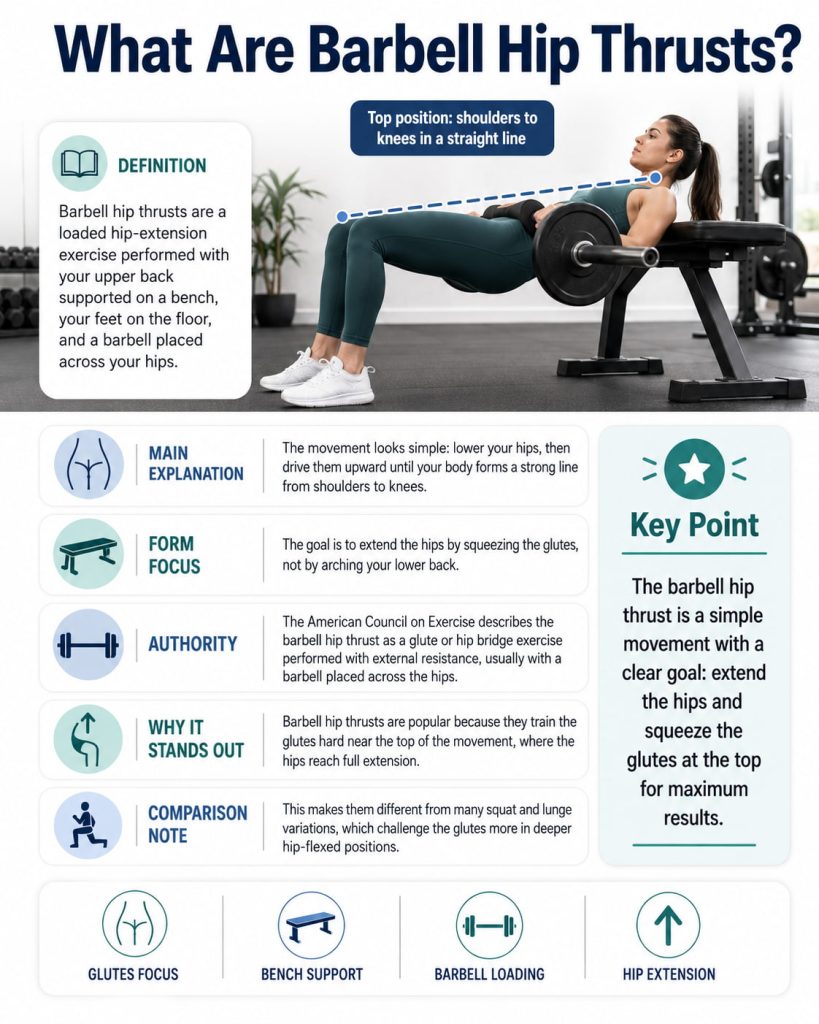
The movement looks simple: lower your hips, then drive them upward until your body forms a strong line from shoulders to knees. But the key is how you move. The goal is to extend the hips by squeezing the glutes, not by arching your lower back.
The American Council on Exercise describes the barbell hip thrust as a glute or hip bridge exercise performed with external resistance, usually with a barbell placed across the hips.
Barbell hip thrusts are popular because they train the glutes hard near the top of the movement, where the hips reach full extension. This makes them different from many squat and lunge variations, which challenge the glutes more in deeper hip-flexed positions.
Barbell Hip Thrusts Muscles Worked
Barbell hip thrusts mainly target the glutes, but several lower-body and core muscles help stabilize the movement.
Primary Muscle Worked
Gluteus maximus
The gluteus maximus is the main muscle responsible for hip extension. In barbell hip thrusts, it works hardest as you drive your hips upward and squeeze at the top.
Secondary Muscles Worked
Gluteus medius and gluteus minimus
These smaller glute muscles help stabilize the pelvis and control hip position. They also help prevent the knees from collapsing inward during the lift.
Hamstrings
The hamstrings assist with hip extension, especially if your foot position places more tension on the back of the thighs.
Adductors
The inner-thigh muscles help support hip extension and stabilize the legs during heavy thrusts.
Quadriceps
The quads help keep the knees stable and maintain your lower-body position.
Core muscles
Your abs and deep core muscles help keep your ribs down, pelvis controlled, and spine stable.
Lower-back stabilizers
The lower back should not be the main driver of the movement, but it helps maintain position when you brace correctly.
A PubMed study comparing barbell hip thrusts with back squats found that the hip thrust produced greater gluteus maximus and biceps femoris activation under the tested conditions, which supports its use as a direct glute-focused exercise.
How to Do Barbell Hip Thrusts With Proper Form
Best for: Building glute strength, glute size, hip-extension power, and focused lower-body accessory work.
How to do it
- Sit on the floor with your upper back against the edge of a stable bench.
- Roll a loaded barbell over your legs and position it across your hip crease.
- Use a barbell pad or folded mat if the bar feels uncomfortable.
- Plant your feet flat on the floor about hip-width apart.
- Set your upper back on the bench so the edge supports your shoulder-blade area.
- Brace your core, keep your ribs down, and lightly tuck your chin.
- Drive through your midfoot and heels to lift your hips.
- Squeeze your glutes until your hips are fully extended.
- Pause briefly at the top without arching your lower back.
- Lower your hips under control and repeat.
Coaching cue
Drive the floor away, tuck the ribs down, and squeeze your glutes like you are trying to lock your hips into a strong tabletop position.
Benefits of Barbell Hip Thrusts
Builds Stronger Glutes
The biggest benefit of barbell hip thrusts is direct glute training. Because the exercise is built around hip extension, it lets you focus on driving the hips upward and squeezing the glutes hard at the top.
This makes it a strong option for lifters who struggle to feel their glutes during squats, lunges, or deadlifts.
Supports Glute Muscle Growth
Barbell hip thrusts can be loaded progressively, which makes them useful for hypertrophy-focused training. You can increase the weight, add reps, add sets, slow the tempo, or pause at the top.
The National Strength and Conditioning Association notes that glute training should consider multiple movement patterns and references research showing that adding barbell hip thrusts can support gluteus maximus hypertrophy.
Trains Hip Extension Directly
Hip extension is the action of moving the thigh backward relative to the pelvis. It matters in many lower-body exercises, including squats, deadlifts, lunges, step-ups, and sprinting.
Barbell hip thrusts train this action directly. That makes them useful for building strength in a movement pattern that carries over to many lower-body lifts and athletic actions.
Allows Heavy Loading With Less Spinal Loading Than Some Big Lifts
Barbell hip thrusts can be loaded heavily, but they do not place the bar on your back like a squat or require the same pulling position as a deadlift.
That does not make them easy or risk-free, but it can make them a practical way to add glute volume without adding as much total fatigue from heavy squats or deadlifts.
Helps Improve Lockout Strength
If you struggle to finish hip-extension movements, hip thrusts can help strengthen the top position. This may be useful for deadlifts, Romanian deadlifts, kettlebell swings, and other hip-extension exercises.
The key is to train the lockout correctly. Finish with the glutes, not the lower back.
Useful for Beginners and Advanced Lifters
Beginners can start with bodyweight bridges and light hip thrusts. Advanced lifters can progress to heavy barbell hip thrusts, pauses, bands, single-leg variations, or higher-volume glute work.
That makes the exercise easy to scale based on strength level and training goal.
Common Barbell Hip Thrust Mistakes
Using Too Much Weight
A heavy hip thrust only works if you can still control the movement. If you cannot reach full hip extension, pause at the top, or lower the bar under control, the weight is too heavy.
Use a load that lets you feel the glutes working through the full range of motion.
Overarching the Lower Back
At the top of the rep, your body should form a strong line from shoulders to knees. You should not finish by throwing your ribs up and arching your lower back.
Think “ribs down, hips through.” This helps keep the movement focused on the glutes.
Not Reaching Full Hip Extension
Stopping short reduces the main benefit of the exercise. The top position is where many lifters get the strongest glute contraction.
Use a controlled range of motion and finish each rep with a brief squeeze.
Placing the Feet in the Wrong Position
Foot position changes how the exercise feels.
If your feet are too far forward, you may feel too much hamstring. If they are too close, you may feel too much quad. Start with your shins close to vertical at the top, then adjust slightly based on comfort and glute tension.
Letting the Knees Cave In
Knees collapsing inward can reduce control and stability. Keep your knees tracking over your toes.
If needed, use a light resistance band around your thighs to practice pushing the knees slightly outward.
Bouncing the Reps
Bouncing through the bottom or rushing the top reduces tension. Lower the bar with control, drive up smoothly, and pause briefly at the top.
Using an Unstable Bench
The bench should not slide, tip, or wobble. Use a stable bench and set up in an open area where the bar can move safely.
If your bench is too high, too low, or unstable, your setup may feel awkward and unsafe.
Barbell Hip Thrusts for Beginners
If you are new to barbell hip thrusts, do not start heavy. Learn the movement pattern first.
A good progression looks like this:
- Bodyweight glute bridge
- Bodyweight hip thrust
- Dumbbell hip thrust
- Light barbell hip thrust
- Standard barbell hip thrust
- Pause or tempo barbell hip thrust
Beginners should focus on control, not load. Your first goal is to feel the glutes working without lower-back strain.
Start with 2–3 sets of 10–12 reps. Rest 60–90 seconds between sets. Once you can complete every rep with clean form, gradually add weight.
Barbell Hip Thrust Progressions and Variations
Bodyweight Hip Thrust
This is the best starting point if you are still learning the setup. It lets you practice the bench position, foot placement, and glute squeeze without worrying about the barbell.
Dumbbell Hip Thrust
A dumbbell hip thrust is a good bridge between bodyweight and barbell work. Place a dumbbell across your hips and perform the same movement.
Pause Barbell Hip Thrust
Pause for 1–3 seconds at the top of each rep. This increases time under tension and teaches you to control the lockout.
Tempo Barbell Hip Thrust
Lower the bar slowly for 2–4 seconds, then drive up with control. This variation is useful when you want more tension with less weight.
Banded Barbell Hip Thrust
Place a resistance band around your thighs to encourage your knees to track outward. This can help some lifters feel the glutes more clearly.
Single-Leg Hip Thrust
This variation increases the challenge on one side at a time. It is useful for improving side-to-side control, but it is harder to stabilize, so start light.
Hip Thrust Machine
A hip thrust machine can make setup easier and may feel more comfortable for some lifters. It is a good option if your gym has one and the machine fits your body well.
How to Add Barbell Hip Thrusts to Your Workout
Barbell hip thrusts can fit into several types of lower-body training plans.
For Glute Growth
Use hip thrusts early in your workout when you are fresh. Pair them with squats, Romanian deadlifts, split squats, cable kickbacks, and abduction work for a complete glute-focused session.
Example:
- Barbell hip thrust: 4 sets of 8–12 reps
- Romanian deadlift: 3 sets of 8–10 reps
- Bulgarian split squat: 3 sets of 8–10 reps per side
- Cable kickback: 2–3 sets of 12–15 reps per side
- Hip abduction: 2–3 sets of 15–20 reps
For Strength
Place barbell hip thrusts after your main squat or deadlift, or use them as the first lift on a glute-focused day.
Use heavier loads, lower reps, and longer rest.
Example:
- Barbell hip thrust: 5 sets of 5 reps
- Rest: 2–3 minutes between sets
For Beginners
Use hip thrusts as a controlled accessory exercise after your main lower-body movement.
Example:
- Goblet squat: 3 sets of 8–10 reps
- Dumbbell Romanian deadlift: 3 sets of 10 reps
- Light barbell hip thrust: 3 sets of 10–12 reps
- Side plank: 2 sets per side
For a Glute Finisher
Use lighter weight and controlled reps at the end of your workout.
Example:
- Barbell hip thrust: 2–3 sets of 15–20 reps
- Pause at the top of every rep for 1 second
- Rest 45–60 seconds between sets
Sample Barbell Hip Thrust Workout
Beginner Glute Workout
- Bodyweight hip thrust: 3 sets of 12 reps
- Goblet squat: 3 sets of 10 reps
- Dumbbell Romanian deadlift: 3 sets of 10 reps
- Step-up: 2 sets of 10 reps per leg
- Side-lying hip abduction: 2 sets of 15 reps per side
Intermediate Glute Workout
- Barbell hip thrust: 4 sets of 8–12 reps
- Romanian deadlift: 3 sets of 8–10 reps
- Walking lunge: 3 sets of 10 reps per leg
- Cable pull-through: 3 sets of 12 reps
- Seated hip abduction: 2–3 sets of 15–20 reps
Advanced Glute Workout
- Heavy barbell hip thrust: 5 sets of 5 reps
- Pause barbell hip thrust: 3 sets of 8 reps
- Bulgarian split squat: 3 sets of 8 reps per leg
- Romanian deadlift: 4 sets of 6–8 reps
- Cable kickback: 3 sets of 12–15 reps per side
Barbell Hip Thrust Safety Tips
- Use a stable bench that does not slide.
- Place the bar in the hip crease, not on the stomach or directly on the hip bones.
- Use a barbell pad or thick mat to reduce discomfort.
- Keep your chin slightly tucked and eyes forward.
- Brace your core before every rep.
- Do not force the range of motion if you feel pinching in the hips.
- Stop the exercise if you feel sharp pain, numbness, dizziness, or unusual symptoms.
If you have current hip, back, or pelvic pain, work with a qualified fitness professional or healthcare provider before loading the movement heavily.
Are Barbell Hip Thrusts Better Than Squats for Glutes?
- Barbell hip thrusts are not automatically “better” than squats. They train the glutes differently.
- Hip thrusts are especially strong for training the glutes near full hip extension. Squats train the glutes, quads, and adductors through a deeper knee- and hip-bending pattern.
- For most lifters, the best answer is to use both. Squats give you a strong compound lower-body pattern, while hip thrusts add direct glute-focused work.
A Journal of Sports Science & Medicine review notes that the barbell hip thrust is widely used for glute activation and performance-focused training, but programming should still depend on the lifter’s goal, experience, and full training plan.
FAQs About Barbell Hip Thrusts
Are barbell hip thrusts good for building glutes?
Yes. Barbell hip thrusts are one of the most useful exercises for directly training the glutes because they load hip extension and allow progressive overload.
How many sets and reps should I do for barbell hip thrusts?
For glute growth, 3–5 sets of 8–15 reps works well for many lifters. For strength, use 3–5 sets of 4–8 reps. Beginners can start with 2–3 sets of 10–12 reps.
Should I feel barbell hip thrusts in my lower back?
You should not feel them mainly in your lower back. A small amount of stabilizing tension is normal, but the main work should come from your glutes. If your lower back takes over, reduce the weight and keep your ribs down at the top.
Where should the bar sit during hip thrusts?
The bar should sit across your hip crease. Use a barbell pad or folded mat for comfort. Avoid placing the bar too high on your stomach or directly on sensitive hip bones.
Are barbell hip thrusts good for beginners?
Yes, but beginners should start with bodyweight hip thrusts, glute bridges, or dumbbell hip thrusts before using a loaded barbell. Good setup and control matter more than heavy weight.
Can I do barbell hip thrusts every day?
Most lifters do not need to do them every day. Two to three times per week is usually enough for glute-focused training, depending on your total lower-body volume, recovery, and workout plan.
What is the difference between a glute bridge and a hip thrust?
A glute bridge is usually performed on the floor. A hip thrust is performed with the upper back supported on a bench, which usually allows a larger range of motion and heavier loading.
Conclusion
Barbell hip thrusts are a powerful glute-building exercise when you do them with control, full hip extension, and proper bracing. Use them to strengthen your glutes, improve hip-extension power, and add focused lower-body volume to your training plan.
Start with a setup you can control, choose a rep range that matches your goal, and progress gradually. For a balanced routine, pair barbell hip thrusts with squats, hinges, lunges, and hip-abduction work.
This content is for informational purposes only and not medical advice.
References
- American Council on Exercise: Understanding the Barbell Hip Thrust
- American Council on Exercise: Hip Bridge Exercise Library
- PubMed: Back Squat and Barbell Hip Thrust EMG Comparison
- PubMed: Barbell, Band, and American Hip Thrust EMG Comparison
- Journal of Sports Science & Medicine: Barbell Hip Thrust, Muscular Activation and Performance
- PubMed Central: Gluteus Maximus Activation During Common Strength and Hypertrophy Exercises
3 thoughts on “Barbell Hip Thrusts: Form, Muscles Worked, Benefits & Mistakes”