Barbell exercises are some of the best strength-training movements because they let you train heavy compound patterns, add weight gradually, and build strength across your whole body. With one barbell, you can train squats, hinges, presses, rows, lunges, glutes, arms, and power-based movements.
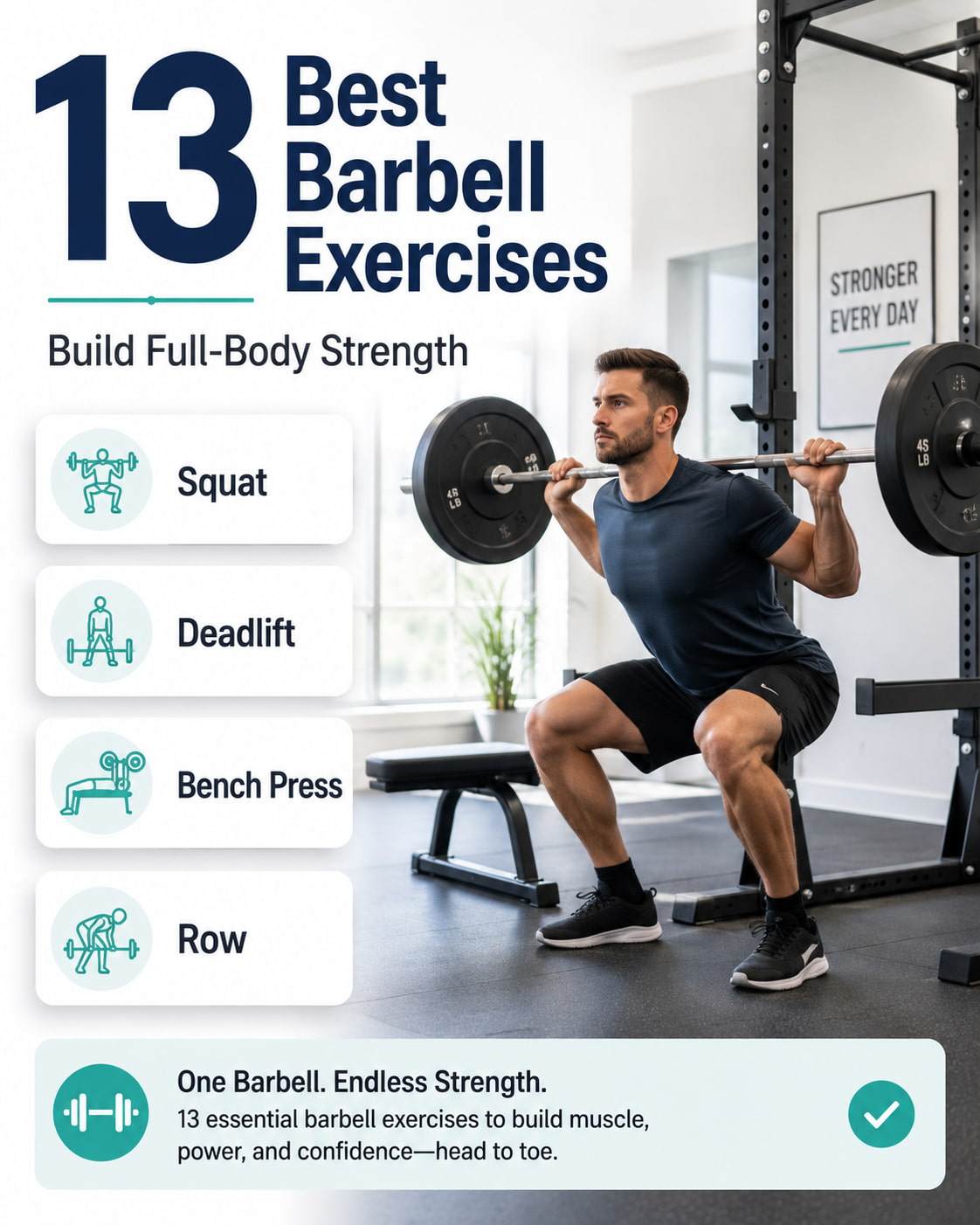
This guide covers the best barbell exercises for full body strength, the muscles worked, proper form, common mistakes, beginner and advanced options, and how to use them in a real workout.
What Are Barbell Exercises and Why Do They Work?
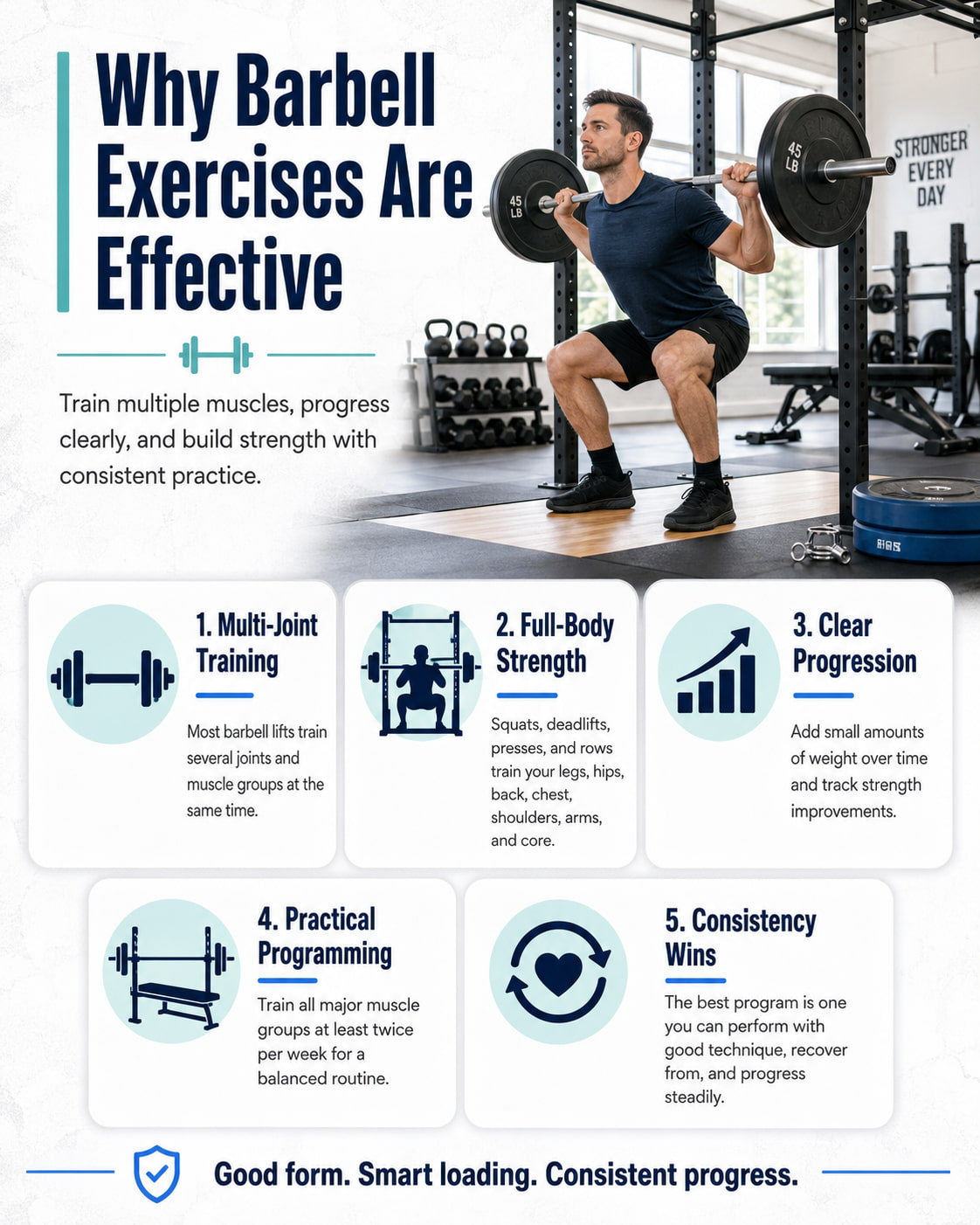
Barbell exercises are strength movements performed with a long straight bar that can be loaded with weight plates. Some lifts use a rack, bench, or safety pins, while others start from the floor.
They are effective because many barbell lifts train several muscle groups at once. Squats train the legs, glutes, and core. Deadlifts train the hips, back, grip, and trunk. Presses and rows build the upper body while also challenging stability.
The biggest advantage is progression. You can start with an empty bar, add small amounts of weight over time, and track strength clearly. For most lifters, the best barbell program is not the most extreme one. It is the one you can perform with good technique, recover from, and progress consistently.
Barbell Safety Tips Before You Start
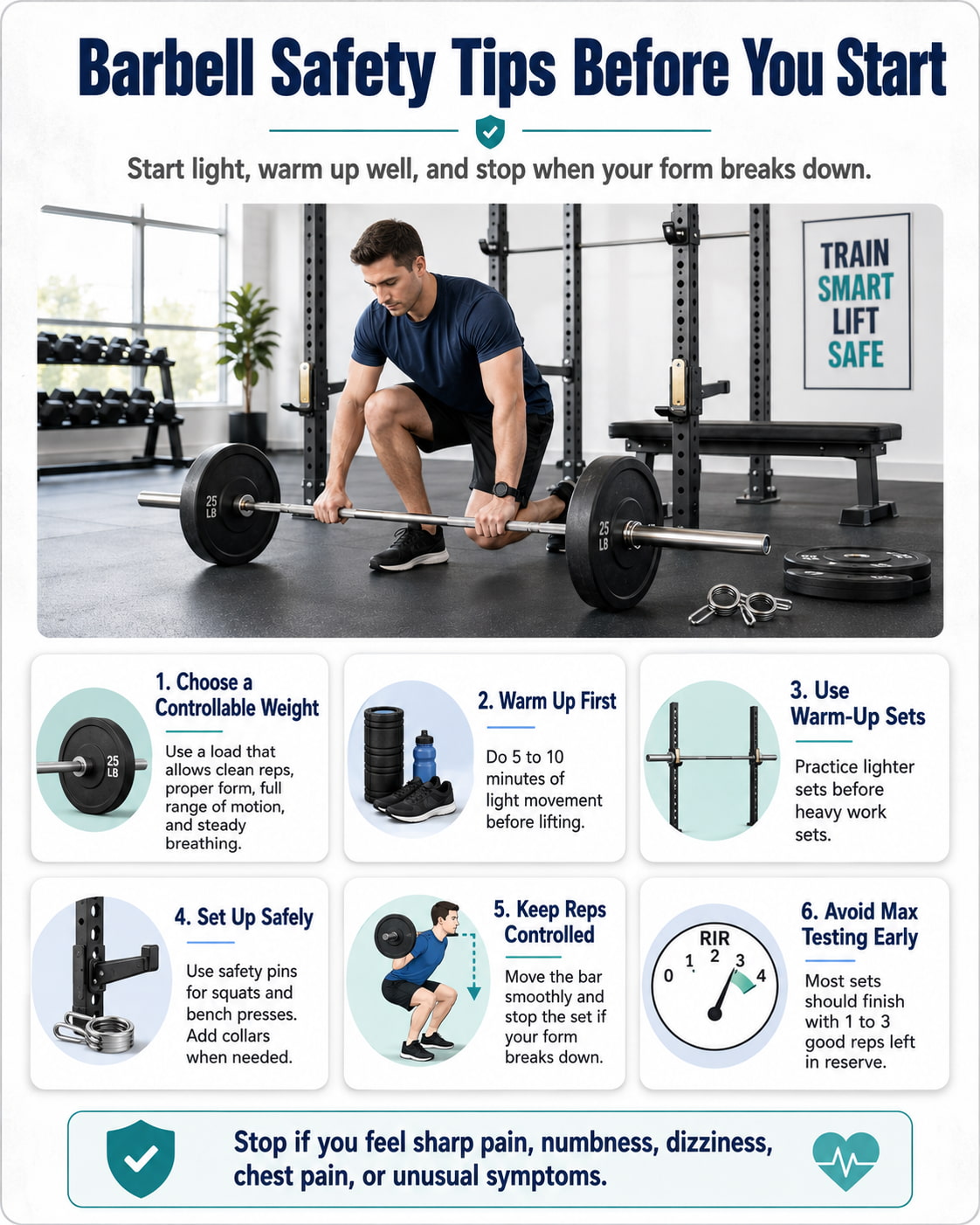
Start with a weight you can control. The Mayo Clinic weight training guide recommends using proper form, moving through a controlled range of motion, breathing properly, and choosing a weight that allows clean reps.
Warm up for 5 to 10 minutes before lifting. Use lighter warm-up sets before your heavy work sets. Set safety pins for squats and bench presses when training in a rack. Use collars when needed, keep the bar path controlled, and stop the set when your form breaks down.
If you are new to barbells, avoid max testing. Most working sets should feel like you could still do 1 to 3 more good reps. Stop and seek professional help if an exercise causes sharp pain, numbness, dizziness, chest pain, severe shortness of breath, or unusual symptoms.
13 Best Barbell Exercises for Full Body Strength
The best barbell exercises cover six major movement patterns: squat, hinge, horizontal push, vertical push, pull, and single-leg work. Together, these movements help you build strength without leaving major muscle groups behind.
1. Barbell Back Squat
Best for: Building lower-body strength, total-body tension, and heavy squat capacity.
Muscles worked: Quadriceps, glutes, hamstrings, adductors, calves, spinal erectors, upper back, and core.
Equipment needed: Barbell, plates, squat rack, and safety pins.
Sets, reps, and rest: Do 3 to 5 sets of 3 to 8 reps for strength or 3 to 4 sets of 8 to 10 reps for muscle building. Rest 2 to 4 minutes between heavy sets.
How to do it:
- Set the bar in a rack just below shoulder height.
- Step under the bar and place it across your upper traps or rear delts.
- Brace your core, unrack the bar, and step back.
- Set your feet about shoulder-width apart with toes slightly out.
- Bend your knees and hips together while keeping your chest controlled.
- Lower to a strong depth, then drive through your midfoot to stand.
Common mistakes: Avoid letting the knees cave inward, lifting the heels, rounding the back, relaxing at the bottom, or loading the bar before your form is stable.
Progression or regression: Beginners can start with a box squat, goblet squat, or empty bar squat. To progress, use pause squats, tempo reps, or heavier strength-focused sets.
2. Barbell Deadlift
Best for: Building full-body pulling strength, posterior-chain power, grip strength, and hip-hinge skill.
Muscles worked: Glutes, hamstrings, quadriceps, erector spinae, lats, traps, forearms, and core.
Equipment needed: Barbell, plates, collars, and a stable floor or lifting platform.
Sets, reps, and rest: Do 3 to 5 sets of 2 to 6 reps for strength. Rest 2 to 5 minutes between heavy sets.
How to do it:
- Stand with the bar over your midfoot.
- Hinge down and grip the bar just outside your legs.
- Brace your core, pull your chest up, and tighten your lats.
- Push the floor away while keeping the bar close.
- Stand tall by extending your hips and knees together.
- Lower the bar under control and reset before the next rep.
Common mistakes: Avoid starting with the bar too far forward, rounding the lower back, jerking the bar off the floor, letting the hips shoot up early, or leaning back too far at the top.
Progression or regression: Beginners can start with rack pulls or block deadlifts. To progress, use paused deadlifts, deficit deadlifts, or heavier low-rep sets.
3. Barbell Bench Press
Best for: Building chest strength, pressing power, triceps strength, and upper-body muscle.
Muscles worked: Chest, anterior deltoids, triceps, serratus anterior, upper back, and core stabilizers.
Equipment needed: Barbell, bench, plates, rack, and safety pins or a spotter.
Sets, reps, and rest: Do 3 to 5 sets of 3 to 8 reps for strength or 3 to 4 sets of 8 to 12 reps for muscle building. Rest 2 to 4 minutes between heavy sets.
How to do it:
- Lie on the bench with your eyes under the bar.
- Plant your feet and set your shoulder blades back and down.
- Grip the bar slightly wider than shoulder-width.
- Unrack the bar and lower it under control toward your lower chest.
- Keep your wrists stacked over your elbows.
- Press the bar back up with control.
Common mistakes: Avoid bouncing the bar, lifting the hips, flaring the elbows too wide, losing upper-back tension, or benching heavy without a safe setup.
Progression or regression: Beginners can start with push-ups, dumbbell bench press, or an empty bar. To progress, use pause reps, close-grip bench press, or heavier strength sets.
4. Standing Barbell Overhead Press
Best for: Building shoulder strength, triceps strength, upper-back stability, and trunk control.
Muscles worked: Deltoids, triceps, upper chest, traps, serratus anterior, glutes, spinal erectors, and core.
Equipment needed: Barbell, plates, and squat rack.
Sets, reps, and rest: Do 3 to 5 sets of 3 to 8 reps. Rest 2 to 3 minutes between challenging sets.
How to do it:
- Set the bar at upper-chest height.
- Grip the bar slightly outside shoulder-width.
- Brace your core and squeeze your glutes.
- Press the bar overhead while keeping your ribs down.
- Finish with the bar stacked over your midfoot.
- Lower the bar back to the front of your shoulders with control.
Common mistakes: Avoid arching the lower back, pressing the bar too far forward, shrugging too early, bending the knees during a strict press, or using too much weight.
Progression or regression: Beginners can start with a landmine press or dumbbell shoulder press. To progress, use pause presses, strict presses, or push presses.
5. Bent Over Barbell Row
Best for: Building back thickness, pulling strength, posture control, and upper-body balance.
Muscles worked: Lats, rhomboids, traps, rear delts, biceps, forearms, spinal erectors, hamstrings, and core.
Equipment needed: Barbell, plates, and collars.
Sets, reps, and rest: Do 3 to 4 sets of 6 to 10 reps. Rest 90 seconds to 3 minutes.
How to do it:
- Stand with your feet about hip-width apart.
- Hold the bar with an overhand grip.
- Hinge forward while keeping your back flat.
- Let the bar hang under your shoulders.
- Pull the bar toward your lower ribs or upper abdomen.
- Lower the bar until your elbows are straight.
Common mistakes: Avoid rounding your back, standing too upright, jerking the bar, pulling too high toward the chest, or using torso momentum.
Progression or regression: Beginners can start with a chest-supported row or inverted row. To progress, use paused rows, Pendlay rows, or heavier strict rows.
6. Barbell Romanian Deadlift
Best for: Strengthening the hamstrings, glutes, hip-hinge pattern, and posterior chain.
Muscles worked: Hamstrings, glutes, erector spinae, adductors, lats, traps, forearms, and core.
Equipment needed: Barbell, plates, and collars.
Sets, reps, and rest: Do 3 to 4 sets of 6 to 10 reps. Rest 90 seconds to 3 minutes.
How to do it:
- Stand tall with the bar in front of your thighs.
- Brace your core and keep a slight bend in your knees.
- Push your hips back while keeping the bar close.
- Lower until you feel a strong hamstring stretch.
- Keep your spine neutral throughout the movement.
- Drive your hips forward to stand tall.
Common mistakes: Avoid squatting the weight down, bending the knees too much, rounding the back, letting the bar drift forward, or forcing extra depth.
Progression or regression: Beginners can start with dumbbell Romanian deadlifts. To progress, use tempo reps, pause reps, or a deficit Romanian deadlift.
7. Barbell Front Squat
Best for: Building quad strength, upright squat mechanics, core strength, and upper-back control.
Muscles worked: Quadriceps, glutes, adductors, hamstrings, upper back, spinal erectors, and core.
Equipment needed: Barbell, plates, squat rack, and safety pins.
Sets, reps, and rest: Do 3 to 5 sets of 3 to 6 reps for strength or 3 sets of 6 to 8 reps for controlled volume. Rest 2 to 4 minutes.
How to do it:
- Set the bar at upper-chest height.
- Place the bar across the front of your shoulders.
- Use a clean grip, cross-arm grip, or straps.
- Keep your elbows high and brace your core.
- Squat down while keeping your torso upright.
- Drive through your midfoot to stand tall.
Common mistakes: Avoid dropping the elbows, rounding the upper back, shifting onto the toes, cutting depth short, or forcing a painful wrist position.
Progression or regression: Beginners can start with a goblet squat or front squat with straps. To progress, use pause front squats or tempo front squats.
8. Barbell Reverse Lunge
Best for: Single-leg strength, glute and quad development, balance, and reducing side-to-side strength gaps.
Muscles worked: Quadriceps, glutes, hamstrings, adductors, calves, and core.
Equipment needed: Barbell, plates, and squat rack.
Sets, reps, and rest: Do 3 to 4 sets of 6 to 10 reps per leg. Rest 90 seconds to 2 minutes.
How to do it:
- Place the bar across your upper back.
- Stand tall with your feet hip-width apart.
- Step one leg backward under control.
- Lower until both knees bend comfortably.
- Keep most of your weight through the front foot.
- Push through the front foot to return to standing.
Common mistakes: Avoid taking too short of a step, pushing mostly off the back foot, leaning forward too much, letting the front knee collapse inward, or rushing reps.
Progression or regression: Beginners can start with bodyweight or dumbbell reverse lunges. To progress, use front-rack reverse lunges, deficit reverse lunges, or pause reps.
9. Barbell Hip Thrust
Best for: Building glute strength, hip extension power, and lower-body accessory strength.
Muscles worked: Gluteus maximus, hamstrings, adductors, quads, core, and hip stabilizers.
Equipment needed: Barbell, plates, bench, bar pad, and collars.
Sets, reps, and rest: Do 3 to 4 sets of 6 to 12 reps. Rest 90 seconds to 3 minutes.
How to do it:
- Sit on the floor with your upper back against a bench.
- Roll the bar over your hips and use a pad for comfort.
- Set your feet about hip-width apart.
- Brace your core and keep your ribs down.
- Drive through your heels and lift your hips.
- Pause at the top, then lower under control.
Common mistakes: Avoid overextending the lower back, placing the feet too far away, pushing through the toes, skipping the top pause, or using more weight than you can control.
Progression or regression: Beginners can start with bodyweight glute bridges or barbell glute bridges from the floor. To progress, use heavier hip thrusts, longer pauses, or single-leg hip thrusts.
10. Barbell Good Morning
Best for: Training the hip hinge, hamstrings, glutes, spinal erectors, and posterior-chain control.
Muscles worked: Hamstrings, glutes, erector spinae, adductors, upper back, and core.
Equipment needed: Barbell, squat rack, plates, and safety pins.
Sets, reps, and rest: Do 2 to 4 sets of 6 to 10 reps with light to moderate weight. Rest 90 seconds to 3 minutes.
How to do it:
- Place the bar across your upper back.
- Stand with your feet about hip-width apart.
- Brace your core and keep your knees slightly bent.
- Push your hips back while keeping your spine neutral.
- Lower until you feel your hamstrings load.
- Drive your hips forward to stand tall.
Common mistakes: Avoid going too heavy, rounding the back, turning it into a squat, looking up aggressively, or dropping lower than you can control.
Progression or regression: Beginners should learn bodyweight hip hinges or Romanian deadlifts first. To progress, use slower tempo reps or a light pause in the hinge position.
11. Close-Grip Barbell Bench Press
Best for: Building triceps strength, pressing lockout strength, and upper-body pushing muscle.
Muscles worked: Triceps, chest, anterior deltoids, serratus anterior, and upper-back stabilizers.
Equipment needed: Barbell, bench, plates, rack, and safety pins or a spotter.
Sets, reps, and rest: Do 3 to 4 sets of 5 to 10 reps. Rest 90 seconds to 3 minutes.
How to do it:
- Lie on a bench with your feet planted.
- Set your shoulder blades back and down.
- Grip the bar just inside shoulder-width.
- Unrack the bar and lower it under control.
- Keep your elbows close to your body.
- Press the bar up while keeping your wrists stacked.
Common mistakes: Avoid using an extremely narrow grip, flaring the elbows, bouncing the bar, losing shoulder position, or loading it heavier than your triceps can control.
Progression or regression: Beginners can start with close-grip push-ups or dumbbell floor presses. To progress, use paused close-grip bench presses or heavier controlled sets.
12. Barbell Bulgarian Split Squat
Best for: Single-leg strength, quad and glute development, balance, and lower-body control.
Muscles worked: Quadriceps, glutes, hamstrings, adductors, calves, hip stabilizers, and core.
Equipment needed: Barbell, bench, rack, plates, and collars.
Sets, reps, and rest: Do 3 to 4 sets of 6 to 10 reps per leg. Rest 90 seconds to 3 minutes.
How to do it:
- Place a bench behind you.
- Set the bar across your upper back.
- Place one foot behind you on the bench.
- Keep your front foot far enough forward to stay balanced.
- Lower under control by bending the front knee and hip.
- Drive through the front foot to return to the top.
Common mistakes: Avoid standing too close to the bench, bouncing from the bottom, pushing too much through the back foot, letting the front knee cave inward, or rushing the setup.
Progression or regression: Beginners can start with bodyweight split squats or dumbbell Bulgarian split squats. To progress, use a barbell, front-rack position, pauses, or deficit reps.
13. Barbell Push Press
Best for: Building full-body power, shoulder strength, triceps strength, and leg drive.
Muscles worked: Shoulders, triceps, upper chest, traps, quads, glutes, calves, core, and upper back.
Equipment needed: Barbell, plates, collars, and squat rack.
Sets, reps, and rest: Do 3 to 5 sets of 2 to 5 reps for power or 3 sets of 5 to 6 reps with moderate load. Rest 2 to 4 minutes.
How to do it:
- Set the bar at upper-chest height.
- Grip the bar slightly outside shoulder-width.
- Place the bar on the front of your shoulders.
- Brace your core and stand tall.
- Dip slightly by bending the knees.
- Drive hard through the floor and press the bar overhead.
- Lower the bar with control.
Common mistakes: Avoid dipping too low, turning the dip into a squat, pressing the bar forward, losing your brace, catching the bar poorly, or going heavy before learning the timing.
Progression or regression: Beginners should learn the strict overhead press first. To progress, use heavier push press sets, push jerks, or clean-to-push-press variations when technique is ready.
Sample Barbell Workout for Full Body Strength
Use this workout 2 or 3 days per week with at least one rest day between sessions. Start light, keep 1 to 3 reps in reserve, and add weight only when your form stays consistent.
| Exercise | Sets | Reps | Rest | Effort |
|---|---|---|---|---|
| Barbell Back Squat | 3 | 5 | 2 to 3 minutes | 2 reps in reserve |
| Barbell Bench Press | 3 | 6 | 2 to 3 minutes | 1 to 3 reps in reserve |
| Barbell Romanian Deadlift | 3 | 8 | 90 to 150 seconds | 2 reps in reserve |
| Bent Over Barbell Row | 3 | 8 | 90 to 150 seconds | 1 to 2 reps in reserve |
| Barbell Reverse Lunge | 2 | 8 per leg | 90 seconds | Controlled form |
| Barbell Hip Thrust | 2 | 10 | 90 seconds | Strong top pause |
Progress by adding 5 pounds to upper-body lifts or 5 to 10 pounds to lower-body lifts when all sets feel clean. If the next weight jump makes your form worse, stay at the same weight for another week.
How Often Should You Do Barbell Exercises
Most lifters can train barbell exercises 2 to 4 days per week. Beginners usually do best with 2 or 3 full-body sessions. Intermediate lifters may use upper-lower splits or full-body sessions with different lift emphasis.
A simple weekly plan is to train full body on Monday, Wednesday, and Friday. Another option is to train lower body on Monday and Thursday and upper body on Tuesday and Friday.
Do not train every heavy lift hard every day. Squats, deadlifts, bench presses, and overhead presses need recovery. Your joints, muscles, grip, and nervous system all need time to adapt.
Common Barbell Training Mistakes
One common mistake is adding weight before the movement is stable. A heavier bar does not build better strength if every rep becomes sloppy.
Another mistake is only training the lifts you enjoy. A balanced barbell plan should include squatting, hinging, pressing, pulling, and single-leg work.
Many lifters also skip warm-up sets. Your first set with the empty bar is not wasted time. It helps you practice positions, build confidence, and prepare your joints and muscles for heavier loading.
The last major mistake is ignoring recovery. Progress comes from training and recovery together. If performance drops every session, sleep is poor, and form feels worse, reduce volume or load for a week.
Barbell Exercise Programming Tips
Use heavier sets of 3 to 6 reps for strength-focused lifts like squats, deadlifts, bench presses, overhead presses, and front squats. Use moderate sets of 6 to 12 reps for rows, Romanian deadlifts, hip thrusts, lunges, and close-grip bench presses.
Train the hardest compound lifts early in the workout. Squats, deadlifts, bench presses, front squats, and push presses require the most focus. Accessory lifts like hip thrusts, close-grip bench presses, and reverse lunges usually fit better after the main lift.
A good working set should feel challenging but controlled. Most of your training should stop before failure, especially on squats, deadlifts, overhead presses, good mornings, and lunges.
FAQs
Are barbell exercises good for beginners
Yes, barbell exercises can be good for beginners when the load is light, the setup is safe, and the exercise matches the person’s skill level. Beginners should start with simple variations such as box squats, Romanian deadlifts, bench presses with safety pins, and rows before attempting heavy or technical lifts.
What is the best barbell exercise for full body strength
The deadlift is one of the best barbell exercises for full body strength because it trains the legs, hips, back, core, and grip. However, a complete program should also include squats, presses, rows, and single-leg work.
Can you build muscle with only a barbell
Yes, you can build muscle with only a barbell if you train the major movement patterns, use enough weekly volume, eat enough protein and calories for your goal, and progress gradually. A barbell can train the legs, glutes, back, chest, shoulders, arms, and core.
How many barbell exercises should I do in one workout
Most workouts only need 4 to 6 barbell exercises. Choose one squat or lunge, one hinge, one press, one pull, and one or two accessories. Doing too many heavy barbell lifts in one session can reduce form quality.
Should I do barbell exercises every day
Most people should not do heavy barbell exercises every day. Barbell training is demanding, especially when using squats, deadlifts, presses, and rows. Two to four sessions per week is more practical for strength, recovery, and long-term progress.
What barbell exercise should I learn first
Many beginners should learn the Romanian deadlift, box squat, bench press setup, and bent-over row before moving into heavier back squats and deadlifts. The best first exercise depends on your mobility, strength, equipment, and coaching support.
Conclusion
Barbell exercises are a powerful way to build full body strength when you train with good form, balanced exercise selection, and steady progression. Start with the basics, use safe loads, and build your program around squats, hinges, presses, rows, lunges, and glute work.
Train consistently, keep your reps controlled, and increase weight only when your technique is ready.
This content is for informational purposes only and is not a substitute for professional medical advice.
References
- American College of Sports Medicine — Resistance Training Guidelines Update
- CDC — Adult Physical Activity Guidelines
- Mayo Clinic — Weight Training: Do’s and Don’ts of Proper Technique
- ACE Fitness — Back Squat Exercise Guide
- NASM — Barbell Deadlift Exercise Guide
- NASM — Barbell Bench Press Exercise Guide
- ACE Fitness — Bent-Over Row Exercise Guide