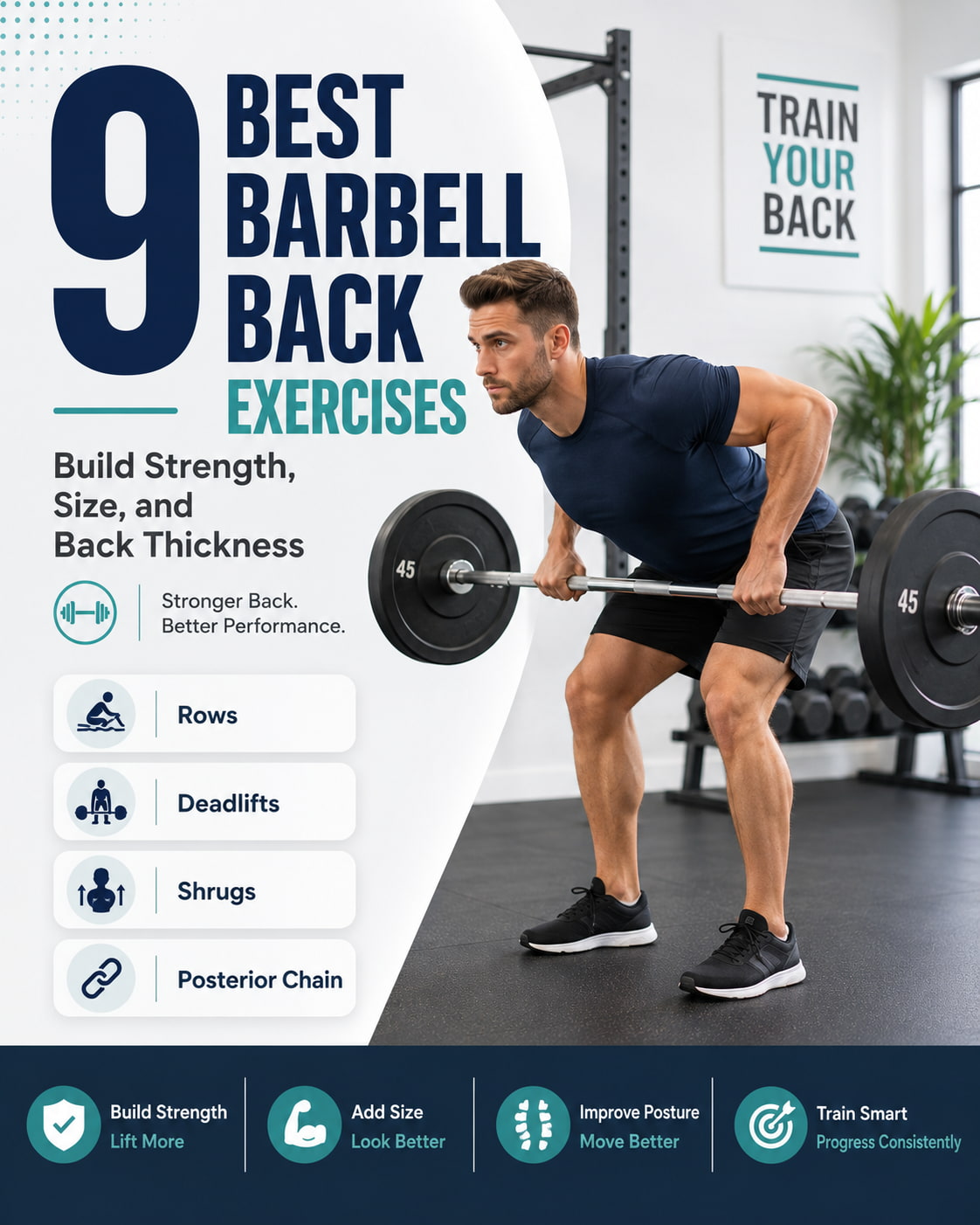
Barbell back exercises help you build a stronger, thicker back by combining heavy rows, hip hinges, and trap-focused pulls with progressive loading. The best plan does not rely on one movement only. It uses different barbell exercises to train the lats, traps, rhomboids, rear delts, spinal erectors, glutes, hamstrings, and grip.
In this guide, you will learn the best barbell back exercises for strength and size, how to perform each one, which muscles they target, how to avoid common mistakes, and how to build them into a practical workout.
How Barbell Back Exercises Build Strength and Size
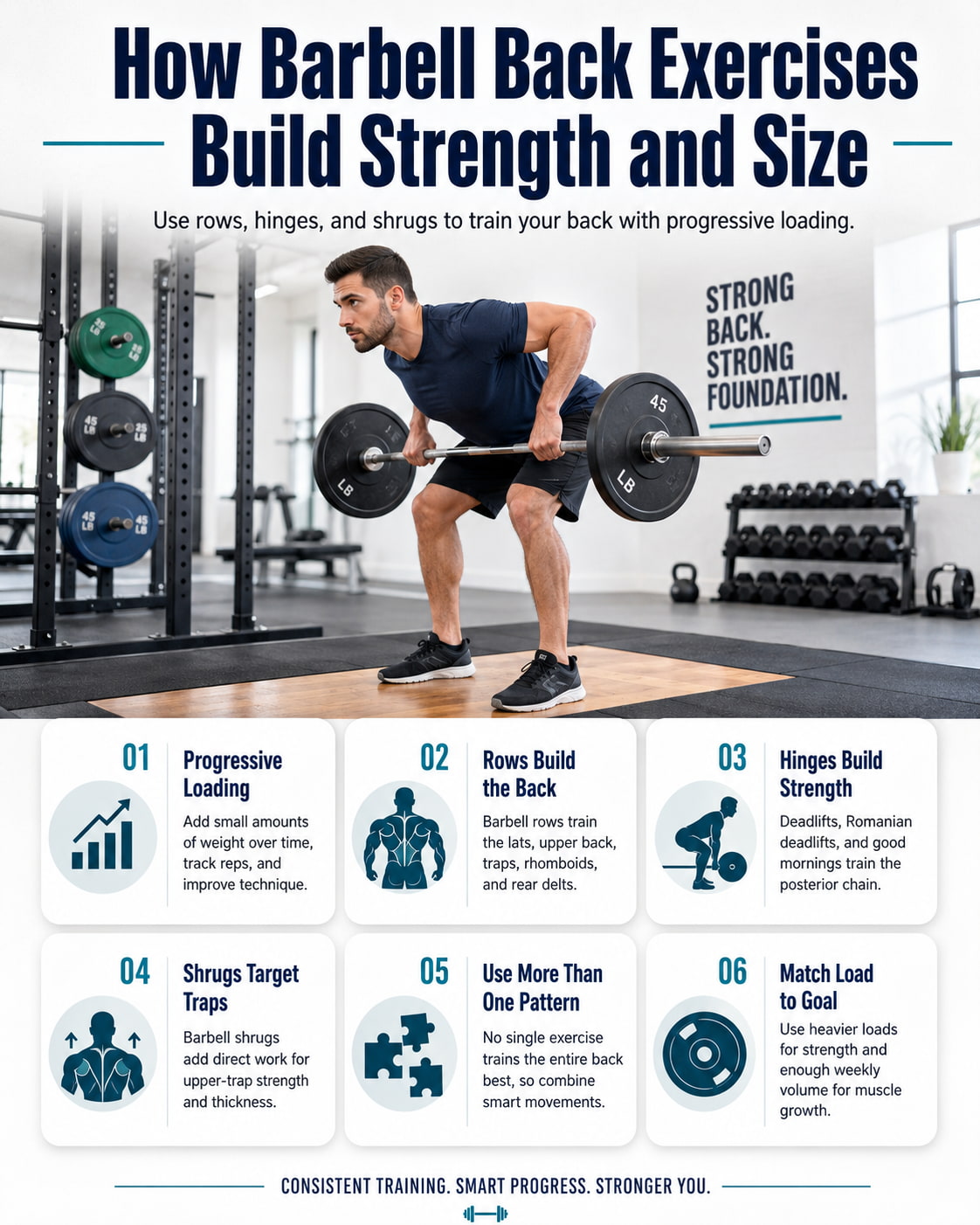
Barbell back exercises work well because they let you train heavy pulling and hip-hinge patterns with measurable progression. You can add weight over time, track reps, improve technique, and build strength across several major muscle groups.
Rows are best for building the lats, rhomboids, traps, rear delts, and upper-back thickness. Deadlifts, Romanian deadlifts, and good mornings train the posterior chain, including the spinal erectors, glutes, and hamstrings. Shrugs add direct work for the upper traps.
A complete back workout should include more than one movement pattern because no single exercise trains the entire back equally well.
Muscles Worked by Barbell Back Exercises

Barbell back exercises mainly train the lats, traps, rhomboids, rear delts, spinal erectors, glutes, hamstrings, biceps, forearms, and grip muscles.
Rows focus more on the lats and upper back. Deadlift variations and good mornings place more demand on the spinal erectors, glutes, and hamstrings. Shrugs mainly target the upper traps.
9 Best Barbell Back Exercises for Strength and Size
The best barbell back exercises combine heavy compound lifts, controlled rowing variations, unilateral work, and direct trap training. You do not need to do all nine in one workout. Choose the movements that match your goal, skill level, recovery, and equipment.
1. Barbell Bent-Over Row
Best for: Overall back size, upper-back thickness, lat strength, and building a stronger horizontal pull.
Muscles worked: Latissimus dorsi, rhomboids, middle traps, lower traps, rear delts, spinal erectors, biceps, forearms, and core.
Equipment needed: Barbell, weight plates, and optional lifting straps.
Suggested sets and reps: Use 3 to 5 sets of 5 to 10 reps. Heavier sets of 5 to 6 reps work well for strength, while sets of 8 to 10 reps work well for size.
Rest: Rest 90 seconds to 3 minutes depending on load and effort.
How to do it:
- Stand with your feet about hip-width apart and hold the bar with an overhand grip.
- Hinge at your hips until your torso is angled forward.
- Keep your spine neutral, knees slightly bent, and core braced.
- Let the bar hang under your shoulders with your arms straight.
- Pull the bar toward your lower ribs or upper stomach.
- Squeeze your shoulder blades back without shrugging hard.
- Lower the bar under control until your arms are straight again.
Common mistakes: Rounding the lower back, jerking the bar, standing upright during each rep, bouncing from the hips, pulling the bar too high toward the chest, and using more weight than you can control.
Expert tip: Think about pulling your elbows back instead of pulling with your hands. This helps you feel the back muscles instead of turning the movement into mostly biceps work.
Progression or regression: Make it easier by rowing from a rack just below knee height. Make it harder by pausing for 1 second at the top of each rep.
2. Pendlay Row
Best for: Strict pulling strength, upper-back power, and lifters who want every rep to start from a dead stop.
Muscles worked: Lats, rhomboids, middle traps, rear delts, spinal erectors, biceps, forearms, and core.
Equipment needed: Barbell, weight plates, and a flat pulling surface.
Suggested sets and reps: Use 3 to 5 sets of 3 to 8 reps. Keep the reps lower if your goal is strength and bar speed.
Rest: Rest 2 to 3 minutes for heavy sets and 90 to 120 seconds for moderate sets.
How to do it:
- Stand with the barbell over your midfoot.
- Hinge forward until your torso is close to parallel with the floor.
- Grip the bar slightly wider than shoulder width.
- Brace your core and keep your spine neutral.
- Pull the bar quickly toward your lower chest or upper stomach.
- Let the bar return fully to the floor after each rep.
- Reset your brace before starting the next rep.
Common mistakes: Letting the hips shoot up, rounding the back, bouncing the bar off the floor, pulling with relaxed shoulder blades, and using a load that turns the exercise into a sloppy heave.
Expert tip: Treat every rep like a single strong pull. Reset your position instead of rushing through the set.
Progression or regression: Make it easier by rowing from blocks or safety pins. Make it harder by using a paused Pendlay row with a controlled stop at the top.
3. Reverse-Grip Barbell Row
Best for: Lat-focused rowing, lower-lat emphasis, and lifters who want a row that keeps the elbows closer to the body.
Muscles worked: Lats, lower traps, rhomboids, rear delts, biceps, forearms, spinal erectors, and core.
Equipment needed: Barbell, weight plates, and optional lifting straps.
Suggested sets and reps: Use 3 to 4 sets of 8 to 12 reps.
Rest: Rest 60 to 120 seconds between sets.
How to do it:
- Hold the barbell with an underhand grip around shoulder width.
- Stand tall, then hinge forward with a neutral spine.
- Keep your knees slightly bent and core braced.
- Let the bar hang under your shoulders.
- Pull the bar toward your lower stomach.
- Keep your elbows close to your sides.
- Lower the bar slowly until your arms are straight.
Common mistakes: Curling the bar instead of rowing it, pulling too high, using too much weight, letting the wrists bend back, and losing your hinge position.
Expert tip: Keep the grip firm but do not squeeze so hard that your forearms dominate the movement. The goal is to drive the elbows back and load the lats.
Progression or regression: Make it easier by using a lighter barbell or rowing from a higher rack position. Make it harder by lowering the bar slowly on each rep.
4. Landmine T-Bar Row
Best for: Heavy upper-back and lat training with a strong neutral-grip feel.
Muscles worked: Lats, rhomboids, middle traps, lower traps, rear delts, spinal erectors, biceps, forearms, and core.
Equipment needed: Barbell, landmine attachment or secure corner setup, weight plates, and V-handle or landmine row handle.
Suggested sets and reps: Use 3 to 4 sets of 6 to 12 reps.
Rest: Rest 90 seconds to 3 minutes depending on load.
How to do it:
- Secure one end of the barbell in a landmine attachment or stable corner.
- Straddle the bar and face the loaded end.
- Hinge forward with a neutral spine.
- Grip the handle with both hands.
- Brace your core and keep your chest lifted.
- Row the handle toward your lower chest or upper stomach.
- Lower the weight under control until your arms are straight.
Common mistakes: Standing too upright, yanking the weight, letting the shoulders roll forward at the bottom, cutting the range short, and loading the bar too heavily.
Expert tip: Keep your chest proud and pull the elbows back. Do not let the movement become a standing shrug.
Progression or regression: Make it easier by using lighter weight and a slightly higher torso angle. Make it harder by pausing briefly at the top of each row.
5. Meadows Row
Best for: Unilateral lat training, side-to-side balance, and building a stronger mind-muscle connection with each side of the back.
Muscles worked: Lats, rhomboids, traps, rear delts, obliques, spinal erectors, biceps, forearms, and grip.
Equipment needed: Barbell, landmine attachment or secure corner setup, weight plates, and optional lifting straps.
Suggested sets and reps: Use 3 to 4 sets of 8 to 12 reps per side.
Rest: Rest 60 to 120 seconds between sides or after both sides are complete.
How to do it:
- Stand beside the loaded end of a landmine barbell.
- Place your outside foot slightly back for balance.
- Hinge forward and brace your core.
- Grip the thick end of the barbell sleeve with one hand.
- Let the working shoulder reach slightly forward at the bottom.
- Row the bar by driving your elbow back.
- Lower slowly and repeat before switching sides.
Common mistakes: Twisting the torso too much, pulling with only the arm, rushing the stretch position, using a load that shortens the range, and letting the shoulder shrug toward the ear.
Expert tip: Let your shoulder blade move at the bottom, then pull your elbow back and slightly out. This creates a strong lat and upper-back contraction.
Progression or regression: Make it easier by using a more upright torso and lighter load. Make it harder by adding a slow 3-second lowering phase.
6. Barbell Deadlift
Best for: Total-body pulling strength, posterior-chain power, spinal erector strength, traps, grip, and heavy strength development.
Muscles worked: Glutes, hamstrings, spinal erectors, traps, lats, quads, adductors, forearms, grip, and core.
Equipment needed: Barbell, weight plates, collars, and a safe lifting platform or gym floor.
Suggested sets and reps: Use 3 to 5 sets of 3 to 6 reps for strength. For general strength and size, use 2 to 4 sets of 5 to 8 reps.
Rest: Rest 2 to 4 minutes for heavy sets.
How to do it:
- Stand with the bar over your midfoot.
- Place your feet about hip-width apart.
- Hinge down and grip the bar just outside your legs.
- Brace your core and pull your chest up.
- Keep the bar close to your shins.
- Push the floor away and stand tall with the bar.
- Lower the bar under control by hinging at the hips first.
Common mistakes: Rounding the back, letting the bar drift forward, pulling before bracing, turning the setup into a squat, bouncing the bar off the floor, and maxing out too often.
Expert tip: Before the bar leaves the floor, think about squeezing your armpits shut. This helps engage the lats and keeps the bar close.
Progression or regression: Make it easier by pulling from blocks or a rack. Make it harder by using paused deadlifts or slower controlled reps.
7. Barbell Romanian Deadlift
Best for: Hamstrings, glutes, spinal erectors, hip-hinge strength, and posterior-chain size.
Muscles worked: Hamstrings, glutes, spinal erectors, lats, traps, forearms, and core.
Equipment needed: Barbell, weight plates, and optional rack.
Suggested sets and reps: Use 3 to 4 sets of 6 to 10 reps.
Rest: Rest 90 seconds to 3 minutes.
How to do it:
- Stand tall with the bar in front of your thighs.
- Hold the bar with an overhand grip.
- Brace your core and keep your shoulders packed.
- Push your hips back while keeping a slight knee bend.
- Lower the bar close to your legs.
- Stop when your hamstrings are stretched or your back position would change.
- Drive your hips forward to stand tall again.
Common mistakes: Squatting the weight, locking the knees, rounding the lower back, lowering too far, letting the bar drift away, and rushing the eccentric phase.
Expert tip: Think “hips back, bar close.” The bar should travel almost straight down your legs rather than swinging forward.
Progression or regression: Make it easier by starting from a rack and using a shorter range of motion. Make it harder by using a 3-second lowering phase.
8. Barbell Good Morning
Best for: Advanced hip-hinge strength, posterior-chain development, lower-back endurance, and teaching strong torso control.
Muscles worked: Spinal erectors, hamstrings, glutes, upper back, core, and adductors.
Equipment needed: Barbell, squat rack, safety pins, and weight plates.
Suggested sets and reps: Use 2 to 4 sets of 6 to 12 reps with light to moderate weight.
Rest: Rest 90 seconds to 2 minutes.
How to do it:
- Set the bar in a squat rack around upper-chest height.
- Place the bar across your upper back like a back squat.
- Step back and stand with your feet about hip-width apart.
- Brace your core and keep a soft bend in your knees.
- Push your hips back as your torso leans forward.
- Lower only as far as you can control with a neutral spine.
- Drive your hips forward to return to standing.
Common mistakes: Using too much weight, bending the knees too much, rounding the back, dropping too low, moving too fast, and losing upper-back tightness.
Expert tip: Keep the movement slow and controlled. You should feel tension through the hamstrings and glutes, not pressure from a loose spine.
Progression or regression: Make it easier by practicing with a dowel or empty bar. Make it harder by adding a pause in the bottom position.
9. Barbell Shrug
Best for: Upper traps, grip strength, and upper-back thickness.
Muscles worked: Upper trapezius, levator scapulae, forearms, grip, and upper-back stabilizers.
Equipment needed: Barbell, weight plates, rack, and optional lifting straps.
Suggested sets and reps: Use 3 to 5 sets of 8 to 15 reps.
Rest: Rest 60 to 120 seconds.
How to do it:
- Stand tall with a barbell in front of your thighs.
- Hold the bar with an overhand grip.
- Keep your arms straight and core braced.
- Lift your shoulders straight up toward your ears.
- Pause briefly at the top.
- Lower your shoulders slowly.
- Repeat without rolling your shoulders.
Common mistakes: Rolling the shoulders, bending the elbows, leaning back, bouncing the weight, using too much weight, and cutting the range of motion short.
Expert tip: Think “up and down,” not “circle.” Shoulder rolling does not make the shrug better and can make the movement less controlled.
Progression or regression: Make it easier by using a lighter barbell or dumbbells. Make it harder by pausing for 2 seconds at the top of each rep.
Best Barbell Back Workout for Strength and Size
Use this workout once per week as a focused back session, or use a shorter version as part of a pull day. Keep your reps controlled and stop each set before your form breaks down.
Barbell Back Workout
| Exercise | Sets | Reps | Rest | Effort |
|---|---|---|---|---|
| Barbell Deadlift | 3 | 3–5 | 2–4 min | 2 reps in reserve |
| Barbell Bent-Over Row | 4 | 6–10 | 90–120 sec | 1–2 reps in reserve |
| Landmine T-Bar Row | 3 | 8–12 | 90 sec | 1–2 reps in reserve |
| Barbell Romanian Deadlift | 3 | 6–10 | 90–120 sec | 2 reps in reserve |
| Barbell Shrug | 3 | 10–15 | 60–90 sec | 1–2 reps in reserve |
Train this workout once per week if you also deadlift, squat, or train legs hard during the week. If your recovery is good, you can train barbell back exercises twice per week by using one heavier day and one lighter technique or hypertrophy day.
How to Program Barbell Back Exercises
For strength, place your heaviest and most technical lift first. This is usually the deadlift, Pendlay row, or heavy bent-over row. Use lower reps, longer rest, and a load you can control with strong bracing.
For size, use moderate loads, more total sets, and controlled reps. Rows, landmine rows, reverse-grip rows, Meadows rows, Romanian deadlifts, and shrugs all work well in hypertrophy-focused rep ranges.
A simple weekly setup can look like this:
| Goal | Weekly Plan |
|---|---|
| Beginner | 2–3 back exercises per week, 2–3 sets each |
| Intermediate | 6–12 total back-focused sets per week |
| Advanced | 10–16 total back-focused sets per week, split across 2 sessions |
Do not stack too many lower-back-demanding exercises in one session. For example, heavy deadlifts, bent-over rows, Romanian deadlifts, and good mornings in the same workout may be too much for many lifters. A smarter plan pairs one heavy hinge with one or two row variations and one accessory exercise.
Common Barbell Back Exercise Mistakes
Using too much weight is the most common mistake. If the bar moves only because you are jerking, bouncing, or changing body position, the load is too heavy.
Poor bracing is another major issue. Rows, deadlifts, Romanian deadlifts, and good mornings require a stable torso. Brace before each hard rep and keep the bar close when hinging.
Many lifters also turn every back exercise into a lower-back endurance test. Unsupported rows are useful, but your lower back should not fail before your target muscles every time. An ACSM Health & Fitness Journal article on the barbell row notes that proper teaching, posture, and exercise technique are important because barbell rows can create higher lumbar compressive loads than some other rowing options.
Finally, do not ignore pain signals. Mayo Clinic’s weight-training guidance emphasizes proper form, controlled lifting, warming up, and stopping exercises that cause pain.
Safety Tips Before You Train Your Back With a Barbell
Warm up before heavy lifting. Start with lighter ramp-up sets and gradually increase weight.
Use collars when plates may slide. Set safety pins when training from a rack. Keep the area around the bar clear.
Keep your spine neutral during rows, deadlifts, Romanian deadlifts, and good mornings. Neutral does not mean perfectly vertical. It means your spine stays controlled instead of rounding or twisting under load.
Progress slowly. Add weight only when your reps stay smooth and your position stays consistent.
Stop and seek professional help if an exercise causes sharp pain, numbness, dizziness, chest pain, severe shortness of breath, radiating symptoms, or unusual discomfort.
FAQs About Barbell Back Exercises
Can you build a big back with only a barbell?
Yes, you can build a strong and muscular back with only a barbell if you use enough variety. Rows build the lats and upper back, deadlift variations train the posterior chain, and shrugs target the upper traps. The main limitation is that barbells do not provide as many angles as cables, machines, or pull-up bars.
What is the best barbell back exercise for thickness?
The barbell bent-over row is one of the best choices for back thickness because it trains the lats, rhomboids, traps, rear delts, and spinal erectors together. Landmine T-bar rows and Pendlay rows are also excellent options.
Are deadlifts enough for back growth?
Deadlifts can build a stronger posterior chain and thicker traps, but they are not enough for complete back growth for most lifters. Add rowing variations to train the lats, rhomboids, rear delts, and middle back through a fuller pulling range.
Which barbell back exercise works the lats best?
Reverse-grip barbell rows, bent-over rows, landmine rows, and Meadows rows are strong choices for lat training. To feel the lats more, keep the elbows closer to the body and pull toward the lower ribs or stomach.
How many barbell back exercises should I do in one workout?
Most lifters need 3 to 5 back exercises in a workout. A good structure is one heavy hinge or heavy row, one main row, one accessory row, and one trap or posterior-chain accessory.
Are barbell rows safe for beginners?
Barbell rows can be useful for beginners who can hinge, brace, and keep a neutral spine. However, beginners should start light. If the lower back cannot hold position, use an easier row variation, reduce the range of motion, or build hinge strength first.
Should I use an overhand or underhand grip for barbell rows?
Use an overhand grip for a balanced upper-back row. Use an underhand grip if you want to keep the elbows closer to the body and emphasize the lats more. If the underhand grip bothers your wrists or elbows, switch back to overhand.
Conclusion
Barbell back exercises are effective because they let you train heavy, track progress, and build strength across the lats, traps, rhomboids, spinal erectors, glutes, hamstrings, and grip. Start with the basics, control your form, and choose exercises that match your goal.
For most lifters, a strong back plan should include one heavy pull, one or two row variations, and one accessory movement for the traps or posterior chain. Progress slowly, keep your technique clean, and let quality reps drive your results.
This content is for informational purposes only and is not a substitute for professional medical advice.
References
- ACE Fitness: Bent-Over Row Exercise Library
- ACE Fitness: ACE-Sponsored Research on the Best Back Exercises
- ACSM: Resistance Training Guidelines Update
- Mayo Clinic: Weight Training Do’s and Don’ts
- NASM: Barbell Deadlift Exercise Library
- NSCA: Romanian Deadlift Technique
- ACE Fitness: Barbell Shrug Exercise Library
2 thoughts on “9 Best Barbell Back Exercises for Strength and Size”